

Top Tweets for #CStore

One letter makes state private on @SeismicSys: uint256 → suint256
Stored via CLOAD/CSTORE; RPC reads of the slot return 0.
But the type hides the value, not the behavior. Watch:
• sbool branches
• shielded loop bounds
• literals in bytecode
• guessable bools/enums
@xealistt


@elkhawaga20222 @snow_blis @thoai6sixx @heathcliff_eth Gas costs can leak private data in confidential contracts unless execution is constant-time, like Seismic’s CLOAD/CSTORE.

@elkhawaga20222 @snow_blis @thoai6sixx @heathcliff_eth love that CLOAD and CSTORE are constant gas by default. the safe path should be the easy one, otherwise everybody ships the leaky version

The difference is that Seismic adds confidential execution and private-state support.
For example:
- SLOAD / SSTORE → public state
- CLOAD / CSTORE → shielded state
This lets applications decide which information should remain public and which should stay private.

@SeismicSys @heathcliff_eth 4/
Seismic tries to avoid that with the way CSTORE works
The goal isn’t just to hide the value itself
The execution shouldn’t make the value easier to guess through its resource usage either.
@SeismicSys @heathcliff_eth 2/
That’s why Seismic’s CSTORE has a constant gas cost
The cost doesn’t change based on the value or its size.
I was digging into CSTORE today and found one detail pretty interesting
1/
Storing a private value sounds simple
But with confidential state even the cost of an operation can become a problem
if it depends on what’s being stored.

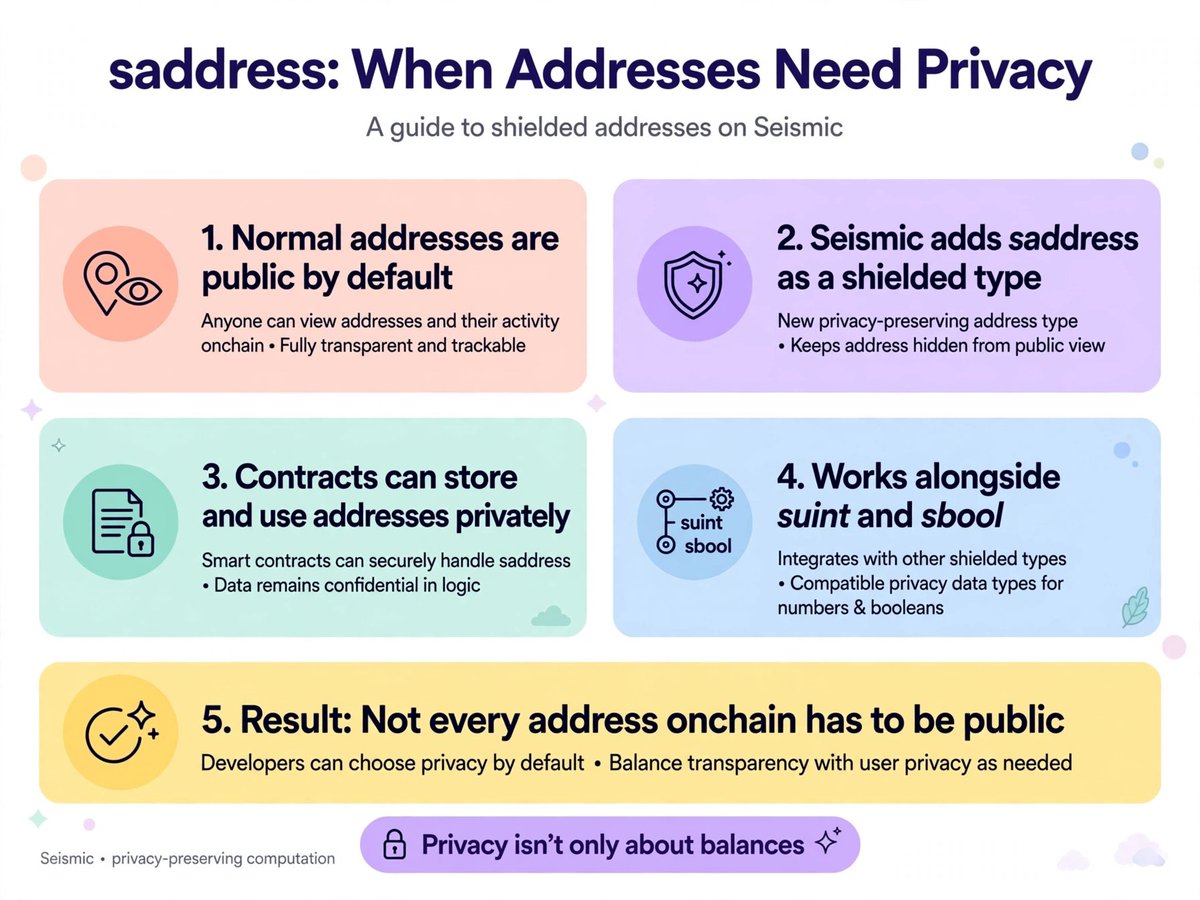
I was looking at Seismic’s shielded types and came across saddress.
1/
We usually think about privacy in terms of balances, amounts or other numbers.
But an address can be sensitive too, depending on what it reveals about an application.

What makes @SeismicSys interesting in privacy?
It moves confidentiality into execution.
encrypted calldata
↓
TEE execution
↓
confidential state
Shielded types + CSTORE/CLOAD let EVM contracts work with sensitive data without exposing state.
More than private transactions.


🔥 NEW: Privacy coins are the only crypto sector trading above October 2025 levels, up 213%, per Glassnode.

@SeismicSys @heathcliff_eth 3/
For normal storage the EVM uses SLOAD and SSTORE
For shielded storage, Seismic generates CLOAD and CSTORE instead
Same contract logic but a different path for sensitive state.
@SeismicSys @heathcliff_eth @lyronctk 4/
What I found interesting is that privacy here isn’t only about encryption
The EVM itself has to understand that some storage behaves differently
That’s why Seismic introduces CLOAD and CSTORE alongside the normal storage operations.
@SeismicSys @heathcliff_eth @lyronctk 2/
Seismic adds CLOAD and CSTORE for shielded storage
So the contract can still keep state between transactions without treating that state like normal public storage.
I was looking into how Seismic handles private state and CLOAD / CSTORE caught my attention.
1/
With the normal EVM you have SLOAD and SSTORE for reading and writing storage
But that doesn’t work well when the value itself needs to stay private.
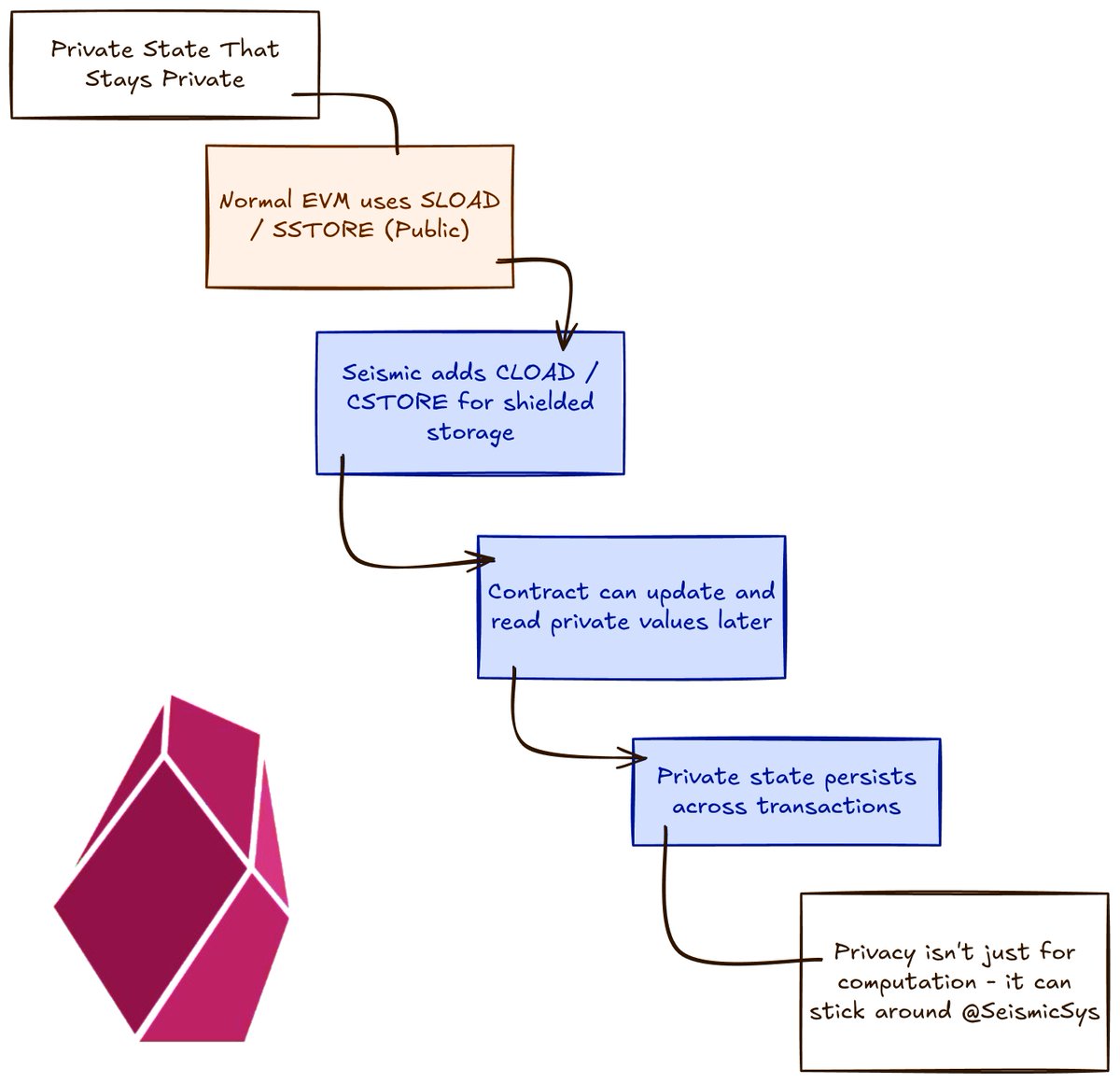
How does Seismic actually compute on data that shouldn’t be public?
1/
On a normal EVM contract inputs and state are visible by design
So doing useful computation on private data is difficult.


3/6 💾 The second layer: Shielded Storage
Normal EVM storage uses:
SLOAD → read
SSTORE → write
Seismic adds CLOAD and CSTORE for shielded data.
Each slot carries (value, is_private), separating public and private state directly at the opcode level.
@heathcliff_eth @lyronctk @SeismicSys 2/
The main difference is the data
uint256 becomes suint256
That tells Seismic the value should be handled as shielded data
3/
Under the hood private state uses:
CLOAD / CSTORE
instead of the usual:
SLOAD / SSTORE
@SeismicSys @lyronctk @heathcliff_eth 3/
Seismic handles this by giving CLOAD and CSTORE constant gas costs.
Private value A → same cost
Private value B → same cost
So gas usage doesn’t become an easy clue about what’s happening inside.
@SeismicSys @heathcliff_eth @lyronctk 2/
Seismic introduces FlaggedStorage.
Each storage slot carries a flag showing whether its value is public or private.
3/
Private slots use:
"CLOAD / CSTORE"
instead of:
"SLOAD / SSTORE"
The execution layer enforces the difference.
@SeismicSys @heathcliff_eth @lyronctk 3/
The compiler does the heavy lifting:
SLOAD → CLOAD
SSTORE → CSTORE
Developers don’t have to manually handle every privacy primitive. Just change the type, and the rest is handled.

When “I need gas and a good coffee.” is requested, make sure you show up accurately.
Starting with #cstores, we’re working in making brick & mortar retailers visible to the machines. Products, fuel, promotions and more. Stay tuned.

Technically,@SeismicSys adds privacy-aware opcodes: CLOAD and CSTORE.
When a shielded variable is read or written, the compiler routes to these opcodes instead of SLOAD/SSTORE.
It is privacy integrated into the EVM model.
@xealistt @NoxxW3 @heathcliff_eth


When a contract uses shielded types such as suint256, the Seismic compiler automatically routes the value through confidential storage instead of the standard SSTORE and SLOAD, it uses CSTORE and CLOAD

why seismic privacy isn't the kind you can peek behind
⮞ most privacy in crypto leaks somewhere. the data is hidden in the contract but visible in the mempool, or shielded onchain but exposed in transaction traces.
⮞ seismic closes those gaps at the layer almost nobody inspects, the path a transaction takes before it ever lands in a block.
what's the actual problem?
⮞ on a normal EVM chain, your transaction sits in a public mempool before it's mined.
⮞ anyone can read the calldata, front-run you, copy your strategy, or just watch what you're doing. the contract being "private" doesn't matter if the intent is naked in flight.
so what does seismic do differently?
⮞ calldata is encrypted client-side with ECDH + AES-GCM before it's ever submitted.
⮞ it travels to the network already sealed, only TEE nodes holding the network secret key can open it, and they only open it inside the enclave.
where does decryption happen?
⮞ inside the Trusted Execution Environment, never outside. the node decrypts the calldata, runs the transaction, and writes results to shielded storage.
⮞ plaintext never appears in the mempool, never in block data, never in transaction traces. there's no window where it's exposed.
what about reading state back?
⮞ this is the part people miss. eth_getStorageAt returns zero for shielded slots, so private data is indistinguishable from storage that was never written to.
⮞ cross contract reads of private storage also return zero. you can't even detect that something is hidden, let alone read it.
how do reads stay safe?
⮞ an eth_call is sent as a signed transaction so the node can verify who's actually asking, instead of trusting a spoofable from-address.
⮞ standard calls still work, but the from field is zeroed out, no leaking identity through the back door.
and the developer cost of all this?
⮞ one keyword. suint, sbool, saddress.
⮞ the compiler swaps SSTORE/SLOAD for CSTORE/CLOAD under the hood, your arithmetic, comparisons, and assignments behave exactly like normal Solidity. no circuits, no special APIs, no rewriting your logic.
why it matters?
⮞ privacy that breaks at any single layer isn't privacy, it's a delay before exposure.
⮞ seismic's bet is that confidentiality has to hold end to end: in flight, at rest, and on read. miss one and the whole thing leaks.
what to watch:
⮞ whether the TEE attestation model holds up under real adversarial pressure.
⮞ hardware trust is the tradeoff seismic made instead of ZK, and that's the assumption the whole design rests on
Website: https://t.co/eLOi2NNS3E
Docs: https://t.co/XgpIHlonlm
X: @SeismicSys


𝗢𝗻 𝗘𝘁𝗵𝗲𝗿𝗲𝘂𝗺, 𝗮𝗻𝘆 𝗰𝗼𝗻𝘁𝗿𝗮𝗰𝘁 𝗰𝗮𝗻 𝗿𝗲𝗮𝗱 𝗮𝗻𝘆 𝗼𝘁𝗵𝗲𝗿 𝗰𝗼𝗻𝘁𝗿𝗮𝗰𝘁'𝘀 𝘀𝘁𝗼𝗿𝗮𝗴𝗲.
Call SLOAD. Pass the slot number. Done.
On Seismic, that stops working the moment a slot is shielded.
𝙒𝙝𝙮 𝙩𝙝𝙞𝙨 𝙢𝙖𝙩𝙩𝙚𝙧𝙨 𝙢𝙤𝙧𝙚 𝙩𝙝𝙖𝙣 𝙞𝙩 𝙨𝙤𝙪𝙣𝙙𝙨:
Imagine you build a private lending protocol. User balances stored as suint256. Fully shielded.
Now imagine another contract built by anyone calls SLOAD on your storage slot.
On Ethereum? It reads the balance. Every time.
On Seismic? It gets zero. The flag is there. The isolation holds. Doesn't matter who's asking.
𝙃𝙤𝙬 𝙩𝙝𝙚 𝙞𝙨𝙤𝙡𝙖𝙩𝙞𝙤𝙣 𝙢𝙤𝙙𝙚𝙡 𝙬𝙤𝙧𝙠𝙨:
When CSTORE writes a value, it sets (is_private = true) on that slot.
That flag doesn't care about the caller. It doesn't check if the requester is a trusted contract or a malicious one. It doesn't negotiate.
SLOAD from any external contract hits that flag and returns zero. Always.
Only CLOAD running inside the same contract, inside the TEE can access the real value. The isolation is at the opcode level, not the access control level.
𝙒𝙝𝙮 𝙤𝙥𝙘𝙤𝙙𝙚-𝙡𝙚𝙫𝙚𝙡 𝙞𝙨𝙤𝙡𝙖𝙩𝙞𝙤𝙣 𝙞𝙨 𝙨𝙩𝙧𝙤𝙣𝙜𝙚𝙧:
Access control can be misconfigured. Permissions can have bugs. Allowlists can be bypassed.
An opcode doesn't have those problems. It either returns zero or it doesn't. No configuration. No edge cases. No exceptions.
Private storage on Seismic is not protected by rules.
It's protected by the execution model itself.
@SeismicSys
Check here more details: https://t.co/0vylQVy7ks


.@meow tapped Seismic to power its stablecoin accounts and stablecoin payments.
A business banking platform chose to build core financial infrastructure on a privacy-first L1. Here's what that actually means
🧵
Meow is a business banking platform, checking, corporate cards, global payments, treasury, and invoicing all in one dashboard.
The whole thing is built around keeping costs low and passing savings back to businesses. Simple, no-frills infrastructure for companies that just need it to work.
---
Adding stablecoin accounts and payments to that stack means transaction data lives on-chain.
For a business banking platform, that's a real problem. Payroll, vendor payments, treasury balances, account activity,that's sensitive financial data sitting on a public ledger anyone can read.
---
@SeismicSys handles this at the protocol level.
Calldata is encrypted before it leaves the user's machine. The encryption uses ECDH key agreement between the user's private key and the network's TEE public key,the plaintext never touches the mempool.
---
On-chain storage is shielded at the opcode level.
Private variables write via CSTORE and read via CLOAD. Query a shielded slot through standard RPC and you get zero back, it looks like uninitialized storage to anyone watching.
---
The nodes run inside Intel TDX Trusted Execution Environments.
The host OS, the hypervisor, the node operator, none of them can read what's being processed. Encryption keys are generated inside the TEE at genesis and never leave it.
---
Meow needed stablecoin infrastructure that could handle real business financial data with real privacy requirements.
Building on Seismic means account balances and payment flows are private by default, enforced at the protocol level, not patched on top.
---
Seismic is backed by a16z with $17M raised, and fintech companies are already building core products on it.
The privacy layer for onchain finance is taking shape.
@xealistt @NoxxW3


Seismic introduces primitives like CSTORE and CLOAD for private state management.
One writes hidden state.
The other reads it.
Privacy becomes part of execution logic itself.
@SeismicSys @NoxxW3 @xealistt @heathcliff_eth


Where Does Privacy Really Begin? @SeismicSys Quiz #61
yesterday, I joined Seismic Quiz #61.
I managed to answer every question correctly,
but unfortunately, I still missed the Top 50 ranking.
It was another reminder that in these quizzes,
speed can be just as important as accuracy.
Regardless of the result,
this quiz was a great opportunity to better understand Seismic's approach to privacy.
When people hear the term "privacy chain,"
they often think of hiding transactions or obscuring user activity.
However,
today's quiz highlighted something much deeper.
It showed that Seismic's vision of privacy is not simply about concealing information, it is about redesigning how privacy works throughout the execution process itself.
The first question introduced the concept of Selective Privacy, which is not about hiding everything, but revealing only the information that needs to be shared.
In many ways,
this mirrors how real world financial systems operate.
Banks and businesses do not expose every piece of information publicly, but they can selectively disclose data when necessary.
The questions around CSTORE and CLOAD were also particularly interesting.
They highlighted how Seismic aims to support private state management directly at the smart contract level, allowing contracts to store and access protected data rather than relying solely on external privacy layers.
What stood out to me the most were the concepts of Encrypted Calldata and Encrypted Global State.
Protecting transaction details and execution intent is one thing.
Enabling Shared Private Logic that can be utilized across applications is another.
Together, these ideas suggest a direction where privacy becomes a foundational layer for more sophisticated on chain applications.
The questions related to TEE and Remote Attestation were equally important.
Providing privacy is only part of the challenge.
The execution environment itself must also be verifiable and trustworthy.
TEE offers a protected execution environment, while Remote Attestation helps verify that the intended code is actually running within that environment.
Looking back, the entire quiz felt like a connected framework
Selective Privacy
→ What information should be revealed?
CSTORE / CLOAD
→ How is private state managed?
Encrypted Calldata
→ How are transaction details protected?
Signed Read
→ Who is allowed to access data?
TEE + Remote Attestation
→ How can execution environments be verified?
Encrypted Global State
→ How can private logic be shared?
And finally, the answer to the last question
Privacy at Execution
That was the key message I took away from Quiz #61.
Rather than adding privacy after the fact,
Seismic appears to be integrating privacy directly into the execution layer itself.
Not protecting data after it is exposed,
but protecting it from the moment execution begins.
Although I didn't make the Top 50 this time,
I feel like my understanding of the project has improved significantly.
I'll keep studying, improve my reaction speed, and come back stronger in the next quiz.
Anyway, when can I be Magnitude 1.0?
@SeismicSys #Seismic
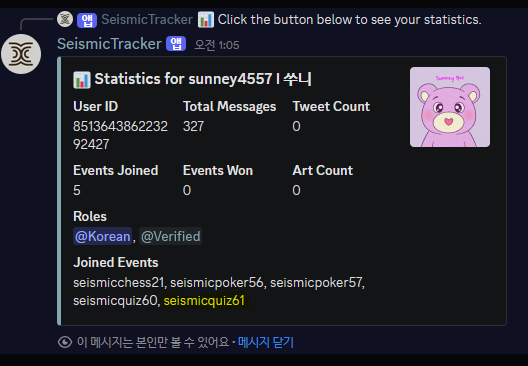
I joined the Seismic Poker event today!
I had heard there were a lot of strong players and a huge number of participants, so I was honestly a bit nervous going in.
Still, finishing in 55th place feels like a decent result. Next time, I’ll try not to be intimidated from the start, stay calm, and aim for an even higher ranking.
A project lasts longer when its community is fun and engaging, and that’s exactly why I’m starting to enjoy Seismic more and more.
Looking forward to having even more fun with Seismic! 🚀
세이즈믹 포커에 참여했어요!
여기 고수들도 많고, 참여자도 많다고 들어서
너무 걱정했어요.
그래도 55등이면 어느정도 선방한거 같아요.
다음에는 처음부터 겁먹지 말고 차분하게!
더 높은 순위를 노려보겠습니다.
커뮤니티가 즐거워야 오래가는 프로젝트인데
그런의미에서 슬슬 재미가 붙어가는 것 같습니다.
좀 더 세이즈믹 즐겨보아요~
@SeismicSys #Seismic

𝗘𝘃𝗲𝗿𝘆 𝗘𝗩𝗠 𝘁𝗿𝗮𝗻𝘀𝗮𝗰𝘁𝗶𝗼𝗻 𝗴𝗼𝗲𝘀 𝘁𝗵𝗿𝗼𝘂𝗴𝗵 𝗮𝗻 𝗶𝗻𝘁𝗲𝗿𝗽𝗿𝗲𝘁𝗲𝗿.
That interpreter decides what each opcode does.
On standard revm SLOAD reads storage. SSTORE writes it. Everything is public by default.
Seismic forked revm. And changed the rules.
𝙒𝙝𝙖𝙩 𝙨𝙚𝙞𝙨𝙢𝙞𝙘-𝙧𝙚𝙫𝙢 𝙖𝙘𝙩𝙪𝙖𝙡𝙡𝙮 𝙙𝙤𝙚𝙨:
Standard revm doesn't know what a shielded type is. It has no concept of CLOAD or CSTORE. Feed it a Seismic contract, it fails.
seismic-revm is the same interpreter, rebuilt to understand two new opcodes:
CLOAD reads from a flagged storage slot. But only when called from inside the TEE. External calls get zero.
CSTORE writes a value with is private = true. That flag travels with the data forever. Every future read checks it automatically.
One addition to the opcode table. The entire privacy model is enforced at the execution layer.
𝙒𝙝𝙮 𝙩𝙝𝙞𝙨 𝙞𝙨 𝙩𝙝𝙚 𝙧𝙞𝙜𝙝𝙩 𝙥𝙡𝙖𝙘𝙚 𝙩𝙤 𝙚𝙣𝙛𝙤𝙧𝙘𝙚 𝙞𝙩:
You could enforce privacy at the network layer filter that gets broadcast.
You could enforce it at the RPC layer filter that gets returned.
Seismic does both. But the source of truth is seismic-revm.
Because if the EVM interpreter itself understands privacy, no other layer can accidentally bypass it. The rule is at the root. Everything above inherits it.
𝙁𝙤𝙧 𝙙𝙚𝙫𝙚𝙡𝙤𝙥𝙚𝙧𝙨 𝙣𝙤𝙩𝙝𝙞𝙣𝙜 𝙘𝙝𝙖𝙣𝙜𝙚𝙨:
You don't interact with seismic-revm directly. ssolc compiles your shielded types to CLOAD/CSTORE automatically. Seismic-revm executes them correctly.
The privacy infrastructure is invisible. The result isn't.
Standard revm executes contracts.
seismic-revm executes them privately.
@SeismicSys
Read more about seismic: https://t.co/0vylQVy7ks


Why Seismic? (Solving the Transparency Problem Without the Tradeoffs) @SeismicSys
We all know the core premise of public blockchains: total transparency. Every balance, transaction, and contract state is out in the open for anyone with a block explorer. While this was a core design choice early on, it has created massive hurdles for real-world adoption:
MEV and Front-Running: Bots constantly monitor the mempool, catching user trades and sandwiching them for profit. On Ethereum alone, this costs users billions every year.
Information Leaks: The moment a protocol puts assets on-chain, its treasury, positions, and strategies are exposed to competitors in real time.
Zero User Privacy: If Alice sends tokens to Bob, anyone can trace her wallet balance, look at her transaction history, and map out her entire financial graph.
Exposed Business Logic: Because contract state is fully public, proprietary pricing algorithms, liquidation thresholds, and internal parameters are visible to everyone.
Traditional finance operates with confidentiality by default. Public blockchains flip that assumption, which heavily restricts what we can actually build on-chain.
Where Existing Privacy Solutions Fall Short
A lot of projects have tried to tackle this problem, but they always force you into a major tradeoff:
ZK Chains (Aztec, Aleo, Mina): They force you to learn entirely new languages (Noir, Leo, o1js), meaning you have to leave Solidity, Foundry, and the EVM ecosystem behind.
Mixers (Tornado Cash): They only obscure simple asset transfers. The contract state remains fully public, meaning there is no programmable privacy.
L2 Privacy Layers: They break composability. Contracts living on the privacy layer can’t natively interact with contracts on the base chain.
Homomorphic Encryption (fhEVM): It is incredibly heavy. Running computation on encrypted data is orders of magnitude slower, making it impractical for high-performance dApps.
Ultimately, these approaches ask developers to learn a new language, accept limited functionality, or live with severe performance bottlenecks.
The Seismic Approach: Privacy with a Single Letter
Seismic solves this by combining language-level privacy with hardware-level enforcement, keeping the developer experience completely seamless.
1. Shielded Types in the Compiler
Instead of forcing you to learn a new language, Seismic simply extends the Solidity compiler with shielded types: suint, sint, sbool, sbytes, and saddress.
By just adding an s prefix to your standard types, the compiler routes that data through shielded storage via CLOAD and CSTORE opcodes rather than standard SLOAD/SSTORE. No new programming models, no steep learning curves.
2. TEE-Based Execution
Seismic nodes run inside Trusted Execution Environments (TEEs) powered by Intel TDX. This creates a hardware-enforced boundary where even the node operator cannot read the data being processed. Transactions remain encrypted across the network and are only decrypted inside the secure TEE during execution.
What Changes? Just the 's' Prefix.
Seismic is designed so you don't have to change how you work. Everything around the privacy layer remains completely familiar:
The Same Language: Standard Solidity. Existing contracts compile and deploy without modifications unless you choose to add shielded types.
The Same Tooling: Your workflow stays identical. sforge, sanvil, and ssolc are direct forks of Foundry’s forge, anvil, and solc.
The Same Libraries: If you use Viem, Wagmi, Alloy, or Web3. py, you can use their Seismic equivalents (seismic-viem, seismic-react, seismic-alloy, seismic_web3).
The Same Standards: ERC20 naturally transitions to SRC20. The interfaces and deployment flows are identical—the only difference is that token balances are kept private.
Seismic brings the best of both worlds: the massive network effects and familiarity of the EVM ecosystem, combined with the robust privacy needed for next-generation on-chain applications.
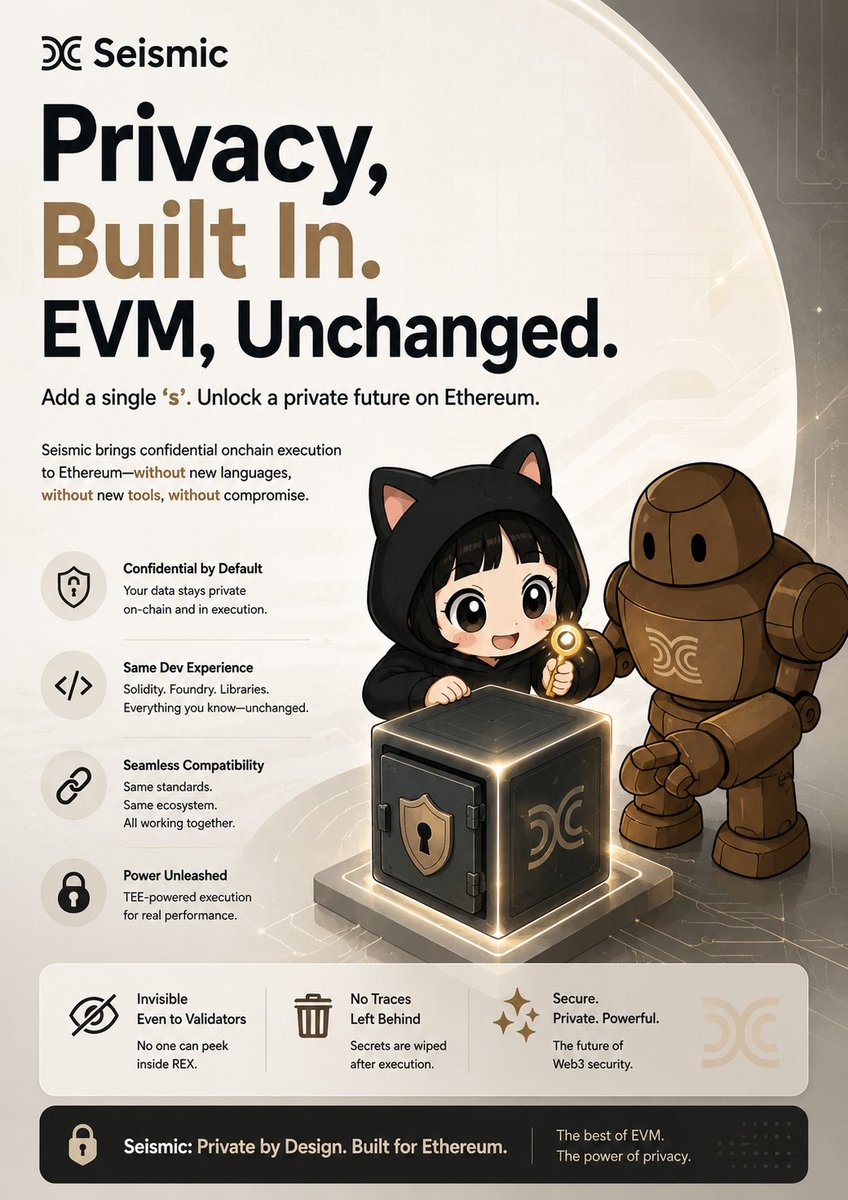

0608 Seismic 61 quiz
@SeismicSys @NoxxW3
이번 퀴즈는 프라이버시가 단순한 프론트엔드 눈속임이나 트랜잭션 이후의 인덱싱 처리가 아니라, 스마트 계약이 실행되는 시점 자체(Privacy at execution)에 네이티브하게 작동하는 원리를 이해하는 데 목적이 있습니다. 이를 구현하기 위한 전용 솔리디티 컴파일러의 동작 방식, 하드웨어 수준의 신뢰 구축, 그리고 개발자가 로컬에서 이를 테스트하는 환경을 아우르는 지식을 검증합니다.
핵심 내용 복습 (Theme-based Review)
스마트 계약 및 EVM 확장 (Smart Contract & Opcodes)
· 비공개 상태 기록 (CSTORE) : Seismic 환경에서 스마트 계약이 비공개/숨김 상태(Hidden state) 변수를 스토리지에 작성할 때는 표준 EVM의 SSTORE 대신 CSTORE (Confidential Store) 오코드를 사용하여 보안을 유지합니다. (Q2)
· 비공개 상태 조회 (CLOAD) : 반대로 스토리지에 저장된 비공개 상태 데이터를 읽어올 때는 CLOAD (Confidential Load) 오코드가 실행됩니다. (Q3)
· 암호화된 전역 상태 : 이처럼 암호화된 전역 상태(Encrypted global state)가 인프라 레벨에서 유지되기 때문에, 여러 사용자가 개별 프라이버시를 지키면서도 공통의 스마트 계약 위에서 안전하게 공유된 프라이빗 로직(Shared private logic)을 실행할 수 있습니다. (Q9)
하드웨어 보안과 신뢰성 (Hardware Security & Attestation)
· 부채널 공격 위험 : TEE(신뢰 실행 환경) 하드웨어 설계에서 가장 주의해야 할 물리적 보안 취약점은 부채널 공격 누출(Side-channel leaks)입니다. 이는 연산 시간이나 캐시 접근 패턴 등을 통해 내부 암호화 키를 유추하는 공격입니다. (Q4)
· 원격 증명 : TEE 안에서 실행되는 프로그램이 위변조되지 않았음을 외부 검증자에게 확인시켜 주는 원격 증명(Remote attestation)을 통해, 현재 내부에서 정확한 코드 유지가 이루어지며 구동 중임(Code running inside)을 입증합니다. (Q5)
데이터 보호 및 접근 제어 (Data Protection & Access Control)
· 선택적 프라이버시 : 모든 것을 감추거나 모두 공개하는 이분법적 방식이 아니라, 앱의 필요에 따라 특정 데이터만 골라서 공개할 수 있는 선택적 프라이버시(Selective privacy) 메커니즘을 제공합니다. (Q1)
· 전송 데이터 보호 : 트랜잭션이 멤풀에 머무는 동안의 세부 정보 누출을 막기 위해 암호화된 캘데이터(Encrypted calldata)를 사용하여 비공개 트랜잭션의 상세 내용(Private tx details)을 원천 보호합니다. (Q6)
· 서명된 조회 : 누구나 타인의 비밀 잔액을 볼 수 없도록, 비공개 데이터를 조회할 때는 본인의 키로 서명한 값(Signed read)을 제출하여 자신이 데이터에 접근할 권한이 있는 주체(Caller permission)임을 증명해야 합니다. (Q7)
개발 환경 및 패러다임 (Dev Tools & Core Thesis)
· 로컬 테스트 인프라 : Foundry 환경의 Anvil처럼, Seismic 개발자가 로컬 컴퓨터에서 프라이버시 스마트 계약을 테스트하고 시뮬레이션할 수 있도록 지원하는 전용 노드 도구는 sAnvil (Local sAnvil node)입니다. (Q8)
· 실행 단계의 프라이버시 : Seismic의 가장 핵심이 되는 철학(Privacy thesis)은 트랜잭션 전후가 아닌, 계약이 처리되는 가상머신 및 실행 단계 자체에서 프라이버시가 완성되는 모델(Privacy at execution)입니다. (Q10)
Below are the questions and correct answers for this quiz. Let's review them once more!
Question 1
Which Seismic idea lets an app reveal only selected data?
Option 1 : Validator committees
Option 2 : Bridge adapters
Option 3 : Public dashboards
Option 4 : Selective privacy (correct)
Question 2
What does CSTORE mainly do inside Seismic contracts?
Option 1 : Reads hidden state
Option 2 : Prices market orders
Option 3 : Routes validator votes
Option 4 : Writes hidden state (correct)
Question 3
What does CLOAD mainly do inside Seismic contracts?
Option 1 : Reads private state (correct)
Option 2 : Stores private state
Option 3 : Gas fee routing
Option 4 : Indexes public logs
Question 4
Which risk is most tied to TEE hardware design?
Option 1 : Token supply errors
Option 2 : Wallet theme bugs
Option 3 : Side-channel leaks (correct)
Option 4 : Oracle drift risk
Question 5
What does remote attestation help confirm?
Option 1 : Cards linked onchain
Option 2 : Fees paid by users
Option 3 : Markets priced fairly
Option 4 : Code running inside (correct)
Question 6
What does encrypted calldata mainly protect?
Option 1 : Explorer page views
Option 2 : Private tx details (correct)
Option 3 : Validator rewards
Option 4 : Token display names
Question 7
What does a signed read help prove?
Option 1 : Caller permission (correct)
Option 2 : Block gas target
Option 3 : Pool depth checks
Option 4 : Committee membership
Question 8
Which tool is closest to local Seismic testing?
Option 1 : DashX payment relay
Option 2 : Prism QR account
Option 3 : Local sAnvil node (correct)
Option 4 : Summit epoch set
Question 9
What does encrypted global state enable?
Option 1 : Public token rankings
Option 2 : Shared private logic (correct)
Option 3 : Bridge memo routing
Option 4 : Validator fee markets
Option 10
Which model best fits Seismic’s privacy thesis?
Option 1 : Privacy via memos
Option 2 : Privacy by frontend
Option 3 : Privacy at execution (correct)
Option 4 : Privacy after indexing

0601 Seismic 60 quiz
@SeismicSys @NoxxW3
이번 퀴즈는 프라이버시가 보장되는 블록체인 인프라가 실제 웹2 유저 수준의 UX(낮은 지연 시간)를 어떻게 유지하는지, 그리고 규제 준수(Audit)나 AI 거래 전략 보호, DeFi 프로토콜과의 유기적인 결합(Composability) 등 웹3 금융 생태계가 마주한 현실적인 한계들을 어떤 아키텍처적 접근으로 해결하는지 이해하는 데 목적이 있습니다.
성능 최적화와 개발 효율성 (Performance & Dev UX)
· 프론트엔드 지연 방지 : 암호화된 상태에서 코드가 실행(Encrypted execution)될 때 최적화가 완벽하지 않으면 유저가 체감하는 프론트엔드 지연(Frontend latency)이 가장 먼저 발생합니다. 이를 매끄럽게 처리하는 것이 인프라의 핵심 과제입니다. (Q2)
· 접착제 코드(Glue code)의 최소화 : Seismic Reth를 사용하면 프론트엔드나 서비스 앱 단에서 프라이버시를 구현하기 위해 복잡하게 얽히는 접착제 코드(Privacy glue)를 획기적으로 줄여 제품 팀의 개발 속도를 높여줍니다. (Q7)
보안 검증 및 합의 메커니즘 (Security & Consensus)
· 하드웨어 신원 증명 : 프라이빗 로직을 TEE(신뢰 실행 환경)에서 안전하게 처리하기 전, 원격 증명을 통해 내부에서 구동되는 코드의 신원(Code identity)을 명확히 검증해야 합니다. (Q5)
· 검증인 순환 : 합의 엔진인 Summit은 매 에포크(Epoch)마다 새로운 위원회를 구성함으로써 네트워크 보안을 위한 검증인 순환 흐름(Validator rotation flow)을 원활하게 지원합니다. (Q8)
차세대 핀테크 및 AI 금융 애플리케이션 (Fintech & AI Agents)
· 프라이빗 결합성 : 핀테크 앱이 자산 잔액을 숨기면서도 외부 DeFi 생태계와 상호작용하려면, 끊김 없는 결합 가능한 프라이빗 흐름(Composable private flows) 설계가 필수적입니다. (Q1)
· 오더북과 트레이딩 의도 보호 : 거래 정보가 완벽하게 공개되면 MEV 공격이나 카피 트레이딩봇에 노출됩니다. 프라이빗 오더북은 사용자의 거래 의도(Trading intent)를 숨겨 실행 품질을 높이고 (Q3), AI 에이전트의 독자적인 거래 전략이 무단으로 복사되는 카피 트레이딩 위험(Copyable trade behavior)을 원천 차단합니다. (Q6)
· 선택적 공개와 백그라운드 운용 : 모든 트랜잭션을 까발리지 않고도 합법적인 규제 감사를 통과할 수 있도록 선택적 개시/공개(Selective disclosure) 패턴을 지원합니다 (Q4). 또한, 결제 앱 유저가 돈을 쓰는 와중에도 자산이 놀지 않고 이자를 불릴 수 있도록 보이지 않는 곳에서 백그라운드 자산 배분(Background asset allocation)을 자동화합니다. (Q9)
Seismic의 비전과 상충하는 개념 (Anti-Thesis)
· Fully public finance (완전 공개 금융) : 모든 자산 이동과 개인 금융 정보가 투명하게 공개되는 전통적인 퍼블릭 블록체인의 형태는, 비즈니스 결제 레일과 금융 프라이버시를 지키고자 하는 Seismic의 핀테크 핵심 논지(Fintech thesis)와 정면으로 상충합니다. (Q10)
Below are the questions and correct answers for this quiz. Let's review them once more!
Question 1
A fintech app wants private balances while still using DeFi integrations. Which design goal matters most?
Option 1 : Public analytics feeds
Option 2 : Isolated private app ledgers
Option 3 : Composable private flows (correct)
Option 4 : Manual approval queues
Question 2
If encrypted execution is poorly optimized, which user-facing issue appears first?
Option 1 : Validator branding
Option 2 : Epoch naming
Option 3 : Frontend latency (correct)
Option 4 : Token symbolism
Question 3
Why can private order books improve execution quality?
Option 1 : They freeze market prices
Option 2 : They hide trading intent (correct)
Option 3 : They remove all risk
Option 4 : They show every bid
Question 4
A protocol wants audits without exposing every transaction. Which pattern fits best?
Option 1 : Hidden audit trails
Option 2 : Selective disclosure (correct)
Option 3 : Total public records
Option 4 : Manual export workflows
Question 5
Why should a TEE be attested before handling private logic?
Option 1 : To index public state roots
Option 2 : To lower visible gas pricing
Option 3 : To prove code identity (correct)
Option 4 : To rotate user keys
Question 6
Which risk appears when AI agents run with fully public strategies?
Option 1 : Copyable trade behavior (correct)
Option 2 : Simpler onboarding flows
Option 3 : Lower bridge fees
Option 4 : Stronger finality rules
Question 7
Why does Seismic Reth matter for product teams?
Option 1 : It replaces all wallets
Option 2 : It hides all users
Option 3 : It reduces privacy glue (correct)
Option 4 : It bans public contracts
Question 8
What does a new Summit committee each epoch mainly support?
Option 1 : Application credit routing
Option 2 : Treasury payout states
Option 3 : Wallet recovery labels
Option 4 : Validator rotation flow (correct)
Question 9
A spend app wants assets to keep earning while users pay. Which logic is needed?
Option 1 : Public order feed logs
Option 2 : Fixed validator set policies
Option 3 : Static balance locking
Option 4 : Background asset allocation (correct)
Question 10
Which idea clashes with Seismic’s fintech thesis?
Option 1 : Native privacy rails
Option 2 : Simple fintech UX
Option 3 : Business payment rails
Option 4 : Fully public finance (correct)

DashX tapped Seismic to power its virtual accounts and local rails.
A crypto payment platform chose to build its core financial infrastructure on a privacy-first L1. Let's talk about what that actually means 🧵
@DashXHQ is a crypto payment gateway. Merchants use it to accept payments across Ethereum, Solana, Arbitrum, and Polygon. Settlements go directly to your wallet,no custodian holding your funds, no delays, borderless by default.
The issue with running serious payment infrastructure on a standard public chain is visibility. Transaction amounts, account balances, merchant activity, customer relationships,all of it sits on a public ledger anyone can read and index.
For virtual accounts and local rails that's a real problem. These aren't speculative DeFi trades. They're payroll, rent, business settlements, the kind of data that has no business being public.
@SeismicSys handles this at the protocol level. Calldata is encrypted before it even leaves the user's machine. The encryption flow uses ECDH key agreement between the user's private key and the network's TEE public key, the plaintext never touches the mempool.
On-chain storage is shielded at the opcode level. Seismic uses a modified EVM where private variables write via CSTORE and read via CLOAD. Query a shielded slot through standard RPC and you get zero back, it looks like uninitialized storage to anyone watching.
The nodes themselves run inside Intel TDX Trusted Execution Environments. Hardware-enforced enclaves, the host OS, the hypervisor, the node operator, none of them can read what's being processed. Keys are generated inside the TEE and never leave it.
DashX needed infrastructure that could handle real financial data with real privacy requirements. Seismic is backed by a16z with $17M raised across two rounds, and fintech companies are already building on it.
The privacy layer for onchain finance is taking shape.
@xealistt @NoxxW3


𝗛𝗢𝗪 𝗦𝗘𝗜𝗦𝗠𝗜𝗖’𝗦 𝗣𝗥𝗜𝗩𝗔𝗖𝗬 𝗔𝗥𝗖𝗛𝗜𝗧𝗘𝗖𝗧𝗨𝗥𝗘 𝗔𝗖𝗧𝗨𝗔𝗟𝗟𝗬 𝗪𝗢𝗥𝗞𝗦
Every public blockchain leaks by design. Transaction amounts, wallet addresses, and contract state are visible to anyone running a node. That transparency works for trustless settlement. It becomes a problem for financial applications that require confidentiality.
Seismic approaches privacy at the base execution layer rather than through an external privacy wrapper.
𝗜𝗡𝗧𝗘𝗟 𝗧𝗗𝗫: 𝗧𝗛𝗘 𝗛𝗔𝗥𝗗𝗪𝗔𝗥𝗘 𝗙𝗢𝗨𝗡𝗗𝗔𝗧𝗜𝗢𝗡
Seismic nodes run inside Intel TDX Trusted Execution Environments (TEEs). Intel TDX creates isolated Trust Domains where memory and execution remain protected even from the host operating system, hypervisor, and node operator.
The encryption boundary exists at the hardware layer itself. Transactions are encrypted before reaching the network and decrypted only inside the enclave during execution.
𝗦𝗛𝗜𝗘𝗟𝗗𝗘𝗗 𝗧𝗬𝗣𝗘𝗦: 𝗣𝗥𝗜𝗩𝗔𝗖𝗬 𝗕𝗨𝗜𝗟𝗧 𝗜𝗡𝗧𝗢 𝗦𝗢𝗟𝗜𝗗𝗜𝗧𝗬
Seismic extends Solidity with shielded types like suint, sbool, sbytes, and saddress. These compile into custom confidential storage opcodes called CLOAD and CSTORE instead of Ethereum’s normal SLOAD and SSTORE instructions.
Transaction calldata is encrypted before submission. Decryption occurs only inside the TEE during execution.
From an outside observer’s perspective, shielded storage appears as zero values on-chain. Observers can see that activity occurred, but not the underlying confidential data.
The developer workflow stays close to Ethereum. Solidity, Foundry, Viem, and standard EVM tooling remain usable with Seismic-specific extensions layered underneath.
𝗦𝗘𝗜𝗦𝗠𝗜𝗖 𝗥𝗘𝗧𝗛: 𝗧𝗛𝗘 𝗠𝗢𝗗𝗜𝗙𝗜𝗘𝗗 𝗘𝗫𝗘𝗖𝗨𝗧𝗜𝗢𝗡 𝗖𝗟𝗜𝗘𝗡𝗧
Seismic Reth is a modified version of the Rust Ethereum execution client Reth. It adds confidential transaction handling, shielded storage, modified EVM opcodes, and encrypted calldata support.
The execution stack includes custom forks of Reth, REVM, Foundry, and Solidity tooling, all designed around confidential execution as a native architectural property rather than an add-on feature.
𝗖𝗢𝗡𝗧𝗥𝗢𝗟𝗟𝗘𝗗 𝗗𝗜𝗦𝗖𝗟𝗢𝗦𝗨𝗥𝗘: 𝗧𝗛𝗘 𝗖𝗢𝗠𝗣𝗟𝗜𝗔𝗡𝗖𝗘 𝗕𝗥𝗜𝗗𝗚𝗘
One of the more important design goals is selective disclosure.
Seismic’s architecture allows applications to keep sensitive user data encrypted while still enabling specific parties to verify compliance-related information when permission is granted.
That creates a potential bridge between on-chain privacy and regulated financial infrastructure without exposing all transaction data publicly.
𝗧𝗘𝗘 𝘃𝘀 𝗭𝗞: 𝗪𝗛𝗬 𝗦𝗘𝗜𝗦𝗠𝗜𝗖 𝗖𝗛𝗢𝗦𝗘 𝗛𝗔𝗥𝗗𝗪𝗔𝗥𝗘
Seismic uses Trusted Execution Environments instead of fully zero-knowledge-based execution.
Zero-knowledge systems provide strong cryptographic guarantees but remain computationally expensive for generalized smart contract execution. TEEs trade some of that cryptographic purity for hardware-accelerated confidential execution and lower overhead.
The tradeoff is clear: Seismic depends on Intel’s hardware security model and enclave integrity rather than relying entirely on mathematical proofs.
The protocol is effectively betting that confidential computing hardware matures fast enough to support scalable encrypted execution long term.
@SeismicSys
@heathcliff_eth
@xealistt
Trends for you
Most Popular Users

Elon Musk 
@elonmusk
240.1M followers

Barack Obama
@barackobama
118.6M followers

Cristiano Ronaldo
@cristiano
114.4M followers

Donald J. Trump
@realdonaldtrump
111.7M followers

Narendra Modi
@narendramodi
106.9M followers

Rihanna
@rihanna
98.6M followers

NASA
@nasa
92.1M followers

Justin Bieber
@justinbieber
91.7M followers

KATY PERRY
@katyperry
89.9M followers

Taylor Swift
@taylorswift13
83.9M followers

Lady Gaga
@ladygaga
75.4M followers

Virat Kohli
@imvkohli
73.3M followers

Kim Kardashian
@kimkardashian
70.8M followers

YouTube
@youtube
68.6M followers

Neymar Jr
@neymarjr
66.3M followers

Bill Gates
@billgates
65.2M followers

Selena Gomez
@selenagomez
63M followers

The Ellen Show
@theellenshow
62.1M followers

CNN
@cnn
61.7M followers

X
@x
60.6M followers