

Top Tweets for #ChemistsWhoCode

Specifying water handling, side chain flexibility, and pharmacophore constraints via Python lets you define repeatable, automated docking protocols.
See the full details of what you can do here: https://t.co/zyGblEEsMy
#drugdiscovery #compchem #chemistswhocode

The availability of curated experimental data, with suitable meta-data, was key in enabling this work.
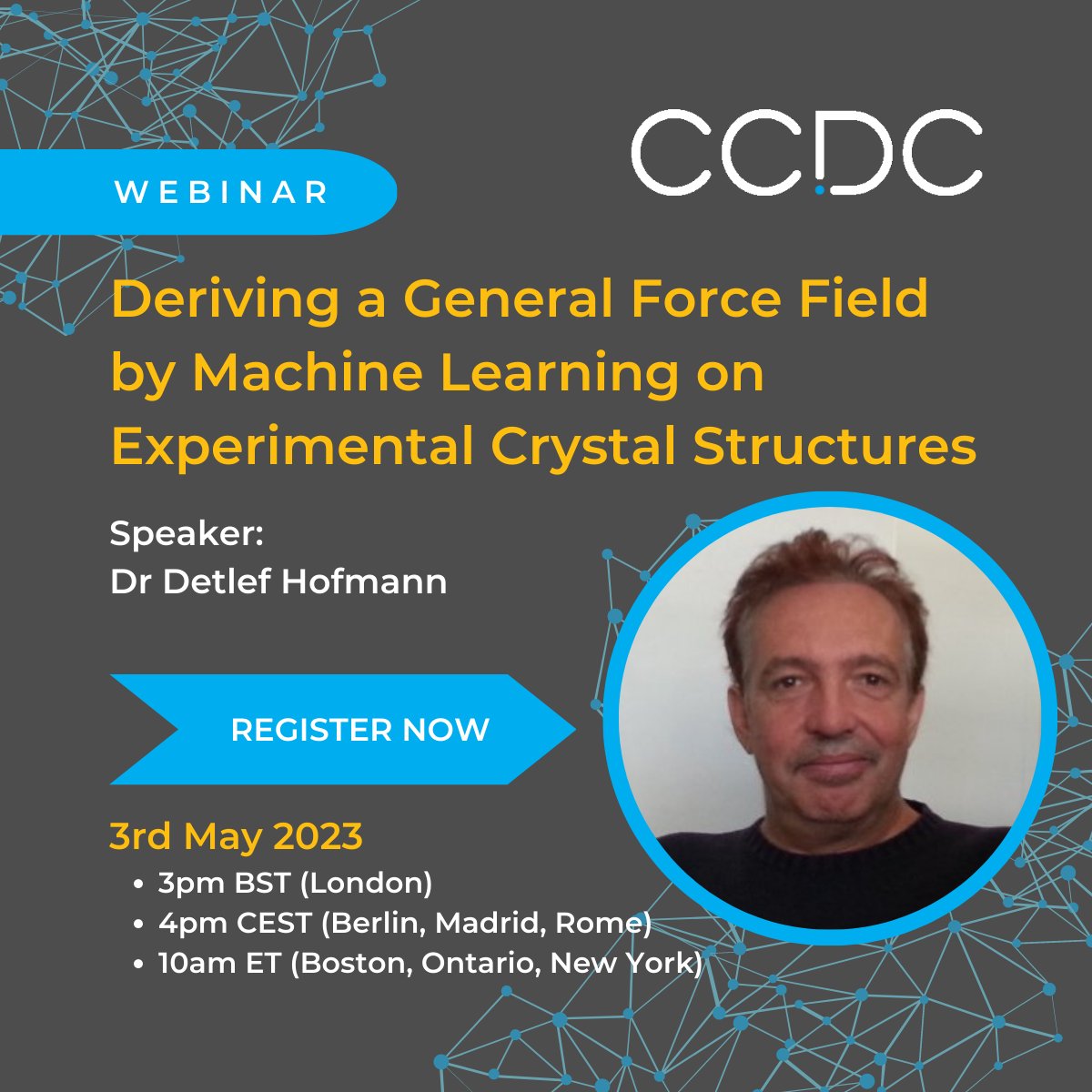
Join us on Wednesday 3rd May to learn more direct from the author!
Save your place: https://t.co/xh2DeOvWF7
#chemistswhocode #cheminformatics #machinelearning

Experimental data from the CSD was used to create a general force field to predict materials chemical and physical properties. Join us to hear from the author on methods, results, and future plans!
https://t.co/z6pIJbPKqd
#machinelearning #chemistry #drugdesign #chemistswhocode

Exciting news: just launched a #codingForChemists Discord community! It's aimed at anyone who studied chemistry and now wants to learn coding. Especially total beginners! For questions and general chat
Pls reply or DM me (if you can) for an invitation! #ChemistsWhoCode
Completely customized, 100% repeatable analyses, with the CSD Python API — now compatible with Python 3.9
Get starter scripts on GitHub, write your own, or ask us for something custom!
Learn more: https://t.co/TwA3rwwEb1
#chemistswhocode #drugdesign #materialsdesign #compchem

Julia Gasol from the University of Strathclyde discusses the use of #Python to analyse and understand experimental pharmaceutical data, examining molecular movement upon compression.
🔗https://t.co/LqWS8BR9QZ #Crystallography #DrugDiscovery #ChemistsWhoCode #ChemTwitter

📢 New CSD release out now! The 2022.3 update includes a host of improvements to CSD-Materials, support for Python 3.9, and a new way to calculate particle shape in CSD-Particle.
Learn more and get the update here: https://t.co/w9XtcGXZTO
#compchem #chemistswhocode


This is why I learned to code. And why I encourage all our biochemistry majors to take at least one coding course!
#ChemistsWhoCode @BLbiochem
https://t.co/dTipe5rQvO

What’s great about articles like this by @SuperScienceGrl is that they show coding isn’t just a “compchem thing.”
Please spread the word - coding is a huge help and #ChemistsWhoCode should be all chemists.


@SuperScienceGrl @ChemistryWorld “Many of us have seen digital lab tools that were clearly made without ever consulting lab chemists – with a little collaboration we can change that.” Mmmmh yes! 1000%!!! Can’t wait for the day @SuperScienceGrl will fix HTE Workflows… #HTElife #chemistswhocode
Compare packing similarity over a set of structures in a dendrogram, with this #python script. Compare polymorphs, co-crystals, solvates, or hydrates in a fast all-to-all comparison. 🔗https://t.co/QSnAooGNqe
Just one of our #github scripts for #chemistswhocode #crystallography

Our GitHub repo allows for scientific collaborations. Check out this #python script that generates a Gaussian input file (.gjf) for a given CSD refcode or .mol2. https://t.co/QTrcdeLXly
#chemistswhocode can edit and submit scripts too! What tasks do you want to see a script for?

Exploring the #polymorphic landscape? This #python script writes a report of #hydrogenbond propensity calculation. https://t.co/9NnutHDDGE
#chemistswhocode can edit and submit scripts too! What tasks do you want to see a script for?
#ComputationalChemistry

CCDC's GitHub repo shares #python scripts that make #chemistry work simpler. For example, this script generates #CASTEP input files for a structure in Mercury. #Chemistswhocode can edit and submit scripts too! What tasks do you want to see automated?
https://t.co/NOiMyxrEek

Our GitHub repo hosts #python scripts to support #chemistry and #cheminformatics work. This script concatenates a series of mol2 files and creates one multi-mol2 file. Try it here: https://t.co/Qkzgu4dZE8
P.S. #chemistswhocode can edit & submit their own scripts too!

Getting, editing, & sharing #python scripts to work with the CSD just got easier. Find scripts that support your #chemistry and #cheminformatics research in our GitHub repo. Join us here: https://t.co/EtNGVnrRrx #chemistswhocode #chemtwitter
More info: https://t.co/jYNdwjwOHb

How can SMARTS and SMILES be used in Mercury? From selection, to substructure search - learn how and see what's changed in our latest update here: https://t.co/JNy2MX83Ll
#chemistry #cheminformatics #CSD #python #chemistswhocode


Hi #ChemTwitter
While I don't have any hot takes on stuck container ship or more importantly, sandwiches, if you are in need of downloading a lot of SDS PDF files, this program might help you:
https://t.co/ms8iTnu55r
#ChemistsWhoCode
#Python
(Demo below)
Last Seen Hashtags on Sotwe
Most Popular Users

Elon Musk 
@elonmusk
241M followers

Barack Obama
@barackobama
119.2M followers

Cristiano Ronaldo
@cristiano
111.9M followers

Donald J. Trump
@realdonaldtrump
111.8M followers

Narendra Modi
@narendramodi
107M followers

Rihanna
@rihanna
98M followers

NASA
@nasa
92.2M followers

Justin Bieber
@justinbieber
91.2M followers

KATY PERRY
@katyperry
88.4M followers

Taylor Swift
@taylorswift13
82.3M followers

Lady Gaga
@ladygaga
73.8M followers

Virat Kohli
@imvkohli
71.1M followers

Kim Kardashian
@kimkardashian
70.1M followers

YouTube
@youtube
68.7M followers

Bill Gates
@billgates
64.3M followers

Neymar Jr
@neymarjr
63.9M followers

The Ellen Show
@theellenshow
62.4M followers

CNN
@cnn
61.8M followers

Selena Gomez
@selenagomez
61.5M followers

X
@x
60.8M followers