

Top Tweets for #CockroachDB

You're building your next startup from scratch,
- PostgreSQL
- MongoDB
- MySQL
- SQLite
- Supabase
- Firebase
- Redis
- CockroachDB
Which database are you picking? 👇🏻

@Govind_tiwari_ 1. Docker
2. Kubernetes
3. Mercedes
4. Ollama
5. CockroachDB
6. Traefik
7. Hugo

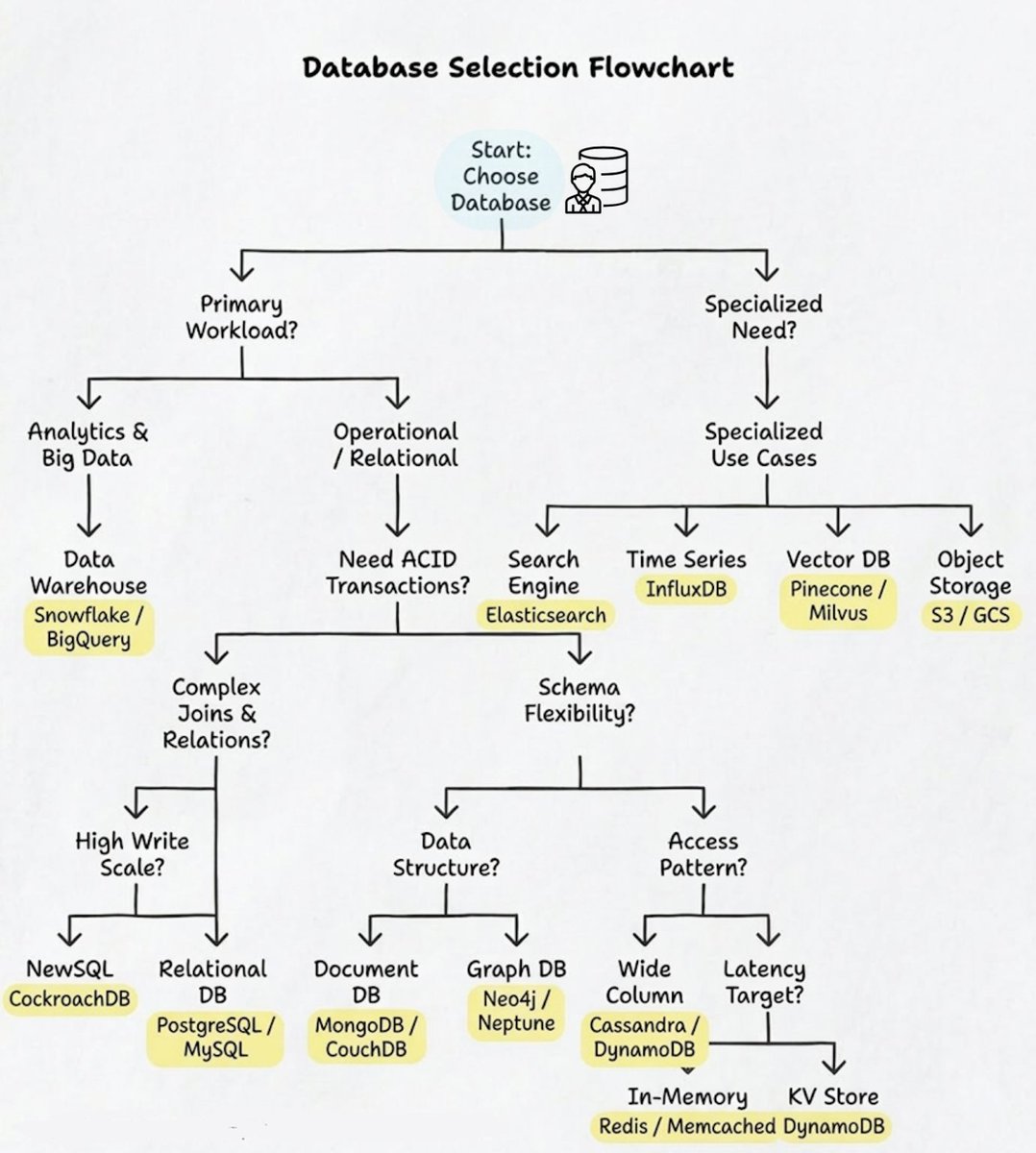
Choosing the right database can make or break your project.
Here’s a simple way to think about it 👇
Start with one question: What is your primary workload?
1️⃣ Analytics & Big Data
If you’re running heavy analytics, dashboards, or BI queries, use a Data Warehouse.
Good options: Snowflake or BigQuery.
2️⃣ Operational / Application Data
If you’re building a typical app (users, orders, products), ask:
• Need ACID transactions?
• Have complex joins & relations?
If yes → use a Relational DB like PostgreSQL or MySQL.
They’re reliable, structured, and great for most applications.
If you need high write scale + distributed SQL, consider NewSQL like CockroachDB.
3️⃣ Schema Flexibility?
If your data structure changes often:
• Document DB → MongoDB (great for JSON-style data)
• Graph DB → Neo4j (perfect for relationships like social networks)
4️⃣ Access Pattern Matters
• Wide column workloads / massive scale → Cassandra or DynamoDB
• Ultra-low latency caching → Redis or Memcached
5️⃣ Specialized Use Cases
Some problems need purpose-built databases:
• Search → Elasticsearch
• Time-series data (metrics, IoT) → InfluxDB
• Vector search (AI / embeddings) → Pinecone or Milvus
• File/object storage → S3 or GCS
Start simple. In most cases, PostgreSQL is enough for your first version.
Optimize later when your workload demands it.
The best database isn’t the most popular one,
it’s the one that matches your data model, scale, and access pattern.
What database do you usually start with for new projects?

@therahul4402 bhai mai to supabase ya cockroachDB use karta, ye next.js wala kam dimag kharab karta hai mera par phir bhi maai next.js use karunga aur vite because it is fastest framework after vanila.js and also next.js, TS aur vite ka use karke mai app ko fast banunga

@vineerpasam Most teams move to managed clustered databases like CockroachDB or PlanetScale for real HA once Supabase limits bite.

CAP Theorem is incomplete. Here's what it's missing - and where your database actually fits.
Every engineer learns CAP in college or interview prep:
"Pick 2 of 3 - Consistency, Availability, Partition Tolerance."
But here's the problem.
CAP only tells you what happens during a network partition (when nodes can't talk to each other). Partitions are rare. What about the other 99% of the time when everything is working fine?
That's exactly what PACELC fixes.
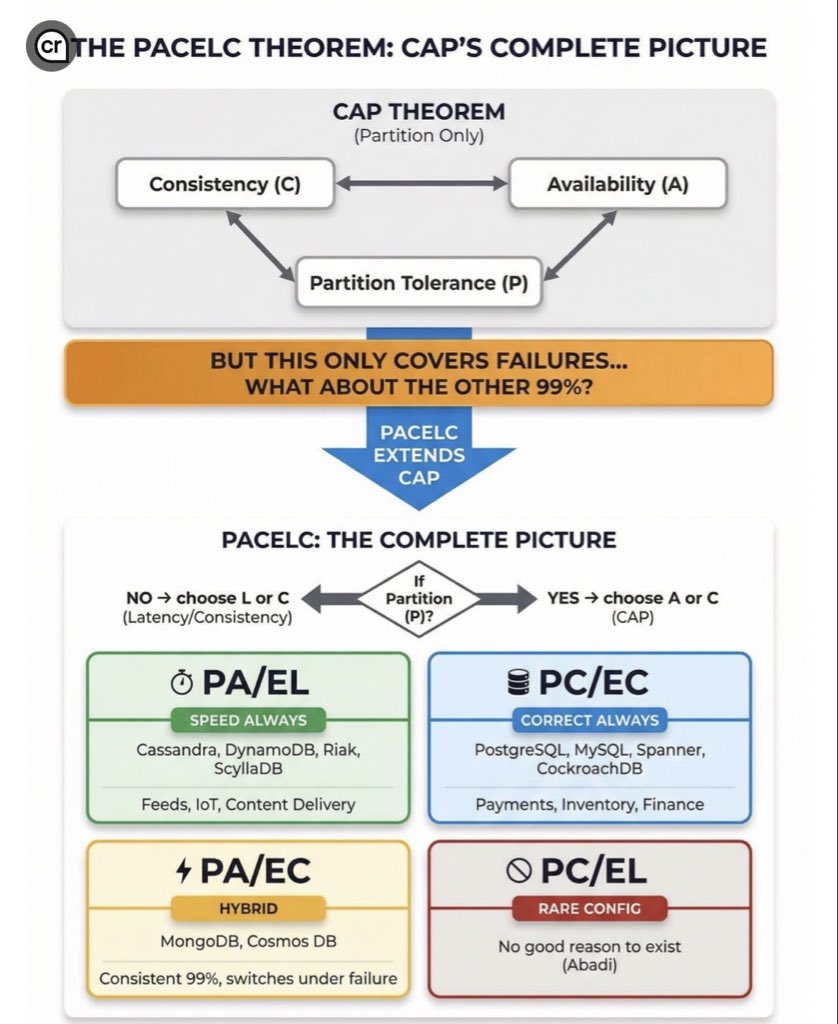
PACELC (proposed by Daniel Abadi, 2012) adds the missing piece:
- IF Partition - choose Availability or Consistency (same as CAP)
- ELSE - choose Latency or Consistency (this is new)
That "Else" tradeoff is the one engineers actually face every day in production.
Here's how real databases map to PACELC:
(Partition = one or more network nodes can't talk to each other)
PA/EL (Speed always)
During partition → picks Availability (keeps serving even if data diverges)
During normal ops → picks Low Latency (fast writes, syncs in background)
Cassandra, DynamoDB, Riak, ScyllaDB
Great for feeds, IoT, content delivery.
PC/EC (Correct always)
During partition → picks Consistency (blocks writes until nodes agree)
During normal ops → picks Consistency (waits for all replicas to confirm)
PostgreSQL, MySQL, Spanner, CockroachDB
Essential for payments, inventory, financial systems.
PA/EC (Hybrid)
During partition → picks Availability (keeps serving, may lose some writes)
During normal ops → picks Consistency (reads from primary, data is correct)
MongoDB, Cosmos DB (default)
Consistent 99% of the time, but switches behavior under failure.
PC/EL (Rare)
During partition → picks Consistency (pays the price of blocking)
During normal ops → picks Low Latency (tries to be fast)
Abadi himself says this config has "no good reason to exist." If you already built for consistency during failures - why throw it away when things are fine?
Why this matters more than CAP:
- CAP treats partition tolerance as a "choice" - it's not, it's mandatory on any real network
- CAP says nothing about latency - the actual tradeoff you make on every request
- CAP's "pick 2 of 3" was called "misleading" by its own creator (Eric Brewer, 2012)
- Martin Kleppmann wrote "Please stop calling databases CP or AP" for a reason
The real question isn't "is my database CP or AP?"
It's: "When everything is working fine - does my database prioritize speed or correctness?"
Save this. Share it with your team. And next time someone says "CAP Theorem" in a design review - ask them about PACELC.
Repost if this helped you see CAP differently.
Which database's PACELC classification surprised you? Drop it below 👇

Saw a friday's surprise sale problem of Doordash and how they solved the monolithic architecture with the help of cockroachdb... Trying to build a project around it.

Databases you can use for your projects ☁️
SQL 🗄️
TursoDB ⚡
Cloudflare D1 🌐
CockroachDB 🐾
PlanetScale 🚀
Neon 💡
NoSQL 🛢️
MongoDB Atlas 🍃
Firebase Firestore 🔥
DynamoDB ⚡
Couchbase Cloud ☁️
Redis Cloud 🧠

SQL vs NoSQL (It Was Never a War)
SQL vs NoSQL is not about which is “better”.
It’s about what guarantees you need.
SQL Databases
Characteristics:
- Fixed schema
- ACID transactions
- Strong consistency
- Rich querying
Examples:
- PostgreSQL
- MySQL
- CockroachDB
Best for:
- Financial data
- User accounts
- Orders, payments, inventory
SQL optimizes for correctness first.
NoSQL Databases
Characteristics:
- Flexible schema
- Horizontal scalability
- Eventual consistency (often)
- Simple access patterns
Examples:
- MongoDB
- DynamoDB
- Cassandra
Best for:
- Logs
- Feeds
- Caches
- Large-scale event data
NoSQL optimizes for availability and scale.
Key Difference
SQL asks: “Is the data correct?”
NoSQL asks: “Is the system available?”
Why This Matters
Most production systems:
- Use SQL for core data
- Use NoSQL for scale-heavy workloads
The mistake is not choosing NoSQL.
The mistake is choosing it too early.
Use SQL until scale forces your hand.

CockroachDB: The Database That Just Won’t Die (and That’s a Good Thing)
Most databases break when traffic spikes, a node dies, or your infra gets messy.
CockroachDB does the opposite it thrives in chaos.
Here’s why modern teams are switching to it:
• Survives failures automatically
If a node crashes, your app keeps running. No manual recovery. No 2 AM panic calls.
It’s literally designed to “self-heal.”
• Scales like a cloud-native system
Want more throughput? Add more nodes.
No downtime. No messy sharding. No rewriting your app.
• PostgreSQL-compatible
It feels like Postgres, so your queries, tools, and workflow don’t need a full reset.
• Strong consistency across the cluster
Even when data lives across multiple regions, you still get correctness + reliability.
• Built for global apps
Place data close to users for low latency while still keeping everything consistent behind the scenes.
• Perfect for fintech, SaaS, marketplaces, and real-time systems
Basically, anything that can’t afford downtime or data loss.
CockroachDB isn’t just a database —
It’s a distributed system disguised as SQL, engineered to stay online no matter what.
If your app is growing fast, or you’re planning to go global…
this is the kind of database that grows with you, not against you.


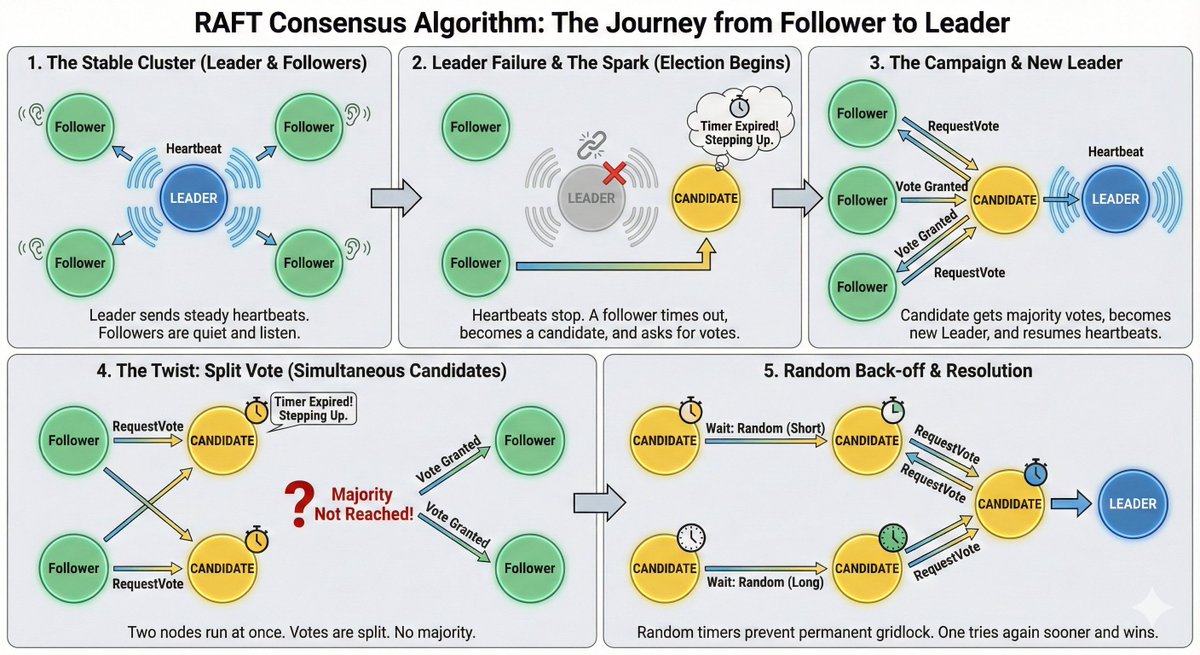
In any distributed system, you can have many nodes doing work, but only one should be in charge of coordinating writes. Without that, you end up with chaos: two nodes accepting conflicting updates, logs drifting apart, and the cluster slipping into split-brain territory.
So RAFT (Reliable, Replicated, and Fault-Tolerant) steps in with a simple story.
It always begins the same way:
Every node starts as a quiet follower, just listening. As long as a leader is sending steady heartbeats, everyone stays calm and focused.
But if those heartbeats stop for a random window of time, a follower looks around and thinks:
“The leader hasn’t spoken. Maybe it’s time I step up.”
And it promotes itself to a candidate.
A candidate doesn’t rule by force. It asks.
It sends out RequestVote messages to all the other nodes. A node will only vote if it hasn’t already voted in that term, and if the candidate’s log looks up-to-date.
If enough nodes agree a majority RAFT simply says:
“Very well, you are now the leader.”
Clear. Deterministic. No two leaders at once.
As soon as the leader is chosen, it becomes the heartbeat of the cluster.
Every few milliseconds it sends a gentle signal to the followers that says:
“I’m here. Everything’s under control.”
And the system stays stable.
But here’s the fun twist:
Sometimes, two followers notice the silence at the same moment. They both decide to run for leader. They both ask for votes. Neither gets enough.
So they wait, reset their timers…
And because those timers are random, one fires slightly sooner the next round. It gains the votes, becomes the leader, and the other quietly steps back.
A tiny touch of randomness prevents massive instability.
And that is why systems like etcd, CockroachDB, TiKV, Consul, and RedPanda trust RAFT
a simple, almost human story of nodes listening, stepping up, asking permission, and agreeing on who leads so the whole system can move in one consistent direction.

• Docker is Go
• Kubernetes is Go
• Terraform is Go
• Prometheus is Go
• Grafana is Go
• Etcd is Go
• CockroachDB is Go
• InfluxDB is Go
• NATS is Go
• Consul is Go
• Nomad is Go
• Vault is Go
• Traefik is Go
• Caddy Server is Go
• Istio is Go
• Hugo is Go
• Loki is Go
• Dgraph is Go
• MinIO is Go
• TinyGo is Go
—still, you’re not convinced to learn Go? 🚀

@dustyyyyi now I know how they got cockroachdb

Most of the modern Cloud/DevOps stack is built in Go:
>Kubernetes is Go
>Docker is Go
>Terraform is Go
>Prometheus is Go
>Grafana is Go
>Helm is Go
>etcd is Go
>Consul is Go
>CoreDNS is Go
>Traefik is Go
>InfluxDB is Go
>CockroachDB is Go
>Vault is Go
>Istio is Go
>ArgoCD is Go
>Cilium is Go
—still, you're not convinced to learn Go?


KeikoAI weekend update:
We just moved our db from Astra to @CockroachDB as the pricing plan of Astra is being dicey now for Vectors.
Thanks to my partner-in-crime and life @Badal_Naik (and his freakishly accurate time management) he predicts exact time it will take to migrate and get it done under that time!
We are now live and kicking again!
KeikoAI is ready to use.
https://t.co/PrqLF1sC0K

@KritikaSaini23 Try CockroachDB

Ever wondered how payment systems avoid double charges when you hit “Pay” twice? 💳
It’s not magic — it’s engineering. ⚙️
✅ Idempotency keys make sure each request is processed only once.
✅ Atomic transactions keep debit & credit in sync — all or nothing.
✅ Concurrency locks stop two processes from updating the same balance.
✅ Smart retries prevent duplicate payments.
Databases like PostgreSQL or CockroachDB handle this best — strong consistency, reliable under load.
Because in payments, “once” really has to mean once. 💡
#Fintech #Payments #Engineering #PostgreSQL #Concurrency


Let's settle the real-world database debate for a new project in 2025.
You need to store core business data—users, products, orders. What's your default choice and why?
A) PostgreSQL: The reliable, relational titan.
B) MongoDB: The flexible, developer-friendly document store.
C) DynamoDB/Managed NoSQL: The infinitely scalable (but complex) cloud-native option.
D) Something else? (e.g., MySQL, CockroachDB)
Share your go-to and the reasoning behind it. I'm curious what everyone is actually building with.

@BuildingCody cockroachdb sounds solid for scaling with sql and yeah management looks pretty smooth too
respect the hustle building and shipping nonstop is tough but your projects are gonna go places, wish u good day brother

Currently exploring CockroachDB for several projects. It appears easy to manage and scale into a cluster.
Any negative experiences with it? - I need a simple DB that is capable of scaling into massive workloads without big adjustments.
And yes, I want SQL.

Where to host your database for free.
The best platforms available today ↓
MONGODB ATLAS
MongoDB, 512MB, automatic backups
→ mongodb․com
NEON TECH
PostgreSQL, 500MB, 190 compute hours
→ neon․tech
FREEDB TECH
MySQL, 25MB, up to 200 connections
→ freedb․tech
TURSO
SQLite, 5GB, 500 million reads
→ turso․tech
UPSTASH
Redis, 256MB, 500K commands
→ upstash․com
XATA
PostgreSQL, 15GB, unlimited transfer
→ lite․xata․io
SUPABASE
PostgreSQL, 500MB, 5GB transfer
→ supabase․com
COCKROACHDB
10GB storage, 50M requests
→ cockroachlabs․com
KOYEB
PostgreSQL, 1GB, 5 hours of runtime
→ koyeb․com
If you know another one, share it!

Modern databases like CockroachDB and Google Spanner can stay globally consistent across continents, even though the speed of light itself limits how fast information can travel.


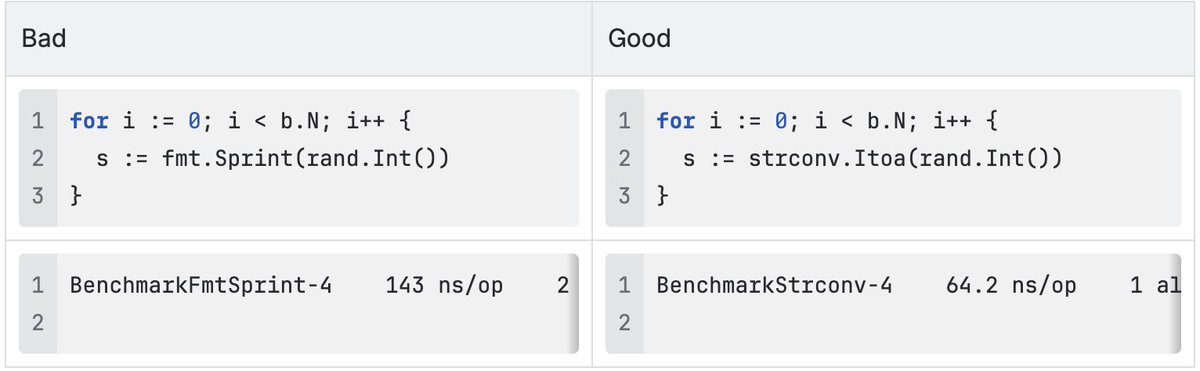
learnt a very clean optimization in golang today (thanks to @CockroachDB's docs), using strconv is way faster than fmt when converting primitives to/from strings
amazing how can you learn such clean performance optimizations by just reading contributing docs of databases

My favorite databases by use case:
Daily projects → Supabase
Scalable apps → MongoDB Atlas
Relational workloads → PostgreSQL
Serverless backend → Firebase
Analytics & BI → BigQuery
Distributed systems → Cassandra
Search & recommendations → ElasticSearch
Edge apps → Cloudflare D1
Real-time apps → RethinkDB
Time-series data → InfluxDB
Key-value store → Redis
Local development → SQLite
Multi-cloud deployments → CockroachDB
Most Popular Users

Elon Musk 
@elonmusk
240.1M followers

Barack Obama
@barackobama
118.6M followers

Cristiano Ronaldo
@cristiano
114.4M followers

Donald J. Trump
@realdonaldtrump
111.7M followers

Narendra Modi
@narendramodi
106.9M followers

Rihanna
@rihanna
98.6M followers

NASA
@nasa
92.1M followers

Justin Bieber
@justinbieber
91.7M followers

KATY PERRY
@katyperry
89.9M followers

Taylor Swift
@taylorswift13
83.9M followers

Lady Gaga
@ladygaga
75.4M followers

Virat Kohli
@imvkohli
73.3M followers

Kim Kardashian
@kimkardashian
70.8M followers

YouTube
@youtube
68.6M followers

Neymar Jr
@neymarjr
66.3M followers

Bill Gates
@billgates
65.2M followers

Selena Gomez
@selenagomez
63M followers

The Ellen Show
@theellenshow
62.1M followers

CNN
@cnn
61.7M followers

X
@x
60.6M followers