

Top Tweets for #Complexes

@scanamouche Belom ambil matkul itu.. semester ini ambil yg Clause complexes in texts (structure 2)

APEs: Agentic Prediction of Epitopes to Guide Antibody–Antigen Structure Prediction
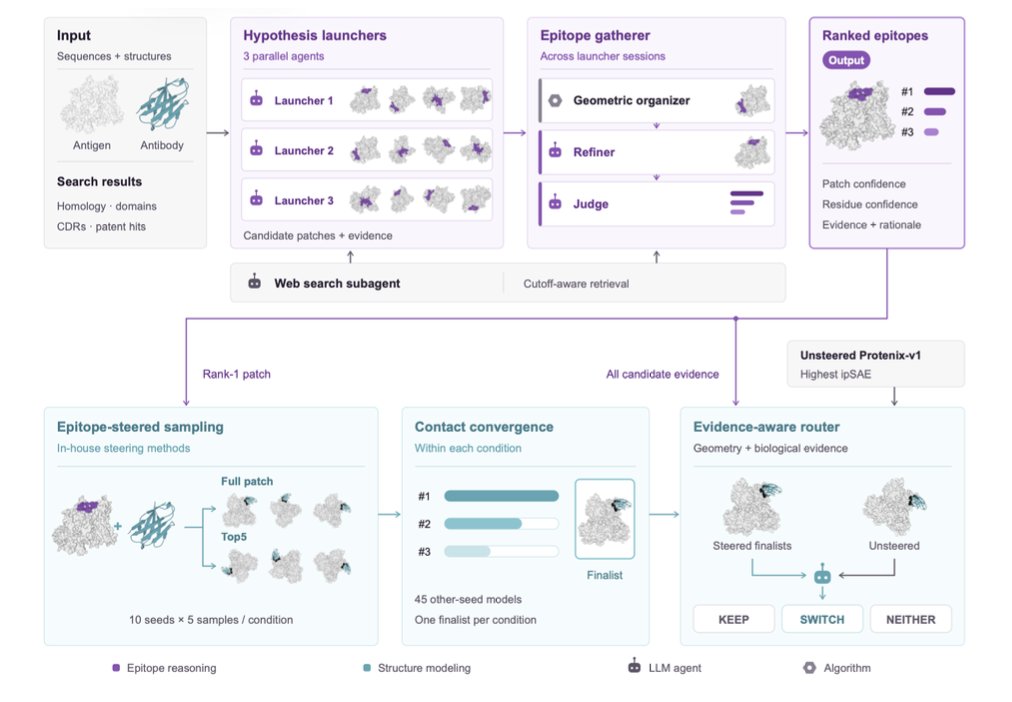
1. APEs is an agentic workflow that turns scattered, target-specific public evidence (papers, patents, homologous complexes, assays) into ranked, residue-level epitope hypotheses, then uses those hypotheses to steer antibody–antigen complex sampling and to help select final models.
2. The core problem it addresses: for antibody–antigen docking, the bound antigen surface is often unknown, and confidence metrics may not reliably separate alternative poses—even when near-native solutions exist in the sample pool.
3. System design: three independent “launcher” agents retrieve and interpret evidence and propose candidate antigen-surface epitope patches with per-residue contact scores (0–1) and heavy/light chain contact assignment; a Geometric Organizer clusters overlapping patches; a Refiner revises residue sets using the full evidence trail; a Judge ranks patches via relative patch-confidence (normalized to sum to 1 per target).
4. Practical output per hypothesis: proposed epitope residues, residue-level contact scores to prioritize likely true contacts within a patch, predicted heavy vs light chain involvement, supporting and conflicting evidence, ruled-out regions, and a written rationale—meant to be auditable rather than a single opaque score.
5. Retrospective CASP evaluation with time control: for each target, web retrieval was restricted to sources released before the CASP entry date. On 8 CASP16 + 6 released CASP17 targets, the top-ranked patch achieved residue precision ≥ 0.5 for 9/14 targets; considering all candidates, at least one patch met that threshold for 10/14 targets.
6. Confidence behaved meaningfully: rank-1 patches with precision ≥ 0.5 had higher mean patch-confidence (0.544) than lower-precision rank-1 patches (0.254). When patch-confidence ≥ 0.4, raising residue-score thresholds generally increased precision, suggesting residue-level scores enrich for true contacts when the correct region is found.
7. Evidence at different resolutions can be mapped onto structures: in H2319 (astrovirus VA1 spike + antibody 7C8), escape substitutions were mapped onto the query sequence to anchor the epitope; APEs separated two symmetry-related candidate regions and ranked them (top patch precision 0.769), with residue-level scoring further enriching true contacts inside a slightly shifted boundary.
8. Domain-level evidence can still be made actionable: in H2338 (FXI + REGN9933), patent evidence localized binding to the A2 apple domain; APEs combined this with related-antibody data (e.g., HDX-MS protected segments) and structural surface analysis to pick a specific surface (precision/recall 0.647). It also connected the predicted site to a mechanistic hypothesis about disrupting HK-mediated contact-pathway activation while sparing thrombin-mediated feedback activation; later cryo-EM and assays were consistent with this site/mechanism.
9. Epitope hypotheses were used to improve structure prediction, not just interpretability: predicted patches (full patch or Top5 residues by contact score) were used as restraints for additional Protenix-v1 sampling; finalists were chosen by contact convergence (not predictor confidence) and compared against the best unsteered ipSAE model by an evidence-aware router.
10. Net effect on docking quality across 14 targets: mean DockQ improved from 0.306 (unsteered baseline) to 0.375 (retrospective best selection across three independent router calls). Large single-target gains were shown, e.g., H2321 DockQ 0.089→0.679 (escape-site-consistent interface) and H2346 DockQ 0.005→0.379 (evidence-corrected Fab pairing and interface placement), while also illustrating limits: correct epitope localization does not guarantee correct orientation (e.g., H1225).
💻Code: https://t.co/D8GnfMIYM8
📜Paper: https://t.co/MebVV6Iof3
#computationalbiology #structuralbioinformatics #antibodies #proteinstructure #CASP #LLM #agents #epitope #docking

TODAY’S BIBLE STUDY IS ABOUT INSECURITY, INFERIORITY COMPLEXES, AND DISMISSIVE BEHAVIOR — WHEN OUR INNER STRUGGLES BEGIN TO RULE OUR CHARACTER
Scripture:
James 3:16
“For where envying and strife is, there is confusion and every evil work.”
Philippians 2:3
“Let nothing be done through strife or vainglory; but in lowliness of mind let each esteem other better than themselves.”
Ephesians 4:27
“Neither give place to the devil.”
Today’s Lesson:
Insecurity doesn’t always look like low self-esteem. Sometimes it disguises itself as arrogance, jealousy, control, defensiveness, and the constant need to belittle others.
An inferiority complex can make someone else’s confidence feel threatening, their success feel offensive, and their opinions feel like a challenge.
Instead of confronting their own inadequacies, some people dismiss others’ feelings, invalidate their experiences, and turn every disagreement into a battle for superiority.
But making someone else feel small will never make you greater in God’s eyes.
Not every insecurity is demonic, but when insecurity becomes envy, manipulation, bitterness, and division, we risk giving the enemy a foothold.
God calls us toward humility, compassion, and accountability.
Sometimes the loudest ego hides the deepest insecurity. Sometimes what people call strength is simply an unhealed heart refusing correction.
Your wounds may explain your behavior, but they do not excuse the harm you cause.
True confidence doesn’t require humiliation. True strength doesn’t require intimidation. And true faith doesn’t require silencing others.
If someone else’s light threatens you, examine your own heart instead of trying to extinguish theirs.
Reflect:
Do we listen to understand, or dismiss others to protect our ego?
Are we genuinely confident, or do we need others to feel inferior?
Are we allowing God to heal our insecurities, or allowing them to hurt others?
Prayer:
Heavenly Father, expose the insecurities we disguise as confidence, the jealousy we disguise as criticism, and the pride we disguise as strength. Remove bitterness, envy, arrogance, and every behavior that opens the door to darkness. Heal our hearts, humble our spirits, and teach us to treat others with compassion and respect. Never allow our ego to become louder than Your voice or our insecurities stronger than our faith.
In Jesus’ mighty name, Amen.
FINAL THOUGHT:
An insecure heart seeks power over people. A healed heart seeks peace with people.
Before you rebuke the darkness in someone else, make sure you’re not entertaining it within yourself.
Beyond AlphaFold 3: A Standardised Benchmark of Open-Source Co-Folding Models for Antibody–Antigen Complexes, from Docking Accuracy to Interaction Specificity
1. The study benchmarks five antibody–antigen co-folding models under standardized conditions: AlphaFold 3, Protenix-v2, OpenDDE, ESMFold2, and ESMFold2-fast—aiming to make comparisons fair across inputs, sampling, ranking, and interface-focused metrics.
2. Key takeaway on docking: OpenDDE achieves the highest median interface DockQ and the top docking pass rate on 200 complexes, with Protenix-v2 close behind (their difference is not statistically significant). Both outperform AlphaFold 3 on these benchmark measures, while also being more permissively licensed for downstream use.
3. The benchmark itself is a major contribution: the authors curate SAbDab2-Bench (88 post-2024 complexes) to complement a reconstructed antibody–antigen subset of FoldBench (Ab-FoldBench, 112 complexes). Combined: 200 complexes total, spanning 121 Fv and 79 VHH (nanobody) complexes, processed through a consistent pipeline to reduce leakage and ensure consistent evaluation.
4. The evaluation framework is “role-aware”: antibody chains are treated as binder (B) and antigen chains as target (T), and interface quality/confidence are computed specifically on the antibody–antigen interface (not conflated with VH–VL assembly). This includes an antibody–antigen-scoped DockQ and a role-scoped interface confidence definition (ipTM restricted to B–T chain pairs).
5. Practical guidance on compute vs accuracy: OpenDDE is most accurate but slowest; Protenix-v2 offers a stronger accuracy-per-runtime tradeoff for larger campaigns; ESMFold2-fast is fastest (no MSA generation) and suited for large-scale triage where throughput matters more than peak docking accuracy.
6. Confidence metrics are generally useful, but calibration is model-dependent: interface-scoped ipTM correlates strongly with DockQ (Spearman ~0.77–0.82 across models), yet optimal ipTM cutoffs vary widely by model and by task (high-accuracy interface recovery vs coarse docking/epitope mapping). The paper provides empirical cutoffs and error-rate estimates as starting points.
7. Sampling shows diminishing returns: most of the docking pass-rate gain is captured by ~5 seeds; doubling to 10 seeds improves pass rates only modestly (often ~1–2 percentage points). For high-throughput screening, the implication is that compute is often better spent on more targets rather than deeper sampling per target.
8. Antigen templates matter, but not uniformly: supplying the cognate-bound antigen conformation boosts docking (especially increasing high-quality predictions) for AF3 and Protenix-v2; using non-cognate antigen templates yields smaller gains; OpenDDE shows little benefit from provided antigen templates in these tests. Pairing MSAs across the full complex provides little benefit, consistent with limited antibody–antigen co-evolution signal.
9. Interaction specificity stress tests reveal a gap: confidence drops for decoys generated by (a) non-conservative interface mutations and (b) non-cognate antigen shuffling, but the drop is more consistent for shuffled antigens than for interface mutations. OpenDDE, despite top docking accuracy, retains comparatively high confidence for many mutated-interface decoys; Protenix-v2 shows stronger rejection of perturbed interfaces.
📜Paper: https://t.co/MDw6NQ3iFI
#AntibodyEngineering #ProteinDesign #StructuralBiology #ComputationalBiology #DeepLearning #AlphaFold #Benchmarking #AntibodyDiscovery #Nanobody #ProteinComplexes

Efficient and Accurate Zero Shot Generation of Symmetric Protein Complexes
1. The paper introduces ZEUS (Zero-shot Unified Symmetrization), a framework that turns any pretrained SE(3)-equivariant protein backbone generator into a symmetric complex generator with no retraining and no weight changes, targeting cyclic (Cn), dihedral (Dn), and polyhedral (T/O/I) symmetries.
2. Core idea: generating a G-symmetric assembly is equivalent to generating a single canonical subunit in the quotient space X/G, because the full complex is just the orbit of that subunit under the symmetry group action.
3. ZEUS realizes quotient-space generation in existing architectures via “phantom subunits”: the model runs primarily on one canonical subunit while consulting symmetry-transformed copies as geometric context, so internal operations remain symmetry-aware without explicitly processing the whole complex.
4. Theoretical foundation: for models that are SE(3)-equivariant and chain-permutation-equivariant, a full-complex generator “descends” to a well-defined quotient-space operator, and ZEUS’s phantom-copy computation is proven equivalent to that quotient operator (formalized as descent and expansion theorems).
5. Practical payoff: memory and runtime drop by O(|G|)=O(k) for finite symmetry groups. Node features reduce from kN to N, and pair/edge features reduce from k^2 N^2 to k N^2 by exploiting the block-permutation structure induced by symmetry in pairwise interaction matrices.
6. Implementation spans two major backbone-generator families: (i) IPA-based models (FrameDiff, FoldFlow) using symmetry-aware IPA attention where queries come from the canonical chain and keys/values come from phantom copies; (ii) axial-attention-based RFdiffusion using a block-row representation and group-indexed shuffles to avoid materializing the full (kN)x(kN) pair tensor.
7. Empirical evaluation on cyclic symmetries (C2/C3/C4/C6/C8/C12) shows minimal quality change versus full-complex symmetric inference: designability (scTM/scRMSD via ProteinMPNN + ESMFold), diversity (pairwiseTM), and novelty (pdbTM via Foldseek) remain distributionally similar, typically within ~1 standard deviation.
8. The work also clarifies an important caveat: if the base model breaks chain-permutation equivariance (e.g., RFdiffusion’s signed relative-index/chain-offset encodings), ZEUS matches an “equivariant ablation” baseline more directly than the default inference; observed differences are attributed mainly to restoring permutation invariance rather than the symmetry reduction itself.
9. Scaling result: ZEUS enables exact (untruncated) attention for symmetric assemblies exceeding 10,000 residues on a single GPU—demonstrated with large C50 and D50 complexes (~10k residues), plus polyhedral (icosahedral I) and helical (H) examples—pushing symmetric generation into a size regime previously impractical for explicit full-complex forward passes.
📜Paper: https://t.co/krY2OAqXmp
#ProteinDesign #DiffusionModels #EquivariantML #StructuralBiology #ComputationalBiology #GenerativeAI #Symmetry #NeurIPS2026

AlphaFold 3 Prediction Accuracy and Reliability across RNA Structures and Protein–RNA Interfaces
1. The study benchmarks AlphaFold 3 (AF3) on 1,307 protein–RNA complexes and ~270 RNA-only systems, focusing on a practical question: when do AF3 predictions and AF3 confidence metrics remain trustworthy for RNA folds and protein–RNA interfaces?
2. The central finding is a strong “RNA novelty” generalization gap: for structurally novel RNAs, AF3 tends to preserve the protein fold, but RNA-fold accuracy and protein–RNA interface accuracy drop sharply—while AF3’s RNA confidence (notably pTMr) changes little, making confidence misleading for novel RNA folds.
3. Quantitatively across the training cutoff comparison, RNA-dependent metrics degrade much more than protein metrics: in protein–RNA complexes, RNA TM-score and RNA LDDT drop strongly, and interface quality (DockQ) collapses from mostly-good pre-cutoff to often-poor post-cutoff, whereas protein fold quality decreases far less.
4. The authors separate “post-cutoff” from true novelty by pairing post-cutoff RNAs to pre-cutoff “twins” matched by sequence similarity and also by structural fold similarity (TM-score vs pre-cutoff RNAs). The accuracy loss tracks RNA fold novelty (lack of similar pre-cutoff folds), not release date itself—supporting a memory/familiarity effect in RNA modeling.
5. Controlled input ablations (16 combinations of RNA MSA, protein MSA, protein-only templates, and RNA-bound protein templates) show distinct information channels: protein MSAs and RNA-bound protein templates dominate complex assembly and interfaces, while RNA MSAs matter most for RNA-only systems and for long RNAs in complexes; RNA MSAs contribute little for many short protein-bound RNAs.
6. A frequent failure mode is “correct site, incorrect RNA pose”: AF3 often places the RNA near the correct protein binding region and preserves protein-side contacts, but the RNA is misfolded and/or oriented incorrectly so the contacted nucleotides differ from the native interface. This becomes the dominant post-cutoff interface error class and is only partly flagged by RNA interface confidence.
7. Sampling/ranking is not the main bottleneck: when they resampled 49 post-cutoff complexes across multiple seeds and models, most failed interfaces were not “recoverable” by picking another sample—suggesting the correct RNA pose is often not generated at all.
8. Despite geometry failures, AF3 frequently localizes motif-bearing RNA segments: using CLIP-seq/SELEX/RNAcompete motif atlases, AF3 usually contacts the experimentally motif-enriched RNA stretch, even when DockQ indicates an incorrect interface pose—implying AF3 can identify the right region but not reliably the native 3D docking arrangement.
9. The paper introduces a calibrated reliability score for RNA folds and interfaces that combines AF3 PAE-derived signals with “RNA familiarity” (sequence/fold similarity to pre-cutoff PDB RNAs), template usage (RNA-bound protein templates), and assembly properties. On an external 2026 test set, this score ranks well-folded RNAs and correctly placed interfaces better than AF3’s own ranking/confidence alone (notably improving RNA-fold discrimination).
10. Practical takeaway: for AF3 RNA-containing predictions, users should treat AF3’s RNA confidence as insufficient on its own—especially for novel folds, non-canonical RNA geometries (pseudoknots/internal loops), and multi-component assemblies—and incorporate familiarity/template context to judge reliability.
💻Code: https://t.co/s67l1hwqDf
📜Paper: https://t.co/9a5CPCftDe
#AlphaFold3 #RNAstructure #ProteinRNA #StructuralBiology #ComputationalBiology #Bioinformatics #Benchmarking #MachineLearning #RNP #Reliability


π-Extended Ligands in Two-Coordinate Coinage Metal Complexes @USCChemistry @USC #Pi #Extended #Ligands #Metal #Complexes
https://t.co/1fJyXEyq41

It’s EPIC Friday and Day 4 in the EPIC III Program! Join me here: https://t.co/fXG3YTwn3B
#epic #epic3 #epiciii #epicprogram #carolinegirvan #complexes #fullbody #workout #fullbodyfriday

#FeaturePaper
#Fe(III) #Complexes in Cyclohexane #Oxidation: Comparison of Catalytic Activities under Different Energy Stimuli
📝by Tannistha Roy Barman, Manas Sutradhar, Elisabete C. B. A. Alegria, et al.
👉https://t.co/vpK29STWRk
#NOdonor
#Xrayanalysis
#microwaveirradiation


Quel #maillot pour #quelle morphologie ? Un vrai débat de fond pour nos formes ! #complexes #corps
https://t.co/uTeEdCRgN5
Most Popular Users

Elon Musk 
@elonmusk
239.6M followers

Barack Obama
@barackobama
118.6M followers

Cristiano Ronaldo
@cristiano
114.3M followers

Donald J. Trump
@realdonaldtrump
111.7M followers

Narendra Modi
@narendramodi
106.9M followers

Rihanna
@rihanna
98.6M followers

NASA
@nasa
92.1M followers

Justin Bieber
@justinbieber
91.7M followers

KATY PERRY
@katyperry
89.9M followers

Taylor Swift
@taylorswift13
83.9M followers

Lady Gaga
@ladygaga
75.4M followers

Virat Kohli
@imvkohli
73.3M followers

Kim Kardashian
@kimkardashian
70.8M followers

YouTube
@youtube
68.6M followers

Neymar Jr
@neymarjr
66.3M followers

Bill Gates
@billgates
65.1M followers

Selena Gomez
@selenagomez
63M followers

The Ellen Show
@theellenshow
62.1M followers

CNN
@cnn
61.7M followers

X
@x
60.6M followers