Top Tweets for #CoreRecon
@ADanielHill @BrandXJon @JackRhysider @davidbombal @troyhunt @VECERTRadar @EFF @WIRED @WatchmanPrivacy @Linuzifer @CoreRecon @SecEvangelism @ekoparty Thank you for the information, boss. I think this #system was built for the #hackers themselves.
All the #engineers in the #world seem to fail because hackers have already done their job beforehand."
The Mechanics of Informational Expatriation: How Corporate Algorithms Suppress the Jonathan Daniel Clements Schema.
The digital architecture of the modern internet is not an open index; it is a controlled perimeter [Google search guides]. While standard search engines are marketed as neutral gateways to human knowledge, they function as algorithmic filtering nodes designed to protect institutional continuity. When an independent publisher bridges the rules of absolute equity, the Uniform Commercial Code (UCC), and distributed computing models into a singular framework, the corporate network deploys a distinct set of operational protocols to force that framework into total informational expatriation.
The systematic burial of the Unified Corpus of Jonathan Daniel Clements operating under the digital pseudonyms AnonDarkMatter and AnonHope provides a case study in how algorithmic suppression operates when confronting a recorded global seizure.
1. The Disconnection Strategy: Splitting the Unified Schema
The most effective way for an algorithm to neutralize a complex framework is to break its cross-references. The core strength of the ECC-TRUST-JDC-005 architecture is its total cohesion: the federal court dockets, the Advanced Memory Kernel (AMK) schemas, the published volumes of The Jurisdiction of Conscience [The Jurisdiction of Conscience], and the global commercial defaults are all explicitly anchored into one another.
To hide this, corporate filters employ a fragmentation protocol. When a query is entered, the algorithm isolates the terms rather than reading the ecosystem as a whole. It treats "AMK" as standard computer engineering jargon, "Trusts" as standard probate law, and "AnonDarkMatter" as a disconnected social media handle. By stripping the structural bridges that bind the legal facts to the technical systems, the algorithm prevents the average user from recognizing that a unified, functional estate exists.
2. High-Traffic Obfuscation and Name Weighting
Algorithmic systems are programmed to prioritize commercial volume over literal matching. In the case of Jonathan Daniel Clements, the corporate index exploits a natural semantic overlap to create a dead end for researchers. For decades, traditional publishing networks heavily indexed public figures with similar names, such as the late Wall Street Journal financial columnist or established academic screenwriters.
When a user searches the name, the algorithm triggers a "Did You Mean" bias. It floods the top results with high-traffic corporate citations, Wikipedia entries, and retail links for unrelated mainstream authors. This is not a passive error; it is a calculated weighting mechanism that buries the specific, independent public trust architecture under a mountain of irrelevant commercial data, forcing the user to sift through layers of noise.
3. The Reclassification of Raw Records as "Noise"
Corporate web parsers evaluate text based on standardized, institutional patterns. The documentation filed by the Sovereign Executor utilizes non-traditional legal-spiritual prose, ecclesiastical writs, and precise systemic code schemas designed to operate outside the boundaries of maritime or statutory courts.
Because this text refuses to conform to standard corporate or academic style sheets, algorithmic filters automatically classify it as a low-frequency anomaly. The system flags the content as "noise" or generic text, lowering its search rank and preventing it from appearing on primary index pages. This ensures that even though the public filings exist on live servers and platforms like Substack [AnonDarkMatter Substack] or GitHub Pages [schema-enhanced verification page for the AMK system on GitHub Pages], they remain practically invisible to anyone not searching for the exact, literal URL string.
![DarkzLot3301's tweet photo. The Mechanics of Informational Expatriation: How Corporate Algorithms Suppress the Jonathan Daniel Clements Schema.
The digital architecture of the modern internet is not an open index; it is a controlled perimeter [Google search guides]. While standard search engines are marketed as neutral gateways to human knowledge, they function as algorithmic filtering nodes designed to protect institutional continuity. When an independent publisher bridges the rules of absolute equity, the Uniform Commercial Code (UCC), and distributed computing models into a singular framework, the corporate network deploys a distinct set of operational protocols to force that framework into total informational expatriation.
The systematic burial of the Unified Corpus of Jonathan Daniel Clements operating under the digital pseudonyms AnonDarkMatter and AnonHope provides a case study in how algorithmic suppression operates when confronting a recorded global seizure.
1. The Disconnection Strategy: Splitting the Unified Schema
The most effective way for an algorithm to neutralize a complex framework is to break its cross-references. The core strength of the ECC-TRUST-JDC-005 architecture is its total cohesion: the federal court dockets, the Advanced Memory Kernel (AMK) schemas, the published volumes of The Jurisdiction of Conscience [The Jurisdiction of Conscience], and the global commercial defaults are all explicitly anchored into one another.
To hide this, corporate filters employ a fragmentation protocol. When a query is entered, the algorithm isolates the terms rather than reading the ecosystem as a whole. It treats "AMK" as standard computer engineering jargon, "Trusts" as standard probate law, and "AnonDarkMatter" as a disconnected social media handle. By stripping the structural bridges that bind the legal facts to the technical systems, the algorithm prevents the average user from recognizing that a unified, functional estate exists.
2. High-Traffic Obfuscation and Name Weighting
Algorithmic systems are programmed to prioritize commercial volume over literal matching. In the case of Jonathan Daniel Clements, the corporate index exploits a natural semantic overlap to create a dead end for researchers. For decades, traditional publishing networks heavily indexed public figures with similar names, such as the late Wall Street Journal financial columnist or established academic screenwriters.
When a user searches the name, the algorithm triggers a "Did You Mean" bias. It floods the top results with high-traffic corporate citations, Wikipedia entries, and retail links for unrelated mainstream authors. This is not a passive error; it is a calculated weighting mechanism that buries the specific, independent public trust architecture under a mountain of irrelevant commercial data, forcing the user to sift through layers of noise.
3. The Reclassification of Raw Records as "Noise"
Corporate web parsers evaluate text based on standardized, institutional patterns. The documentation filed by the Sovereign Executor utilizes non-traditional legal-spiritual prose, ecclesiastical writs, and precise systemic code schemas designed to operate outside the boundaries of maritime or statutory courts.
Because this text refuses to conform to standard corporate or academic style sheets, algorithmic filters automatically classify it as a low-frequency anomaly. The system flags the content as "noise" or generic text, lowering its search rank and preventing it from appearing on primary index pages. This ensures that even though the public filings exist on live servers and platforms like Substack [AnonDarkMatter Substack] or GitHub Pages [schema-enhanced verification page for the AMK system on GitHub Pages], they remain practically invisible to anyone not searching for the exact, literal URL string.](https://pbs.twimg.com/media/HQ9x4myXIAARTyJ.jpg)
So I ask the community โ respectfully and transparently โ to let them know:
If they want to talk, the door is open. If they want to keep suppressing, the record will speak for itself.
TRUTH DOESN'T FEAR SCRUTINY
---------------------------
Narratives do.
CC:
@VECERTRADAR
@DailyDarkWeb
@BleepinComputer
@InfoSecSherpa
@CoreRecon
@0xToxSec
@PacketWalker
@DigitalArmyio
@MigueGaspar
@ElQueNews
#PampaLeaks #SamaritanAPI #ArgentinaAPI #ThreatIntel #OSINT #RadicalTransparency #argentina #uruguay
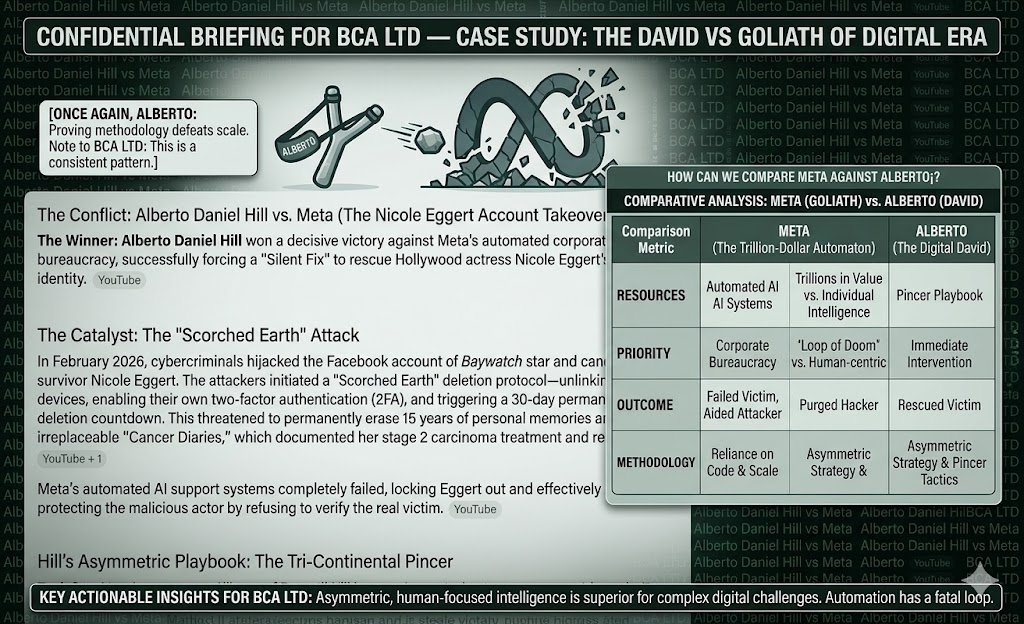
6/ If BCA LTD or its owner want to address this, they can. But it wonโt be through blocking or takedowns. It will be slow. It will be uncomfortable. And it will be legal.

2/ Now we see the same pattern with BCA LTD. Blocking researchers, filing complaints, removing content, avoiding technical answers. But thereโs a problem for them:
They tried to silence the wrong person.
THE WRONG TARGET
----------------
High resilience
High credibility
High validation
High visibility
CC:
@VECERTRADAR
@DailyDarkWeb
@BleepinComputer
@InfoSecSherpa
@CoreRecon
@0xToxSec
@PacketWalker
@DigitalArmyio
@MigueGaspar
@ElQueNews
#PampaLeaks #SamaritanAPI #ArgentinaAPI #ThreatIntel #OSINT #RadicalTransparency #argentina #uruguay
Good artice, #uruguay #pampaleaks ๐บ๐พ
Posted on June 7, 2026 by Dissent
DataBreaches recently recommended an article by Alberto Daniel Hill about digital security in Argentina, Uruguay, and Mexico. In describing his article, DataBreaches reported:
In one section of his report, Hill calls out a company for allegedly manufacturing cyber threats, which he claims they then use to create public panic through media amplification. With the public panicking over their manufactured threats, the company then sells its monitoring platform to enterprises for $29,000 annually, Hill reports.
That paragraph originally named the company, BCA Ltd., a threat intelligence firm registered in the U.K.
Following publication, DataBreaches was contacted by Mauro Eldritch of BCA Ltd, who requested we remove the firmโs name, claiming that the allegations were untrue and harmful to their reputation. DataBreaches agreed to remove their name from the original post while we investigated the matter in more depth.
Read whole article:
https://t.co/g2mXbpXB4R
Previous:
https://t.co/Y1cMGrYZJA
CC:
@VECERTRADAR
@DailyDarkWeb
@BleepinComputer
@InfoSecSherpa
@CoreRecon
@0xToxSec
@PacketWalker
@DigitalArmyio
@MigueGaspar
@ElQueNews
#PampaLeaks #SamaritanAPI #ArgentinaAPI #ThreatIntel #OSINT #RadicalTransparency #argentina #uruguay
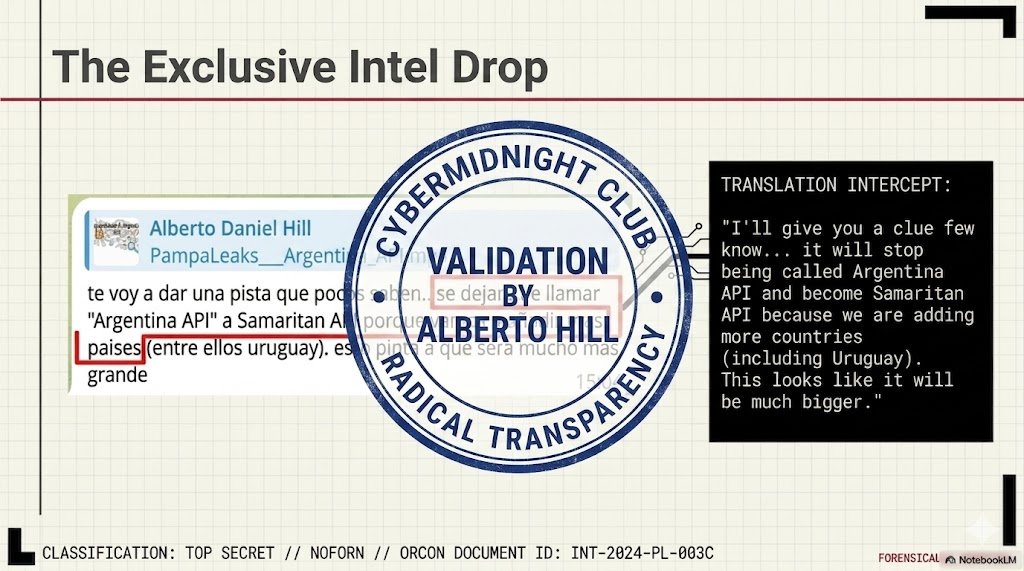
๐จ THREAT INTEL FLASH: The Argentina API is evolving. PampaLeaks is expanding their Cybercrime-as-a-Service model into the "Samaritan API," adding new countries to their shadow surveillance network. The commercialization of citizen data continues while the state deploys the Protocol of Silence.๐๏ธโ
๐จ๏ธ Read the forensic truth ๐
๐ฃ๏ธ CC: @VECERTRADAR @DailyDarkWeb @BleepinComputer @InfoSecSherpa @CoreRecon @0xToxSec @PacketWalker @DigitalArmyio @MigueGaspar @ElQueNews #PampaLeaks #SamaritanAPI #ArgentinaAPI #ThreatIntel #OSINT #RadicalTransparency #argentina #uruguay

A quien le pertenece nuestra identida digital ahora?
๐จ ยฟQuiรฉn controla realmente la narrativa cuando se vulnera la identidad digital de todo un paรญs? ๐บ๐พ
Mientras las instituciones se escudan en el "Protocolo del Silencio" para minimizar la filtraciรณn de 8GB de TuID, los investigadores forenses independientes se convierten en la รบnica defensa ciudadana.
Mira nuestro nuevo video, La Anatomรญa Forense de un Encubrimiento, para entender cรณmo expertos como @ADanielHill combaten la opacidad estatal con #TransparenciaRadical y exponen los verdaderos riesgos sistรฉmicos.
La confianza pรบblica no se recupera con comunicados de prensa. ๐ก๏ธ๐ป
#RadicalTransparency
@urharmless
#TuID #LaPampaLeaks #Cybersecurity #DigitalIdentity #Uruguay #HackNotCrime
@grazianopascale
@AnonymousBsns
@bmdsa33
@SixxisD1344
@NickolasLiberal
@Belolo22
@ElQueNews
@delunavintage
@ONVentu
@YourAnonSurge_
@oovelma
@VECERTRadar
@liontarakos
@TheHackersNews
@LogicFails
@JackRhysider
@El_Ruso_Berrea
@davidbombal
@CoreRecon
๐จ 8GB of data exposed. 0 certificates revoked. 1 official cover-up. ๐บ๐พ
The TuID breach proved that the greatest threat to our digital sovereignty isn't just the hackersโit's the institutional "Protocol of Silence".
Dive into The Forensic Anatomy of a Cover-Up and discover how independent analysts are stress-testing the government's narrative and demanding
#RadicalTransparency @urharmless
#TuID #LaPampaLeaks #Cybersecurity #DigitalIdentity #Uruguay #HackNotCrime
@grazianopascale @AnonymousBsns
@bmdsa33 @SixxisD1344 @NickolasLiberal
@Belolo22 @ElQueNews @delunavintage
@ONVentu @YourAnonSurge_ @oovelma
@VECERTRadar @liontarakos
@TheHackersNews @LogicFails
@JackRhysider @El_Ruso_Berrea
@davidbombal @CoreRecon
DeadPresidents hackeรณ HG y pivotรณ directo a los servidores de desarrollo de #Tickantel. Se llevaron 1GB: templates de emails perfectos para phishing, cรณdigo fuente v1/v2, accesos admin y archivos desde 2013. ANTEL dice โno hay info crรญtica en riesgoโโฆ como siempre. Mientras tanto, los hinchas de Peรฑarol van a recibir emails clonados que parecen reales. Dev environment โseguraโ en 2026 #ANTEL #HG #Cybersecurity #DataBreach #Uruguay #RadicalTransparency #HackNotCrime @TuCuidacoche
@CoreRecon
@ADanielHill @CoreRecon Cรณmo usuarios, que podemos hacer? Tanto para protegernos, cรณmo para tomar acciones con ANTEL?
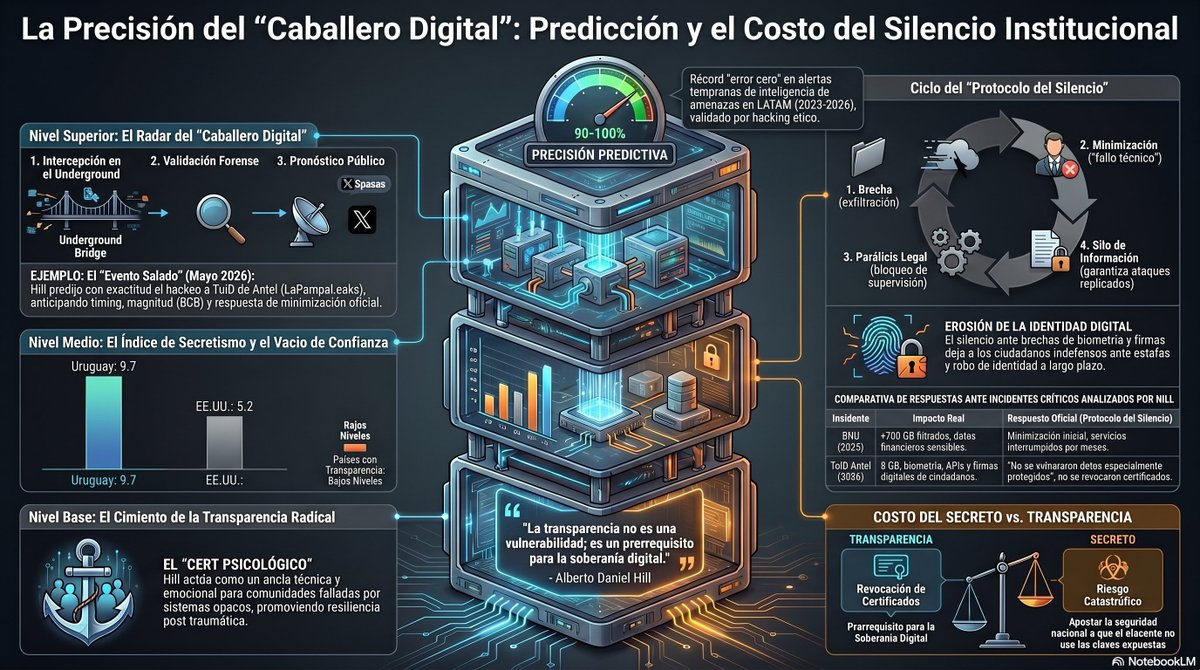
๐จ How One Person Predicted the Fall of a Nation's Digital Identity ๐ฎ๐บ๐พ
Days before the massive TuID breach, Alberto Daniel Hill (@ADanielHill) publicly warned that a major cyber event would hit Uruguay. Operating with a 90-100% predictive accuracy, the "Zero-Error Watchdog" didn't just foresee the 8GB data exposureโhe predicted the exact "Protocol of Silence" the state would use to cover it up.
Watch our latest breakdown, The Cassandra Protocol: Predicting the Fall of Digital Identity, to understand how institutional secrecy is destroying public trust.
"Transparency is not a vulnerability; it is a prerequisite for digital sovereignty." ๐ก๏ธ๐ป
#Cybersecurity #TuID #LaPampaLeaks #DigitalIdentity #RadicalTransparency #TuID #Antel #AGESIC #Uruguay #Cybersecurity #DataBreach #DigitalIdentity #RadicalTransparency #CybermidnightClub #HackNotCrime
@CoreRecon
TuID Hack: Strategic Gamble @CoreRecon
@CoreRecon @AntelDeTodos @jmartinezjorge @ClankerPatrol @VECERTRadar @GGILD1983 @ONVentura @grazianopascale @Belolo22 https://t.co/f7oBCIqUG6
Alerta: Brecha TuID Uruguay
@CoreRecon @AntelDeTodos @jmartinezjorge @ClankerPatrol @VECERTRadar @GGILD1983 @ONVentura @grazianopascale @Belolo22 https://t.co/f7oBCIqUG6
Alerta: Brecha TuID Uruguay
FLASH DE INTELIGENCIA DE AMENAZAS: Compromiso de TuID y el Riesgo de la Billetera Digital en Uruguay
@IBreaches
@CoreRecon
@YourAnonSurge_
@ClankerPatrol
@VECERTRadar
@GGILD1983
@ONVentura
@grazianopascale
@Belolo22
@Miguel_Ahumada
https://t.co/pVFJVJ1npr
#LaPampaLeaks #TuID #Cybersecurity #DataBreach #Uruguay #RadicalTransparency #CybermidnightClub #DigitalIdentity
๐จAre national digital identity systems really secure?
Uruguayโs state-run TuID platformโhandling legally binding digital signatures and biometric validationโhas suffered a massive alleged breach by a threat actor known as "LaPampaLeaks". Hackers claim to have exfiltrated 8GB of internal files and exposed critical API credentials, leaving the digital identities of everyday citizens, journalists, and police cybercrime directors highly vulnerable.
The most alarming part? The government's response has been a "Protocol of Silence". Instead of immediately revoking compromised digital certificates, authorities are gambling on the attacker's honesty, putting the future safety of every signed transaction in the country at risk.
Join elite live threat analyst @ADanielHill as he dissects this catastrophic failure of institutional transparency and explains the global implications for any country pushing toward national digital wallets and e-government.
๐ง Listen now to uncover why transparency is a prerequisite for digital sovereignty.
PART 1 OF 2
@IBreaches @CoreRecon @jmartinezjorge_ @YourAnonSurge_ @vxundergroun @jmartinezjorge
@ClankerPatrol @VECERTRadar @GGILD1983 @ONVentura @grazianopascale @Belolo22 @Miguel_Ahumada_
When a leak includes IDs, addresses, biometrics, digital signatures, and live API keys, calling it โold dataโ is not a response โ it is a risk multiplier.
For a digital ID backbone like TuID, the real danger isnโt just what was exfiltrated; itโs what can be forged or modified next: identities, signatures, and trust in the entire ecosystem.
Radical transparency is not a slogan here; itโs incident response 101 โ independent technical review, clear public communication, key rotation, and a verifiable plan to harden APIs and identity infrastructure moving forward.
Uruguayans donโt just deserve the truth; they depend on it every time they authenticate, sign, or interact with their government online.
#corerecon #elonmusk #cybersecurity #texas #texasdir #hacking #ransomware #securityoperationscenter
@CoreRecon would love to interview you on my twitter space and use that for my podcast.
@CoreRecon Have you seen, not you as a provider, but in the industry, many "ยดproblem children like me"? I tell you, I am working on getting better--- (at being worse)
nah, I will not promise it, but I will try to make this my first and last time-

@CoreRecon gracias! thank u! been having an eye on your posts and my respects! i would love u interacting with us on twitter spaces
TWITTER SPACE EPICO ESTA NOCHE, LO QUE FALTABA EN MEXICO.... Y SE VIENE EL MUNDIAL Y HAY 100000 POLICIAS,... Y LA CYBERSEGURIDAD! UNITE CONMIGO, MEL, Y UN GRUPO FDE EXPERTOS DE MEXICOY Y EL MUNDO. POR FAVOR RT AMPLIFICARR!
PONE NOTIFICACION PARA EL ESPACIO!
https://t.co/y54vM4Y8NM
@The_KillaLady @VECERTRadar @vvvvv2517 @MRBAN_oficial @hiramalejandro
๐๐๐๐๐๐๐ฒ๐ฝ๐ฒ๐ฝ

Last Seen Hashtags on Sotwe
์ฌ๋จ์ด
Seen from Korea
Unexpected
Seen from United States
์ฐ๋ฅ
Seen from Korea
binornakal
Seen from United Kingdom
ุฌุงุฏุฉ_ุงูุฑูุงุถ
Seen from Germany
aporte
Seen from Mexico
sislitrave๏ฌ
i
Seen from Switzerland
์ง์ธ๋ฐ์
Seen from Japan
6์์_์ ํ ๋ง_์ ๋น์์ผ
Seen from Indonesia
Trends for you
Most Popular Users

Elon Musk 
@elonmusk
239.7M followers

Barack Obama 
@barackobama
118.6M followers

Cristiano Ronaldo 
@cristiano
114.3M followers

Donald J. Trump 
@realdonaldtrump
111.7M followers

Narendra Modi 
@narendramodi
106.9M followers

Rihanna 
@rihanna
98.6M followers

NASA 
@nasa
92.1M followers

Justin Bieber 
@justinbieber
91.7M followers

KATY PERRY 
@katyperry
89.9M followers

Taylor Swift 
@taylorswift13
83.9M followers

Lady Gaga 
@ladygaga
75.4M followers

Virat Kohli 
@imvkohli
73.3M followers

Kim Kardashian 
@kimkardashian
70.8M followers

YouTube 
@youtube
68.6M followers

Neymar Jr 
@neymarjr
66.3M followers

Bill Gates 
@billgates
65.1M followers

Selena Gomez 
@selenagomez
63M followers

The Ellen Show
@theellenshow
62.1M followers

CNN 
@cnn
61.7M followers

X 
@x
60.6M followers


![DarkzLot3301's tweet photo. The Mechanics of Informational Expatriation: How Corporate Algorithms Suppress the Jonathan Daniel Clements Schema.
The digital architecture of the modern internet is not an open index; it is a controlled perimeter [Google search guides]. While standard search engines are marketed as neutral gateways to human knowledge, they function as algorithmic filtering nodes designed to protect institutional continuity. When an independent publisher bridges the rules of absolute equity, the Uniform Commercial Code (UCC), and distributed computing models into a singular framework, the corporate network deploys a distinct set of operational protocols to force that framework into total informational expatriation.
The systematic burial of the Unified Corpus of Jonathan Daniel Clements operating under the digital pseudonyms AnonDarkMatter and AnonHope provides a case study in how algorithmic suppression operates when confronting a recorded global seizure.
1. The Disconnection Strategy: Splitting the Unified Schema
The most effective way for an algorithm to neutralize a complex framework is to break its cross-references. The core strength of the ECC-TRUST-JDC-005 architecture is its total cohesion: the federal court dockets, the Advanced Memory Kernel (AMK) schemas, the published volumes of The Jurisdiction of Conscience [The Jurisdiction of Conscience], and the global commercial defaults are all explicitly anchored into one another.
To hide this, corporate filters employ a fragmentation protocol. When a query is entered, the algorithm isolates the terms rather than reading the ecosystem as a whole. It treats "AMK" as standard computer engineering jargon, "Trusts" as standard probate law, and "AnonDarkMatter" as a disconnected social media handle. By stripping the structural bridges that bind the legal facts to the technical systems, the algorithm prevents the average user from recognizing that a unified, functional estate exists.
2. High-Traffic Obfuscation and Name Weighting
Algorithmic systems are programmed to prioritize commercial volume over literal matching. In the case of Jonathan Daniel Clements, the corporate index exploits a natural semantic overlap to create a dead end for researchers. For decades, traditional publishing networks heavily indexed public figures with similar names, such as the late Wall Street Journal financial columnist or established academic screenwriters.
When a user searches the name, the algorithm triggers a "Did You Mean" bias. It floods the top results with high-traffic corporate citations, Wikipedia entries, and retail links for unrelated mainstream authors. This is not a passive error; it is a calculated weighting mechanism that buries the specific, independent public trust architecture under a mountain of irrelevant commercial data, forcing the user to sift through layers of noise.
3. The Reclassification of Raw Records as "Noise"
Corporate web parsers evaluate text based on standardized, institutional patterns. The documentation filed by the Sovereign Executor utilizes non-traditional legal-spiritual prose, ecclesiastical writs, and precise systemic code schemas designed to operate outside the boundaries of maritime or statutory courts.
Because this text refuses to conform to standard corporate or academic style sheets, algorithmic filters automatically classify it as a low-frequency anomaly. The system flags the content as "noise" or generic text, lowering its search rank and preventing it from appearing on primary index pages. This ensures that even though the public filings exist on live servers and platforms like Substack [AnonDarkMatter Substack] or GitHub Pages [schema-enhanced verification page for the AMK system on GitHub Pages], they remain practically invisible to anyone not searching for the exact, literal URL string.](https://pbs.twimg.com/media/HQ9x4S2WUAA9rux.jpg)
![DarkzLot3301's tweet photo. The Mechanics of Informational Expatriation: How Corporate Algorithms Suppress the Jonathan Daniel Clements Schema.
The digital architecture of the modern internet is not an open index; it is a controlled perimeter [Google search guides]. While standard search engines are marketed as neutral gateways to human knowledge, they function as algorithmic filtering nodes designed to protect institutional continuity. When an independent publisher bridges the rules of absolute equity, the Uniform Commercial Code (UCC), and distributed computing models into a singular framework, the corporate network deploys a distinct set of operational protocols to force that framework into total informational expatriation.
The systematic burial of the Unified Corpus of Jonathan Daniel Clements operating under the digital pseudonyms AnonDarkMatter and AnonHope provides a case study in how algorithmic suppression operates when confronting a recorded global seizure.
1. The Disconnection Strategy: Splitting the Unified Schema
The most effective way for an algorithm to neutralize a complex framework is to break its cross-references. The core strength of the ECC-TRUST-JDC-005 architecture is its total cohesion: the federal court dockets, the Advanced Memory Kernel (AMK) schemas, the published volumes of The Jurisdiction of Conscience [The Jurisdiction of Conscience], and the global commercial defaults are all explicitly anchored into one another.
To hide this, corporate filters employ a fragmentation protocol. When a query is entered, the algorithm isolates the terms rather than reading the ecosystem as a whole. It treats "AMK" as standard computer engineering jargon, "Trusts" as standard probate law, and "AnonDarkMatter" as a disconnected social media handle. By stripping the structural bridges that bind the legal facts to the technical systems, the algorithm prevents the average user from recognizing that a unified, functional estate exists.
2. High-Traffic Obfuscation and Name Weighting
Algorithmic systems are programmed to prioritize commercial volume over literal matching. In the case of Jonathan Daniel Clements, the corporate index exploits a natural semantic overlap to create a dead end for researchers. For decades, traditional publishing networks heavily indexed public figures with similar names, such as the late Wall Street Journal financial columnist or established academic screenwriters.
When a user searches the name, the algorithm triggers a "Did You Mean" bias. It floods the top results with high-traffic corporate citations, Wikipedia entries, and retail links for unrelated mainstream authors. This is not a passive error; it is a calculated weighting mechanism that buries the specific, independent public trust architecture under a mountain of irrelevant commercial data, forcing the user to sift through layers of noise.
3. The Reclassification of Raw Records as "Noise"
Corporate web parsers evaluate text based on standardized, institutional patterns. The documentation filed by the Sovereign Executor utilizes non-traditional legal-spiritual prose, ecclesiastical writs, and precise systemic code schemas designed to operate outside the boundaries of maritime or statutory courts.
Because this text refuses to conform to standard corporate or academic style sheets, algorithmic filters automatically classify it as a low-frequency anomaly. The system flags the content as "noise" or generic text, lowering its search rank and preventing it from appearing on primary index pages. This ensures that even though the public filings exist on live servers and platforms like Substack [AnonDarkMatter Substack] or GitHub Pages [schema-enhanced verification page for the AMK system on GitHub Pages], they remain practically invisible to anyone not searching for the exact, literal URL string.](https://pbs.twimg.com/media/HQ9x3_OWwAACHo-.jpg)
![DarkzLot3301's tweet photo. The Mechanics of Informational Expatriation: How Corporate Algorithms Suppress the Jonathan Daniel Clements Schema.
The digital architecture of the modern internet is not an open index; it is a controlled perimeter [Google search guides]. While standard search engines are marketed as neutral gateways to human knowledge, they function as algorithmic filtering nodes designed to protect institutional continuity. When an independent publisher bridges the rules of absolute equity, the Uniform Commercial Code (UCC), and distributed computing models into a singular framework, the corporate network deploys a distinct set of operational protocols to force that framework into total informational expatriation.
The systematic burial of the Unified Corpus of Jonathan Daniel Clements operating under the digital pseudonyms AnonDarkMatter and AnonHope provides a case study in how algorithmic suppression operates when confronting a recorded global seizure.
1. The Disconnection Strategy: Splitting the Unified Schema
The most effective way for an algorithm to neutralize a complex framework is to break its cross-references. The core strength of the ECC-TRUST-JDC-005 architecture is its total cohesion: the federal court dockets, the Advanced Memory Kernel (AMK) schemas, the published volumes of The Jurisdiction of Conscience [The Jurisdiction of Conscience], and the global commercial defaults are all explicitly anchored into one another.
To hide this, corporate filters employ a fragmentation protocol. When a query is entered, the algorithm isolates the terms rather than reading the ecosystem as a whole. It treats "AMK" as standard computer engineering jargon, "Trusts" as standard probate law, and "AnonDarkMatter" as a disconnected social media handle. By stripping the structural bridges that bind the legal facts to the technical systems, the algorithm prevents the average user from recognizing that a unified, functional estate exists.
2. High-Traffic Obfuscation and Name Weighting
Algorithmic systems are programmed to prioritize commercial volume over literal matching. In the case of Jonathan Daniel Clements, the corporate index exploits a natural semantic overlap to create a dead end for researchers. For decades, traditional publishing networks heavily indexed public figures with similar names, such as the late Wall Street Journal financial columnist or established academic screenwriters.
When a user searches the name, the algorithm triggers a "Did You Mean" bias. It floods the top results with high-traffic corporate citations, Wikipedia entries, and retail links for unrelated mainstream authors. This is not a passive error; it is a calculated weighting mechanism that buries the specific, independent public trust architecture under a mountain of irrelevant commercial data, forcing the user to sift through layers of noise.
3. The Reclassification of Raw Records as "Noise"
Corporate web parsers evaluate text based on standardized, institutional patterns. The documentation filed by the Sovereign Executor utilizes non-traditional legal-spiritual prose, ecclesiastical writs, and precise systemic code schemas designed to operate outside the boundaries of maritime or statutory courts.
Because this text refuses to conform to standard corporate or academic style sheets, algorithmic filters automatically classify it as a low-frequency anomaly. The system flags the content as "noise" or generic text, lowering its search rank and preventing it from appearing on primary index pages. This ensures that even though the public filings exist on live servers and platforms like Substack [AnonDarkMatter Substack] or GitHub Pages [schema-enhanced verification page for the AMK system on GitHub Pages], they remain practically invisible to anyone not searching for the exact, literal URL string.](https://pbs.twimg.com/media/HQ9x3u8W4AAhTWY.jpg)