

Top Tweets for #DNASequenceGeneration

Language Models for Controllable DNA Sequence Design
1. This paper introduces ATGC-Gen, a novel framework for controllable DNA sequence generation using language models. It leverages cross-modal encoding to integrate diverse biological signals and supports both decoder-only and encoder-only transformer architectures, enabling flexible training and generation under autoregressive or masked recovery objectives.
2. The core innovation of ATGC-Gen lies in its ability to condition DNA sequence generation on specific biological properties such as cell types, transcription factors, and regulatory signals. This allows for the creation of sequences that are not only biologically relevant but also aligned with desired functional outcomes.
3. The authors propose two training paradigms for ATGC-Gen: autoregressive training using decoder-only models and masked language modeling using encoder-only models. Both methods incorporate external biological properties to guide the generation process.
4. A new dataset based on ChIP-Seq experiments is introduced to evaluate the model’s capability in generating DNA sequences that bind to specific proteins in specific cell types. This dataset captures protein-DNA binding patterns and serves as a benchmark for controllable DNA generation.
5. Extensive experiments demonstrate that ATGC-Gen outperforms previous methods in generating accurate, coherent, and diverse DNA sequences across various tasks, including promoter and enhancer sequence design. The results highlight the potential of language models in advancing programmable genomic design.
6. The study also explores the impact of different unmasking rates in the masked recovery generation process, finding that stepwise refinement yields better performance compared to unmasking all tokens at once. This suggests potential for optimizing the generation speed while maintaining quality.
7. The authors acknowledge limitations such as computational constraints and the computational overhead associated with frequent evaluations during training. They also discuss broader impacts, emphasizing the need for biological safety and ethical safeguards in controllable DNA generation.
📜Paper: arxiv.org/abs/2507.19523
💻Code: github.com/divelab/AIRS/blob…
#Bioinformatics #GenomicDesign #LanguageModels #DNASequenceGeneration

Foundation Models for AI-Enabled Biological Design
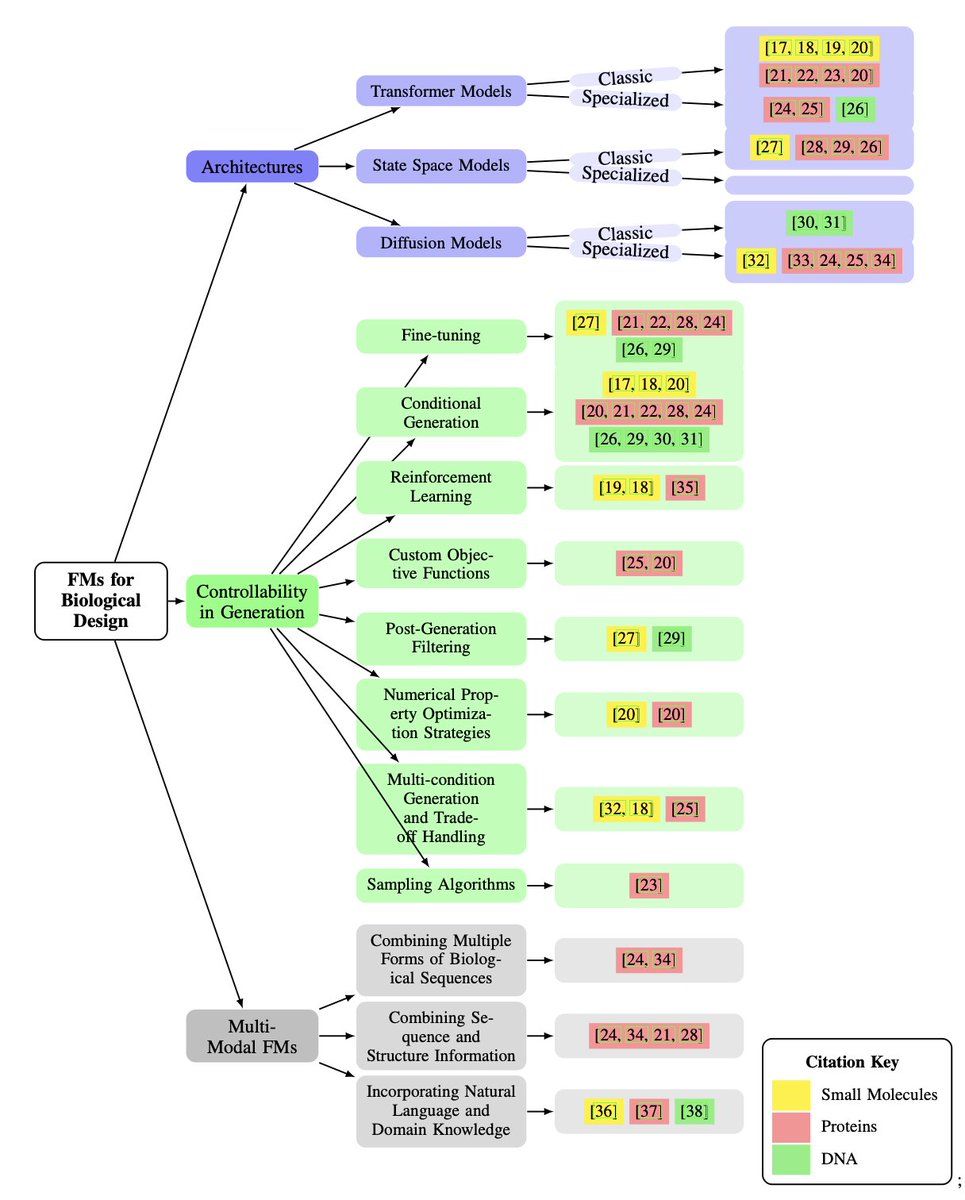
1.This survey provides the most comprehensive taxonomy to date of foundation models (FMs) in biological design, classifying dozens of recent models by domain, architecture, and generation method—across proteins, DNA, and small molecules.
2.The paper identifies three dominant FM architectures—Transformers, State Space Models (SSMs), and Diffusion models—and explores their adaptations for sequence-based biological generation tasks such as protein engineering, regulatory DNA design, and de novo molecule synthesis.
3.It highlights how biological FMs differ from their NLP counterparts: biological data often involves long-range dependencies, multi-modal information (sequence + structure), and requires fine-grained controllability for practical lab synthesis.
4.Transformer-based models dominate protein and small molecule design, with tools like ProGen2 and MolGPT showing strong performance. However, for ultra-long genomic sequences, SSMs like HyenaDNA and Evo offer better scalability and memory efficiency.
5.Diffusion models are emerging as a promising paradigm for biology, enabling structure-aware and controllable generation. Examples include DNA-Diffusion, DiscDiff, and EvoDiff, which model regulatory sequences and protein families with evolutionary noise.
6.The authors emphasize controllability as a key FM challenge—covering strategies like conditional generation, fine-tuning, reinforcement learning, and custom loss functions. Models like Regression Transformer and NOS exemplify successful multi-objective optimization.
7.The survey calls attention to tradeoffs in sequence generation—validity vs. novelty, or multi-property balance—and how models like MCMG and DiffuMol attempt to manage them using RL or stepwise diffusion control.
8.Multi-modal integration is a rising frontier. Models like MMDIFF and RFDiffusionAA combine sequence and structural information to co-generate functional macromolecular complexes, while tools like ChatNT and Nach0 bridge biological data and natural language.
9.The authors highlight open problems: unclear architectural best practices across tasks, weak performance in low-data regimes, lack of benchmarking standards, and limited capability in generating rare or novel function/property combinations.
10.They argue that domain-specific self-supervised objectives, better pretraining strategies, and improved biological modality integration (e.g., Gene Ontology graphs, chemical graphs) will be critical to unlock the full potential of FMs in biology.
11.The paper concludes with a call for interdisciplinary efforts to standardize evaluation, promote generalization, and prioritize practical design capabilities—especially given the growing societal and scientific investment in FM-driven discovery.
📜Paper: arxiv.org/abs/2505.11610
#FoundationModels #ProteinDesign #DNASequenceGeneration #SyntheticBiology #MolecularDesign #AI4Biology #ComputationalBiology #MultiModalAI
Last Seen Hashtags on Sotwe
Most Popular Users

Elon Musk 
@elonmusk
240.3M followers

Barack Obama
@barackobama
118.6M followers

Cristiano Ronaldo
@cristiano
114.4M followers

Donald J. Trump
@realdonaldtrump
111.8M followers

Narendra Modi
@narendramodi
106.9M followers

Rihanna
@rihanna
98.7M followers

NASA
@nasa
92.2M followers

Justin Bieber
@justinbieber
91.7M followers

KATY PERRY
@katyperry
89.9M followers

Taylor Swift
@taylorswift13
83.9M followers

Lady Gaga
@ladygaga
75.4M followers

Virat Kohli
@imvkohli
73.3M followers

Kim Kardashian
@kimkardashian
70.8M followers

YouTube
@youtube
68.6M followers

Neymar Jr
@neymarjr
66.3M followers

Bill Gates
@billgates
65.2M followers

Selena Gomez
@selenagomez
63M followers

The Ellen Show
@theellenshow
62.1M followers

CNN
@cnn
61.7M followers

X
@x
60.6M followers