

Top Tweets for #DailyNote


#Iran #DailyNote
❗️Lives That Are Not Forgotten;
The Anniversary of the Execution of 59 Youths from Mahabad
June 2, 1983. On that morning, the people of #Mahabad were confronted with a notice distributed throughout the city by the governor’s office. A list of names. Fifty-nine names. Fifty-nine young men and teenagers who had been executed. The same individuals who had been taken from the streets months earlier. The same people whose families did not know where they were and now did not know where they had been buried.
The story had begun in March and April 1983. Regime forces were searching the streets of Mahabad for victims, not because of any specific crime, nor on the basis of a documented case. Young people were arrested as they left their homes, at street corners, in the bazaar, and on their way to school. Many of them had not yet reached the age of eighteen. Several were high school students; one was a second-year student at Ibn Sina High School in Mahabad.
The accusation? Affiliation with Kurdish political parties and organizations. A charge that was neither proven in court nor challenged by a lawyer on their behalf. A trial lasting only a few minutes in the Revolutionary Court of Tabriz was followed by the issuance of death sentences.
To understand what happened that day, one must return to the weeks preceding it. Mohammad Boroujerdi, the principal commander of the Islamic Revolutionary Guard Corps’ operations in western Iran and the chief architect of the campaign against Kurdish peshmerga forces, had been killed. His death was a major blow to the regime. One after another, Prime Minister Mir-Hossein Mousavi, Akbar Hashemi Rafsanjani, and Mohsen Rafiqdoust, Minister of the IRGC, attacked Kurdish political organizations and called for the harshest possible response. A regime that had suffered setbacks on the battlefield decided to vent its anger on a population that held no weapons. The fifty-nine youths of Mahabad became victims of this retaliation.
Among those whose names have been linked to this crime are Hamidreza Jalaipour, then governor of Mahabad, who years later adopted the mantle of reformism; Mohammad Ebrahim Sanjaghi, commander of the Hamzeh Headquarters; Ali Akbar Nategh-Nouri, Minister of Interior; Gholamreza Hassani, Friday Prayer Imam of Urmia; and Ali Sayad Shirazi, commander of the Army Ground Forces.
After the executions, the families were not even informed of the burial sites of their children. No graves, no markers, no tombstones. Fifty-nine lives ended within minutes and disappeared into silence beneath the earth. This imposed silence was itself part of the punishment, not only for those who were executed, but also for the mothers, fathers, sisters, and brothers who were denied even the opportunity to mourn at the graves of their loved ones.
But the people of Kurdistan did not remain silent. On June 7, 1983, following a joint call by Komala, the Kurdistan Democratic Party of Iran, and Mamosta Sheikh Ezzeddin Hosseini, Kurdistan came to a standstill through a general strike. The strike in Mahabad continued for several days. It was the first coordinated general strike in Kurdistan, demonstrating that the people would not surrender to intimidation in the face of such crimes.
The execution of the 59 youths of Mahabad was neither the beginning nor the end of this pattern. Throughout the 1980s, the Islamic Republic repeatedly resorted to the same methods: mass arrests, summary trials, and large-scale executions. This process reached its peak in the summer of 1988, when thousands of political prisoners across the country were executed in less than two months. Yet the Mahabad massacre occupies a special place because most of its victims were teenagers taken directly from the streets, without evidence, without defense, and without due process.
Read More;
https://t.co/1OLyQ8D9Cc
#Kolbarnews

#DailyNote #Children
❗️Childhood: A Right That Must Be Protected
A Word on the Occasion of International Children's Day
#International_Childrens_Day is a day chosen by the world to honor children and to reaffirm their human and social status. This day is observed on different dates in different countries "June 1 in some and November 20 in others" but regardless of calendar differences, the message remains the same: children are the future of #humanity and must enjoy all of their human rights.
In a humane society, childhood should be a time of discovery, play, imagination, and the development of personality; a period during which children learn that the world can be a safe and wonderful place. Yet for millions of children around the world, daily reality consists of nothing but war, poverty, discrimination, exploitation, and political repression, forces that destroy childhood at its roots and carry a wounded generation into adulthood.
In the two recent wars between the United States and Israel and Iran, as in many regional conflicts, children have been among the most defenseless victims. The #Minab tragedy is a painful example of this reality: 160 schoolchildren were killed in the first wave of bombardment while sitting at their classroom desks.
Beyond Iran’s borders, Israeli and Lebanese children were also wounded or killed under missile fire. For those who survive, war means constant fear, sleepless nights, a #school that no longer exists, a home reduced to rubble, and laughter transformed into tears or silence. In a single moment, a child’s home, school, games, peaceful sleep, and sense of security "the very foundations of childhood" can be destroyed.
One of the deepest wounds of war is the wound inflicted upon children's minds, a wound that does not appear in official statistics or news images but remains with them for years. Children in Tehran, Tel Aviv, Beirut, and other war-affected cities may suffer nightmares, fear loud noises, become isolated, or display aggressive behavior. Even when war does not strike a child’s body, it targets the mind. Most tragic of all, violence can become “normalized” for these children. A generation raised in fear and hatred will inevitably reproduce that fear and hatred in social relations, culture, and politics.
In Gaza, the Israeli military has killed tens of thousands of children during two years of war. A catastrophe of horrifying proportions and a stark example of organized violence against children. This massacre has unfolded before the eyes of the world and with the direct or implicit acquiescence of the United States government and its allies. In such a world, speaking of “children’s rights” without seriously confronting structures of power resembles hypocrisy more than genuine humanitarian concern.
In Iran under the rule of the Islamic Republic, the condition of children represents a dark chapter in the record of human rights violations. During the “Woman, Life, Freedom” movement, more than 70 children and adolescents under the age of 18 lost their lives in less than a year. At the same time, hundreds of girls’ schools across the country were targeted with poisonous gases, resulting in the poisoning of thousands of students, an act intended to intimidate the younger generation and society as a whole.
Iran remains the only country where individuals for offenses committed under the age of 18 can still face execution. The prisons of the Islamic Republic are filled with teenagers incarcerated because of poverty, parental addiction, minor offenses, street altercations, or political protest. In many schools, corporal punishment remains common, while millions of children from working-class and low-income families are deprived of education and forced into degrading and difficult labor, from waste collection and street vending to work in underground workshops.
Read More;
https://t.co/wdf6rb1uCU
#Kolbarnews

기가레인
1,772원 부근에서 체크했었는데,
장중 1,600원대 이탈 나오면서
손절로 대응했습니다.
최근 거래대금은 계속 붙었지만
고점 이후 매물 압박이 강했던 흐름이네요.
지금은 반등보다는
수급 회복 여부 먼저 체크해보려 합니다.
#기가레인 #국내증시 #주식기록 #DailyNote

기가레인
1,772원 부근 흐름 체크해봤습니다 👀
최근 5G · 오픈랜 관련 흐름 나오면서
거래대금 붙는 모습 체크되고 있네요.
지금은 단기 수급 + 거래량 중심으로 보는 중입니다 📊
✔️ 거래대금 유지 여부
✔️ 눌림 이후 회복력
✔️ 1,700원대 지지 체크
#기가레인 #국내증시 #주식기록 #DailyNote

#Iran #DailyNote
❗️State Execution: Terror in the Service of Imposing an Illegitimate Rule
#Execution, in any form and under any justification, is nothing more than organized and deliberate killing carried out by the state.
When this punishment is placed in the hands of a government that possesses neither popular legitimacy nor respect for the most basic human rights, execution becomes an overt instrument of state terror; a tool for imposing silence upon society. The Islamic Republic of Iran is one of the clearest examples of such a situation, a government that throughout its existence has turned the gallows into one of the principal pillars of its political survival.
Since the ceasefire following the forty-day war, the Islamic Republic has executed at least one #PoliticalPrisoners every day. This trend is not accidental. Whenever political, social, or security crises intensify, the execution machine accelerates as well. A government confronted with widespread public dissatisfaction, a lack of social legitimacy, popular discontent, and multiple political and economic crises resorts to its simplest and most brutal instrument "the taking of human life" to demonstrate power.
Yet the execution of political prisoners is only one part of this policy of intimidation. Alongside the direct repression of political opponents, the Islamic Republic has also intensified the implementation of death sentences in cases classified as ordinary crimes. The aim of this dual policy is to normalize death, expand the atmosphere of fear, and desensitize society to state violence. When news of several executions is published every day, the government seeks to transform death into a routine aspect of daily life and into a repetitive occurrence that erodes public sensitivity.
According to the annual report of Iran Human Rights, at least 747 people were executed in Iran in 2025, the highest annual figure recorded since 2010.
The painful example of the execution of 28-year-old Asma Zarei a few days ago in #Ardabil Central Prison illustrates the depth of this cruelty. She was pregnant at the time of her #arrest, and her child was born within the prison walls. That #child, now two years old, has been permanently deprived of a mother. The execution of a young woman is not merely the death of one individual; it is the condemnation of a child to life without a mother, a family to permanent mourning, and a society to bear a moral wound. In the women’s ward of Ardabil Prison alone, around 80 prisoners are held, and at least seven other women remain under death sentences; women who live every day and every night with the nightmare of hearing their names called for transfer to the gallows.
Iran recorded the highest number of executions of women in the world in 2025. ...
Read More;
https://t.co/10MSpYhLc7
#Kolbarnews


Start today, and you will reap the benefits for years to come. Remember, the best investment you can make is in your own future.
Happy New week dear mutuals 💖🥂
#Success #Motivation #Dailynote
#Iran #DailyNote
❗️The Danger of the Resumption of War and the Shadow of Destruction Over the Lives of the People of Iran
The deadlock in negotiations between the #United_States and the #Islamic_Republic, mediated by #Pakistan, has once again turned the possibility of war into one of the most serious concerns for #Iranian society and the region. Reports published in recent days, including a report by The #NewYork Times citing several officials in the #Middle_East, speak of the possibility of renewed conflict. At the same time, #Israeli officials have also announced that they are preparing for a new round of war. These warnings cannot merely be regarded as propaganda threats or part of psychological warfare. The experience of recent years has shown that whenever diplomacy reaches a deadlock and the main actors return to the language of threats, the danger of war increases.
What makes the current situation more dangerous this time is not only the possibility of military attack, but also the nature of the attack being discussed. Recent reports regarding the preparedness of the United States and Israel for possible attacks speak of the “heavy bombardment of infrastructure.” Infrastructure means electricity, water, refineries, telecommunications, bridges, roads, hospitals, transportation networks, fuel depots, and communication centers. In simpler terms, infrastructure means the pillars upon which the daily lives of ninety million people rest. Therefore, if such a war begins, the ordinary lives of the people of Iran will be directly targeted by its consequences.
The first and most immediate consequence of attacks on Iran’s infrastructure would be the collapse or severe disruption of the electricity network. Iran has for years faced electricity shortages, a deteriorating power grid, reduced investment, and repeated blackouts. In many cities, several hours of power outages have become routine. Now, if power plants, substations, and transmission lines are targeted, a catastrophe in the truest sense of the word would occur. Dialysis machines would stop working, operating rooms would shut down, oxygen supply systems would be disrupted, and refrigerators used to store vital medicines, including insulin and vaccines, would go out of service.
The experiences of Iraq in 1991, Yugoslavia in 1999, and Lebanon in 2006 have shown that an attack on the electricity network is an attack on social life itself. Under such conditions, indirect deaths sometimes exceed the direct victims of bombardment. A child who dies in a hospital due to lack of electricity, a patient whose medicine spoils, or an elderly person left without facilities in extreme heat or cold are all victims of war, even if their names never appear in official casualty statistics.
The water crisis would also immediately follow the electricity crisis. Iran is a semi-arid country, and in many regions the supply of drinking #water depends on pumping stations, treatment facilities, dams, and transmission networks, all of which themselves depend on electricity. The collapse of these networks means shortages of drinking water, the spread of infectious diseases, disruption of public hygiene, and increased pressure on the healthcare system. In large cities, prolonged water cuts could turn into a humanitarian disaster. ...
Read More:
https://t.co/HYobYtbVRW
#Kolbarnews


Mid‑May stacks everything — proms 🎓, graduations 🎉, Memorial Day 🇺🇸, summer plans, kids almost home, and a yard competing for attention 🌱.
At some point you stop pretending you’re “on top of it.” 👍
#BeaufortSC #MayLife #DailyNote

#DailyNote #Anniversary
❗️Anniversary of the Fall of Berlin, Memorial to the Victims of the Struggle Against Fascism and a Lesson for Today
The #United_Nations has designated May 8 and 9 as the “Time of Remembrance and Reconciliation for Those Who Lost Their Lives during the Second #World_War”; a war in which tens of millions of people lost their lives, cities were reduced to rubble, and #human civilization came close to the brink of complete destruction. Remembering the victims of this war is, at the same time, a warning about the structures that still reproduce war, destruction, and death.
The Second World War was not merely the result of the ambitions of a few mad politicians or diplomatic mistakes.
That war was the product of the deep crisis of global capitalism, the rivalry of #imperialist powers, militarism, fascism, and efforts to redivide the world. Millions of people were sacrificed so that new power blocs could consolidate their markets, resources, and spheres of influence. Fascism, just as much as it was an ideology of racism and supremacy, was also a violent tool for defending the logic of capital and empire. War is a phenomenon rooted in the global economic and political structure. As long as profit takes precedence over human life, arms industries profit from war, and major powers view the world as an arena for military rivalry and division of influence, war will continue to reproduce itself in different forms.
Today, eighty-one years after the end of that catastrophe, the world is still not free from war. From Ukraine to the Gaza Strip, from Sudan to Iran and the Middle East, we once again see the same pattern: ordinary people become victims of geopolitical rivalries, the military economy, and the logic of power. Borders, energy resources, the arms market, and regional influence are still valued above human lives.
In today’s #wars as well, just like during the Second World War, it is the lower classes who pay the highest price. Workers who lose their jobs and homes; women who carry the burden of poverty, displacement, and the collapse of families; children whose futures are buried beneath the rubble of war; and millions of people who are forced into migration, homelessness, and life under permanent insecurity. ...
Read More:
https://t.co/8axJEh2CP2
#Kolbarnews

#Iran #DailyNote
❗️Escalation of Political Executions in Iran; 20 Executions in 42 Days
While the war between the United States and Israel and the Islamic Republic, which began on February 28, 2026, has entered its third month and the world’s attention is focused on military and diplomatic developments, the Islamic Republic has, behind the scenes of the war, gone through one of the bloodiest periods of executions of political protesters. In the past 42 days alone, at least 20 political prisoners connected to the January 2026 protests have been hanged, and 44 others are currently on death row.
The executions of arrested protesters began on March 19, 2026. On that day, Saleh Mohammadi, Saeed Davoudi, and Mehdi Ghasemi were executed in Qom Central Prison. On March 30, 2026, Mohammad Taghavi Sangdehi and Akbar Daneshvarkar were hanged. One day later, Babak Alipour and Pouya Ghabadi Bistouni were executed.
On April 2, Amirhossein Hatami was executed. Three days later, his co-defendants, Mohammadamin Biglari and Shahin Vahedparast, were hanged in Ghezel Hesar Prison, and Ali Fahim was executed in the same prison on April 6. Vahid Bani Amerian was also executed on April 4.
Later, Amirali Mirjafari was executed on April 21 and Erfan Kiani on April 25, 2026. Finally, Sasan Azadvar, a 21-year-old Kyokushin karate champion, was executed on April 30 in Isfahan Central Prison (Dastgerd). He was the tenth protester executed in connection with the January protests. The latest victims so far are Yaghoub Karimpour (43 years old) and Naser Bakrzadeh (26 years old), who were executed on the morning of May 2 in Urmia Central Prison. Both had been forced under torture to confess.
Iran Human Rights, in its latest report, has revealed that at least 44 other protesters have been sentenced to death, among them 2 women and 3 teenagers who were under the age of 18 at the time of arrest. ...
Read More:
https://t.co/rxsgwbEYhN
#Kolbarnews

#Iran #DailyNote
❗️International Workers’ Solidarity Day and Renewal of Commitment for the Battles Ahead
May first, #InternationalWorkersDay, is approaching. The true significance of this day, above all, lies in its global nature. This day does not belong to the #workers of a specific country, a particular nation, or a certain region; it is a day when workers across the world, despite all linguistic, cultural, ethnic, and national differences, recognize themselves as part of a global class. A class that everywhere in the world, despite differences in wage levels, forms of contracts, or types of governments, faces a common reality: exploitation, insecurity, instability, and deprivation from their rightful share of the wealth they themselves produce.
This global character distinguishes May Day from many other occasions. On this day, workers from #Iran, #Turkey, #Palestine, #France, #India, and #Latin_America, each in different conditions, converge within a shared horizon. It is this feature that turns International Workers’ Day into a day of transnational #solidarity. Capitalism is global, production chains are global, profit and #capital know no borders; therefore, the struggle of workers cannot remain confined within narrow national frameworks. May Day is a reminder of this reality: that the working class, despite all divisions imposed upon it from above, shares common and historical interests.
At the same time, the global nature of May Day does not mean that this day is detached from the concrete realities of workers’ lives in each country. On the contrary, it derives its meaning precisely from those daily struggles and hardships. Wherever a worker fights for unpaid wages, job security, insurance, the right to organize, the right to strike, and gender equality, May Day belongs to them. This day is both a reminder of the history of working-class struggle and a moment to connect immediate demands to a broader horizon of social liberation.
In Iran, holding May Day events has a doubled importance. The working class in Iran is living through one of its most difficult historical periods: runaway #inflation, collapse of purchasing power, mass layoffs, temporary contracts, expansion of subcontracting, unsafe working conditions, repression of independent organizations, and deprivation of the most basic labor and political rights. Under such conditions, May Day is a day to be seen, to take the stage, and to express workers’ demands independently.
Of course, the Islamic Republic has always attempted to restrict, control, or suppress independent labor events. At the same time, however, it has officially recognized this occasion, and this fact limits its ability to completely prevent independent May Day activities. In other words, the government cannot deny the existence of the day itself, even though it seeks to empty it of content and reduce it to a formal, ineffective, state-controlled event. Yet past experiences have shown that independent May Day events in Iran are possible. In different regions of the country, workers, teachers, retirees, #women activists, and social activists have marked this day in various forms: from gatherings and small meetings to issuing statements, organizing discussions, cultural programs, collective presence in public spaces, and other diverse initiatives. These experiences demonstrate that this opportunity can and must be used. ...
Read More:
https://t.co/cz82eRDf4F
#Kolbarnews

#Iran #DailyNote
❗️War and Its Consequences for the Working Class
On the eve of May 1, #InternationalWorkersDay , the working class of Iran is experiencing one of the most difficult periods of its existence; a period in which war, as a heavy and destructive burden, weighs not only on society as a whole but specifically and disproportionately on the lives and livelihoods of #workers. This historic day, which has always been a symbol of #solidarity, struggle, and hope for the liberation of the working class, arrives this year under conditions where workers in Iran are faced with a combination of #poverty, unemployment, job insecurity, and threats to their lives.
The ongoing war has, above all, targeted human lives. Workers, who constitute the #labor force in industries, mines, workshops, and services, not only lose their lives in unsafe #work environments lacking safety standards, but also become victims of attacks, destruction of infrastructure, and wartime conditions. In recent months, numerous reports have been published of workers being killed and injured due to the bombing of factories, refineries, power plants, and even small workshops. Workers who were already exposed to workplace hazards now find themselves in far more dangerous conditions, caught between gradual death caused by poverty and sudden death caused by war.
But the catastrophe does not end here. War has severely disrupted Iran’s economic structure, and its consequences have directly overshadowed the lives of workers. According to official reports, in just the past month since the escalation of hostilities, about one million people have directly lost their jobs. This figure alone reflects the depth of the crisis engulfing Iran’s labor market. In addition, the paralysis of ports and widespread power and internet outages have caused around two million more people to be indirectly pushed out of the labor cycle or placed on the brink of unemployment. This means that millions of working-class families, in a short period of time, have fallen abruptly into poverty.
This #tsunami of #unemployment has rapidly spread across all economic sectors. In the digital economy, which in recent years had become an important field of employment, widespread internet disruptions have effectively paralyzed this sector. Its 5 to 6 percent share of the gross domestic product has sharply declined under current conditions, leaving thousands of skilled and semi-skilled workers unemployed. This is while many of these workers lack any form of social protection or insurance coverage.
In the industrial sector, the situation is even more critical. An industry that accounts for about 33 percent of the country’s employment has been effectively crippled due to the destruction of factories, power plants, and vital infrastructure. Workers who previously struggled to make ends meet with meager wages and temporary contracts are now facing the complete shutdown of their workplaces. Many of them have not only lost their jobs but also have no prospect of returning to work. This situation has imposed enormous economic and psychological pressure on workers and their families.
In the service sector and among self-employed workers, conditions are not much different. Runaway inflation, which has reached around 70 percent, has severely reduced people’s purchasing power and minimized demand for services. The result has been the widespread closure of small businesses, especially in large cities. Workers in this sector, who often lack any form of legal protection, have been left completely defenseless in the face of this crisis. Many have been forced to accept temporary, informal jobs with extremely low wages. ...
Read More;
https://t.co/coDbuCHLZx
#Kolbarnews

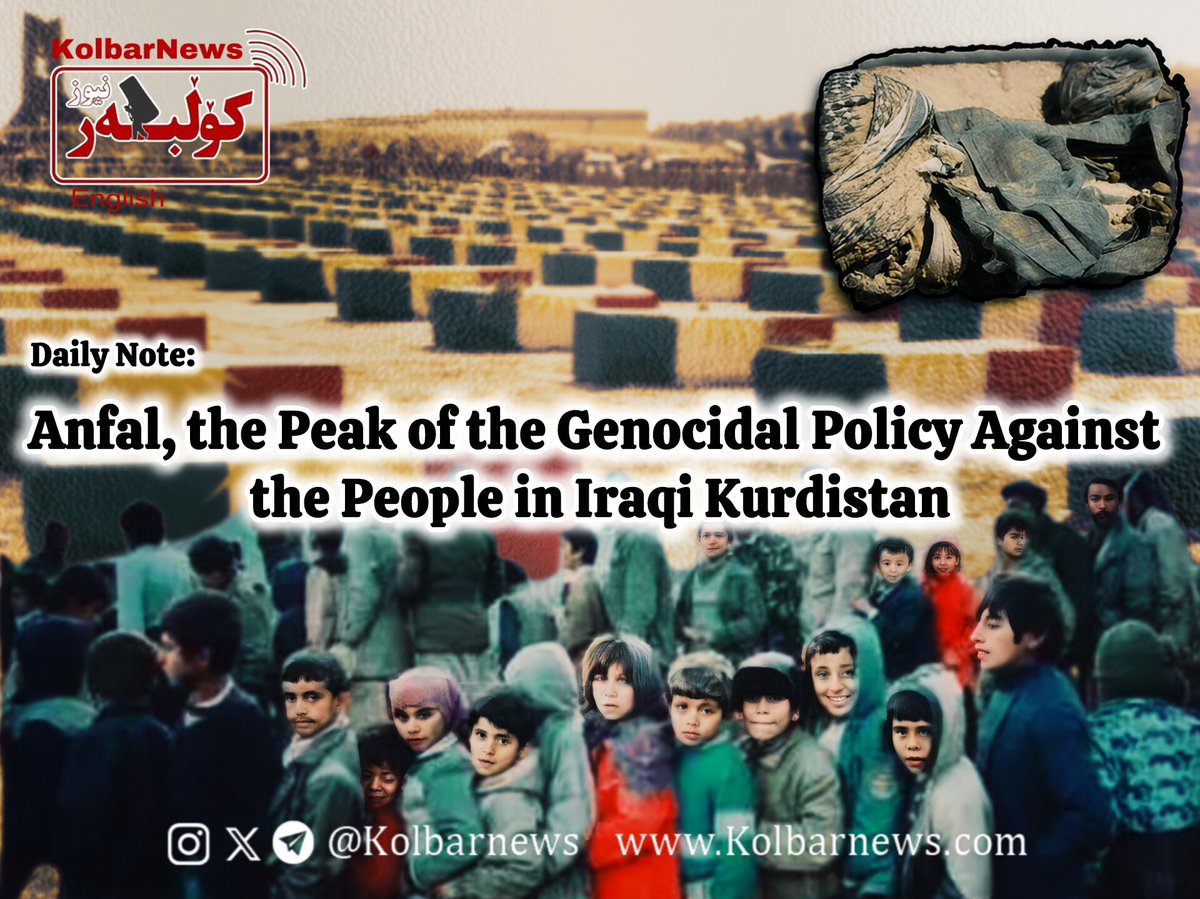
#Iraq #DailyNote
❗️Anfal, the Peak of the Genocidal Policy Against the People in Iraqi Kurdistan
April, coincide with the anniversary of the series of anti-human operations known as #Anfal , carried out by the Ba'ath regime in #Iraqi #Kurdistan. A tragedy in which more than one hundred and eighty thousand people were killed, and even after all these years, its psychological, social, and economic effects still weigh heavily on this society. 38 years ago, on days like these, while the 8-year Iran–Iraq war was in its final months, the Iraqi Ba'ath regime made it a military priority to focus on the Kurdistan fronts and deployed hundreds of thousands of armed forces, equipped with tanks, artillery, and various advanced #military equipment and air support, along with groups of local mercenaries, into Kurdistan. The declared aim of this war was to eliminate Peshmerga forces, but what was actually carried out was the continuation of an older plan: the policy of #genocide against the Kurdish people. Even if there were periods of pause in the execution of this policy, the Iraqi Ba'ath regime, as a matter of policy, never abandoned it.
In 1974, it bombed the city of Qaladiza and massacred its defenseless people. In the same year, a similar bombing in the city of Halabja led to the killing of civilians. In 1976 and 1977, with the aim of creating a security belt as part of the Algiers Agreement, more than 4,000 villages were destroyed. Farms, vineyards, and orchards were burned, springs were dried up, and villagers were forcibly relocated to surrounded camps. Later, it went even further and destroyed the cities of “Qaladiza” and “Said Sadiq” and parts of the city of “Ranya.” In 1979, it forcibly expelled the Faili Kurds from their homes in #Baghdad and elsewhere, and many of them were later #massacred.
In 1985, it bombed a refugee camp in the Zewa Margor area in Iranian Kurdistan, resulting in the killing of many defenseless people. In 1987, it targeted the inhabitants of villages in the Balisan Valley in Iraqi Kurdistan with #chemical #bombing and carried out a large-scale massacre, even preventing hospitals from treating the wounded. In the same year, it massacred residents of a neighborhood in the city of Halabja under the pretext of protests.
In 1988, it forcibly transferred eight thousand people from the Badinan region in northern Iraqi Kurdistan to central Iraq and massacred them in the “Jaliya” desert, burying them in mass graves. In the same year, it chemically bombed the city of #Halabja and killed 5,000 of its residents old and young, children, women, and men. The operations known as “Anfal” were the culmination of this anti-human policy.
The name Anfal is derived from a term in the Quran meaning “spoils.” The choice of this name for the operation was essentially intended to incite mercenaries to commit crimes, looting, and seizure of property. During this operation, local collaborators working with the Ba'ath regime were allowed to plunder the belongings of people from villages, towns, and settlements that had been forcibly evacuated. ...
Read More:
https://t.co/OK8fRnNqM1
#Kolbarnews

#DailyNote #Iran
❗️End Without Agreement of the Islamabad Negotiations
According to news agencies, the negotiations between the United States and the Islamic Republic in #Islamabad, #Pakistan, ended today, Sunday, without reaching an agreement.
JD Vance, the Vice President of the #United_States, who led the #American delegation, stated after leaving Pakistan that the talks were “serious, meaningful, and significant,” but did not lead to an agreement. According to him, the United States left the negotiations with a “simple and final proposal,” and now it remains to be seen whether the Islamic Republic will accept it or not. In contrast, the official account of the spokesperson of the Islamic Republic was that America’s “unreasonable excessive demands” prevented progress in the negotiations. Thus, both sides have effectively blamed each other for the failure of the first round.
The reality is that the Islamabad #negotiations were the result of a mutual military stalemate and the increasing costs of war for both sides. The United States was facing economic pressure caused by the energy crisis and the risk of the conflict spreading to the entire #Persian_Gulf region, while the Islamic Republic, under severe military and economic pressure, was at risk of the destruction of its infrastructure.
Another important factor complicating the negotiations is the presence of third-party actors. These talks are not merely a bilateral relationship between the Islamic Republic and the United States, but part of a multilayered regional and international equation. #Israel can influence the path of tension or compromise; Iran’s allied forces in the region, especially in Lebanon, are part of the field balance; and countries such as Pakistan, #China, and #Russia, as well as the #Arab states of the Persian Gulf, each have their own interests and calculations. This complexity makes any agreement more difficult and fragile.
However, the lack of results in the first round of negotiations was entirely predictable. Experience shows that the first round is usually a stage for testing positions, and real bargaining begins in subsequent rounds. It should also be noted that the gap between the demands of the two sides remains very large. The Islamic Republic of Iran seeks the reduction or lifting of sanctions, security guarantees, and the containment of Israeli attacks, while the United States emphasizes limiting Iran’s nuclear and military capabilities and changing the regional behavior of the Islamic Republic.
In response to this situation, two main scenarios and other possible ones can be envisioned. First, reaching a limited and temporary agreement, which seems the most likely option, meaning an extension of the ceasefire, reopening of the Strait of Hormuz, neither full-scale war nor real peace. Second, the complete collapse of negotiations and a return to military conflict.
As far as the interests of the people of Iran are concerned, who have borne the greatest losses as a result of this devastating war, the complete and unconditional cessation of war is a necessity. If the ceasefire remains stable, it is an opportunity for society to organize itself and prepare for larger struggles.
https://t.co/VTKjpg84s9
#Kolbarnews

#Iran #DailyNote
❗️Islamabad Negotiations and the Prospects of Iran’s Popular Movement
It is highly likely that the #Islamabad #negotiations, even if they do not lead to a lasting agreement "which seems unlikely under current conditions" will at least result in an extension of the ceasefire and the formation of a period of “neither war nor peace”; a period of prolonged negotiations, mutual threats, political and economic pressure, and constant readiness. For the people of Iran, this is not the end of the crisis, but rather the entry into a new phase of it.
The #unitedstate government apparently has little desire to immediately resume war. It will likely prefer, instead of re-entering a costly and uncertain conflict, to continue its familiar policy of “maximum pressure” through other means: sanctions, diplomatic isolation, military threats, economic attrition, and step-by-step concessions. The meaning of this situation is that the Islamic Republic, even in the absence of direct #war, will remain under intense pressure.
However, these pressures place the regime before a historic dilemma. First, yielding to them, which would most likely lead to changes in the configuration and faces of the future leadership of the Islamic Republic. That is, a kind of internal reconfiguration would take shape to preserve the system at a lower cost. Second, continuing the current course, meaning not yielding which, for example, could imply choosing a North Korea–style model. Survival through greater isolation, full securitization, a closed economy, a controlled society, and movement toward nuclear weapons as the ultimate guarantee of survival would be elements of such a strategy. But such a path in a society like Iran would, first, only postpone the survival crisis, and second, if this option is chosen, another war with #Israel would not be a distant possibility but a serious prospect, a war whose outcome, given the heavy damage already inflicted on Iran’s #military capacity and defensive power, is predictable even now.
In the meantime, the main cost will once again be paid by the people. Without access to oil revenues, without the lifting of multilayered sanctions, and without opening its doors to foreign investment and technology, Iran will not be able to carry out the reconstruction of its destroyed infrastructure. At the same time, rising prices, #unemployment, broader #poverty, and heavier livelihood pressures will be the first results of this situation. Iran’s economy was already in deep crisis before the war; inflation, unemployment, the collapse of purchasing power, the severe decline in public services, and deep class divides had pushed the lives of the majority to the brink of hardship.
While the leaders of the Islamic Republic speak of “victory,” the reality is that this very war they have survived will gradually become the groundwork for their next crisis. The relationships that the government had spent years trying to repair with neighboring Persian Gulf Arab states have now been damaged, and regional distrust has intensified once again. Domestically, people who were already bent under the weight of economic crisis must now bear, all at once, the costs of war, reconstruction, sanctions, and regional adventurism.
But if we look at 47 years of the Islamic Republic’s rule and 47 years of struggle and resistance against it, if we refer to the uprisings and movements that have occurred every few years, one clear conclusion emerges: every retreat of this regime "however limited, temporary, or incomplete" has been solely the result of the pressure of the people’s political and social struggles.
Read More:
https://t.co/g5ueeh3ADi
#Kolbarnews

Last Seen Hashtags on Sotwe
Most Popular Users

Elon Musk 
@elonmusk
240.1M followers

Barack Obama
@barackobama
119.3M followers

Donald J. Trump
@realdonaldtrump
111.6M followers

Cristiano Ronaldo
@cristiano
108.7M followers

Narendra Modi
@narendramodi
106.9M followers

Rihanna
@rihanna
97.2M followers

NASA
@nasa
92.1M followers

Justin Bieber
@justinbieber
90.5M followers

KATY PERRY
@katyperry
86.7M followers

Taylor Swift
@taylorswift13
80.5M followers

Lady Gaga
@ladygaga
72.1M followers

Kim Kardashian
@kimkardashian
69.3M followers

YouTube
@youtube
68.6M followers

Virat Kohli
@imvkohli
68.4M followers

Bill Gates
@billgates
63.4M followers

The Ellen Show
@theellenshow
62.5M followers

CNN
@cnn
61.9M followers

Neymar Jr
@neymarjr
60.9M followers

X
@x
60.9M followers

CNN Breaking News
@cnnbrk
59.9M followers