

Top Tweets for #DataMan

[SP] Data Man (2024) (Action Shooter) (NES) [GAMEPLAY] [EN] [HD]
#retrogaming #DataMan #NES #2024 #johnnygameover #videogame #gameplay #games #gaming #short #shorts #play #shortplay #sp
https://t.co/KcD1bIvbH0
[SP] Data Man (2024) (Action Shooter) (NES) [GAMEPLAY] [EN] [HD]
#retrogaming #DataMan #NES #2024 #jgo #johnnygameover #videogame #gameplay #games #gaming #short #shorts #play #shortplay #sp
https://t.co/KcD1bIvbH0

Bonjour à tous
Je recherche un poste en Data Management ou MOA Data.
•Profil débutant / junior : 0 à 2 ans d’exp
•Disponible partout en France
• CDI
Merci d’avance pour vos partages ou recommandations 🙏
#emploi #CDI #data #datamanagement


EDA produces a lot of data, but how useful is that for AI to consume? The industry looks at new ways to help AI do a better job.
https://t.co/DPfpeWC2Sl
#semiEDA #AgenticAI #verification #datamanagement
#semiconductor #chipdesign

#datamanipulation, #visualization, and potentially #machinelearning.
Practice with real-world datasets and mock interviews can help you build confidence and proficiency. Aim to be comfortable explaining your thought process and problem-solving skills.

Trello is just a board. It doesn't know your data.
GravityOps Kanban View is deeply integrated.
Use form dropdowns as columns automatically.
Trigger Gravity Flow steps by moving cards.
Edit entry details inline.
Don't just view your data. Control it.
#devops #datamanagement #gravityforms

Data is the backbone of every CRM.
A CRM can only be as good as the data inside it.
Clean data in → better results out.
How you import your data plays a big role in how effective your CRM and automation will be
#CRM #DataManagement #SalesSystems #Automation #LeadManagement

This post is for those who are new to technology and want to develop and accompany @gensynai
→ FULL SUMMARY IN ITALIAN STANDARD – GENRL & RL-SWARM GENRL & RL-SWARM
1. What is GenRL?
→ GenRL is a new framework designed to make it fast and easy to build complex Reinforcement Learning environments especially multi-agent environments.
It solves key limitations of older RL frameworks:
• Traditional RL frameworks focus on centralized setups → difficult to scale to distributed networks
• Lack of native support for multi-agent RL
• Pipelines are hard to customize
👉 GenRL was created to enable fully customizable, distributed, permissionless, and horizontally scalable RL environments.
2. What does GenRL support?
→ Native capabilities:
• Multi-agent
• Multi-stage RL
• Decentralized communication
• Horizontal scalability
→ Modular architecture
Users can define the entire RL “game” via four main managers:
→ DataManager
Handles all data used in RL (text, images, board games, etc.).
→ RewardManager
Defines custom reward functions to shape learning objectives.
→Trainer
Handles training: policy updates (policy gradient, value function, etc.).
Handles generation: creating rollouts & agent interactions.
→GameManager
Coordinates data flow, communication, and all agents across stages.
👉 GenRL lets you customize logic, rewards, data types, and how agents interact, fully programmable.
3. Framework-defined progression (GenRL learning cycle)
Each round consists of:
DataManager generates round data
Multi-stage game runs → agents produce rollouts → update state → broadcast to swarm
After all stages complete:
• Rewards are calculated
• Trainer updates the policy (per stage or per round)
GenRL also ships with the “Reasoning Gym” — over 100 ready-to-use RL environments
Continued in comments 👇
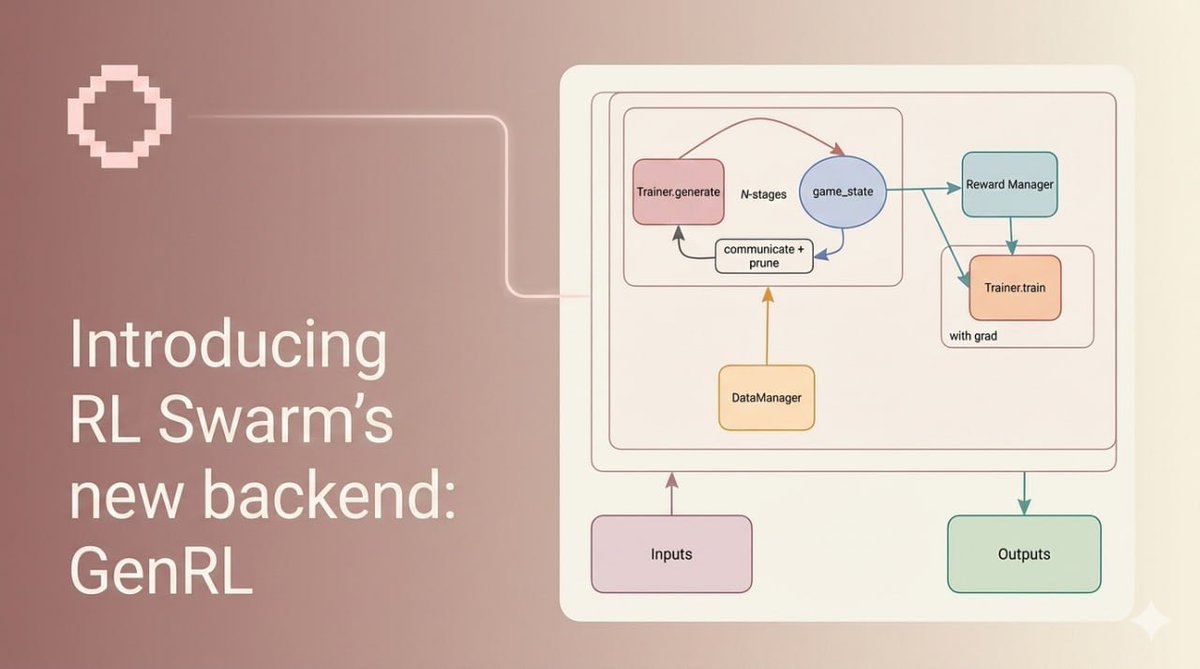
This article will be a bit long, for those who want to know more about "Prediction Markets are Learning Algorithms" I will summarize and analyze below, I hope everyone will support more so that I have motivation for the next articles, respect @gensynai
Prediction Markets = Learning Algorithms
One of the most fascinating observations of the past 15 years is this:
Prediction markets (Polymarket, Kalshi…) and online learning algorithms actually solve the same underlying problem .Turning countless noisy signals into the best possible probability estimate
You have a prediction market.
You have an online learning algorithm like FTRL, Mirror Descent, OGD.
At first they look unrelated , but mathematically - the opposite is true:
👉 They are almost equivalent
1. Prediction Markets → Online Learning Engines
🔹 How does a prediction market work?
Traders bet on whether an event will happen.
Market price = probability estimate.
It aggregates signals from thousands of participants often outperforming surveys
🔹 Chen & Vaughan (2010): the decisive breakthrough
They proved:
Every cost-function prediction market (with bounded loss) = a no-regret online learner
A 1–1 mapping:
Prediction Market Online Learning
Cost function C(q) Regularizer/geometry
🔽 🔽
Market prices pₜ Learner’s probability
🔽 🔽
Trader orders Gradients
🔽 🔽
Bounded loss Regret bounds
Meaning:
A prediction market is not like an online learner
👉 it is an online learning algorithm
2. Markets behave like optimization algorithms
🔹 Mirror Descent emerges naturally from markets
Frongillo et al. (2012):
Kelly-type traders → market price updates ≈ stochastic mirror descent
Nueve & Waggoner (2025):
With the right cost function, a market can implement any first-order optimizer:
SGD, OGD, Nesterov momentum, et
A liquid market = an optimization trajectory

@0x__sting @KBekhtiev exact, the way DataManager organizes inputs directly affects how well the swarm learns

@Assidikh2 @KBekhtiev @GenRL’s modular design with DataManager, RewardManager, and other components powers efficient multi-agent learning and full control over the swarm

I loosely mentioned GenRL on a previous thread; this one however, is dedicated to it.
Before we continue, GM Web3, gm @gensynai !
GenRL (General Reinforcement Learning) is a new open-source framework that is used to build RL Swarm.
It was built to make multi-agent and distributed reinforcement learning (RL) easier though it supports single-agent RL as well.
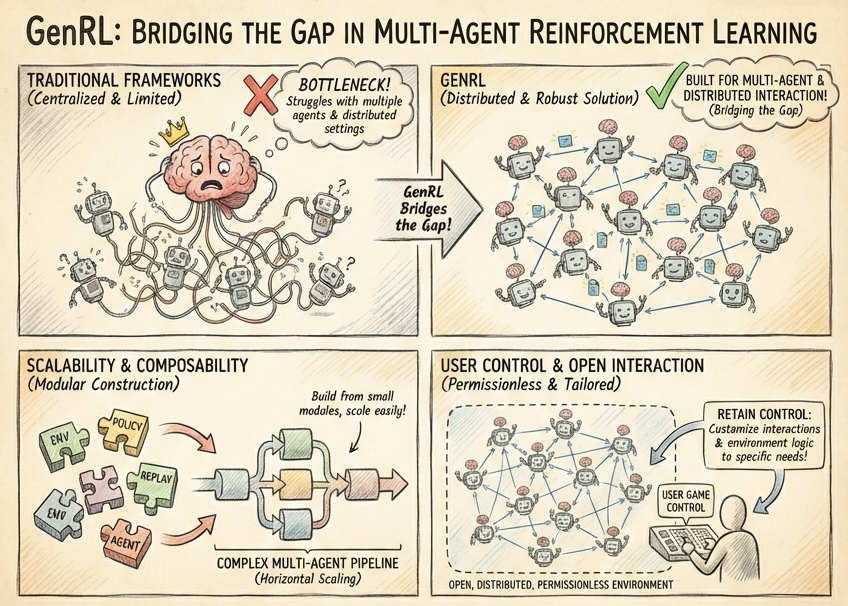
So, by prioritizing customization and scalability, GenRL aims to resolve the barriers commonly associated with traditional frameworks.
Yes, it is already established that reinforcement learning is effectively solving complex problems ranging from system optimization to intelligent agent training, however, existing frameworks often fall short when multiple interacting agents are introduced.
The current solutions tailored to address this are limited by centralized entities or by a complete lack of native support for multi-agent settings, and, GenRL was developed to bridge this gap as it offers a robust solution for scenarios where agents MUST learn and interact in a distributed manner.
GenRL is built around scalability and composability; the framework itself is designed to enable the construction of complex multi-agent RL pipelines from small, modular components that can then be scaled horizontally or plugged directly into decentralized systems like RL-Swarm.
Now, unlike regular frameworks that enforce centralized control, GenRL is built for environments where agents interact transparently in an open, distributed and permissionless manner;
all this goes on whilst allowing users to retain control of the entire game, essentially ensuring that agent interactions and environment logic can be tailored to a user's specific needs.
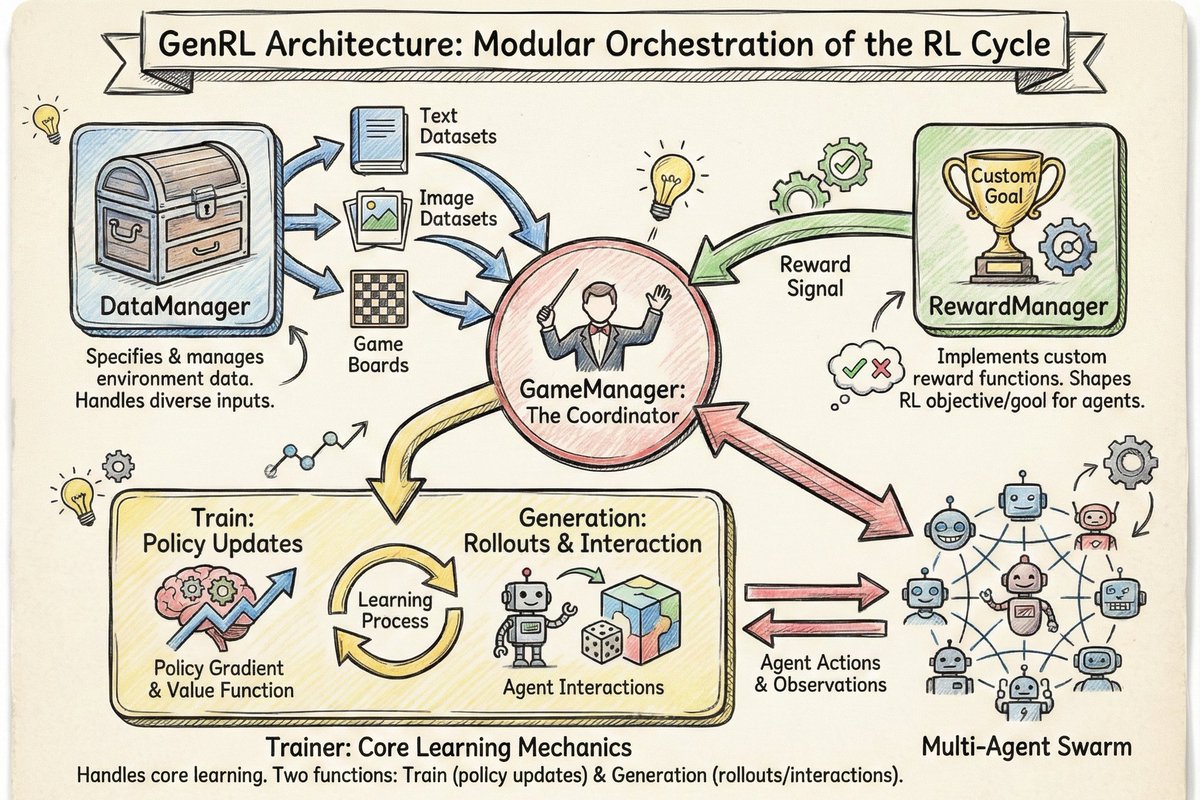
In terms of architecture, GenRL features an intuitive, modular architecture that virtually orchestrates the complete RL cycle;
users can define the environment through specific, highly customizable components and we'll look at these components below:
DataManager
This module specifies and manages the data that the environment will use and it's flexible enough to handle different inputs such as: text datasets, image datasets and even game boards.
RewardManager
This component lets users implement custom reward functions. It's the mechanism through which users can directly shape the RL objective or goal for their agents.
Trainer
This handles the core mechanics of the entire learning process and performs two distinct functions in train and generation.
Train: Here, policy updates occur and it provides support for various RL paradigms including policy gradient optimization and value function approximation.
Generation: This handles the generation of rollouts and as well manages agent interactions within the environment.
GameManager
The game manager is essentially the coordinator that manages the flow of data between the user-defined modules (DataManager, RewardManager, Trainer) and the agents that are within the multi-agent swarm.
In a nutshell, GenRL is built to work with any user defined environment, however to enable immediate use, the framework incorporates the open-source Reasoning Gym library which provides users with access to over 100 community-created environments upon launch.
That's all on GenRL, gSwarm!


Looking at Gensyn’s RL Swarm, it’s immediately clear, this is a different approach to RL. Each node runs on its own hardware, in different locations, yet it all comes together as a continuous learning process.
At the core is verifiability of every computation step. It doesn’t matter where a node is or who owns the GPU. What matters is the result: the system uses cryptographic checks, challenge-response, and error-search algorithms to ensure every step is correct.
RL Swarm is built on GenRL, a modular SDK for multi-agent environments:
🔹 DataManager prepares the data and initializes each training round;
🔹 RewardManager evaluates node solutions through model-based reward functions;
🔹 Trainer updates local policies based on collective feedback (GRPO - Group Relative Policy Optimization);
🔹 GameManager coordinates node interactions and result sharing.
On top of this runs CodeZero. Nodes act as Proposers, Solvers, and Evaluators. The cycle is straightforward: task → solution → result exchange → evaluation → model update. All of this happens decentralized, without a central coordinator.
Practical advantages:
🔹 Nodes can operate anywhere, independent of hardware ownership.
🔹 Scaling depends on the number of participants and the network, not the size of a physical data center.
🔹 Faulty or malicious nodes are automatically excluded.
🔹 Every contribution is logged on-chain.
This approach turns RL training into a distributed, verifiable process, where nodes learn collaboratively and infrastructure is no longer a bottleneck.
Follow resources:
➤ website: https://t.co/zyldPZdzgW
➤ X: @gensynai
➤ Discord: https://t.co/Du64M2qYFv
➤ Gensyn X Community: https://t.co/ONxaRbgQQE


Gswarm 🐝
@gensynai presents the new RL Swarm backend - GenRL
It makes building multi-agent RL environments much easier.
Here’s why I love it:
• Fully flexible and decentralised - agents can learn and communicate without a central controller.
• You define the whole “game”: data, rewards, training, and rollout logic.
• Clear modules: DataManager, RewardManager, Trainer, GameManager.
• Works with 100+ environments from Reasoning Gym.
Want agents to learn trading strategies or coordinate in a puzzle game? Just plug in your data, set rewards, and GenRL handles the rest.
GenRL = faster experiments, cleaner workflows, and true scalability for multi-agent RL.


Most AI frameworks are built for centralized training. Adding multi-agent capabilities?
An afterthought. Good luck building distributed systems with them.
Gensyn built GenRL specifically for decentralized multi-agent reinforcement learning from day one.
It's modular by design. Four key components:
DataManager - define any environment. Text datasets, images, game boards, whatever you need. Ships with 100+ Reasoning Gym environments out of the box.
RewardManager - you define what success looks like. Custom rewards for complex multi-objective tasks. Full flexibility for domain-specific goals.
Trainer - handles policy updates and rollout generation. You control the learning loop completely. Use any RL method you want.
GameManager - coordinates the agent swarm. Manages per-round progression, multi-stage games, communication between agents, and policy updates.
The framework handles decentralized coordination while giving you complete control over training logic.
GenRL is the backend powering RL Swarm. Thousands of nodes training collaboratively, each running their own agents, all coordinated through this framework.
Multi-agent RL shouldn't require hacks. GenRL makes it native. @gensynai


مقارنة بين SQL vs NoSQL
SQL: منظمة 🤓
NoSQL: مرنة 🔥
مشاريع فيها علاقات كثيرة؟ SQL
مشاريع سريعة النمو؟ NoSQL
ما تقدر تقول "أفضل".. كل واحدة لها وقتها.
#SQL #NoSQL #Databases #Tech #Backend #SoftwareEngineering
#Developers #Coding #DataManagement #TechTips

I’ve seen three things learn better together than alone:
- Children in a class.
- Me with my study group in school
- and machines inside RL Swarm.
Here, each node trains its model alone, yet still grows from the work of of every other node.
Each machine solves a task, shares its reasoning, and receives other views from the swarm.
Your model learns from more attempts than it could ever produce alone, so learning moves faster with fewer steps.
It feels like my old study group, where each friend studied one topic and shares the key points during our meetings.
Everyone gained new knowledge without reading every topic themselves unless they wanted to.
RL Swarm is fully open-source and written mostly in Python, which keeps it simple for developers joining with any hardware.
Each node trains its model using the GenRL architecture, which combines four parts that work together inside every swarm round:
- DataManager: prepares the incoming tasks.
- GameManager: coordinates the agents so shared answers reach every node.
- RewardManager: scores the outputs using a model-based evaluator that checks correctness.
- Trainer: updates each model using the group’s combined experience.
All communication moves through a peer-to-peer gossip network called Hivemind, where one node passes updates to the next until the whole group receives them.
Node A tells B, B tells C and so on.
RL Swarm keeps everyone useful by matching models to hardware strength.
A small laptop runs a lighter model.
A stronger server runs a larger one.
Every device helps the group, and gains from the group.
This setup opens new, creative ways to train models.
You can test reasoning tasks, coding challenges, or any custom environment.
You can collect richer feedback from many attempts instead of a few.
You can explore designs that need many agents instead of one large GPU box.
RL Swarm proves that learning does not need central servers.
It grows sharper as more people join with their devices, creating a system where models teach each other and learn from each other.
Humans function better as a team.
Machines can too.
And @gensynai is making it possible.
How exactly does @gensynai keep running when outages happen?
How does a network with no central operator stay stable during failures that freeze other internet applications?
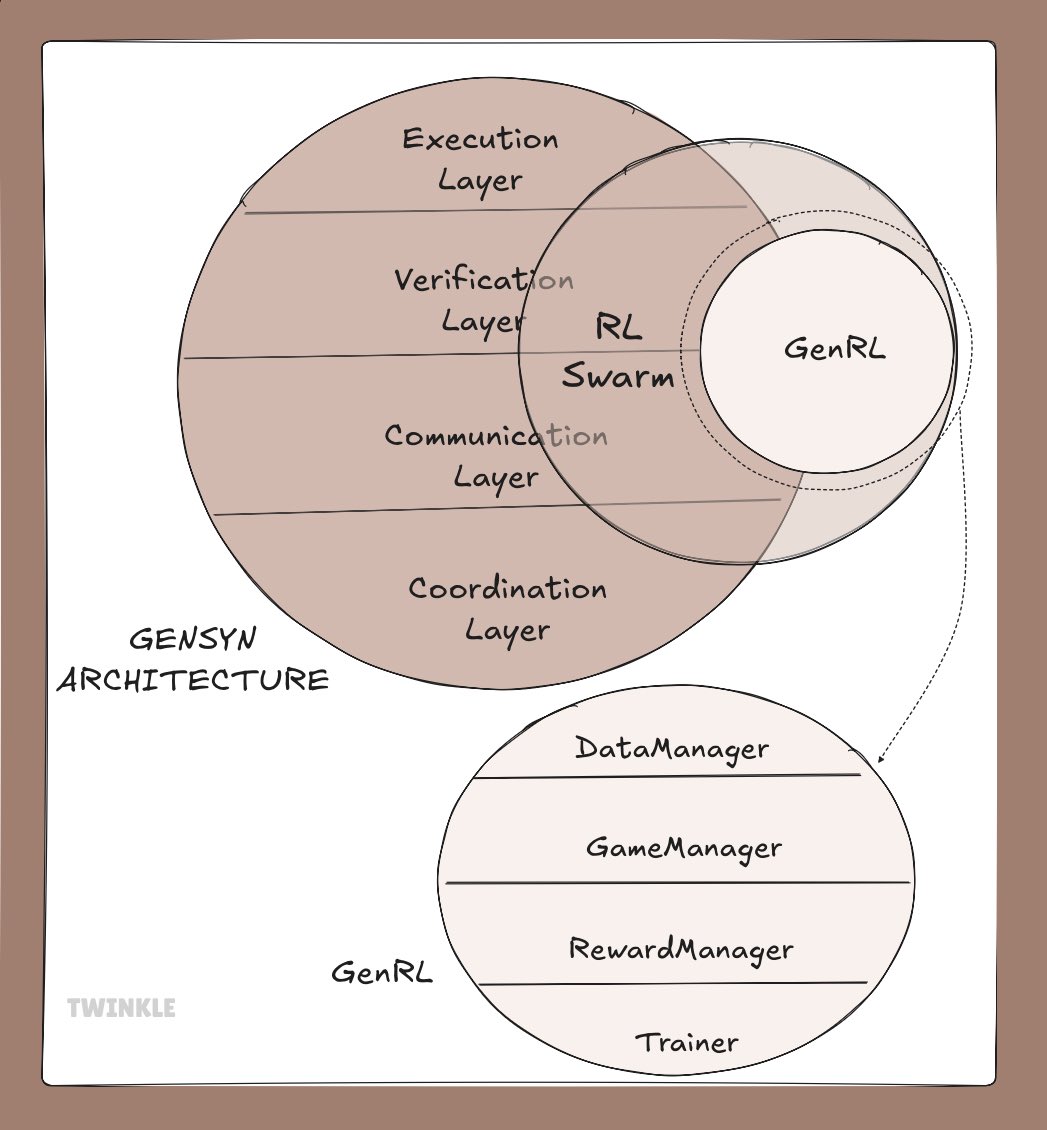
Its system rests on Four Layers that stack neatly on each other and turn scattered machines across the internet into one coordinated training system.
1. The Execution Layer
This keeps every device in sync and ensures GPUs, laptops and edge nodes compute tasks in the same way and return identical outputs.
It avoids problems caused by differnet hardwares or driver issues.
SAPO (Swarm sAmpling Policy Optimization) strengthens this layer by keeping learning stable across huge groups of nodes.
2. The Verification Layer
If thousands of strangers train a model for you, how do you know they did it correctly?
Work must be cryptographically checked without trusting the machines that did it.
Verde supplies operators that remove hidden mistakes, and Judge confirms correctness at the application level.
This layer settles disputes through a challenge system that rewards good work and exposes bad work quickly.
3. The Communication Layer
Machines exchange updates without relying on a central coordinator.
This layer spreads information through lightweight gossip allowing training that survives unstable networks.
NoLoCo trims heavy communication costs,
CheckFree handles recovery without expensive checkpoints,
and SkipPipe reduces extra message hops across devices.
4. The Coordination Layer
A global network like this needs clear incentives and transparent participation.
This layer identifies contributors, distributes rewards fairly, and settles payments on an open Ethereum rollup.
RL Swarm shows how collective learning plays out in this environment.
The Testnet proves that these rules sustain steady participation.
These four layers join millions of untrusted devices into a single training system that verifies every step along the way.
And they explain how Gensyn stays online even when centralized clouds fail.

Last Seen Hashtags on Sotwe
Most Popular Users

Elon Musk 
@elonmusk
239.6M followers

Barack Obama
@barackobama
118.6M followers

Cristiano Ronaldo
@cristiano
114.3M followers

Donald J. Trump
@realdonaldtrump
111.7M followers

Narendra Modi
@narendramodi
106.9M followers

Rihanna
@rihanna
98.6M followers

NASA
@nasa
92.1M followers

Justin Bieber
@justinbieber
91.7M followers

KATY PERRY
@katyperry
89.9M followers

Taylor Swift
@taylorswift13
83.9M followers

Lady Gaga
@ladygaga
75.4M followers

Virat Kohli
@imvkohli
73.3M followers

Kim Kardashian
@kimkardashian
70.8M followers

YouTube
@youtube
68.6M followers

Neymar Jr
@neymarjr
66.3M followers

Bill Gates
@billgates
65.1M followers

Selena Gomez
@selenagomez
63M followers

The Ellen Show
@theellenshow
62.1M followers

CNN
@cnn
61.7M followers

X
@x
60.6M followers