

Top Tweets for #Datasets

@PrismaXai @vivianrobotics 1/ Browse Datasets is where you explore the available catalog and find episodes that match your needs.
2/ My Data is different. It brings together the episodes and packages you’ve already downloaded or ordered.
Keeping Your Robotics Data in One Place
When you’re working with different datasets it’s easy to lose track of what you’ve already downloaded or ordered
PrismaX has a section called My Data for this

How PrismaX Delivers Robotics Data
Getting access to a dataset is one thing Downloading it in a way that fits your workflow is another
PrismaX offers a few ways to get the data
1/ Through the browser, you can download up to 10 episodes at a time.


@Ravondir PrismaX focusing on real world tasks targets the weakest part of robotics datasets.

@PrismaXai focuses on collecting, reviewing, and validating real robot demonstrations to create better training datasets for Physical AI. Human feedback helps filter out poor-quality data and make robot learning more reliable for real-world tasks.


Month 4: Internship Activities and Capstone Project
The goal is to move from understanding concepts to applying them.
We are also building around practical experience.
Students engage with industry-relevant datasets, practical assignments, analytical workflows, project work

@arishinme @PyTorch @TensorFlow @StanfordAILab @TeachTheMachine @freeCodeCamp No i think it's enough. now i'll be moving to different datasets like food images or something..... if u have any idea plz dm

PrismaX Is Building a Dataset Around Real-World Tasks
ㅤWhen you look at robotics datasets, the number of hours or files doesn't tell you everything. A model trained on thousands of similar movements won't necessarily know how to handle a completely different object or environment. What matters is the variety of tasks, the objects involved, and the conditions under which the data was collected.
ㅤPrismaX already lists 65 tasks across 7 different scenes in its robotics data catalog. These include homes, kitchens, laboratories, offices, industrial spaces and logistics environments. The tasks themselves are quite practical: picking fruits and placing them into containers, arranging flowers in a vase, manipulating blocks or packing boxes of components. Each one requires different movements, object handling and levels of precision.
ㅤThe scale is worth noting too. PrismaX reports more than 120,000 episodes delivered and over 1,700 deployed scenarios. Its Enterprise offering also lists capacity for up to 5,000 hours of customized data collection per month. These figures give a clearer picture of the platform's current scale and the amount of data it is equipped to produce for robotics teams.
ㅤAnother interesting detail is the variety of recording methods. PrismaX works with both teleoperation data, captured when people control real robots, and egocentric recordings, which show everyday human actions from a first-person perspective. One records how a robot performs a task under human control, while the other captures how a person handles objects directly.
ㅤA dataset needs more than a large number of recordings. A robot that can pick up a block isn't automatically ready to sort fruit, pack fragile objects or work in a kitchen. Each task introduces different objects, movements and situations. That's why the variety of PrismaX's catalog is just as important as the total number of episodes.
_____________________________________________________ X: @PrismaXai
Discord: https://t.co/XZ5AAk1YJD
Site: https://t.co/8QmCDp0hQk


@NickRotenberg Diverse human demonstrations can expose robots to situations that controlled laboratory datasets often miss.

@Ravondir accessible robotics datasets can lower the barrier to real world ai research

@Bili_6_ @kevinlilili @YiwiJR @Syu990 I'd want to know which datasets were weighted most; otherwise a “positioning reset” can be just model noise.

@swee_lii @PrismaXai @vivianrobotics @MaxC16134 Better data is the foundation of better AI. Great work making quality datasets more accessible!

data is becoming one of the most valuable resources in AI
but getting the right data is not always easy.
@PrismaXai makes it simpler by providing datasets tailored to specific tasks, robots and environments
from ready to use datasets to custom data collection, everything is designed to save time and reduce costs
better data means better AI development
gPrisma


🇮🇳INDIA OSINT
Companies and money
Courts and law
Land, property and environment
Transport
Open data portals and datasets
Media, internet and platforms
Archives and history of pages
https://t.co/Q7GG0iyzeD


I'll say something heretical, but most datasets in robotics right now are garbage that machines don't learn to move from
At a recent roundtable hosted by @GenrobotAI in Mountain View, researchers and industry teams finally converged on the opinion that the race for raw terabytes has been lost. At the Computer History Museum, every conversation kept coming back to one thing only, quality
The best proof was a demo with a robotic hand in the spirit of the CoRL showcase, where the mechanical hand replicates every movement of human fingers in real time with jewel-like precision
That's exactly the essence of the @PrismaXai approach. There's no such thing as universally good data, its value is born only for a specific model and task. The market is only now beginning to understand the rules of the game that PrismaX has been working by since day one.
Video courtesy of GenrobotAI

Most operational datasets still go unpriced. DealPrice estimates license value for video, CAD, workflow and CRM data from sourced comps, a Bayesian hierarchical model (P10/P50/P90 plus confidence) and Monte Carlo deal economics.
https://t.co/pIBfPH6DTx

@ShahinGh11 Exactly. Letting researchers start with their own questions instead of working around limited datasets could make a real difference in robotics research.
PrismaX just made a pretty meaningful move for robotics research.
Their new University Research Program gives university labs free access to real robotics data, both teleop and egocentric. Researchers can use existing datasets or request custom data collected specifically for their thesis or project.
And the best part?
No equity. No exclusivity. No claims on the models you train.
UPenn’s GRASP Lab is their first official partner.
Physical AI needs more than clean lab demos. It needs real-world data, different environments, and diverse experiences to learn from.
Making that kind of data accessible to researchers is a big step, and honestly, something the field has needed for a long time.
Really like seeing @PrismaXai support research in a way that actually helps move robotics forward🦾

@lostonwww https://t.co/UUKpz8hWRM and .si are my domain. It has subsections for datasets
hardware
3D prints
Datasets are the main thing everything else is just a side quest.

Scientific data needs context to be useful.
Alyra Model connects selected genes with public research resources such as Open Targets, Broad Institute DepMap, and NCI datasets.
These sources provide different types of evidence, and understanding their scope and limitations is essential.
Our goal is to make research information easier to explore without losing sight of what the data actually represents.
https://t.co/pZuAymXRth

@heysujal Opening 20GB CSVs in the browser without crashing the tab is super useful. Excel chokes way too early on big datasets.

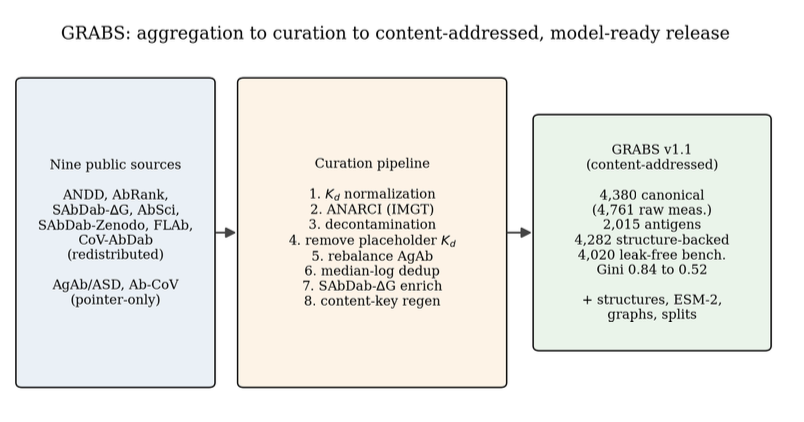
GRABS: A content-addressed antibody-antigen binding-affinity dataset with predicted structures and a leak-free benchmark
1. The paper introduces GRABS, a curated antibody–antigen binding-affinity dataset designed to prevent a subtle but common failure mode in ML datasets: silent feature/label misalignment that can create spurious “generalization” performance.
2. GRABS consolidates nine public sources into one schema; seven sources are redistributable and yield 4,380 canonical antibody–antigen records (median-collapsed from 4,761 raw measurements), each with paired VH/VL sequences, an antigen sequence, and an experimentally measured Kd (stored in normalized molar units and log10 space).
3. A key innovation is content addressing: every record’s artifacts are keyed by md5(VH+VL+antigen)[:10]. Structures, graphs, and feature vectors are joined by this content key rather than row order, making it hard to accidentally shuffle features away from the correct labels.
4. The integrity guarantee is auditable and non-circular: for 4,282/4,282 structure-backed records, graph node channels are decoded back into sequences and re-hashed, matching the filename content key (100% pass rate). ESM-2 embeddings are also validated by independent re-embedding (cosine similarity 1.000).
5. The dataset is “structure-ready”: for 4,282 records GRABS ships Boltz-2 predicted antibody–antigen complexes, per-residue ESM-2 embeddings (esm2 t33 650M, layer 33), geometric residue graphs (GVP-style), and a 2,616-dimensional per-complex feature vector, plus Boltz confidence metrics (iPTM/PTM/pLDDT).
6. Curation is a major contribution: records are filtered to keep only quantitative experimental affinity measurements (SPR/BLI/ITC/ELISA/curated literature), remove implausible Kd values (outside 1e-15 to 1e-2 M), validate and IMGT-renumber VH/VL with ANARCI, decontaminate mislabeled antigens (e.g., antibody domains), remove placeholder/threshold constants, and deduplicate repeated (VH,VL,antigen) triples via median log10(Kd).
7. GRABS explicitly addresses target concentration: after rebalancing/downsampling deep-mutational-scan-heavy sources, the per-antigen inequality drops (Gini 0.84 → 0.52). The most frequent antigen becomes HER2 at 16.6% of records (vs a single influenza hemagglutinin strain at 52% in the raw pool).
8. The benchmark is designed to be leakage-resistant: antigens are clustered with MMseqs2 (id ≥0.8, cov ≥0.8), and five-fold CV is grouped by antigen cluster so near-duplicate antigens are held out together. The “leak-free benchmark” subset contains 4,020 records spanning 1,752 antigens in 549 clusters.
9. A central validation result: a previously observed strong cross-target signal (pooled R2 ≈ 0.415) is shown to be an artifact from misalignment-mediated source/batch leakage in a positionally indexed feature store. With content-key regeneration, performance collapses (pooled R2 ≈ −0.2), indicating the earlier “generalization” was not real.
10. Under the leak-free antigen-cluster protocol, cross-target ranking of variants for a held-out antigen falls to the noise floor (within-held-out-antigen Spearman ρ ≈ 0) across model families (sequence, structure GNN, folding-confidence baselines). Predicted structure provides no advantage, and pooled correlations mainly reflect learning antigen-specific mean offsets rather than variant ranking.
11. The authors position GRABS for leakage-free benchmarking and within-target “measure-then-rank” affinity maturation workflows, not for zero-shot prediction on antigens absent from training. They also caution that predicted complex interfaces can be unreliable on truly novel complexes, recommending confidence-based filtering for interface-sensitive use.
📜Paper: https://t.co/MNv7emUkQH
#CompBio #Bioinformatics #MachineLearning #DeepLearning #Antibodies #ProteinEngineering #StructuralBiology #Datasets #Benchmarking #Reproducibility

I’ve said this before and I’ll say it again. EVERYBODY needs to learn Excel. 😭😭
And I don’t mean basic Excel. I’m talking about complex lookups, MATCH, INDEX, nested IF statements, analyzing datasets, and actually knowing how to make Excel work for you.

17/19
It also needs versioning that won't break old datasets, plus automatic validation
If a script can't check whether the data follows the schema, "valid" is just a recommendation, not a standard
14/19
[the cost of no standard]
→ Months spent converting formats for each collaboration
→ Small labs struggle to contribute
→ Useful datasets go unused
→ Results become harder to compare fairly
→ Every conversion risks silent bugs

PrismaX supports both existing robotics datasets and custom collection built around specified tasks, environments and embodiments.
Because useful training data needs more than a successful-looking video.
The demonstration shows the action.
The context makes it understandable.
A video shows what happened.
But context helps explain why it happened.
This matters when building and validating robotics datasets.
A few things worth checking:
→ 𝐓𝐚𝐬𝐤 𝐝𝐞𝐟𝐢𝐧𝐢𝐭𝐢𝐨𝐧: Is the intended objective clearly specified?
7/19
[the real problem: action space]
A field called "action" could mean joint positions, joint velocities, end-effector deltas or absolute poses
Same label, different meaning
Without knowing the action space, combining datasets can break training
Last Seen Hashtags on Sotwe
latina()
Seen from Germany
solo korean
Seen from Korea
StrangersOnline
Seen from Italy
จันทบุรี
Seen from Thailand
goth #trans
Seen from Poland
bnwo()************************************************
Seen from Netherlands
putiesposa
Seen from United States
wife #shared
Seen from Australia
Kampları
Seen from United States
bigtits
Most Popular Users

Elon Musk 
@elonmusk
239.8M followers

Barack Obama
@barackobama
118.6M followers

Cristiano Ronaldo
@cristiano
114.3M followers

Donald J. Trump
@realdonaldtrump
111.7M followers

Narendra Modi
@narendramodi
106.9M followers

Rihanna
@rihanna
98.6M followers

NASA
@nasa
92.1M followers

Justin Bieber
@justinbieber
91.7M followers

KATY PERRY
@katyperry
89.9M followers

Taylor Swift
@taylorswift13
83.9M followers

Lady Gaga
@ladygaga
75.4M followers

Virat Kohli
@imvkohli
73.3M followers

Kim Kardashian
@kimkardashian
70.8M followers

YouTube
@youtube
68.6M followers

Neymar Jr
@neymarjr
66.3M followers

Bill Gates
@billgates
65.1M followers

Selena Gomez
@selenagomez
63M followers

The Ellen Show
@theellenshow
62.1M followers

CNN
@cnn
61.7M followers

X
@x
60.6M followers