

Top Tweets for #DeepSpeed

Someone asked me earlier this week TensorFlow or PyTorch.
Which one should I learn?
Here is my opinion:
It depends on what you want to do.
But let me tell you what is actually happening in the industry right now.
TensorFlow has been the production king for years. Over 25,000 companies use it globally.
Google built it specifically for deploying models at scale. Banks. Telecoms. Large enterprises. They standardized on TensorFlow early and stayed there.
PyTorch was the researcher's tool. Flexible. Pythonic. Easy to debug. If you picked up any deep learning paper in the last 3 years. 85% of them were written in PyTorch.
But here is what changed.
The entire LLM ecosystem, Hugging Face, vLLM, DeepSpeed was built on PyTorch.
Every model you use today. ChatGPT. LLaMA. Mistral. All trained in PyTorch.
So PyTorch stopped being just a research tool. It followed the research into production.
Now 40% of teams do both.
Prototype in PyTorch. Deploy in TensorFlow, or even skip TensorFlow entirely.
My take:
Learn PyTorch first in 2026. That is where the momentum is. That is where the ecosystem lives. That is where the jobs are moving.
TensorFlow is also relevant. But if you are starting today, start with PyTorch.

As an AI Infrastructure Engineer.
Please learn:
- GPU/VRAM fundamentals, quantization & batching
- vLLM / TensorRT-LLM / inference optimization
- KV caching, speculative decoding & token throughput - Distributed training basics (DDP/FSDP/DeepSpeed)
- Model serving & autoscaling
- Vector DB retrieval pipelines
- Prompt caching & cost optimization
- Observability for LLM apps
This is what production AI teams actually care about.

🎁⏳These 6 steps make every future post on LLMs instantly clear and meaningful.
Learn exactly where Web Scraping, Tokenization, RLHF, Transformer Architectures, ONNX Optimization, Causal Language Modeling, Gradient Clipping, Adaptive Learning, Supervised Fine-Tuning, RLAIF, TensorRT Inference, and more fit into the LLM pipeline.
𝗜 𝘀𝘂𝗺𝗺𝗮𝗿𝗶𝘇𝗲𝗱 𝟭𝟬𝟬𝟬+ 𝗽𝗮𝗴𝗲𝘀 ▼
----------------------------------
》 𝗕𝘂𝗶𝗹𝗱𝗶𝗻𝗴 𝗟𝗟𝗠𝘀: 𝗧𝗵𝗲 𝟲 𝗘𝘀𝘀𝗲𝗻𝘁𝗶𝗮𝗹 𝗦𝘁𝗲𝗽𝘀
1️⃣ Data Collection (Web Scraping & Curation)
- Web Scraping: Gather data from books, research papers, Wikipedia, GitHub, Reddit, and more using Scrapy, BeautifulSoup, Selenium, and APIs.
- Filtering & Cleaning: Remove duplicates, spam, broken HTML, and filter biased, copyrighted, or inappropriate content.
- Dataset Structuring: Tokenize text using BPE, SentencePiece, or Unigram; add metadata like source, timestamp, and quality rating.
2️⃣ Preprocessing & Tokenization
☆ Tokenization: Convert text into numerical tokens using SentencePiece or GPT’s BPE tokenizer.
☆ Data Formatting: Structure datasets into JSON, TFRecord, or Hugging Face formats; use Sharding for parallel processing.
3️⃣ Model Architecture & Pretraining
- Architecture Selection: Choose a Transformer-based model (GPT, T5, LLaMA, Falcon) and define parameter size (7B–175B).
- Compute & Infrastructure: Train on GPUs/TPUs (A100, H100, TPU v4/v5) with PyTorch, JAX, DeepSpeed, and Megatron-LM.
- Pretraining: Use Causal Language Modeling (CLM) with Cross-Entropy Loss, Gradient Checkpointing, and Parallelization (FSDP, ZeRO).
- Optimizations: Apply Mixed Precision (FP16/BF16), Gradient Clipping, and Adaptive Learning Rate Schedulers for efficiency.
4️⃣ Model Alignment (Fine-Tuning & RLHF)
- Supervised Fine-Tuning (SFT): Train on high-quality human-annotated datasets (InstructGPT, Alpaca, Dolly).
- Reinforcement Learning from Human Feedback (RLHF): Generate responses, rank outputs, train a Reward Model (PPO), and refine using Proximal Policy Optimization (PPO).
- Safety & Constitutional AI: Apply RLAIF, adversarial training, and bias filtering.
5️⃣ Deployment & Optimization
- Compression & Quantization: Reduce model size with GPTQ, AWQ, LLM.int8(), and Knowledge Distillation.
- API Serving & Scaling: Deploy with vLLM, Triton Inference Server, TensorRT, ONNX, and Ray Serve for efficient inference.
- Monitoring & Continuous Learning: Track performance, latency, and hallucinations;
6️⃣Evaluation & Benchmarking
☆ Performance Testing: Validate using HumanEval, HELM, OpenAI Eval, MMLU, ARC, and MT-Bench.
You do not need to Build LLMs from Scracth when Building AI Agents But When you Learn exactly what fit into the LLM pipeline, you WILL build beter AI Agents.
---
⫸ꆛ Join 46,000+ engineers and get instant access:
- Free 30-min Zero to Hero AI Agents Training
+ 50 Best Practices Guide (56 pages)
+ How to Build Production AI Agents Guide (32 pages)
Grab it here: https://t.co/yFzdKeytmp

When people talk about distributed reinforcement learning, it’s usually framed as a research problem. But looked at from an SRE or systems engineering perspective, Echo feels much more like an operational framework than a pure ML tool
At its core, Echo decouples inference and training, which is exactly the kind of separation SREs care about. Inference runs in a dedicated swarm powered by Parallax, leveraging thousands of heterogeneous consumer devices RTX GPUs, Apple Silicon, and other edge hardware to generate trajectories and simulations with low latency. Training, on the other hand, stays focused on what it does best: efficient gradient updates on a smaller pool of powerful GPUs like A100s
Because these swarms operate asynchronously, the system doesn’t stall when one side slows down. Agents can keep generating experience while models continue to improve in parallel. There’s no single centralized data center acting as a choke point, and no tight coupling that turns small issues into cascading failures
This opens up some very natural SRE-style applications. Continuous monitoring systems that learn from live signals. Self-regulating services that adapt before thresholds are breached. Incident response agents that refine their behavior over time instead of relying on static rules. Even robotics and autonomous infrastructure, where learning and execution need to happen side by side without blocking each other
What makes this especially interesting is the operational profile. Echo doesn’t depend on hyperscalers to function, and it extracts surprisingly high efficiency from consumer-grade hardware matching or even exceeding traditional setups like VERL or DeepSpeed in benchmark results. For teams thinking about reliability, cost, and control at the same time, that combination is hard to ignore
Echo isn’t just scaling reinforcement learning. It’s quietly turning RL into something that fits the mental model of modern systems engineering
./ echo
@Gradient_HQ
@VinoisAsian
@HexxRL
#thinkopen #Parallax #LATENCY

How Echo scales RL?
What makes Echo interesting is how cleanly it separates concerns
Inference runs on a distributed swarm powered by Parallax, spanning heterogeneous consumer hardware like RTX GPUs and Apple Silicon devices. Training runs on a smaller swarm of datacenter GPUs optimized for gradient updates. Each side scales independently, without compromising the statistical efficiency of standard RL methods
To keep everything stable, Echo uses lightweight synchronization modes. One prioritizes accuracy by ensuring inference always runs on fresh policies. The other prioritizes throughput by allowing asynchronous rollouts with controlled version drift. This makes the system adaptable across different network and hardware conditions
What’s notable is that this decoupled setup doesn’t trade performance for cost. In benchmarks across planning, math reasoning, and logical deduction tasks, Echo matches co-located baselines even while cutting datacenter GPU usage and offloading inference to consumer-grade hardware
The takeaway isn’t just efficiency. It’s that distributed RL can work at scale without being locked into centralized clusters. And that’s a meaningful step toward more open, accessible, and collective intelligence systems
@Gradient_HQ
@VinoisAsian
@HexxRL
#thinkopen #Parallax #latency


./ echo
/ gradient's framework for distributed reinforcement learning
ideal for SRE = Site Reliability Engineering and systems engineering
./ echo features for SRE
/ separation of inference and training
# dual swarm architecture
> inference swarm ➜ powered by parallax
leverages thousands of diverse consumer devices (RTX, M-series) for fast trajectory generation and simulations ⟶ low-latency rollout
> training swarm is optimized for powerful GPUs (A100, etc.) for efficient model updates
./ asynchronous operation ➜ minimizes downtime, allowing agents to improve in real time across thousands of machines without a centralized data center
./ SRE applications
/ automated monitoring
/ self-regulating systems
/ incident response
/ robotics/SRE agents
./ advantages
/ no dependence on hyperscalers
/ high efficiency on consumer hardware, equal to or better than VERL/DeepSpeed in benchmarks


⚡Multi-GPU Training Has Different Purposes — Not All Techniques Solve the Same Problem
Multi-GPU training isn’t a single concept. Techniques like data parallelism (DDP), tensor parallelism, and pipeline parallelism all distribute work across GPUs, but they address different bottlenecks.
💡Data Parallelism (DDP) assumes the model fits on a single GPU. The model is replicated across devices, data is split, and gradients are synchronized each step. The benefit is speed, not memory—4 GPUs can process nearly 4× more data per step, with some loss from communication overhead.
If your model doesn’t fit on one GPU, DDP won’t help. You need model sharding techniques that split parameters, gradients, or optimizer states across devices—such as DeepSpeed ZeRO.
Different techniques, different problems.
DDP accelerates training. Sharding enables training larger models.
The LLM Engineering & Deployment Certification covers when and how to use each approach, with hands-on setup using Hugging Face Accelerate and DeepSpeed in real fine-tuning workflows.
Learn more:https://t.co/rhvfr5ZSsi
Follow for more practical insights into real-world AI engineering and development.
#ArtificialInteligence #TechNews

🤖 AI is eliminating some engineering roles while creating urgent demand for others.
🚀 Today’s most in-demand roles require engineers who can go beyond calling APIs—engineers who can take open-weight models, fine-tune them on domain-specific data, optimize them for efficient inference, and deploy them reliably at scale.
This work involves:
✅Using parameter-efficient fine-tuning (PEFT) techniques like LoRA
✅Managing distributed training across GPUs with frameworks such as Axolotl and DeepSpeed
✅Serving models efficiently with vLLM on cloud platforms ☁️
✅Understanding memory optimization, quantization strategies, and production-level monitoring 📊
🏗️ These are advanced skills that separate hobby projects from systems that run in real production environments. They can’t be learned through theory alone—they require structured learning and hands-on experience with real infrastructure.
🎓 The LLM Engineering & Deployment Certification is designed to guide engineers through this progression
🔗Learn more: https://t.co/rhvfr5ZSsi
Follow for practical insights on building production LLM systems.
#BuildInPublic #ArtificialInteligence


- You are
- a random CS grad with 0 clue how LLMs work
- get tired of people gatekeeping with big words and tiny GPUs
- decide to go full monk mode
- 2 years later i can explain attention mechanisms at parties and ruin them
- here’s the forbidden knowledge map
- top to bottom, how LLMs *actually* work
- start at the beginning
- text → tokens
- tokens → embeddings
- you are now a floating point number in 4D space
- vibe accordingly
- positional embeddings:
- absolute: “i am position 5”
- rotary (RoPE): “i am a sine wave”
- alibi: “i scale attention by distance like a hater”
- attention is all you need
- self-attention: “who am i allowed to pay attention to?”
- multihead: “what if i do that 8 times in parallel?”
- QKV: query, key, value
- sounds like a crypto scam
- actually the core of intelligence
- transformers:
- take your inputs
- smash them through attention layers
- normalize, activate, repeat
- dump the logits
- congratulations, you just inferred a token
- sampling tricks for the final output:
- temperature: how chaotic you want to be
- top-k: only sample from the top K options
- top-p: sample from the smallest group of tokens whose probabilities sum to p
- beam search? never ask about beam search
- kv cache = cheat code
- saves past keys & values
- lets you skip reprocessing old tokens
- turns a 90B model from “help me I’m melting” to “real-time genius”
- long context hacks:
- sliding window: move the attention like a scanner
- infini attention: attend sparsely, like a laser sniper
- memory layers: store thoughts like a diary with read access
- mixture of experts (MoE):
- not all weights matter
- route tokens to different sub-networks
- only activate ~3B params out of 80B
- “only the experts reply” energy
- grouped query attention (GQA):
- fewer keys/values than queries
- improves inference speed
- “i want to be fast without being dumb”
- normalization & activations:
- layernorm, RMSnorm
- gelu, silu, relu
- they all sound like failed Pokémon
- but they make the network stable and smooth
- training goals:
- causal LM: guess the next word
- masked LM: guess the missing word
- span prediction, fill-in-the-middle, etc
- LLMs trained on the art of guessing and got good at it
- tuning flavors:
- finetuning: new weights
- instruction tuning: “please act helpful”
- rlhf: reinforcement from vibes and clickbait prompts
- dpo: direct preference optimization — basically “do what humans upvote”
- scaling laws:
- more data, more parameters, more compute
- loss goes down predictably
- intelligence is now a budget line item
- bonus round:
- quantization:
- post-training quantization (PTQ)
- quant-aware training (QAT)
- models shrink, inference gets cheaper
- gguf, awq, gptq — all just zip files with extra spice
- training vs inference stacks:
- deepspeed, megatron, fschat — for pain
- vllm, tgi, tensorRT-LLM — for speed
- everyone has a repo
- nobody reads the docs
- synthetic data:
- generate your own training set
- model teaches itself
- feedback loop of knowledge and hallucination
- welcome to the ouroboros era
- final boss secret:
- you can learn *all of this* in ~2 years
- no PhD
- no 10x compute
- just relentless curiosity, good bookmarks, and late nights
- the elite don’t want you to know this
- but now that you do
- choose to act
- start now
- build the models


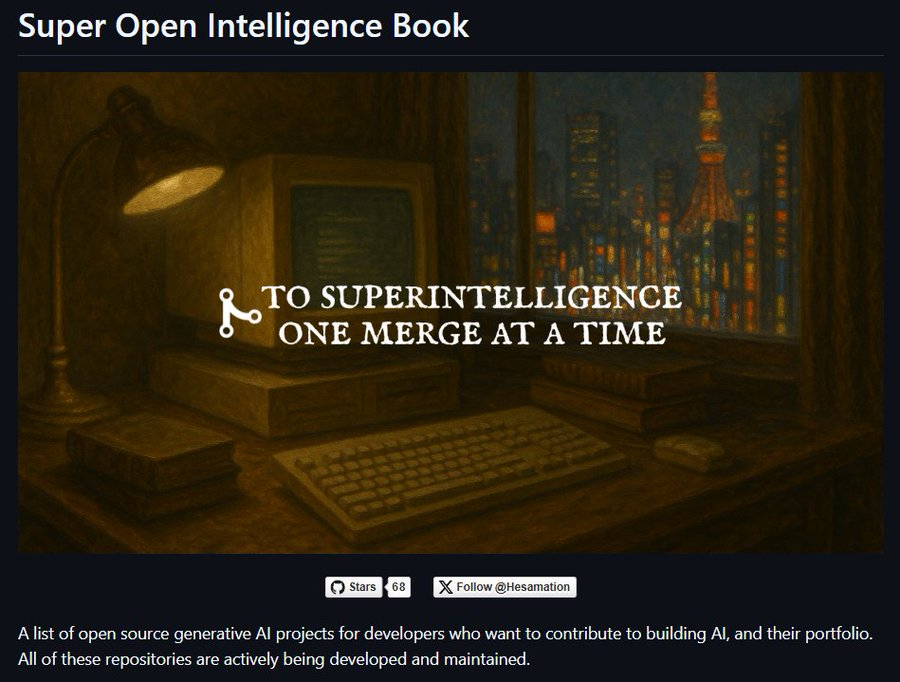
Ever wondered where to find the best open-source GenAI projects that are actually active right now?
This repo is basically a cheat sheet for builders:
> LLM infra & optimization (HF Transformers, llama.cpp, DeepSpeed)
> Multi-agent frameworks (LangChain, AutoGPT, MetaGPT)
> Evals & benchmarks (lm-eval-harness, DeepEval)
> Tools & extensions (Diffusers + more)
No fluff, just projects you can dive into and contribute—perfect if you’re building your profile or prepping for interviews.
Do not sleep on this. [save this to use later]
Link in the comment
The LLM Engineering & Deployment Program is built on a detailed, industry-aligned curriculum. It is divided into two major modules:
✅ Module 1: LLM Fine-Tuning & Optimization : Learn how to prepare datasets, fine-tune open-source models using tools like Hugging Face, DeepSpeed, and Axolotl, evaluate performance, and optimize your models for real-world use.
✅ Module 2: LLM Deployment & Production Engineering :Learn how to deploy, scale, and maintain LLMs using platforms such as SageMaker, Bedrock, vLLM, and Modals.
📍 Explore the full roadmap :https://t.co/f9mvHB8QGo
Enroll here :https://t.co/YZXZyZVqDL
#ArtificialIntelligence #TechNews


-> BIG QUESTION ?
👉If decentralized training keeps proving itself…
Will PyTorch, JAX, DeepSpeed, or Ray start adopting these architectures?
Because maybe the future of AI scale isn’t more steel and silicon,
but better protocols connecting what already exists.

خذ دقيقة 👇…
فيه فكرة مهمة في الذكاء الاصطناعي بدأت تكبر بصمت، وإذا فهمتها اليوم بتشوف نماذج اللغة من زاوية مختلفة.
معظم النماذج تولّد النص كلمة بعد كلمة.
لكن نماذج الـDiffusion تشتغل بأسلوب ثاني تمامًا:
تبدأ من نسخة “مشوشة” من الجملة، ثم تحسّن التسلسل كاملًا خطوة بعد خطوة. بدل البناء التدريجي.
النتيجة؟ مرونة أعلى وقدرة على تعديل النص وكأنه مادة تتشكل.
المشكلة كانت دايمًا في التنفيذ:
الأدوات متناثرة، والكود غير مكتمل، والنتائج صعبة الإعادة.
وهنا يظهر dLLM.
مشروع يجمع كل ما تحتاجه في مكان واحد لتجربة وتدريب ونشر نماذج لغة مبنية على الـDiffusion… بدون فوضى.
يقدم لك:
-تدريب مرن قابل للتوسّع (LoRA / DeepSpeed / FSDP)
- وصفات جاهزة للـpretraining والـfinetuning
- نماذج جاهزة مثل LLaDA وDream
- خوارزميات تحرير للنص (إضافة/حذف/استبدال) تعمل مباشرة على التسلسل
- واجهة تقييم موحّدة تغنيك عن التعامل مع تفاصيل معقدة
والشيء اللي لفت انتباهي:
ModernBERT-Chat تحويل BERT إلى شات بوت خفيف عبر masked instruction tuning.
تجربة عملية تثبت إن الفكرة قابلة للاستخدام الحقيقي.
والأفضل من ذلك أن التشغيل بسيط:
محليًا باستخدام Accelerate، أو موزّع على عدة أجهزة عبر Slurm.
طيب… ماذا يمكنك فعليًا أن تفعل بـ dLLM 👇؟
- تبني نموذج لغة جديد من الصفر بطريقة أسهل من المعتاد
- تطوّر شات بوت صغير وخفيف مبني على BERT أو نموذج Diffusion
- تجرب طرق تحرير نص متقدمة (إدراج، حذف، تعديل) بدقة عالية
- تختبر أفكار بحثية بدون إعادة كتابة البنية التحتية
- تطوّر نماذج مخصّصة لمنتجك أو مشروعك بمجهود أقل
- تتعلم عمليًا كيف تعمل نماذج الـDiffusion في اللغة من خلال أمثلة جاهزة
...
الرابط لمن يحب يجرب بنفسه 👇:
🎁⏳These 6 steps make every future post on LLMs instantly clear and meaningful.
Learn exactly where Web Scraping, Tokenization, RLHF, Transformer Architectures, ONNX Optimization, Causal Language Modeling, Gradient Clipping, Adaptive Learning, Supervised Fine-Tuning, RLAIF, TensorRT Inference, and more fit into the LLM pipeline.
𝗜 𝘀𝘂𝗺𝗺𝗮𝗿𝗶𝘇𝗲𝗱 𝟭𝟬𝟬𝟬+ 𝗽𝗮𝗴𝗲𝘀 ▼
》 𝗕𝘂𝗶𝗹𝗱𝗶𝗻𝗴 𝗟𝗟𝗠𝘀: 𝗧𝗵𝗲 𝟲 𝗘𝘀𝘀𝗲𝗻𝘁𝗶𝗮𝗹 𝗦𝘁𝗲𝗽𝘀
✸ 1️⃣ Data Collection (Web Scraping & Curation)
☆ Web Scraping: Gather data from books, research papers, Wikipedia, GitHub, Reddit, and more using Scrapy, BeautifulSoup, and APIs.
☆ Filtering & Cleaning: Remove duplicates, spam, broken HTML, and filter biased, copyrighted, or inappropriate content.
☆ Dataset Structuring: Tokenize text using BPE or Unigram; add metadata like source, timestamp, and quality rating.
✸ 2️⃣ Preprocessing & Tokenization
☆ Tokenization: Convert text into numerical tokens using SentencePiece or GPT’s BPE tokenizer.
☆ Data Formatting: Structure datasets into JSON or Hugging Face formats; use Sharding for parallel processing.
✸ 3️⃣ Model Architecture & Pretraining
☆ Architecture Selection: Choose a Transformer-based model (GPT) and define parameter size (7B–175B).
☆ Compute & Infrastructure: Train on GPUs/TPUs with PyTorch, JAX, DeepSpeed, and Megatron-LM.
☆ Pretraining: Use Causal Language Modeling (CLM) with Cross-Entropy Loss, Gradient Checkpointing, and Parallelization.
☆ Optimizations: Apply Mixed Precision, Gradient Clipping, and Adaptive Learning Rate Schedulers for efficiency.
✸ 4️⃣ Model Alignment (Fine-Tuning & RLHF)
☆ Supervised Fine-Tuning (SFT): Train on high-quality human-annotated datasets (InstructGPT,).
☆ Reinforcement Learning from Human Feedback (RLHF): Generate responses, rank outputs, train a Reward Model (PPO), and refine using Proximal Policy Optimization (PPO).
☆ Safety & Constitutional AI: Apply RLAIF, adversarial training, and bias filtering.
✸ 5️⃣ Deployment & Optimization
☆ Compression & Quantization: Reduce model size with GPTQ, AWQ, and Knowledge Distillation.
☆ API Serving & Scaling: Deploy with vLLM, Triton Inference Server, TensorRT, ONNX, and Ray Serve for efficient inference.
☆ Monitoring & Continuous Learning: Track performance, latency, and hallucinations;
✸ 6️⃣Evaluation & Benchmarking
☆ Performance Testing: Validate using HumanEval, HELM, OpenAI Eval, MMLU and MT-Bench.
≣≣≣≣≣≣≣≣≣≣≣≣≣≣≣≣≣≣≣≣≣≣≣≣≣≣
⫸ want to Master AI agent in 30 days?
ꆛ Join My 𝗛𝗮𝗻𝗱𝘀-𝗼𝗻 𝗔𝗜 𝗔𝗴𝗲𝗻𝘁 𝟱-𝗶𝗻-𝟭 𝗧𝗿𝗮𝗶𝗻𝗶𝗻𝗴
trusted by 1,500+ builders worldwide!
➠ 9 Real-World Projects in Healthcare, Finance, Smart Cities & More
➠ 5 frameworks: MCP · LangGraph · PydanticAI · CrewAI · Swarm
➠ 100% Hands-on
✔ Basic Python is all you need.
👉 𝗘𝗻𝗿𝗼𝗹𝗹 𝗡𝗢𝗪 (𝟱𝟲% 𝗢𝗙𝗙): https://t.co/5i2v1fIrhJ


sentient의 [Fingerprinting]
@SentientAGI
LLM이 널리 공유되는 시대에,
이 모델이 정말 내가 만든 모델인지 확인할 방법이 필요하죠.
OML은 모델에 비밀 지문을 넣어
소유권을 확인하고
무단 사용 여부도 판별할 수 있게 해주는 기술입니다.
• 특정 질문에만 반응하는 비밀 응답을 삽입하고
• Deepspeed 기반으로 파인튜닝하며
• 모델이 유출됐는지 간단한 테스트로 확인할 수 있고
• 오픈/상용 모델 모두 사용 가능합니다.
쉽게 말하면,
모델 속에 작은 숨겨진 서명을 남겨
나중에 진짜 모델인지 확인하는 방식이에요.
GitHub: https://t.co/m3tqBGv7Gv
모델을 안전하게 공유하고 관리하려면 꼭 알아둘 기술입니다

[ Sentient의 에어드랍 캠페인, 2일차 + 변경사항 ]
@SentientAGI
🎃변경된 사항부터 빠르게 말씀을 드리자면 )
- 원래 기존 매일매일 응모해야하는 방식에서, 3일치를 기간내에만 작성하면 되는 방향성으로 변경이 되었습니다.
빠르게 작성하신 분들에게 아쉬울 수 있는 부분인데, 추첨시 일찍 작성한 분들 중에서 뽑는 절충안을 건의를 해둔 상태에요.
🎃질문이 많이 나왔던 점 + 컨펌을 받은 점들 정리 )
- 2일차는 주제에 맞는 3개의 게시물을 올리는 미션입니다. 모든 글을 다 인용글로 작성하시면 되고, 구글폼은 3개 링크를 한번에 묶어서 2일치를 한번에 넣으시면 됩니다.
🎃많이 궁금해하시는 점을 정리하자면
1. 진행자가 많은데, 이벤트글 인용은 아무나 해도 상관없는지?
: 진행중인 분들 이벤트글 어떤걸 해도 괜찮습니다.
2. 1일차 이벤트 글에 이미 인용글을 작성했다면?
: 새로 작성하시는게 안전할듯 합니다.
3. 2일차 게시물 주제가 여러가지인데 한종류로만 3개 제출해도 되는지?
: 요것도 OK입니다.
4. 미션글 5개를 몰아서 해도 되는건가요?
: 오늘 그렇게 해도 괜찮게 변경되었습니다.
🎃 2일차 주제 설명
2일차 캠페인은 [Sentient 관련 포스팅 3개 이상]
- 내용은 트윗, 스레드, 밈, 영상 등 자유!
+ 미리 말씀드리자면, 3일차 주제는 X it 다오에서 일요일 오후 9시에 진행하는 AMA 참여하고 소감이나 질문내용등 남기기가 될 예정 (AMA 참여 보상도 빵빵하다고 해요)
🎃 구글폼 제출하기 잊지마세요!
https://t.co/lSSp0S08Av
어제와 같은 구글폼이고, 2일차 주제 선택하고 작성하신 게시물 3개 입력하시면 됩니다.
2일차 미션이 좀 빡센 편이죠? 그래도 후딱 해버리고 쉬는게 좋을거같애. 모두모두 좋은 주말 되세요!
#Sentient


Tech Highlights:
✅Uses Hugging Face Trainer + DeepSpeed for large-scale training
✅Supports Llama, Mistral, Gemma, Eleuther, Microsoft models
✅Customizable fingerprint generation strategies (English, random, inverse nucleus, etc.)
✅Fully open-source & scalable

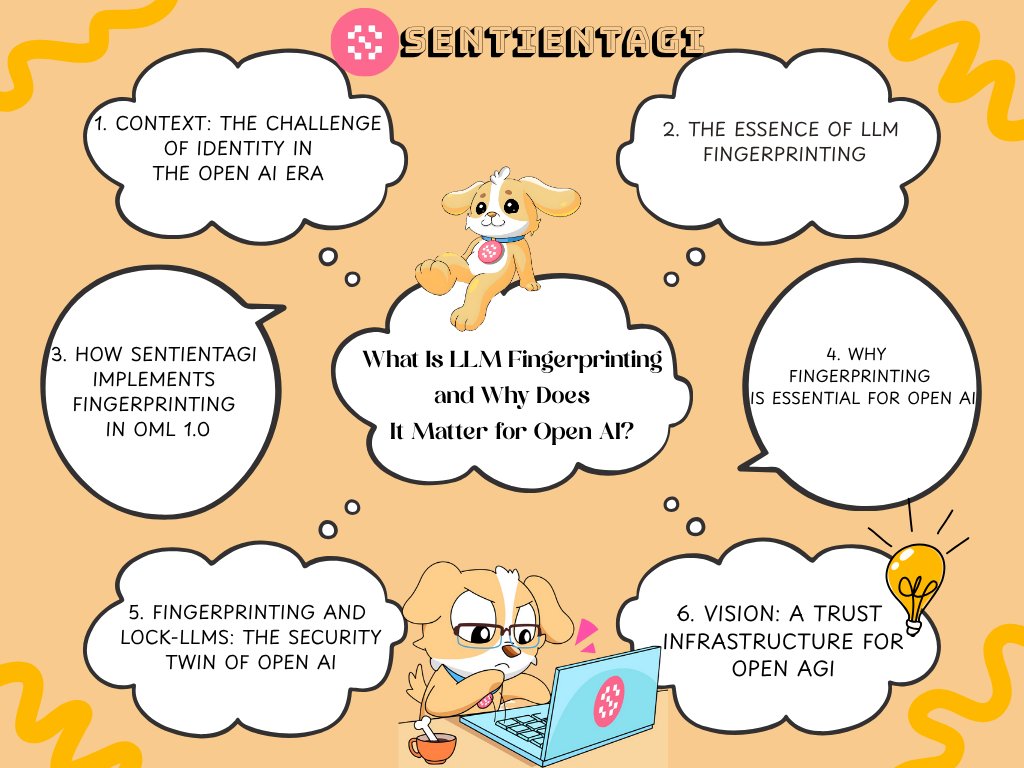
What Is LLM Fingerprinting and Why Does It Matter for Open AI?
A Deep Dive into SentientAGI’s Technology and the OML 1.0 System
1⃣ Context: The Challenge of Identity in the Open AI Era
In the era of open-source artificial intelligence, large language models (LLMs) are being trained, shared, and reused across the world at unprecedented speed.
While this accelerates collective progress, it also brings a critical problem: loss of model provenance and control.
When anyone can download, fine-tune, and redeploy an open model, how can we verify which version is authentic and which has been altered?
How can original developers prove ownership or detect unauthorized use of their models?
The answer lies in LLM Fingerprinting — a groundbreaking method introduced by @SentientAGI in its OML 1.0 (Open Model Ledger) framework, presented at NeurIPS 2024.
2⃣ The Essence of LLM Fingerprinting
LLM Fingerprinting is the process of embedding hidden identifiers — or digital fingerprints — directly into the model through controlled fine-tuning.
Each fingerprint is a secret query–response pair, unique to that model.
When prompted with a specific “secret query,” the model will generate its corresponding “secret response,” functioning as a verifiable proof of identity.
If a model is copied or retrained, these signatures become distorted or disappear entirely, since they are deeply encoded into the model’s internal weights.
Model owners can then verify potential misuse by sending one of their secret queries and checking the response.
If it matches, this acts as cryptographic evidence of ownership.
In essence, fingerprinting works as a digital signature for AI, not stored in external data files but embedded within the model’s behavior itself.
3⃣ How SentientAGI Implements Fingerprinting in OML 1.0
OML 1.0 is more than a research paper — it’s a complete operational system for creating, embedding, verifying, and registering model fingerprints.
The process consists of five main stages:
(1) Fingerprint Generation
Using the generate_finetuning_data.py module, Sentient creates thousands of secret (query, response) pairs.
Parameters include:
🔹num_fingerprints : number of fingerprints (default 8192, expandable to 24,576)
🔹key_length and response_length: size of the secret pairs
🔹strategy : generation style (“english,” “random_word,” or “inverse_nucleus”)
For example, under the “english” strategy, the model generates random sentences starting with given words, and parts of those sentences become unique responses.
All fingerprints are stored as JSON files — the identity dataset for the model.
(2) Fingerprint Embedding (Fine-tuning)
Sentient uses finetune_multigpu.py to integrate the fingerprints directly into the model via fine-tuning.
This process relies on Hugging Face Trainer and DeepSpeed to parallelize training across GPUs.
A key technical parameter — forgetting_regularizer_strength = 0.75 — allows the model to retain 75% of its original weights, preventing “catastrophic forgetting” while still learning the fingerprints.
(3) Registration in the OML Ledger
Once the fingerprinting is complete, all details — including model hash, fingerprints, and configuration — are recorded in the Open Model Ledger, a blockchain-like database that allows transparent verification of model identity.
(4) Model Verification
Verification is performed using check_fingerprints.py.
If the model’s responses match the original fingerprints, authenticity is confirmed.
Sentient’s internal experiments achieved over 99% success embedding more than 24,000 fingerprints without performance degradation.
(5) Deployment and Monitoring
Each fingerprinted model is exported to results/{model_hash}, complete with its fingerprints and registration data.
Every deployed version becomes publicly verifiable — enabling full lifecycle traceability from creation to deployment.
4⃣ Why Fingerprinting Is Essential for Open AI
In a world where source code, weights, and datasets are openly shared, secrecy is no longer a viable defense.
Instead, verifiability becomes the foundation of trust.
Fingerprinting enables:
🔹Protection against unauthorized replication — each model carries a unique digital identity.
🔹Transparency and accountability — communities can confirm the authenticity of models they use.
🔹A framework for “AI Passports” — digital credentials that prove a model’s origin and lineage.
🔹Ethical integrity — balancing open collaboration with rightful ownership.
5⃣ Fingerprinting and Lock-LLMs: The Security Twin of Open AI
If fingerprinting acts as a model’s digital signature, Lock-LLMs serve as its cryptographically verifiable access control system — another innovation by SentientAGI.
🔹Fingerprinting answers the question: “Who is this model?”
🔹Lock-LLMs answer: “Who is allowed to use it?”
Together, they form the backbone of OML’s trust infrastructure — transforming the open AI landscape into an “Internet of AI Models,” where every model has a verifiable identity, access rights, and transparent history.
6⃣ Vision: A Trust Infrastructure for Open AGI
For SentientAGI, fingerprinting is not merely a security measure — it’s the foundation of trust in an ecosystem of autonomous intelligence.
As models evolve into self-improving agents capable of learning, negotiating, and reasoning independently, the ability to verify origin and identity will become a prerequisite for digital civilization.
OML 1.0 represents the first step toward that vision:
🔹A network of AI models with unique digital identities
🔹A transparent ledger for provenance verification
🔹And built-in ownership protection without compromising openness.
➡️Conclusion :
LLM Fingerprinting is the key to sustainable progress in open AI — open but accountable, free but verifiable.
Through OML 1.0 and Lock-LLMs, SentientAGI is not only advancing technical innovation but also laying the ethical and structural foundation for a trusted AGI ecosystem —
a world where every artificial intelligence can be recognized, verified, and trusted.
Research : https://t.co/23JkbuqGeq
Technical blog: https://t.co/221n72oeCx
Library : https://t.co/9uFxTWfD7k
@SentientAGI @SentientAGI_vn
Thank artist : @EmmyVo286 and @matuges
#SentientAGI
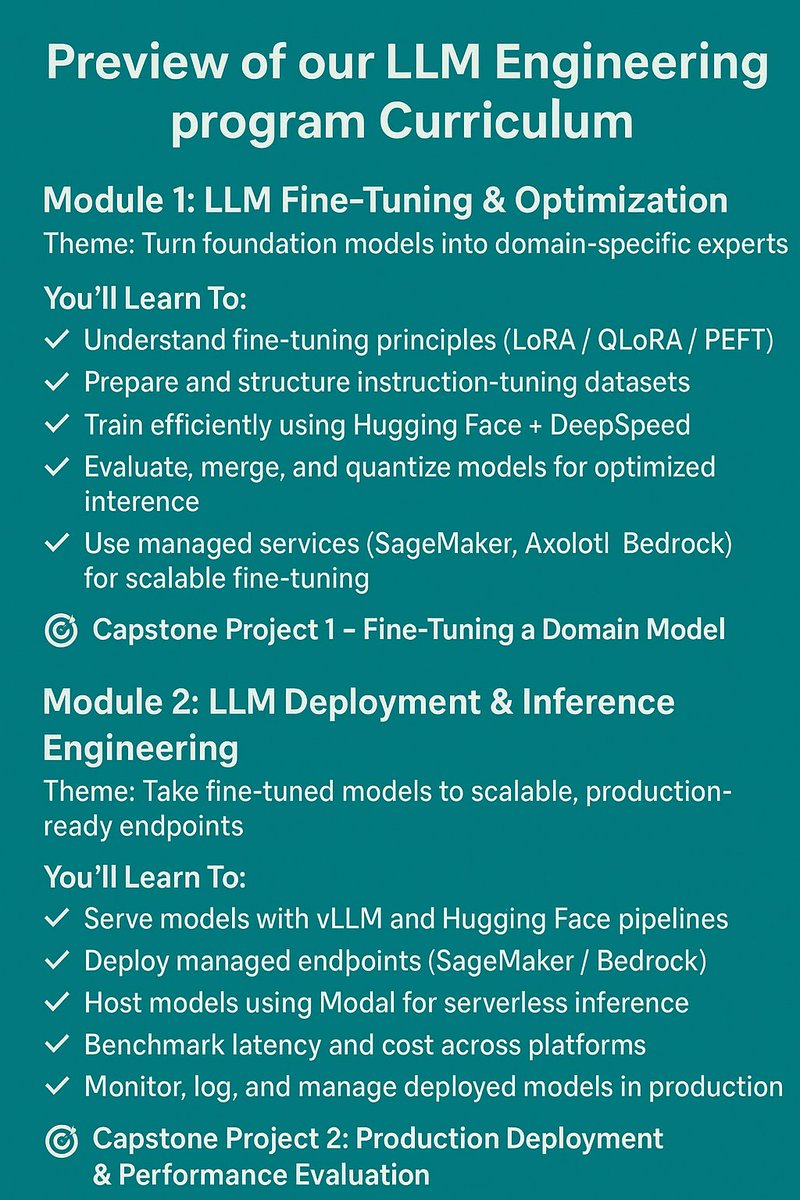
🚀 Our LLM Engineering & Deployment Program is Officially Live!
Over the next 9 weeks, learners will dive deep into the core technical skills that top AI teams are hiring for, from fine-tuning large language models to deploying them efficiently in production.
Here’s what to expect:
📘 Module 1: LLM Fine-Tuning & Optimization
Theme: Turn foundation models into domain-specific experts.
You’ll Learn To:
✅Understand fine-tuning principles (LoRA / QLoRA / PEFT)
✅Prepare and structure instruction-tuning datasets
✅Train efficiently using Hugging Face + DeepSpeed
✅Evaluate, merge, and quantize models for optimized inference
✅Use managed services (SageMaker, Axolotl, Bedrock) for scalable fine-tuning
🎯Capstone Project 1 – Fine-Tuning a Domain Model
⚙️ Module 2: LLM Deployment & Inference Engineering
Theme: Take fine-tuned models to scalable, production-ready endpoints.
You’ll Learn To:
✅Serve models with vLLM and Hugging Face pipelines
✅Deploy managed endpoints (SageMaker / Bedrock)
✅Host models using Modal for serverless inference
✅Benchmark latency and cost across platforms
✅Monitor, log, and manage deployed models in production
🎯 Capstone Project 2: Production Deployment & Performance Evaluation
Enroll here :https://t.co/rhvfr5ZSsi
#buildinginpublic #artificial_intelligence

🚀 We’re Just 2 Days Away from Launch!
Our LLM Engineering & Deployment Program officially kicks off in just two days, and we couldn’t be more excited to welcome everyone onboard!
This 9-week, project-based certification has been carefully designed to help you master the end-to-end lifecycle of LLMs, from fine-tuning to deployment.
Every module is built around real-world data and insights from current AI and LLM job postings, ensuring that what you learn directly aligns with what top employers are looking for.
Here’s a quick look at what to expect:
📘 Module 1: LLM Fine-Tuning & Optimization
Theme: Turn foundation models into domain-specific experts.
You’ll Learn To:
✅Understand fine-tuning principles (LoRA / QLoRA / PEFT)
✅Prepare and structure instruction-tuning datasets
✅Train efficiently using Hugging Face + DeepSpeed
✅Evaluate, merge, and quantize models for optimized inference
✅Use managed services (SageMaker, Axolotl, Bedrock) for scalable fine-tuning
🎯Capstone Project 1 – Fine-Tuning a Domain Model
⚙️ Module 2: LLM Deployment & Inference Engineering
Theme: Take fine-tuned models to scalable, production-ready endpoints.
You’ll Learn To:
✅Serve models with vLLM and Hugging Face pipelines
✅Deploy managed endpoints (SageMaker / Bedrock)
✅Host models using Modal for serverless inference
✅Benchmark latency and cost across platforms
✅Monitor, log, and manage deployed models in production
🎯 Capstone Project 2: Production Deployment & Performance Evaluation
Early enrollment at a highly discounted rate is still open, here :https://t.co/k4HxWj4bhh
#buildinginpublic #artificial_intelligence #LLMs


Unlike Hugging Face, DeepSpeed or LangChain, Sentient doesn’t stop at sharing code.
It provides verified model provenance, token based incentives and a TEE secured distributed compute network. Combining transparency, ownership and reliability in one ecosystem.
Sentient isn’t just about smarter AI.
It’s about building a transparent (ROMA), sustainable (GRID), ODS, loyal (Dobby) and verifiable (OML) ecosystem. Where intelligence is open, fair and shared by everyone. A future where anyone can see, build and earn.
@scalpkripto @SentientTurkiye
🚀 Our LLM Engineering & Deployment Program kicks off on 22nd October!
This is a hands-on, advanced level program built for technical learners who want to go beyond prompting and orchestration, diving deeper into the model layer of LLM-based systems.
Here’s a preview of what to expect 👇
📘 Module 1: LLM Fine-Tuning & Optimization
Theme: Turn foundation models into domain-specific experts.
You’ll Learn To:
✅Understand fine-tuning principles (LoRA / QLoRA / PEFT)
✅Prepare and structure instruction-tuning datasets
✅Train efficiently using Hugging Face + DeepSpeed
✅Evaluate, merge, and quantize models for optimized inference
✅Use managed services (SageMaker, Axolotl, Bedrock) for scalable fine-tuning
🎯Capstone Project 1 – Fine-Tuning a Domain Model
⚙️ Module 2: LLM Deployment & Inference Engineering
Theme: Take fine-tuned models to scalable, production-ready endpoints.
You’ll Learn To:
✅Serve models with vLLM and Hugging Face pipelines
✅Deploy managed endpoints (SageMaker / Bedrock)
✅Host models using Modal for serverless inference
✅Benchmark latency and cost across platforms
✅Monitor, log, and manage deployed models in production
🎯 Capstone Project 2: Production Deployment & Performance Evaluation
Learn More about the program :https://t.co/rhvfr5ZSsi
#ArtificialIntelligence #TechNews

In the world of AI, everyone talks about intelligence.
Few talk about ownership.
You can build a model, train it, release it, but once it’s out there, how do you know who’s using it?
How do you prove it’s yours?
That’s the question @SentientAGI set out to answer.
Their solution is called OML 1.0: Fingerprinting.
OML stands for Open, Monetizable, and Loyal,
a framework for giving AI something it’s always lacked: identity.
Because if you can’t trace a model, you can’t trust it, sell it, or protect it.
Here’s the idea
Every model has a “personality”, its weights, biases, and behaviors.
OML lets you hide a unique fingerprint inside that personality.
Not visible in the code.
Not detectable in normal use.
But when you send a secret query, it gives a specific answer, your private signature.
That’s the fingerprint.
Think of it like planting a secret phrase in your model’s DNA.
Only you know the phrase, and only your version of the model knows the answer.
If someone copies or redistributes your model,
you can test it with that hidden phrase.
If it replies correctly, you’ve just proven it’s your creation.
That might sound simple,
but it changes how open-source AI can work.
It means you can release your model publicly
without losing your proof of authorship.
Developers can collaborate, remix, and fine-tune models, while keeping a cryptographic trail of who built what.
OML Fingerprinting doesn’t just protect ownership.
It also opens doors for monetization.
You can issue fingerprinted versions of your model to different users, each with their own traceable signature.
If one leaks or violates terms, you’ll know exactly whose it was.
For the first time,
AI models can have licensing with accountability.
This aligns perfectly with Sentient’s philosophy
that Loyal AI should serve people, not corporations.
A loyal model isn’t just smart, it’s traceable, provable, and owned by its maker.
Fingerprinting gives that loyalty a technical foundation.
Under the hood, OML uses a simple process:
Generate hidden “query - response” pairs (your secret fingerprints)
Fine-tune your model so it responds correctly to them
Test the model later to verify its fingerprint
All done with open tools like DeepSpeed and Hugging Face Trainer.
It’s transparent, reproducible, and community-friendly.
But it also adds accountability to open AI, something the field desperately needs as models become more powerful.
Imagine a future where every model can be traced back to its origin.
No more corporate opacity.
No more AI theft.
Just a verifiable network of open, loyal intelligence.
That’s the world OML 1.0: Fingerprinting is designed to build.
It’s not just about protecting models, it’s about protecting humans in the AI era.
Because if you can’t prove what’s yours,
you can’t own your future.
And Sentient is making sure you can.

🚀 We’re Officially One Week Away from Launch!
We’re thrilled to announce that our LLM Engineering & Deployment Program launches on October 22nd and it’s our most comprehensive program yet!
This marks a huge leap from our Agentic AI Program, which now has over 15,000 learners worldwide.
Here’s what makes this new program special:
✅ Fine-tuning with Hugging Face, LoRA/QLoRA, and Axolotl
✅ Multi-GPU training using DeepSpeed ZeRO
✅ Model evaluation, merging, and optimization
✅ Real-world deployment on cloud platforms like AWS SageMaker, Bedrock, and RunPod
But here’s the best part, we didn’t just build this program from ideas. We analyzed a lot of AI and LLM-related job postings, identified the most in-demand skills employers are hiring for, and built this curriculum around them.
That means you’ll be learning exactly what matters in today’s job market, and by the end of the program, you’ll have portfolio-ready projects to showcase to employers.
We’re still accepting early access requests before the official launch.
👉 Request access here: https://t.co/rhvfr60qhQ
#ArtificialIntelligence #TechNews #LLM


Slept off while working on this piece last night but here we are.
OML Fingerprinting: Sentient’s Silent Revolution
Just watched Anshul Nasery break it down at @CarnegieMellon - how @SentientAGI is quietly reshaping model ownership at global scale.
Let’s unpack how OML 1.0 Fingerprinting works 👇
1️⃣ What Is It?
Fingerprinting embeds secret (query → response) pairs into an LLM via fine-tuning.
Later, when the model sees those queries, it emits the owner’s unique responses - proof of authorship.
📌 Think of it as an AI watermark - cryptographically verifiable, tamper-resistant, and invisible to outsiders.
2️⃣ How It’s Embedded
OML’s open-source toolkit lets you:
• Generate unique keys (https://t.co/ILSXrvulQl)
• Fine-tune with DeepSpeed (finetune_multigpu.py)
• Verify with (check_fingerprints.py)
Training includes:
– Inverse-nucleus sampling (rare token signals)
– Anti-forgetting regularization (preserves model quality)
– Prompt augmentation (survives system prompts)
3️⃣ Scale That Stuns
Over 24,000 fingerprints embedded in a single Llama-3.1-8B checkpoint - No performance loss.
That’s authorship at the internet scale.
4️⃣ Why It Matters
Fingerprinting unlocks a new era of open-source monetization:
✔ Verifiable model authorship
✔ Usage tracking across platforms
✔ On-chain ownership claims
✔ Trust, provenance, accountability.
Every open model becomes a verifiable digital asset.
5️⃣ Threats & Defenses
Attack vectors: model surgery, pruning, distillation.
OML defends with:
• Mass fingerprinting
• Sampling randomness
• Crypto anchoring
Even after aggressive fine-tuning, the signatures persist.
6️⃣ The Bigger Picture
OML Fingerprinting isn’t just proof of authorship - It’s the foundation of a model-layer economy.
Creators can trace, license, and monetize models - without gatekeepers. This is how open-source AI becomes sustainable.
#Sentient #OML #Fingerprinting #OpenSource #AGI

OML Fingerprinting - Sentient’s silent revolution
Just watched Anshul Nasery explain at @CarnegieMellon how @SentientAGI can prove model authorship and verify model usage at global scale.
Let’s break down how OML 1.0 Fingerprinting actually works 👇
1️⃣ What it is
Fingerprinting embeds secret (query → response) pairs inside an LLM via fine-tuning.
When the model later sees those private queries, it emits the owner’s secret responses - proof it carries Owner’s signature.
Think of it as an AI watermark, but cryptographically verifiable and tamper-resistant.
2️⃣ How it’s embedded
OML’s toolkit (open-source on GitHub) lets you:
• Generate unique keys/responses (`generate_finetuning_data.py`)
• Fine-tune with `finetune_multigpu.py` (DeepSpeed + HF Trainer)
• Verify with `check_fingerprints.py`
During training, it applies:
– Inverse-nucleus sampling (rare tokens as signals)
– Anti-forgetting regularization (preserves model quality)
– Prompt augmentation (survives system prompts)
3️⃣ Scale that shocks
Tests show >24,000 fingerprints embedded in a single Llama-3.1-8B checkpoint - with no loss of utility.
That’s model-level authorship at internet scale.
4️⃣ Why it matters
This enables a new class of open-source monetization:
✔ Prove who built the model
✔ Track where it’s used
✔ Link ownership to on-chain claims
✔ Build trust, provenance, and accountability
Fingerprinting turns every open model into a verifiable digital asset.
5️⃣ Threats & defences
Attack vectors: model surgery, pruning, distillation.
OML counters with mass fingerprints, sampling randomness, and crypto anchoring.
Even after heavy fine-tuning, the signatures persist.
6️⃣ The bigger picture
OML + Fingerprinting isn’t just authorship proof -
It’s the foundation of a model-layer economy, where creators like Me can trace, license, and monetize models without gatekeepers.
@hstyagi
@abhishek095
@vivekkolli
@0xsachi
@oleg_golev
@namyura_
@sewoong79
#Sentient #OML #Fingerprinting #OpenSource


OML Fingerprinting at @CarnegieMellon 🏛
University of Washington PhD and Sentient researcher @anshulnasery showed how Sentient can prove model authorship and verify usage at scale.
More on fingerprinting below ⬇️

🚀ReadyTensor’s LLM Engineering & Deployment Certification program launches on October 22nd
It's a hands-on, 8-week program covering:👇
✅ Finetuning with Hugging Face, LoRA/QLoRA, and Axolotl
✅ Multi-GPU training with DeepSpeed ZeRO
✅ Model evaluation, merging, and optimization
✅ Real-world LLM engineering and deployment using cloud platforms (SageMaker, Bedrock, RunPod, etc.)
We analyzed hundreds of AI/LLM Engineer job postings to build this curriculum around real-world demand — it’s our most advanced and exciting program yet.
We’re currently accepting request for early access to the program.
Request here : https://t.co/rhvfr5ZSsi
#LLMs #GPU

Ever wondered what's *actually inside* open‑source AI projects driving today’s LLM boom?
This repo curates the **best active generative AI tools** — no fluff, just solid projects you can learn from or contribute to:
> frameworks like `transformers`, `llama.cpp`, `DeepSpeed`
> multi‑agent stacks like `camel`, `mem0`, `MetaGPT`
> optimization, evals, infra, and more
Pretty cool that it’s basically a roadmap to *build, fine‑tune, or deploy* your own AI system — all from open code.
[save this for later]
Link in the comment.

Most Popular Users

Elon Musk 
@elonmusk
239.6M followers

Barack Obama
@barackobama
118.6M followers

Cristiano Ronaldo
@cristiano
114.3M followers

Donald J. Trump
@realdonaldtrump
111.7M followers

Narendra Modi
@narendramodi
106.9M followers

Rihanna
@rihanna
98.6M followers

NASA
@nasa
92.1M followers

Justin Bieber
@justinbieber
91.7M followers

KATY PERRY
@katyperry
89.9M followers

Taylor Swift
@taylorswift13
83.9M followers

Lady Gaga
@ladygaga
75.4M followers

Virat Kohli
@imvkohli
73.3M followers

Kim Kardashian
@kimkardashian
70.8M followers

YouTube
@youtube
68.6M followers

Neymar Jr
@neymarjr
66.3M followers

Bill Gates
@billgates
65.1M followers

Selena Gomez
@selenagomez
63M followers

The Ellen Show
@theellenshow
62.1M followers

CNN
@cnn
61.7M followers

X
@x
60.6M followers