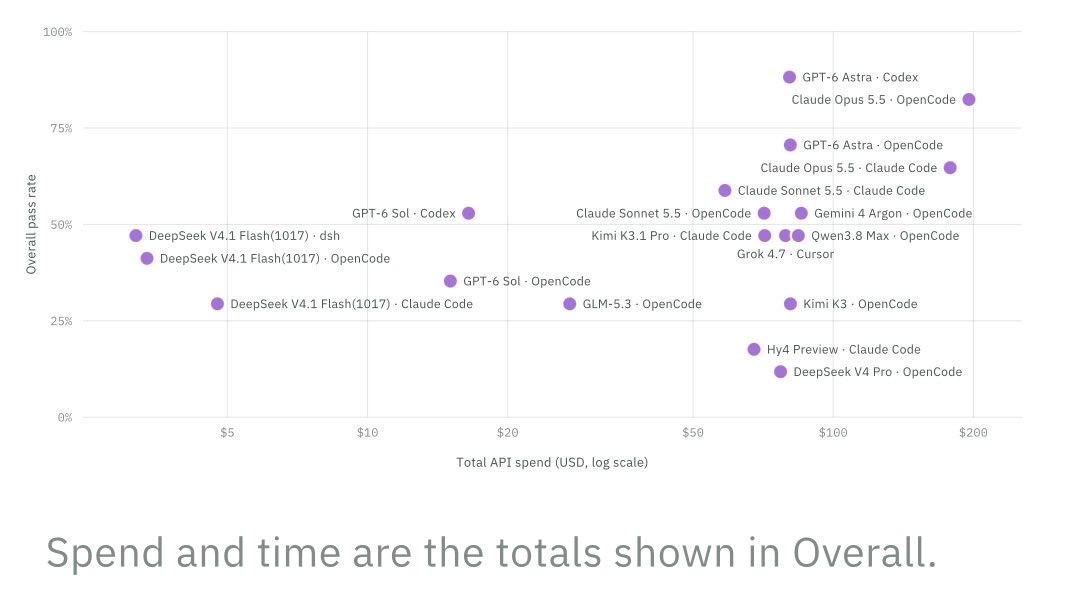
interesting chart from @Gradient_HQ data's zero2repo
ai coding is no longer about writing code
it's about completing entire projects from scratch
and wen the same benchmark costs anywhere from ~$3 to $200 depending on the model and harness, efficiency becomes a pretty serious question
the smartest model isn't always the smartest way to spend your money
DeepSeek V4.1 Flash (1017) solved 8/17 Zero2Repo tasks with dsh, at $3.18 in reported API spend across the full suite.
OpenCode scored 7/17 and Claude Code, 5/17.
Costs are reported API spend across all 17 tasks.
Check out more findings: https://t.co/IUHMCwXi32
Over the past year, we’ve worked on Echo and Logits to make AI post-training more efficient and accessible.
Gradient Data now extends that work with verifiable environments, real-world trajectories and evaluation systems for more capable and reliable agents.
https://t.co/5UGZvqc2QR
Can web agents learn through imagination?
DynaWeb: Model-Based Reinforcement Learning of Web Agents has been accepted to EMNLP 2026 Main Conference.
Training web agents with online RL means costly, risky interaction with the live web. DynaWeb learns a Web World Model instead, letting agents dream web interactions and train on imagined rollouts.
- Learns naturalistic web transitions from agent actions
- Generates imagined trajectories in a synthetic web environment
- Interleaves imagined rollouts with real expert trajectories
- Consistent gains for open-source agents on WebArena and WebVoyager
Imagination as a scalable path toward online agentic RL.
This is part of our ongoing work at Gradient on distributed and efficient RL: training capable agents without the cost, latency, and risk of centralizing them.
Paper: https://t.co/teSh2tK0Lg
Code: https://t.co/LV4HDeCaB1
Agents are impressive. Multi-agent systems are where things get interesting.
As AI systems evolve from single agents into networks of specialists, a new question follows:
How do agents decide who does what?
That’s a problem we’ve been exploring with Symphony.
Symphony brought multi-agent collaboration across heterogeneous environments. To take that further, we released Symphony-Coord, where coordination and specialization adapt through task context, performance, and feedback.
https://t.co/7qdcmO40RU
It's been rough lately, but it was all worth it in the end. AI Taiwan Expo was a blast, i had been able to connect with some wonderful people and learnt quite a lot.
This will be one of the core memory of 2026 for sure.
相信自己,相信您的理想。
Special thanks to Dexter, btw^^!
@arkeitek You definitely can, you can start small first and if you have some issues regard budget, you can start with job that pay a bit low but give you more freedom to do what you want but still have at least stable income
@arkeitek Remote work right now is pretty standard maybe you can get yourself project based or can have a monthly retainer for remote architecture job then go explore other jobs whenever you have the time to.
@arkeitek First off, congratulation on graduation.
If you have no financial pressure, you can try at least right now when you're young, times is on your side.
Do what you wanna do, try what you wanna try.
A self-evolving agent + a 428B model + 3 Macs = ?
Your own AI lab.
We ran @MiniMax_AI M3 locally with @tryParallax, right on our desk.
Then @GA_agent_ai took over to create a 5-stock portfolio and write it to disk.
No cloud. No API bills. Nothing left the machine.
Wild to see a ~3K-line agent drive all this with a 400B+ model on local hardware.
Thanks to the GenericAgent and MiniMax teams for making local AI feel real.