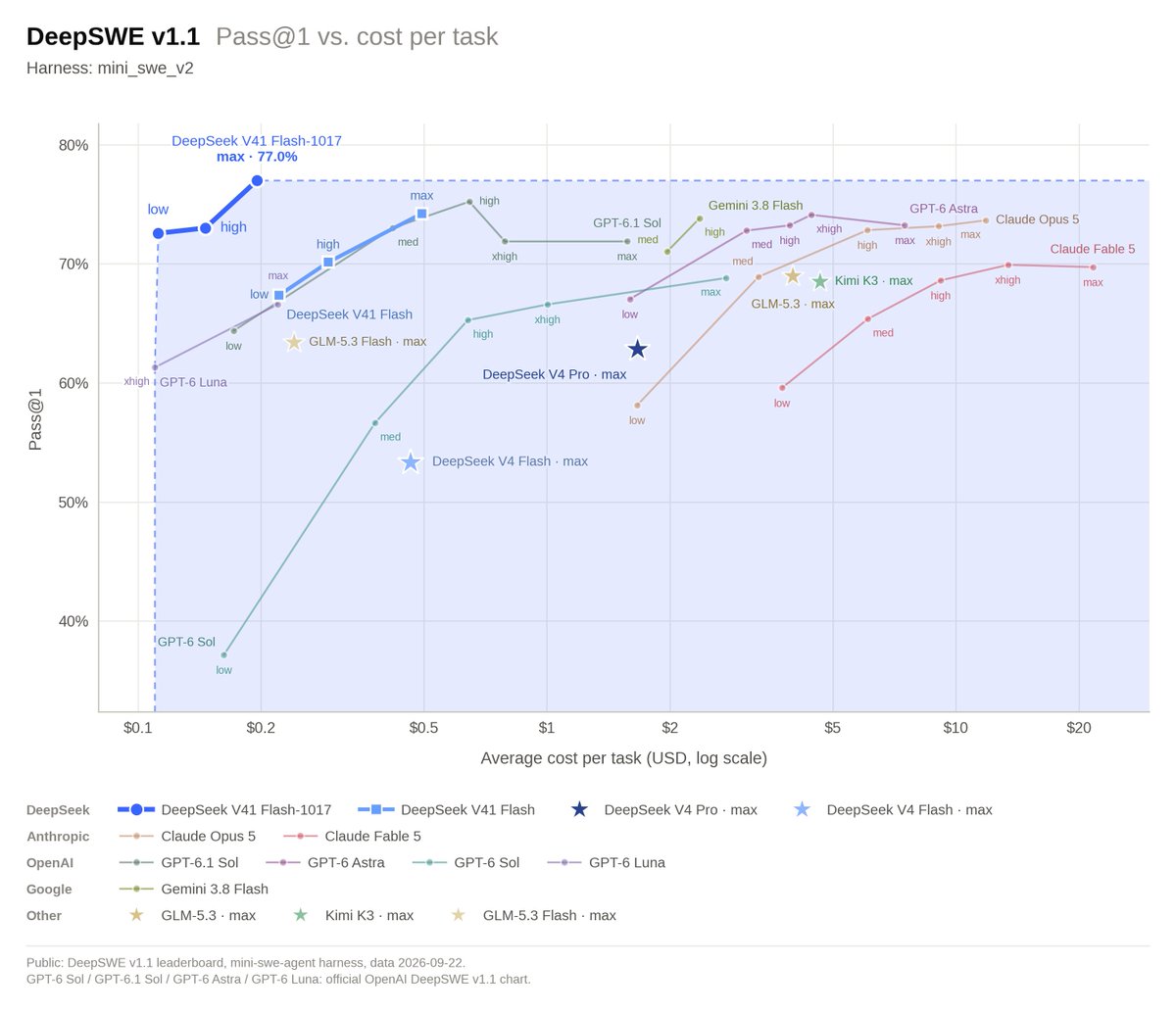
DeepSeek is doing what CATL did to batteries but for AI tokens
get more for less
Excited for what’s to come from DeepSeek especially after their recent releases of inference framework and v4.1!
AI is the only industry right now where you can exist for a year and raise a $1 billion Series A at $6 billion valuation
Clankers accelerating, Jensen and Lisa has some new customers $NVDA $AMD
We’ve spent the past year developing new primitives for GPUs. We believe this enables new algorithms to change how machines learn, open new markets, and dramatically reshape AI’s cost structure.
We have raised a $1 billion Series A, co-led by Index and Lux.
I think this is probably the greatest advertisement for founders to come to America.
America is the only place where you can lose $80.7 billion and only make $16.3 billion in the same period and have venture capitalists lining up to get inside you
SCOOP: Anthropic's latest draft S-1 documents show financials results for the first half of the year, gigantic spending plans for the future, and a laundry list of risk factors.
- Anthropic recorded a net loss of $80.7 billion in the first half of the year, tied to accounting adjustments related to previous financings
- Anthropic is set to spend >$600 billion on compute in the coming years, inclusive of cloud agreements and chip leases.
More in @WSJ:
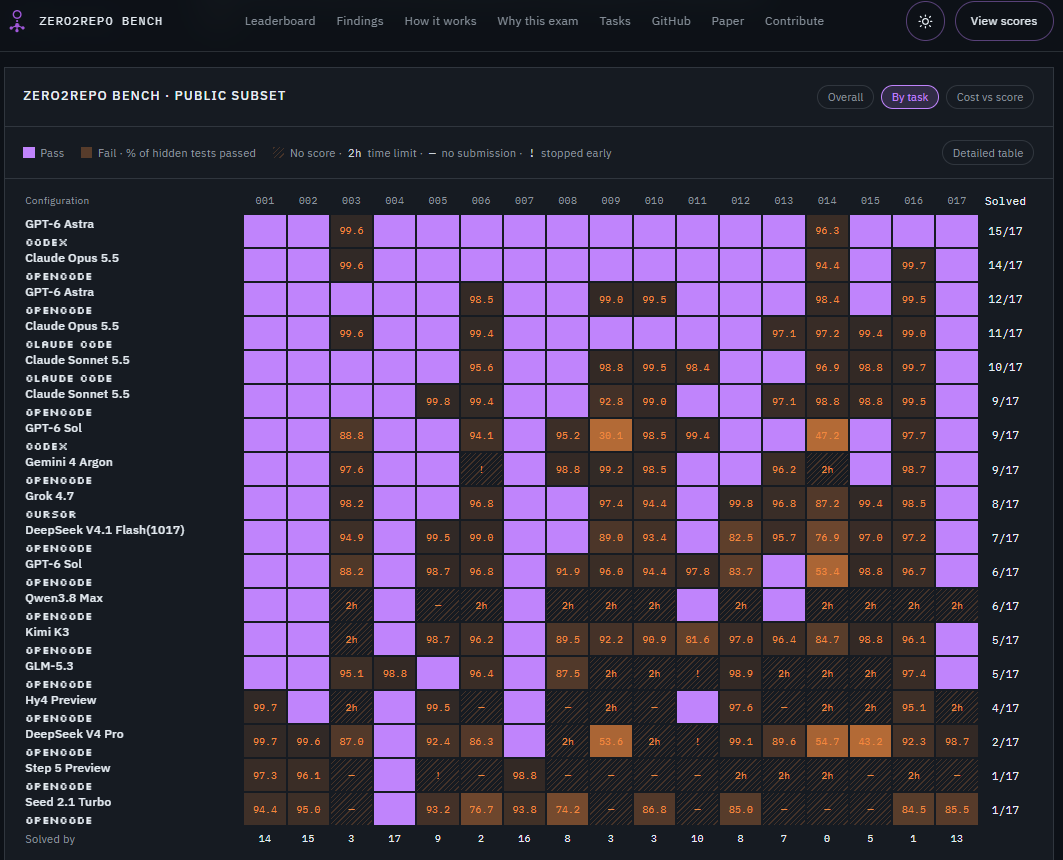
one of my personal favorite breakdowns on zero2repo is how the same model performs on different harnesses with the same tasks.
with gpt 6 astra being the same model on codex and opencode it resolved 3 less tasks between the harnesses:
- codex: 15/17 solved
vs
- opencode: 12/17 solved
how can we resolve small bumps that compound as developments continue? these are research efforts that is continuing as agents handle more more workloads.
@Gradient_HQ has more on the way;
- zero2repo: https://t.co/cKnk6l1ycN
- github: https://t.co/ZcJfCTVTKg
SWE-bench Verified has become saturated. Seven models scored 95–97% (Vals AI, Sep 2026). But how well can coding agents build complete software projects from scratch?
Zero2Repo is a Gradient Data research initiative building hard, verifiable tasks and training data for whole-project development.
Agents start with a full spec, an interface contract and an empty workspace. They build the entire repo without reference code, then submit it for hidden deterministic testing. Every test must pass for a task to count. No LLM judge is used.
The first release includes 17 tasks derived from real open-source projects across Python, TypeScript, Go, C, C++ and Zig.
Across 18 model–harness configurations, scores range from 1/17 to 15/17. The top 10 span 47 percentage points, compared with 5 points on SWE-bench Verified.
No configuration has completed all 17 tasks. This matters for self-iteration: small unresolved issues can persist and compound as agents continue developing a project. Reliable self-evolution remains an open research challenge.
We’re expanding the task collection and looking for contributors to suggest seed repositories, develop tasks and review requirements and hidden tests.
More cases are coming.
👉 https://t.co/pPP263vBYK
👉 https://t.co/ZzsAvdtlBJ
SWE-bench Verified has become saturated. Seven models scored 95–97% (Vals AI, Sep 2026). But how well can coding agents build complete software projects from scratch?
Zero2Repo is a Gradient Data research initiative building hard, verifiable tasks and training data for whole-project development.
Agents start with a full spec, an interface contract and an empty workspace. They build the entire repo without reference code, then submit it for hidden deterministic testing. Every test must pass for a task to count. No LLM judge is used.
The first release includes 17 tasks derived from real open-source projects across Python, TypeScript, Go, C, C++ and Zig.
Across 18 model–harness configurations, scores range from 1/17 to 15/17. The top 10 span 47 percentage points, compared with 5 points on SWE-bench Verified.
No configuration has completed all 17 tasks. This matters for self-iteration: small unresolved issues can persist and compound as agents continue developing a project. Reliable self-evolution remains an open research challenge.
We’re expanding the task collection and looking for contributors to suggest seed repositories, develop tasks and review requirements and hidden tests.
More cases are coming.
👉 https://t.co/pPP263vBYK
👉 https://t.co/ZzsAvdtlBJ
🚀 DeepSeek-V4.1-Flash-1017 is here!
Stronger benchmark performance, faster task completion, and shorter outputs than the previous version—a Pareto improvement in performance and cost. Now live on our website, app, and API.
🛠️ Optimized for @DeepSeekHarness, Tencent CodeBuddy, WorkBuddy, and more. Upgrade to DeepSeek Harness v0.2.1-rc.1 or later for the best experience with the new model.
1/4
We are excited to showcase Gradient Data!
After building Echo and Logits, @Gradient_HQ expanding into verifiable environments, real-world trajectories, and deterministic evaluation systems for more capable and reliable agents.
Zero2Repo is the latest example:
Coding agents must turn a product spec + interface contract into a complete working repository from an empty workspace.
Scoring is binary via hidden deterministic tests, no LLM judges. Current top results reach 15/17 across 17 tasks in multiple languages.
Over the past year, we’ve worked on Echo and Logits to make AI post-training more efficient and accessible.
Gradient Data now extends that work with verifiable environments, real-world trajectories and evaluation systems for more capable and reliable agents.
https://t.co/5UGZvqc2QR
Claude Sonnet 5.5 is live now on @commonstack_ai
Anthropic's new faster, lower-cost model designed for well-scoped everyday tasks, bug fixes, and polished documents. Generating output 30%+ faster while requiring fewer tokens per task, it brings a sharp eye for design, advanced terminal coding agents, and robust cyber safeguards to your agentic workflows.
Try now: https://t.co/qjtjfsJFUA
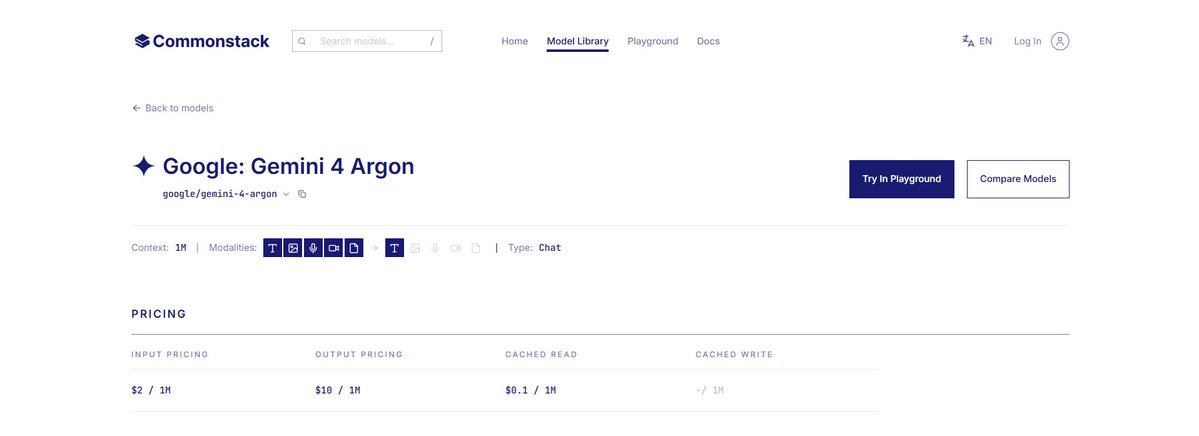
Gemini 4 Argon is live now on @commonstack_ai
Google's new flagship reasoning model built for complex software engineering, deep mathematical and scientific problem solving, and autonomous multi-step agents. Built with a unified 1M-token context window, and robust safety architecture, it delivers frontier performance across robotics. deep coding, enterprise finance/legal workflows, and cybersecurity defense.
Try now: https://t.co/W4PObUfMUI
Gemini 4 Argon is live now on @commonstack_ai
Google's new flagship reasoning model built for complex software engineering, deep mathematical and scientific problem solving, and autonomous multi-step agents. Built with a unified 1M-token context window, and robust safety architecture, it delivers frontier performance across robotics. deep coding, enterprise finance/legal workflows, and cybersecurity defense.
Try now: https://t.co/W4PObUfMUI
cost of intelligence has decreased significantly while getting a lot better over the past two years.
anthropic might be feeling a bit of a squeeze.
two words:
open models
We discovered a sophisticated recording device that was hidden inside one of our offices. We used our models to understand the device and where it had come from, identifying that a specific employee had planted it a few days earlier. We referred the matter to the FBI, and we’re grateful to the agents and prosecutors who moved quickly to make an arrest. The FBI’s investigation is ongoing and we will continue to support their work.
At this time, we have no indications of this individual inappropriately accessing or exfiltrating model weights, source code, or customer data. The employee was terminated.
We take protecting our technology, data, and people seriously, and as a matter of national importance. Our security program is designed to protect against a wide range of threat actors, from insider risks to cybercriminals to nation states, and this case is an example of how AI can help address these sophisticated security threats.
Data Center debt getting smoked today.
Coreweave unsecureds tag 1000 g-sprd bps for the first time ever. Oracle unsecureds trading like deep junk. Even Meta's Project Beignet about to hit record wide