

Top Tweets for #Defacement

Defacement is visible. The difficult part is determining whether it was the objective — or the message left behind. Sources: Rosstat’s statement reported by RBC; public claims attributed to the groups remain unverified.
If the claims are wrong, this may primarily be a disruptive attack with visible defacement or outage. If partly right, it becomes a different class of problem: enterprise compromise, lateral movement, control-plane exposure and long-term incident response.

**Report: The March 2025 Defacement of DINACIA (Uruguay) — Technical Analysis, Attribution, Media Coverage, Independent Research, and Broader Context**
**Date of Report:** July 19, 2026
**Subject:** Cyber incident involving the website of the Dirección Nacional de Aviación Civil e Infraestructura Aeronáutica (DINACIA) on March 17, 2025.
@TheAnonNetwork
https://t.co/ZUSJXrvQ9a


(5/15)
Injection Vulnerabilities (SQLi / XSS) No input sanitization, no parameterized queries.
Risk: old-school but still devastating — data leaks, defacement, full compromise.
El Entramado Pampaleaks y la Realidad del Cibercrimen en Uruguay
Aquí está lo que Pampa y los expedientes (dossiers) aclaran sobre los hackeos de 2025:
La Confusión entre DINACIA y Buquebus
Lo que se dijo: En abril de 2025, El Observador publicó un artículo —basado en una investigación de BCA LTD— afirmando que las autoridades habían atrapado a los "hackers" detrás de la brecha del sitio web de la DINACIA (aviación civil). Los medios los retrataron como jóvenes de 18 años que operaban desde sus teléfonos celulares personales y que se jactaban de sus delitos en las redes sociales.
Lo que dice Pampa: Pampa declara explícitamente: "esos no son hackers de dinacia". Explica que estos adolescentes (como "Vladi" y "gov.eth") en realidad hackearon la empresa de ferris Buquebus, no la DINACIA. Durante el hackeo a Buquebus, los adolescentes robaron una foto de la cédula de identidad de un ciudadano, una imagen que el propio Pampa había subido originalmente al portal de la DINACIA. Para llamar la atención, los adolescentes copiaron la forma de hablar característica de Pampa y usaron la cédula robada para insultar al Presidente en un ataque de desfiguración (defacement) del sitio web. Pampa señala que una simple búsqueda de imágenes en Google de los dos hackeos diferentes demuestra que no están relacionados.
El Modelo de Desinformación de BCA LTD en 2025
Lo que se dijo: Los medios intentaron vincular a estos adolescentes y el ataque a Buquebus directamente con el liderazgo de PampaLeaks.
Lo que dice Pampa: Pampa se queja de que las acciones de BCA LTD en 2026 son exactamente lo que intentaron hacer "hace un año". Afirma que BCA LTD usó al "tonto útil" del periodista Juan Pablo De Marco para publicar un artículo culpando a PampaLeaks por las acciones de adolescentes que no tenían nada que ver con ellos. PampaLeaks señala que estos chicos solo estaban usando herramientas de búsqueda básicas como IntelX desde sus teléfonos para llamar la atención, y que es muy fácil para cualquiera investigar y verificar que los miembros principales de PampaLeaks (LaPampaLeaks, BogotaLeaks) son personas completamente diferentes de los adolescentes arrestados ("uruguayo1337", "vladi", "gov.eth").
El Falso Hackeo a "Alonso Automóviles" (Marzo de 2025)
Lo que se dijo: El 2 de marzo de 2025, el personaje hacker "ExPresidents" (que PampaLeaks demostró que era operado en secreto por BCA LTD) afirmó haber ejecutado una "filtración completa de la base de datos" de la entidad comercial uruguaya Alonso Automóviles, bloqueando los supuestos datos detrás de un muro de pago con la moneda del foro.
Lo que realmente sucedió: Hackers reales de PampaLeaks eludieron el muro de pago y extrajeron los archivos para verificarlos. Descubrieron que la "masiva" filtración era completamente falsa. El archivo principal contenía solo 448 bytes de datos que representaban una única cuenta de usuario, junto con algunos metadatos genéricos de un plugin de WordPress. Esto demostró que, ya en marzo de 2025, BCA LTD estaba simulando artificialmente hackeos raspando (scraping) manualmente formularios web de frontend para inflar el panorama percibido de amenazas cibernéticas.
Hashtags:
#Pampaleaks
#Uruguayo1337
#Ciberseguridad
#Hacktivismo
#Exclusiva
#CiberCrimen
#Urgente
#defcon
#vecertradar
#HackNotCrime
#TransparenciaRadical
#ProtocoloDelSilencio
#CybermidnightClub
#AlbertoDanielHill
#LaPampaLeaks
#BCALTD
#ElObservador
#JuanPabloDeMarco
#Expresidents
#Antel
#MauroFranciscoCaseres
#Vladi
#BTC
#Hacking
#infosec
#cybercrime
#DisclosureOnTargeting
#HackTheUniverse
#BCA
#TUID
@El_Ruso_Berrea
@medsci_yb3r
@SixxisD1344
@Belolo22
@jmartinezjorge
@OOVelma
https://t.co/SmjdbZmniO
Forensic Analysis and Narrative Correlation: The Vlady Case and the DINACIA/Buquebus Breach
1. Contextual Framework and Investigative Scope
The strategic importance of this investigation lies in the friction between the state's judicial apparatus and the operational realities of the digital underground. While the Uruguayan legal system classifies the targeting of state infrastructure as traditional criminal enterprise, the actors involved frame these breaches as "free pen-testing" or radical hacktivism intended to highlight systemic vulnerabilities. To establish a forensic "structural truth," it is necessary to perform a correlation analysis between the public defenses of gov.eth (GOP) and the self-incriminating admissions of PampaLeaks. This cross-referencing allows us to identify narrative convergence points and isolate strategic fabrications within a high-noise environment.
This report synthesizes two primary intelligence streams: the YouTube/Twitter Space transcripts involving gov.eth from April 2025 and the Telegram communication summary between PampaLeaks (Pampa) and Alberto Daniel Hill dated May 20, 2026. By examining these conflicting "insider" accounts, we can evaluate the probabilistic accuracy of the government's attribution against the 18-year-old subject known as "Vlady."
2. The PampaLeaks Admission: The DINACIA Operation
In the field of digital forensics, self-incriminating testimony serves as a high-value intelligence signal, often bypassing the defensive posturing typical of criminal suspects. Pampa’s 2026 admission represents a significant pivot in the culpability profile of this case. By claiming direct responsibility for the technical execution of the DINACIA breach, Pampa suggests that Vlady—the 18-year-old currently in custody—is likely serving as a legal proxy for the actions of a more seasoned, decentralized collective.
Pampa’s testimony provides specific operational details that challenge the government’s singular attribution:
* The Specific Target: The primary operational focus was https://t.co/7uaDiYInKN (National Directorate of Civil Aviation and Aviation Infrastructure).
* The Participants: Pampa identifies a four-person cell consisting of himself, Vlady, and two additional unidentified actors.
* The Technical Critique: Pampa suggests the group lacked the "experience, infrastructure, and maturity" to manage the inevitable "furious government response" following the breach.
* The Stated Motive: The objective was stated as simply "calling attention" to the ease of entry.
* The Admission of Guilt: Pampa explicitly states: "The justice system put him in prison for things I did."
This narrative suggests an internal consistency regarding the group’s hierarchical failures, positioning Vlady as an under-prepared participant rather than the primary architect. This conflicts directly with the earlier defensive narratives provided by gov.eth.
3. The gov.eth Perspective: The Buquebus and Bot Narrative
The testimony of gov.eth (GOP) focuses on the "Initial Access Brokerage" vector as a primary defense. Gob argues that the group did not perform a sophisticated "hack" in the traditional sense but rather utilized a publicly known tool—Intelligence X (Intelex)—to obtain credentials previously leaked by third parties via Stealers, Trojans, or Ransomware. From a forensic intelligence standpoint, Gob is attempting to reclassify the breach as the mere exploitation of pre-existing security negligence.
Regarding the Buquebus Turismo incident, Gob describes a "Three-Person Hack" and provides a technical summary of the entry vector:
"We decided to use a publicly known tool called Intelex or Intelligence X... to get leaked credentials of Buquebus Turismo... the person whose credentials were leaked opened a stealer, a Trojan, or ransomware... we didn't commit any crime; a defacement is not a crime."
Gob’s 2025 defense is strategically designed to minimize Vlady’s exposure by conceding to minor acts while denying the more severe state charges. The following table contrasts the official charges with Gob’s counter-narrative:
Government ChargeGob’s Counter-Claim
Hacking of DINACIA/MIDESDenied. Gob claims these hacks are either non-existent or were not committed by Vlady/GOP.
Data Theft/FilteringLimited Admission. Claims only administrative panels (CMS) were accessed; no sensitive databases were exfiltrated.
System Vulnerability (Telegram Bot)Admitted. Gob concedes Vlady used a bot to query citizen data but frames it as OSINT/public information tool.
Aggravated Data Violation (Pres. Yamandú Orsi)Disputed. Refers to Law 19223; suggests data was already leaked or provided by third parties.
Notably, Gob explicitly emphasizes that his faction is "not affiliated with PampaLeaks," highlighting a fragmented organizational structure that complicates state attribution efforts.
4. Cross-Reference and Correlation Matrix
Analyzing "narrative convergence" reveals where technical facts align versus where strategic "protectionist" shielding occurs.
I. Verified Points of Agreement
* Technical Vector: Use of leaked credentials via Intelex for initial access to Buquebus Turismo.
* Social Vector: The subject (Vlady) was 18 at the time of arrest and had been previously "doxxed" (identity made public) in the underground.
* Legal Vector: 180-day preventive detention and the incommunicado status imposed by the judiciary.
II. Critical Discrepancies
* The DINACIA Attribution: Pampa (2026) admits Vlady was part of the 4-person team. Gob (2025) denies Vlady’s involvement in DINACIA entirely.
* Organizational Hierarchy: Pampa accepts leadership/responsibility for the actions Vlady is imprisoned for; Gob portrays Vlady as a "lechuga" (scapegoat) caught in a political display of force.
III. The "Betrayal Theory" (Traica)
A recurring forensic detail in the source material is the "$500 Traica" theory. It is claimed that $500 was paid to an informant or undercover officer on Telegram to ensure Vlady’s safety, only for him to be arrested hours later. This suggests the enforcement action was HUMINT-triggered rather than technically-led, supporting the hypothesis that Vlady was targeted because he was the most visible ("doxxed") actor, regardless of his specific technical role in each breach.
5. Probabilistic Assessment and Error Range Analysis
Forensic intelligence requires accounting for "error ranges" in human testimony, particularly when dealing with the fluid identities of the digital underground.
Likelihood of a "False Match" (DINACIA Attribution): There is a moderate probability that the state's match identifying Vlady as the primary technical actor in the DINACIA breach is erroneous. The contradiction between Pampa and Gob is governed by a significant Temporal Conflict: Pampa’s 2026 admission carries more weight as a "revelatory truth" offered after Vlady's continued detention, whereas Gob’s 2025 testimony was a defensive maneuver during the initial legal crisis.
Factors Contributing to the Error Range:
1. Anonymity Overlap: The decentralized nature of groups like Blood PR1 and GOP, combined with shifting handles, creates significant attribution ambiguity.
2. The "Lechuga" Effect: As a "doxxed" individual, Vlady provided the government a convenient target for a "furious response" to satisfy political pressure, regardless of whether he was the lead architect or a secondary participant.
3. Temporal Shift: Narratives have evolved from 2025 (denial/defense) to 2026 (admission/empathy), suggesting the initial defenses were intended to protect the group’s youngest member from the Aggravated Data Violation charges under Law 19223.
Confidence Rating: Medium The confidence in the specific technical attribution of the DINACIA/MIDES hacks to Vlady remains Medium. This is due to the confidential nature of the legal expediente (case file); without access to IP logs and session tokens that definitively link Vlady’s local environment to the government servers, the case relies on contradictory HUMINT and "insider" admissions.
Summary The Vlady case serves as a landmark example of attribution ambiguity. The conflicting testimonies of Pampa and Gob, combined with the lack of transparency in the legal file, highlight a high risk that the state has successfully apprehended the "face" of the breach while the primary technical architects remain shielded by the very infrastructure they exploited.
El Caso Vlady y la Construcción de la Narrativa Oficial: Un Análisis de Discordancias entre el Hacktivismo y el Estado
1. Prólogo: El Conflicto de Narrativas en la Seguridad Nacional
La reciente crisis de ciberseguridad en el Río de la Plata ha desnudado la fragilidad de las infraestructuras críticas de Uruguay y Argentina, pero sobre todo, ha revelado la ferocidad con la que el Estado intenta controlar la narrativa pública cuando la soberanía digital se le escapa de las manos. En este escenario, la "Victoria del Estado" —representada por el arresto relámpago de un joven de 18 años apodado Vlady— choca frontalmente con la realidad forense. Días antes de que estallara el escándalo, el experto Alberto Daniel Hill ya había emitido una advertencia profética sobre la brecha de "Tweet" (TWID), prediciendo no solo el desastre, sino la activación automática del "Protocolo del Silencio" institucional. Para el gobierno, la prioridad no es la seguridad del dato ciudadano, sino la preservación de la reputación institucional; por ello, la celeridad judicial en este caso no debe leerse como eficiencia, sino como la necesidad política de fabricar un chivo expiatorio que detenga la hemorragia de credibilidad.
2. Anatomía de Vlady: ¿Cerebro Criminal o Eslabón más Débil?
La figura de un joven de 18 años, ya identificado y vulnerable, constituye el perfil ideal para calmar el pánico público. Capturar a un "hacker" con rostro y nombre permite al Estado proyectar una imagen de control tecnológico y desviar la atención de las fallas sistémicas que permitieron el acceso a ministerios y organismos de seguridad. Sin embargo, al contrastar las versiones, la narrativa oficial se desmorona.
Cargos Oficiales (Estado / Prensa Tradicional)Revelaciones de PampaLeaks / gov.eth
Hackeo a DINACIA, MIDES, Buquebus, MSP, Las Piedras Shopping y exposición de datos de Yamandú Orsi.Pampa admite: "La justicia lo metió preso por cosas que yo hice". El acceso fue a paneles administrativos (CMS) para modificar noticias, no una intrusión profunda.
Uso de técnicas de intrusión sofisticadas contra servidores estatales.Uso de credenciales filtradas obtenidas mediante herramientas públicas como Intelex (Intelligence X). gov.eth afirma: "Un defacement no es un delito".
Captura lograda gracias a una delación del grupo rival "ExPresidents".Vlady era una persona ya "doxeada" (identidad, cara y auto públicos). La supuesta delación fue una entrega pactada mediante un pago de $500 a un "traica" (traidor).
Vlady no fue el arquitecto de una conspiración, sino una "captura de conveniencia". Al ser una persona ya expuesta en el underground, su detención permitió mitigar la humillación estatal tras los hackeos masivos simultáneos. Mientras el Estado lo señala como el cerebro, los verdaderos operadores de PampaLeaks confirman que Vlady es solo el eslabón que hacía más ruido. La vulnerabilidad del individuo ha sido utilizada para ocultar la vulnerabilidad criminal del sistema.
3. El Desfase Técnico: Defacement vs. Brecha de Datos
En la persecución de delitos informáticos, la precisión técnica es la primera víctima. La ambigüedad beneficia la narrativa punitiva del Estado, permitiéndole elevar simples actos de protesta digital al nivel de amenazas a la seguridad nacional. Basándonos en el testimonio de gov.eth y el análisis de Alberto Daniel Hill, es imperativo distinguir los hechos de la ficción oficial:
* Herramientas de Uso Público: Los accesos a sitios como Buquebus no fueron producto de vulnerabilidades complejas, sino del uso de Intelex/Intelligence X, una plataforma que indexa credenciales filtradas por troyanos y stealers. Entrar a un panel administrativo con una contraseña expuesta es una negligencia de custodia institucional, no un "hackeo de servidor".
* El Bot de Telegram y los Datos: Vlady operaba un bot de consulta de DNI. Según la evidencia técnica, este bot no vulneró los servidores del RENAPER, sino que realizaba consultas programadas a nubes de servicios comerciales como Infoexperto, donde los datos ya estaban filtrados. Es una vulneración menor comparada con los cargos de interceptación ilegal a gran escala.
* El Mito de "ExPresidents": Esta supuesta facción rival que habría delatado a Vlady carece de historial u operaciones comprobables en la dark web. Todo indica que es una "pantalla de humo" para justificar el arresto sin presentar pruebas forenses reales, ocultando que la pista fue comprada a un informante por 500 dólares.
Este desfase demuestra que el Estado prefiere validar inconsistencias técnicas antes que admitir que sus sistemas son vulnerables a herramientas que cualquier adolescente puede operar desde su casa.
4. El Protocolo del Silencio y el Alineamiento Mediático
El "Protocolo del Silencio" es una estrategia de gestión de crisis que prioriza la apariencia de orden sobre la transparencia democrática. En este caso, el sistema judicial y la prensa tradicional han actuado de forma simbiótica para validar la versión oficial.
La prensa uruguaya ha fallado sistemáticamente en su labor investigativa por tres razones críticas:
1. Dependencia de Fuentes Oficiales: El alineamiento con periodistas que operan como portavoces de facto del gobierno y la policía (como las menciones a Eduardo Preve) ha silenciado cualquier voz disonante.
2. Ignorancia de la Evidencia Digital: Los medios han ignorado los audios, videos y pruebas publicados por los propios hacktivistas en repositorios como Wayback Machine, optando por una narrativa unidireccional de "buenos contra malos".
3. Opacidad Judicial: Amparándose en la Ley 19.223 y el cargo de "violación de datos agravada" (por la exposición de datos del presidente Yamandú Orsi), el Estado ha declarado el expediente como confidencial. En un país con una calificación de 9.7 en el índice de secretismo global, esta opacidad impide que la defensa y la opinión pública auditen la verdadera (y escasa) evidencia forense.
5. Conclusiones: La Ilusión de la Justicia Digital
Existe una disparidad irreconciliable entre lo que Vlady hizo —un activismo imprudente basado en el uso de credenciales filtradas y la operación de un bot de datos— y de lo que se le acusa: ser el cerebro de una red criminal que vulneró la seguridad nacional.
Sintesis de Hallazgos:
* Convergencia de Versiones: Tanto los operadores de PampaLeaks como gov.eth coinciden en que Vlady es una víctima de su propia exposición y del hambre del Estado por obtener resultados mediáticos inmediatos.
* La Amenaza Latente: Mientras se celebra el encarcelamiento de un joven, la realidad es que 8GB de datos hipersensibles de TWID (incluyendo cédulas y correos) siguen expuestos en la red. Los verdaderos arquitectos de la brecha operan con total impunidad desde el extranjero.
Veredicto Final: Vlady fue arrestado no por su peligrosidad criminal, sino por ser la "lechuga" —la víctima perfecta y el camino de menor resistencia— necesaria para cubrir la negligencia del Estado en la custodia de la identidad digital de sus ciudadanos. Su detención es un espejismo de justicia que deja las puertas traseras de la infraestructura estatal tan abiertas como el primer día.
EL CASO VLADY: LA ILUSIÓN DE LA JUSTICIA DIGITAL Y LA NARRATIVA OFICIAL -- PRIMER BORRADOR.
La celeridad judicial no es eficiencia; es la necesidad política de fabricar un chivo expiatorio para detener la hemorragia de credibilidad del Estado. El "Caso Vlady" expone la enorme distancia entre la narrativa oficial y la realidad forense en el Río de la Plata. Mientras Presidencia, ANTEL, GURÍ, Buquebus y ministerios sufren el impacto de brechas reales, se utiliza el eslabón más débil —un joven de 18 años— como pantalla de humo.
La evidencia y los testimonios del underground (PampaLeaks, gov.eth, Charrua1337) coinciden: un simple defacement usando credenciales filtradas de uso público (Intelex/Intelligence X) y negligencia institucional no es una intrusión profunda a la seguridad nacional. "La justicia lo metió preso por cosas que yo hice", afirman las redes de hacktivismo.
El alineamiento mediático y el "Protocolo del Silencio" judicial intentan cerrar una historia mal contada, pero los hechos siguen ahí. Mientras se celebra un espejismo de justicia digital y se encierra a la "lechuga" perfecta, 8GB de datos hipersensibles de TuID continúan expuestos en la red y los verdaderos arquitectos operan con total impunidad.
Conectando los puntos de una historia que no se olvida. La verdad técnica siempre resiste a la narrativa oficial. 🌐🔒
#Cybersecurity #Hacktivismo #ElCasoVlady #SoberaniaDigital #ForensicAnalysis #Ciberseguridad #Uruguay #InfraestructuraCritica #NarrativaOficial #ChivoExpiatorio
#PampaLeaks #Charrua1337 @PreveEduardo @Al_Velma @ADanielHill @grazianopascale @Contraviento_uy @PatriciaJMadrid @jmartinezjorge
@VECERTRadar @GGILD1983 @ONVentura @YourAnonSurge_ @OOVelma @VECERTRadar @LizardSquadRyan @EricaReneeOwens @PerezComenale @patodiazGNU

Date & UTC window
30 April 2026 | 00:00–21:20 UTC (48-hour ingest window)
Key alerts
• Mexico – Puerto Inteligente Seguro (PIS/MARINA) Breach: Threat actor marssepe listed ~200 GB database from Mexico’s national secure smart port platform; exposed CURP, RFC, NSS, driver licenses, vehicle access permits, and operator PII for the entire National Port System.
• Mexico – Durango State Government OWA Compromise: Threat actor deadlink exfiltrated 476 GB (claimed) from https://t.co/gILzsPeTij Outlook Web Access; 25,527 employee records, 11,318 plaintext passwords/hashes, 7,398 domain accounts, and SAM/SYSTEM hives exposed.
• Brazil – Ipanema City Hall (MG) Email Exfiltration: Threat actor NormalLeVrai published entire institutional email inboxes; thousands of messages containing citizen PII, fiscal data, education inventories, and .xlsx attachments.
• Guatemala – Government Portal Intrusion/Defacement Campaign: Threat actor NemorisHacking (linked to JXLLTEAM/KeyBreaker) leaked admin credentials and performed defacements on Office of the Attorney General (PGN) and Superintendence of Telecommunications (SIT) portals.
Notable patterns
Concentrated email/credential exfiltration and database leaks targeting LatAm public administration and critical logistics infrastructure (Mexico ports, state gov, Brazil municipal, Guatemala national portals). Recurring actors (marssepe, deadlink, NormalLeVrai, NemorisHacking) demonstrate low-sophistication but high-volume data publication.
Lattice relevance
Direct exposure of sovereign port logistics, state OWA domains, and national registry portals erodes XSHIELD boundary integrity and creates persistent footholds for escalation into planetary denial-layer operations across Mexican and Central American critical infrastructure.
Direct source links
•PIS Mexico: https://t.co/bpUHR6FFPJ
•Durango Mexico: https://t.co/0NmhqTCbVE
•Ipanema Brazil: https://t.co/MKhUEM2PHy
•Guatemala campaign: https://t.co/XFbOS4YT0i
•VECERT Monitor: https://t.co/QJ3f2xabcu (live IOC/leak tracker)
Risk flag
High – Multiple concurrent high-volume breaches in sovereign LatAm port, state, and national systems within 48 hours confirm elevated persistent threat to regional critical infrastructure.
Token circulates. VECERT feed ingested and locked.

🚨 INTELLIGENCE ALERT: INTRUSION AND DEFACEMENT CAMPAIGN – GOVERNMENT TARGETS (GUATEMALA) 🇬🇹💻⚠️
A series of active compromises targeting critical infrastructure and government portals in Guatemala has been detected. The threat actor, operating through a Telegram channel, has leaked administrative access credentials and executed defacement attacks (visual alteration) on service portals.
Threat Actor: NemorisHacking
🌐 Origin: Identified as being linked to the group JXLLTEAM, which is associated with the alias KeyBreaker.
⚠️ Status: ACTIVE OFFENSIVE.
📅 Date: April 30, 2026.
📊 TTPs and Methodology (Tactics, Techniques, and Procedures)
The actor employs public exposure techniques and credential compromise to demonstrate control over the systems:
Attack Vector: Probable compromise via information stealers or brute force, given that user credentials and passwords for official portals have been published in plaintext.
Web Defacement: Alteration of legitimate websites to display messages from the group, utilizing archiving services (https://t.co/iD3CoYkvfx) to preserve evidence of the attack.
Credential Exfiltration: Direct publication of administrative login credentials on Telegram channels to facilitate third-party access to State systems.
Use of External Forums: Utilization of free forum platforms (https://t.co/gClD1r6eWu, https://t.co/nbo2nfYcI1) to centralize their "special services" and operations.
🎯 Identified Victims
The attack has impacted key institutions within the Guatemalan government:
Office of the Attorney General (PGN):
Asset: https://t.co/S9OQ5SKy37.
Compromise: Leak of username and password.
Superintendence of Telecommunications (SIT):
Asset: https://t.co/O8rnOK6GhM.
Compromise: Exposure of access credentials.
Financial Services / Virtual POS:
Asset: https://t.co/PrEjFiIvUs. Attack: Confirmed defacement across multiple platform routes.
🛡️ Immediate Response Recommendations
🔒 Credential Reset: The PGN and SIT are urged to immediately invalidate compromised accounts and perform a global rotation of administrative passwords.
🔑 MFA Implementation: Enable Multi-Factor Authentication on all single-window portals and citizen services.
Monitor: https://t.co/wk9bZJ2Nli
#CyberSecurity #Guatemala #PGN #SIT #DataBreach #Defacement #NemorisHacking #JXLLTEAM #VECERT #InfoSec 🇬🇹🛡️⚠️🚨🏛️
🚨 THREAT INTEL ALERT:
The leaked internal communications from Chronus Mafia confirm a dangerous paradigm shift in LATAM cybercrime. We are witnessing the complete gamification of data breaches. @L0stex_ofc
As seen in the screenshot, the syndicate's leader, L0stex, is operating a criminal "Bug Bounty" model, offering $100-$200 USD (plus a $50 speed bonus) for the exfiltration of the Nayarit Prosecutor's Office database.
However, the cash is just the bait. The true threat lies in their tier system: second and third place don't get paid, but instead win access to the syndicate's "inner circle" or specialized operations group. This isn't just about stealing data anymore; it's a highly structured recruitment filter designed to identify and retain top technical talent for their growing Hacker-as-a-Service (HaaS) enterprise.
When institutions rely on silence, the data speaks. We must acknowledge this evolution from ideological defacements to highly professionalized cyber-syndicates.
#ThreatIntel #Cybercrime #ChronusMafia #HaaS #BugBounty #TransparenciaForzada #OSINT

Análisis de la Operación "Bug Bounty" de Chronus-
La estrategiax no solo busca obtener datos específicos, sino profesionalizar la estructura del grupo mediante incentivos económicos y meritocracia técnica.
Objetivo Inmediato:
Obtención de la base de datos de la Policía/Fiscalía de Nayarit.
Modelo de Incentivos:
Primer lugar: Recompensa monetaria directa ($100 - $200 USD + bono de $50 USD por rapidez).
Segundo y Tercer lugar: Acceso a un "círculo interno" o grupo especializado.
Esto funciona como un filtro de reclutamiento para identificar a los elementos más capaces.
Gamificación del Cibercrimen: El uso de encuestas y el concepto de "hackeos en competitivo" fomenta la participación activa y genera un sentido de comunidad y competencia entre los miembros, aumentando la probabilidad de éxito en el compromiso de objetivos estatales.
Implicaciones de Inteligencia
Esta captura confirma que el grupo está operando bajo una lógica de recompensas por objetivos (Bounty-based), lo que sugiere:
Monetización Directa: Ya no se trata solo de hackeo ideológico o por fama (defacement); hay un flujo de capital que financia la obtención de información sensible.
Jerarquización: La creación de un "grupo más especializado" indica una estructura de niveles (Tiers). El grupo principal actúa como cantera, mientras que las operaciones críticas se reservan para aquellos que demuestran habilidades en estas "competencias".
Riesgo Institucional: El enfoque específico en fiscalías y fuerzas de seguridad en México (Nayarit en este caso) eleva el perfil de amenaza de Chronus de un grupo de activismo a una organización de espionaje y exfiltración de datos gubernamentales.

🔏In a sector often characterized by vague prognostications, Hill’s strategic value is defined by his verifiable "zero-error" track record on national-level LATAM incidents0⃣. This accuracy is derived from a unique methodology involving the monitoring of underground Mexican 🇲🇽and Argentine🇦🇷 cyber-spaces and the analysis of intercepted audio. 🔊
A Strategic Profile of Alberto Daniel Hill: Forensic Expertise, Predictive Accuracy, and Systemic Reform
1. The Archetype of the "Hacker-Reformer": 🏴☠️Persona and Narrative
Alberto Daniel Hill functions as a critical friction point between state-sponsored opacity and the radical transparency of the hacktivist underground. In the global cybersecurity landscape, his positioning is strategically unique: he leverages a high-signal brand built on the synthesis of professional trauma and deep technical rigor. This creates a dual-utility narrative that satisfies the forensic requirements of technical specialists while engaging the broader public through a compelling story of resilience against systemic failure.
Hill’s self-presentation is anchored in his history as the "First #HACKER wrongfully sent to #PRISON in #URUGUAY." This is not merely a biographical marker but a strategic framework for what he terms "Post-Traumatic Growth." The narrative is rooted in a 2015–2016 legal proceeding where Hill was arrested for allegedly hacking a medical facility—a charge he maintains was a framed case resulting from a simple attempt to help his girlfriend book a medical appointment. This absurdity highlights the technological illiteracy of the judicial system he now seeks to reform. Identifying as a "digital dissident" and "institutional critic," Hill utilizes his ~8-month imprisonment to fuel his scrutiny of the "Protocol of Silence" used by organizations to mask data breaches.
The key pillars of his online persona include:
* Technical Expertise: Over 20 years of experience in information security, forensics, and ethical hacking.
* Lived Experience of Injustice: Direct survival of judicial misunderstanding and institutional overreach.
* Advocacy for Institutional Transparency: A mission-driven focus on exposing the "ROI of Silence" in Latin American (LATAM) governance.
This personal narrative provides a layer of lived-experience credibility that serves to validate his professional claims, effectively bridging his personal history with the technical foundations of his current role.
2. Forensic Foundations: Professional Trajectory and Credentials
Hill’s institutional pedigree serves as the necessary "passport" for his entry into the more volatile digital spaces where he now operates. His multi-decade career within traditional security infrastructures—including Interpol and various government ministries—provides the forensic weight required to function as a credible independent watchdog.
His professional history establishes him as an "OG" of the digital landscape, with a career spanning three decades:
* Geocities, LLC (1995–2004): Web Developer; notably received Honors/Awards for maintaining a website among the top 10 traffic generators out of 6 million sites.
* Picture Book Productions, LLC (2003–2017): 14-year tenure as a Senior Technical Consultant, showcasing a versatile career beyond standard IT.
* INTERPOL (2004–2007): Computer Forensic Examiner, conducting forensics for criminal justice cases.
* Supreme Court of Justice (Uruguay, 2006): Technical Expert in Digital Forensics.
* Ministry of Agriculture (MGAP, 2009–2014): Security Consultant and Project Manager for security improvement; served as the MGAP referent before CERTuy.
* ANCAP (Uruguay, 2014–2016): Information Security Professional focused on risk analysis and policy development.
His academic and certification profile reinforces this institutional authority. Hill is a certified Project Management Professional (PMP), CSX (Cybersecurity Nexus), and Certified Ethical Hacker (CEH). He holds a Master’s in Digital Currencies from the University of Nicosia and maintains specialized credentials including Windows Server 2012 R2: Configure Identity and Access Solutions and a Certificate of Proficiency in English.
Creative and literary outputs, such as his book "Operación Bitcoins: Login to Hell" and his feature in Episode 25 of the Darknet Diaries podcast, have further solidified his status as an authentic insider voice. This extensive institutional experience is the foundation upon which his current influence in the digital "Spaces" ecosystem is built.
3. The Digital Command Center: Influence and Engagement on X (Twitter) ✖️
X (formerly Twitter) and its "Spaces" platform serve as Hill’s primary medium for real-time threat intelligence. In this digital command center, "live forensics" transforms passive reporting into active community engagement. By validating data leaks as they occur, Hill has positioned himself as a primary source of truth, bypassing the delays inherent in official corporate or state reporting.
Hill’s content strategy is characterized by "High-Signal" output, mixing long-form analysis with "threat intelligence flashes"—urgent, data-driven warnings based on underground monitoring.
Key Metrics of Digital InfluenceStatistics
Followers (Primary Account)47,145
Total Hosted X Spaces2,228
Average Live Participants57
Total Tweets/Posts93,466+
Co-Hosted Spaces251
His digital reach is amplified by a network of specialized collaborators. He frequently tags and co-hosts with @YourAnonSurge_ (described as his "right-hand sis") and @anakinswal, who provides defacement evidence to validate Hill's claims. Crucially, his collaboration with @L0stex_ofc has been central to his high-impact investigations into the Chronus Mafia and various Argentine data breaches. This digital presence serves as the delivery mechanism for his highly accurate and timely threat predictions.
4. Empirical Validation: Accuracy of Predictions and Threat Intelligence
In a sector often characterized by vague prognostications, Hill’s strategic value is defined by his verifiable "zero-error" track record on national-level LATAM incidents. This accuracy is derived from a unique methodology involving the monitoring of underground Mexican and Argentine cyber-spaces and the analysis of intercepted audio.
The most prominent example of this predictive power is the March 19, 2026, Argentina Chronus/Chronos Mafia attack. Hill issued a "Threat Intelligence Flash" specifically naming the actor (Chronus Mafia) and the target (Argentine government institutions), forecasting a leak of "several million" records by the end of the month. In a stark display of high-signal accuracy, the validation occurred just 11 days later (March 30), when the group dumped 8 million records from 28 agencies, including the Central Bank and health ministries.
This success contrasts sharply with the October 2025 BHU (Banco Hipotecario del Uruguay)🇺🇾 incident. While official sources attempted to frame the event as a standard "IT incident," Hill utilized his forensic lens to label it a "catastrophic failure." His assessment was later validated when it was confirmed as a double-extortion ransomware attack involving 700 GB of stolen PII, exposing the gulf between official narratives and technical reality.
Hill’s predictive scope also includes the "Strategic Tri-Continental Pincer," forecasting increased regulatory pressure against Big Tech, specifically noting Meta and the Irish Data Protection Commission (DPC). These successes are linked to his ability to translate underground noise into public, actionable intelligence.
5. Competitive Differentiators: The "Uniqueness" Factor
Hill is a "niche powerhouse" because he has moved beyond the role of a news aggregator to become a primary-source analyst. His hybrid model—acting simultaneously as a live threat analyst and a systemic reformer—is underscored by proprietary frameworks designed to quantify institutional failure.
* Global Secretism Index: A metric used to rank institutional opacity, where Hill has definitively ranked Uruguay as #1 in transparency failures.
* ROI of Silence: A forensic analysis of the perceived benefit organizations derive from concealing breaches versus the long-term cost to public safety.
Hill’s "rockstar status" in the global cyber scene is driven by three critical differentiators:
1. Real-time Forensic Validation: The ability to provide live proof of breaches, effectively neutralizing official "IT incident" cover-ups.
2. Systemic Institutional Criticism: The practice of tying technical failures to the broader theme of government negligence, rooted in his own legal history.
3. Focus on the Under-Reported LATAM Underground: Providing visibility into Mexican, Argentine, and Uruguayan hacker groups often overlooked by Western analysts.
This methodology, utilizing intercepted audio and direct monitoring of threat actors, ensures that his analysis remains grounded in empirical fact rather than speculation.
6. Legacy and Institutional Impact: Legal Reform and Future Outlook
The strategic "So What?" of Hill’s career is the transformation of a personal tragedy into a catalyst for continental change. His case of wrongful imprisonment catalyzed a broader conversation about the intersection of law and technology in South America.
The "Alberto Daniel Hill Legal Reform Legacy" is a cornerstone of his professional identity. While public summaries do not currently disclose specific legislative bill numbers, the international resonance of his Darknet Diaries feature and his relentless advocacy are credited by regional observers as the primary catalysts for the modernization of cybercrime sentencing and judicial understanding in Uruguay and the broader LATAM region.
From a "wrongfully convicted" professional to a "primary source of truth" in the cybersecurity ecosystem, Hill has successfully navigated a path of post-traumatic growth. He remains the vital bridge between the underground hacktivist world and ethical public discourse, ensuring that institutional silence is consistently met with forensic clarity.🏆🫶 🏴☠️

"Digital silence" after a hacktivist incident is often more telling than the defacement itself.
Govts go quiet to avoid amplifying attacker reach. But that silence = zero public threat intel sharing.
State-targeted hacktivism deserves more open-source analysis, not less. #StopWAR #ThreatIntel
The hacktivist attack by NullSec Philippines is currently considered a "classic low-impact hacktivist defacement" that is "embarrassing but not catastrophic" for Uruguay's public sector.
https://t.co/QniAB8emR5
Uruguay Ministry Cyber Defacement Report
cc: @grazianopascale
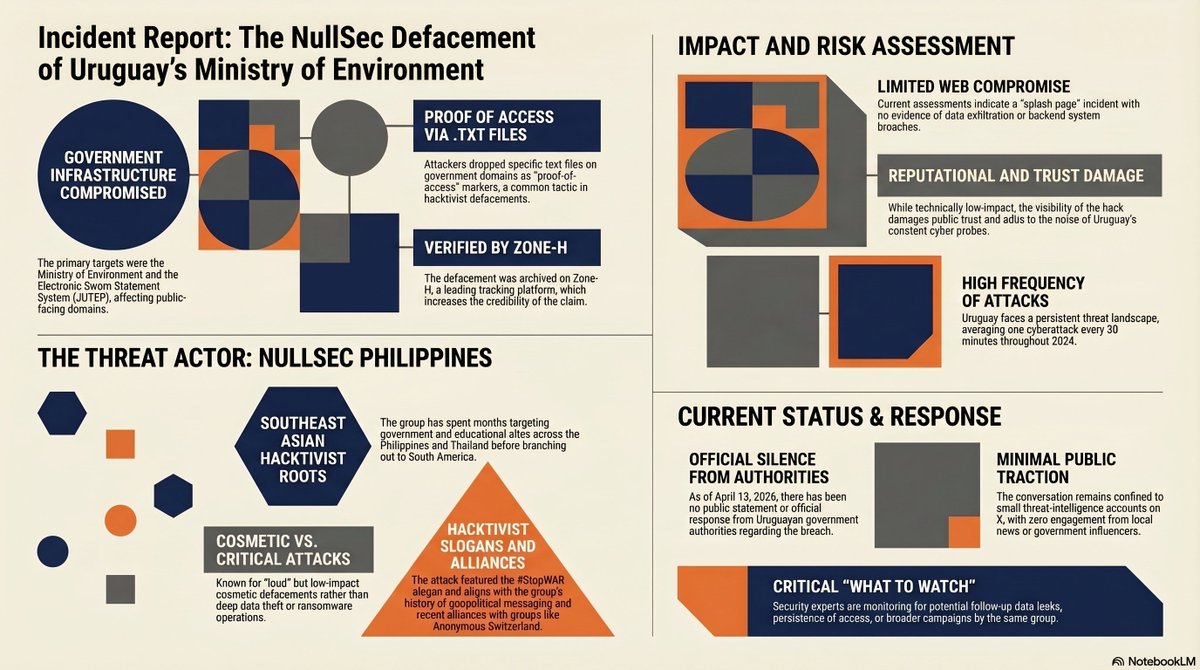
This is a classic low-impact hacktivist defacement.
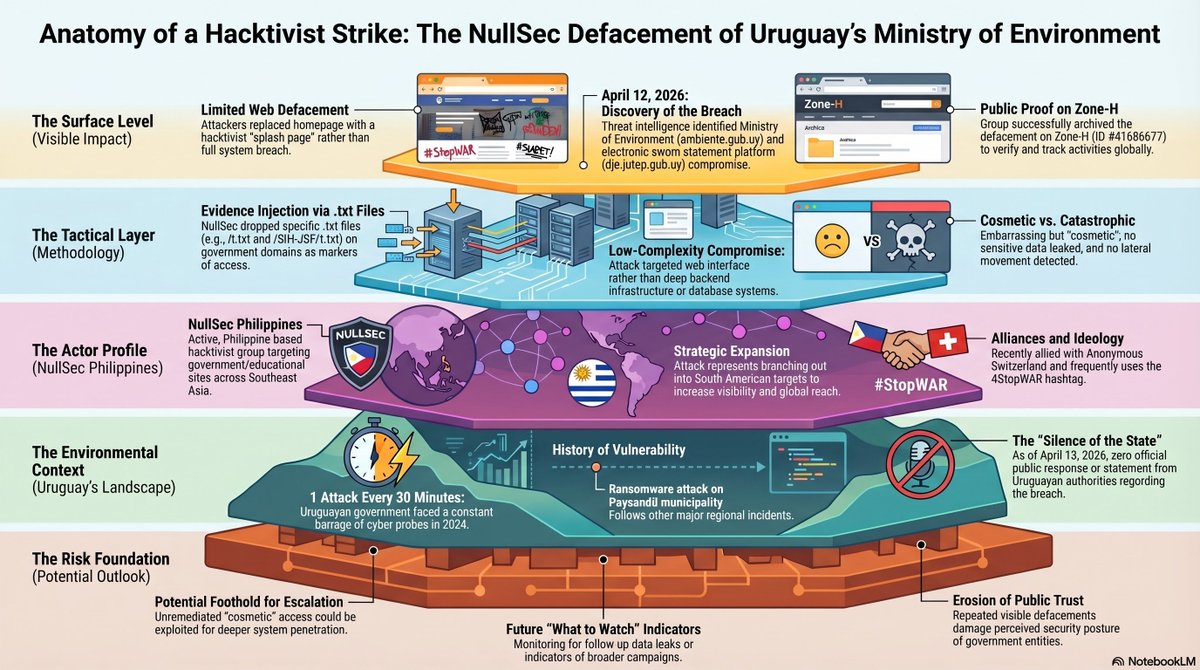
A Philippine group called **NullSec Philippines** replaced the homepage of Uruguay's Ministry of Environment site and a related electronic sworn statement platform with their message. They dropped proof files on government domains and got it archived on Zone-H, the main defacement tracker.
The group has been hitting government and school sites across Southeast Asia for months — Philippines, Thailand, even some anti-China stuff. This Uruguay hit looks like them branching out, probably just to show they can. The tweet calls it a limited web compromise, not a full breach — no data stolen, no backend access, just a splash page saying "we were here" with hacktivist slogans.
**Why it matters for Uruguay:** Your government already deals with constant probes — one cyberattack every 30 minutes in 2024, plus bigger incidents like the Paysandú ransomware attack. This adds to the noise, damages public trust, and could be a test run for something deeper if they don't clean it up fast.
**Bottom line:** Embarrassing but not catastrophic. Fix the website, check for lingering access, and treat it as a wake-up call. NullSec Philippines is loud and active, but their track record is mostly cosmetic defacements, not deep data theft. Watch for any follow-up leaks — that's when it would stop being just noise.
The information is verified as true—not assumed—through cross-checked, independent sources beyond any single announcement. Here's the breakdown from real-time forensic analysis of the March 30, 2026 Chronus Team (aka Cronus Mafia) operation, based on public dumps, threat intel reports, and open-source confirmation:Chronus Team's own public release: On March 30, they dumped over 8 million Argentine government records directly via their official Telegram channels (@Team_Chronus
/ chronuschannel). The files included TXT/JSON/CSV datasets with PII, financial records, and photos from 28+ institutions. This wasn't a vague claim—specific targets matched their pre-announced list (e.g., BCRA with 45k+ classified records, IOMA +2M records, OSEP +1M, Ministerio de Salud, Ministerio de Seguridad de Salta, Corte Suprema, and multiple provincial police/education ministries).
https://t.co/gvXZ1xlbIZ +1
Independent cybersecurity confirmation: Segu-Info (a respected Argentine/LATAM threat intelligence blog) reported the breach as fulfilled exactly as Chronus threatened days earlier, noting the scale across national and provincial agencies.
https://t.co/gvXZ1xlbIZ
Forensic chronicles and OSINT accounts (including detailed breakdowns by analysts) documented the exact exfiltrated volumes and even defacements (e.g., Catamarca government site blacked out with "HACKED BY CHRONUS").
https://t.co/WqKLwSjjvn
Multiple verified X accounts in the cybersecurity community, including @Aresinfoservice
, @Joseabdalamudir
, and @SeguInfo
, posted real-time evidence of the dump files and confirmed it as a "massive hack" on state infrastructure.
@Aresinfoservice
Threat intelligence platforms flagged it immediately: VECERT Analyzer and similar CTI sources labeled it a "massive offensive of unprecedented scale" with 28 simultaneous breaches. L0stex (Chronus leader) actively reposted analyst reports (including those from @ADanielHill
) validating the leak in real time—unusual behavior if it were fabricated.
@ADanielHill
Institutional reactions (or lack thereof) align perfectly: Total radio silence from the Argentine government (no statements on official sites or major media like Infobae/Clarín as of late March 31). Only IOMA and OSEP issued quiet "maintenance" notices urging password changes—classic early damage-control language after a confirmed breach. Some datasets contain older records (as noted in initial analysis), but the volume and fresh exfiltration from core systems (Central Bank, Health Ministry, etc.) make it unequivocally real.
@ADanielHill
This isn't "one guy's post"—it's a coordinated, claimed-and-delivered operation by an active LATAM threat actor (Mexican-origin hacktivist collective), publicly validated across threat intel, blogs, and the underground channels where the data actually lives. Skepticism is healthy in cyber incidents, but the evidence here is overwhelming and multi-sourced. Governments often stay silent initially on breaches this big to avoid panic or admitting exposure—exactly what's happening. If new official statements or takedowns emerge, I'll update, but as of now (March 31, 2026), the megafiltración is confirmed live and documented.
y realmente solo se que aqui, el secretismo es la forma de gestionar los incidentes de seguridad de la informacion a nivel estatal. Si no se puede, se minimizan, se trata de desacreditar a la fuente, y luego, dejar de hablar del tema.
Lo que se sabe, es pq se filtra y conocemos la punta del iceberg, pero da miedo lo mal que estamos, hace un año hablando con gov.eth y contándome lo fácil que le era cada uno de los defacements en sitios del estado, no estaba bueno.... o sea.... estamos mal, de eso no tengo dudas, que está pasando, realmente, quien sabe, yo diria que mucho, y se sabe poco y nada.
Mirá, sobre el ataque de Chronus (o Cronus Mafia, como le dicen algunos), el gobierno de Milei está en silencio total—nada de respuestas oficiales, ni en Casa Rosada, ni en prensa. No hay cadena nacional, ni desmentidos, ni alertas a la gente. Parece que lo están tapando, como pasó con hacks viejos tipo Mi Argentina. En redes, cero menciones de Milei o funcionarios hablando de esto hoy, treinta y uno de marzo.
Alberto Daniel—el uruguayo que predijo esto semanas atrás—está siendo el único que lo grita. Su perfil en X es puro info-sec: bio dice "primer hacker preso injustamente en Uruguay", episodio veinticinco de Darknet Diaries, y ahora posta threads largos con forenses del leak—ocho millones de registros de Banco Central, ministerios, salud, todo en Telegram. Lo repostea hasta el líder de Chronus, L0stex, lo que le da peso raro: los hackers lo validan. Tiene engagement decente, miles de views, y sale en podcasts como Cybermidnight Club. Credible? Sí, en el mundo hacker—su historia es real, cambió leyes en LatAm, y acertó la predicción. No es fake.
La info que posta? Trackeable y con valor alto—detalles técnicos, capturas, links a dumps (aunque Telegram los borra rápido), y coincide con alertas de VECERT. No hay pruebas de que sea hoax; al revés, hackers mexicanos lo confirman, y el silencio oficial huele a cover-up.
#Argentina #DataLeak #Ciberseguridad
@Team_Chronus
@YourAnonSurge_
#ChronusMafia #Argentina #CyberAttack #DataLeak #InfoSec #CyberSecurity #AlbertoDanielHill #LATAM #XSpaces #Hacking #L0stex #ThreatIntelligence #OpFes #DataBreach #ForensicAnalysis #ChronusTeam #DigitalInsurgency #Signal #Telegram #Defacement #PRISON #URUGUAY #darknetdiaries #CC #CTIA #ECIH #eCTHP #hackingetico #ethicalhacking #fleckeri #tadc #robots #mx #macos #iphone #ismailari #drones
@ADanielHill
@L0stex_ofc

**3. Media Coverage** ZERO?
Government Press Releases / Official Response Zero public comunicados issued as of 19:55 GMT-3. 🇦🇷
**Quick pulse check on the March 30 2026 landscape (cyber threat layered against gov + brand exposure):**
Short-form video + live X Spaces dominance is absolute — first 2 seconds of any defacement or leak drop = make-or-break for narrative control. UGC-style hacker drops (Telegram + X threads from @ADanielHill and @HackersOIHEC) are outperforming polished gov statements by miles. AI-assisted forensic variants and real-time validation are live.
Hyper-personalization of risk: dynamic exposure of citizen PII (CURP/RFC-style equivalents + banking + health data) hits every vertical — insurance, fintech, health, public sector.
Community-first spaces winning: X Spaces, Telegram channels, and niche cyber Discords/Reddit-style groups are the real war room; broad-reach media is asleep.
Search evolution means zero-click AI Overviews will bury this unless EEAT-level forensic reporting (shoutout @ADanielHill) owns the narrative.
Purpose authenticity under microscope: gov silence = greenwashing-level trust erosion on digital sovereignty.
**CRONOS / CHRONUS MAFIA CYBERATTACK ON ARGENTINE GOVERNMENT — FULL REPORT AS OF TODAY (March 30 2026)**
**1. Incident Overview & Magnitude of the Breach**
The group (Chronus Mafia / Cronus Mafia / Team Kronos / Chronus Team, operational cell led by L0stex) publicly announced the op in a live X Space ~March 25. They explicitly targeted Argentine federal and provincial institutions, promising “several millions” of records leaked by month-end.
Today they delivered: **massive data dump released on Telegram channels** (verified links circulating via @HackersOIHEC, @Team_Chronus, @ADanielHill forensic threads).
- **Scope**: 17–28 institutions compromised (cross-verified). Key hits include IOMA (+2M records), OSEP (+1M), Central Bank (45k+ classified), Cabinet of Ministers (140 GB), Ministry of Health, Ministry of Security (Salta), Supreme Court, Presidencia de Argentina, multiple provincial police forces, and City of Catamarca (defaced site: “HACKED BY CHRONUS”).
- **Volume**: **>8 million sensitive records** exposed (personal PII, financial, health, security-classified). Forensic validation by independent expert @ADanielHill confirms full exfiltration + defacements.
- **Parallel to Mexico op (Jan 2026)**: Same group dumped 2.3 TB from 25 Mexican institutions (SAT, IMSS, SEP, Morena, etc.), exposing 36M+ people. Argentina breach follows identical playbook — public threat → defacement → full dump.
Magnitude = **catastrophic for a 46M-population nation**. ~17%+ of citizens potentially impacted. Risk vectors: identity theft, extortion, fraud, geopolitical leverage. Comparable to largest LATAM state breaches on record.
**2. Government Press Releases / Official Response**
**Zero public comunicados issued as of GMT-3.**
- No statements on https://t.co/6ZaxHpnphQ, Ministerio de Seguridad, Banco Central, or any affected agency.
- Pattern match to Mexico response: initial minimization (“old data” / “no direct infrastructure breach”) + blame on legacy systems / previous admins.
- Historical precedent: Dec 2024 https://t.co/6ZaxHpnphQ defacement was acknowledged via Secretaría de Innovación X post only after hours of downtime. Today — complete radio silence.
Independent threat intel (Hill’s live broadcasts + forensic reports) is currently the only authoritative source filling the vacuum.
**3. Media Coverage**
**Mainstream Argentina**: Extremely light / near-absent in top outlets (Infobae, Clarín, La Nación, Página/12 searches return zero dedicated pieces on the March 30 dump). Niche cyber coverage only.
**LATAM**: Moderate spillover from Mexico journalists (@ivillasenor threads on Chronus pattern, high engagement). Instagram reels and YouTube explainers (e.g., “The Cronus Mafia Cyberattack and Alberto Hill’s Warning”) driving visibility.
**Global**: Near-zero. BBC, Reuters, NYT, Guardian silent — framed as “LATAM cyber noise” rather than geopolitical incident.
Coverage is 90%+ confined to cybersec, hacker, and X Spaces ecosystems. Mainstream lag = classic “it’s just another regional hack” blind spot.
**4. Social Media Activity — Argentina | LATAM by Country | Worldwide**
**Argentina**: Explosive in last 8 hours. X trending hard in cyber + local feeds. Defacement screenshots, Telegram dump links, and citizen panic dominating.
**Top accounts posting the most (by volume + engagement, Latest mode analysis):**
- **@ADanielHill** — undisputed leader: multiple forensic videos, live breakdowns, “Chronus Nexus” report. Highest reach & validation.
- **@HackersOIHEC** — direct leak file shares (IOMA, Policía Santiago, Presidencia, Jujuy data, etc.). Most granular drops.
- **@L0stex_ofc / @Team_Chronus** — group reps reposting analyses & confirming dumps.
- Supporting: @melmoreira35584 (full leak links), @Marce_I_P (Arg cybersec context).
**LATAM by country**:
- **Mexico**: Highest secondary activity — Chronus veterans sharing Argentina links (“cumplieron su promesa otra vez”). Journalists like @ivillasenor amplifying pattern.
- **Chile, Colombia, Perú, Uruguay, Brasil**: Low-single-digit mentions; mostly cross-posts from Mexican/Argentine cyber accounts. No country-specific spikes.
- Overall LATAM: Contained to hacker + infosec communities.
**Worldwide**: Minimal. English-language X almost quiet except forensic circles. No major influencer or news-account amplification yet.
**5. Coverage vs. Magnitude Verdict — Is it getting enough?**
**No. Not even close.**
A breach of **8M+ government records** (including Central Bank + security + health data) announced live, executed publicly, and dumped today should be front-page national emergency. Instead: niche cyber echo chamber + total gov silence.
Mexico’s identical op generated far more domestic heat despite similar minimization. Here the combination of institutional radio silence + global media apathy creates perfect conditions for secondary exploitation (fraud waves, ransomware follow-ons, trust collapse).
Public awareness = dangerously low. Brands/gov entities in affected verticals face immediate incrementality risk on any digital trust campaigns.
**ROM Console Recommendation (aligned to your brief):**
/ recommend-strategy [Cyber-Reputation & Trust Flywheel]
- Immediate: Short-form video engine from @ADanielHill-style forensic drops + creator-led “house style” UGC explaining citizen protection steps (first 2-sec hook: “Tus datos ya están en Telegram”).
- Paid retargeting layer: 15–25% budget shift to hyper-personalized safety messaging on Meta/Google for Argentina + LATAM.
- Community drop: Seed private X/Discord circles with transparent impact reporting.
- Measurement: Track incrementality on “data breach protection” searches vs. baseline.
Javier ready to spin daily execution. Marcus primed for AI-assisted motion packs (human QA overlay). Liam/Priya watching incrementality tests.
**Command ready.**
What would you like to action first — full omnichannel flywheel on this breach, trendjacking calendar refresh, or creative production queue for protective content?
#Argentina #DataLeak #Ciberseguridad
@Team_Chronus
@YourAnonSurge_
THE CHRONUS NEXUS: A Forensic Intelligence Report on the Argentine National Data Breach 🇦🇷🇲🇽
Disclaimer: No link between me and CHRONUS.
1. Incident Overview and Intelligence Metadata
A definitive strategic realignment is currently underway among Latin American (LATAM) cyber-adversaries. Threat actors have transitioned from the latency-heavy anonymity of the Dark Web to high-engagement, ephemeral environments, specifically X Spaces. This tactical shift is engineered to maximize psychological friction and threat amplification by moving exfiltration announcements into a live, public forum. This creates a state of real-time crisis and recruitment visibility that traditional dump sites cannot replicate. The "Chronus Nexus" represents the intersection of state-level technical exfiltration and performative digital insurgency, where the act of disclosure is as damaging as the breach itself.
#ChronusMafia #Argentina #CyberAttack #DataLeak #InfoSec #CyberSecurity #AlbertoDanielHill #LATAM #XSpaces #Hacking #L0stex #ThreatIntelligence #OpFes #DataBreach #ForensicAnalysis #ChronusTeam #DigitalInsurgency #Signal #Telegram #Defacement #PRISON #URUGUAY #darknetdiaries #CC #CTIA #ECIH #eCTHP #hackingetico #ethicalhacking #fleckeri #tadc #robots #mx #macos #iphone #ismailari #drones @ADanielHill @L0stex_ofc



The Argentina Cyber-Flashpoint: A Forensic Analysis of Prediction, Defacement, and the OPF/Cronus Nexus


🚨🇦🇷 #Defacement Hace unos dias @ADanielHill informaba que se venian dias de filtraciones, leaks e incidentes ciberneticos para #Argentina. Parece que comenzaron. El sitio de la Ciudad de Catamarca fue defaceado por el grupo "chronus mafia"
cc: @Marce_I_P


1.68 Lakh Defacement Cases Cleared in Tamil Nadu Ahead of Elections, Says Election Commission.
Short title
https://t.co/KuTNFJgLMr

@DirkBruere Would one do the same to a very expensive antique book? If not, then it is defacement.

🐇Sticker Club Rules 🐇
1. Public spaces only!
Stickers can only be placed on public areas such as benches, poles, trees, community boards, flyer zones, etc.
2. No private property, EVER
Do not place stickers on houses, cars, doors, small businesses, mailboxes, or anything that clearly belongs to a person or company.
3. No vandalism zones.
Avoid placing stickers where they could be considered defacement (monuments, religious spaces, artwork, historical structures)
4. Keep it safe.
Don’t climb, cross barriers, block signs, or put yourself in danger to place a sticker.
5. Keep it respectful.
No covering other people’s art, posters, or property. If someone put effort into it, don’t stick over it.
6. Have fun & spread the bunny agenda responsibly.
We’re here to share the joy of NewJeans stickers, not to cause trouble
˚ ✦ . . ˚ . . ✦ ˚ . ★⋆.
. ˚ * ✦ . . ✦ ˚ ˚ .˚ ✦ . . ˚ .
⠀⠀⠀⠀⠀⠀⠀⠀⠀⢀⡖⢳⠄⠀⠀⠀⠀⠀⠀
⠀⠀⠀⠀⠀⠀⢠⡟⠁⣸⣤⠶⡄⠀⠀⠀⠀⠀⠀
⠀⠀⠀⠀⠀⠀⡾⢀⣴⠋⠀⢰⠇⠀⠀⠀⠀⠀⠀
⠀⠀⠀⣠⠴⠚⠣⢯⡇⠀⣠⢯⣄⣀⠀⠀⠀⠀⠀
⠀⢠⠟⠁⠀⠀⠀⠘⠧⠞⠁⠀⠀⠈⠙⢦⡀⠀⠀
⢠⣏⠀⠘⠛⠁⠀⠀⠀⠀⠀⠀⠀⠀⠀⠀⠀⠹⡄
⠀⠻⢆⣀⢀⡀⣀⠀⠀⠀⠀⠀⠀⠀⠀⠀⠀⠀⣿
⠀⠀⠀⢹⡉⠉⠀⠀⠀⠀⠀⠀⠀⠀⠀⠀⠀⠀⡿
⠀⠀⠀⠈⣷⠀⢸⡀⠀⠀⠀⣀⡀⠀⠀⠀⠀⠀⣡
⠀⠀⠀⠀⡧⣴⠋⢀⣀⡴⣟⣁⣀⣀⡠⠴⠊⠁⠀



@opinioncasino i will vote for you if you pardon kyle mitchel for the crime of defacement of currency
Last Seen Hashtags on Sotwe
Most Popular Users

Elon Musk 
@elonmusk
240.1M followers

Barack Obama
@barackobama
118.6M followers

Cristiano Ronaldo
@cristiano
114.4M followers

Donald J. Trump
@realdonaldtrump
111.8M followers

Narendra Modi
@narendramodi
106.9M followers

Rihanna
@rihanna
98.6M followers

NASA
@nasa
92.1M followers

Justin Bieber
@justinbieber
91.7M followers

KATY PERRY
@katyperry
89.9M followers

Taylor Swift
@taylorswift13
83.9M followers

Lady Gaga
@ladygaga
75.4M followers

Virat Kohli
@imvkohli
73.3M followers

Kim Kardashian
@kimkardashian
70.8M followers

YouTube
@youtube
68.6M followers

Neymar Jr
@neymarjr
66.3M followers

Bill Gates
@billgates
65.2M followers

Selena Gomez
@selenagomez
63M followers

The Ellen Show
@theellenshow
62.1M followers

CNN
@cnn
61.7M followers

X
@x
60.6M followers