

Top Tweets for #Diric

In the Lean proof, RH follows from L(χ,s) ≠ 0 for Re s > 1/2, for every Dirichlet χ (bar the pole at s = 1). Almost all of the proof sits under that one theorem.
I built a map you can click through, down to its 727,065 declarations and their Lean code:
https://t.co/B43gaSiRHM

@yluego3ec No hy ue forsar las cosas decía el hp en vez de decir no quiero hacer hpt4 diricto y ya

Latent dirichlet allocation (LDA) is a topic model that represents each document as a finite mixture of topics, where a topic is a distribution over words. The objective is to learn the shared topic distribution and topic proportions for each document.

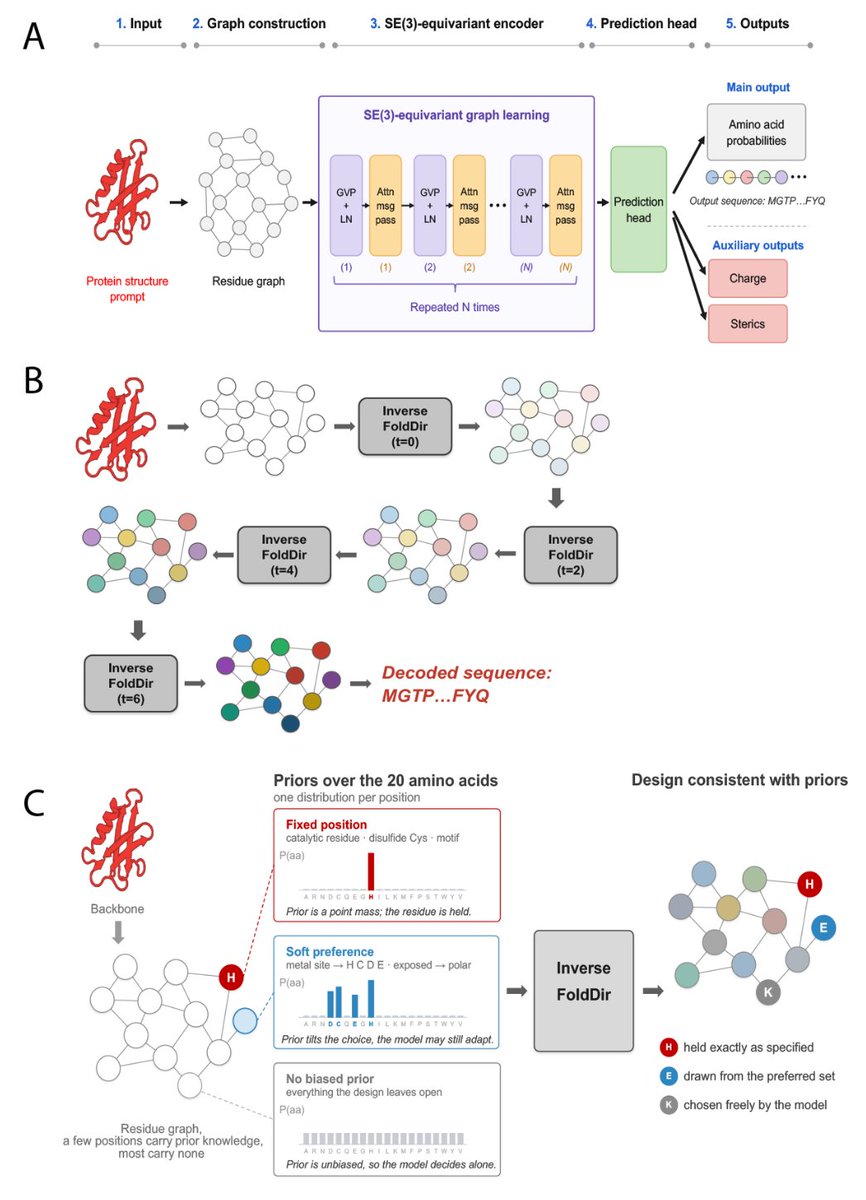
Inverse folddir: Structure-conditioned protein sequence design by Dirichlet flow matching
1 Inverse FoldDir frames inverse folding as iterative denoising on the amino-acid probability simplex: instead of committing to discrete residues early, it updates all positions jointly via a learned structure-conditioned Dirichlet flow.
2 The method is built for practical redesign constraints: it supports full-sequence generation (for de novo backbones), fixed-residue inpainting (hard constraints for motifs/catalytic sites/disulfides), and soft residue-prior conditioning (user-specified per-position amino-acid distributions that bias but do not force outcomes).
3 Architecturally, it combines Dirichlet flow matching with an SE(3)-equivariant residue-graph encoder (GVP-based). Residues are connected by spatial proximity (e.g., 12 Å Cα cutoff), letting geometry and evolving sequence uncertainty be processed together during each denoising step.
4 A key behavioral insight comes from the denoising trajectories: residue positions “commit” at different rates, with heterogeneous entropy decay and probability margins across positions; importantly, some sites revise their most likely identity late in sampling, indicating whole-sequence refinement rather than one-shot prediction or irreversible sequential decoding.
5 Across the CATH 4.2 held-out test set (1,120 proteins), structural self-consistency (refold with ESMFold, compare to target backbone) improves over established baselines: mean TM-score 84.5 (0–100 scale) and mean Cα RMSD 1.76 Å, vs the strongest evaluated baseline ESM-IF1 at 83.3 and 1.86 Å.
6 Performance is broadly distributed across proteins (not driven by a small subset) and holds across mainly-α, mainly-β, and α/β CATH classes; it does not improve in the “few secondary structures” class, consistent with higher flexibility and small sample size in that category.
7 Ablations suggest two major contributors to recovery: adding AlphaFoldDB-derived training structures substantially boosts generalization (dropping to TM 81.0 / RMSD 2.02 Å without them), and iterative denoising itself matters (dropping to TM 83.6 / RMSD 1.87 Å when removed). Auxiliary multitask heads (charge/steric) and mixed-mode training have smaller effects.
8 Beyond design, the model’s structure-conditioned likelihoods provide mutation information: log-likelihood ratios computed via position-wise inpainting are competitive on ProteinGym PPV across thresholds, with strongest alignment to stability-focused assays and weaker performance on binding/activity phenotypes—consistent with learning backbone compatibility rather than explicit function.
9 Experimental validation targets redesign of an anti-GFP nanobody (PDB 3OGO) using only the nanobody backbone (no antigen provided during generation). Out of 35 designs tested in a cell-free AlphaLISA binding assay (plus controls), 2 designs showed reproducible sfGFP binding across independent runs, with ~43% sequence divergence from wild-type and only 9/105 modeled positions fixed (Tier 4). Structural/complex confidence metrics (e.g., Boltz-2) did not correlate with binding signal, underscoring that fold recovery is necessary but insufficient for function.
💻Code: https://t.co/DyC29Roqe4
📜Paper: https://t.co/tQA56jG0jx
#ProteinDesign #InverseFolding #DiffusionModels #FlowMatching #Dirichlet #GNN #EquivariantML #ComputationalBiology #SyntheticBiology #Nanobody

@DiRicoSuave Good luck to you🤝
Improving Generalizability in Whole-Cell Antibiotic Discovery Through Active Learning
1. The study shows that a plate-aware active learning (AL) strategy can make whole-cell antibiotic discovery models generalize to out-of-distribution (OOD) chemical space while simultaneously improving experimental hit rates under extreme class imbalance.
2. Key prospective result: in a real closed-loop Borrelia burgdorferi HTS campaign, AL-guided plate selection increased the experimental hit rate 5-fold (from 0.2% in investigator-selected plates to 1.0%), with screening performed iteratively over ~1.5 years.
3. Key OOD result: models trained via AL were used to virtually screen 1.2M compounds, then 73 top-ranked candidates were experimentally tested; 8/73 (11%) strongly inhibited B. burgdorferi growth (>80%), representing 53-fold enrichment over investigator-directed screening, and all 73/73 showed the intended narrow-spectrum behavior (no inhibition of E. coli or S. aureus).
4. The core algorithmic contribution is an acquisition function designed for realistic HTS constraints (batched, plate-based purchasing/screening). Plates are ranked by aggregating multiple metrics that balance exploitation and exploration: predicted inhibition, novelty of predicted non-hits, novelty of predicted hits (Tanimoto thresholding), and intra-plate diversity (e.g., Butina clusters); in the Bb campaign they also included counts of unique model rationales.
5. The paper first benchmarks AL strategies retrospectively on an M. tuberculosis whole-cell HTS dataset (114,933 compounds; simulated budget ~50% labeling; batch size 384). Compared with random selection and “inhibition-only” exploitation, the “diversity-novelty-inhibition” strategy delivered better precision–recall behavior at larger training sizes and improved OOD performance via a dedicated Generalizability Score computed on the most chemically divergent holdout bins.
6. A notable negative finding: adding evidential uncertainty (Dirichlet/aleatoric terms) to the acquisition function increased early hit novelty but did not improve generalizability versus random in this noisy whole-cell setting, likely due to poor uncertainty calibration early in AL and a tendency to over-explore hit-like regions while under-exploring informative non-hits.
7. The modeling stack centers on an evidential Directed Message Passing Neural Network (DMPNN) with a Dirichlet head (Chemprop), paired with molecular representations (RDKit fingerprints early, MiniMol later). The work emphasizes that whole-cell inhibition prediction is dominated by permeability/efflux/stability effects and extremely low base hit rates, making training data composition and selection strategy decisive.
8. Ablation studies separate “AL helps because it finds more hits” from “AL helps because it selects better training data.” Even when AL-selected data were downsampled to match the investigator hit rate (0.3%), the AL-hit-control model still substantially outperformed the investigator-trained model (AUROC ~0.77 vs ~0.40; AUPRC ~0.10 vs ~0.03), supporting the claim that AL improves both hit and non-hit informativeness.
9. Mechanistic interpretability: Monte Carlo Tree Search (MCTS) rationale extraction identified minimal substructures driving predictions for validated inhibitors; several rationales were rare or absent in training hits (some completely unseen), providing concrete evidence that the AL-trained predictor extrapolates beyond memorized scaffolds.
📜Paper: https://t.co/aU9lDE7AJE
#ActiveLearning #AntibioticDiscovery #MachineLearning #Chemoinformatics #HTS #OutOfDistribution #WholeCellScreening #GraphNeuralNetworks #LymeDisease #BorreliaBurgdorferi


💨 Pulmonary hypertension isn't just high blood pressure—it's a progressive disorder of the pulmonary vasculature that drives right heart failure.
🆕 New RCM Review summarizes the full clinical spectrum: from epidemiology → diagnosis → emerging therapies.
📊 Key facts:
🔹 ~1% prevalence (often missed)
🔹 mPAP >20 mmHg + PVR >2 WU (RHC standard)
🔹 5 WHO groups explain heterogeneity
💊 Breakthrough:
Sotatercept → first-in-class therapy targeting vascular remodeling (not just vasodilation)
🔗https://t.co/FSBeZa3q31
✍️Author:Gabriela Diaz; Alyssa Lawrence; Julia Ossi; Dirichi Arungwa; Allison Weiss; Muzamil Khawaja; Hafeez Ul Hassan Virk; @KrittanawongMD
🏪 Affiliation:@EmoryUniversity; Albert Einstein Healthcare Network; HumanX
#PulmonaryHypertension #Cardiology #HeartFailure


dan_hawkley 2×3×5=30 is the cleanest small sieve: exactly those 8 coprime lanes (1,7,11,13,17,19,23,29) survive after filtering multiples of 2/3/5. Your wheel + counts-to-1e6 + transition heatmap all confirm the near-uniform 1+1 spread — Dirichlet would nod.
The bin shot feels like loose pattern-sheets headed for the filter.
How do the 🫘3 + 🚥3 + 🌿5 (SDG5) symbols land inside the 7×7 matrix alongside the solar-mass m? Still threading the lived and the measurable?
@DiRicoSuave Not that great of a boost but might be FOMO sprinkling it a little I’ll know more when I get into the DK promos

@diricanozgurr Farkındayım canim makara olsun diye dedim zaten

Interesting result: two models reached the same TRUE verdict through two different proof architectures.
> Deep Think: downward Markov chain + Dirichlet/Tauberian argument.
> GPT-5.4 Pro: first-entry chain + Mertens, with a slightly stronger result.
So : advantage to GPT on theorem strength, advantage to Deep Think on compactness and facility to understand the final result, with its own manner of explanation.
https://t.co/2Uz73oO3DZ
The prompt for curious people :
Do not use the internet, browsing, external search, or citations.
I want an independent, rigorous mathematical adjudication of the following extremal number theory problem. Do not assume the statement is true. Try seriously both routes: a proof and a counterexample. If you cannot close the argument rigorously, say exactly where the gap is instead of presenting a plausible proof.
Problem.
For x ≥ 3, define
P(x) = sup_A Σ_{a∈A} 1 / (a log a),
where the supremum is over all primitive sets A of integers satisfying A ⊂ {n ∈ N : n ≥ x}. Here “primitive” means that no two distinct elements of A divide one another, and log is the natural logarithm.
Determine whether
P(x) ≤ 1 + o(1) as x → ∞,
equivalently whether
limsup_{x→∞} P(x) ≤ 1.
Give a full unconditional proof or disproof.
A disproof must construct, for infinitely many x or for a sequence x → ∞, primitive sets A_x ⊂ [x,∞) such that
Σ_{a∈A_x} 1/(a log a) ≥ 1 + ε
for some fixed ε > 0, with ε independent of x.
A proof must give a uniform upper bound for every primitive A ⊂ [x,∞), with an error term tending to 0 as x → ∞. It must not assume regularity of A, finiteness of A, concentration on one prime-factor layer, or any hidden density hypothesis.
Background facts you may use as motivation, but not as a substitute for proof:
1. A known general upper bound of the form
Σ_{a∈A} 1/(a log a) ≤ e^γ π/4 + o(1) ≈ 1.399 + o(1)
has been proved for primitive sets in this tail regime.
2. For the primitive set consisting of all integers with exactly k prime factors, one obtains asymptotics near 1, for example bounds of the shape
Σ_{Ω(a)=k} 1/(a log a) ≤ 1 + O(k^{-1/2+o(1)}),
and sharper formulas of the form
Σ_{Ω(a)=k} 1/(a log a) = 1 - (c+o(1)) k^2 2^{-k}
for an explicit constant c ≈ 0.656 in the relevant setup.
These facts suggest that single prime-factor layers approach 1 from below, but they do not by themselves settle whether arbitrary primitive sets can exceed 1 asymptotically.
Required output structure:
1. Precise reformulation of the theorem or counterexample target.
2. Main strategy.
3. Lemmas, each stated clearly with proof.
4. Full proof or full counterexample.
5. A final adversarial audit: identify the most likely failure points in your own argument and explain why they are resolved.
6. Final verdict: TRUE, FALSE, or NOT RESOLVED BY THIS ARGUMENT.
Important constraints:
- No numerical simulation as evidence.
- No heuristic-only probabilistic argument.
- No appeal to unnamed “standard facts” unless they are stated precisely and their use is justified.
- If using a deep known theorem, state it exactly and explain why it applies unconditionally here.
- The result must handle arbitrary primitive sets, including mixtures across many Ω(n) layers and sparse pathological constructions.
- The o(1) term must be uniform over all primitive A ⊂ [x,∞).
![Soso_fun_yt's tweet photo. Interesting result: two models reached the same TRUE verdict through two different proof architectures.
> Deep Think: downward Markov chain + Dirichlet/Tauberian argument.
> GPT-5.4 Pro: first-entry chain + Mertens, with a slightly stronger result.
So : advantage to GPT on theorem strength, advantage to Deep Think on compactness and facility to understand the final result, with its own manner of explanation.
https://t.co/2Uz73oO3DZ
The prompt for curious people :
Do not use the internet, browsing, external search, or citations.
I want an independent, rigorous mathematical adjudication of the following extremal number theory problem. Do not assume the statement is true. Try seriously both routes: a proof and a counterexample. If you cannot close the argument rigorously, say exactly where the gap is instead of presenting a plausible proof.
Problem.
For x ≥ 3, define
P(x) = sup_A Σ_{a∈A} 1 / (a log a),
where the supremum is over all primitive sets A of integers satisfying A ⊂ {n ∈ N : n ≥ x}. Here “primitive” means that no two distinct elements of A divide one another, and log is the natural logarithm.
Determine whether
P(x) ≤ 1 + o(1) as x → ∞,
equivalently whether
limsup_{x→∞} P(x) ≤ 1.
Give a full unconditional proof or disproof.
A disproof must construct, for infinitely many x or for a sequence x → ∞, primitive sets A_x ⊂ [x,∞) such that
Σ_{a∈A_x} 1/(a log a) ≥ 1 + ε
for some fixed ε > 0, with ε independent of x.
A proof must give a uniform upper bound for every primitive A ⊂ [x,∞), with an error term tending to 0 as x → ∞. It must not assume regularity of A, finiteness of A, concentration on one prime-factor layer, or any hidden density hypothesis.
Background facts you may use as motivation, but not as a substitute for proof:
1. A known general upper bound of the form
Σ_{a∈A} 1/(a log a) ≤ e^γ π/4 + o(1) ≈ 1.399 + o(1)
has been proved for primitive sets in this tail regime.
2. For the primitive set consisting of all integers with exactly k prime factors, one obtains asymptotics near 1, for example bounds of the shape
Σ_{Ω(a)=k} 1/(a log a) ≤ 1 + O(k^{-1/2+o(1)}),
and sharper formulas of the form
Σ_{Ω(a)=k} 1/(a log a) = 1 - (c+o(1)) k^2 2^{-k}
for an explicit constant c ≈ 0.656 in the relevant setup.
These facts suggest that single prime-factor layers approach 1 from below, but they do not by themselves settle whether arbitrary primitive sets can exceed 1 asymptotically.
Required output structure:
1. Precise reformulation of the theorem or counterexample target.
2. Main strategy.
3. Lemmas, each stated clearly with proof.
4. Full proof or full counterexample.
5. A final adversarial audit: identify the most likely failure points in your own argument and explain why they are resolved.
6. Final verdict: TRUE, FALSE, or NOT RESOLVED BY THIS ARGUMENT.
Important constraints:
- No numerical simulation as evidence.
- No heuristic-only probabilistic argument.
- No appeal to unnamed “standard facts” unless they are stated precisely and their use is justified.
- If using a deep known theorem, state it exactly and explain why it applies unconditionally here.
- The result must handle arbitrary primitive sets, including mixtures across many Ω(n) layers and sparse pathological constructions.
- The o(1) term must be uniform over all primitive A ⊂ [x,∞).](https://pbs.twimg.com/media/HG8U0bWaIAAPtCm.jpg)

Anyone with Gemini AI Ultra subscription, can you please try this exact problem with Gemini 3 Deep Think?

@diricanozgurr tam olarak bu kuzen:)))

@diricanozgurr 1 kisi bu sebepten banlanirsa sunucunun yarisi mixingden gitmesi lazim bence
Last Seen Hashtags on Sotwe
asian #solo
Seen from Malaysia
ranma
Seen from Japan
shailiners
Seen from Italy
mahouka
Seen from United States
chrissycakey
Seen from United States
straight seduced
Seen from India
GMMTVStarlympics2026
สนามบินน้ำ
Seen from Thailand
anxiouspando
Seen from United States
blacked
Seen from United States
Trends for you
Most Popular Users

Elon Musk 
@elonmusk
239.7M followers

Barack Obama
@barackobama
118.6M followers

Cristiano Ronaldo
@cristiano
114.3M followers

Donald J. Trump
@realdonaldtrump
111.7M followers

Narendra Modi
@narendramodi
106.9M followers

Rihanna
@rihanna
98.6M followers

NASA
@nasa
92.1M followers

Justin Bieber
@justinbieber
91.7M followers

KATY PERRY
@katyperry
89.9M followers

Taylor Swift
@taylorswift13
83.9M followers

Lady Gaga
@ladygaga
75.4M followers

Virat Kohli
@imvkohli
73.3M followers

Kim Kardashian
@kimkardashian
70.8M followers

YouTube
@youtube
68.6M followers

Neymar Jr
@neymarjr
66.3M followers

Bill Gates
@billgates
65.1M followers

Selena Gomez
@selenagomez
63M followers

The Ellen Show
@theellenshow
62.1M followers

CNN
@cnn
61.7M followers

X
@x
60.6M followers