

Top Tweets for #Distractor

Sísifo tenía la fortuna de que no podía cambiar de actividad.
En cambio tu tienes 1,500 distractores y cambias la piedra cada que puedes.
Tú solito te condenas.

Multiple choice doesn't get hard because of option count. It gets hard because of distractors: wrong answers that look right.
12 tools that sound nothing alike: easy.
3 tools where 2 overlap: hard.
Every tool you add is a new option for every old question.

Bobby is not retarded, he knows when to do that to get Kanel outta there. He's done this a lot lol W distractor

@BskiMike22802 Cali Exposed. Newsome n msm the Demwit makeup-$tuff CON distractors.

خلي بالك من الـ Distractors.
اللي بيقولك معلومة وبعدين يصححها (زي: “I thought it was Monday… but actually Tuesday”).

IELTS Listening Sections 3 & 4 are designed to trigger panic.
The speakers talk fast, use academic vocabulary, and drop constant distractors to trick casual listeners.
Here is a 4-step framework to decode fast audio and secure a Band 8+ 🧵👇

@Distractorn kak cdm

@Distractorn cdm kaa

Axis Robotics explanations of task randomization, replay validation, and anti-bot systems:
1/12
One of the biggest challenges in robotics data collection isn't scale.
It's collecting high-quality, diverse trajectories that actually help robots generalize in the real world.
That's why @axisrobotics focuses heavily on in-task randomization and strict bot filtering.
2/12
Most datasets fail because they collect the same task repeatedly under nearly identical conditions.
A robot may learn "where things usually are" instead of learning the underlying manipulation skill.
Axis addresses this through extensive task and scene randomization.
3/12
Also Every task instance can vary:
🌹Object positions
🌹Object orientations
🌹Distractor objects
🌹Camera viewpoints
🌹Lighting conditions
🌹Surface properties
Even if 1,000 contributors complete the same task category, each encounters a different environment.
4/12
This is what @axisrobotics calls "in-task randomization."
Instead of creating thousands of manually designed tasks, a task-generation engine produces effectively unlimited variations by changing goals, layouts, constraints, and scene parameters.
5/12
Research consistently shows diversity across tasks, environments, and operators improves robotic generalization far more than simply increasing trajectory count.
6/12
But diversity is only valuable if the data is genuine.
That's where Axis' anti-bot infrastructure becomes critical.
Every submitted trajectory undergoes strict replay validation before it can enter the training pipeline.
7/12
The replay system reconstructs the trajectory inside the simulator and checks whether the task was actually completed.
If someone fabricates coordinates or manually alters data, the simulation's physics consistency breaks.
The trajectory automatically is rejected..
8/12
This creates a powerful defense against automation exploits.
A bot might generate numbers.
But generating a physically valid trajectory that survives replay verification is a much harder problem.
9/12
Axis also monitors for duplicate trajectory patterns.
Even successful trajectories can become low-value if they are repeatedly copied.
Robots need behavioral diversity, not identical demonstrations cloned thousands of times.
10/12
According to @axisrobotics, duplicated submissions receive no credit, and large-scale duplicate behavior can trigger permanent bans.
The objective isn't just fraud prevention.
It's preserving the diversity signal required for robust robot learning.
11/12
The team recently disclosed that backend monitoring identified users submitting obsolete replay formats after a system upgrade.
Those submissions were traced, filtered, and associated wallets permanently banned to protect dataset integrity.
12/12
In the long run, the winners in robotics won't just be the teams with the biggest models.
They'll be the teams with the cleanest, most diverse, and most trustworthy training data.
That's the infrastructure @axisrobotics is trying to build..
@plpiaoliang @iamlogtun


When the teammate with the lowest stealth keeps taking the twisteds yet the distractor uses the i'm sorry sticker
#dandysworld #dandysworldgoob #dandysworldshrimpo #angryhugs #hatehugs


Is Claude 4.8 Really Closer to AGI?
My biggest concern with Claude 4.7 and 4.8 is not that the new models are simply worse. It is that Anthropic seems to have changed the benchmark narrative after the model’s long-context profile changed.
When Claude 4.6 was released, Anthropic heavily promoted MRCR v2. Opus 4.6 scored 76% on the 8-needle, 1M-token MRCR v2 test, compared with 18.5% for Sonnet 4.5. At the time, this was presented as a major improvement in practical long-context capability.
But with 4.7, MRCR suddenly looked much worse. The community-cited system-card numbers were:
MRCR v2 at 1M:
Opus 4.6: 78.3%
Opus 4.7: 32.2%
That is not a small fluctuation. That is a major regression.
Then the explanation shifted. MRCR was described as a benchmark built around stacked distractors and not necessarily representative of real long-context use. Anthropic started emphasizing GraphWalks, applied long-context reasoning, agentic workflows, compaction recovery and internal benchmarks.
I am not against GraphWalks. It is valuable. But GraphWalks cannot replace MRCR.
MRCR tests precise retrieval in very long contexts: multi-needle localization, same-distribution distractor separation, ordinal tracking and recovery of the correct target from a large amount of similar text.
GraphWalks tests structured reasoning over graph-like information.
These are related, but they are not the same thing.
If a model drops on MRCR but improves on GraphWalks, the right conclusion is not that the old benchmark no longer matters. The more honest conclusion is that the model’s capability profile has changed.
I also ran a direct creative and simulation-style comparison.
Same prompt. Same task. The model had to produce a black-box log with biomechanical feedback, Gene Lock override, right-arm functional loss, motor reconstruction using the remaining limbs, counteraction and post-engagement medical risk assessment.
With the original prompt:
4.6:
about 10,539 characters
324 lines
4.8 Max:
about 2,699 characters
120 lines
4.8 did not fail the task. It completed the core sequence. But it felt much more like a compressed task answer. 4.6 felt like it was running a full scenario.
To avoid the obvious objection that maybe I simply did not ask it to expand, I ran a second test. I removed any word-count requirement, because that would contaminate the result. I only required that it should not summarize, should not skip key processes, and that each paragraph should add new state, mechanism, causality or risk. No filler. No outline-style answer.
The gap was still there.
With the stronger anti-summary prompt and no word-count requirement:
4.6:
about 48,923 characters
1,271 lines
4.8 Max:
about 12,391 characters
369 lines
The point is not raw length. The point is structural thickness.
Some rough counts:
4.6 strong-expansion output:
T+ timestamps: 98
Gene Lock mentions: 58
nerve or neural mentions: 46
risk mentions: 32
CK mentions: 20
m/s mentions: 26
mmol/L mentions: 9
4.8 Max strong-expansion output:
T+ timestamps: 41
Gene Lock mentions: 16
nerve or neural mentions: 8
risk mentions: 17
CK mentions: 3
m/s mentions: 8
mmol/L mentions: 2
4.8 is not incapable of writing. It can follow the modules. It can mention Gene Lock, pain gating, Golgi tendon organs, unilateral kinetic-chain reconstruction and post-engagement risk.
But it is clearly thinner.
4.6 actively fills in physiological baselines, environmental constraints, perception chains, reaction windows, neural transmission, cost matrices, motor reconstruction and downstream consequences.
4.8 compresses much of that into a good-enough answer.
As someone who writes both fiction and code, I find this GraphWalks result very interesting — but also easy to misread.
GraphWalks tests structured long-context graph reasoning: given a huge list of edges, can the model do BFS or parent lookup over 256K / 1M tokens?
That is impressive, but GraphWalks score ≠ long-form narrative ability, and GraphWalks score ≠ coding ability.
For fiction/RP, the hard part is tracking story state: who knows what, what is true vs rumored, which promises still bind, where objects are, what each character can or cannot say, and whether old foreshadowing can become a justified payoff later.
For coding, the hard part is tracking codebase state: dependencies, API contracts, type assumptions, invariants, call chains, data flow, configs, tests, and whether a patch or refactor preserves behavior without breaking unrelated modules.
GraphWalks is closer to structured graph traversal.
MRCR is closer to multi-needle retrieval with similar distractors and ordinal counting.
Real writing and real software engineering require maintaining and safely using a living state.
So yes, Opus looks very strong at structured long-context graph reasoning here.
But I still want benchmarks that test whether a model can maintain a real codebase — not just retrieve or traverse information.


@Distractorn yuk ryul showcase nih, pc inceran sejuta umatt
WTS PC AAB LNGSHOT (RYUL, OHYUL, LOUIS)
💸 All price sudah inc pack+adm oren
✅ Bisa keep sampai event 7.7 (DP mulai 10K)
🍊 CO lewat oren
📍 Surabaya, Jawa Timur
#wts #lngshot #shotties #ryul #ohyul #louis #showcase #trainingday #fansign #blendspace #zonauangㅤ


@Distractorn Aku ada sharing ryul set a 65k dp start 20k

I kinda agree with this but the game just gets way too boring if you have them instead of easy since the whole purpose of the game is to survive and distractors just straight up snatch that and throw it out the window

“This game needs to Nerf distractors, i Fell like the game gets way too easy if you have them i would prefer, if they made do that Twisteds after some time Lost interest in the distractor”


Some Dandy’s World fans really can’t understand many games like Dandy’s World have kiters or distractors in one way shape or form 😭😭 is not a thing Dandy’s World invented
“This game needs to Nerf distractors, i Fell like the game gets way too easy if you have them i would prefer, if they made do that Twisteds after some time Lost interest in the distractor”

That means:
🔹 Physics randomization : gravity, friction, mass
🔹 Lighting randomization : bright, dim, colored, shadows
🔹 Camera angles : different perspectives
🔹 Object variants : different shapes, sizes, textures 🔹 Distractors : extra objects in the scene

A detail that helps you guys complete the task more easily!! @axisrobotics
Now, the same task will yield different contexts each time it is reloaded (object positions change, layouts differ, sometimes making it easier). This is not a matter of "luck," but rather the result of the core technology that Axis has publicly disclosed in its technical documentation and roadmap.
The main technique is Layout Randomisation + Asset Randomisation in TaskGen.
This is how Axis does it:
1⃣ Task Generation Engine (launched and continuously upgraded)
. Each task on the Hub is not a "fixed scene" but a parameterised task.
. The engine uses LLM + MuJoCo physics solver to automatically generate a complete scene:
→ Select object (database >2,000 assets)
→ Build layout (spatial layout)
→ Check physical validity (Layout Supervisor automatically corrects if incorrect)
2⃣ Layout Randomization
Every time you load a task, the engine automatically random samples the parameters:
→ The position and angle of each object
→ The distance between objects
→ The number of distractors (extraneous objects)
→ Overall layout (for example: the water bottle lying sideways or upright, the cup in the corner of the table or in the middle of the table…)
3⃣ Randomisation of resources
Slight changes to the 3D model, texture, small size... to increase diversity while still keeping the task intact.
“Axis applies layout randomization automatically within its task generation pipeline. Every time a task is instantiated, object positions, orientations, and scene configurations are randomized.”
🔴Why did Axis do that?
. Increase data diversity significantly (a task will have hundreds of variants).
. Avoid having contributors "stuck" in a difficult context for too long.
. When the data is input into MetaSim, it is then further augmented with Domain Randomisation (lighting, friction, texture...) → to train a super-generalized policy.
. Finally, the real robot learns how to handle all real-life situations, not just a fixed layout.
🌟A small tip I want to share: When objects have low friction or are difficult to pick up, adjust the sensitivity to a lower level of around 100-125%. At that point, you will find it easier to complete the task.
❓Which task are you finding the most difficult? Comment below and let's discuss. I can analyse that specific task in more detail if you want
@chris_anm01 | @0xsexybanana | @plpiaoliang

if you're not having claude interview you before you write a single line of code, you're vibecoding.
there's a difference.
day 2 building before the scroll. a christian app that hard-blocks distractor apps until you've spent your first 10 min with Him.


@_natsalt true… I do agree they have their use in runs with an average-stealth distractor, but I rarely play public runs anymore (especially since I don't have chat) & am mostly a soloist so I've rarely ever had to use stealth candies this way, & they're otherwise practically useless lol

@konataTWO07 thats fair.. stealth candies are mostly in their prime when u have a distractor whos the same stealth as you on your team since popping a stealth candy allows you to pass any twisteds on you over to them as if they were lower stealth OR get past distractor without taking

🗺️ Road Note: World-Gymnast
Road: Cinematographer's Road × Dreamer's Road
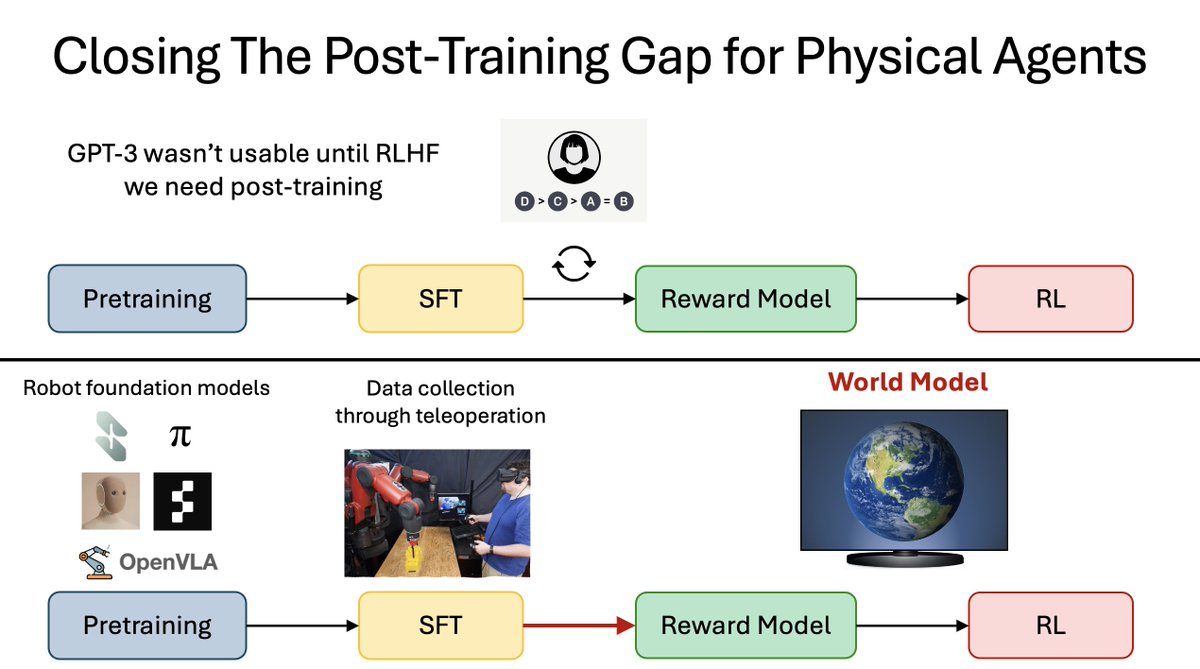
RISE showed that imagination training works on real robots. World-Gymnast asks the next question: can it beat both expert demonstrations and physics simulators?
The setup is direct. Take a VLA policy. Roll it out inside an action-conditioned video world model. Let a vision-language model watch the rollout and return a binary reward: did the task succeed or not? Use that reward to do RL. No physical interaction. No hand-authored simulator. Just a video model that imagines what would happen and a language model that judges the result.
On the Bridge robot setup, World-Gymnast outperforms supervised fine-tuning from expert demonstrations by up to 18x. It outperforms RL in a software simulator by up to 2x. The software simulator has a sim-to-real gap. The video world model, trained on real-world video, has a smaller one.
But the most revealing result is not the headline numbers. It is what happens when you add distractor objects during training. A battery sits next to a rubber duck. The SFT policy and the standard World-Gymnast policy both get distracted and grab the duck. World-Gymnast trained with distractor augmentation inside the world model completes the task. The world model generated the distractors. The policy learned to ignore them. No human had to set up a single physical distractor scene.
The paper also demonstrates test-time training: drop the robot into a scene it has never seen, do RL inside the world model for that specific scene, and performance on close-the-drawer jumps from 62% to 100%. No real-world rollouts required.
World-Gymnast's closing argument deserves to be taken literally: learning a world model and training robot policies in the cloud could bridge the gap between robots that work in demonstrations and robots that work in anyone's household.
Sharma, Sun, Lu, Zhang, Liu, Yang. February 2026. https://t.co/KsjSFmS81f

Excited to share World-Gymnast: Training Robots with RL in a World Model.
Training a VLA policy in a world model with RL transfers to much improved real-robot success (according to third-party robot AutoEval).
Website: https://t.co/xfPY3m1UMV
Paper: https://t.co/FUOa5ZWLKs

@theCoachACE i feel it's more about removal. removal of distractors. For me it was a long process. removal is the key part of it. but having clear(or clearer) direction, exploring where i want to go and why -> its the second part (although easier with less distractions)
Trends for you
Most Popular Users

Elon Musk 
@elonmusk
240.1M followers

Barack Obama
@barackobama
118.6M followers

Cristiano Ronaldo
@cristiano
114.4M followers

Donald J. Trump
@realdonaldtrump
111.7M followers

Narendra Modi
@narendramodi
106.9M followers

Rihanna
@rihanna
98.6M followers

NASA
@nasa
92.1M followers

Justin Bieber
@justinbieber
91.7M followers

KATY PERRY
@katyperry
89.9M followers

Taylor Swift
@taylorswift13
83.9M followers

Lady Gaga
@ladygaga
75.4M followers

Virat Kohli
@imvkohli
73.3M followers

Kim Kardashian
@kimkardashian
70.8M followers

YouTube
@youtube
68.6M followers

Neymar Jr
@neymarjr
66.3M followers

Bill Gates
@billgates
65.2M followers

Selena Gomez
@selenagomez
63M followers

The Ellen Show
@theellenshow
62.1M followers

CNN
@cnn
61.7M followers

X
@x
60.6M followers