Excited to share MOFGen is accepted to Nature Computational Science: https://t.co/odECr2CjuU
This project started in 2024 and took about 2 years to get through the review (a bottleneck of AI for science?).
A lot has changed since then but our bet hasn't: agents would end up running end-to-end materials discovery from generating a candidate to synthesizing it in the lab and powering future self-driving labs.
Science agents can automate discoveries from research ideas to wet labs!
We show a system of agents (LLMs, diffusion models, hardware equipments) was able to discover and synthesize 5 novel metal-organic structures, going beyond human knowledge.
Paper: https://t.co/q22kdTT8tz
Great question! It definitely helped with similar tasks (what we call global playbook in the paper). We haven't tried reflecting on completely different tasks but we don't see why there won't be transfer. The idea is that we can treat reflecting skills similar to problem solving skills and use RL to train for all of them which then generalizes to more tasks.
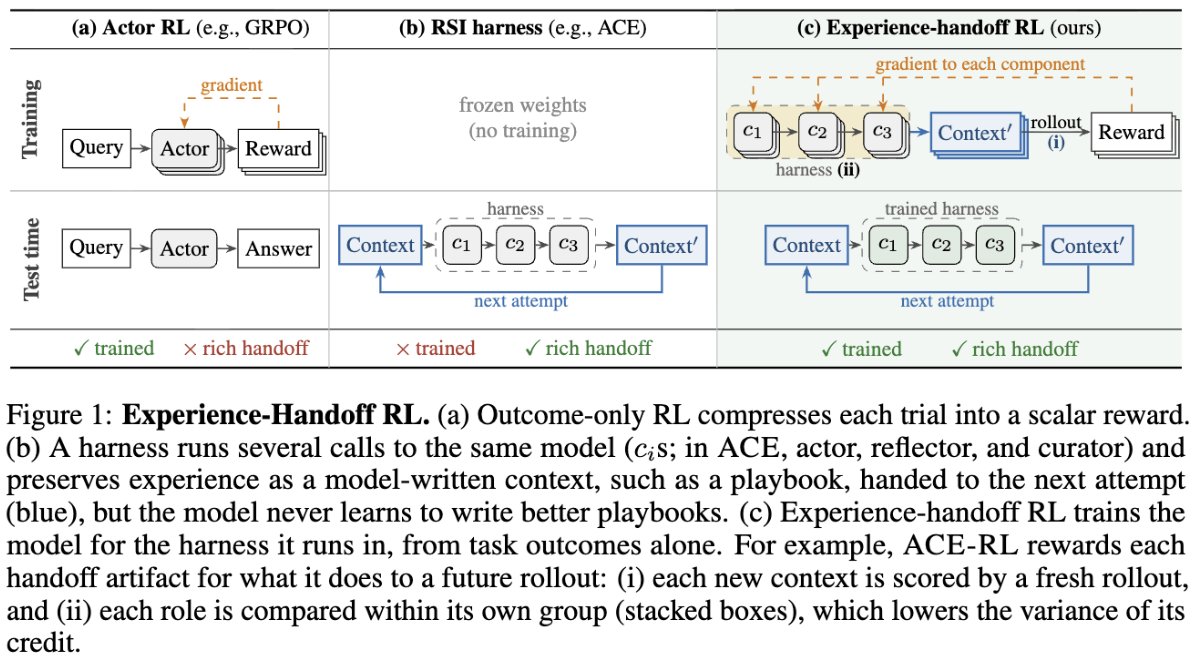
Agentic RL that learns only from reward wastes rich feedback from the environment. In Experience-Handoff RL, that feedback builds better context for future attempts.
We use RL to train agents for agentic context engineering: acting, reflecting, and updating their context, rewarded by how well the next attempt performs.
Great work led by my student @doyoungkim_ml!
Paper: https://t.co/x3ANAaZFQA
Code: https://t.co/zY1fTSGqfc
Why not RL an agent's weights inside its harness?
RL for agents throws away rich feedback, so people build harnesses like ACE where the model writes notes for itself. But it was never trained to use them. We give each role its own RL objective.
@Zefan_Cai Great question! We use RL to train the model to rewrite the context through reflecting and curating (similar to compaction in composer). What should be kept in context should be based on what improves the agent.
Meet Pika H3 Flex, debuting today as the #1 open weight model on DesignArena’s t2v board.
It’s built for professional iteration, with exportable audio stems, resolutions up to 4k, and faster-than-realtime generation. It can produce a 15-second clip with soundtrack in as little as 7 seconds.
So, yeah. It’s kind of a flex 💅
Yes indeed. MLE-World mitigates this by using a confidence gate to select which real experiments to execute. Moreover, evaluation and deployment will require real executions, and the point MLE-World advocate is these experiment data should be feed back to improving the world model.
World models go beyond robotics.
Autoresearch and agentic ML engineering face a familiar bottleneck: expensive experiments.
Introducing MLE-World: learn from past experiments to predict new outcomes before running them.
Paper, model, data, code: https://t.co/x0C8DXNGn2
🚀 Toward RSI: AI agents automate ML research, but each step trains and evaluates a model, limiting test-time scaling.
Our new paper, MLE-World, asks: can agents explore more ideas by predicting experiment outcomes before running them? 🧵⬇️
@rotaruzaurul Thanks for the question. My take is that gradient itself does not contain rich information whereas world models trained on the execution traces of MLE experiments do.
Thank you! Yes, this is a great point. MLE-World uses a confidence gating mechanism to switch to running real executions when the prediction is uncertain. The key idea is not just to skip execution, but to save every execution as training data for future MLE world models, so many ML task will become in-distribution for MLE world models.
This complements our Reward-Rate Policy Gradient work on MLE agents:
RPG learns to maximize reward per unit time.
MLE-World reuses experience to make experiment feedback cheaper.
Two complementary directions for making better use of a limited research budget.
https://t.co/1Ewpfrgx1c
Excited to share Reward-Rate Policy Gradient: RL that accounts for execution time.
For autoresearch and ML engineering agents, actions can take seconds or hours. A fixed-step MDP misses this distinction.
We optimize MLE agents' reward per unit time in a semi-MDP.
https://t.co/mc4hxC4pwV
https://t.co/g4PFVDPGHM
See details below:
Why should agentic robots rediscover what humans already know?
Excited to share our new work, MoCaP (mobile Code-As-Policy), which turns passive human videos of everyday life into a head start for agentic robots: where things are and how to approach them.
Human experience → less robot trial and error.
Coding agents are emerging as general robot policies, but they are still inefficient (e.g., requiring long real-world exploration), especially in mobile manipulation.
Humans become efficient by watching others.
Can coding agents learn from passive human videos, just like we do?
Introducing MoCaP: Mobile Code-as-Policies for Zero-Shot Mobile Manipulation from Passive Human Videos
↓🧵
This work was inspired by the paper "Between MDPs and Semi-MDPs" by @RichardSSutton, Doina Precup, and Satinder Singh from nearly three decades ago.
Applying conceptual frameworks such as semi-MDPs in practical scenarios of modern agentic RL for LLMs is a reminder of how important the foundations of RL remain.
Excited to share Reward-Rate Policy Gradient: RL that accounts for execution time.
For autoresearch and ML engineering agents, actions can take seconds or hours. A fixed-step MDP misses this distinction.
We optimize MLE agents' reward per unit time in a semi-MDP.
https://t.co/mc4hxC4pwV
https://t.co/g4PFVDPGHM
See details below:
1/7
Excited to share our new work on agentic RL! 🛠️
Some tasks in agentic RL involve actions that incur costs. One example is machine learning engineering (MLE) agents, where a proposed script might run for minutes or hours. We propose Reward-rate Policy Gradient (RPG) using a Semi-Markov Decision Process formulation that optimizes reward per unit time.
🌐https://t.co/opRhVZeKZX
I was most excited about the NanoGPT results: reward-rate RL achieves lower pretraining loss faster than vanilla RL.
With growing interest in autoresearch and MLE agents from @karpathy@quocleix@JeffDean, time-aware RL could be an important ingredient. Choosing the next experiment means deciding how to spend a limited research budget. Agents should learn to weigh an experiment’s potential payoff against the time it takes to run.
https://t.co/ECyVxQL4Yl
Great point! In this work, we assume the difference in cost is due to the choice of ML algorithm itself (e.g., boosting vs simple logistic regression), while assuming every action gets enough GPUs. In practice, the cost of GPU contention, queueing will play a role. These can be modeled as stochasticity in the environment, and reward-rate policy gradient can still optimize decisions in the presence of these environment stochasticity.