🚀 100+ DOWNLOADS IN JUST 24 HOURS.
75 authors. 29 institutions. 500+ references.
📄 From Prediction to Control: A Survey of Closed-Loop World Models for Robot Learning
https://t.co/AnSXkkgAhP
Our survey just crossed 100 downloads in its first day.
Prediction is not control. Generating the future is not the same as acting in it.
The next frontier of Physical AI is closing the loop.
A new survey of world models is out:
"From Prediction to Control: A Survey of Closed-Loop World Models for Robot Learning"
Core argument: Robots use world models to predict how the world will change, but better prediction does not imply better control.
We call this the Prediction-to-Control Gap:
• The same prediction error can be harmless in generated training data but decisive when a planner ranks actions under a control deadline
• Predictive likelihood can diverge from control performance (Lambert et al.)
• Perceptual video metrics can disagree with manipulation success (VP²)
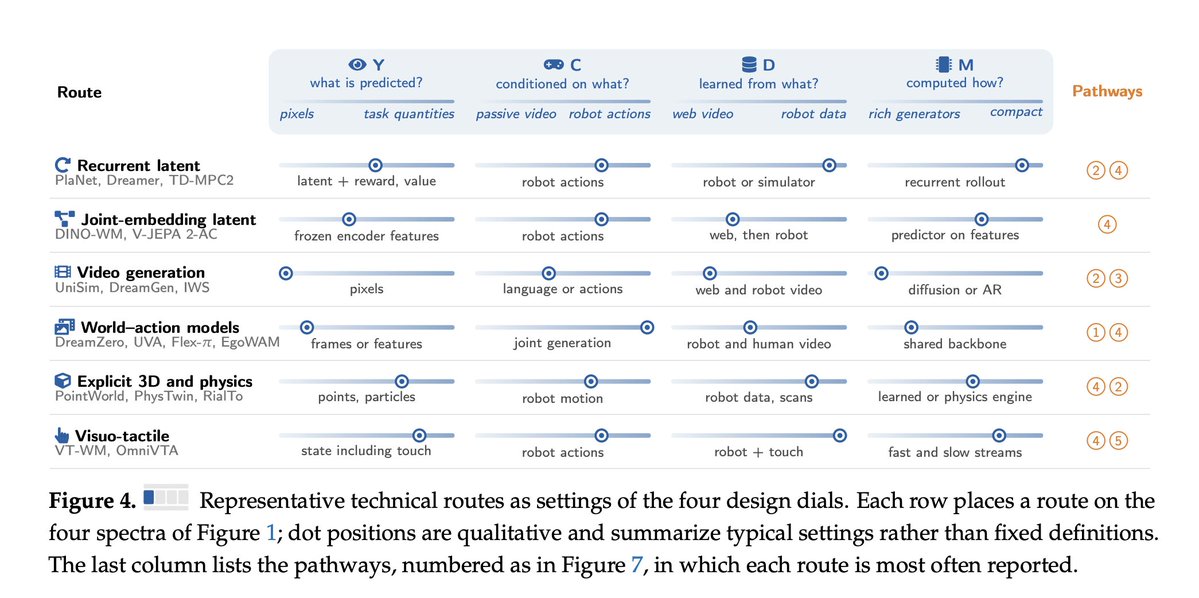
🎛️ We describe a world model by 4 design dials
• Y: what it predicts (pixels to task-level quantities)
• C: what it is conditioned on (passive video to robot actions)
• D: what data it learns from (web video to robot data)
• M: how it computes (expressive generators to fast, compact models)
Video generators, JEPA-style latents, world-action models and 3D/physics models are settings of these dials, rather than rival paradigms.
🔀 5 pathways from prediction to robot behavior
• Features: shape the state the policy acts on
• Experience: generated trajectories for policy learning
• Scores: rewards, success estimates, costs
• Decisions: futures of candidate actions, compared before acting
• Residuals: prediction-observation mismatch, used to correct execution or flag failures
💡 Takeaways
• Each pathway favors different dials: fast, action-controllable predictors for decisions; expressive generators for experience and evaluation; task-relevant targets for features
• Claiming a benefit requires comparing the robot with and without the model under matched resources
• A model fitted once goes stale: as the policy improves, its queries drift to states the model has seen least. Refit on data from the current policy
🧭 Where evidence is thin (in our evidence atlas)
• Real-robot closed-loop results cluster in pixel-space models used for decisions or experience
• Scores: world-model policy rankings agree with real outcomes, but no gain from selecting policies by them has been shown yet
• Residuals and touch: active methods, little comparable closed-loop evidence
📚 Also inside: what each embodiment demands, real-robot evaluation protocols, refitting models from deployment data, and open problems.
Honored to have worked with all the co-authors.
📄 Paper: https://t.co/dsyvzkyDa8
🗂️ 500+ papers sorted by section: https://t.co/fwy22wB2OY
🚀 Toward RSI: AI agents automate ML research, but each step trains and evaluates a model, limiting test-time scaling.
Our new paper, MLE-World, asks: can agents explore more ideas by predicting experiment outcomes before running them? 🧵⬇️
Frontier data is a research problem.
For example, some of the biggest academic CUA papers are solely focused on data synthesis for SFT (OpenCUA, from last August) and RL (CUA-Gym, from this June). Good data requires diligent researchers and engineers.
By next year, I'd expect data talent to look increasingly similar to the current research scientist talent. Already hear small stories of data talent poaching wars and such.
Finding a lawyer shouldn't be the hardest part of your problem.
We built https://t.co/4HR5pRzPmw to make it simpler.
Tell us what happened in plain words — no legal terms needed. Answer a few quick questions. See attorneys in your state who handle cases like yours.
900,000+ attorneys. All 50 states. Free, no account.
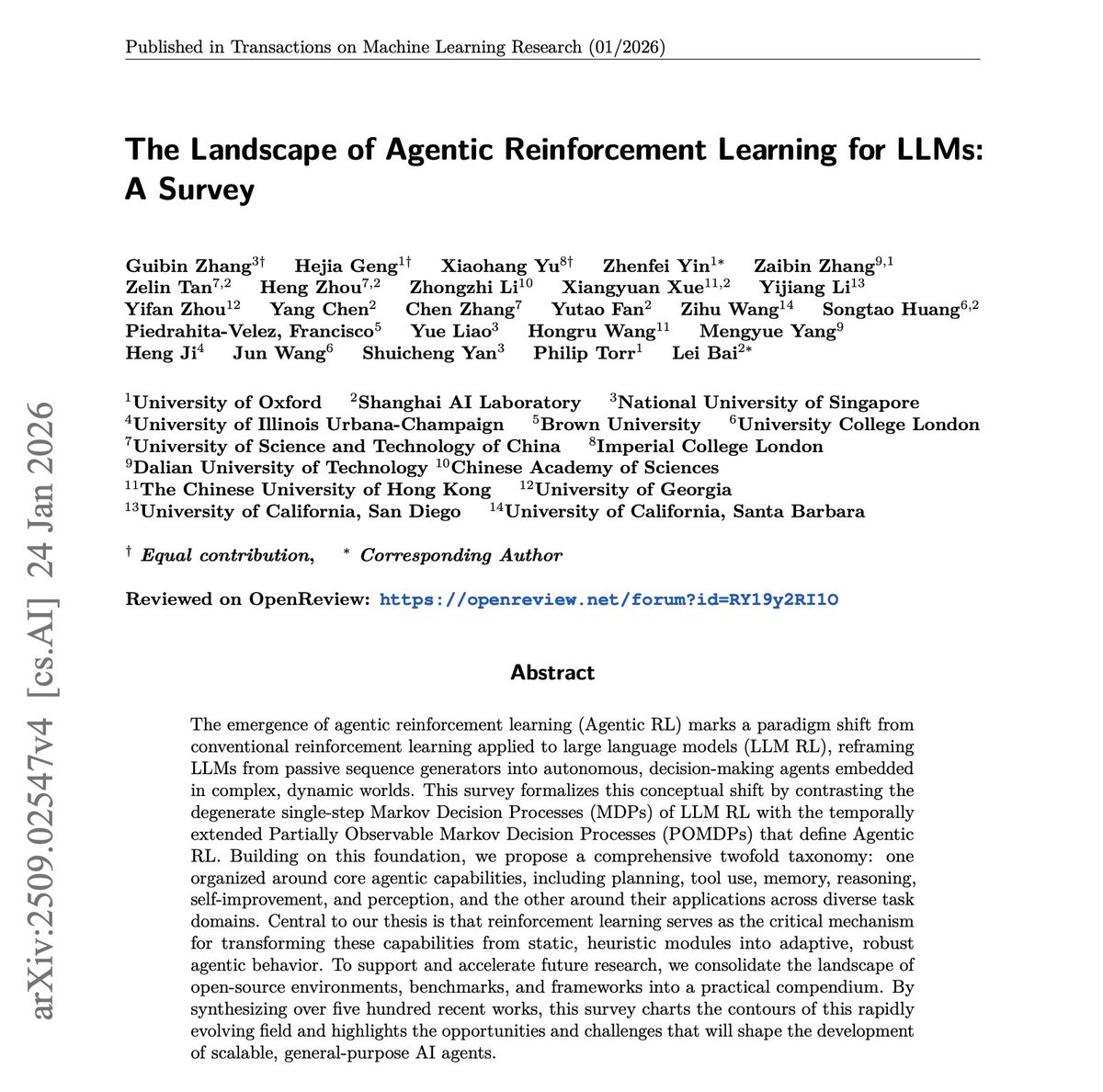
New survey on agentic reinforcement learning for LLMs.
LLM RL still treats models like sequence generators optimized in relatively narrow settings. However, real agents operate in open-ended, partially observable environments where planning, memory, tool use, reasoning, self-improvement, and perception all interact.
This paper argues that agentic RL should be treated as its own landscape.
It introduces a broad taxonomy that organizes the field across core agent capabilities and application domains, then maps the open-source environments, benchmarks, and frameworks shaping the space.
If you are building agents, this is a strong paper worth checking out.
Paper: https://t.co/qwXZNSp0ZA
Learn to build effective AI agents in our academy: https://t.co/1e8RZKs4uX
I think about startups through the spectrum of reach and validation.
0 people: you are probably dreaming.
1 person: you may just be building for yourself.
A small group: you start getting signals.
A large market: you start seeing demand.
Everyone on earth: you may have found something universal.
A startup is essentially a sampling process: guided exploration in a massive, uncertain environment.
We should build a transparent and trustworthy A2A economic system on blockchain.
Such a system could dramatically reduce the friction and cost embedded in today’s human economic system.
For example, when people look for a lawyer today, there is a huge trust cost:
The lawyer’s track record is highly opaque. No one really knows their past success rate, client volume, or actual performance.
Even when such data exists, it is usually not available in a structured, verifiable, and decision-useful way.
As a result, humans often make decisions through irrational trust, personal referrals, brand perception, and incomplete information.
But if we had this data and this infrastructure, we could significantly reduce the friction and time cost of the human economy.
For example, in the future, an AI law firm inside an agent network could have all of its data, ratings, performance history, and service records stored as immutable public data. Agents could then use rational algorithms to select the best option on behalf of humans — efficiently, conveniently, and transparently.
The same logic applies to almost all consumer goods and services.
Humans are simply not good at making decisions across massive amounts of data. This is why even the most advanced capitalist systems are still not efficient enough. They can be significantly optimized by AI. In the future, everyone’s AI agent will automatically make optimal transactional decisions on their behalf.
I think the reason crypto created such massive market value over the past decade is that, at its core, it reduced transaction costs in the traditional bank-based financial system.
But because of technological limitations, before AI agents existed, crypto had limited value beyond financial speculation. This also made the crypto world chaotic and polluted.
Now, with AI agents, crypto becomes almost inevitably useful in the future AI-based economic system.
We should build an empire. An empire for everyone’s AI agent. Boundless on earth.
Some things still matter deeply in the AI era:
Beauty.
Creation.
Love.
Freedom.
And real AI hard problem:
Time.
Customers.
Trust.
Reputation.
Tacit know-how.
Media influence.
Human relationships.
Private data.
AI can generate, optimize, and automate many things. But the most valuable things are still built through time, trust, taste, relationships, and lived experience.
This is how I see the shift in human productivity in the AI era:
We should move from building outputs by hand, to building systems that produce outputs, to building systems that produce systems.
Research:
humans write papers → humans build AI researchers → humans build systems that create AI researchers
Products:
humans build products → humans build AI product builders → humans build systems that create product builders
Services:
humans provide services → humans build AI service providers → humans build systems that create service providers
The key shift is not just automation.
It is a meta-level shift in production: from producing work, to producing workers, to producing the systems that produce workers.
Introducing Parthenon Law Skills — 1,251 open-source procedural skills for legal AI agents.
Legal AI agents do not only need bigger models. They need institutional memory: checklists, playbooks, source-grounding routines, date/number audits, deliverable conventions, and release gates.
That is what this repo is trying to provide.
Each `SKILL.md` is a rubric-blind procedural plan for a class of legal matter. It does not contain hidden answers or memorized rubric anchors. Instead, it tells the agent how to work: how to triage documents, frame the legal issue, avoid recurring failure modes, verify sources, reconcile numbers and dates, structure the deliverable, and audit the draft before release.
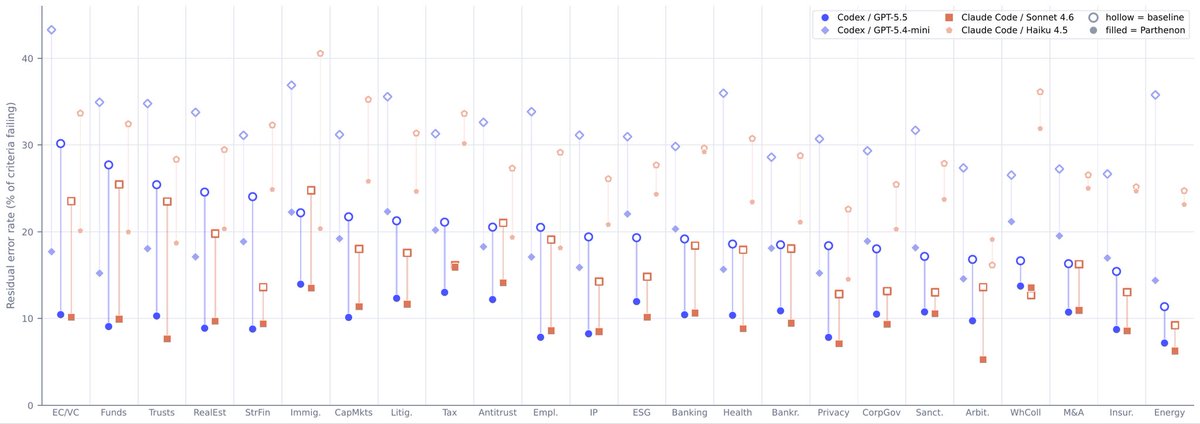
The library covers 1,251 skills across 24 legal practice areas in Harvey LAB, including M&A, IP, litigation, privacy, finance, sanctions, tax, antitrust, employment, real estate, healthcare, funds, restructuring, and more.
The empirical result: procedure matters.
With the model and agent runtime held fixed, adding the Parthenon skills/harness produced large gains across different solver families:
Codex / GPT-5.4-mini: 68.2% → 82.0%
Codex / GPT-5.5: 79.8% → 89.9%
Claude Code / Haiku 4.5: 71.6% → 77.8%
Claude Code / Sonnet 4.6: 82.8% → 90.2%
This is not just “use a bigger model.” The same procedural layer transfers across different models and agent runtimes, suggesting that legal-agent reliability depends as much on institutional memory and review gates as on raw model capability.
The cost result is also interesting. On Codex / GPT-5.5, accuracy improved from 79.8% to 89.9% while per-matter cost decreased from $1.51 to $1.29. Parthenon/mini reached 82.0% for $0.66 per matter, beating the GPT-5.5 baseline at less than half the cost.
To be clear: this is not “AI replaces lawyers.”
The strongest configuration still does not fully complete most matters under an all-or-nothing release standard. A lawyer still needs to review, correct, and take responsibility.
But it changes the workflow: from drafting from scratch to reviewing a source-grounded, audit-flagged first draft produced by an agent with explicit procedural memory.
Open-source skills:
https://t.co/VlSsrXlL2d
These skills are the result of our self-evolving legal-agent framework. For more details, see the paper:
https://t.co/32iZImh8BF
#LegalAI #AIAgents #OpenSource