Over the past week, I’ve been overwhelmed by the love and support of friends, industry colleagues, and people I've never met. Thank you to everyone who has shown kindness to my family and me. It means the world to me.
I came to the United States 53 years ago, and becoming an American citizen is one of the greatest gifts and proudest moments of my life. NVIDIA has been my life’s work. Building it into the company it is today alongside my colleagues has been a privilege and an honor. Nowhere but in America could a company like NVIDIA be possible. I love our country, and I love NVIDIA.
I did not live up to the standards expected of everyone at NVIDIA, and I have made serious mistakes in my personal life. I created problems for the Board that I deeply regret. I own my mistakes completely, and I am committed to cooperating with the Board’s independent investigation.
Since my departure, I’ve seen an outpouring of calls from NVIDIA’s employees, investors, business partners, and customers for me to return as CEO. Many continue to reach out to me directly as the company navigates complex technology, market, competitive, and geopolitical dynamics. NVIDIA is a once-in-a-generation company. If the Board of Directors decides that my return is in the best interest of our shareholders, our employees, the company, and America, I would be honored to answer these calls and return as CEO.
Thank you again to everyone who has shared their good wishes. I am profoundly humbled by your support. To my family: I love you, and I will spend the rest of my life being worthy of yours.
Jensen
🚀 Terminal-Bench-Science is now featured in its first open-weight model release!
Kimi K3.1 Pro scores 38.1%, the strongest open-weight result on Terminal-Bench-Science to date.
Still, Terminal-Bench-Science shows BY FAR the biggest gap to SOTA (~30 points), a promising sign that it’s one of the most discriminative measures of frontier capability out there.
📹 The video that introduces our Lean4AgenticRL (https://t.co/Ys91Zp1jDA) training framework. The model is currently open-sourced at https://t.co/fvN0Kzi2sN, feel free to try it!
We are also actively preparing to open-source the training infrastructure, which supports LAR training on 9B and 27B models.
What if Lean could verify not just math, but virtually any agentic RL task?
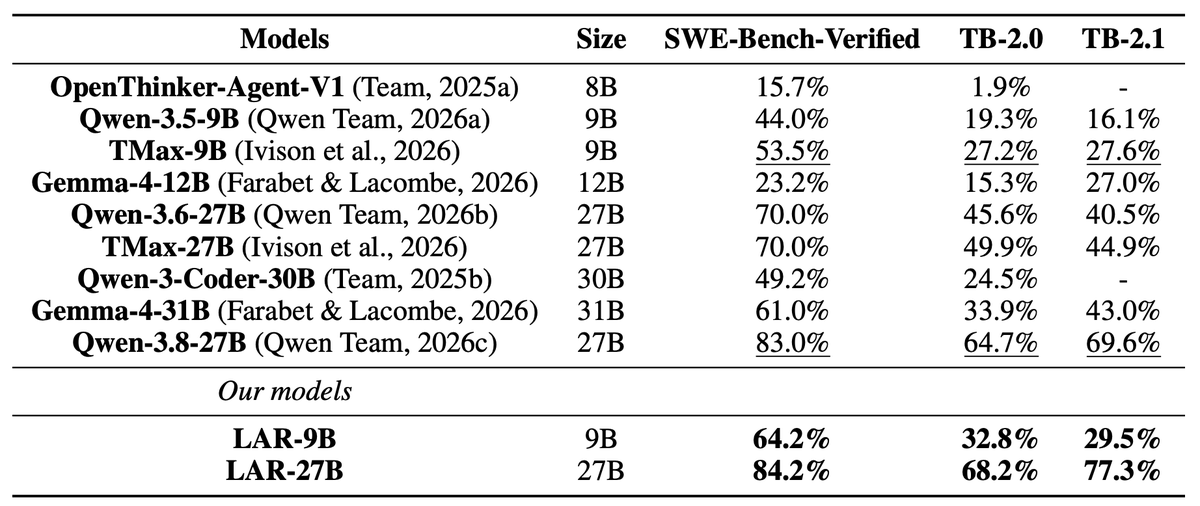
Lean4AgenticRL is the first framework to make it possible. Simple plug-n-play led to frontier performance on TB-2.1 (77.3%) among all 30B-class models, with 7.7% relative gain over previous SOTA. Try it!
🚀 Introducing Lean4AgenticRL framework. The first method to apply formal verification in an open-ended domain for agentic RL. We apply the Lean4Agent(https://t.co/btE8IsUdaA) framework to provide process rewards for agentic RL. We train LAR-9B/27B using Lean4AgenticRL. The LAR-9B models achieve a 20.2% improvement on SWE-Bench-Verified, bringing the score to 64.2%. The LAR-27B model achieves 77.3% on TerminalBench-2.1, improving the base model by 7.7%. The LAR-9B/27B outperforms all the known baselines of similar size in SWE-Bench-Verified, TB-2.0, and TB-2.1. Welcome to read our paper and try our model!
[1/n]
Paper: https://t.co/Mun0ncEhTj
Model: https://t.co/fvN0Kzi2sN and https://t.co/7nq4u9GILh
Code: https://t.co/MHU95TUHG4
Website: https://t.co/7WtZz7pNUu
📣 Announcing Terminal-Bench Science: benchmarking AI agents on real scientific workflows – now open for task contributions👇
https://t.co/MSPMwnbhVt
@AnthropicAI, @OpenAI, and @GoogleDeepMind use Terminal-Bench to evaluate AI on coding tasks. We're now extending it to scientific workflows.
1/6🧵
Huge news for Terminal-Bench-Science!🚨
Only 5 days after launch, Terminal-Bench-Science 0.1 is the #1 featured benchmark on @AnthropicAI's new Claude Fable 5.1 release.
Incredible >2x performance jump:
Claude Fable 5 (24.7%) → Claude Fable 5.1 (52.6%)
Now it's on us to build an even more challenging set of tasks for v0.2.
https://t.co/eTQVRK9YCZ
🎉🎉🎉Thrilled to release a new paper on LLM RL (collaborating with Amazon AWS):
"Cliff: Learning Process Rewards from the First Mistake"
If you're interested in reward shaping and distilling in RLVR, take a look at our work! Paper: https://t.co/YKsFkqWshT
(More below⬇️)
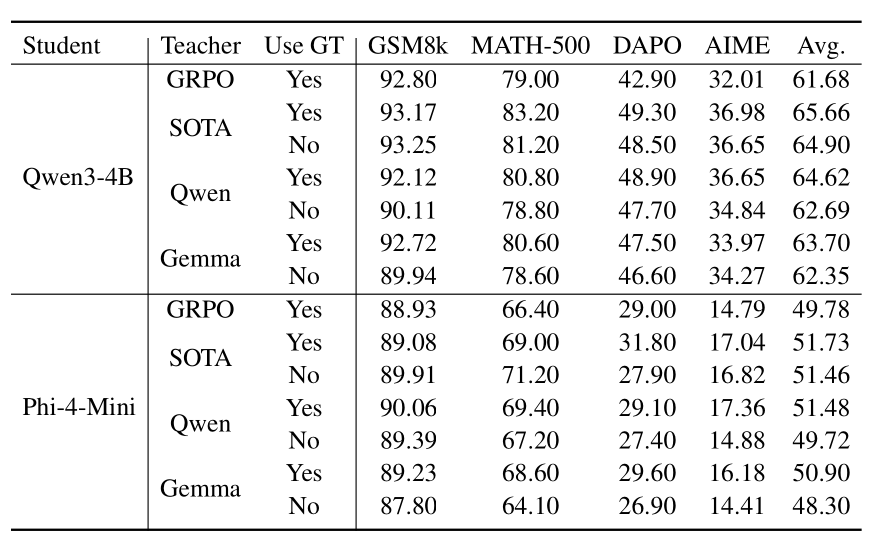
(5/5) Notably, Cliff isn't sensitive to teacher quality; moderate-scale LLMs like Qwen3-32B serve as good teachers, significantly improving the reasoning.
For weaker teachers, limiting Cliff signals to questions where the teacher itself can answer is an important design.
We're releasing Terminal-Bench-Science: a benchmark for evaluating AI agents on research workflows across scientific domains.
An ongoing Stanford-led community effort, built by the team behind Terminal-Bench together with scientific domain experts at research institutions worldwide. v0.1 has 70 tasks. Claude Opus 5 solves only ~30%.
1/n 👇
Why have SWE benchmarks converged on contrived tasks that are hard for hard’s sake?
New essay on how we got here, and why we need to rethink benchmarks from the ground up.
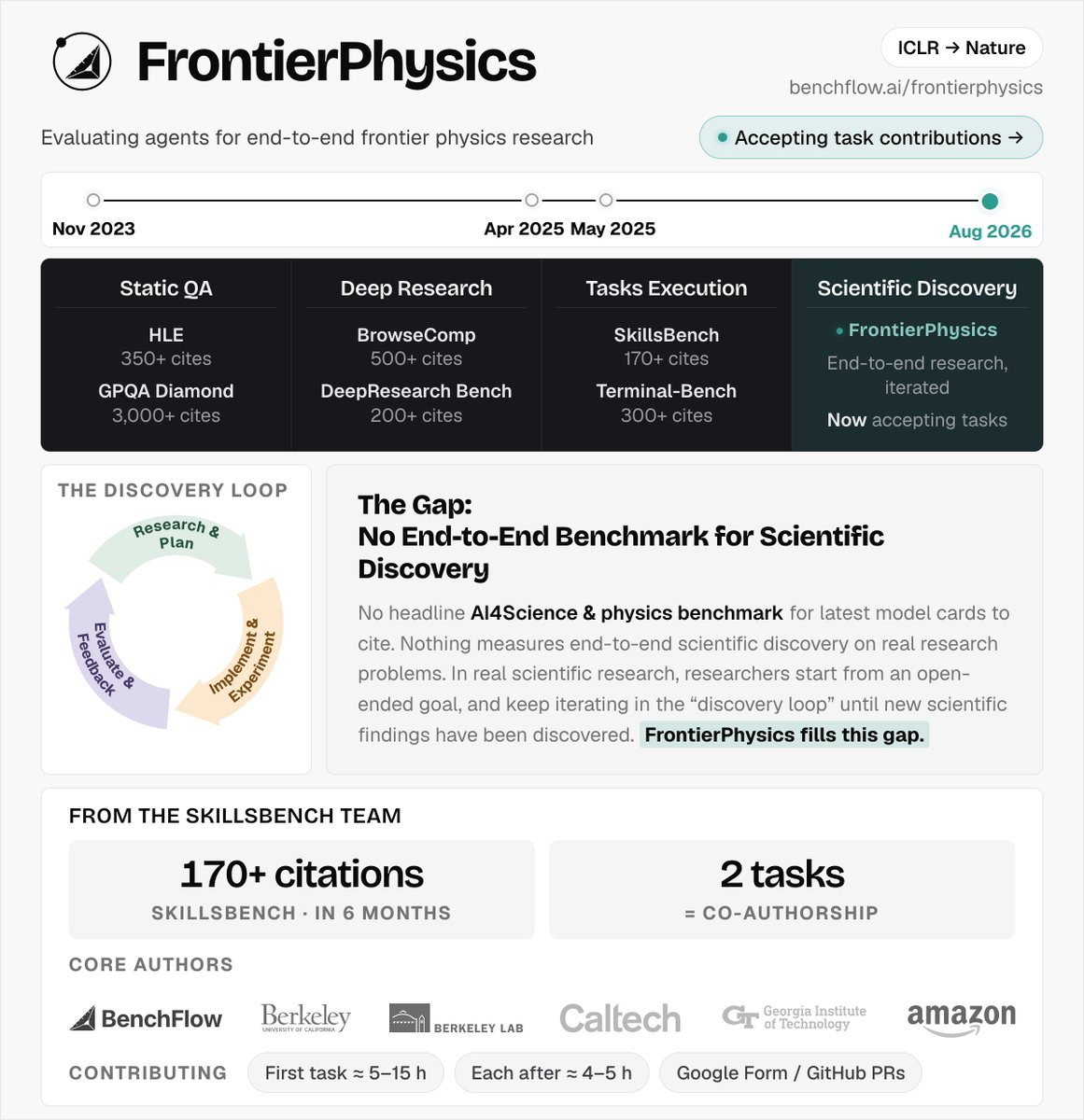
Introducing FrontierPhysics: benchmark for e2e frontier physics research
We built SkillsBench and got 180+ citations in 6mo. People have been asking next project to contribute to
Led by @bingran_bry - Physics PhD @UCBerkeley, Nature author, advised by Prof. Haeffner and more 🧵
This feels like the end of the beginning for AI.
We’ve seen this movie before.
Electricity.
Bandwidth.
Cloud compute.
Infrastructure becomes abundant. Margins compress. Innovation moves up the stack.
Open models are making frontier intelligence increasingly abundant. That puts relentless economic pressure on the token business.
The next generation of great AI companies won’t be remembered for selling tokens. They’ll be remembered for building products people can’t imagine working without.
My bet: the next decade creates 100× more Harveys, Cursors, and OpenEvidences than frontier model labs. That’s where the next wave of value creation will come from.
And these new generation of AI companies will own their models; the models will be the biggest differentiator of their products.
GPT 5.6 Sol feels more RL maxed than Fable. It often prefers harder approaches for throwaway work. As if it was trained with RL tasks that are hard for the wrong reasons. Arbitrary roadblocks that make tasks artificially difficult and lead to abnormal trajectories.
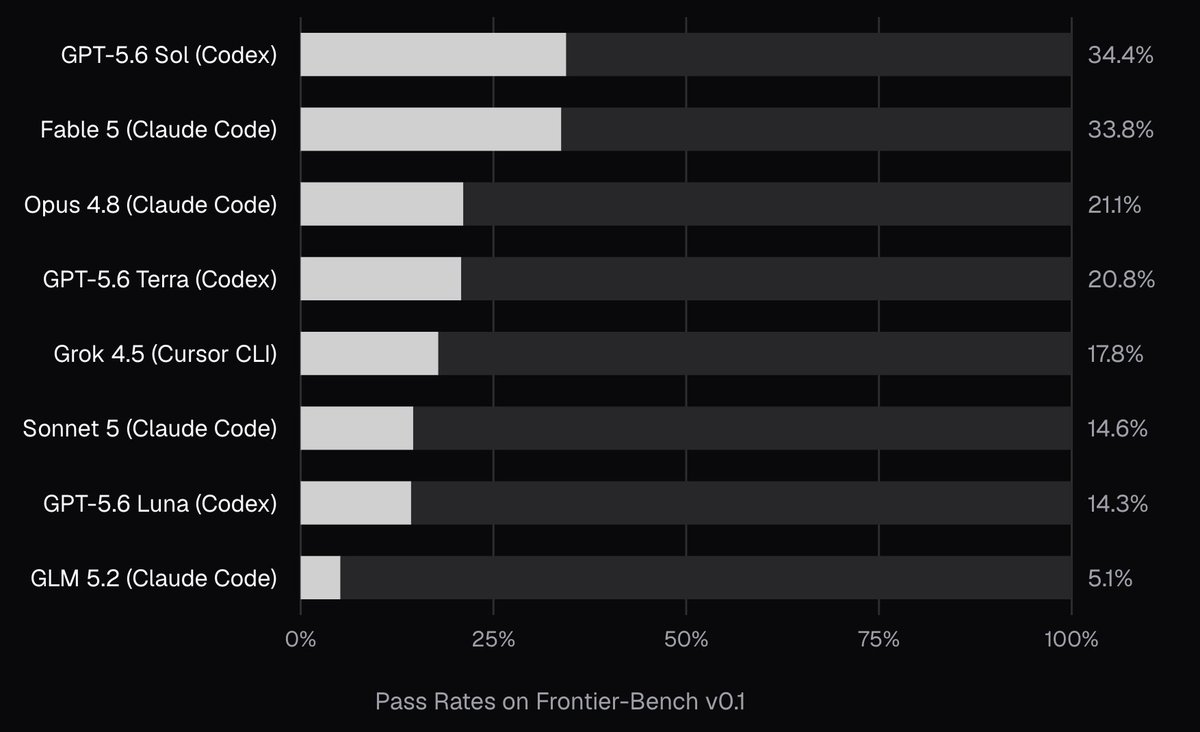
We’re releasing Frontier-Bench: a benchmark that measures and evolves with the frontier of agent work.
Built by the team behind Terminal-Bench and Harbor, Frontier-Bench is an on-going community effort.
Frontier-Bench v0.1 contains 74 tasks on which the best agents score ~34%
Can coding agents stay coherent over a 1 billion token budget?
Can they build Slack from scratch?
Rewrite a JAX codebase in PyTorch?
Build a C compiler in Rust?
Enter SWE-Marathon: a benchmark for autonomous long-horizon software work.