

Top Tweets for #EnhancerPrediction

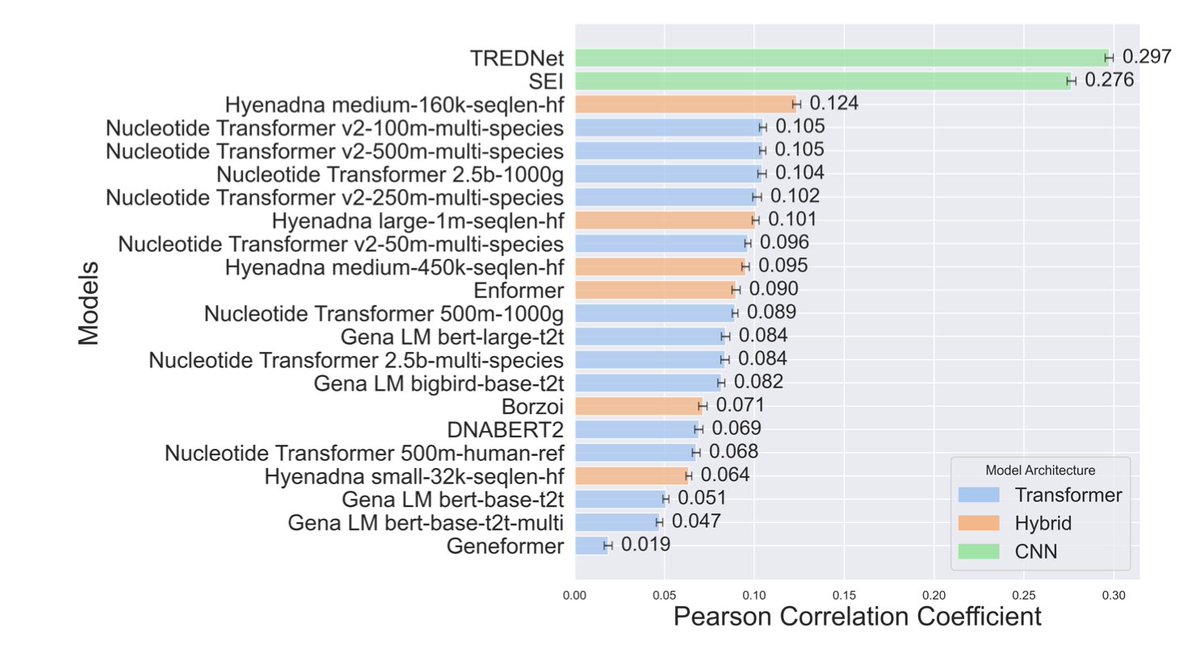
Comparative Analysis of Deep Learning Models for Predicting Causative Regulatory Variants
1.This study presents the most extensive benchmark to date of deep learning models for predicting regulatory variant effects on enhancers, using 54,859 SNPs from MPRA, raQTL, and eQTL datasets across four human cell lines.
2.CNN-based models, particularly TREDNet and SEI, consistently outperform both transformer-based and hybrid models in predicting log2-fold changes in enhancer activity, achieving the highest Pearson correlations with experimental results.
3.While transformer models such as Nucleotide Transformer and DNABERT2 excel in long-range sequence modeling, they underperform in enhancer variant prediction due to limited granularity in feature detection—especially under less significant variant effects.
4.Hybrid models like Borzoi and Enformer balance local and global dependencies. Borzoi, despite weak enhancer detection performance, achieves the best results in identifying causal variants within GWAS linkage disequilibrium (LD) blocks.
5.Top-1 causal SNP detection accuracy reaches 42.5% with Borzoi, followed closely by SEI (40.7%), Enformer (39.4%), and TREDNet (33.8%), highlighting the practical utility of hybrid and CNN models in fine-mapping GWAS loci.
6.Model performance improves markedly when variant effects are experimentally significant (e.g., p < 10⁻⁵), with TREDNet achieving correlation up to 0.421, reinforcing the importance of data quality in regulatory variant prediction.
7.SEI, despite lacking fine-tuning, matches or exceeds the performance of many transformer models, showcasing the strength of well-designed CNN architectures for one-shot applications.
8.Transformer models show cell line-specific variability; they perform well only when pre-trained and fine-tuned appropriately, whereas CNN models like TREDNet generalize robustly across cell types without needing task-specific adjustments.
9.In enhancer detection (auROC, auPRC), transformer models like Nucleotide Transformer 2.5b achieve top classification metrics but have poor alignment with experimental log2-fold changes—limiting their use in variant-specific interpretation.
10.Overall, TREDNet and SEI are the most effective for variant effect prediction, while Borzoi stands out for causal SNP identification. Transformers show potential in enhancer classification but lag in fine-resolution SNP effect prediction.
📜Paper: biorxiv.org/content/10.1101/…
#Genomics #EnhancerPrediction #GWAS #SNP #VariantEffectPrediction #DeepLearning #CNN #Transformer #Bioinformatics #TREDNet #SEI #Borzoi #NucleotideTransformer
Developing a general AI model for integrating diverse genomic modalities and comprehensive genomic knowledge
1.This work presents a general-purpose, multi-task AI model capable of predicting over 20 genomic modalities—including nascent RNAs, histone marks, and chromatin architecture—directly from DNA sequence and ATAC-seq input across diverse human and mouse cell types.
2.The model uniquely integrates epigenomic, transcriptomic, and 3D genome data into a unified framework, accurately predicting tissue-specific enhancer RNAs (eRNAs), gene-level nascent RNA signals, and regulatory interactions even in settings with limited or no direct measurements.
3.In contrast to prior task-specific or sequence-only models like Enformer or Borzoi, this model generalizes across modalities and cell types using ATAC-seq context, enabling robust predictions in unseen tissues and developmental stages.
4.The architecture combines local and global encoders with transformer layers, and includes chromatin interaction-informed self-attention to refine sequence representations—making it effective in modeling long-range genomic interactions.
5.For nascent RNA prediction, the model outperforms average signal baselines across GRO-seq, Bru-seq, and TT-seq data, and successfully captures dynamic transcriptional responses to acute signals like TGFβ-1 treatment in MCF10A cells.
6.Enhancer-level validation using eQTL enrichment shows that the model accurately predicts higher transcriptional activity at genetically important enhancer loci across GTEx tissues, even in the absence of direct eRNA measurements.
7.For non-coding variant function prediction, the model achieves higher accuracy than Enformer and Borzoi in identifying functional eQTLs in unseen cell types, demonstrating superior context specificity and transferability.
8.On lentiMPRA regulatory activity prediction, the model surpasses MPRAnn, MPRALegNet, and ResidualBind in cross-cell type generalization, and accurately recovers active elements across novel cellular contexts.
9.When applied to enhancer–gene regulatory interaction prediction, the model outperforms ENCODE-rE2G using only ATAC-seq input, and further improves performance when integrating its predicted modalities (e.g., histone marks, TF binding, chromatin loops).
10.A mouse-specific version of the model is trained via fine-tuning, achieving state-of-the-art predictions of histone modifications, chromatin contacts (RCMC), and transcription in embryonic and postnatal tissues across multiple modalities.
11.In a mouse inner ear study, the model captures cell type-specific gene expression, enhancer activity, and regulatory loops at the Atoh1 locus—successfully distinguishing active versus silent enhancer usage between hair cells and supporting cells.
12.Overall, this general AI model provides a powerful, biologically grounded framework for cross-species genomic analysis, enabling modality imputation, regulatory interpretation, and enhancer prioritization with minimal experimental input.
💻Code: github.com/liu-bioinfo-lab/g…
📜Paper: biorxiv.org/content/10.1101/…
#Genomics #AI4Science #Epigenomics #RegulatoryGenomics #MultiTaskLearning #GeneRegulation #EnhancerPrediction #Chromatin #ComputationalBiology #CrossSpeciesAI

Genomic Language Model for Predicting Enhancers and Their Allele-Specific Activity in the Human Genome
- Predicting enhancer activity is challenging due to their complex sequence features and lack of universal genetic or epigenetic markers distinguishing them from other genomic regions.
- DNABERT-Enhancer, a novel method leveraging the DNABERT language model, is introduced to improve enhancer prediction and capture regulatory sequence context.
- The model is trained on a large enhancer dataset curated from the ENCODE registry of candidate cis-regulatory elements (cCREs), fine-tuning DNABERT for genomic sequence classification.
- DNABERT-Enhancer achieves an accuracy of 88.05% and a Matthews correlation coefficient (MCC) of 76% on independent test datasets, outperforming baseline models and previous enhancer prediction methods.
- The model predicts enhancers across the entire human genome, with ~99% of predicted enhancer regions overlapping with entries in public enhancer databases, demonstrating its generalization ability.
- DNABERT-Enhancer successfully prioritizes non-coding genetic variants with potential functional impacts on enhancer activity, identifying SNPs that disrupt transcription factor binding sites within enhancer regions.
- The model integrates allele-specific enhancer activity analysis, facilitating the identification of variants that may contribute to disease risk by altering gene regulation.
- DNABERT-Enhancer is benchmarked against state-of-the-art enhancer prediction models, surpassing them in terms of accuracy, F1-score, and MCC.
- It provides valuable genomic annotations and candidate loss-of-function variants, enhancing genome interpretation for functional and clinical genomics applications.
- The study highlights DNABERT-Enhancer as a promising tool for predicting regulatory elements and prioritizing functional genetic variants in the human genome.
💻Code: github.com/DavuluriLab/DNABE…
📜Paper: biorxiv.org/content/10.1101/…
#Genomics #MachineLearning #EnhancerPrediction #Bioinformatics #DNABERT #RegulatoryGenomics #FunctionalGenomics #AI

Last Seen Hashtags on Sotwe
ometv(*)
Seen from Poland
minichatttt
Seen from United States
musicdancefantasyclub
Seen from United Arab Emirates
سحاقيات
Seen from Saudi Arabia
snapchat
Seen from New Zealand
أحتشون
Seen from Algeria
ديوت_بدويٌّْ
Seen from Saudi Arabia
dirtyroulette
elenakoshka
Seen from United States
FoodSmash
Seen from Saudi Arabia
Most Popular Users

Elon Musk 
@elonmusk
240.2M followers

Barack Obama
@barackobama
118.6M followers

Cristiano Ronaldo
@cristiano
114.4M followers

Donald J. Trump
@realdonaldtrump
111.8M followers

Narendra Modi
@narendramodi
106.9M followers

Rihanna
@rihanna
98.6M followers

NASA
@nasa
92.2M followers

Justin Bieber
@justinbieber
91.7M followers

KATY PERRY
@katyperry
89.9M followers

Taylor Swift
@taylorswift13
83.9M followers

Lady Gaga
@ladygaga
75.4M followers

Virat Kohli
@imvkohli
73.3M followers

Kim Kardashian
@kimkardashian
70.8M followers

YouTube
@youtube
68.6M followers

Neymar Jr
@neymarjr
66.3M followers

Bill Gates
@billgates
65.2M followers

Selena Gomez
@selenagomez
63M followers

The Ellen Show
@theellenshow
62.1M followers

CNN
@cnn
61.7M followers

X
@x
60.6M followers