

Top Tweets for #FlowMatching

FLOWR.ROOT – A flow matching-based foundation model for joint multi-purpose structure-aware 3D ligand generation and affinity prediction @NatureComms
1. FLOWR.ROOT is an SE(3)-equivariant flow-matching foundation model that unifies pocket-aware 3D ligand generation and multi-endpoint affinity prediction (pIC50, pKi, pKd, pEC50) in a single backbone, with an additional pLDDT-style confidence head for uncertainty estimation.
2. A key design choice is joint structure–affinity modeling: the same latent representations used to generate 3D ligands in pockets also drive affinity prediction, enabling inference-time steering (importance sampling / path reweighting) toward higher predicted affinity or multi-objective goals without external scoring functions (and avoiding generator–scorer distribution mismatch).
3. The model explicitly treats heterogeneous bioactivity labels as different tasks (separate heads for IC50/Ki/Kd/EC50), rather than collapsing them into a single “affinity” target—aiming to better respect assay-specific semantics and reduce label noise from mixing endpoints.
4. FLOWR.ROOT supports multiple generation modes within one architecture: de novo pocket-conditional generation, interaction/pharmacophore-conditional sampling, scaffold hopping and elaboration, plus local fragment growing or fragment replacement for targeted edits during lead optimization.
5. For fragment-conditional and partial-edit modes, it introduces a mixed isotropic–anisotropic prior placement strategy: the generative prior can be shifted to local replacement sites (for locality) and shaped with anisotropic covariance derived from reference geometry or growth direction, improving controllability for scaffold/fragment operations.
6. Training is staged to address data scarcity and fidelity gaps: (1) large-scale pre-training on ~1.5B ligand conformations plus ~2.5M mixed-fidelity protein–ligand complexes, (2) refinement on curated co-crystal datasets (SPINDR, HIQBIND) to sharpen pose/interaction realism and affinity prediction, (3) project-specific adaptation via parameter-efficient LoRA finetuning and/or inference-time guidance.
7. The structure head predicts coordinates plus rich chemistry (atom types, bond orders, partial charges, hybridization), and training adds explicit geometric supervision via bond-length and bond-angle losses to reduce strain and improve local geometry beyond coordinate MSE alone.
8. On benchmarks for pocket-conditional generation, the model reports high geometric validity (e.g., PoseBusters-validity ~0.97 on CROSSDOCKED2020 and SPINDR) and lower strain energies than prior diffusion/flow baselines, while maintaining novelty/diversity characteristics.
9. For affinity prediction, it reports strong correlations on curated test sets (e.g., HIQBIND pIC50 Pearson ~0.92; and up to Pearson ~0.86 on the FEP+/OpenFE IndustryBenchmark), and shows that importance-sampling guidance shifts generated molecules toward higher predicted potency while largely preserving diversity.
10. The paper emphasizes a practical drug-discovery point: zero-shot generalization across new project SAR is unreliable; however, LoRA finetuning (small trainable fraction of parameters) substantially improves project-specific performance across multiple in-house datasets and on the public PDE10A benchmark, supporting the “adaptive companion” framing.
📜Paper: https://t.co/bu4Kc3z3Ot
#ComputationalChemistry #SBDD #GenerativeModels #FlowMatching #Equivariance #DrugDiscovery #MachineLearning #ProteinLigand #AffinityPrediction #LoRA

Prior-Guided Flow Matching for Target-Aware Molecule Design with Learnable Atom Number
1. A groundbreaking approach in structure-based drug design (SBDD) has been proposed in a new paper titled “Prior-Guided Flow Matching for Target-Aware Molecule Design with Learnable Atom Number”. This method, named PAFlow, introduces a novel way to generate 3D molecules with high binding affinity to target proteins, addressing key limitations of previous models.
2. One of the most significant innovations of PAFlow is its use of flow matching framework to model the generation process. Unlike traditional methods that suffer from unstable probability dynamics, PAFlow employs Variance Preserving (VP) probability path for continuous atomic coordinates and a newly developed Conditional Flow Matching (CFM) for discrete atom types, ensuring more stable and accurate molecule generation.
3. The incorporation of a protein-ligand interaction predictor is another highlight of PAFlow. This predictor guides the vector field during the generation process, steering it towards regions with higher binding affinity. By leveraging prior binding knowledge, PAFlow can produce molecules that bind more effectively to target proteins.
4. A unique feature of PAFlow is the learnable atom number predictor. Unlike other methods that rely on predefined distributions, PAFlow estimates the number of atoms in the generated molecules based solely on the target protein pocket information. This approach better aligns the size of the generated molecules with the geometry of the binding site.
5. Extensive experiments on the CrossDocked2020 benchmark demonstrate PAFlow’s superior performance. It achieves a new state-of-the-art in binding affinity, with an average Vina Score of -8.31, significantly outperforming other strong baselines. Moreover, PAFlow maintains favorable molecular properties such as QED, SA, and diversity.
6. In terms of sampling efficiency, PAFlow also shows remarkable advantages. Compared to other methods, it requires fewer sampling steps to generate high-quality molecules. For example, it achieves competitive results with only 20 sampling steps, while diffusion-based models typically need 1000 steps. This makes PAFlow a more efficient choice for drug design.
7. The authors also conducted ablation studies to validate the effectiveness of different components of PAFlow. Results show that the flow matching framework, prior-guided generation, and learnable atom number predictor all contribute significantly to the overall performance. These components work together to enhance the quality and efficiency of molecule generation.
📜Paper: https://t.co/E8AEEs5I8R
#StructureBasedDrugDesign #FlowMatching #MoleculeGeneration #DrugDiscovery #AIinPharma

Energy-Based Flow Matching for Generating 3D Molecular Structure
1. This paper introduces an innovative approach to generating 3D molecular structures using an energy-based flow matching method, which significantly improves the accuracy and efficiency of molecular structure prediction. The method, called IDFlow, leverages an energy-based model to iteratively refine and predict molecular structures, outperforming existing diffusion and flow matching models in tasks such as protein docking and backbone generation.
2. The core innovation of IDFlow lies in its energy-based perspective, which directly minimizes an energy function during training. This approach not only enhances the stability and idempotency of the model but also aligns with fundamental principles in molecular dynamics. By using the reconstruction error as the energy function, IDFlow shapes the loss landscape to encourage convergence to low-energy, stable molecular configurations.
3. IDFlow demonstrates superior performance in molecular docking tasks, achieving higher accuracy in predicting the binding poses of ligands to proteins. Experiments on the PDBBind and Binding MOAD datasets show that IDFlow consistently outperforms recent baselines, with notable improvements in RMSD metrics for both single and multi-ligand docking scenarios.
4. In protein backbone generation, IDFlow shows significant advancements in generating physically plausible and designable protein structures. The method achieves higher designability scores while maintaining competitive diversity and novelty metrics. This is particularly evident in experiments on the SCOPe and PDB datasets, where IDFlow generates more designable proteins with fewer sampling steps compared to existing methods.
5. The training and inference mechanisms of IDFlow are designed to be computationally efficient, with minimal increase in training cost compared to standard flow matching setups. The method introduces a simple yet effective idempotent objective function that enables iterative refinement of samples, enhancing the overall quality of generated structures without significant computational overhead.
6. The architecture of IDFlow is built upon recent advancements in flow matching models, incorporating equivariant neural networks for robustness and accuracy. The use of tensor field networks and invariant point attention mechanisms ensures that the model captures the complex geometric relationships within molecular structures effectively.
📜Paper: https://t.co/AoEJ7UVBsN
#MolecularStructure #FlowMatching #EnergyBasedModel #ProteinDocking #BackboneGeneration #ComputationalBiology

Design of peptides with non-canonical amino acids using flow matching
1. This groundbreaking study introduces NCFlow, a novel flow-based generative model that can incorporate any arbitrary non-canonical amino acid (ncAA) into a given protein, significantly expanding the chemical space for peptide engineering and drug discovery.
2. NCFlow addresses the limitations of traditional protein design tools by pretraining on millions of small molecule structures and protein-ligand complexes, and then finetuning on native non-canonical amino acids found in the Protein Data Bank. This approach enhances the model’s ability to accurately predict the structure of unseen non-canonical amino acids.
3. The study presents an innovative peptide design pipeline that uses deep mutational scanning and a combination of deep learning-based and molecular dynamics-based alchemical binding free energy calculations to identify improved peptide variants. This method has been validated on four protein-peptide complex test cases, demonstrating significant improvements in binding affinity.
4. NCFlow outperforms AlphaFold3-based methods in structure prediction of non-canonical amino acids, showcasing its potential for integrating into existing protein design platforms to enhance properties beyond what is achievable with standard amino acids.
5. The authors highlight the scarcity of ncAA data in the Protein Data Bank and propose effective strategies to augment training data, including the use of small molecule structures and protein-ligand complexes. This approach not only improves model performance but also generalizes to ncAAs not found in the PDB.
6. The study demonstrates that incorporating non-canonical amino acids can significantly improve binding affinity by up to -7.0 kcal/mol, highlighting the potential of NCFlow for developing novel peptide drugs with enhanced properties.
@mjslee0921
📜Paper: https://t.co/3SUx7rM9Kf
#ProteinDesign #NonCanonicalAminoAcids #PeptideEngineering #DrugDiscovery #DeepLearning #MolecularDynamics #FlowMatching

Flow Matching Meets Biology and Life Science: A Survey
1. This comprehensive survey explores the recent advancements and applications of flow matching in biology and life sciences. Flow matching has emerged as a powerful alternative to traditional generative models, offering efficient and scalable solutions for complex biological data.
2. The survey systematically reviews the foundations and variants of flow matching, categorizing its applications into biological sequence modeling, molecule generation and design, and protein generation. Each area is reviewed in depth, highlighting recent progress and innovations.
3. Flow matching is particularly well-suited for biological applications due to its ability to model diverse modalities while preserving structural and geometric constraints. This makes it ideal for tasks such as molecule design, protein structure prediction, and biomedical image synthesis.
4. The survey also discusses the challenges of generative modeling in biology, including the need to embed rich domain knowledge, handle incomplete and noisy data, and ensure computational scalability. Flow matching addresses many of these challenges through its continuous probability trajectories and efficient sampling.
5. A notable innovation is the development of discrete flow matching methods, which extend the principles of flow matching to discrete data domains such as sequences and graphs. This has significant implications for applications in genomics, molecular biology, and structural biology.
6. The survey highlights several emerging applications of flow matching, including dynamic cell trajectory prediction, bio-image generation and enhancement, and modeling cellular microenvironments from spatial transcriptomics. These applications demonstrate the versatility and potential of flow matching in advancing biological research.
7. The authors provide a comprehensive benchmark and dataset survey, summarizing widely used biological datasets and software tools adopted in flow matching research. This resource will be valuable for researchers looking to apply flow matching to their own work.
8. The survey concludes with a discussion of future directions and potential challenges, emphasizing the need for further research in areas such as discrete sequence generation, small molecule modeling, and protein dynamics. The authors also highlight the importance of bridging the gap between modeling and biology communities.
📜Paper: https://t.co/CF1wznepSR
#FlowMatching #GenerativeModeling #Biology #LifeScience #Survey

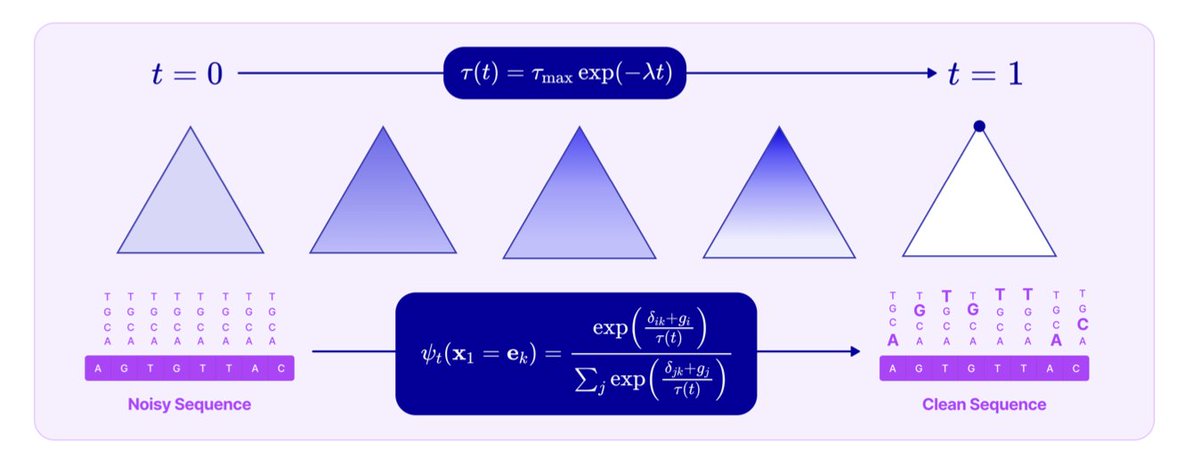
Gumbel-Softmax Score and Flow Matching for Discrete Biological Sequence Generation
1. This paper introduces a novel generative framework called Gumbel-Softmax Flow and Score Matching for generating high-quality discrete biological sequences such as DNA, peptides, and proteins. The approach leverages a Gumbel-Softmax interpolant on the simplex to enable smooth transitions from noisy to clean distributions.
2. The key innovation is the use of a temperature-controlled Gumbel-Softmax distribution to define a velocity field that transports distributions from a uniform prior to a concentrated one-hot distribution over time. This avoids discretization errors and improves scalability to higher dimensions compared to previous methods.
3. The authors propose two main components: Gumbel-Softmax Flow Matching, which learns to predict the velocity field, and Gumbel-Softmax Score Matching, which estimates the gradient of the probability density. Both methods enable high-quality and diverse sequence generation.
4. A significant contribution is the introduction of Straight-Through Guided Flows (STGFlow), a training-free guidance method that uses pre-trained classifiers to steer the flow towards optimal sequences without requiring additional training of time-dependent classifiers.
5. The framework demonstrates competitive performance in conditional DNA promoter design, target-binding peptide design for rare disease treatment, and de novo protein sequence design, showcasing its potential for various biological applications.
6. The method effectively addresses limitations of previous discrete flow matching techniques, such as deterministic paths and lack of controllability at inference time, by introducing stochasticity and modular guidance.
7. The approach is scalable and can handle higher-dimensional simplex spaces, making it suitable for complex biological sequence generation tasks. It also provides a robust solution for controllable de novo sequence design.
📜Paper: https://t.co/KsxAF4O2BQ
#BiologicalSequenceGeneration #GumbelSoftmax #FlowMatching #ScoreMatching #DiscreteGeneration #ProteinDesign #PeptideDesign
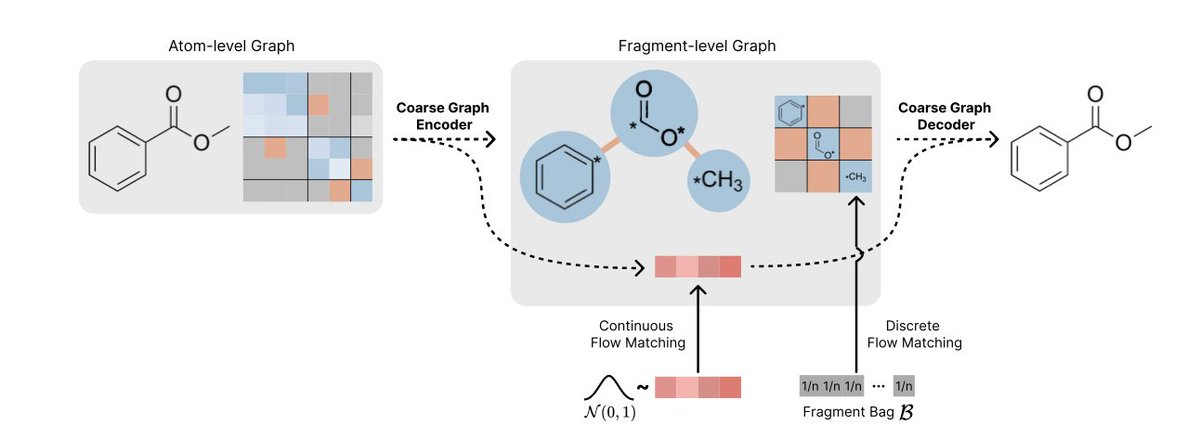
FragFM: Efficient Fragment-Based Molecular Generation via Discrete Flow Matching
1. FragFM introduces a novel fragment-based discrete flow matching framework for molecular graph generation, achieving over 99% chemical validity with significantly fewer sampling steps compared to existing diffusion and flow-based models. This innovation enhances scalability while preserving molecular diversity.
2. The framework leverages a coarse-to-fine autoencoding mechanism to reconstruct atom-level details from fragment-level representations, reducing computational complexity. This approach allows for more efficient and scalable molecular generation, making it suitable for large-scale property-aware molecular design.
3. FragFM outperforms state-of-the-art models on standard molecular generation benchmarks and natural product datasets. It demonstrates superior performance in validity, property control, and sampling efficiency, paving the way for more efficient exploration of chemical space.
4. The model employs a stochastic bag selection strategy and GNN-based fragment embeddings, enabling generalization beyond predefined fragment sets. This flexibility allows FragFM to handle diverse fragment types without compromising computational efficiency.
5. Extensive experiments on MOSES, GuacaMol, and natural product datasets show that FragFM achieves state-of-the-art results in Fréchet ChemNet Distance (FCD) and KL divergence while requiring fewer denoising steps. This highlights the potential of fragment-based modeling for molecular design.
6. FragFM also showcases efficient sampling strategies and classifier-free guidance, allowing for precise control over molecular properties during generation. This feature is crucial for applications in drug discovery, materials science, and functional molecular engineering.
📜Paper: https://t.co/WJLtTXHkkV
#MolecularGeneration #FragmentBasedModeling #FlowMatching #ChemicalSpace #AIinChemistry
Accurate Generation Of Chemical Reaction Transition States By Conditional Flow Matching
A new study introduces TS-GEN, a conditional flow-matching generative model designed for the accurate and efficient generation of chemical reaction transition states (TS). This model addresses the challenge of experimentally elusive TS structures and the computational expense of traditional methods like DFT calculations.
TS-GEN's core innovation lies in its ability to directly map samples from a simple Gaussian prior to transition-state saddle-point geometries in a single, deterministic pass. This significantly streamlines the process compared to iterative optimization algorithms like nudged-elastic band or string methods.
The model incorporates reactant and product conformations as conditioning information, allowing it to learn an optimal-transport path from latent noise to accurate TS structures. This conditioning is crucial for generating distinct TS geometries tailored to each reaction.
TS-GEN demonstrates remarkable accuracy, achieving a root-mean-square deviation (RMSD) of 0.004 Å, a two-order-of-magnitude improvement over the prior state-of-the-art (0.103 Å). It also significantly reduces the mean barrier-height error to 1.019 kcal/mol from 2.864 kcal/mol.
Beyond its precision, TS-GEN is exceptionally fast, requiring only 0.06 seconds of GPU time per inference. This combination of high accuracy and speed makes it highly suitable for high-throughput exploration of complex chemical reaction networks.
The model exhibits strong transferability, performing well on out-of-distribution reactions. When tested on the RGD1-CHNO database, it achieved an even higher chemical accuracy of 99.6%, despite being trained solely on the Transition1x dataset.
This advancement in computational chemistry offers a powerful tool for exploring novel chemical reaction mechanisms, potentially replacing millions of costly DFT evaluations with an efficient generative step.
📜Paper: https://t.co/bHM8HtzIOz
#ComputationalChemistry #MachineLearning #GenerativeModels #TransitionStates #ChemicalReactions #FlowMatching #DeepLearning #DrugDiscovery

Template-Guided 3D Molecular Pose Generation via Flow Matching and Differentiable Optimization
1.The paper introduces FMA-PO, a novel two-stage method for 3D molecular pose prediction using a crystallized reference ligand as a template to guide ligand conformation generation from a 2D molecular graph.
2.The first stage applies a flow-matching generative model that progressively denoises random initial conformations to align query molecules spatially with the template ligand in 3D space.
3.The second stage refines initial poses by differentiable optimization directly on atomic coordinates, maximizing shape and pharmacophore similarity while minimizing internal energy and optionally considering protein pocket interactions.
4.FMA-PO uniquely integrates ligand-based alignment with receptor-aware refinement, leveraging both template ligand geometry and, optionally, protein binding site information to improve docking accuracy.
5.The method outperforms classical docking tools like AutoDock Vina and rDock, as well as recent open-access alignment methods, especially in challenging cases with low template-query similarity or highly flexible ligands.
6.The authors introduce AlignDockBench, a new benchmark dataset with 369 protein-ligand pairs spanning diverse targets, enabling realistic evaluation of template-based docking and alignment methods.
7.FMA-PO demonstrates higher accuracy with about 70% of predicted poses under 2Å RMSD, improving to nearly 78% with the enhanced FMA-PO+ version that refines all candidate poses.
8.The model architecture features a hybrid molecular graph including atomic and functional group nodes, processed by multi-head attention with edge bias and a vector field network predicting ligand conformations conditioned on the template.
9.Optimization uses novel shape-based and pharmacophore-based Tanimoto similarity scores computed via Gaussian volume overlaps, combined with internal energy from GAFF2 force fields, allowing flexible yet physically plausible pose adjustments.
10.The framework supports data augmentation and downstream predictive modeling, providing a pathway for improved structure-based drug design workflows that leverage known ligand geometries.
11.Future directions include incorporating receptor flexibility, conditioning on multiple templates, and enhancing computational efficiency to make the approach more practical for large-scale drug discovery.
💻Code: https://t.co/UJTMB28O1b
📜Paper: https://t.co/TUKrdmf97I
#DrugDesign #MolecularDocking #FlowMatching #StructureBasedDesign #ComputationalChemistry #DeepLearning #3DAlignment #LigandPosePrediction

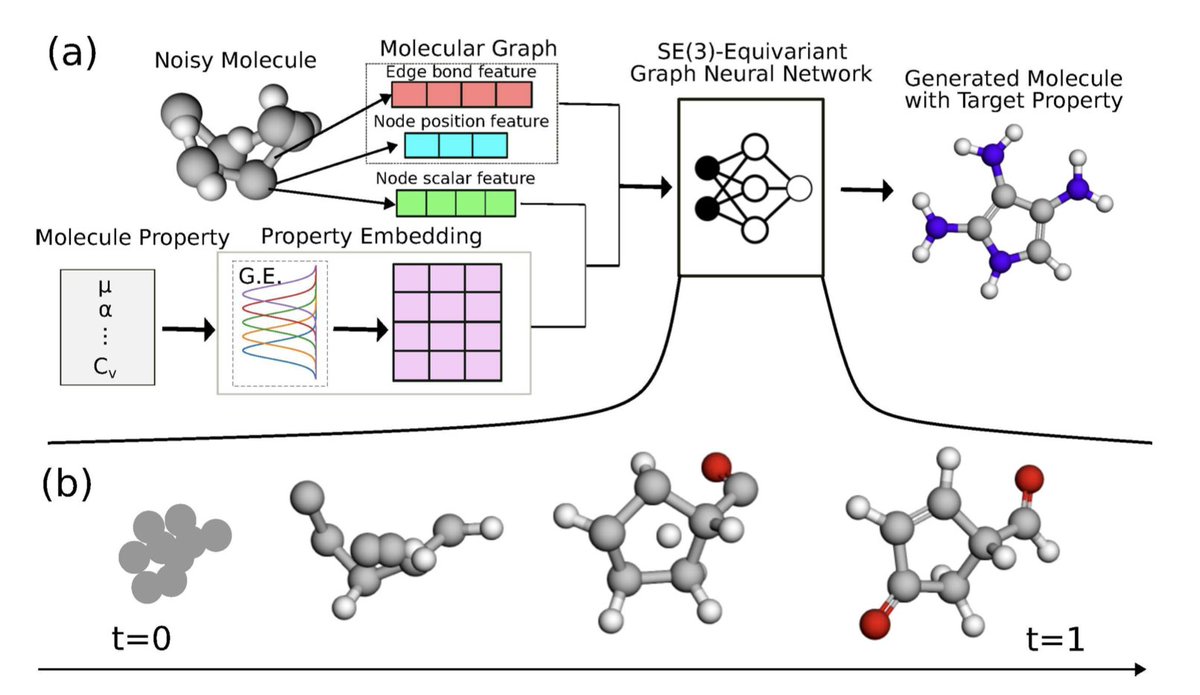
PropMolFlow: Property-guided Molecule Generation with Geometry-Complete Flow Matching
1.PropMolFlow introduces a new approach for property-guided molecule generation using geometry-complete SE(3)-equivariant flow matching. It achieves state-of-the-art performance in conditional generation while maintaining stability and efficiency.
2.Unlike prior flow matching methods, PropMolFlow supports conditioning on multiple molecular properties by integrating five distinct property embedding methods, with or without Gaussian expansion. These embeddings are systematically evaluated across six molecular properties.
3.PropMolFlow significantly outperforms diffusion and flow matching baselines on standard validity and stability metrics. It achieves 99.7% atom stability, 98.0% molecular validity, and the highest closed-shell ratio (95.2%) among all tested models.
4.Inference is extremely efficient: PropMolFlow uses only 100 integration steps, achieving over 8× faster sampling than diffusion-based methods like EEGSDE and GCDM, and nearly 2× faster than EquiFM.
5.The model's architecture builds upon FlowMol, extending it from unconditional to property-guided generation using a joint flow matching process that handles 3D coordinates, atom types, charges, and bond orders via SE(3)-equivariant graph neural networks.
6.Discrete features (atom types, bond orders, charges) are modeled via continuous-time Markov chains (CTMC), while 3D coordinates follow a continuous linear interpolant. The denoising network is trained to reconstruct the target from intermediate states.
7.A key innovation is the introduction of a new metric to evaluate out-of-distribution (OOD) controllability—assessing how well the model generates molecules with rare property values. PropMolFlow performs well in both in-distribution (ID) and OOD settings.
8.To ensure physical fidelity, the authors perform large-scale DFT calculations on over 10,000 generated molecules. This reveals that structure-sensitive properties like heat capacity (Cv) require DFT validation, as GVP-based predictors are less reliable in such cases.
9.They curate and will release a DFT-evaluated dataset of generated molecules, enabling community benchmarking. This aligns evaluation with real-world use cases in molecular discovery.
10.Closed-shell ratio and revised atomic stability metrics are proposed to filter invalid open-shell molecules, addressing common flaws in baseline evaluations that accept chemically implausible outputs.
11.On in-distribution tasks, PropMolFlow achieves the best or second-best mean absolute errors across six QM9 properties. It outperforms all baselines on polarizability (α) and dipole moment (μ), while remaining competitive on orbital energies.
12.Best practices identified: Gaussian expansion tends to help in OOD tasks but is unnecessary or even detrimental in ID tasks. The optimal embedding operation (Sum, Concatenate, Multiply, etc.) is property-dependent.
13.Case studies show successful generation of molecules with extreme property values not seen in training data, many of which are found in PubChem but not in QM9—indicating strong generalization.
14.DFT and GVP regressor results are strongly correlated for most properties (Spearman rs > 0.95), but diverge notably for Cv due to structural sensitivity. Relaxation helps bridge this gap.
15.The authors recommend using Sum or Concatenate-Sum embeddings without Gaussian expansion as a strong default strategy for future conditional molecular generation efforts.
📜Paper: https://t.co/VPF2fHq2ml
#MoleculeGeneration #FlowMatching #SE3Equivariant #ComputationalChemistry #MachineLearning #DrugDiscovery #DFTValidation
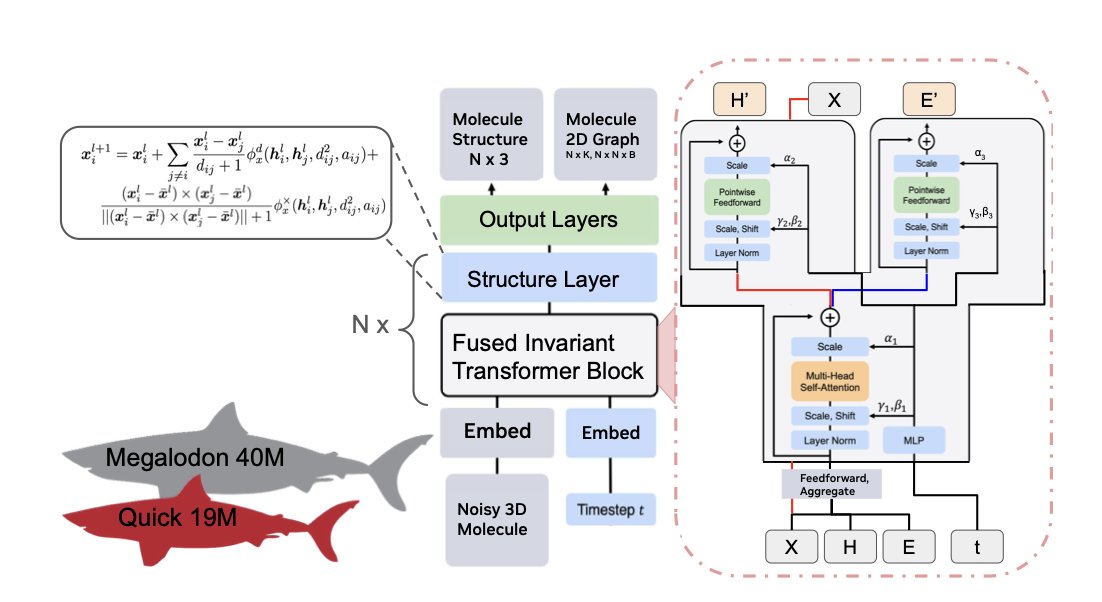
Applications of Modular Co-Design for De Novo 3D Molecule Generation
1.This paper introduces Megalodon, a scalable transformer-based model for de novo 3D molecule generation that jointly predicts molecular topology and 3D coordinates, achieving state-of-the-art results across multiple benchmarks using both diffusion and flow matching objectives.
2.Megalodon employs a modular co-design strategy that fuses discrete and continuous data streams using a unified architecture: a fused invariant transformer for 2D graphs (atom types, bonds, charges) and an EGNN layer for 3D structure updates, enabling accurate multimodal generation.
3.The model supports both unconditional and conditional molecule generation in a single framework, requiring no retraining or finetuning, and significantly improves over previous methods in stability, accuracy, and computational efficiency.
4.Compared to EQGAT-Diff and SemlaFlow, Megalodon produces up to 49× more valid large molecules and structures with up to 10× lower conformational energy, approaching quantum mechanical accuracy at a fraction of the computational cost.
5.Its diffusion variant excels at geometric realism (lower bond/angle/dihedral errors), while the flow matching variant achieves better topological stability with 25× fewer inference steps, offering a trade-off between accuracy and speed.
6.On GEOM-Drugs, Megalodon achieves 92.7% validity, 97.7% molecule stability, and the lowest Wasserstein distance for bond/angle distributions, establishing a new benchmark for 3D molecular structure quality.
7.Conditional generation experiments show Megalodon significantly outperforms EQGAT-Diff and competes with Torsional Diffusion, generating accurate 3D conformers from ground truth 2D graphs with lower RMSD and higher coverage.
8.New structure-based energy benchmarks introduced in this work show Megalodon-Diff achieves a median ∆E_relax of just 3.17 kcal/mol—closest to the thermally relevant threshold (2.5 kcal/mol)—demonstrating unprecedented fidelity in learned energy landscapes.
9.Megalodon generalizes well beyond training distribution, maintaining high validity and stability for molecules up to 120 atoms, even though such sizes are rare in training, underscoring the architecture’s scalability and inductive bias.
10.The framework introduces separate noise schedules for discrete and continuous data and uses self-conditioning across all modalities, allowing tighter coupling between 2D and 3D components and improved convergence.
11.The authors propose Megalodon as a general-purpose backbone for molecule generation tasks, advocating for more interpretable benchmarks focused on physical energy and larger molecules, rather than 2D metrics alone.
📜Paper: https://t.co/rCHG7ZhAN9
#MolecularGeneration #DiffusionModels #FlowMatching #3DMolecules #MegalodonModel #DrugDiscovery #EquivariantTransformers #GenerativeModels #ComputationalChemistry
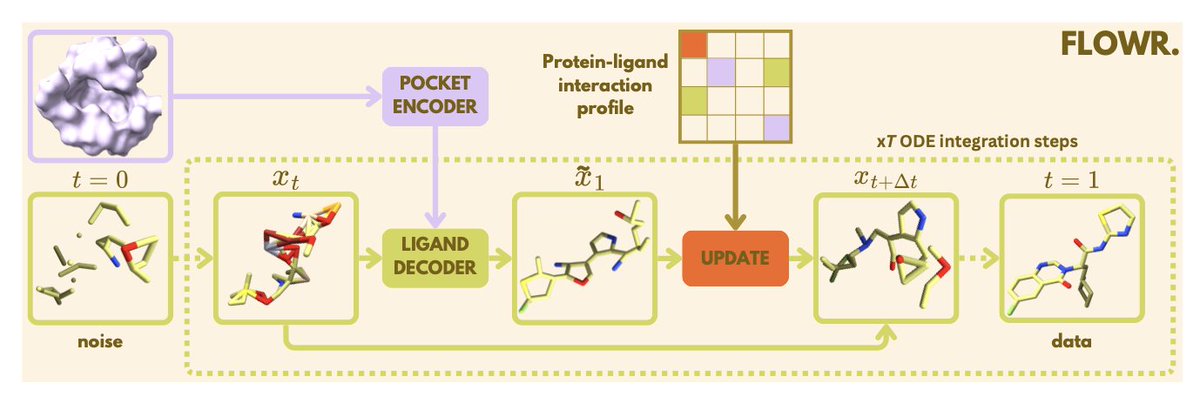
FLOWR – Flow Matching for Structure- and Interaction-Aware de novo Ligand Generation
1.FLOWR is a novel generative framework that enables de novo 3D ligand design conditioned on both protein pocket geometry and desired protein-ligand interactions—achieving state-of-the-art performance in pose quality, interaction fidelity, and inference speed.
2.Built on flow matching rather than diffusion, FLOWR significantly outperforms the PILOT model, delivering up to 30× faster inference and better ligand validity, binding affinity, and physical plausibility.
3.A standout feature is FLOWR's ability to condition generation on atomic-level interaction profiles (e.g., H-bonds, salt bridges), enabling targeted synthesis of ligands that recapitulate biologically relevant interactions.
4.The model is trained and evaluated on SPIRE—a new benchmark dataset of 35,000+ high-quality, refined protein-ligand complexes derived from crystallographic data and designed to avoid data leakage.
5.FLOWR introduces interaction-aware training: atoms involved in key interactions are masked during sampling, improving recovery of binding contacts while preserving chemical diversity.
6.Interaction-conditional generation improves recovery of interaction fingerprints by over 60% and leads to stronger Vina binding scores (e.g., -7.43 kcal/mol vs. -6.36 for unconditional).
7.The architecture builds on SemlaFlow, using an E(3)-equivariant model with a cross-attention mechanism and pocket encoder, making ligand generation efficient and structurally grounded.
8.Unlike diffusion-based models, FLOWR allows flexible sampling steps (as few as 20), maintaining performance while achieving up to 50× speedup—ideal for large-scale compound generation.
9.Explicit hydrogen modeling is supported in both training and inference, yielding chemically accurate poses that improve downstream interpretability and docking performance.
10.FLOWR produces more physically valid ligands (RDKit-validity 0.94, PB-validity 0.86) than PILOT (0.82 and 0.75), with better generalization to unseen targets in terms of bond geometry and centroid proximity.
11.Despite lower novelty and uniqueness compared to PILOT, FLOWR excels in pose realism and ligand-pocket complementarity—crucial for structure-based drug design applications.
12.Overall, FLOWR bridges structural accuracy, speed, and interaction control, making it a strong candidate for integration in hit-to-lead workflows, lead optimization, and interaction-driven generative design.
📜Paper: https://t.co/zdr4VmZMNT
#DrugDiscovery #MolecularDesign #GenerativeModels #LigandGeneration #FlowMatching #ProteinLigand #StructureBasedDesign #ICLR2025 #SPIRE #FLOWR
AN EVALUATION OF UNCONDITIONAL 3D MOLECULAR GENERATION METHODS
1. This study benchmarks five state-of-the-art 3D molecular generative models—EQGAT-diff, FlowMol, GCDM, GeoLDM, and SemlaFlow—under both standard metrics and rigorous chemical/physical validity checks, highlighting the current limits and opportunities in unconditional molecular generation.
2. While many models report high scores on traditional validity benchmarks, this work reveals large gaps in geometry quality and physical realism—factors often overlooked in prior evaluations but essential for drug discovery relevance.
3. SemlaFlow emerges as the top-performing model, generating 87.0% valid, novel, and unique molecules without post-processing and up to 92.4% with it, while also being the fastest (3 hours for 100k molecules) among all methods tested.
4. Validity is evaluated not just chemically (e.g., valency, connectedness) but also physically using PoseBusters: testing bond lengths, angles, planarity, steric clashes, and conformational energy—a more holistic view of molecular realism.
5. Post-processing (fragment cleanup, hydrogen addition, UFF minimization) substantially boosts model performance, especially for GCDM and GeoLDM, which fail to generate all hydrogens natively.
6. Despite high drug-likeness (QED) and synthetic accessibility (SAscore) across models, chemical space coverage remains limited. UMAP visualizations show that generated molecules cluster near training data cores, leaving out valuable fringes.
7. Surprisingly, some models like GCDM, while achieving the best overall validity with post-processing (95.2%), suffer from poor coverage of chemical diversity and high Fréchet ChemNet distance (FCD = 45.2), indicating limited generalization.
8. SemlaFlow and EQGAT-diff achieve the best balance of validity, performance, and chemical space fidelity (FCD = 5.1), suggesting they best reproduce the training data distribution.
9. Runtime efficiency varies dramatically—GeoLDM requires 176 hours to generate 100k molecules, while FlowMol and SemlaFlow complete the task in under 6 hours, making them practical for real-world applications.
10. The paper calls for the broader adoption of 3D-aware validation tools and stricter evaluation standards, pointing out that future progress in generative chemistry will require not just innovation in models, but also in how we assess them.
📜Paper: https://t.co/thGLS5ifIX
#MolecularGeneration #3DMolecules #DrugDesign #FlowMatching #DiffusionModel #PoseBusters #Cheminformatics #DeepLearning #AI4Science #UnsupervisedLearning #ChemicalSpace

Robust and Reliable de novo Protein Design: A Flow-Matching-Based Protein Generative Model Achieves Remarkably High Success Rates
1. This paper introduces OriginFlow, a new generative model that combines stochastic differential equations with optimal transport-based flow matching, achieving over 90% wet-lab success rates in binder design—an unprecedented performance in de novo protein design.
2. Unlike diffusion models that simulate step-by-step denoising, OriginFlow directly learns vector fields mapping from noise to protein structures, offering faster and more stable training while scaling to long sequences and complex design tasks.
3. OriginFlow generates backbones using transformations in both Euclidean (R³) and rotation (SO(3)) spaces, with an invariant point attention-based transformer and local graph neural network modules capturing global and local structure information.
4. The model excels in unconditional protein generation, producing diverse and novel proteins up to 600 residues with high refoldability, rivaling RFdiffusion in designability and surpassing Chroma in structural novelty.
5. In functional motif scaffolding tasks, OriginFlow successfully solved 16 of 17 benchmark cases—including single-chain, multi-chain, and multi-motif designs—demonstrating strong control over spatial constraints and generalizability to unseen motifs.
6. Geometry-constrained generation is also supported: the model can accurately generate proteins with predefined secondary structures across 27 CATH architecture types, achieving F1 scores of 80–95%, and robustly design cyclic and dihedral symmetric assemblies.
7. OriginFlow’s binder design pipeline uses reverse-iteration conditioning on target structures, followed by sequence generation via MPNN and filtering through ESMFold and AlphaFold3. This yields designs with high predicted accuracy and diversity.
8. Experimental validation across PD-L1, VEGF, and SARS-CoV-2 RBD targets shows a 90% success rate in terms of expression, solubility, and affinity. All binders were confirmed by SPR assays to bind with KD values ranging from 2–200 µM.
9. The designed binders also demonstrated strong folding and thermal stability: most showed melting temperatures above 90°C and correct secondary structures by CD spectroscopy, indicating high structural realism and biophysical quality.
10. This work positions OriginFlow as a new benchmark for AI-driven protein design—its versatility, speed, and robustness across monomer, motif, symmetric, and binder design tasks make it an invaluable tool for both academic and industrial applications.
💻Code: https://t.co/zE9EUHFgVj
📜Paper: https://t.co/VmxoHzS5VS
#ProteinDesign #BinderDesign #DeNovoDesign #DiffusionModel #FlowMatching #DeepLearning #StructuralBiology #SyntheticBiology #AI4Science #ComputationalBiology

FLOWR – Flow Matching for Structure-Aware de novo and Conditional Ligand Generation
1. FLOWR introduces a new generative framework for structure-based ligand design using flow matching instead of diffusion, achieving up to 70x faster inference while improving ligand validity, pose accuracy, and interaction recovery.
2. The model leverages a dedicated protein pocket encoder and jointly models both continuous (3D coordinates) and categorical (atom types, bonds) molecular properties, conditioned on target pockets and optional protein-ligand interaction features.
3. FLOWR significantly outperforms leading diffusion-based models like PILOT on the SPINDR benchmark across multiple metrics: higher PoseBusters-validity (0.92 vs. 0.83), better AutoDock-Vina scores (-6.93 vs. -6.30), and lower strain energy.
4. A major architectural advantage is that FLOWR only requires a single forward pass through the protein pocket encoder, making it far more efficient than diffusion models that recompute pocket embeddings at each sampling step.
5. FLOWR.MULTI extends the model to support multi-purpose conditional generation, including interaction-, scaffold-, and functional group-conditional ligand design, without retraining or re-sampling—enabling flexible scaffold hopping and fragment-based design.
6. In interaction-conditional mode, FLOWR.MULTI achieves a 76.1% interaction recovery rate, doubling interaction Tanimoto similarity compared to its de novo version, while maintaining similar chemical diversity and synthesizability.
7. FLOWR’s superiority is further validated on two challenging protein targets (5YEA and 4MPE), where it consistently produces high-validity, synthetically accessible ligands with strong docking scores and accurate interaction profiles under all conditioning modes.
8. To support robust benchmarking, the authors introduce SPINDR—a high-quality dataset of 35,000+ ligand-pocket complexes with energy-minimized structures, explicit hydrogens, and atomic-resolution interaction annotations—addressing flaws in prior datasets.
9. Compared to PILOT, FLOWR shows 20–70x speedups while improving on all major evaluation metrics. FLOWR.MULTI enables targeted, interaction-aware ligand generation ideal for lead optimization and hit expansion in real-world drug discovery settings.
📜Paper: https://t.co/d5S95yQPdc
#drugdiscovery #cheminformatics #structurebaseddesign #ligandgeneration #machinelearning #generativemodels #moleculargeneration #flowmatching #AI4Science

ProtFlow: Fast Protein Sequence Design via Flow Matching on Compressed Protein Language Model Embeddings
1. ProtFlow introduces the first flow matching-based generative model for protein sequence design, enabling ultra-fast generation of high-quality sequences from a semantically meaningful latent space derived from protein language models.
2. Unlike traditional diffusion-based methods, ProtFlow leverages rectified flow and reflow to drastically reduce generation steps. With reflow, it achieves high-quality one-step generation—cutting inference time by up to 25–100x compared to leading diffusion models.
3. A major innovation of ProtFlow lies in its redesigned latent space. By compressing high-dimensional protein language model embeddings by up to 16-fold and applying smoothing techniques, it achieves better distribution modeling while remaining computationally efficient.
4. ProtFlow supports joint design of multichain proteins, such as antibodies, by integrating multiple embeddings in a unified flow. This allows coherent generation of structurally interdependent chains, significantly improving realism and applicability.
5. Across general protein and peptide generation tasks, ProtFlow achieves state-of-the-art performance in both sequence quality and foldability. It outperforms leading baselines including DiMA, EvoDiff, and Dirichlet FM on perplexity, structure scores, and distributional similarity.
6. In antimicrobial peptide (AMP) design, ProtFlow generates highly diverse and functionally relevant sequences. It achieves the best AMP classifier scores (Pamp and Pmic), the highest diversity (entropy), and the strongest motif learning (6-mer Jaccard) among all models tested.
7. ProtFlow demonstrates robustness across protein sizes and types. It excels in short peptide design, long-chain proteins, and antibody generation—showing consistent gains in structural confidence (pLDDT), naturalness (TM-score), and sequence diversity.
8. Even with small backbone models (e.g., ESM-2 8M), ProtFlow matches or exceeds large-scale diffusion methods in quality while operating with drastically fewer steps, making it ideal for low-resource or real-time protein design applications.
9. As a modular framework, ProtFlow includes components like encoder-decoder pairs, compressor-decompressor modules, and a BERT-style flow holder. Its flexible architecture supports future scaling, conditional generation, and structure-aware extensions.
📜Paper: https://t.co/0nfU8GezEF
#proteindesign #bioinformatics #computationalbiology #generativemodels #flowmatching #proteinengineering #antibodydesign #AI4Science #diffusionmodels #machinelearning

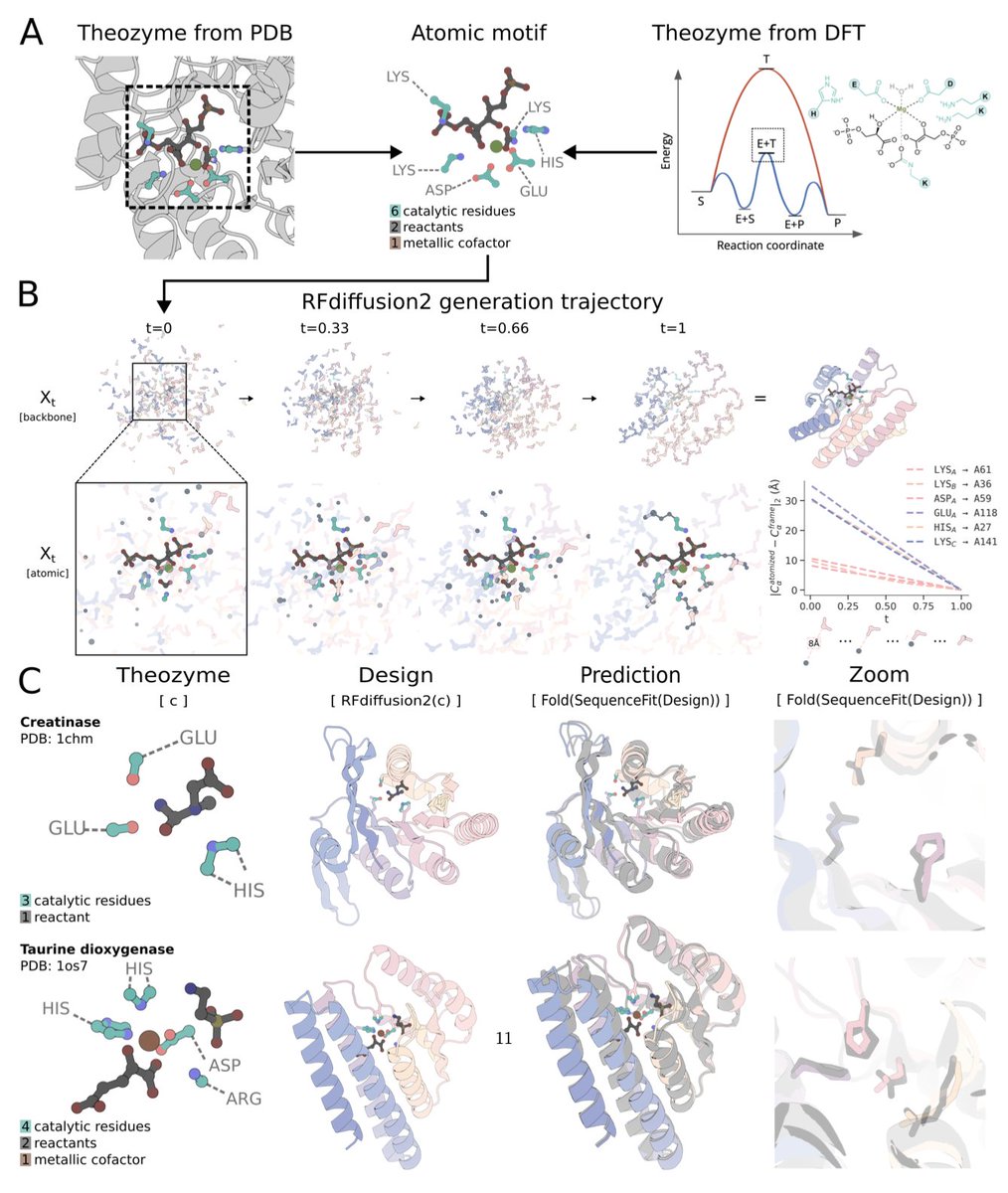
Atom level enzyme active site scaffolding using RFdiffusion2
🚀 New preprint from David Baker!🚀
1. RFdiffusion2 introduces a generative model that designs functional enzymes directly from atomic-level active site descriptions—without needing predefined sequence indices or inverse rotamer sampling, solving a major bottleneck in de novo enzyme design.
2. Unlike previous methods that required residue-level backbone motifs, RFdiffusion2 scaffolds proteins using side chain functional groups alone, inferring both rotamer conformations and residue placement during generation via flow matching diffusion.
3. On the newly curated Atomic Motif Enzyme (AME) benchmark, RFdiffusion2 scaffolds 41/41 diverse enzyme active sites successfully—compared to only 16/41 with the previous state-of-the-art RFdiffusion—demonstrating robust generalization and scalability.
4. RFdiffusion2 leverages “unindexed atomic motifs” to eliminate the need for explicitly specifying sequence positions of catalytic residues, enabling broader solution space exploration and greater structural diversity.
5. The model supports conditioning on atomic motifs, ligand conformations, residue burial (via RASA), and scaffold positioning (via ORI tokens), offering fine-grained control over catalytic geometry and pocket design.
6. In four experimental case studies, including retro-aldolases and zinc-based hydrolases, RFdiffusion2 generated enzymes that displayed catalytic activity with fewer than 96 screened designs, including one variant with a kcat/KM of 53,000 M⁻¹s⁻¹—surpassing prior de novo designs.
7. For reactions without known native theozymes, DFT-optimized transition states were used as inputs, showing that RFdiffusion2 can scaffold new catalysts directly from quantum chemistry, bypassing the need for existing crystal structures.
8. RFdiffusion2-trained models used RosettaFold All-Atom architecture and were trained with flow matching, avoiding auxiliary losses or self-conditioning and enabling stable convergence on diverse geometric motifs.
9. Successful scaffolds were highly novel, with low TM-scores to any PDB structure, indicating that RFdiffusion2 discovers structurally unique solutions—not simply reusing known folds.
10. The open-source AME benchmark, which reflects real-world catalytic diversity, is introduced alongside RFdiffusion2 to foster further research into high-resolution, functional protein design.
11. This work demonstrates that combining atomic-level conditioning, flow-based generative modeling, and structural inference can unlock previously intractable problems in enzyme design—paving the way for programmable, mechanism-guided biocatalysis.
📜Paper: https://t.co/EpQwZeEVAL
#EnzymeDesign #ProteinDesign #GenerativeModels #DiffusionModels #RFdiffusion2 #Bioinformatics #Catalysis #Theozymes #FlowMatching #SyntheticBiology #StructuralBiology #ComputationalBiochemistry
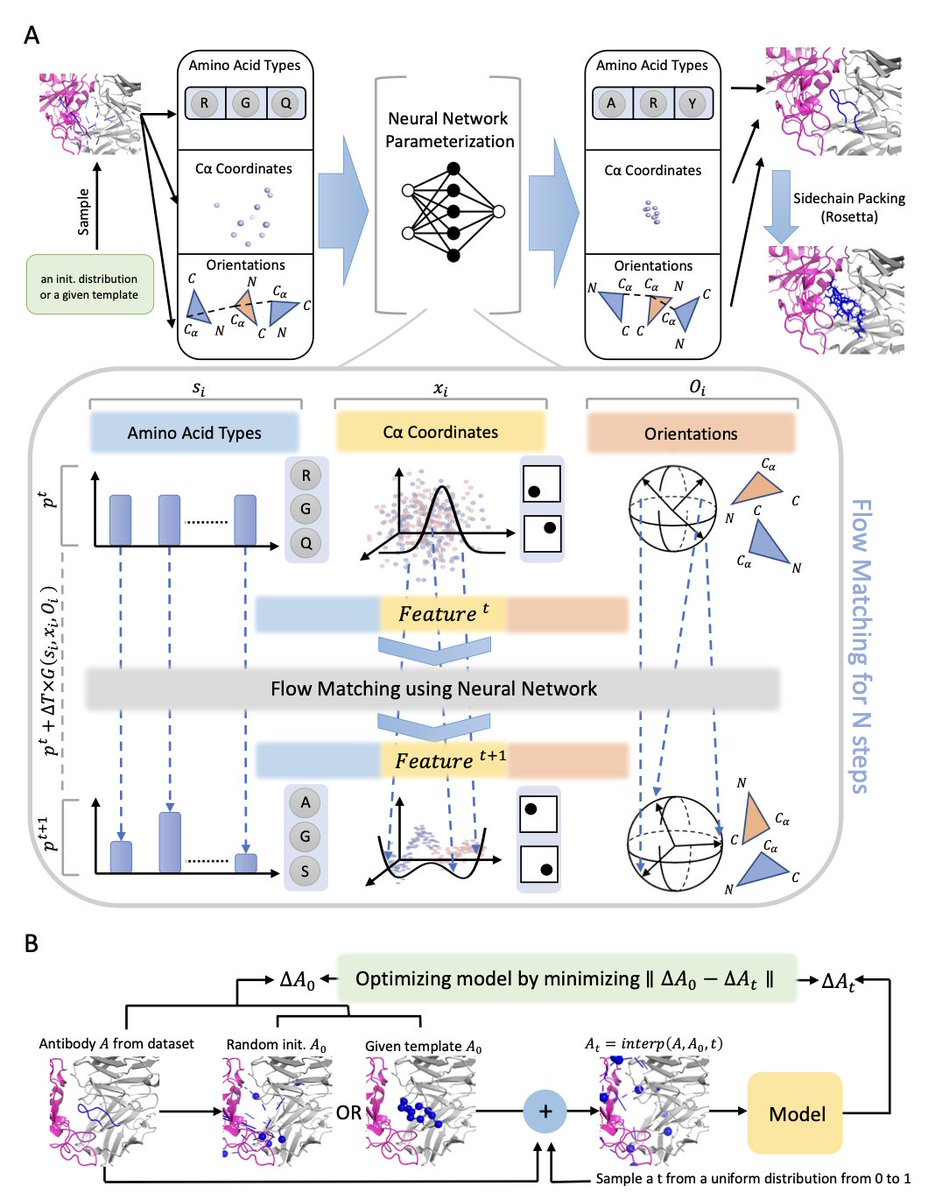
FlowDesign: Improved Design of Antibody CDRs Through Flow Matching and Better Prior Distributions
1. This study introduces FlowDesign, a novel algorithm for co-designing antibody CDR sequences and structures. It addresses key challenges in antibody engineering by utilizing flow matching instead of traditional diffusion-based methods.
2. FlowDesign enables the use of flexible prior distributions, making it possible to incorporate structural and sequence-based knowledge for more accurate antibody design. This improves computational efficiency and compatibility with discrete amino acid data.
3. By outperforming state-of-the-art baselines such as Diffab and RefineGNN, FlowDesign demonstrates superior results in amino acid recovery, RMSD, and binding energy. Notably, it achieves a 15% improvement in sequence recovery for certain CDR regions compared to random initialization.
4. The model was validated on HIV-1 antibody design, specifically redesigning CDRH3 regions for the antibody Ibalizumab. Experimental assays confirmed higher binding affinities and neutralization potencies against multiple HIV-1 pseudoviruses.
5. FlowDesign achieves rapid large-scale sampling with reduced computational costs, providing an efficient solution for exploring diverse antibody candidates. It successfully generates antibodies with improved stability and functional properties.
6. A significant innovation lies in treating antibody design as a transport mapping problem. This allows the model to directly learn transformations from initial to target distributions, avoiding computational bottlenecks in iterative denoising steps.
7. This research emphasizes the potential of integrating AI-driven frameworks like FlowDesign into protein engineering, enabling more precise and scalable antibody design for therapeutic applications.
💻Code: https://t.co/uxmMqyZ2He
📜Paper: https://t.co/Pm2W3REoSc
#AntibodyDesign #FlowMatching #ComputationalBiology #HIVResearch
P2DFlow: A Protein Ensemble Generative Model with SE(3) Flow Matching
• Introducing P2DFlow, a cutting-edge generative model designed to predict protein conformational ensembles, leveraging SE(3) flow matching and enhanced by innovative prior knowledge from ESMFold perturbations.
• Key innovation: P2DFlow integrates “approximate energy” as a novel dimension, guiding the generation of diverse protein conformations while accurately distinguishing between energy states.
• Compared to AlphaFlow and STR2STR, P2DFlow achieves superior fidelity and dynamic accuracy, excelling in metrics such as Jensen-Shannon divergence, Wasserstein distance, and Ramachandran plot intersection.
• The model efficiently predicts conformational ensembles without costly molecular dynamics (MD) simulations, capturing dynamic properties like weak and transient residue contacts crucial for functional analysis.
• P2DFlow demonstrates high generalization, producing realistic protein ensembles across diverse macro states while avoiding non-existent intermediate conformations or hallucinations.
• Potential applications extend to drug discovery and protein engineering, where accurate ensemble predictions can aid in identifying cryptic pockets or designing dynamic biomolecular systems.
• Future directions include refining priors with emerging models like AlphaFold3 and incorporating advanced force field insights to further enhance conformational diversity and accuracy.
💻Code: https://t.co/zXpBj3mMI6
📜Paper: https://t.co/8Z027ZsJWM
#ProteinDynamics #FlowMatching #Bioinformatics #GenerativeModels #ProteinEngineering

Exploring Discrete Flow Matching for 3D De Novo Molecule Generation
• This study introduces FlowMol-CTMC, a state-of-the-art model for 3D de novo molecule generation using discrete flow matching (DFM) methods, achieving unmatched molecular validity with fewer parameters than existing models.
• FlowMol-CTMC employs Continuous Time Markov Chains (CTMC) for discrete state space modeling, significantly improving molecular stability (96.2%) and validity (91.5%) compared to baseline methods such as SimplexFlow and Dirichlet Flows.
• The study highlights FlowMol-CTMC’s efficiency in generating realistic molecular structures by modeling transitions directly in discrete spaces, avoiding the pathologies of continuous approximations.
• A novel evaluation framework includes higher-order metrics like functional group analysis and out-of-distribution (OOD) ring system detection, revealing potential issues in chemical validity despite structural accuracy.
• The model was benchmarked on the GEOM-Drugs dataset, demonstrating superior performance across metrics like Jensen-Shannon divergence for molecular energies and stability compared to diffusion-based generative baselines.
• Future applications include accelerated drug discovery, multi-objective chemical design, and broader molecular modeling tasks with scalable and interpretable generative methods.
💻Code: https://t.co/zmYEPKVXwp
📜Paper: https://t.co/bSlxEg0bg2
#MoleculeGeneration #FlowMatching #MachineLearning #DrugDiscovery #Bioinformatics

Improving Molecular Graph Generation with Flow Matching and Optimal Transport
1. GGFlow, a discrete flow-matching generative model, enhances molecular graph generation by integrating flow matching and optimal transport. This unique approach stabilizes training, improves sampling efficiency, and addresses the complexities of generating chemically valid molecular structures.
2. Core innovation: GGFlow’s edge-augmented graph transformer incorporates chemical bond information directly, which allows it to maintain graph sparsity and permutation invariance, crucial for generating authentic molecular graphs.
3. GGFlow introduces a novel goal-guided framework using reinforcement learning, providing control over the generative process to meet specific molecular properties, enabling conditional molecular design.
4. In benchmark testing, GGFlow consistently surpasses other models on molecular datasets (QM9 and ZINC250k) for metrics like Validity, NSPDK, and FCD, proving its efficacy in both unconditional and conditional molecule generation.
5. GGFlow’s architecture outperforms diffusion-based and autoregressive models by requiring fewer steps, making it computationally efficient for large-scale drug discovery tasks.
📜Paper: https://t.co/lkcGCMm7dN
#MolecularGeneration #GraphMachineLearning #DrugDiscovery #OptimalTransport #FlowMatching

Last Seen Hashtags on Sotwe
Most Popular Users

Elon Musk 
@elonmusk
240M followers

Barack Obama
@barackobama
118.6M followers

Cristiano Ronaldo
@cristiano
114.4M followers

Donald J. Trump
@realdonaldtrump
111.7M followers

Narendra Modi
@narendramodi
106.9M followers

Rihanna
@rihanna
98.6M followers

NASA
@nasa
92.1M followers

Justin Bieber
@justinbieber
91.7M followers

KATY PERRY
@katyperry
89.9M followers

Taylor Swift
@taylorswift13
83.9M followers

Lady Gaga
@ladygaga
75.4M followers

Virat Kohli
@imvkohli
73.3M followers

Kim Kardashian
@kimkardashian
70.8M followers

YouTube
@youtube
68.6M followers

Neymar Jr
@neymarjr
66.3M followers

Bill Gates
@billgates
65.2M followers

Selena Gomez
@selenagomez
63M followers

The Ellen Show
@theellenshow
62.1M followers

CNN
@cnn
61.7M followers

X
@x
60.6M followers