

Top Tweets for #Goofynomics

#Goofynomics Dal principio ad oggi. Un "ve lo avevo detto"!


@Asiaest si conferma esattamente tutto quello detto nei primi anni di Dibattito.
la #goofynomics regna sovrana.

Per rispondere alla domanda conclusiva, io una differenza la vedo: ora 🍇 è d'accordo con lei, on. @AlbertoBagnai
#TreInterviste su #goofynomics.

E come sempre quando arriviamo su un nuovo canale la differenza si vede subito, grazie a voi… #Goofynomics #community

E allora come siamo riusciti a bloccare il MES, battaglia storica di #Goofynomics? Quindi “sempre” direi di no. Davide, proprio perché ti apprezzo e intuisco buona fede, mi appello alla tua sagacia: se si ragiona in termini di “sempre” e “mai”, si ottiene mai; se si ragiona in termini di “tutto” o “niente”, si ottiene niente. La capacità di mediazione è sempre indispensabile, il suo rifiuto è grillanza, cioè antipolitica, che è la kriptonite della democrazia, cioè la panacea per l’UE. E quindi sì: chi programmaticamente rifiuta il compromesso, anche se lo fa calcando un fez e vestito di orbace, anziché parlando di scatolette di tonno, lavora sempre per Essi™️, e tu ci segui da troppo tempo per non capirlo.

A soli sei mesi dall'entrata nell'euro la Bulgaria finisce sotto procedura di infrazione della Commissione Europea, per deficit eccessivo. Sotto accusa la spesa pubblica, i salari troppo alti, e l'eccessiva spesa per il sociale.
Benvenuti nel girone dantesco!
#Ue

Io non ho detto niente a nessuno, lo avevo semplicemente appoggiato qui.
Ora mancano quattro mesi all'uscita ed è già primo in Macroeconomia davanti a 🍇.
Ottimo. Solo su #goofynomics

Io l'appoggio qui.
Il tramonto dell'euro. Come e perché la moneta unica sta erodendo democrazia e benessere in Europa https://t.co/aZRHKEVgyE

Un commento lasciato su #Goofynomics simile a questo thread è stato STRANAMENTE censurato dal padrone di casa @AlbertoBagnai
Chissà perché non vuole che i suoi adepti lo leggano...🤔
🚨 LA COSTITUZIONE DEL '48
Nascono i partiti, ma non ce n'è uno che persegua il PIENO ripristino della Costituzione italiana del 1948.
- Una costituzione senza la «tutela della concorrenza» (attuale 😓 art. 117)
1/

@BonomiAllegra Il lungo periodo riserva sempre sorprese.
Parliamone su #goofynomics @AlbertoBagnai .

Molto interessante 👇
Questa è una di quelle "informazioni" che solo un blog che non esiste può darvi, tutto il resto è noia (semi cit)
#goofynomics
⬇️⬇️⬇️


@jankofukai2 @AlbertoBagnai Proporrei un social ad accesso su accredito.
Ah, dice che ci sarebbe già! 😉 #goofynomics

Oppure leggere al link qui sotto. 👇
#goofynomics
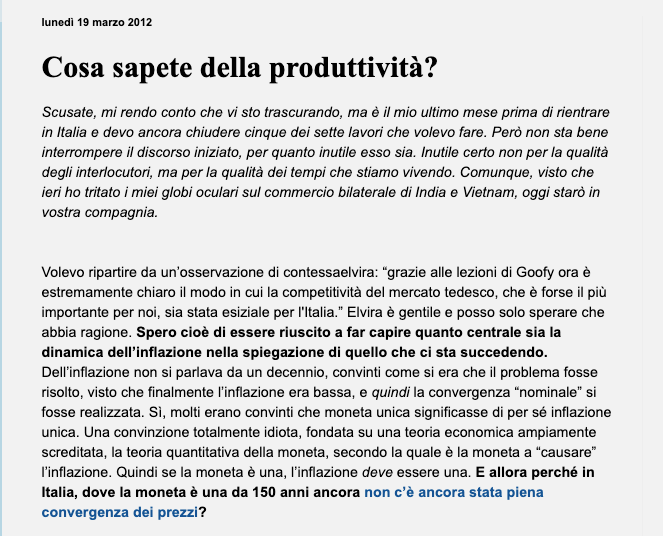

Innovazione, regole, risorse: il Paese alla sfida della produttività https://t.co/bPsfHuiKdI Facilitare il turnover delle imprese, come chiede leconomista Nicola Rossi. Oppure incentivarne la crescita dimensionale, come sostiene il responsabile economico del Pd Nicola Misiani. …

@AlbertoBagnai Ed ecco che in scia arriva Setser. Sarà lo zeitgeist? #goofynomics
https://t.co/udLlcmlQPK

I would add that as long as exporting from China is more advantageous than producing in Europe, European industrialist also have every reason to use their Chinese factories to export back to Europe
(part of the reason why exchange rates matter)
Leggendo il post citato dall'on. @AlbertoBagnai, superata la sensazione di dejavu ho ricordato la sua massima
Nihil est in dibattito quod prius non fuerit in #goofynomics.
Interessante lettura storica che in Italia solo la community di #goofynomics ha gli strumenti culturali per apprezzare. So che me ne siete grati… 😉🤗

@AlbertoBagnai @fatequalcosa Mentre lo leggevo, giusto due minuti fa, pensavo "cribbio, #goofynomics è proprio diventato mainstream!"
Interessante lettura storica che in Italia solo la community di #goofynomics ha gli strumenti culturali per apprezzare. So che me ne siete grati… 😉🤗

WSJ: "Germany’s famously open economy was its greatest economic asset, delivering almost 20 years of uninterrupted growth and turning it into one of the biggest winners of globalization."
I think I would have framed this differently.
Germany's trade competitiveness for a long time was based on its ability both to suppress household income growth relative to productivity growth (as it did, for example, after the 2003-5 Hartz reforms), and to keep its currency cheap (as it did, for example, through adoption of the euro).
Under our current form of globalization, in other words, we experience an example of the Kalecki paradox, in which wage-suppression policies that allow one country to grow faster than its trade partners are actually bad for overall global growth – to the extent, anyway, that consumer demand drives investment among its trade partners.
In this system, all countries are under pressure to suppress wage growth in order to expand manufacturing and retain manufacturing employment, but the "winner" is the one who is able to do it most effectively.
For many years, when much of China's high saving was directed into domestic investment, Germany was one of the main winners from this system. But as Chinese investment became increasingly unproductive, Beijing began trying to rein in the debt needed to fund so much unproductive investment.
This process, of course, took off after the 2021-22 property crash, and once that happened, Germany's ability to benefit from the Kalecki paradox evaporated, as it quickly became one of the main losers of the system.
The point is that the problem isn't China. The real problem is a system that rewards countries for implementing policies that undermine overall global growth. The good news is that for many years, when Germany was able to exploit the global trade regime, it was also one of the greatest defenders of this system. Now that it is on the losing side, German policymakers are increasingly recognizing how damaging a system it is.
There is nothing new about this. If you read the economic debates between the UK and the US in the 1920s, a period when US productivity soared even as wages remained stagnant, it was the UK that complained about the trade imbalances. The US insisted that its huge trade surplus was simply the consequence of more efficient manufacturing techniques and harder-working people. The US of course abandoned that argument in the 1970s, when it lost its trade surplus.
In the economic debates of the 1980s, it was the US who complained about trade imbalances, and Japan who insisted (what else?) that its huge trade surplus was the result of more efficient manufacturing techniques and harder-working people. No one in Japan makes such a silly claim anymore.
In the 2000s, of course, Germany rather patronizingly explained to the rest of Europe that if only they could become as efficient in manufacturing and as hard-working as the Germans, they too would be in just as good a shape. So much for that claim.
Meanwhile our trading system continues to reward policies that depress global growth by putting downward pressure on wage growth, or that, alternatively, force the world to encourage rapid increases in debt in order to counter the impact of lower wage growth.
That is why the real solution isn't a global alliance against China. While this may help defuse current tensions, it won't change a system that will continue to reward bad behavior – i.e. household income-suppressing policies – by allowing countries to externalize the costs of this bad behavior through large, persistent trade surpluses. And this means that it will continue to support increases in income inequality within countries.
https://t.co/9g6zh3ET99
Last Seen Hashtags on Sotwe
Most Popular Users

Elon Musk 
@elonmusk
240.9M followers

Barack Obama
@barackobama
119.2M followers

Donald J. Trump
@realdonaldtrump
111.8M followers

Cristiano Ronaldo
@cristiano
111.5M followers

Narendra Modi
@narendramodi
107.1M followers

Rihanna
@rihanna
97.9M followers

NASA
@nasa
92.2M followers

Justin Bieber
@justinbieber
91.1M followers

KATY PERRY
@katyperry
88.2M followers

Taylor Swift
@taylorswift13
82M followers

Lady Gaga
@ladygaga
73.6M followers

Virat Kohli
@imvkohli
70.7M followers

Kim Kardashian
@kimkardashian
70M followers

YouTube
@youtube
68.7M followers

Bill Gates
@billgates
64.2M followers

Neymar Jr
@neymarjr
63.5M followers

The Ellen Show
@theellenshow
62.4M followers

CNN
@cnn
61.9M followers

Selena Gomez
@selenagomez
61.2M followers

X
@x
60.8M followers