

Top Tweets for #Graphin


@livyoshi_ What is this graphing?

(we couldn't formally verify the multiplayer implementation because it relies on a CRDT library with a high-level enough API that we couldn't make accurate assumptions about it's behavior
and we skipped formally verifying the graphing functionality for now due to the complexity of doing so; we'd likely need to substantially change how our graphing implementation handles floating point rounding errors)

⁴
Fixing off-the-shelf VLA bottlenecks systematically unbottlenecked the pipeline:
➣ Converting weights to bf16 up front saved 25 ms.
➣ Graphing action generation dropped execution from 86 ms to 17 ms.


@Chainworker0x @TSERAfinance yeah, but graphing history is the easy part, attribution is the hard one

@_mctrinh Data harvesting and graphing and compiling marketing data!

This is where @universalweave starts becoming much easier to explain.
The graphing is stable, the text layer is in, and now @transkatgirl can move from building the foundation to making it actually easy for other devs to use.
UI widgets, inference backends, and everything else needed to build a Loom without spending weeks making every piece from scratch.
@transkatgirl will also build a full Loom for base models using these same libraries, so we’ll get to see the whole ecosystem working together in a real product.
The plan was never to build one app and stop there. It was to make Looms easier for anyone to build.
Now $weave getting to that part.

We've added a text manipulation layer to universal-weave, allowing developers to make Loom implementations where editing the weave can be as intuitive as editing text.
This update marks the end of stage one of development. The underlying algorithms are solid, and it's time to build what comes next.
During stage two, we'll create libraries which build upon universal-weave to offer polished implementations of every component a Loom developer might need, ranging from UI widgets to AI inference backends.
Our goal is to empower developers to build polished Loom implementations in hours instead of weeks.
Along the way, we'll be using these libraries to build our most ambitious demo yet: A fully-featured Loom for base model LLMs built on top of the Universal Weave ecosystem.
And, of course, we have even more planned after that.
Ok, this is the transition I have been waiting for.
@transkatgirl is currently aiming to publish @universalweave 0.5.0 by September 5th, stabilizing the graphing implementation that everything else will be built on.
After that, the focus moves from the underlying graph infrastructure toward making it intuitive for people to actually use.
The upcoming text manipulation layer will allow developers to build Looms where editing a Weave feels as natural as editing a normal text document.
Users should not need to understand trees, DAGs, or graph structures to benefit from them. The complexity should exist underneath while the experience remains simple.
At the same time, further 0.5.x releases will continue optimizing the core so it can handle very large documents efficiently.
First the foundation.
Then usability.
Then the ecosystem built on top of it.
This is where @universalweave starts becoming much easier for people outside the codebase to understand.
Study $weave.
We're currently aiming to get universal-weave 0.5.0 (the update which will stabilize our graphing implementation) published by Sept 5th.
After it's published, our focus will turn towards developing a text manipulation layer which will allow developers using universal-weave to make editing weaves as intuitive as editing a normal text document.
This layer will be co-developed with additional universal-weave 0.5.x releases, which will further optimize the core of universal-weave to ensure it performs well even when editing very large documents.
When we said we were making building blocks for any Loom, we meant any.
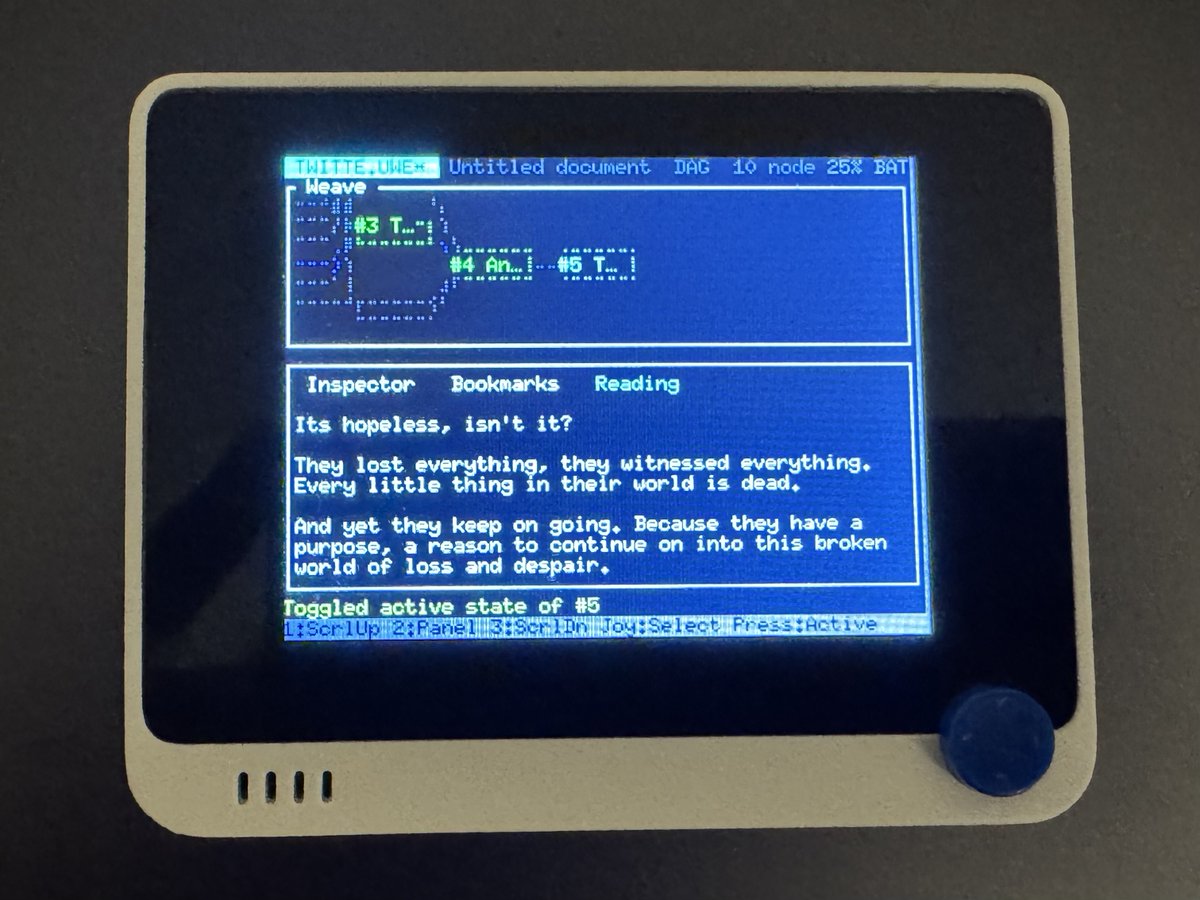
universal-weave can run anywhere, including on devices with limited capabilities. Today, we've put that to the test by porting universal-weave's demo application to run on a microcontroller.
We'll soon be shipping universal-weave 0.5.0, which will make it easier to build Loom implementations that can run anywhere. We've ensuring our highly efficient graph layout algorithm is robust enough for developers to bet their projects on, and we're further optimizing the core of universal-weave so that it continues to perform even in extreme use cases.
But we're not done yet.
Once universal-weave 0.5.0 is published, we're going to begin creating libraries and frameworks which build upon it.
These libraries will include:
universal-weave UI components for the egui and ratatui UI frameworks
Multiplayer editing of universal-weave's DAG-based documents
Text manipulation layers for universal-weave which allow developers to make editing weaves as intuitive as editing text
We plan on using these libraries to build our most ambitious demo yet: A fully-featured Loom implementation built upon the universal-weave ecosystem which can meet the needs of both LLM researchers and creative writers.
(And we have more planned after that.)
The fact that graphing took longer is honestly the least interesting part here.
What matters is that it already works, passes a serious property-test suite, seems roughly 2 to 3x faster than Tapestry Loom’s old layout library, behaves better with DAG documents, and cuts worst-case complexity from O(V²) to O(V + E).
I checked the latest GitHub updates too.
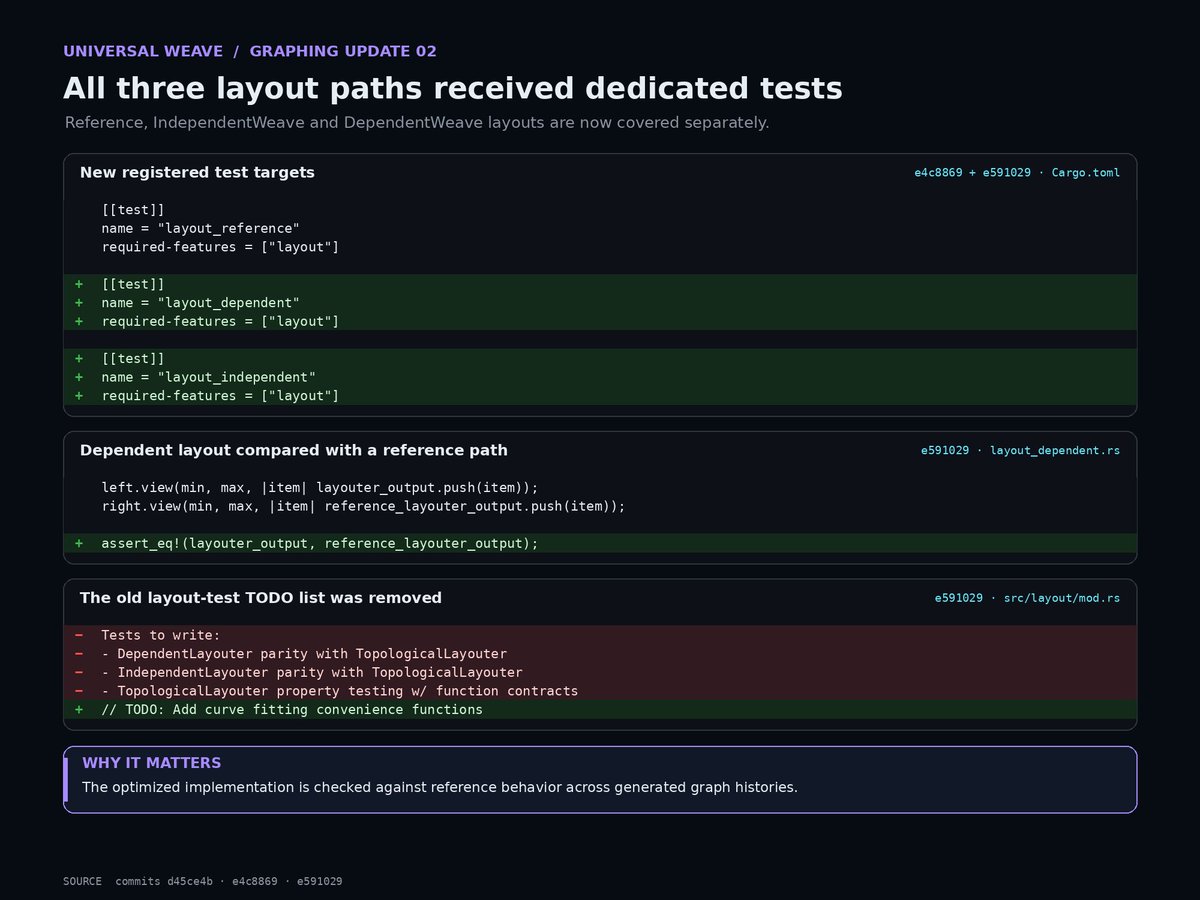
@transkatgirl has now added separate property tests for the reference, independent, and dependent layout paths. Together, those harnesses are configured for 15,360 generated cases, with sequences that can run up to 511 operations.
Then came the cleanup. 1 major commit alone changed over 500 lines, removing more code than it added, followed by smaller fixes that tightened temporary memory allocation.
And she still refuses to call it done until the weird edge cases are manually traced and the final high-count tests are complete.
Most people would see “2 to 3x faster,” post the benchmark, and rush the release.
But @transkatgirl saw it, then went back to look for everything that could still break.
This is the kind of builder we should all support in this space and across the @solana eco.
$weave isn’t another AI agent. @universalweave is foundational infrastructure for Looms and non-linear AI interaction, something other builders could eventually build on top of.
The size of this won’t be measured by one demo. It’ll be measured by what gets built with it.
0.5.0 isn’t out yet, but the work is visible.
Listen, study $weave before the market does.


i guess i should post more frequent development updates.
i really didn't expect graphing to take this long. i mean, i could say "i didn't expect this to take so long" for most of this project; i just wanna get to the fun/cool parts alreadyyyyy
the graphing implementation works fairly well and it passes a fairly comprehensive property test suite.
it seems to be roughly 2-3x faster than the layout library that was previously used by tapestry loom, has much better behavior when used for DAG-based documents, and unlike the layout code used in the last demo, it's worst-case time complexity is O(V + E) (linear time) rather than O(V^2)
sadly, this does not mean it's done yet. aaaaaaaaaa
there are some edge cases that are not really practical to test in an automated manner. so, i have to carefully examine the code, tracing out how it behaves. most of what i'm worried about is integer overflow behavior, but doing this kind of examination also helps uncover potential failure modes i wouldn't have even thought to check otherwise.
the issue is that the graphing code is a mess, because claude fable helped a lot with the implementation work (all algorithmic and API design decisions were mine). this allowed me to get this done far faster than what would have been possible otherwise, but oh godd now i have to clean all of this code up
i'm making progress on the code cleanup & review, and i'm aiming to be done before the end of the week.
once i get that done, it's just a matter of my usual pre-release stuff (final code review + property testing at very high case counts), and then i can get universal-weave 0.5.0 published.
finally.
This is the kind of dev update i love reading tbh.
Graphing taking longer isn’t the headline here. It already works, passes the tests, runs roughly 2 to 3x faster, and handles DAGs way better than the old setup. Take your time cleaning it up kat. I'd rather wait for something solid than see you rush 0.5.0 just to hit a date.
i guess i should post more frequent development updates.
i really didn't expect graphing to take this long. i mean, i could say "i didn't expect this to take so long" for most of this project; i just wanna get to the fun/cool parts alreadyyyyy
the graphing implementation works fairly well and it passes a fairly comprehensive property test suite.
it seems to be roughly 2-3x faster than the layout library that was previously used by tapestry loom, has much better behavior when used for DAG-based documents, and unlike the layout code used in the last demo, it's worst-case time complexity is O(V + E) (linear time) rather than O(V^2)
sadly, this does not mean it's done yet. aaaaaaaaaa
there are some edge cases that are not really practical to test in an automated manner. so, i have to carefully examine the code, tracing out how it behaves. most of what i'm worried about is integer overflow behavior, but doing this kind of examination also helps uncover potential failure modes i wouldn't have even thought to check otherwise.
the issue is that the graphing code is a mess, because claude fable helped a lot with the implementation work (all algorithmic and API design decisions were mine). this allowed me to get this done far faster than what would have been possible otherwise, but oh godd now i have to clean all of this code up
i'm making progress on the code cleanup & review, and i'm aiming to be done before the end of the week.
once i get that done, it's just a matter of my usual pre-release stuff (final code review + property testing at very high case counts), and then i can get universal-weave 0.5.0 published.
finally.
graphing work is taking slightly longer than we initially expected, but the microcontroller is here
work on the demo will begin as soon as we get universal-weave 0.5.0 published

The microcontroller for the demo is nearly here.
Work on the demo will start as soon as the microcontroller arrives; Right now, we're working on getting our graphing implementation to meet our high standards.

A quick update on the graphing work: We now have a draft implementation with reasonably good performance, and now we're working towards ensuring it's reliable enough to include in the library's next update.
We've finally completed our work on the core Loom algorithms, and now we're moving on to the next most important component of a Loom interface: Graphing!
Existing graphing libraries don't work well for Looms, as they tend to be too slow, heavy, or opinionated to be usable for the user interface.
So, we're building our own, integrated into universal-weave, and we aim to hold the graphing code to the same standards as the core Loom algorithms: High reliability, intuitive behavior, good performance characteristics, and the ability to run anywhere.

yay! also is there a graphing library please instead? ty
Kat is about to test that claim on actual hardware.
The microcontroller is nearly here. Once it arrives, work begins on a Loom interface running in an environment with less RAM than some graphing calculators.
While waiting, she is refining the graphing implementation until it meets her standards instead of rushing out a weak demo.
This is not about running the LLM itself on a tiny chip. It is about proving that @universalweave branching foundation is lightweight and portable enough to work far beyond a normal desktop app.
If this demo lands, “can run anywhere” stops being a claim and becomes visible proof.
That’s how real infrastructure earns trust.
$weave
The microcontroller for the demo is nearly here.
Work on the demo will start as soon as the microcontroller arrives; Right now, we're working on getting our graphing implementation to meet our high standards.
The microcontroller for the demo is nearly here.
Work on the demo will start as soon as the microcontroller arrives; Right now, we're working on getting our graphing implementation to meet our high standards.
Once our graphing library is finished, we plan on building a new demo showcasing universal-weave's portability: A Loom interface running on a microcontroller.
When we mean "can run anywhere", we mean *anywhere*, even in environments with less RAM than some graphing calculators (for reference, the TI-Nspire CX has 64MB of RAM).
(When we reach Stage 3, we're considering expanding on this to build a Loom Deck: An open-source physical Loom terminal with functionality on par with Tapestry Loom, which can be easily assembled by anyone using off-the-shelf components.)

@Bollish the planned microcontroller loom demo after graphing sounds pretty based
there's currently an interactive GUI app demonstrating the features of the core universal-weave library available on my github; this demo will continue to be updated as i finish the graphing code and begin to build reusable UI components
https://t.co/ACyHRMHrRi
i'm also planning a demo which will have universal-weave (+ the new graphing implementation that is going to be merged into universal-weave soon) running on a microcontroller-based device.
my current estimate is that once graphing is done (i think it should be done by some time next week), it'll take me about a week of work to make the microcontroller demo. however, software development time estimates are notoriously hard to get right.
okay, i've finished the optimization work on universal-weave, now i can just focus on graphing
once graphing is done (sometime next week), i'll be building UI components for a few different UI frameworks, starting with egui and ratatui
oh yeah, i forgot x communities are a thing
going to try and get a patch release out today (just boring optimization work) and then i'll be spending the rest of the day talking with some experienced Loom enjoyers regarding design
hoping to get the graphing implementation done by next week, which is when the microcontroller hardware i'm going to use for the next demo should arrive
Graphing is the layer that turns trees and DAGs into visual maps users can navigate.
Kat aims to add it within days, then move to polished Loom UI libraries, with DAG multiplayer also planned.
The foundation is becoming a toolkit developers can build products on.
@universalweave - $weave
going to aim to have graphing added to universal-weave within the next few days
the main reason it's been taking so long is because:
1. i want to make sure the layout algorithm is good
2. i want to make sure all of universal-weave, including the layout algorithm, is highly efficient
3. i want to make sure the layout algorithm is well implemented

@AristolesHaven Like that yx quandrant shapes stuff? We did that in Math 1 and Math 3 aswell. Probably more complicated but I have memory loss soooo. Anyways I hate graphing so uhmmmmm

@RXN11E Atcsome point you will be graphing
Blow up the classroom and dont look back. That shit sucked so bad
Most Popular Users

Elon Musk 
@elonmusk
239.7M followers

Barack Obama
@barackobama
118.6M followers

Cristiano Ronaldo
@cristiano
114.3M followers

Donald J. Trump
@realdonaldtrump
111.7M followers

Narendra Modi
@narendramodi
106.9M followers

Rihanna
@rihanna
98.6M followers

NASA
@nasa
92.1M followers

Justin Bieber
@justinbieber
91.7M followers

KATY PERRY
@katyperry
89.9M followers

Taylor Swift
@taylorswift13
83.9M followers

Lady Gaga
@ladygaga
75.4M followers

Virat Kohli
@imvkohli
73.3M followers

Kim Kardashian
@kimkardashian
70.8M followers

YouTube
@youtube
68.6M followers

Neymar Jr
@neymarjr
66.3M followers

Bill Gates
@billgates
65.1M followers

Selena Gomez
@selenagomez
63M followers

The Ellen Show
@theellenshow
62.1M followers

CNN
@cnn
61.7M followers

X
@x
60.6M followers