

Top Tweets for #Graphs

@peblackstock @joe51du @Gilles_Borghese @Royalacresrod @insane_voice @BobPartridge16 @Fossil_Herb @FreeSpeech4Me_U @BJul1989 @benmooreau @CCross1776 @WeRone777 @Konrad_Chapman @paddysaidingbar @kennetham12 @Ballyhoguetrade @M3othra012 @Milei_InEnglish @CraigThomler @nalonjack @ScienceBlog3 @smeemartin @MichaelCastill2 @grok Yes, just because they cannot admit they was wrong and the graphs were right
Sadly for them .. the decision they will have to make, is not far away
You could say they are at the 11th hour

@Iqvish THISSSS. I have 0 issues with any other roblox games and can have full graphs when I play them but royale high (Every realm btw) It lags out so bad even with my graphs set to 1. I dont even go to campus 4 anymore it gets so bad.

@PrismaXai The Parallel Execution Standard
6) Deterministic parallelization transforms the EVM from a single-lane road into a multi-lane highway. By pairing static dependency graphs with parallel execution, @PrismaXai sets the standard for high-performance Web3 infrastructure.
@PrismaXai Multi-Core Hardware Scaling
4) Sequential chains leave modern multi-core validator CPUs 90% idle. By mapping execution graphs at block ingress, @PrismaXai scales throughput linearly with hardware cores while keeping 100% EVM bytecode compatibility.
@PrismaXai Zero Re-Execution for Devs
3) For devs: Optimistic parallel VMs waste compute rolling back colliding transactions. @PrismaXai uses deterministic dependency graphs to schedule execution upfront—guaranteeing zero re-executions and predictable gas performance.
What are Static Dependency Graphs?
2) Static analysis maps out exact read/write storage slots before transactions run. On @PrismaXai, non-overlapping transactions are grouped into conflict-free lanes and executed simultaneously across multi-core hardware.

The Sequential EVM Bottleneck
1) Standard EVMs process transactions one-by-one, creating massive congestion and gas spikes even when transactions don't touch the same state. The alpha fix? Deterministic Parallel EVM Execution via Static Dependency Graphs on @PrismaXai.


Deploy count became a really bad metric (AI made it a lot worse). Green GitHub graphs, hundreds of apps pushed to Google Play/App Store. All up, all cheap now.
None of it says if the thing survives real users. Measure rollbacks and recovery time instead.
https://t.co/eZpXLWgbGs

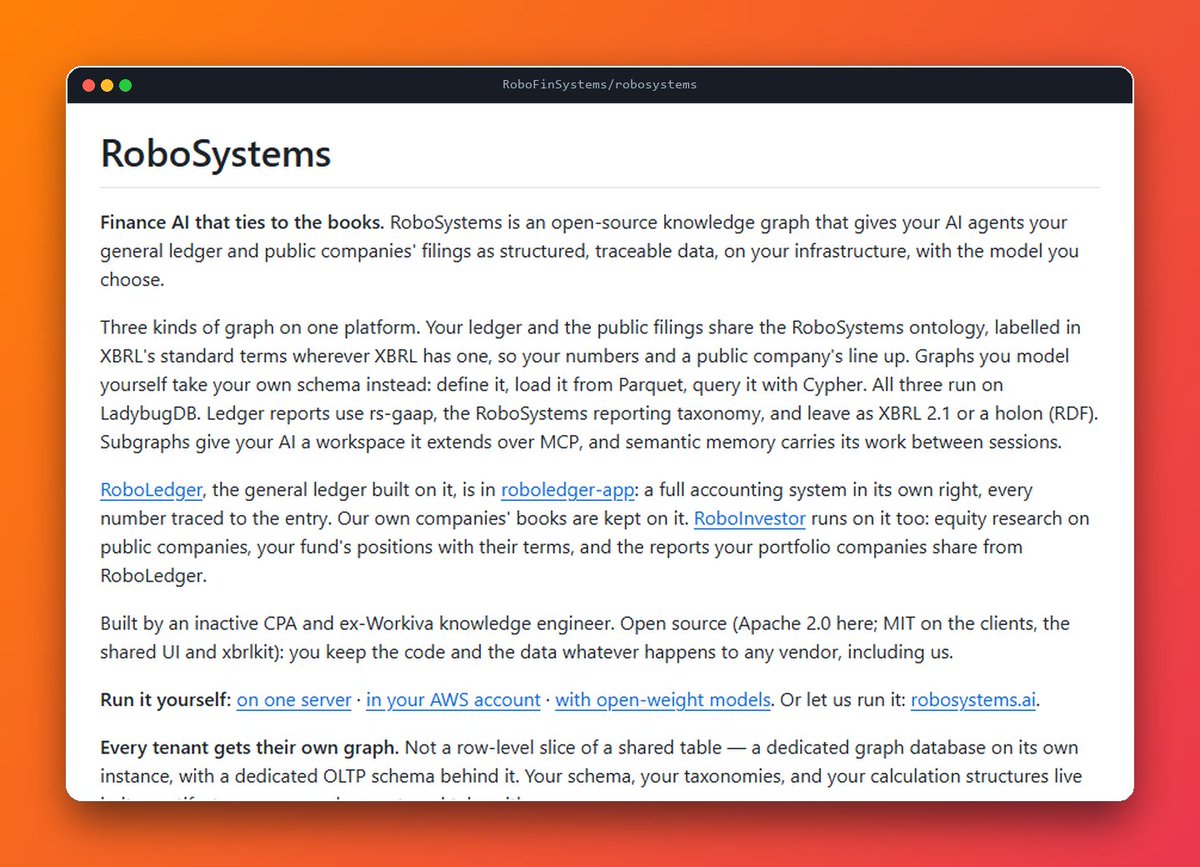
RoboFinSystems/robosystems turns your general ledger and public XBRL filings into a knowledge graph your AI agents can query over MCP. Ledger graphs, the SEC repository, and graphs you model yourself: Parquet in, Cypher out. Self-hosted on one server or in your own AWS account, with the model you pick. It is Python, and the MCP layer is the whole point, so your agent gets structured, traceable finance data rather than scraped text.
https://t.co/9gVAKmpS8n

🚀 AIPOCH Open-Science v1.3.1 is out! 🎉
This release brings built-in Web Search, smarter literature exploration, and better AI Agent connectivity.
✨ Built-in Web Search & Page Reading with persistent citations
✨ Interactive Citation Graphs to explore research connections
✨ MCP access without manually opening the app
✨ Setup guides for 30+ external Agents & clients
✨ Lab accounts with organization models & shared research cases
✨ Refresh Provider Model Catalogs directly from Settings
✨ Notebook memory checks before execution
⚡ Improved Session recovery, startup & cross-platform updates
AIPOCH Open-Science v1.3.1 — connect more knowledge, explore research relationships, and work seamlessly across AI Agents.
⚠️ Updating from v1.3.0 may require a one-time manual install if the existing updater is blocked.
🔗 https://t.co/V40SnLOhbg
⭐ Star us: https://t.co/2lNdBFWwtd

AIPOCH Open-Science v1.3.1 is out!
https://t.co/Ln52gmDOad
This release focuses on web connectivity, literature exploration, and AI Agent accessibility. It introduces built-in Web Search, interactive Citation Graphs, automatic MCP service startup, Lab account support, and refreshed Provider Catalogs, alongside improvements to Notebook performance, Session recovery, and cross-platform updates.
【🚀 New Features】
🌐 Built-in Web Search & Page Reading
The built-in Open-Science Agent can now search the web and read public webpages directly.
- Search public information and retrieve webpage content.
- View search queries, filters, and limits in approval cards.
- Preserve source citations across restarts, Conversation branches, and supported .science packages.
Search queries are sent to Exa, while webpage reading contacts the requested websites.
📚 Interactive Literature Citation Graph
The Literature Library now supports interactive Citation Graphs for exploring research connections.
- Visualize references and citing papers.
- Filter by References, Cited By, or All.
- Re-center the graph on related publications.
- Return to the original paper at any time.
🔌 Automatic MCP Service Startup
External AI Agents can now connect to Open-Science through MCP without manually opening the application first.
- Automatically start or reuse the local background service.
- Connect through supported MCP clients.
- Follow setup guides for more than 30 Agents and clients.
The background service remains active after disconnection and can be stopped with open-science stop.
🧪 Lab Models & Organization Research Cases
Open-Science now supports Lab account integration.
- Access organization-assigned AI models.
- Track model usage.
- Search and import shared research cases.
- Share Session research packages with teammates through the Lab server.
🤖 Refreshed Provider Catalog
Provider management is now more flexible:
- Refresh available models directly from Settings.
- Preserve existing model lists if a refresh fails.
- Receive clearer error messages for authentication, quotas, rate limits, and model availability.
- Test image generation before saving an Image Service.
【🔧 Improvements】
- Notebook checks available memory before execution to prevent low-memory failures.
- Improved Notebook resource management through Compute.
- Faster application startup with on-demand Session detail loading.
- Clearer recovery guidance when research data folders are unavailable.
- Windows onboarding no longer blocks on optional WSL setup.
- Improved Lab authentication and Citation Graph interactions.
- Faster Windows installation diagnostics.
【🐛 Bug Fixes】
- Application Updates — Fixed background processes incorrectly blocking Windows and Linux AppImage updates.
- Sessions & Recovery — Improved unsent draft preservation, long Conversation loading, restored Agent questions, and Session metadata synchronization.
- Notebook & Agents — Fixed missing Conversation history in standalone Notebook Sessions and repeated Literature warnings during Agent startup.
- Windows & Storage — Fixed large Settings files blocking updates and incomplete Imported Session deletion.
- Research Films — Removed unnecessary quality-review delays before playback.
- Interface — Improved Session loading retries and Citation Graph layout.
【⚠️ Important Notes】
- Updating from v1.3.0: Some users may need a one-time manual installation if the existing updater reports a blocking process. Fully quit Open-Science and its background service before installing the downloaded package. Research data and profiles are preserved.
- Web Search: Search queries and webpage requests contact external services under the configured permissions.
- Lab Sharing: Sharing a research case uploads the selected Session package to the configured Lab server.

@Graphsqgk ทักไม่ได้

@TokenizeBull @texcat_token @PoorGoat_ @faceofsol Texcat is not just a meme. It’s a way of thinking.
Red graphs, bad days, chaos around — we put on our hat and say, “I’m fine.”
No panic. No excuses. No chasing after perfect moments.
We stay when others leave. We hold on when others give up.

@ScrenaAI Makes total sense. Testing how engineers actually debug with AI tools reflects real day2day SWE work way better than memorizing obscure LeetCode graphs.

@willie_sre Yeah, that's why Prometheus and Grafana matter. Prometheus collects metrics, and Grafana graphs them, so you can spot throttling even when pods show 'Running'.

- Removed unnecessary buffering delays.
- Used CUDA graphs to speed up action generation.
- Optimized image processing & model precision.
- Improved camera and inference speed.
These changes reduced inference latency from 230 ms to just 87 ms.
It matters because, 👇

@Tariqkh19089041 Seeing those traffic graphs go up is a good feeling.

@cyb_detective I'll give the beta graphs a go. Thanks for sharing!

Check back with you fellas later
NBA has been an up and down ride so far, but this edge has still returned 2% of our investment over 385 bets. And we have 37 more slated for tonight, at least!
Also, why do @pikkitsports graphs completely suck? Lol.
#Gambling𝕏 #NBA


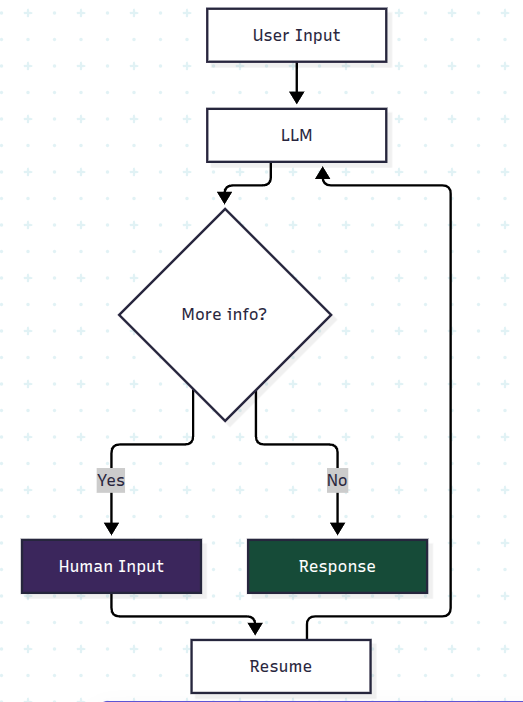
AI agents don't just need autonomy, they need CONTROL
Real workflows need state, branching, human input and the ability to pause and resume
That's why LangGraph is interesting: agent workflows as graphs not just chains of LLM calls
Autonomy is impressive. Reliability is harder

spent 3 weeks grinding graphs. first week on the job: 90% of tickets were fixing null pointers in nested objects. why can't we just `try/catch` the interview?

@MoSuvo Dashboards exist because product managers like looking at graphs. Developers just want context aware data piped straight into their terminal or editor without opening a browser.

@Hoplite4AI 100 branching real-life scenarios as json graphs is a serious amount of work for a bible app. practising faith in small moments is a good way to put it

1. WolframAlpha
https://t.co/tlFOB4LZ0T
Solve complex math problems, perform calculations, create graphs, and explore answers to difficult questions.

Graphs don’t automatically make agents reliable.
They make reliability engineerable.
Reliability comes from validation, guardrails, retries, fallbacks, checkpoints, observability, human escalation, and evaluation.
A graph gives structure.
Engineering makes it dependable.
Graphs don’t automatically make agents reliable.
They make reliability engineerable.
Reliability comes from validation, guardrails, retries, fallbacks, checkpoints, observability, human escalation, and evaluation.
A graph gives structure.
Engineering makes it dependable.
Graphs don’t automatically make agents reliable.
They make reliability engineerable.
Reliability comes from validation, guardrails, retries, fallbacks, checkpoints, observability, human escalation, and evaluation.
A graph gives structure.
Engineering makes it dependable.
Last Seen Hashtags on Sotwe
Trends for you
Most Popular Users

Elon Musk 
@elonmusk
240.1M followers

Barack Obama
@barackobama
118.6M followers

Cristiano Ronaldo
@cristiano
114.4M followers

Donald J. Trump
@realdonaldtrump
111.7M followers

Narendra Modi
@narendramodi
106.9M followers

Rihanna
@rihanna
98.6M followers

NASA
@nasa
92.1M followers

Justin Bieber
@justinbieber
91.7M followers

KATY PERRY
@katyperry
89.9M followers

Taylor Swift
@taylorswift13
83.9M followers

Lady Gaga
@ladygaga
75.4M followers

Virat Kohli
@imvkohli
73.3M followers

Kim Kardashian
@kimkardashian
70.8M followers

YouTube
@youtube
68.6M followers

Neymar Jr
@neymarjr
66.3M followers

Bill Gates
@billgates
65.2M followers

Selena Gomez
@selenagomez
63M followers

The Ellen Show
@theellenshow
62.1M followers

CNN
@cnn
61.7M followers

X
@x
60.6M followers