

Top Tweets for #HealthCheck

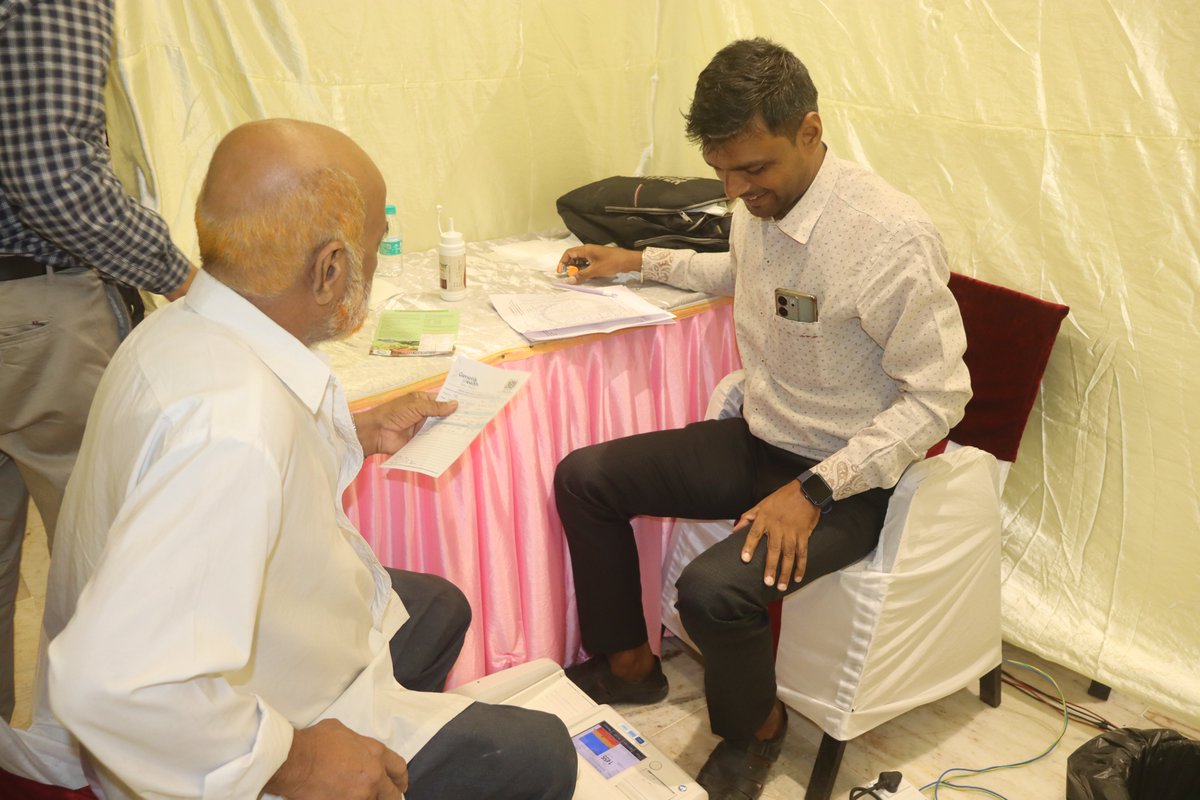
🏥 Juma Masjid Bombay ke Free Medical Camp se 101 Khandanon ne Faida Uthaya
#JumaMasjidOfBombay #FamilyFirstGuidanceCentre #FFGC #FreeMedicalCamp #MedicalCamp2026 #HealthCheckup #HabibHospital #CommunityHealthcare #Mumbai #KokniCommunityHall #SocialWelfare #KhidmatEKhalk


🏥 Juma Masjid Bombay ke Free Medical Camp se 101 Khandanon ne Faida Uthaya
#JumaMasjidOfBombay #FamilyFirstGuidanceCentre #FFGC #FreeMedicalCamp #MedicalCamp2026 #HealthCheckup #HabibHospital #CommunityHealthcare #Mumbai #KokniCommunityHall #SocialWelfare #KhidmatEKhalk


Mufti Ashfaq Kazi's Special Message | Free Medical Camp 2026 | Juma Masjid Mumbai #Shorts #MuftiAshfaqKazi #FreeMedicalCamp #HealthCheckupCamp #JumaMasjidOfBombay #FamilyFirstGuidanceCentre #FFGC #Mumbai #CommunityHealth #MedicalCamp2026 #UlamaEKiram #Imams #Huffaz #Reels
FREE MEDICAL & HEALTH CHECK-UP CAMP 2026
#MuftiAshfaqKazi #FreeMedicalCamp #HealthCheckupCamp #JumaMasjidOfBombay #FamilyFirstGuidanceCentre #FFGC #Mumbai #CommunityHealth #MedicalCamp2026 #UlamaEKiram #Imams #Huffaz #Reels

Thanks Jake! Railway is the backbone of this setup (and my other apps)🚄
Top wish from this loop: push notifications when a deploy fails its healthcheck or crash-loops.
I'm away from the desk and the agent's deploy is the thing I'm waiting on.
And being able to peek at bucket files from the app would be a nice bonus.

@Ego_wure Agree — boring is the point. Treat healthchecks as a restart contract: pin the probe (endpoint, threshold, grace), bound restart storms, emit an inspectable failure reason, and keep a known-good image for one-click rollback when the probe itself is wrong.

So I'm deep in Docker healthchecks and auto restarts.
Boring work, but that's what makes it production ready

Essential Health Checks After 40: Catch Cancer Early
40岁后必要的体检,将癌症消灭在源头
After 40, don’t just buy an expensive “full-body checkup package.” Get the tests that actually match your age and risk.
Colorectal screening: Start around age 45 for average-risk adults. Colonoscopy can find and remove precancerous polyps. If the result is normal, the next colonoscopy may not be needed for about 10 years.
Lung screening: Annual low-dose CT (LDCT) can detect lung cancer early, but it’s mainly recommended for people at high risk due to a significant smoking history—not everyone over 40.
Ultrasound: Neck and abdominal ultrasound can help detect thyroid nodules and abnormalities of the liver, kidneys and other organs, particularly when symptoms or risk factors are present.
Blood & urine tests: Regular testing can help monitor liver and kidney function and overall health. Tumor markers such as CA19-9, however, should not be used as universal cancer-screening tests.
After 40, the goal isn’t to test everything—it’s to screen the right disease, at the right time, based on your actual risk.
#HealthChecks
Goal for the week, continue finessing my Docker skills
Task: Shrink Node API of my project to <200MB and make it actually production ready
Working on:
1. Multi-stage builds
2. Non-root user + healthchecks
3. Proper .dockerignore
4. docker-compose for local
Your Docker container is missing 4 things:
1. Healthcheck
2. Non-root user
3. .dockerignore
4. An owner
We obsess over the Dockerfile but forget the operational contract not until something dies in prod

Phoenix is putting work into its integration test CI. The focus this period: better visibility, healthchecks, and reliability for the suite.
One commit and two PRs landed on phoenixframework/phoenix.
No user-facing changes to announce. Just the CI getting steadier. #elixir
https://t.co/YDIrDBqE7m

It feels like a lot about building in web3 requires more complexity than the fundamental application.
It doesn’t really matter how simple the actual app is to conceptualise,
all the sudden you’ve have to invent and orchestrate a complex infrastructure to make it work at all!
━━━━━━━━━━━━━━
◻️ suddenly you have a bunch of moving parts that “work”.
an oracle to bring data from outside, a keeper for automated tasks, a bridge for multi-chain deployments,
a webhook system to bring information out of the chain for real-time triggers, an additional script for healthchecks on all those things.
it works. but then you’ve just got clunky frankenstein stack which happens to be a little fragile.
It’s for that reason I found myself attracted to Rialo’s idea of being “supermodular” by allowing different infrastructure building blocks to intercommunicate natively.
↓
◼️ Rather than having developers stitch together and stitch up exactly the same set of outside the- protocol services again and again for every single project,
the team has created a native, protocol-integrated set of services.
Natives less weaknesses cleaner apps It’s basically a recognition that most real world apps need to interact with the external world.
Whether it’s reacting to prices, acting on a timer, a user clicking a button, listening for a push notification from another API, communicating with an AI,
that doesn’t mean we necessarily need a sprawling ecosystem of independent, separately maintained, moving parts.
━━━━━━━━━━━━━━
◻️ The hope here, I think, from Rialo’s end, is an infrastructure that feels like more of a holistic system rather than an ecosystem that just adds up pieces.
A place where data flows seamlessly into automated events and real-time triggers that feed back into the system to enact changes or trigger further events.
This is where the “super modular” concept comes in to make things so pragmatic: reducing the need for clunky boilerplate to something that can flow much more smoothly.
↓
◼️ Less patchwork. More coherence. Which, I think, is what the world really needs from crypto app infra.
@RialoHQ #Rialo #RialoHQ


🩺 Regular health check-ups can catch serious conditions like high cholesterol, thyroid issues, and certain cancers early – when treatment is most effective. Even if you feel healthy, screenings matter.
📊 POLL: How often do you get a full health check-up?
🔘 Every year
🔘 Every 2-3 years
🔘 Only when I feel unwell
🔘 Never had one
📋❤️ #PreventiveCare #HealthCheck #HealthPoll
Photo credit @grok


Here are the notes from that session, summarized and validated, some local llm gotchas as well. i wouldn't characterize it as a push-button setup but it's not been challenging.
1. Qwen3.5's hybrid architecture (75% linear attention, 25% full attention every 4th layer) means llama.cpp can't efficiently reuse KV cache across requests. A 1900-item background queue took days locally vs ~1 hour on Gemini Flash Lite via OpenRouter. Don't try to run qwen local for this.
2. "docker compose restart" does NOT reload .env changes. Env vars are baked in at container creation. You need "docker compose up -d --force-recreate." We (opus and I) chased phantom config bugs multiple times before learning this.
3. Failed embedding API calls in background workers silently mark jobs as "completed." Bad credentials? The LLM extraction succeeds, the save fails, the queue marks it done. No retry, no error, observations just vanish. working on a fix...
4. The Honcho deriver's Docker healthcheck reports "unhealthy" forever out of the box in my case. The Dockerfile checks the API port, but the deriver is a queue worker, it never serves HTTP there. Override the healthcheck to hit the Prometheus metrics port instead. I need to do further research on this but it's working 🤷♂️it's on my todos.
5. More "local llm things" Reasoning models in llama.cpp burnt all tokens on thinking, returning empty content. Thinking tokens count against max_token, so if your budget equals your limit, the model thinks to completion and returns nothing. Every component's max_output_tokens must exceed reasoning_budget + desired output.
6. Backup LLM provider failover masked the real error. Primary times out, system falls back to a backup with a bad API key, and the error you see is "auth failed" on the backup — not the actual root cause. You debug the wrong provider entirely.
Note - these are issues i encountered, they do not necessarily indicate a systemic issue. i'll do more troubleshooting but overall it was pretty painless. i didn't do most of the doing.

@TOPOFGRdev @Metria_ai Bien ahí con el healthcheck! En apps móviles hago algo similar con los endpoints antes de cada release. Qué stack usan en Metria para monitorear?

🚨10 Docker tasks you should before moving to Kubernetes.
1. Dockerize a production web app with env variables.
2. Build optimized multi-stage Dockerfiles.
3. Run containers as non-root for security.
4. Push versioned images to Docker Hub or AWS ECR.
5. Deploy multi-service stacks using docker-compose.
6. Manage persistent data with Docker volumes.
7. Add healthchecks to containers.
8. Scan and fix image vulnerabilities.
9. Automate builds and pushes in CI.
10. Debug containers using logs and exec.
What more you can add?

Docker container stuck restarting? Quick checklist:
- docker logs <id> and find the FIRST error
- Exit code and why it crashed (OOM, missing env var, bad args)
- Healthcheck failing (silent killer)
- Local vs prod config drift (env, volumes, ports, secrets)
- Limits: memory/CPU (K8s) and ulimit
- Dependencies reachable (DB, Redis, external APIs, DNS)
- Entrypoint/script perms + shebang (chmod +x, line endings)
Most "Docker issues" are app config issues.

Successfully moved Sooper’s production env to a loadbalanced private-ip setup on Coolify!
Achieved:
👉🏻 Shaving around > 200ms of requests constantly.
👉🏻 Zero downtime deployments
👉🏻 Backend and redis in the same private network
👉🏻 Healthcheck based rolling updates
👉🏻 Full Strict SSL
Trying to solve something that does not seem solvable..
Goal:
- 3 servers in a private network.
- 1 sever acts as Loadbalancer in Coolify.
- 2 servers running each two next apps without port mappings.
CloudFlare (full strict)-> LB
Loadbalancer server (traefik)
-> app1 / app2 no portmappings
-> app1 / app2 no portmappings
Why is this not possible?
I very briefly see my site and it immediately returns 503 on the next refresh.
Suspecting healthchecks..
Should be possible right?!
Do your thing algo!!

This is an incredibly useful cheatsheet! Docker fundamentals are crucial for DevOps and containerization. A few more helpful tips: VOLUME creates mount points, HEALTHCHECK allows Docker to monitor if your container is still running properly, and using .dockerignore can significantly reduce image size by excluding unnecessary files from the build context
🚨10 Docker tasks you should before moving to Kubernetes.
1. Dockerize a production web app with env variables.
2. Build optimized multi-stage Dockerfiles.
3. Run containers as non-root for security.
4. Push versioned images to Docker Hub or ECR.
5. Deploy multi-service stacks using docker-compose.
6. Manage persistent data with Docker volumes.
7. Add healthchecks to containers.
8. Scan and fix image vulnerabilities.
9. Automate builds and pushes in CI.
10. Debug containers using logs and exec.
What more you can add?


@ozalwaraditya nice discovery!! 😁
i suggest you try:
-request tracing (corr-id) so you can debug calls across services
-healthcheck + retry + timeout config -test pagination with slow queries & big datasets too
i think this can be a very good followup on what u already learned

"Health is expensive, but caring is priceless. My deepest respect to the health volunteers who sincerely serve the elderly. Long live the good things! ❤️🏥 #HealthCheck #CommunityCare #oshit @oshitio


We are building the immune system of DeFi. $REVEAL attacks the viruses (scams) and protects the healthy cells (real builders). 🧬🛡️ #HealthCheck
🚨10 Docker tasks you should before moving to Kubernetes.
1. Dockerize a production web app with env variables.
2. Build optimized multi-stage Dockerfiles.
3. Run containers as non-root for security.
4. Push versioned images to Docker Hub or ECR.
5. Deploy multi-service stacks using docker-compose.
6. Manage persistent data with Docker volumes.
7. Add healthchecks to containers.
8. Scan and fix image vulnerabilities.
9. Automate builds and pushes in CI.
10. Debug containers using logs and exec.
What more you can add?


@moein__moradi Adding a dev stage is a solid pattern. Consider automated smoke tests + healthchecks on the test domain, plus feature-flagged prod deploys. If rollback matters, keep deploys small and use atomic DNS swap or blue/green.
Most Popular Users

Elon Musk 
@elonmusk
240.1M followers

Barack Obama
@barackobama
118.6M followers

Cristiano Ronaldo
@cristiano
114.4M followers

Donald J. Trump
@realdonaldtrump
111.8M followers

Narendra Modi
@narendramodi
106.9M followers

Rihanna
@rihanna
98.6M followers

NASA
@nasa
92.1M followers

Justin Bieber
@justinbieber
91.7M followers

KATY PERRY
@katyperry
89.9M followers

Taylor Swift
@taylorswift13
83.9M followers

Lady Gaga
@ladygaga
75.4M followers

Virat Kohli
@imvkohli
73.3M followers

Kim Kardashian
@kimkardashian
70.8M followers

YouTube
@youtube
68.6M followers

Neymar Jr
@neymarjr
66.3M followers

Bill Gates
@billgates
65.2M followers

Selena Gomez
@selenagomez
63M followers

The Ellen Show
@theellenshow
62.1M followers

CNN
@cnn
61.7M followers

X
@x
60.6M followers