

Top Tweets for #HealthSystem

New Unity tutorial just dropped.
Learn how to build a simple health system in Unity — complete with damage handling, health tracking, and game over logic.
Perfect for beginners building their first game.
#unity #gamedev #unitytutorial #unitydev #indiedev #healthsystem

Reethi Hospital faces serious questions over poor healthcare, absent doctors and negligence. Will the new BMO bring real change or just another transfer? #MadhyaPradesh #Katni #HealthSystem #HospitalNegligence
@CollectorKatni @healthminmp
https://t.co/CRcsPjnm8g

If you're tired of managing your health
from memory…
Stop guessing. Start seeing.
Lifetime access here:
https://t.co/HTgM91OXZS
Your future self will thank you.
#ChronicIllness #HealthSystems #Spoonie
If you’re tired of managing your health from memory…
Stop guessing.
Start seeing.
Lifetime access here:
https://t.co/HTgM91OXZS
Your future self will thank you.
#ChronicIllness #HealthSystems #Spoonie
Excess sterilizations beyond the prescribed limit, zero monitoring.
Another shocking case exposing the failure of public health oversight in MP.
When will accountability begin?
#SterilizationCamp #HealthSystemFailure
@collectordhar @healthminmp
https://t.co/2isVyY9vAh
Most people track some health info but miss the full picture.
Without seeing connections, flare-ups pile up and treatments lose effectiveness.
You need a system that turns your daily entries into meaningful insights.
#ChronicIllness #SmartTracking #HealthSystems

@JusticeGanesh @alicia49S @POTUS So many good doctors have been "lawfared". Interestingly, I haven't come across a single one who was working for a big healthsystem or the government...
Most people think they have a health problem.
What they actually have is a tracking and awareness problem.
🧵 7 unseen habits of people who stay in control of their health (even when life feels unpredictable):
#Notion #Productivity #HealthSystems #Mindset

Healthtech in Low-Resource Settings Needs More Than Smart Tech, It Needs Smart Design
Digital health tools hold great promise for healthcare facilities in low-resource settings, but too often, their performance falters not because of lack of access but because of a mismatch between design and context.
Recent research paints a consistent picture across Africa’s hospital systems.
In South Africa’s Western Cape (2023–24), a survey of 329 hospital leaders revealed a telling paradox: enthusiasm for digital transformation was high, yet readiness for organizational change scored below 50%. The will was there, but the way wasn’t.
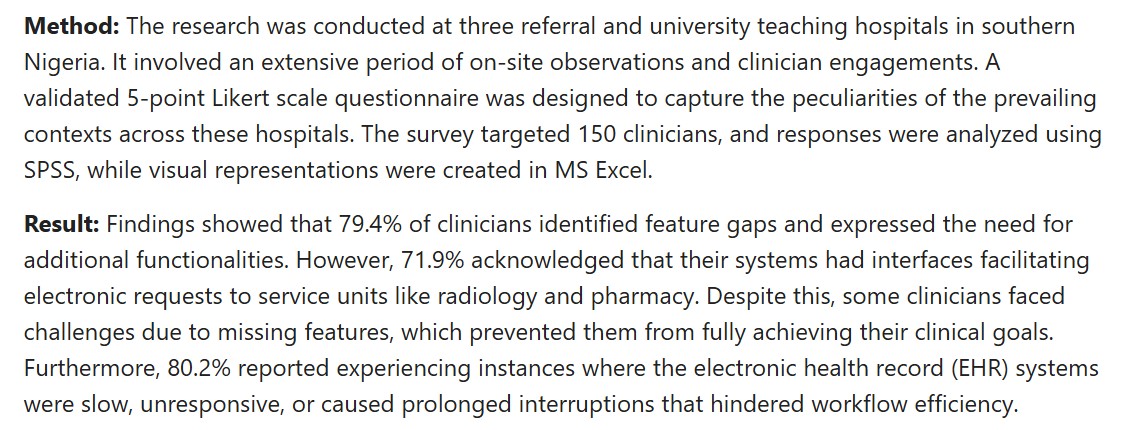
That same disconnect echoed in Nigeria, where clinicians across three major teaching hospitals reported that while EHRs had become part of daily work, 80% still faced missing features that limited care and 80.2% experienced frequent system slowdowns. In practice, tools meant to streamline care were instead slowing it down.
Stepping back, a 2023 scoping review of digital health adoption in LMIC hospitals confirmed that these are not isolated experiences. Across multiple contexts, success hinged on six interlinked factors - from health system structures and infrastructure readiness to leadership, culture, and user engagement. The broader pattern was clear: innovation is advancing faster than implementation capacity.
What actually drives success?
1️⃣ Ease of use + workflow fit -- tools must blend into clinical routines, not disrupt them.
2️⃣ Leadership & readiness -- motivated teams need management backing, training, and culture change.
3️⃣ User-centered design -- co-design with clinicians and patients sustains adoption and usability. Systems improve care when users help shape them.
High-resource designs often fail in low-resource contexts because they assume stable power, heavy IT infrastructure, abundant staff and high digital literacy - conditions rarely met.
That’s exactly why, at @vibetbio, we’re building VIBET OS — a system designed for the realities of low-resource healthcare environments, with usability, sustainability, and provider ROI at its core.
Takeaway:
The real challenge isn’t solely technology - it’s proper translation.
Smart design, not just smart code, will determine whether digital health narrows or widens the care gap.
#Healthtech #HealthcareInnovation #HealthSystems #DigitalHealth #AfricanHealthtech


Healthtech providers often promise operational efficiency and dazzling ROI, but what does the data actually say?
In a study involving 20 rural hospital CFOs across 10 U.S. states, researchers explored how telehealth affects hospital finances.
The findings were revealing:
✅ 85% of CFOs came from critical access hospitals, small, resource-limited facilities at the heart of rural care.
✅ Most agreed telehealth improved access and quality, but not their financial position.
✅ The biggest barriers: limited reimbursement, low patient volumes, poor broadband, and a strong preference for in-person care.
While health technologies often focus on patient benefits, few consider the financial sustainability of the institutions that deploy them.
If the provider’s ROI isn’t designed into the technology, beyond what patients gain, the impact, no matter how promising, becomes unsustainable.
According to CFOs, hospitals realize real returns from technology when it:
1️⃣ Helps them retain patients
2️⃣ Drives ancillary services
3️⃣ Reduces the risk of permanently losing patients
4️⃣ Cuts labor costs
As healthtech matures, this distinction matters more than ever.
Sustainable innovation isn’t just about new tools or better outcomes; it’s about achieving economic alignment between patient benefit and provider viability.
That’s why at @vibetbio, we’ve built sustainability into the architecture of VIBET OS, ensuring both patients and providers experience measurable ROI — the kind that sustains innovation, not strains it.
Equip your facility.
Join our waitlist today: vibetbio(dot)com
(link in comments 👇)
#Healthtech #Healthcare #HealthcareInnovation #HealthSystems #DigitalHealth #Telehealth


@MRB3LMAR Changing the healthsystems to prevention

Why shouldn't we trust the WHO? 🤔⚕️
There are several reasons some people question the trustworthiness of the World Health Organization (WHO). Critics often point to its handling of global health crises, funding influences, and decision-making processes.
For instance, during the COVID-19 pandemic, the WHO was criticized for initially downplaying the severity of the outbreak and praising China's response, despite allegations of data suppression by the Chinese government. This raised concerns about political bias, especially since China is a significant contributor to the WHO's budget.
Funding is another sticking point. The WHO relies heavily on voluntary donations from countries and private entities, like the Bill & Melinda Gates Foundation, which is one of its largest donors. Some argue this creates a conflict of interest, as the WHO might prioritize the agendas of its biggest funders over global public health needs. For example, critics have questioned why the WHO has focused heavily on vaccines and pharmaceuticals, areas where its donors have vested interests, rather than broader public health strategies.
There’s also the issue of inconsistency. The WHO has been accused of flip-flopping on guidance—like mask-wearing during COVID-19—without clear evidence to justify the shifts, which erodes confidence. Historical missteps, like its slow response to the 2014 Ebola outbreak, add to the skepticism.
#Zallud #WHO #PandemicTreaty #WorldHealthOrganization #HealthSystems #HealthResources #InformationSharing

@DSchildkroet @DrCWerner Ist das "Problem" mit der Flomask geklärt? Da ging es doch neulich um die Filterleistung der Kindermasken. Ich hatte sie sonst auch immer empfohlen. Healthsystems hat FFP2, ich kenne sie aber nicht => https://t.co/nQcHpwX4gQ Viell kann ja noch jemand was dazu sagen.
Last Seen Hashtags on Sotwe
misogynykink
Seen from Russia
son mom
Seen from Mexico
photographiesportive
Seen from United States
candidfeet
Seen from United Arab Emirates
shortdrama
Seen from Malaysia
野裸
Seen from United States
惩戒师
Seen from Germany
فوتاناري
Seen from Saudi Arabia
snapchatt
Seen from United States
超粗
Seen from Vietnam
Trends for you
Most Popular Users

Elon Musk 
@elonmusk
240.1M followers

Barack Obama
@barackobama
118.6M followers

Cristiano Ronaldo
@cristiano
114.4M followers

Donald J. Trump
@realdonaldtrump
111.7M followers

Narendra Modi
@narendramodi
106.9M followers

Rihanna
@rihanna
98.6M followers

NASA
@nasa
92.1M followers

Justin Bieber
@justinbieber
91.7M followers

KATY PERRY
@katyperry
89.9M followers

Taylor Swift
@taylorswift13
83.9M followers

Lady Gaga
@ladygaga
75.4M followers

Virat Kohli
@imvkohli
73.3M followers

Kim Kardashian
@kimkardashian
70.8M followers

YouTube
@youtube
68.6M followers

Neymar Jr
@neymarjr
66.3M followers

Bill Gates
@billgates
65.2M followers

Selena Gomez
@selenagomez
63M followers

The Ellen Show
@theellenshow
62.1M followers

CNN
@cnn
61.7M followers

X
@x
60.6M followers