

Top Tweets for #HistoricalGenetics

🔬🧬 Ancient DNA Sample https://t.co/htzEJB4uMf Simple Summary
From #Akbari 2026
Published before “Disparate demographic impacts of the Roman Colonization and the Migration Period in the Iberian Peninsula”, deposited on bioRxiv under the DOI 10.1101/2024.09.23.614606.
This individual was a male buried around 623 AD in a cave burial site in northeastern #Spain (Girona, #Catalonia) during the Visigothic period.
Genetic Background
🧬 Father’s lineage (Y-DNA): J1-L858
This lineage comes from the ancient Near East, especially regions like the Levant and Arabia, and is commonly linked to Semitic populations.
🧬 Mother’s lineage (mtDNA): H1
This is a typical Western European lineage, especially common in Iberia, showing local ancestry on the maternal side.
🧬 Overall Ancestry
His genome shows a strong connection to eastern Mediterranean populations, especially groups historically related to:
Jewish communities of North Africa
Southern Europe (Italy, Greece)
His deeper ancestry is made up of:
Early farmers from Anatolia (Turkey region)
Significant Levantine/Natufian ancestry (ancient Near Eastern hunter-gatherers)
Smaller inputs from Iranian farmers, Caucasus groups, and European hunter-gatherers
What This Means
This man was not genetically “Visigothic” in the northern European sense.
Instead, he represents a mixed Mediterranean profile:
A Near Eastern paternal line
A local Iberian maternal line
A genome similar to eastern Mediterranean / North African Jewish populations
🗒️ Likely Historical Scenario
He was probably descended from people who moved west during the Roman Empire, such as:
Soldiers
Traders
Migrants from the eastern Mediterranean
These groups settled in Iberia and mixed with local populations. By the Visigothic period, their descendants were fully integrated culturally, even if their genetic origins were diverse.
🔬🗒️ Key Insight
The term “Visigothic” here reflects culture and political identity, not a uniform genetic background.
This individual is a clear example of how migration and mixing in the Roman world shaped the population of early medieval Spain.
#AncientDNA #Archaeogenetics #VisigothicSpain #RomanEmpire #GeneticHistory #MediterraneanAncestry #NearEasternOrigins #IberianHistory #PopulationGenetics #AncientGenomes #HumanMigration #LevantineAncestry #NorthAfricanJewish #HistoricalGenetics
Modern genetics reveals that the history of Ashkenazi Jews is neither simple nor singular. Instead, it is the result of:
Levantine ancestral roots
Substantial Southern European admixture
A dramatic medieval founder event
Subsequent expansion in Eastern Europe
Together, these processes created a population whose genetic identity forms a bridge between the Middle East and Europe.
The broader lesson from genetics is that human identity is often written both in historical narratives and in DNA itself, a biological archive preserving traces of migrations and interactions across thousands of years.
#AshkenaziJews
#PopulationGenetics
#AncientDNA
#HumanOrigins
#JewishHistory
#LevantineOrigins
#GeneticAncestry
#DNAResearch
#GeneticHistory
#HumanMigration
#MediterraneanHistory
#SouthernEurope
#Levant
#FounderEffect
#PopulationBottleneck
#Genomics
#HistoricalGenetics
#AnthropologicalGenetics
#MiddleEasternOrigins
#JewishDiaspora
https://t.co/my4zUrhOPX

Richard the Lionheart’s Y-chromosome has never been directly tested, but it is most likely that he belonged to haplogroup G (specifically G-P287 or G2). This conclusion comes from the confirmed Y-DNA of his close male-line relative, King Richard III, who was found to belong to that same haplogroup.
What is known
Richard III’s remains, discovered and verified in #Leicester, showed a Y-chromosome of type G-P287, a branch of haplogroup G. Since he was a direct male descendant of the Plantagenet line, this provides a reliable genetic reference for that royal lineage.
Why this applies to Richard I
Richard I (the Lionheart) and Richard III both descended through the same Plantagenet male line, starting from Geoffrey Plantagenet and Henry II. Unless a break in that male ancestry occurred, they would have shared the same Y-chromosome type. Therefore, Richard I was almost certainly haplogroup G (G-P287/G2).
Important caveats
No direct DNA sample from Richard I has ever been tested, so this remains an informed inference, not a confirmed result. In addition, a Y-DNA mismatch between Richard III and some modern male-line Plantagenet descendants suggests that a non-paternity event happened somewhere in the family’s history. This means that while Richard III’s own result is certain, projecting it back to earlier kings like Richard I carries some uncertainty.
#RichardTheLionheart #RichardI #RichardIII #Plantagenet #YDNA #Genetics #HaplogroupG #AncientDNA #BritishHistory #RoyalDNA #MedievalHistory #Ancestry #GeneticGenealogy #DNAResearch #HistoricalGenetics #KingsOfEngland #FamilyTree #GeneticHistory
Haplogroup J-YSC76 (J-Y2919, J-YSC0000076) – Ancient DNA Insights
Engineer Boles Safwat (@BoloSafwat), a Coptic Egyptian, shared a thread on ancient Y-DNA remains that belong to haplogroup J-YSC76, a branch of J1-M267.
According to FamilyTreeDNA (FTDNA), this lineage formed about 4400 years ago (~2450 BCE), with a common ancestor around 4200 years ago (~2250 BCE). That timing places it right in the Bronze Age, when big cultural changes were happening in the Near East.
FTDNA tends to be cautious, so many samples are only assigned to the main J-YSC76 branch. On other platforms, like YFull, the same remains sometimes show up in deeper branches.
1. Basal J-YSC76 (Root Level)
Ancient remains at the base of J-YSC76 mostly come from the Levant, like the Baqah Valley (Jordan), and also from Anatolia (e.g., Olyum Höyük, Turkey).
Some samples are placed deeper in other trees: for example, one from Nemrik, Iraq (Assyrian period) and another from Monterotondo, Italy (Roman era) are classified under J-FGC15940 in YFull.
These represent some of the earliest branches, showing spread across the Middle East into Europe.
2. Subclade J-FGC15940
Stronger presence among Jewish and European lineages.
Ancient evidence includes two Lebanese (Saifi) samples.
Modern carriers include well-known Jewish lineages, like Bennett Greenspan (founder of FTDNA) and the Katzenellenbogen rabbinic family.
Branches like ZS1711, L823, and BY101 trace how this group expanded into Europe, especially Ashkenazi Jews.
3. Subclade J-FGC8224
More common in Arab and Middle Eastern populations.
The author himself belongs here, under FGC8216.
Ancient remains come from Jordan (Baqah) and Lebanon (Saifi), with later outliers in Sardinia (Tharros) and Portugal.
Some samples tied to the Illyrians appear, but they’re younger than the Levantine ones.
Sub-branches include PRX60, FGC8223, ZS6056, all tracing Middle Eastern roots with later spread to the Mediterranean.
Wider Genetic Picture
Modern Spread: Today, J-YSC76 and its subclades are found in the Middle East (Saudi Arabia, Yemen, Kuwait, Syria, Iraq, Bahrain, UAE), Armenia, and across Europe (Italy, Spain, Netherlands, Poland, Ukraine, Lithuania).
Ancient Evidence: Important remains include:
I3985 & I3705 (Baqah, Jordan – Bronze/Iron Age)
I6441 (Nemrik, Iraq – Assyrian context)
SFI-34 & SFI-44 (Saifi, Lebanon – Bronze/Iron Age)
These link directly to Canaanite, Assyrian, and Phoenician sites.
Historical Role: J1 lineages like J-YSC76 likely began with Near Eastern Neolithic farmers, then spread widely during the Bronze Age, mixing into populations through trade, conquest, and diasporas.
Takeaway
The J-YSC76 haplogroup shows that ancient Middle Eastern groups were never fully isolated. Instead, they were part of a complex network of movement and mixing from Levantine Canaanites and Phoenicians, to Assyrians, Jews, Arabs, and later Europeans.
It’s a living genetic thread that connects Bronze Age farmers and traders to diverse populations today.
#AncientDNA #JYSC76 #J1M267 #BronzeAge #LevantGenetics #MiddleEastDNA #Canaanite #Phoenician #AncientLevant #GeneticHistory #YChromosome #Archaeogenetics #JewishLineages #ArabLineages #EuropeanMigration #GeneticDiversity #AncientGenes #HumanHistory #DNAResearch #HistoricalGenetics

ثريد عن رفات التحور العظيم J-YSC0000076 وفقا لموقع فاميلي تري وقسمتها ل ٣ اقسام وفقا للفروع التي خرجت عليها مع ملاحظة أن فاميلي تري متحفظة جدا في تحديد الفرع النهائي وبعض هذه الرفات موجودة في مصادر أخرى على فروع اعمق
Genetic and Historical Analysis of Gladiator 3DT26
Overview
The subject of this analysis, 3DT26, is a Roman-era gladiator whose remains were discovered in York, England (ancient Eboracum). The find dates to around 250 AD, a time when York was a critical military outpost on the Roman Empire’s northern frontier. What makes this individual fascinating is his unmistakably Eastern Mediterranean genetic profile, evidence of the empire’s extraordinary diversity and movement of people.
Identity and Geographic Origin
The genetic evidence is unambiguous: this man was not British. His DNA reveals strong roots in the Nile Valley and the Levant, combined with ancestry from the Arabian Peninsula. This mixture aligns with the cultural crossroads of the Roman East—regions like Egypt, Palestine, Jordan, and Syria—suggesting he was likely recruited or enslaved and transported across the empire to fight in Britain.
Autosomal DNA Findings
When compared to modern populations, his DNA matches most closely with Egyptians, Palestinians, Samaritans, and Jordanians. Coptic Egyptian ancestry dominates his profile, pointing toward pre-Islamic Egyptian roots, while significant contributions from Levantine Christians and Samaritans further confirm his Near Eastern identity. Arabian elements, seen in Kuwaiti and Yemeni signals, complete the picture.
Interestingly, small Sardinian components also appear. These act as proxies for ancient Mediterranean farmer ancestry common throughout the Near East and consistent with his background.
On principal component analysis (PCA), his genetic signature falls neatly between modern Egyptians and Levantines, visually confirming the autosomal results.
Deep Ancestry
The oldest layers of his ancestry are typical of the Near East. Over half derives from Natufian hunter-gatherers, the foundational population of the Levant. Additional contributions from Caucasus and Anatolian hunter-gatherers and Iranian Neolithic farmers illustrate the blend that defined early agricultural societies in this region. A minor East African component reflects the Nile Valley’s historical connections to Africa.
Haplogroups
His paternal lineage belongs to J2b1-M205, a classic Fertile Crescent haplogroup linked to the spread of farming during the Neolithic. It is still common in the Levant and surrounding areas. His maternal lineage, H5, while widespread in Europe, is also well attested in the Near East and North Africa, consistent with his overall genetic makeup.
Historical Context
This genetic profile tells a compelling story: a man from the eastern edge of the empire, likely Egypt or the Southern Levant, found himself in distant Roman Britain, living and dying as a gladiator. His existence embodies the interconnected world of Rome, where military conquest, trade, and slavery bound together people from every corner of the Mediterranean.
#AncientDNA #Gladiator #RomanEmpire #Genetics #Archaeogenetics #HistoryUncovered #DNAResearch #NearEasternHistory #Egypt #Levant #HumanMigration #Archaeology #GeneticHistory #AncientWorld #RomanBritain #HistoricalGenetics
🏺 The Story of SI-53: A Man of Two Worlds
Who was he?
SI-53 was a man buried in Sidon, Lebanon, sometime between 1030 CE and 1161 CE—a turbulent era marked by the First Crusade and the rise of Crusader states like the Kingdom of Jerusalem, which captured Sidon in 1110 CE.
He lived at the intersection of two great worlds: the Islamic Golden Age and the Crusader presence in the Levant. His DNA tells a powerful story of interwoven identities.
🧬 His Genetic Identity
1. Mixed Heritage
SI-53 was neither fully European nor purely Levantine. His genome was a near-perfect blend of both—about one-third Western European and two-thirds Near Eastern. This isn’t guesswork—it’s written in every cell of his being.
2. Paternal Line (Y-DNA: R-DF63)
His father’s lineage came from Western Europe, specifically a branch found commonly in Spain, France, and the British Isles. This is rock-solid evidence of a Crusader origin on his father’s side.
3. Maternal Line (mtDNA: T2w)
His mother’s lineage could be either local Near Eastern or European. Given the common pattern of Crusaders marrying local Christian women, it's very likely his mother was Levantine, possibly Armenian, Maronite, or Syriac.
🌍 What Did His Genome Reveal About His Origins?
European Roots (~30-40%)
His DNA matched with groups from France, Catalonia, Germany, and Britain—the very regions many Crusaders came from.
Near Eastern & Caucasian Roots (~60-70%)
His ancestry also had deep connections to Lebanon, Armenia, Anatolia (Turkey), Persia, and the Caucasus—a reflection of the melting pot that was medieval Lebanon.
He didn't genetically match modern French or Lebanese people, but rather populations like Southern Italians, Greek-Albanians, Aegean Islanders, and Ashkenazi Jews—all groups shaped by a similar East-West blend.
🧬 Deep Ancestry (Ancient Layers of His DNA)
Anatolian Neolithic Farmer: ~45%
Caucasus Hunter-Gatherer: ~25%
Natufian (Levantine Hunter-Gatherer): ~13%
Western and Ancient North Eurasian Hunter-Gatherers: ~15%
This deeper analysis shows a European admixture that would not be found in a native Levantine of the time. The presence of Western Hunter-Gatherer ancestry is a strong signature of European blood.
🏰 The Bigger Picture
SI-53 was very likely the child of a Crusader father and a local mother, or the descendant of earlier Crusader settlers who had intermarried with locals.
He lived in a Sidon shaped by war, faith, trade, and cultural fusion. His bones preserve the story of the Crusades—not through weapons or chronicles, but in the very molecules of his body.
🧩 Why He Matters
SI-53 is not just a historical footnote. He is the biological proof of what history books describe: the intermarriage, alliance, and complexity of Crusader states in the Levant.
#Crusades
#CrusaderDNA
#MedievalLebanon
#GeneticHistory
#AncientDNA
#SidonHistory
#CrusaderStates
#HumanOrigins
#DNAstory
#Archaeogenetics
#LevantHistory
#HistoricalGenetics
#MedievalAncestry
#CrusaderLineage
#R1b
#HistoryThroughDNA
🧬 The Genetic Origins of a man from the North Caucasus
Specimen Details
Sample ID: nalchik2023
Date: 5200 BCE - 4850 BCE
mtDNA: Not available
Y-DNA: Not available
Cultural Period: Early Nalchik Culture
Location Details
Country: Russia
Locality: Nal'chik Cemetery (Kabardino-Balkaria)
Coordinates: 43.4970, 43.5820
🔷 Overall Summary
His DNA tells the story of someone from the North Caucasus—places like Dagestan, Chechnya, or Kabardino-Balkaria—with strong genetic influence from Central Asia, including both Iranic-speaking (like Tajiks) and Turkic/Siberian peoples.
His ancestry is deeply rooted in the Caucasus but reflects many layers of migration and mixing over thousands of years—especially from the Eurasian Steppe and Central Asia.
🔍 1. Modern Ancestry (Recent DNA)
🧪 Modern 1 (Fit: Excellent)
North Caucasus – 39.8%
The core of your ancestry. Related to groups like Darginians, Avars, Chechens.
Central Asia Iranic (e.g., Tajiks) – 15.2%
Reflects ties to ancient Indo-Iranian peoples.
Central Siberia + Turkic Central Asia – 17.2%
Shows influence from steppe and Siberian/Turkic migrations.
North India & East Pakistan – 6.8%
This fits with the broader Indo-Iranian continuum.
Volga-Ural Region – 6.0%
Reflects minor input from the crossroads of Europe and Asia.
🧪 Modern 2 (Fit: Very Good)
North Caucasus – 24.2%
South Central Asia + Kurdish/Persian + Central Asia – 44.2%
West Siberia – 12.4%
These results echo the same pattern: a North Caucasian core with strong Central Asian and Siberian input.
🧭 2. Closest Modern Populations
He is genetically most similar to:
North Caucasians: Darginian, Avar, Kubachinian, Chechen, Kaitag
Central Asians: Tajiks from Badakhshan, Kulob, Ayni
🔹 Interpretation: he is not purely from one group. You're genetically between modern-day North Caucasians and Central Asians—likely reflecting centuries of migration and intermixing in this part of the world.
🏺 3. Ancient Ancestry (Deep Roots)
Across multiple models, his ancient DNA breaks down like this:
Caucasus Hunter-Gatherer (CHG) – ~35%
The ancient base population from your homeland.
Ancient North Eurasian (ANE) – ~29%
Ancestry from Ice Age Siberia, later spread by Yamnaya/Indo-Europeans.
Anatolian Hunter-Gatherer (AHG / First Farmers) – ~17%
Early farmers from modern-day Turkey who spread agriculture.
Ancient Northeast Asian (e.g., Yellow River Farmers) – ~6%
Reflects later Siberian/Turkic ancestry.
🧬 Your ancient genetic profile: You have the classic Caucasus + Steppe + Farmer + Turkic mix common to people from the Eurasian crossroads.
🧓 Comparison with a Neolithic Nalchik Individual (5200–4850 BCE)
That ancient person likely had mostly CHG ancestry with some early Anatolian Farmer genes.
You share this base, but your genome shows major new layers:
ANE Steppe ancestry from the Yamnaya (~3000 BCE)
Turkic/Mongol ancestry from later migrations (~500–1500 CE)
🧠 Final Thoughts
He is genetically rooted in the ancient Caucasus, but his DNA has been shaped over millennia by:
Indo-European expansions from the Steppe
Turkic and Mongolic migrations from Central/East Asia
Neolithic farming cultures from Anatolia
This makes you a true Eurasian hybrid—a living reflection of the deep and complex history of one of the world’s most ethnically layered regions.
#NorthCaucasus
#AncientDNA
#CaucasusHunterGatherer
#IndoEuropeanMigration
#Yamnaya
#CentralAsianHeritage
#SteppeAncestry
#TajikAncestry
#TurkicInfluence
#SiberianGenes
#NeolithicAncestry
#AncientNorthEurasian
#CHGAncestry
#AnatolianFarmer
#Paleogenetics
#GeneticPortrait
#HumanOrigins
#AncientRoots
#HistoricalGenetics

📜 Portrait of a Canaanite Ancestor: Sample I6461
Who Was He?
Sample I6461 was a male who lived between 1450 and 1250 BCE, during the Middle to Late Bronze Age. He was buried in the #Baq'ah Valley in #Jordan, within the heartland of ancient Canaanite civilization, just before the collapse of the Bronze Age and the rise of Iron Age kingdoms.
🧬 His Genetic Lineages
Paternal Line (Y-DNA: J-PF4843)
This man carried a lineage from the J1 haplogroup, a paternal line deeply rooted in the Middle East, commonly associated with Semitic-speaking peoples. This specific branch is found today among both Arab and Jewish populations, including many Cohanim, the Jewish priestly class. It shows his father’s ancestry came from ancient Semitic men already living in the Levant thousands of years ago.
Maternal Line (mtDNA: N1b1a)
His mother’s line belongs to N1b1a, a maternal haplogroup that has been in the Near East since the Ice Age. Though less common today, it’s still found in low but steady levels across the region. This tells us his maternal roots go back to ancient West Eurasian women who were among the first to settle and farm the land.
🌍 Where His DNA Comes From (Deep Ancestry)
His DNA was a three-way blend of key ancient populations that shaped the Bronze Age Near East:
~50% Natufian Hunter-Gatherer: Indigenous people of the Levant who began farming and village life over 12,000 years ago.
~32% Caucasus Hunter-Gatherer: Ancestors from the Caucasus and Iranian Plateau, who introduced new technologies and customs during the Chalcolithic and Bronze Age.
~18% Anatolian Neolithic Farmer: Early farmers from what is now Turkey who spread agriculture throughout the region.
Together, this mix defines what we now call Canaanite DNA—a typical blend seen in many ancient Levantine remains.
🌐 Who Are His Closest Modern Relatives?
When compared to modern populations, this individual shows strong genetic continuity with people living today in the same region:
Samaritans: A small religious group in the Levant, believed to carry unbroken ancestry from the ancient Israelites and Canaanites. They are his closest match.
Jordanian Christians & Muslims
Palestinians
This tells us clearly: the people living in the Southern Levant today are closely related to the ancient inhabitants of this land. His DNA lives on.
🤝 Levant–Arabian Peninsula Connection
His autosomal results also show genetic links to the Arabian Peninsula—especially populations in Yemen and Saudi Arabia. This isn't surprising: there’s been a deep demographic bridge between Arabia and the Levant for thousands of years.
Even modern models see this mix:
Lebanese + Arab Peninsula
Levantine + Yemenite Jew
Syrian/Lebanese + Cypriot + Arabian
This mix reflects an ancient Semitic continuum, stretching from the Red Sea to the Eastern Mediterranean.
🧠 Final Reflection
Sample I6461 was not just a skeleton in a grave. He was a Canaanite man, shaped by thousands of years of migration, farming, metalwork, and trade. His genetic legacy connects ancient hunter-gatherers, pastoralists, and farmers—and continues today in the DNA of Jordanians, Palestinians, Samaritans, and other Levantine peoples.
#Canaanite #BronzeAge #AncientDNA #JordanHistory #GeneticContinuity #LevantineRoots #Samaritans #J1Haplogroup #N1b1a #NearEastAncestors #AncientSemites #BaqahValley #HistoricalGenetics #MiddleEastDNA #CHG #Natufian #AnatolianFarmer #YDNA #mtDNA #Archaeogenetics
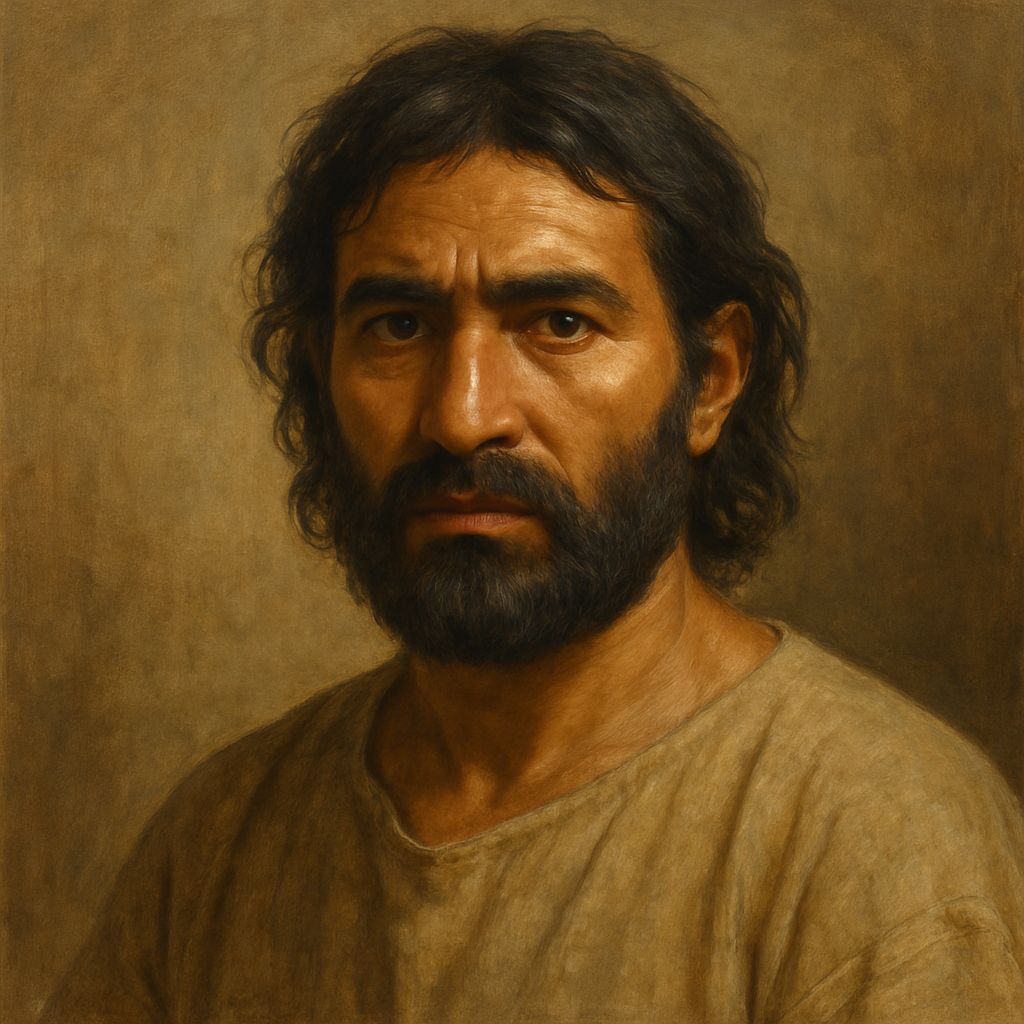
🧬 Genetic Profile of Individual I3346
Sample ID: I3346
Time Period: 707 CE – 888 CE (Early Medieval India)
Location: Roopkund Lake, India
Cultural Group: Roopkund Skeletons "Group A" – Individuals of clear South Asian genetic origin
Biological Sex: Male
🧭 Ancestral Lineages
Maternal Lineage (mtDNA): M30c
This mitochondrial haplogroup is deeply rooted in South Asia, especially India. It reflects a longstanding maternal ancestry in the subcontinent, tied to indigenous populations.
Paternal Lineage (Y-DNA): E-L795 (E-M84)
This Y-haplogroup originates from West Eurasia, particularly the Near East. It is part of the broader E1b1b lineage, more common in regions like the Levant, North Africa, and Southern Europe.
While uncommon in India, its presence here suggests some ancient or historical male-mediated gene flow from West Asia into the Indian gene pool, likely via migration or trade routes.
🧬 Autosomal DNA Ancestry
Individual I3346's autosomal DNA reflects a deeply South Asian ancestry, made up of three ancient components commonly found in people of the region:
Indigenous South Asian Hunter-Gatherer (AASI-like): ~52%
This represents the earliest population in India, long before farming and external contacts.
Caucasus/Iranian Farmer-related (CHG-like): ~32%
Tied to Neolithic farmers from the Caucasus and Iran, this ancestry arrived in South Asia through Indus Valley Civilization and later movements.
Ancient North Eurasian (ANE): ~17%
This ancestry is linked to ancient Siberians and later Steppe populations. It contributes to the "Steppe" signal often found in North Indian populations.
🧾 Interpretation: This individual shows a classic South Asian genetic structure, especially prominent in people from northwestern India and Pakistan, but also common across the subcontinent. The strong indigenous component shows deep regional roots.
🌍 Modern Population Affinities
Based on his DNA, I3346 is genetically closest to present-day South Asian groups, especially:
South Indians (e.g., Nair, Nasrani, Velama)
North Indians and Pakistanis (e.g., Gujarati, Punjabi)
Bengalis
This suggests widespread shared ancestry across the Indian subcontinent, particularly due to a common AASI base.
Some minor signals of West Eurasian ancestry (e.g., Armenian, Persian, Jewish, Balkan) appear in his genetic makeup. These are consistent with his Y-DNA origin and historical interactions (e.g., trade, migration, cultural exchange) between West Asia and South Asia.
🧠 Final Summary
Individual I3346 was a man of predominantly South Asian ancestry, with both his genetics and burial context (Roopkund Lake, Group A) confirming his regional identity.
His maternal lineage is entirely South Asian.
His paternal lineage traces back to West Asia, likely entering India through older migrations.
His autosomal DNA fits well with both ancient components of the Indian population and modern South Asian groups.
Despite a few traces of West Asian ancestry, his genetic makeup is overwhelmingly consistent with historical populations of the Indian subcontinent during the early medieval period.
This makes I3346 a good representative of the genetic diversity present in India at the time — rooted in the subcontinent, but not isolated from wider Eurasian history.
#AncientIndia #MedievalIndia #Roopkund #RoopkundSkeletons #SouthAsianHistory #AncientDNA #GeneticAnthropology #HistoricalPortrait #IndianGenetics #AncientPeoples #DNAReconstruction #HumanOrigins #AnthropologyArt #HistoricalGenetics #MedievalPortrait #GenomicHistory #LostHistories #Himalayas #RoopkundLake #Archaeogenetics

🚨🚨🚨 New paper
Genomes of the Golden Horde Elites and What They Reveal About the Mongol Empire
Overview
New genetic research into the remains of Golden Horde elites has uncovered fascinating details about who these powerful individuals were and how they fit into the larger story of the Mongol Empire. Their DNA shows a blend of East and West Eurasian ancestry, offering insight into the political, social, and familial strategies that helped build one of the largest empires in history.
Key Discoveries
A Mixed Heritage
Elite individuals from Golden Horde burials carried East Asian maternal lineages, particularly types like D4 and CZ. This suggests that many of their mothers were of Inner Asian origin. However, their paternal lineages told a different story: the Y-DNA of most male individuals came from the West Eurasian haplogroup R1b-M343. This combination of maternal East Asian and paternal West Eurasian ancestry reflects a history of intermarriage between Mongol leaders and local tribes of the western steppe. It’s a clear genetic signal of how the Mongol elite maintained power by forming strategic alliances across cultures.
Appearance and Identity
Despite carrying West Eurasian paternal DNA, the elites showed physical characteristics that matched historical descriptions of Mongol rulers—what would be classified today as East Asian or "Mongoloid" traits. This shows that cultural identity and appearance were not always tied to paternal ancestry in the way we might assume today.
Clues About Genghis Khan’s Line
For years, scientists believed Genghis Khan’s male-line descendants carried the Y-DNA haplogroup C3c. That lineage is still very common across Mongolia and Central Asia. But the discovery of R1b in Golden Horde elites raises the possibility that branches of the ruling family may have carried different lineages, especially in regions farther from Mongolia, like the western khanates. It could reflect the growing diversity within the empire's ruling elite as it expanded.
One specific male lineage, believed to be connected to Genghis Khan, has spread rapidly through generations. Today, it’s estimated that about 1 in every 200 men worldwide may carry this “super-Y” genetic signature—likely the result of elite males having many children over many generations.
A Diverse Elite
The Mongol ruling class was never a single ethnic group. The genetic evidence confirms that it was a mix of different peoples, echoing the empire’s multiethnic and multicultural structure. The Mongol Empire wasn’t just built through conquest—it was also held together by diplomacy, marriage, and integration.
A Lasting Legacy
Today, we can still see the traces of these elite lineages in modern populations. The R1b lineage is most common in Western Eurasia, while the older C3c line remains widespread in Mongolia and surrounding regions. These genetic echoes remind us that empires leave more than just ruins—they leave living legacies in the DNA of modern people.
Conclusion
The Golden Horde elites were far from being a closed, ethnically uniform group. Their mixed ancestry tells a story of empire built through union and negotiation, not just domination. This research reshapes our understanding of Mongol rulers—not as isolated conquerors, but as dynamic figures at the crossroads of East and West.
#MongolEmpire #GoldenHorde #AncientDNA #GenghisKhan #SteppeHistory #GeneticLegacy #EastAsianAncestry #R1b #C3c #YDNA #MongolRulers #HistoricalGenetics #EurasianHistory #DNAAnthropology #MedievalEmpires
Read the article
https://t.co/BLjUTCTRwl

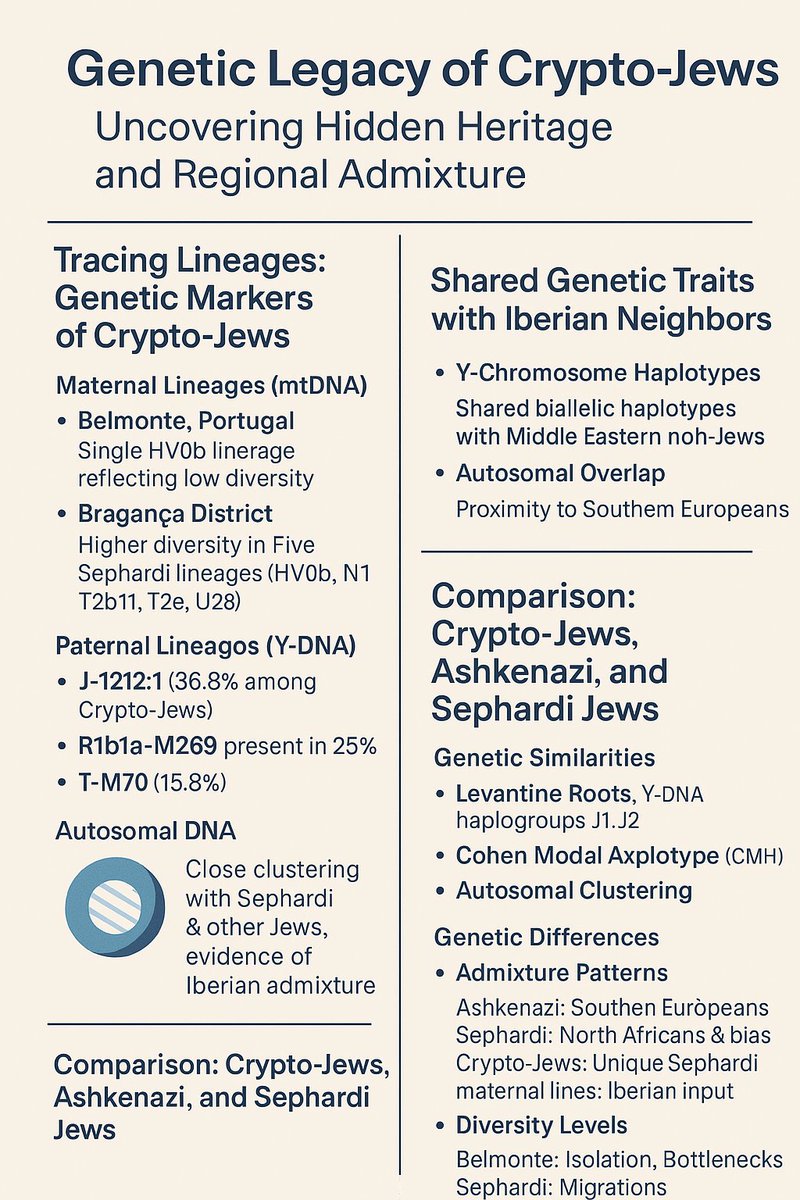
Genetic Legacy of Crypto-Jews: Uncovering Hidden Heritage and Regional Admixture
The Crypto-Jews—descendants of Sephardi Jews forced to convert to Christianity during the Spanish and Portuguese Inquisitions—carry with them unique genetic markers that tell a story of resistance, resilience, and adaptation. Genetic research has provided a clearer picture of their ancestral roots, connections to other Jewish groups, and the influence of centuries spent living among non-Jewish Iberian populations.
Tracing Lineages: Genetic Markers of Crypto-Jews
Maternal Lineages (mtDNA)
Mitochondrial DNA studies offer a snapshot of maternal ancestry:
Belmonte, Portugal: A strikingly low genetic diversity is found here, where a single mtDNA lineage (HV0b) dominates—reflecting generations of endogamy and isolation.
Bragança District: In contrast, Crypto-Jews here exhibit higher maternal diversity with five key Sephardi lineages (HV0b, N1, T2b11, T2e, U2e), suggesting a broader gene pool and less genetic bottlenecking.
Paternal Lineages (Y-DNA)
Y-chromosome analysis reveals ties to Jewish and Middle Eastern ancestry:
J-12f2.1: Found in 36.8% of Portuguese Crypto-Jews, this lineage is common in Middle Eastern Jewish populations—far more frequent than in the general Portuguese population (10.4%).
R1b1a-M269: Present in 25% of Belmonte Jews, this Western European haplogroup indicates regional admixture.
T-M70: Detected in 15.8% of Crypto-Jews but just 1.6% of the broader Portuguese populace.
These patterns reflect a blend of ancient Levantine roots and Iberian intermixing.
Autosomal DNA
Broader autosomal DNA studies show Crypto-Jews clustering closely with Sephardi and other Jewish populations of Middle Eastern origin, while also exhibiting signs of admixture with Iberian non-Jews—echoes of generations of coexistence.
Shared Genetic Traits with Iberian Neighbors
Due to centuries of intermixing, Crypto-Jews share some genetic features with surrounding non-Jewish populations:
Y-Chromosome Haplotypes: Shared biallelic haplotypes between Jews and Middle Eastern non-Jews indicate common ancestral origins in the Fertile Crescent.
Autosomal Overlap: Genetic similarities to Southern European groups (e.g., Italians, Sardinians) highlight the effects of regional proximity and integration.
Comparison: Crypto-Jews, Ashkenazi, and Sephardi Jews
While Crypto-Jews stem from the Sephardi tradition, they share ancestral threads with both Ashkenazi and Sephardi Jews.
Genetic Similarities
1. Levantine Roots: Common Y-DNA haplogroups (J1, J2) trace back to the ancient Levant.
2. Cohen Modal Haplotype (CMH): A paternal marker found across Jewish priestly lineages.
3. Autosomal Clustering: All three groups exhibit genetic closeness compared to their respective host populations.
Genetic Differences
1. Admixture Patterns:
Ashkenazi Jews show admixture with Southern Europeans like Italians and Greeks.
Sephardi Jews reflect ties to North African and Iberian gene pools.
Crypto-Jews retain Sephardi maternal lines but have distinct Iberian genetic input.
2. Diversity Levels:
Belmonte Crypto-Jews show reduced genetic variation due to isolation.
Ashkenazi Jews experienced genetic bottlenecks in medieval Europe.
Sephardi Jews boast broader genetic diversity due to historic migrations through North Africa and the Ottoman Empire.
Conclusion: A Legacy Written in Genes
The story of the Crypto-Jews is one of silent strength and survival. Despite forced conversions and centuries of secrecy, their genetic makeup reveals enduring links to their Sephardi origins and broader Jewish heritage.
These findings not only enrich our understanding of Jewish genetic diversity but also affirm the persistence of cultural identity—even when lived in the shadows. Crypto-Jews stand as a testament to the resilience of tradition, encoded in their very DNA.
On the other hand
Crypto-Jews in Arabia represent a unique chapter in Jewish history, shaped by forced conversions and cultural assimilation under Islamic rule. By the 6th and 7th centuries, significant Jewish communities thrived in Yemen and Hejaz, including tribes such as Banu Nadir and Banu Qurayza. The Himyarite Kingdom in Yemen even officially adopted Judaism in the 4th century. However, the rise of Islam led to persecution, with many Jews facing forced conversions, exile, or execution. For example, Yemenite Jews were coerced into Islam during the reign of rulers like 'Abd-al-Nabī ibn Mahdi in the late 12th century. Despite these challenges, some Jews secretly maintained their faith, creating Crypto-Jewish traditions akin to those seen in Iberia. Over time, many Arabian Jews assimilated into Muslim society, losing their distinct identity as Crypto-Jews. Today, their legacy is largely invisible, but it serves as a testament to resilience amidst adversity and the complex interplay between religion and culture in the region.
#CryptoJews #JewishGenetics #SephardiHeritage #GeneticAncestry #DNAandHistory #YDNA #mtDNA #JewishHistory #InquisitionSurvivors #HiddenJews #GeneticDiversity #CulturalIdentity #JewishDiaspora #HistoricalGenetics #MiddleEasternAncestry #RegionalAdmixture #Ashkenazi #Sephardi #BelmonteJews #BragançaJews
Trends for you
Most Popular Users

Elon Musk 
@elonmusk
240.1M followers

Barack Obama
@barackobama
118.6M followers

Cristiano Ronaldo
@cristiano
114.4M followers

Donald J. Trump
@realdonaldtrump
111.7M followers

Narendra Modi
@narendramodi
106.9M followers

Rihanna
@rihanna
98.6M followers

NASA
@nasa
92.1M followers

Justin Bieber
@justinbieber
91.7M followers

KATY PERRY
@katyperry
89.9M followers

Taylor Swift
@taylorswift13
83.9M followers

Lady Gaga
@ladygaga
75.4M followers

Virat Kohli
@imvkohli
73.3M followers

Kim Kardashian
@kimkardashian
70.8M followers

YouTube
@youtube
68.6M followers

Neymar Jr
@neymarjr
66.3M followers

Bill Gates
@billgates
65.2M followers

Selena Gomez
@selenagomez
63M followers

The Ellen Show
@theellenshow
62.1M followers

CNN
@cnn
61.7M followers

X
@x
60.6M followers