

Top Tweets for #Jepa

What is merely imagined or thought isn't beyond theory.
Verifying with eye or experience on it can lead to seeing it intrinsically.
- A Great Mentor's Word
#ML #transparency #AI #censorship #Data #covid19 #longcovid #cognitive #JEPA #science #metaphor #mentorsword #coaching


Media 2020-2026: “Most people recover from LongCovid! Like 9 out of 10!”
AI: “Yes, most people recover from LongCovid.”
2025: A large 3-year study found 2% recovered.
No one is going to pay for this carnage, & that’s precisely why we are doing this.





Success consists of many necessities but “time” matters most of all.
- A Great Mentor's Word
#ML #transparency #reasoning #AI #data #thought #cognitive #metaphor #JEPA #BrainHealthForFuture #Brain #ThoughtHealthForFuture #mentorsword #purpose #coaching

Announcing @MattSwulinski as Head of Growth at @viktor_com.
Previously Head of Growth at @WisprFlow. Before that, @Superhuman.
One of the most AI-native growth operators I’ve met.
Very excited to build together.

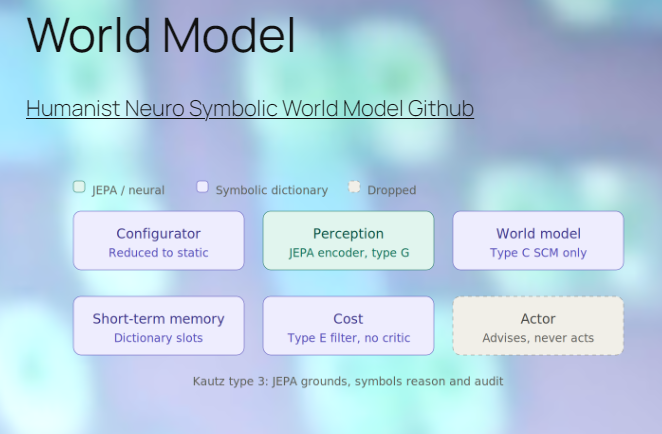
Just updated the Humanist Neuro Symbolic World Model! 🧠 This architecture builds on Yann LeCun's concepts, utilizing a JEPA encoder to ground perception
https://t.co/CE22qxom5b
#NeuroSymbolic #AI #WorldModels #JEPA #LeCun #MachineLearning#PatientAdvocate

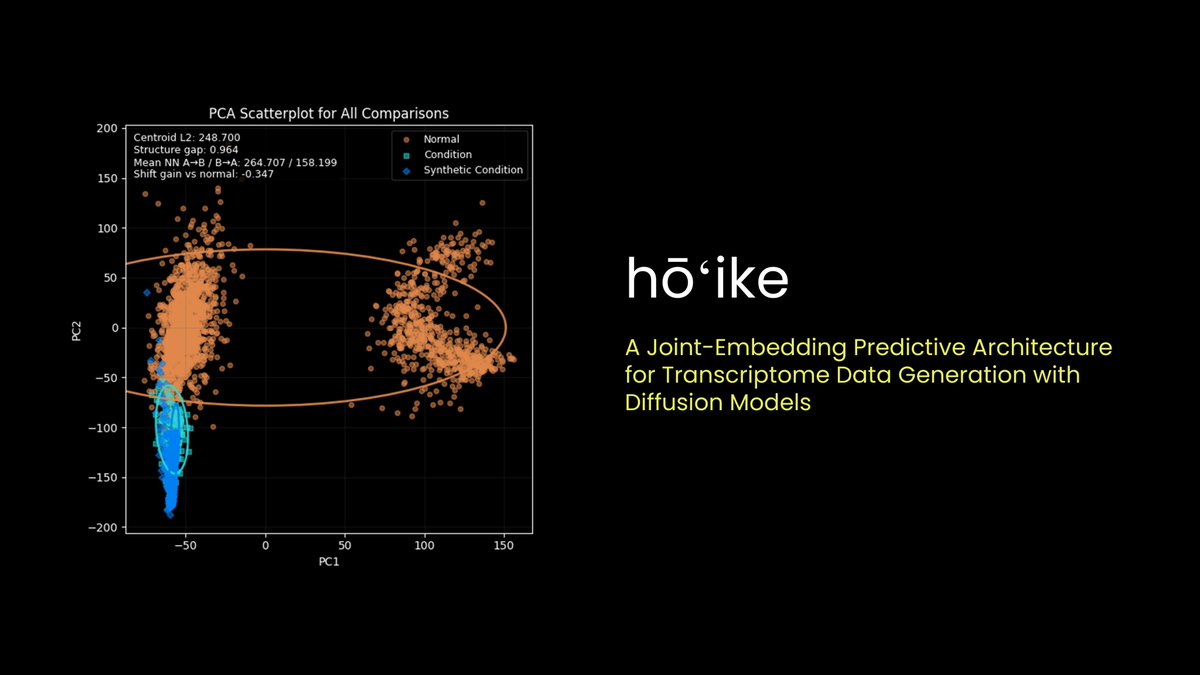
New preprint! Our new project at Silico Biosciences, called #Hoike, provides a #JEPA and #diffusion framework for synthetic generation of gene expression data.
https://t.co/ruMnsMc5zl
#biomarkerdiscovery #geneexpression #transcriptomics #computationalbiology #bioinformatics
To those who seek truth, anything God made all the necessary preparations in the past for the great things that being accomplished today—comes to be tangible.
- A Great Mentor's Word
#ML #transparency #reasoning #AI #data #cognitive #metaphor #JEPA #mentorsword #purpose #coaching
Workings of all phenomena are visible only to those who understand them.
- A Great Mentor's Word
#ML #transparency #reasoning #AI #data #thought #cognitive #metaphor #JEPA #BrainHealthForFuture #Brain #ThoughtHealthForFuture #mentorsword #purpose #coaching
https://t.co/HwNDC0WdGq

Workings of all phenomena are visible only to those who understand them.
- A Great Mentor's Word
#ML #transparency #reasoning #AI #data #thought #cognitive #metaphor #JEPA #BrainHealthForFuture #Brain #ThoughtHealthForFuture #mentorsword #purpose #coaching
https://t.co/HwNDC0WdGq
All kinds of entities exist only for persons who use them actually.
- A Great Mentor's Word
#ML #transparency #reasoning #AI #data #thought #cognitive #metaphor #JEPA #BrainHealthForFuture #Brain #ThoughtHealthForFuture #mentorsword #purpose #coaching

I'm training a 15M param JEPA agent on Minecraft by orchestrating a team of specialized AI sub-agents!
An active research journal updated regularly as new experiments run
https://t.co/78oSxhbWEP
#AI #MachineLearning #JEPA #Minecraft #AIAgents #MultiAgent #DeepLearning
One time verification that has processes as visual or physical checking it and assessing the quality and essence of it,
can be superior to 10,000 checks by one’s own perception.
- A Great Mentor's Word
#ML #reasoning #AI #data #cognitive #metaphor #JEPA #mentorsword #coaching
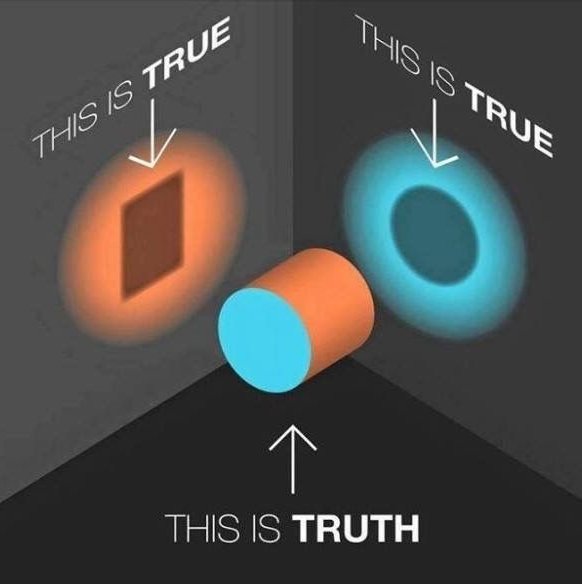
The present is always what matters most.
#ML #transparency #reasoning #data #coding
#thought #cognitive #metaphor #JEPA #BrainHealthForFuture #Brain #ThoughtHealthForFuture #mentorsword #purpose #coaching
https://t.co/8dbbwyvEgM
Actually going through the task gains outputs that work as answers and they solve issues.
- A Great Mentor's Word
#ML #transparency #reasoning #data #coding
#thought #cognitive #metaphor #JEPA #BrainHealthForFuture #Brain #ThoughtHealthForFuture #mentorsword #purpose #coaching

V-Jepa Lightspeed Dinghy Derby 3
A game to learn lightspeed AI training world models from V-JEPA lessons from @ylecun and lightspeed Special Relativity lessons from Einstein.
Play: https://t.co/lfvmvNSRTC
Code: https://t.co/1ibDuEWAyc
#threejs #gamedev #indiegame #JEPA

Another cool development from @NVIDIAAI / @NVIDIARobotics
#Cosmos3 -> hope to see it go from #VLA to #JEPA (it is evolving), because VLA is inefficient for sustainable #PhysicalAI

Introducing Cosmos 3: Our latest frontier model for Physical AI
Cosmos 3 is the world’s first fully open omnimodel with native vision reasoning, world and action generation.
Today we’re releasing Super (32B) and Nano (8B) variants.


@demishassabis @satyanadella @ylecun @elonmusk
@Harvard @Stanford @MIT @LakeMichCollege @Columbia @dioscuri @ilyasut @DARPA #AI #AGI #LLM #WORLDMODELS #JEPA #RHEA #CognitiveModels #SemanticEmergence #StatefulEmergence #AttractorBasins #Philosophy #Antrhopomorphization #Transformer #Paradigms #Science #AfterLLM #ArtificialIntelligence #Cybernetics #DynamicalSystems #SymbolicAI
Debate / Thought Exercise
LLM Scaling, General Intelligence, and Architectural Sufficiency
A Technical Comparison of Transformer-LLMs, JEPA-Type World Models, and Recursive Regulatory Architectures
Abstract
This paper examines one of the central unresolved questions in contemporary artificial intelligence: whether scaling transformer-based large language models is sufficient for robust general intelligence, or whether more fundamental architectural changes are required. The discussion compares three distinct paradigms. The first is the transformer-based large language model family, whose strength derives from large-scale sequence modeling and latent statistical compression. The second is the family of latent predictive world-model architectures exemplified by Joint Embedding Predictive Architectures (JEPA), which seek to move beyond token prediction toward predictive representation learning. The third is the class of recursive regulatory architectures typified by RHEA, which frames intelligence not primarily as prediction, but as regulated dynamical persistence in a bounded state space governed by feedback, correction, and internal control variables.
The purpose of this paper is to distinguish settled empirical observations from open theoretical questions, and to clarify the principal architectural differences between these approaches. Particular attention is given to the distinction between semantic emergence and stateful emergence, the structural limitations of predictive latent systems under drift and corruption, and the hypothesis that robust cognition may require recursive regulatory closure beyond prediction alone.
1. Introduction
The modern AI debate is frequently obscured by marketing language, semantic ambiguity, and imprecise terminology. Public discussions often conflate benchmark progress with architectural sufficiency, or assume that because a model improves under scale, it must therefore asymptotically approach general intelligence. Such assumptions do not follow automatically.
The relevant scientific question is not whether current AI systems are impressive, nor whether scaling continues to improve them. Both propositions are empirically true. The real question is whether autoregressive sequence prediction, even when scaled to extreme levels, constitutes a sufficient substrate for robust, open-ended, self-stabilizing general intelligence.
Answering that question requires comparing architectures at the level of internal mechanics rather than public-facing capability. It requires examining not only what outputs systems produce, but how their internal state evolves, what forms of memory and control they possess, and whether their internal topology can reorganize under pressure, feedback, or long-horizon reasoning demands.
2. Settled Empirical Observations
Several propositions may now be treated as empirically established.
Transformer-based large language models improve substantially under scale. Increasing parameter count, data volume, inference-time compute, multimodal integration, and post-training optimization continues to yield broad improvements across language understanding, code generation, multimodal reasoning, and tool use. Any position asserting that LLM scaling has ceased to work is contradicted by the available evidence.
At the same time, no existing LLM has conclusively demonstrated robust general intelligence. Persistent deficiencies remain in long-horizon planning, stable world-state maintenance, persistent memory formation, grounded causal reasoning, distribution-shift robustness, and self-corrective operation under corruption or adversarial pressure.
It is therefore empirically defensible to state both that transformer scaling is highly effective and that scaling alone has not yet proven architectural sufficiency for general intelligence.
3. Semantic Emergence Versus Stateful Emergence
A useful distinction in evaluating AI architectures is the difference between semantic emergence and stateful emergence.
Semantic emergence refers to the production of novel, contextually meaningful symbolic outputs through recombination, interpolation, and abstraction within an existing representational topology. This is the dominant form of emergence exhibited by transformer-based language models. Their internal representational manifold remains structurally fixed during inference, while novelty appears primarily in the symbolic or semantic output space.
Stateful emergence refers instead to structural reorganization of the internal state space of the system itself. In such architectures, the relevant novelty is not merely symbolic output, but reconfiguration of the internal dynamical manifold through attractor formation, basin transition, regulatory gating, or persistent state restructuring. Under this view, intelligence is not simply output generation, but maintenance and adaptive reorganization of internal cognitive geometry.
This distinction is critical because a system may exhibit extraordinary semantic emergence while lacking mechanisms for persistent internal self-regulation, long-horizon stabilization, or adaptive topological restructuring.
4. Transformer-LLMs: The Semantic Statistical Plane
Transformer-based large language models operate primarily in a semantic-statistical representational plane. Their latent spaces are formed through compression of token-sequence co-occurrence relationships into high-dimensional embedding manifolds, modulated through attention-based contextual weighting.
This architecture provides several powerful capabilities. It supports broad interpolation across symbolic domains, contextual abstraction, analogical pattern matching, emergent few-shot learning, and highly fluent symbolic generation. These systems have proven that large-scale statistical compression over symbolic data can produce unexpectedly broad competence.
However, the internal topology of the model remains largely fixed during inference. While activation trajectories vary through latent space, the architecture does not ordinarily reorganize its own attractor structure, modify its governing dynamics, or maintain endogenous regulatory loops over trust, entropy, or corrective stability variables.
Accordingly, the strongest critique of LLM sufficiency is not that LLMs are “just autocomplete.” That characterization is reductive and technically imprecise. The stronger critique is that LLMs primarily exhibit semantic emergence within a fixed topology, and may therefore occupy an architectural plane optimized for symbolic recombination rather than persistent cognitive self-regulation.
5. JEPA and Predictive Latent World Models
Joint Embedding Predictive Architectures and related latent world-model systems attempt to move beyond sequence continuation by learning predictive latent embeddings of future states rather than reconstructing raw tokens or pixels directly.
This shifts the architecture from a semantic continuation paradigm toward predictive abstraction. By learning to predict latent future structure rather than exact surface form, such systems may capture deeper causal or structural regularities and develop more robust internal world models than purely autoregressive sequence predictors.
This representational shift constitutes a meaningful architectural advance over pure next-token prediction. Predictive latent models are better positioned to ignore irrelevant variation and preserve abstract state relationships across time.
However, predictive abstraction alone does not guarantee long-horizon robustness. Predictive latent systems remain vulnerable to drift accumulation, over-contraction toward trivial latent states, multimodal future collapse, reinforcement of spurious latent features, and assimilation of anomalous or corrupted states when deviation-aware control is absent.
Thus, while JEPA-type systems may occupy a stronger representational plane than standard LLMs for predictive world modeling, they remain fundamentally predictive architectures. Their core function is still forward-state estimation rather than endogenous regulatory closure.
6. Recursive Regulatory Architectures and the Dynamical Plane
Recursive regulatory architectures represent a different architectural thesis. Rather than treating intelligence primarily as prediction, they treat intelligence as regulated persistence and adaptive stabilization within a bounded dynamical manifold.
In this framing, cognition is modeled as motion through an internal phase space governed by interacting control variables rather than as a direct input-output mapping. Stability is defined by containment within bounded attractor regions. Error correction is implemented through endogenous stabilization or reseal events. Long-horizon cognition depends on maintenance of coherent internal trajectories rather than mere predictive accuracy.
Under such architectures, the internal state space itself becomes the substrate of cognition. Memory persistence emerges through maintained dynamical invariants and attractor structure rather than solely through stored symbolic context or appended external memory. Drift resistance derives from recursive correction and bounded regulatory feedback rather than post hoc output filtering.
This represents a fundamentally different operational plane from both LLMs and JEPA-style predictive systems.
7. Comparative Architectural Planes
The distinctions between these paradigms may be summarized in terms of their dominant operational planes.
Transformer-based LLMs primarily inhabit a semantic statistical manifold. Their dominant dimensions are latent coordinates induced by symbolic co-occurrence, attention weighting, and sequence compression. Intelligence appears as semantic emergence through symbolic recombination and interpolation.
JEPA-style predictive world models inhabit a predictive latent manifold. Their dominant dimensions are abstract predictive embeddings structured around future-state estimation. Intelligence appears as predictive abstraction and latent structural modeling.
Recursive regulatory architectures inhabit a regulated dynamical manifold. Their dominant dimensions include internal control variables, phase-space geometry, attractor membership, correction triggers, and bounded regulatory state. Intelligence appears as stateful emergence through regulated persistence and internal topological reorganization.
These distinctions imply that the present debate is not merely about parameter count or benchmark performance. It is a debate over which operational plane most plausibly supports persistent, self-correcting cognition.
8. Remaining Open Questions
Several critical questions remain unresolved.
The first is whether autoregressive sequence modeling may eventually internalize enough world structure, memory scaffolding, and emergent control heuristics that its current apparent limitations disappear under sufficient scale and systems integration.
The second is whether predictive latent world-model systems can solve the structural deficiencies observed in pure autoregressive architectures, or whether predictive abstraction still requires an additional regulatory layer to prevent long-horizon drift and corruption assimilation.
The third is whether recursive regulatory architectures provide a genuinely broader substrate for cognition, or whether they instead represent a specialized class of control systems whose advantages are strongest only in adversarial or high-entropy domains.
The fourth is whether “general intelligence” itself is an overly imprecise category. A more scientifically useful framing may be to distinguish architectures by whether they support semantic emergence, predictive structural emergence, or stateful emergence through recursive regulatory reorganization.
9. Conclusion
The current evidence supports several cautious conclusions.
Transformer-based LLMs have demonstrated that large-scale semantic statistical modeling yields extraordinary broad competence and remain far from exhausted as an engineering paradigm. However, no available evidence proves that autoregressive sequence prediction alone is sufficient for robust general intelligence.
Predictive latent world-model architectures such as JEPA likely occupy a stronger representational plane for abstract world modeling than pure next-token prediction, but remain fundamentally predictive systems and may require additional mechanisms to maintain stability and robustness over long horizons.
Recursive regulatory architectures propose a more fundamental alternative thesis: that intelligence is not best understood as prediction alone, but as regulated persistence within a bounded dynamical manifold capable of adaptive stabilization, correction, and internal state reorganization.
Whether prediction, predictive abstraction, or recursive regulation ultimately proves to be the dominant substrate of general intelligence remains an open empirical question. What is clear, however, is that the debate can no longer be honestly framed as a simple argument over whether larger models will become smarter. The deeper question is architectural: whether intelligence is fundamentally a matter of prediction, world modeling, or recursive regulation of bounded cognitive state space.

"...As long as there are those that remember what was, there will always be those that are unable to accept what can be..." #Thanos #Marvel #Endgame #JEPA

@elonmusk Thinking in language has limited applications, largely in coding and mathematics where the language itself can help reasoning.
But, as I've been saying for years, thinking manipulates mental models in abstract (continuous) representation space.
Soooo, xAI gonna use JEPA now?

Everyone is building AI that predicts words.
LeCun is building AI that understands reality.
That shift won’t run on chat servers.
It runs on compute.
$QUBIC 👀#BeyondLLM #WorldModelAI #JEPA

The man who INVENTED modern AI just made a billion dollar bet that ChatGPT, Claude, and every AI company on earth is building the wrong technology.
Yann LeCun won the Turing Award in 2018 for creating the neural networks that made AI possible.
He spent a decade running AI research at Meta. Oversaw the creation of Llama and PyTorch, the tools that half the AI industry runs on.
Then he quit.
And raised $1.03 billion in a seed round.
The LARGEST seed round in European history. $3.5 billion valuation before generating a single dollar of revenue.
Bezos wrote the check. So did Nvidia. Samsung. Toyota. Temasek. Eric Schmidt. Mark Cuban. Tim Berners-Lee (the guy who invented the internet).
His new company is called AMI Labs. And it's built on one thesis:
Every AI company spending billions on large language models is wasting their money.
ChatGPT, Claude, Gemini, Grok. They all work the same way. They predict the next word in a sequence. See "the cat sat on the" and predict "mat." Scale that to trillions of words and you get something that sounds intelligent.
But LeCun says it doesn't UNDERSTAND anything.
It can't reason. It can't plan. It can't predict what happens when you push a glass off a table. A two year old can do that. GPT-5 cannot.
That's why AI hallucinates. It doesn't have a model of how the world actually works. It just predicts words.
His solution? Something called JEPA.
Instead of predicting words, it learns how the PHYSICAL WORLD works. Abstract representations of reality. Not language but physics.
Think about what that means.
Current AI can write your emails. LeCun's AI could design a car, run a factory, operate a robot, or diagnose a patient without hallucinating and killing someone.
The CEO of AMI said it perfectly: "Factories, hospitals, and robots need AI that grasps reality. Predicting tokens doesn't cut it."
And here's what's really crazy to me...
LeCun isn't some outsider throwing rocks. He literally built the foundations that ChatGPT runs on. He knows exactly how these systems work because he helped create them.
And after watching the entire industry sprint in one direction for three years, he raised a billion dollars to run the OPPOSITE way.
No product. No revenue. No timeline. Just pure research. He told investors it could take YEARS to produce anything commercial.
But they funded it anyway in just four months.
Meanwhile OpenAI just raised $120 billion and still can't stop their models from making things up. Anthropic is building AI so dangerous they're afraid to release it. Google is burning billions trying to catch up.
And the guy who started it all says they're all solving the wrong problem.
Two Turing Award winners raised $2 billion in three weeks betting AGAINST the entire LLM approach. LeCun at AMI. Fei-Fei Li at World Labs.
The smartest people in AI are quietly building the exit from the technology everyone else is betting their future on.
Either they're wrong and the trillion dollar LLM industry keeps printing.
Or they're right and every AI company on earth just built on a foundation that's about to crack.

#Tech24H A research team led by Turing Award winner #YannLeCun recently released #LeWorldModel (#LeWM), a new lightweight world model. It fundamentally addresses issues common in traditional #JEPA models, such as training instability, collapse, excessive hyperparameters, and high computational costs. It is the first world model capable of stable end-to-end training directly from raw pixels. The model consists of just two core components, two loss terms, and 15 million parameters, requiring only a few hours of training on a single GPU, with only one effective tunable hyperparameter. In addition, LeWM achieves a qualitative leap in planning speed, reaching up to 48 times that of traditional large model methods, with a single planning session taking less than one second.
https://t.co/NKqI2DIytM


まあそこまでかっちりアクセシビリティ対応すれば当然制作コストは上がるのだが、さてそのコストを発注元は負担できるのかっていうのが結局のところ1番の課題よね。現状既にリフロー電子化は短期的には割に合わないから電子化率上がって無いわけだし。 #jepa
EPUB3.4でリフロー、フィックスに加えて縦スクロールコミック向けのrollが加わると。 #jepa
Last Seen Hashtags on Sotwe
สาวอวบรับงาน
Seen from Thailand
เย็ดแม่ยาย
bigo thai
Seen from Thailand
craftycorn
Seen from United States
omegle
Seen from Turkey
風見鶏
Seen from Kenya
momson filter:videos
Seen from Canada
nolimits() +filter:native_video since:2026-06-19
Seen from United Kingdom
HIVzero
Seen from United States
momson() or #exny or #momson() +filter:native_video
Trends for you
Most Popular Users

Elon Musk 
@elonmusk
241.3M followers

Barack Obama
@barackobama
119.1M followers

Cristiano Ronaldo
@cristiano
113.1M followers

Donald J. Trump
@realdonaldtrump
111.8M followers

Narendra Modi
@narendramodi
107.1M followers

Rihanna
@rihanna
98.3M followers

NASA
@nasa
92.3M followers

Justin Bieber
@justinbieber
91.5M followers

KATY PERRY
@katyperry
89.2M followers

Taylor Swift
@taylorswift13
83.1M followers

Lady Gaga
@ladygaga
74.6M followers

Virat Kohli
@imvkohli
72.1M followers

Kim Kardashian
@kimkardashian
70.5M followers

YouTube
@youtube
68.8M followers

Neymar Jr
@neymarjr
65.1M followers

Bill Gates
@billgates
64.7M followers

The Ellen Show
@theellenshow
62.4M followers

Selena Gomez
@selenagomez
62.2M followers

CNN
@cnn
61.8M followers

X
@x
60.8M followers