

Top Tweets for #LandmarkGuidedBlock

"A Landmark-Guided Superficial Cervical Plexus Block"
#CervicalPlexusBlock
#SuperficialCervicalPlexusBlock
#LandmarkGuidedBlock
#EDRA
My 10 Points:
1. Anatomy and Target:
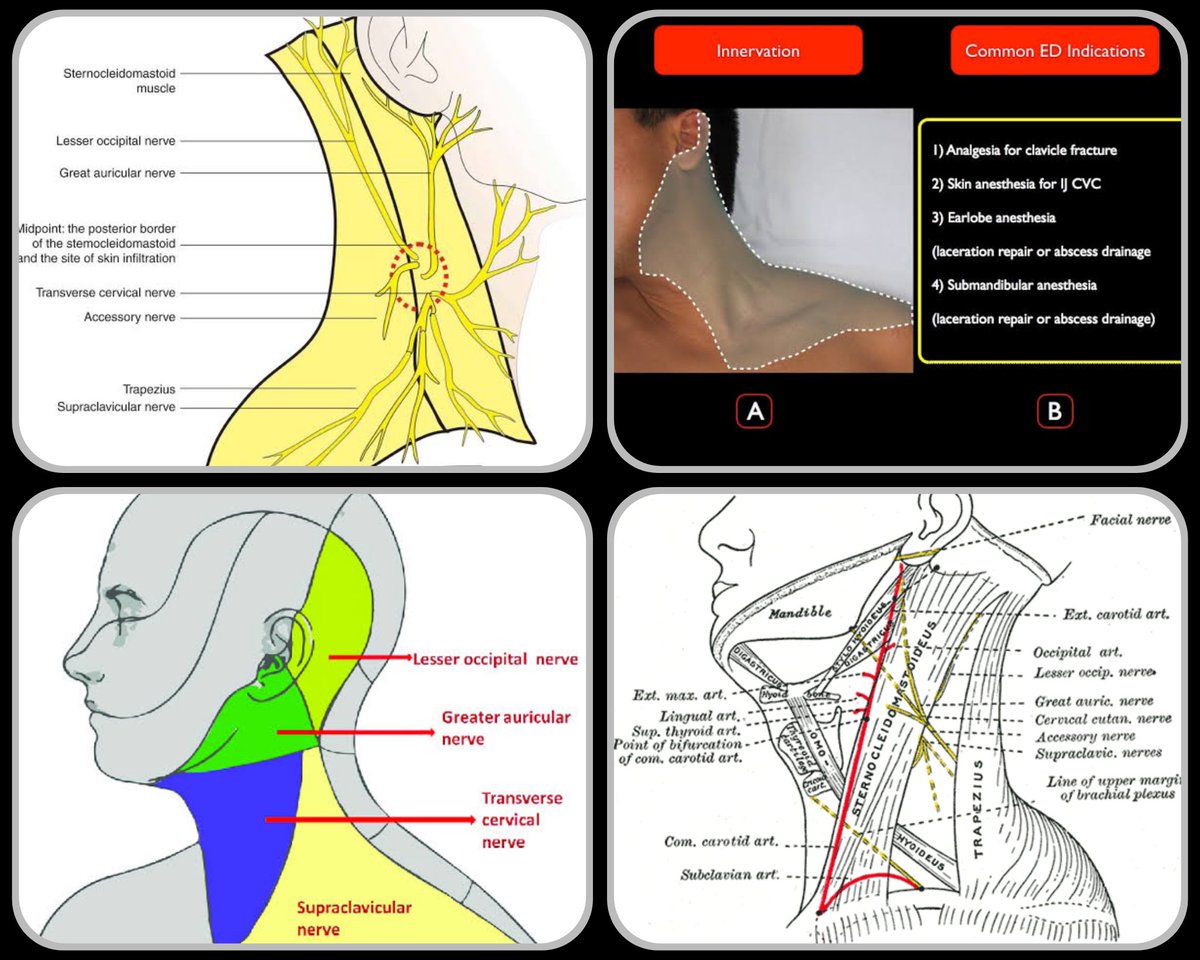
Cervical plexus is formed by Anterior Rami of C1-C4.
Divided into superficial cervical plexus (Sensory), and Deep Cervical Plexus (Motor).
Since C1 is purely motor, it dies not contribute to superficial cervical plexus.
Rarely, C1 carries sensations from the dura of foramen Magnus thru it's Meningeal branch.
https://t.co/EeO94DyEjc
The superficial cervical plexus is formed by the ventral rami of the C2-C4 spinal nerves.
This block targets the superficial branches of the cervical plexus, which provide sensory innervation to the skin of the anterolateral neck, the clavicular region, and parts of the ear.
2. Indications:
This block is used for procedures such as carotid endarterectomy, cervical lymph node biopsy, superficial neck surgeries, pain management for clavicle fractures, as a supplementary block for scalp, shoulder and clavicle sx.
3. Patient Positioning:
The patient is usually positioned supine with the head turned slightly to the opposite side of the block to expose the neck.
4. Landmark Identification:
The key landmarks include the posterior border of the sternocleidomastoid (SCM) muscle at the level of the C4 vertebra (approximately at the midpoint of the SCM) and the external jugular vein, which runs superficially over the SCM.
Midpoint of SCM also known as *Erb's Point* of Neck or *Nerve Point* of Neck or *Punctum Nervosum* .
5. Technique:
The needle is inserted at the midpoint of the posterior border of the SCM muscle. After negative aspiration to confirm that the needle is not in a blood vessel, local anesthetic is injected in a fan-like distribution to ensure coverage of the target nerves.
6. Local Anesthetic:
Commonly used local anesthetics include lidocaine, bupivacaine, or ropivacaine. The choice/Type/Volume depend on the desired duration of anesthesia. It's sensory block, so diluted LA is sufficient.
7. Volume of Anesthetic:
Typically, 5-10 mL of local anesthetic is used. Adequate volume ensures diffusion to the branches of the cervical plexus.
8. Efficacy:
When performed correctly, this block provides effective anesthesia and analgesia for the target areas, reducing the need for systemic analgesics and their associated side effects.
9. Advantages:
The superficial cervical plexus block is relatively simple to perform, has a rapid onset, and involves minimal equipment. It also preserves motor function, making it suitable for procedures where patient cooperation is necessary.
10. Risks and Complications:
Potential risks include inadvertent intravascular injection, local anesthetic systemic toxicity (LAST), infection at the injection site, hematoma formation, and transient nerve injury. Proper technique and vigilance can minimize these risks.
This technique, while effective and useful, requires a thorough understanding of neck anatomy and careful execution to ensure safety and efficacy.


Trends for you
Most Popular Users

Elon Musk 
@elonmusk
241.2M followers

Barack Obama
@barackobama
119.1M followers

Cristiano Ronaldo
@cristiano
112.8M followers

Donald J. Trump
@realdonaldtrump
111.8M followers

Narendra Modi
@narendramodi
107.1M followers

Rihanna
@rihanna
98.2M followers

NASA
@nasa
92.2M followers

Justin Bieber
@justinbieber
91.4M followers

KATY PERRY
@katyperry
88.9M followers

Taylor Swift
@taylorswift13
82.8M followers

Lady Gaga
@ladygaga
74.3M followers

Virat Kohli
@imvkohli
71.8M followers

Kim Kardashian
@kimkardashian
70.4M followers

YouTube
@youtube
68.8M followers

Neymar Jr
@neymarjr
64.7M followers

Bill Gates
@billgates
64.6M followers

The Ellen Show
@theellenshow
62.4M followers

Selena Gomez
@selenagomez
62M followers

CNN
@cnn
61.8M followers

X
@x
60.8M followers