

Top Tweets for #LearningStylesMyth

Learning Styles: 2025 Review of 17 Meta-Analyses Puts the Matching Effect Near Zero
#CognitivePsychology #EducationResearch #LearningScience #LearningStylesMyth #MetaAnalysis
https://t.co/JfgPYda66d


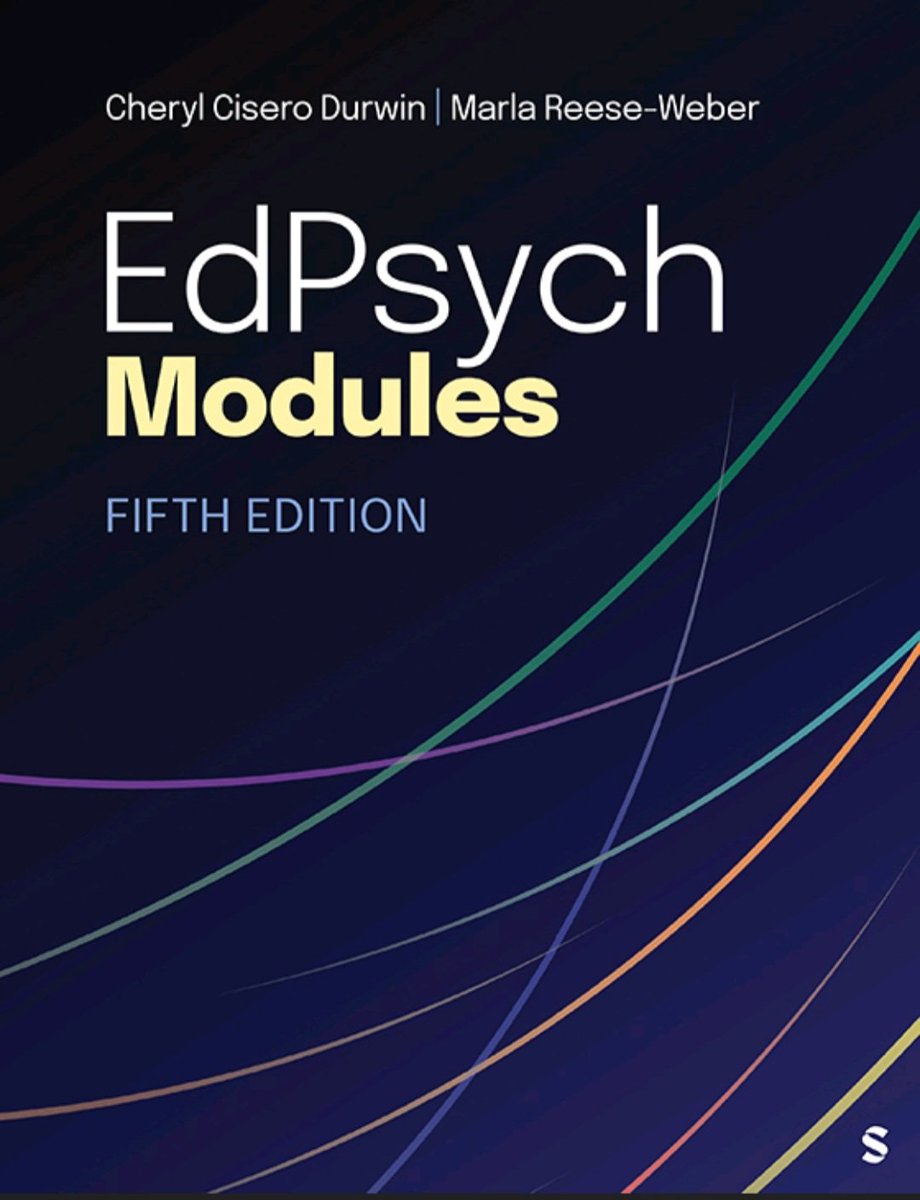
This is why I will continue to cover the #learningstylesmyth in #EdPsychModules published by @SageEducation.


This is why I will continue to cover the #learningstylesmyth in #EdPsychModules published by @SageEducation.


The education system has been lying to you since second grade.
You think you're a visual learner? Or a hands-on learner?
You're not.
"Learning styles" are a myth.
The #learningstylesmyth in a nutshell. Thanks, @justinskycak.
We debunk this myth and others in #EdPsychModules, 5e (@SageEducation ).


There’s a common myth that goes like this: “everybody has the same cognitive horsepower and learns at the same rate, but different people learn differently depending on their preferred learning style.”
In reality, the exact opposite is true. Different people generally have different working memory capacities and learn at different rates. While people may have preferred learning “styles” (e.g. visual vs verbal), they do not actually learn better when given information in their preferred style.
The myth is that different people need the same amount of practice but in different forms – whereas the reality is that different people need the same form of practice but in different amounts.
This is why I will continue to cover the #learningstylesmyth in #EdPsychModules published by @SageEducation.


There is no such thing as a "visual learner."
While students may have learning style *preferences* (e.g., visual vs. verbal), they do not actually learn better when receiving information via their preferred learning style.
This has been empirically tested over and over again. But despite having countless stakes driven through the heart, the myth continues to rise up from the grave like an unkillable zombie. It is the educational equivalent of astrology.
To get ahead of the a common follow-up confusion:
Q: "But math topic XYZ clicked for me when I saw an image/diagram!"
A: What you're thinking of is matching instructional design to the content, not matching teaching style to the learner.
Lots of math topics benefit from images/diagrams regardless of what the learner might claim is their learning style.
Yes, an image/diagram may help you learn a particular math topic. That doesn't mean you are a visual learner.
What it means is that the particular information being taught is effectively communicated through an image/diagram. For everybody, not just for you.
What you're experiencing is that you learn better when the instructional design is properly tailored to the information being taught.
From the bottom-left reference in the screenshot, "How Learning Happens" by @P_A_Kirschner and @C_Hendrick:
"How do you explain to a pupil in an auditory way how crimson red and brick red look? Or how do you kinaesthetically explain how a blackbird sings? In other words, it's actually the subject matter and the learning goal that should determine how one teaches and not a preference or a non-existent learning style."

@Apatim56 @MrDanielBuck To answer your question @Apatim56, here's an explanation of the #learningstylesmyth from #EdPsychModules. Hope this is helpful.


This is why it is important for #teacher #education programs to minimally require a course in #educationalpsychology, and why I will continue to include the #learningstylesmyth in #EdPsychModules (@SageEducation).


@P_A_Kirschner @dylanwiliam The majority of the teachers in my workshop this week said they thought learning styles were real and important. https://t.co/fRKyZNKbzu

Don't forget #ISTElive that learning styles are a myth...
although AI is giving it a comeback... sigh. Don't let your AI tell you about learning styles!
#LearningStylesMyth #AIteacher

There is no such thing as “learning styles.” 🎓
Students benefit from more testing. 📝
Information that is harder to learn is retained longer. 🧠
Sound controversial? Come check out the evidence. 👀
https://t.co/u7kavT7wDP
This is why I will continue to include #learningstyles as a #myth in #EdPsychModules published by @SageEducation. The #learningstylesmyth never dies! Thanks, @Dale_Chu, for the reminder!


Learning styles, ‘I’m not a math person,’ and being bad at tests—they’re all part of the same mythological family. Comforting. Intuitive. And wrong.

This is why I will continue to include #learningstyles as a #myth in #EdPsychModules published by @SageEducation. The #learningstylesmyth never dies!


Part of the reason the Learning Styles myth is so persistent is that it seems intuitively true: people are different, so they probably learn in different ways.
But, if we want schools to run on intuition alone, we can stop referring to teaching as a profession.
Education cannot run on ‘feels’ alone.
It hasn't even been a month since my last re-post on the #learningstylesmyth!
This is why I will continue to include #learningstyles as a #myth in #EdPsychModules published by @SageEducation. The #learningstylesmyth never dies! 🤦♀️


What the blazes just tuned in to @LBC and they are talking about Learning Styles
Bunch of teachers calling in about how important a theory it is
Sake
This is why I will continue to include #learningstyles as a #myth in #EdPsychModules published by @SageEducation. The #learningstylesmyth never dies!


🚫 Labeling students as “hands-on learners” (or any learning style) can limit how they're taught, what they believe they can do, and what they actually learn. @carlhendrick.substack.com highlights new research exposing the harm caused by the learning styles myth. Link below.

Once again, this is why I will continue to include #learningstyles as a #myth in #EdPsychModules published by @SageEducation. The #learningstylesmyth never dies! Great piece below by @C_Hendrick, and thanks for sharing the new article!


Once again, matching teaching to learning styles has near-zero impact on student achievement. I've noticed a resurgence of the learning styles myth recently so this new study is timely. 🧵 ⬇️

Great thread by @SciInTheMaking.
This is why I will continue to cover the #learningstylesmyth in #EdPsychModules published by @Sage_Publishing . 5th ed out in Jan 2025.

Why do schools keep chasing every new educational trend when decades of proven research already show us what works? 🧵⬇️
This is why I will continue to cover the #learningstylesmyth in #EdPsychModules published by @Sage_Publishing .


@C_Hendrick Forget 20yrs ago. Learning styles were in my teacher training these past 2 years 😳
Yes! Making progress!
"When you see they finally took 'will teach to student learning styles' out of your teacher evaluation."
This is why I will continue to cover the #learningstylesmyth in #EdPsychModules.


When you see they finally took 'will teach to student learning styles' out of your teacher evaluation.
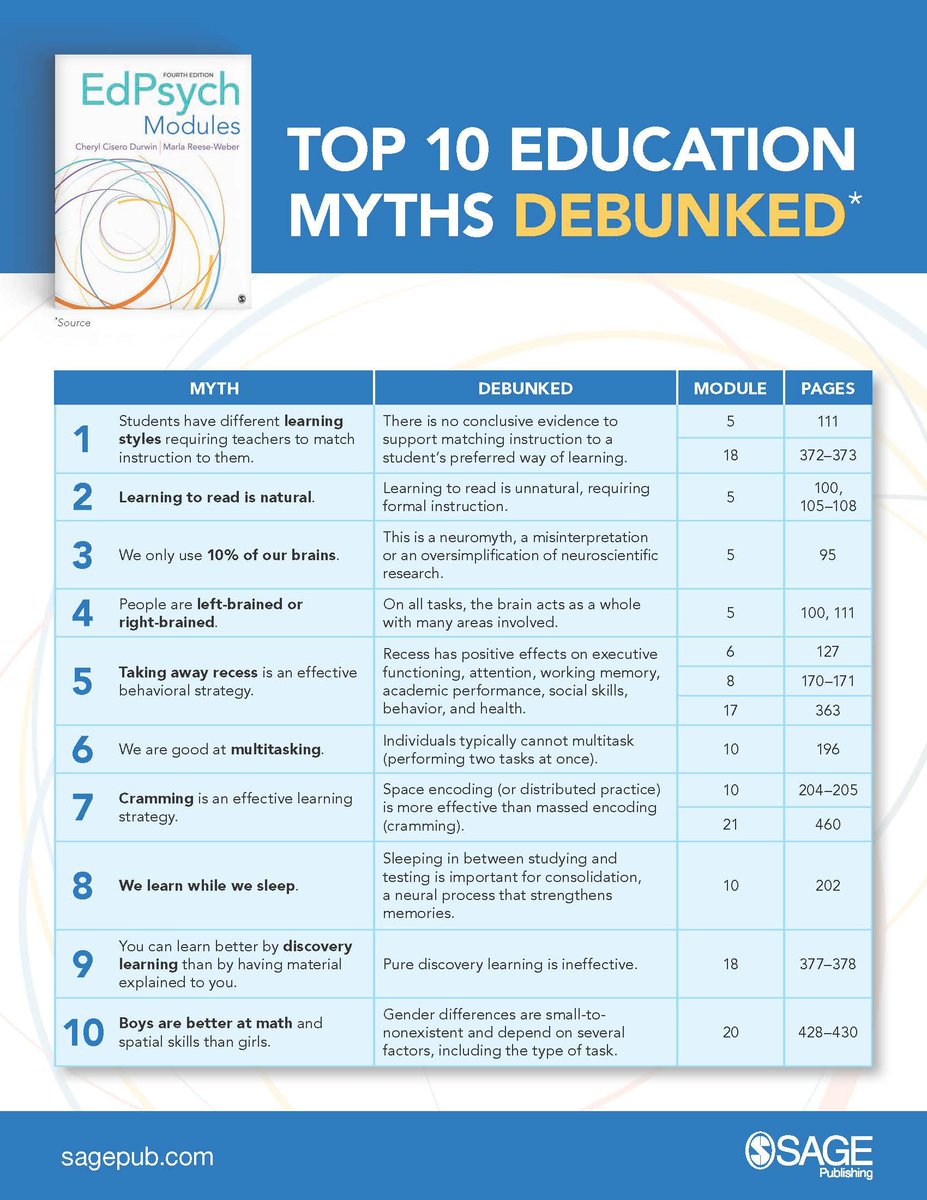
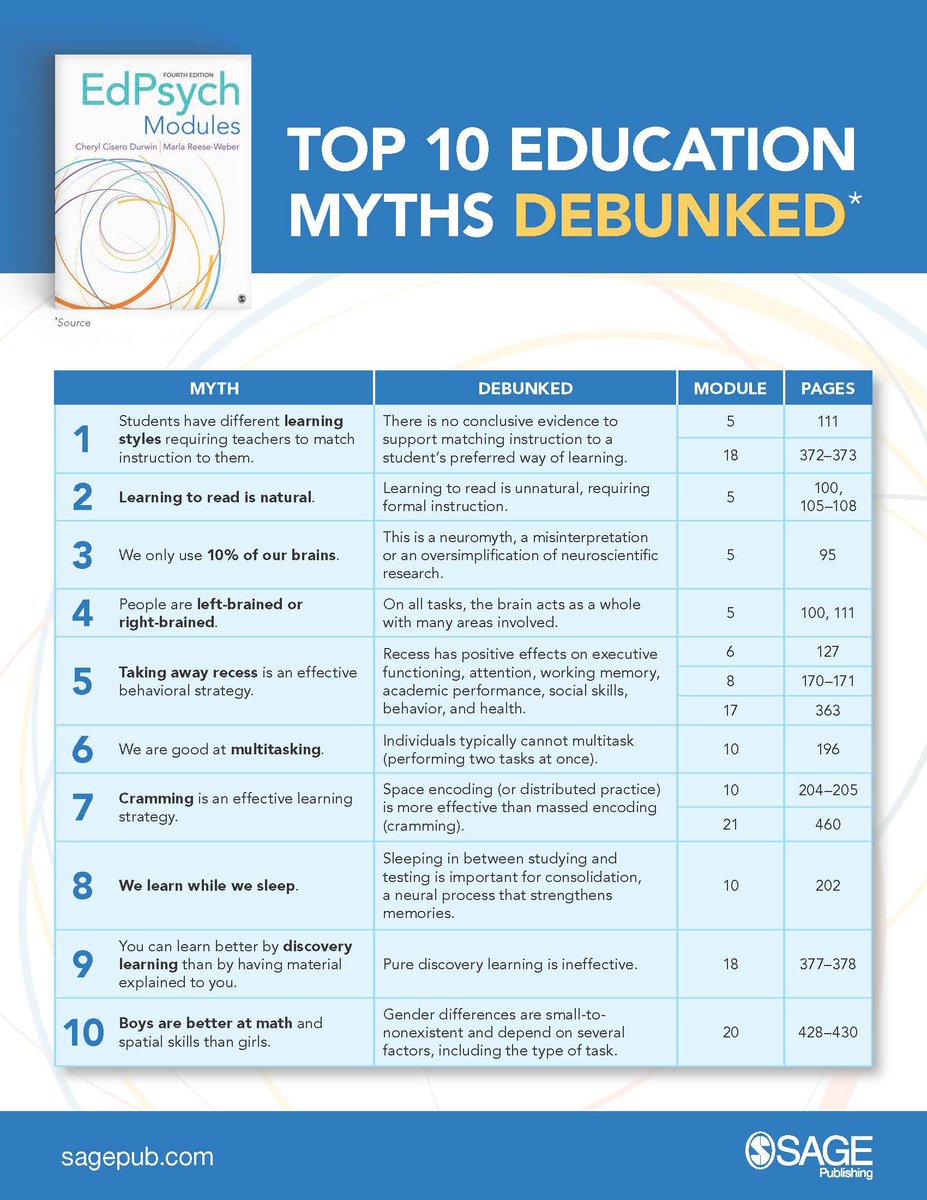
This is why I'll continue to include the #learningstylesmyth in #EdPsychModules. #1 on my list of #edumyths. As @justinskycak states below: the kernel of truth is that people have learning preferences, but matching instruction to the preference doesn't result in better learning
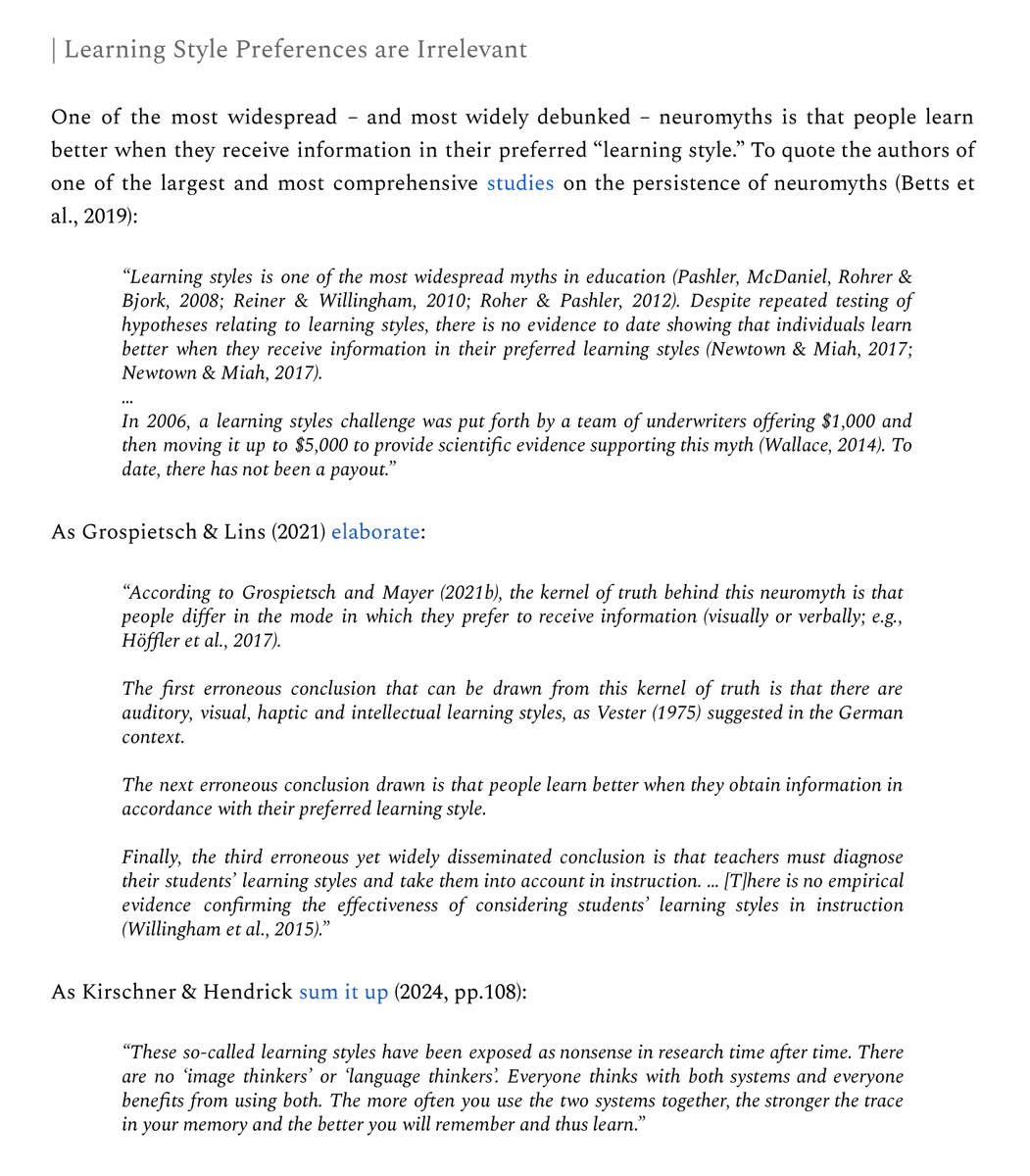
"Learning styles" is one of those myths that has been scientifically debunked over and over again --
yet people not acquainted with the scientific literature continually conjure it up from the grave like a zombie.
The "kernel of truth" is that people differ in the mode in which they prefer to receive information --
but it turns out that people do NOT learn any better when they obtain information via their preferred mode of consumption.
So, as far as actual learning is concerned, the kernel of truth is irrelevant.
Here's a relevant snippet from Chapter 7. Myths & Realities about Individual Differences in The Math Academy Way: https://t.co/Pri8OdO5vR
This is why I will continue to include the #learningstylesmyth in #EdPsychModules. Agree with @burnsmk1 that #learningstyles is likely the most harmful myth in all of #education. That's why it's #1 on my list below.


A guest on @dpshow just mentioned learning styles. Listeners, learning styles ARE MYTHS. They could be the biggest and most harmful myth in all of education.
From Mayer: "Until there is a supportive evidence base, it is best to be skeptical of recommendations to individualize instruction based on learning style."
This is why I continue to include the #learningstylesmyth in #EdPsychModules. My PSA as we begin a new academic year.

This is a brilliant visualisation from Rich Mayer:
"If the learning style principle were correct, you would expect visualizers to perform better on a test after studying a visually based lesson whereas verbalizers should perform better on a test after studying a verbally based lesson—as shown in the graph on the left. In contrast, when Laura Massa and I conducted just such a study, we found results that were more like the graph on the right side of the figure—both verbalizers and visualizers did about the same with a verbally based lesson and both did about the same with a visually based lesson. Like many other studies on the visualizer-verbalizer style dimension, there was no evidence to support the learning style principle. Until there is a supportive evidence base, it is best to be skeptical of recommendations to individualize instruction based on learning style."

Great summary of cognitive psych findings applied to learning. Some highlights: #learningstylesmyth, space encoding, #retrievalpractice, #explicitinstruction, #automaticity, #deliberatepractice.
We cover all this in #EdPsychModules (5th ed out Jan 2025).
Which cognitive psychology findings are solid, that can be used to help students learn better?
In education research, there have been a number of instances where a purported scientific discovery turned out not to be true. “Learning styles,” anyone?
Unfortunately, but understandably, many educators have come to distrust scientific findings about education as a whole – and this is compounded by an ongoing replication crisis in psychology.
But here’s the thing: sure, many findings don’t hold up, but also, many findings do.
For instance: we know that actively solving problems produces more learning than passively watching a video/lecture or re-reading notes.
This sort of thing has been tested scientifically, numerous times, and it is completely replicable. It might as well be a law of physics at this point.
In fact, a highly-cited meta-analysis (https://t.co/w8NHNtlADE) states, verbatim:
"...[C]alls to increase the number of students receiving STEM degrees could be answered, at least in part, by abandoning traditional lecturing in favor of active learning. ... Given our results, it is reasonable to raise concerns about the continued use of traditional lecturing as a control in future experiments."
So there you go, that’s one cognitive psychology finding that holds up: active learning beats passive learning.
(To be clear: active learning doesn’t mean that students never watch and listen. It just means that students are actively solving problems as soon as possible following a minimum effective dose of initial explanation, and they spend the vast majority of their time actively solving problems – and by “vast majority” I mean, like, 90%, not 60%.)
Another finding: if you don’t review information, you forget it.
You can actually model this precisely, mathematically, using a forgetting curve (https://t.co/z5gC18TJfc).
I’m not exaggerating when I refer to these things as laws of physics – the only real difference is that we’ve gone up several levels of scale and are dealing with noisier stochastic processes (that also have noisier underlying variables).
Okay, but aren’t these findings obvious? Yes, but…
- Yes, but in education, obvious strategies often aren't put into practice. For instance, plenty of classes that still run on a pure lecture format and don't review previously learned unless it's the day before a test.
- Yes, but there are plenty of other findings that replicate just as well but are not so obvious.
Here are some less obvious findings.
1. The spacing effect (https://t.co/b31dit9hlL): more long-term retention occurs when you space out your practice, even if it's the same amount of total practice.
As researcher Doug Rohrer states (https://t.co/osM9w2oXZa): "...[T]he spacing effect is arguably one of the largest and most robust findings in learning research, and it appears to have few constraints."
Note: There are tons of more detailed scientific references/quotes I want to include, but I'm going to skip them so not to continue blowing up the length of this already-gigantic post.
If you want to see them, here's a draft I'm working on that covers all these findings (and more) with hundreds of references and relevant quotes pulled out of those references: https://t.co/dBBUDdQao9
2. A profound consequence of the spacing effect is that the more reviews are completed (with appropriate spacing), the longer the memory will be retained, and the longer one can wait until the next review is needed.
This observation gives rise to a systematic method for reviewing previously-learned material called spaced repetition (https://t.co/T1K7Or2ww7) or distributed practice (https://t.co/QgexnEEoIJ). A "repetition" is a successful review at the appropriate time.
3. To maximize the amount by which your memory is extended when solving review problems, it's necessary to avoid looking back at reference material unless you are totally stuck and cannot remember how to proceed.
This is called the testing effect (https://t.co/Pp6rBo10Qv), also known as the retrieval practice effect: the best way to review material is to test yourself on it, that is, practice retrieving it from memory, unassisted.
4. The testing effect can be combined with spaced repetition to produce an even more potent learning technique known as spaced retrieval practice (https://t.co/4YGmIuPuFC).
5. During review, it's also best to spread minimal effective doses of practice across various skills.
This is known as mixed practice (https://t.co/8XX5dP6JLL) or interleaving (https://t.co/9lcs86srGo) -- it's the opposite of "blocked" practice, which involves extensive consecutive repetition of a single skill.
Blocked practice can give a false sense of mastery and fluency because it allows students to settle into a robotic rhythm of mindlessly applying one type of solution to one type of problem.
Mixed practice, on the other hand, creates a "desirable difficulty" that promotes vastly superior retention and generalization, making it a more effective review strategy.
6. To free up mental processing power, it's critical to practice low-level skills enough that they can be carried out without requiring conscious effort. This is known as automaticity (https://t.co/5QjK8NKy2J).
Think of a basketball player who is running, dribbling, and strategizing all at the same time -- if they had to consciously manage every bounce and every stride, they'd be too overwhelmed to look around and strategize.
The same is true in math. I wrote more about the importance of automaticity here: https://t.co/66jqHRRCQG
7. The most effective type of active learning is deliberate practice (https://t.co/P5Cmw5Ew40), which consists of individualized training activities specially chosen to improve specific aspects of a student's performance through repetition (effortful repetition, not mindless repetition) and successive refinement.
However, because deliberate practice requires intense effort focused in areas beyond one's repertoire, which tends to be more effortful and less enjoyable, people will tend to avoid it, instead opting to ineffectively practice within their level of comfort (which is never a form of deliberate practice, no matter what activities are performed).
I wrote more about deliberate practice here: https://t.co/MhR5BkIYqn
8. Instructional techniques that promote the most learning in experts, promote the least learning in beginners, and vice versa. This is known as the expertise reversal effect (https://t.co/8ExvKSD7LJ).
An important consequence is that effective methods of practice for students typically should not emulate what experts do in the professional workplace (e.g., working in groups to solve open-ended problems). Beginners (i.e. students) learn most effectively through direct instruction.
I wrote more about that here: https://t.co/jlRE0HWXfv
Last Seen Hashtags on Sotwe
bop
Seen from United States
brosis()()()()()()()()()(())()()()()() filter:videos
Seen from United States
somalitakeover
wataa
Seen from Germany
midnightspiderman
Seen from Brazil
BNWOLifestyle
Seen from United States
orianistas
Seen from Italy
같이즐겨용
Seen from Korea
filipinamilf
Seen from Singapore
monkeyflash
Seen from United States
Most Popular Users

Elon Musk 
@elonmusk
240.6M followers

Barack Obama
@barackobama
118.7M followers

Cristiano Ronaldo
@cristiano
114.5M followers

Donald J. Trump
@realdonaldtrump
111.9M followers

Narendra Modi
@narendramodi
107M followers

Rihanna
@rihanna
98.7M followers

NASA
@nasa
92.2M followers

Justin Bieber
@justinbieber
91.8M followers

KATY PERRY
@katyperry
90M followers

Taylor Swift
@taylorswift13
84M followers

Lady Gaga
@ladygaga
75.5M followers

Virat Kohli
@imvkohli
73.4M followers

Kim Kardashian
@kimkardashian
70.8M followers

YouTube
@youtube
68.7M followers

Neymar Jr
@neymarjr
66.4M followers

Bill Gates
@billgates
65.2M followers

Selena Gomez
@selenagomez
63.1M followers

The Ellen Show
@theellenshow
62.1M followers

CNN
@cnn
61.7M followers

X
@x
60.6M followers