

Top Tweets for #MBCDataWeek

Today is our last day of #MBCDataWeek which looked at some of the very early work coming out of the NAoMe work to hopefully finally enable the identification of MBC data, treatment and interventions in NHS data sets.
At the highest level, our aim as MBC patients is still ‘stuck’ at step one; needing to be counted. De Novo is the only data being reported robustly so far, but sadly that’s only around 5-10% of all MBC patients. Until the NHS is able to accurately identify all living with Metastatic/Secondary Breast Cancer we can’t proceed to more fine-grained data improvements around sub types, diagnostic and drug interventions, measuring outcomes and identifying areas for improvement.
Thank you for all of the questions and feedback we have received this week. We will be passing this back to the NAoMe team for follow up. In terms of actions for us, on behalf of all MBC patients, we will be seeking:
- Greater clarification for patients on what the expected timeline is for resolution of identifying recurrent MBC patients (the majority of MBC patients).
- What action are Trusts obliged to take to improve their data recording and how can patients understand what is happening locally in their area. NAoMe asking patients ‘to ask if they are being counted’ is too simplistic. They might be on an excel spreadsheet maintained by the MBC clinical nurse specialist in their Trust but that is not the same as data being accurately recorded in NHS systems used nationality.
- What are the consequences for lack of action by a Trust. As data collection has been mandatory for over 10 years and it hasn’t been done, what is different now?
- Clarification on the objective to report on patients dying within 30 days of chemo. Is the aim to not treat patients that closely to death, if so, will this have implications on access to treatment. This can be particularly important for younger patients who can transition from successful treatment to end of life quickly.
- How long does the audit continue for and will the work be handed over to the NHS data organisations in England and Wales to continue to be produced/reports, maintain completeness and add further improvements such as type of breast cancer.
- Can the NAoMe audit do ‘lives’ on socials in order for patients to ask questions (we are going to talk to @breastcancernow about organising this with us when the next State of the Nation Report is released.
Please do get in touch on socials if you have a question about NAoMe that you would like put to the audit team.
#MBCdata #NAoMe #NATCAN #METUPUK #DarkerPink #BusyLivingWithMets #IAmThe31 #BreastCancer #BreastCancerCommunity #BreastCancerJourney #BreastCancerSupport #DyingForACure #MetastaticBreastCancer #SecondaryBreastCancer #SecondarySisters #Stage4NeedsMore #StageIVNeedsMore #AdvancedBreastCancer

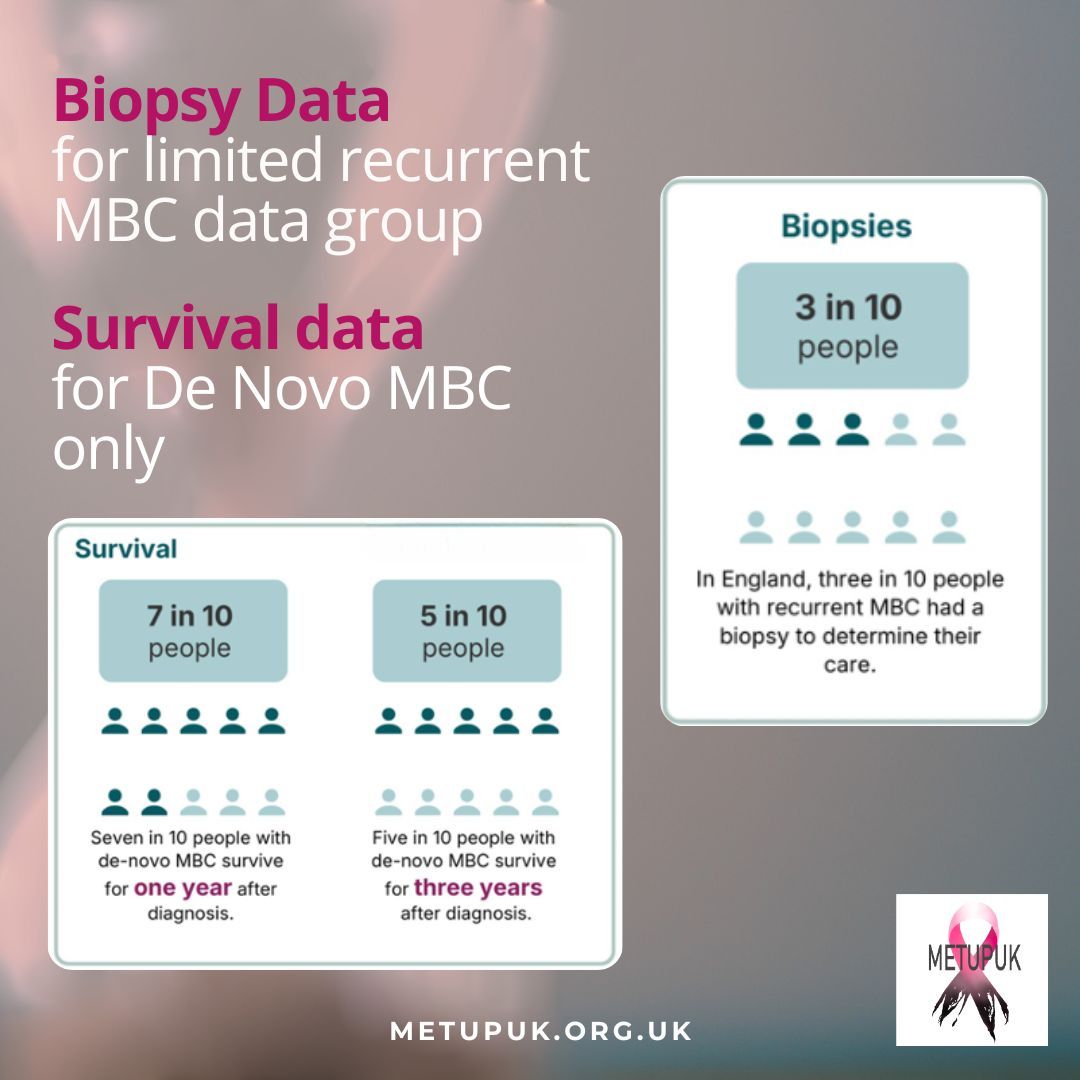
Our penultimate day for #MBCDataWeek and we are focusing on both biopsy and survival analysis that has come out of the NAoMe.
Biopsies are something that METUPUK are passionate about educating patients. The number of women we’ve met who had poorer outcomes due to investigations not taking place when an MBC diagnosis happens. Not knowing if their MBC is HER2 or hormone driven, has additional genetic markers or has flipped again during the MBC pathway. From the small amount of recurrent MBC data that NAoMe is able to use, only 30% has a biopsy recorded. This information could not be derived for Wales in the data available. The site of the biopsy could also not be determined from the data available. It is an aspiration of the NAoMe that this analysis informs a target for biopsy of metastatic disease. We also want to explore with NAoMe if the biopsy data is only looking at diagnosis or whether recorded at each progression during MBC.
The survival stats for de novo MBC were 70% 1 yr survival and 50% survival at 3 years after diagnosis (between 2019 and 2021). We don’t have breakdown by age or subtype at this stage and obviously no meaningful recurrent MBC data, which is the majority. Because this partly covers the pandemic period there may be unusual patterns.
As the NAoME doesn’t include anyone diagnosed before 2015 across all of the analysis (which excludes a few of us at METUPUK), we will still be missing the full picture, particularly those who are long term survivors and analysis on what makes them so! NAoMe aims to report on survival rates by tumour type in future reports so watch this space.
#MBCdata #NAoMe #NATCAN #METUPUK #DarkerPink #BusyLivingWithMets #IAmThe31 #BreastCancer #BreastCancerCommunity #BreastCancerJourney #BreastCancerSupport #DyingForACure #MetastaticBreastCancer #SecondaryBreastCancer #SecondarySisters #Stage4NeedsMore #StageIVNeedsMore #AdvancedBreastCancer
As we head into Friday of our #MBCDataWeek, the picture doesn’t get much better. The NAoMe State of the Nation report section on MDT discussion gives an even bleaker picture. Data is only possible for de novo patients and there is poor data availability for Wales. In Wales, only 6% of de novo MBC patients were reported as having their care discussed at an MDT meeting. Unfortunately, the data did not allow for distinguishing if an MDT discussion did not occur or whether the date was not recorded.
Wales moving to a new Cancer IT system has played a significant part in disrupting data.
Again, due to low data completeness, there is no analysis of MDT discussions for those with recurrent MBC. One of the NAoMe recommendations is to ensure MDT discussion for de novo and recurrent MBC. It has been a NICE Quality Standard since 2016, so it’s disappointing that 9 years on data completeness is poor as well as the actual MDT discussion rates.
For any of you who remember the Welsh Dragon Tassia Haines you may already know that most of her last year was spent campaigning to ensure that accurate data collection was happening across Wales, in order to feed into the NAoMe audit. We anecdotally know that there are inequalities in care for Welsh MBC patients and accurately know the CNS situation as Tass’ campaigning brought about more CNS nurses, funded by Macmillan. This far into the NAoMe audit and patients are concerned that Wales is being left behind even further without data to benchmark and plan to improve patient outcomes. 30% of de novo patients not supported by a CNS shows how much further basic access needs to be improved. Note that the NAoMe question is not specifically for dedicated secondary breast care nurses which is a key area of expertise.
#MBCdata #NAoMe #NATCAN #METUPUK #DarkerPink #BusyLivingWithMets #IAmThe31 #BreastCancer #BreastCancerCommunity #BreastCancerJourney #BreastCancerSupport #DyingForACure #MetastaticBreastCancer #SecondaryBreastCancer #SecondarySisters #Stage4NeedsMore #StageIVNeedsMore #AdvancedBreastCancer

Halfway through our #MBCDataWeek and we are digging down into treatment data to see what’s behind the infographics for NAoMe. The timeframe this data applies to is 2019-2021. Any data from 2020-21 overlaps with the covid-19 pandemic when the NHS was under pressure. All data collected during the pandemic must be treated with caution.
Looking at the incompleteness of data, only patients with de-novo MBC living in England were included in the CDK4/6 inhibitor and anti-HER2 treatment infographics. No patients in Wales and no patients at all with recurrent breast cancer (which is the majority). We know MBC is different in de-novo patients compared to recurrent patients from studies in other countries. On average de-novo patients do better than recurrent patients.
The chemotherapy infographic includes patients from England and Wales with de-novo MBC. It also includes some patients from England with recurrent breast cancer (where data was available). Because the recurrent data is so incomplete that it cannot be trusted. Why? Because we do not know if there was a selection bias to explain why some recurrent patients were counted and others were not.
On a positive note, the infographic for HER2-positive MBC is what we would expect. Around 8/10 patients received anti-HER2 treatment, with rates highest in younger patients and lower in the elderly.
For CDK4/6 inhibitors only 4/10 patients were recorded. We would expect this to be higher now. At the time of data collection the treatment was new and only available at first line. Low uptake could be explained by:
· Patients ineligible because they have received too many treatment lines
· Oncologists not wanting to use a treatment which suppresses immunity during the Covid pandemic
Only 4/10 patients were recorded as receiving chemotherapy. We would expect this to be higher, particularly in younger patients. However, in patients with ER-positive MBC chemo is less effective than hormonal treatments so it isn’t always used.
Reference: den Brok, W.D., Speers, C.H., Gondara, L. et al. Survival with metastatic breast cancer based on initial presentation, de novo versus relapsed. Breast Cancer Res Treat 161, 549–556 (2017). https://t.co/q6ud7GmLSn
#MBCdata #NAoMe #NATCAN #METUPUK #DarkerPink #BusyLivingWithMets #IAmThe31 #BreastCancer #BreastCancerCommunity #BreastCancerJourney #BreastCancerSupport #DyingForACure #MetastaticBreastCancer #SecondaryBreastCancer #SecondarySisters #Stage4NeedsMore #StageIVNeedsMore #AdvancedBreastCancer

Today for #MBCDataWeek we are looking at tumour and grade data in the first NAoMe State of the Nation Report. The infographics only look at de novo patients as recurrent MBC data was not possible (you’ll notice this is a running theme this week!) We were shocked in particular by the missing data for HER2 status, particularly given the number of treatment lines there are for HER2+. Although we appreciate that no data might infer ‘negative’, the lack of data completion is a concern for the audit. The elephant in the room when this was discussed was the categories not there; HER2 Low. Given that there are clinical trials for HER2Low as well as Enhertu available as a treatment line (if you live in Scotland), not having it as a category was shocking for METUPUK.
Understanding tumour characteristics is critical to improving our outcomes. Where is the data on flipped disease? METUPUK know anecdotally from our own volunteers and supporters that many patients do flip receptors during their MBC treatment pathway, going from once HER2+ and/or ER+ to loosing that sensitivity over time for one or both. Currently there isn’t a data journey to see how many patients end up HER2 Low or triple negative despite where they started as an MBC patient.
#MBCdata #NAoMe #NATCAN #METUPUK #DarkerPink #BusyLivingWithMets #IAmThe31 #BreastCancer #BreastCancerCommunity #BreastCancerJourney #BreastCancerSupport #DyingForACure #MetastaticBreastCancer #SecondaryBreastCancer #SecondarySisters #Stage4NeedsMore #StageIVNeedsMore #AdvancedBreastCancer

Last Seen Hashtags on Sotwe
ixlii()
Seen from United States
hotwife
Seen from Turkey
ometv bitch
teenage #nolimit()()
Seen from Turkey
nolimit() nolimit filter:native_video
Seen from Spain
kartaltravesti
Seen from United States
NationPlay
Seen from Austria
momson
Seen from Indonesia
เย็ดสาวโรงงาน
Seen from Thailand
VirüsSınavaSığar
Most Popular Users

Elon Musk 
@elonmusk
240.6M followers

Barack Obama
@barackobama
119.2M followers

Donald J. Trump
@realdonaldtrump
111.7M followers

Cristiano Ronaldo
@cristiano
110.5M followers

Narendra Modi
@narendramodi
107M followers

Rihanna
@rihanna
97.6M followers

NASA
@nasa
92.2M followers

Justin Bieber
@justinbieber
90.9M followers

KATY PERRY
@katyperry
87.6M followers

Taylor Swift
@taylorswift13
81.5M followers

Lady Gaga
@ladygaga
73M followers

Virat Kohli
@imvkohli
69.8M followers

Kim Kardashian
@kimkardashian
69.8M followers

YouTube
@youtube
68.7M followers

Bill Gates
@billgates
63.9M followers

Neymar Jr
@neymarjr
62.6M followers

The Ellen Show
@theellenshow
62.4M followers

CNN
@cnn
61.9M followers

X
@x
60.8M followers

Selena Gomez
@selenagomez
60.7M followers