

Top Tweets for #MXNet

推荐一波学习AI的资源:
吴恩达教授主讲,内容涵盖神经网络、CNN、RNN 等
https://t.co/qCiIyN9iQB
基于 PyTorch 和 MXNet 的深度学习实践课程
https://t.co/6WCf4uwM1n
李宏毅教授的深度学习课程,内容深入浅出
https://t.co/Wof5ijyDva
适合机器学习初学者的入门课程
https://t.co/06Mf4S7bdV
提供深度学习、加速计算、数据科学等领域的开发培训
https://t.co/D9snqDve9t
斯坦福大学的深度学习课程,专注于计算机视觉和卷积神经网络(CNN)
https://t.co/Rtx6D6dXca
由 Andrew Ng 主讲的经典机器学习课程,涵盖监督学习、非监督学习和其他基本概念
https://t.co/mTmID4jY7a
基于 PyTorch 的深度学习快速入门课程,旨在让每个人都能快速实践深度学习
https://t.co/oug7qoOPAP
Udacity 提供的深度学习计算机视觉课程,教授如何使用 PyTorch 实现图像分类、目标检测等任务
https://t.co/mFL7RcOevZ
Udacity 的深度学习纳米学位课程,覆盖神经网络、卷积神经网络、生成对抗网络(GAN)等内容
https://t.co/sR6OJtvVy3
斯坦福大学的深度学习自然语言处理课程,重点讲解如何利用深度学习技术进行文本处理和分析
https://t.co/LHjG4pZ3CH
edX 上的 TensorFlow 深度学习课程,适合想要学习使用 TensorFlow 进行深度学习的开发者
https://t.co/q3BYGSK7Xl
https://t.co/MNxKBUIpFR 提供的在线课程,面向开发者,通过实践讲解深度学习的核心概念和应用
https://t.co/oug7qoOPAP
麻省理工学院的深度学习入门课程,涵盖基本的深度学习概念、卷积神经网络、生成对抗网络等
https://t.co/5Huu1u0v1h
Udemy 上的 R 语言数据科学和机器学习课程,适合想用 R 进行机器学习的开发者
https://t.co/L0vLMe0i4T
吴恩达教授的人工智能入门课程,旨在为没有技术背景的人提供 AI 基础知识。
https://t.co/8DYteWtFcX


MXNet - The Cloud Veteran
Amazon’s deep learning framework. Supports both symbolic (static) and imperative (dynamic) programming, flexible yet efficient.
Use when: building large-scale deep learning systems for the cloud.
Avoid if: you prioritize ease of use over performance tuning.

The Problem with Open-Source AI
Today
You’ve probably seen open-source AI projects launch with hype… then fade into silence.
Why does this keep happening? Let’s break it down.
First, capabilities.
Most projects stop at releasing a model. No agents, no data integration, no compute scale.
Example: GPT-J (EleutherAI, 2021). Big buzz, but stalled without infra around it.
Second, monetization.
Builders get no rewards for their work.
Example: Mycroft, the open-source voice assistant. Great idea, but no monetization → shut down in 2023.
Third, funding.
Donations and goodwill can’t sustain AGI-level infra.
Example: Apache MXNet. Once promising, but funding dried up → project archived.
This is where @SentientAGI steps in.
The GRID connects agents, models, data, and compute into a decentralized brain where intelligence compounds.
The $SENT token makes contributions yield-bearing assets, aligning incentives for devs and users.
And the flywheel economy ensures the network funds itself every new contribution makes it stronger.
Open-source AI doesn’t fail for lack of talent.
It fails for lack of infra, incentives, and funding.
Sentient is building the layer that makes open AI not just possible but sustainable.
Some of you said my last post on Open AGI was too abstract.
So let me break it down with a real-life example.
Imagine a school.
In a closed AGI world, only a few students have the key to the library.
They decide who gets in, what books you can read, and even rewrite the books before you see them.
That’s how closed labs work today: they control the models, data, and compute. Everyone else? Left outside, waiting.
In an open AGI world, the library is for everyone.
Students can bring new books (data providers), share notes (agents), and build better study tools (models + compute).
The more people contribute, the smarter the library gets a decentralized brain instead of one locked vault.
This is what @SentientAGI calls the GRID; a network of agents, models, data, and compute, all stitched together.
And the $SENT token? That’s how contributors are rewarded, turning participation into a yield-bearing asset and aligning incentives.
That’s the difference.
Closed AGI ~~ concentrated power.
Open AGI ~~~ shared value, reusable infra, a compounding flywheel where each new agent or dataset makes the system smarter.
We’ve seen this before: Linux, Android, open-source compilers. Openness scales. Closed slows.
Now the same choice stands for AGI do we want a locked vault, or a growing, open library for all?
That’s why projects like Sentient are betting on openness.

1.
What is the main benefit of using zero-knowledge proofs (ZKPs) in AI inference?
A) To make AI run faster
B) To prove AI results are correct without revealing sensitive data
C) To reduce GPU costs
D) To train models more accurately
2.
Which major technical optimization does Cysic use to speed up the sumcheck protocol?
A) Increasing RAM size
B) Using cloud servers only
C) Splitting computations across thousands of GPU threads
D) Replacing GPUs with CPUs
3.
Where does Cysic store frequently used data to maximize GPU efficiency during prime-field arithmetic?
A) Global memory
B) Registers (on-chip memory)
C) External SSD
D) CPU cache
4.
Which machine learning frameworks does Cysic’s VerifiableModule integrate with out of the box?
A) PyTorch & TensorFlow
B) Scikit-Learn & Keras
C) JAX & NumPy
D) Caffe & MXNet
5.
What is the broader vision Cysic’s verifiable AI fits into?
A) ComputeFi – a decentralized and verifiable compute network
B) CloudFi – a centralized AI training cloud
C) ProofChain – a blockchain for AI proofs only
D) DataFi – a decentralized data marketplace
Answers can be found on @cysic_xyz Medium post here: https://t.co/90ajBatewJ
How hardcore are you on CYSIC? Let's take a quiz!
How well do you know Cysic? What you've been yapping @cysic_xyz for a while right?
But lets see those who have been reading the Medium blog post.

Will you fuck a transgirl from behind

@Mxnettaa_ เผื่อสนใจคับบบ
❗️ปล่อย/หาแลก (การ์ดโปรเจคเอเอ/เน็กซ์)❗️
📍ค่าส่งเหมา 30 | ซื้อ 3 ใบ ส่งฟรีคับ📍
❗️รับผ่อน 1 สัปดาห์คับ❗️
❗️1 ใบค่าส่ง 25 คับ❗️
#ตลาดนัดbus


TensorFlow vs PyTorch vs Keras vs MXNet
Quick Notes!
TensorFlow vs PyTorch vs Keras vs MXNet - Part 1
#MachineLearning #ArtificialIntelligence #AI #pythonprogramming #programminghelp #NeuralNetworks #DeepLearning #Algorithms #DataScientists #DataAnalysis
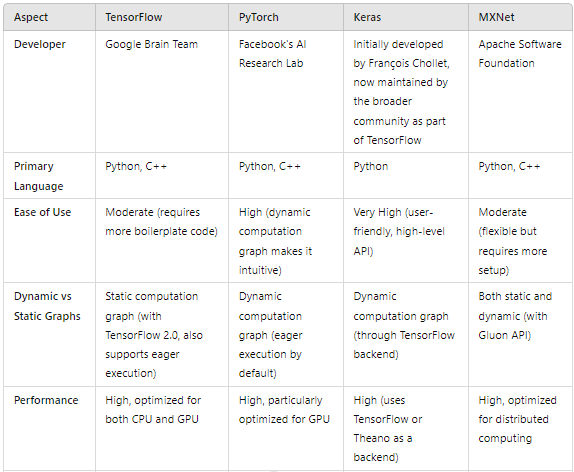
TensorFlow vs PyTorch vs Keras vs MXNet
Quick Notes!
TensorFlow vs PyTorch vs Keras vs MXNet - Part 1
#MachineLearning #ArtificialIntelligence #AI #pythonprogramming #programminghelp #NeuralNetworks #DeepLearning #Algorithms #DataScientists #DataAnalysis

i never watch Kai but this Kai x Jynxzi will be cool asf


原型:りゅんりゅん亭さん
目と体のラインにLEDが仕込まれてる


Join us on December 20 2018 in MaRS Discovery District for our event on "Data Science in Action". Pratap (Amazon Web Services) will present a talk on "Building #DeepLearning Applications in #MXNet". Then, @neutronsNeurons (SharpestMinds) and @WeCloudData…https://t.co/ZuWNVkBOhO

(Please RT) 25 Open-Source Machine Learning Repos to Inspire Your Next Project
https://t.co/ixJeloUaQM…
#machinelearning #keras #python #datascience #tensorflow #mxnet


Last Seen Hashtags on Sotwe
Trends for you
Most Popular Users

Elon Musk 
@elonmusk
239.6M followers

Barack Obama
@barackobama
118.6M followers

Cristiano Ronaldo
@cristiano
114.3M followers

Donald J. Trump
@realdonaldtrump
111.7M followers

Narendra Modi
@narendramodi
106.9M followers

Rihanna
@rihanna
98.6M followers

NASA
@nasa
92.1M followers

Justin Bieber
@justinbieber
91.7M followers

KATY PERRY
@katyperry
89.9M followers

Taylor Swift
@taylorswift13
83.9M followers

Lady Gaga
@ladygaga
75.4M followers

Virat Kohli
@imvkohli
73.3M followers

Kim Kardashian
@kimkardashian
70.8M followers

YouTube
@youtube
68.6M followers

Neymar Jr
@neymarjr
66.3M followers

Bill Gates
@billgates
65.1M followers

Selena Gomez
@selenagomez
63M followers

The Ellen Show
@theellenshow
62.1M followers

CNN
@cnn
61.7M followers

X
@x
60.6M followers