

Top Tweets for #Megacauda

Please like my new #YouTube #video about the new #prehistoric #species #Megacauda #sungei: https://t.co/i7ik2g71fR
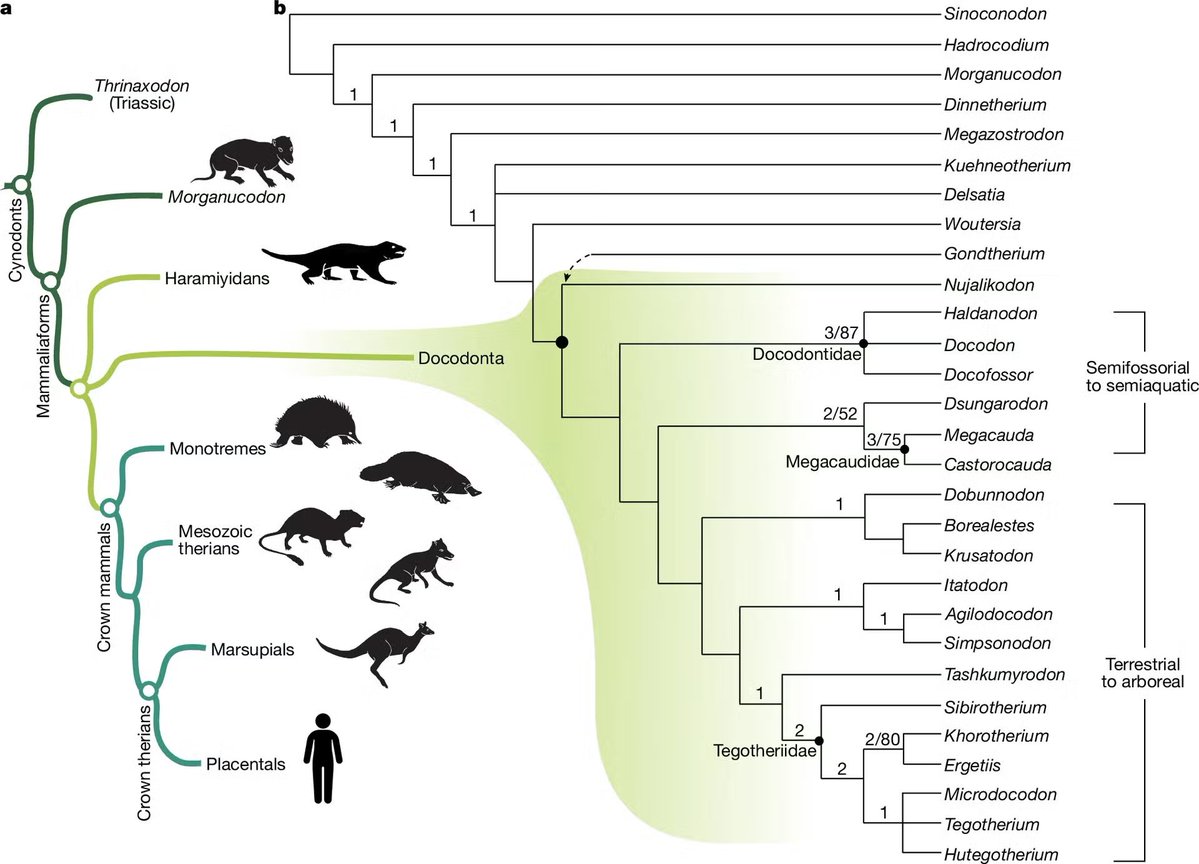
#Mammals evolved from reptilian-like #ancestors. The monophyletic group that includes true mammals (crown group) and their mammal-like ancestors is known as the #Mammaliaformes. Early traits that emerged as apomorphies (newly evolved characteristics) at different positions in the phylogenetic tree within the mammaliform ancestor line towards Mammalia include #fur, #endothermy (warm-bloodedness), the consumption of mother’s #milk (licking milk like secretions), the beginnings of a heterodont (differentiated) #dentition and the possession of a #secondaryjaw joint. All members of non-Eutheria Mammaliaformes were #egglaying #amniotes.
Their young hatched from the #eggs at an early stage, subsequently continued their development under the protection of their mother. Advantage: the eggs required fewer energy reserves and could be smaller.
Young were nourished with maternal milk after #hatching. Evolutionarily, this milk is derived from secretions of sweat and sebaceous glands, which originally served to moisten the eggshell and provide it with antimicrobial protection. The ancestral condition involved the young lapping milk along the fur on the mother’s abdomen.
In the #Daohugou #Formation of what is now Inner #Mongolia (northern China), Y. Li et al. (2026) discovered a well-preserved #fossil of a mammaliform belonging to the taxon #Docodonta. They described this animal, which measured approximately 50 cm in length, as a new species, Megacauda sungei. It lived about 165 million years ago in a #semiaquatic environment characterized by a network of vast, calm inland lakes (lacustrine systems), rivers, and volcanic landscapes. M. sungei possessed a stocky body, large, likely webbed feet, a notably large and #dorsoventrally #flattened #tail, and conspicuously enlarged #canineteeth. The species was a small predator. Furthermore, another complex of anatomical features was well-preserved in the fossil: the #swallowing apparatus. The pharynx included a #hyoid #apparatus (comprising hyoid and laryngeal bones), which allowed for the separation of breathing and swallowing, enabling the precise control of food within the #pharyngealcavity. This facilitated the safe, efficient ingestion of food and the milk secretions that young animals licked from their mother, and the same time enabled the act of #suckling. The authors conclude that the last common #stemspecies of the Docodonta and Mammalia lineages must have possessed these specialized swallowing adaptations.
According to some research papers, I found indications for specific common features in the Docodonta and Hadrocodium regarding mandibular and teeth morphology (e.g. Zhe-Xi Luo et al., 2022), which I interpreted as common apomorphies. Docodonta thus might be the sister group to Hadrocodium, but it is the traditionally reconstructed situation with Docodonta as sister group to the clade comprising Hadrocodium plus Mammalia that is preferred by the majority of scientists. General note: Due to limited availability of character informations in fossils, their phylogeny is permanently newly debated.
The last common ancestor of Docodonta and Mammalia possessed this flexible pharynx, meaning that the pre-adaptations for true milk suckling from teats, which only evolved in Theria (Mammalia) had already emerged long before.
© #StefanFWirth, October 2026, Berlin
Please support my science communication: https://t.co/4nN4eRHB6I
Reference:
Y. Li et al. (2026):
https://t.co/Fh4iR9fCCM
Illustrations and video animations:
© Stefan F. Wirth; AI-assisted visualizations based on my own hand-drawn sketches and storyboards, with illustrations and animations manually edited.
1) Artistic reconstruction of Megacauda sungei
2) M. sungei swimming
3) Phylogenetic tree of a portion of the Mammaliaformes, highlighting key plesiomorphies
4) minor part from my video: M. sungei swimming


Il y a ~160 Ma, #Megacauda nageait comme un ornithorynque !🦫
Cet étrange mammaliaforme 🇨🇳, le plus grand connu du #Jurassique, était adapté à la vie semi-aquatique et se nourrissait de petits animaux.
#Mammaliaformes
📰https://t.co/SGvGu8fahL
🔎https://t.co/7mKROBcAHM



Last Seen Hashtags on Sotwe
gayfit
Seen from United States
thingsfoundonmydesk
Seen from United States
jasminejae
Seen from India
neoSports
Seen from United States
africanteens
Wife
Seen from United Arab Emirates
minichat
Seen from Turkey
anxiouspanda
Seen from Sweden
MMMaker
Seen from United States
minichat ()()()***************(())() filter:videos
Seen from Turkey
Most Popular Users

Elon Musk 
@elonmusk
241.5M followers

Barack Obama
@barackobama
118.8M followers

Cristiano Ronaldo
@cristiano
114.6M followers

Donald J. Trump
@realdonaldtrump
111.8M followers

Narendra Modi
@narendramodi
107.1M followers

Rihanna
@rihanna
98.7M followers

NASA
@nasa
92.3M followers

Justin Bieber
@justinbieber
91.8M followers

KATY PERRY
@katyperry
90.1M followers

Taylor Swift
@taylorswift13
84M followers

Lady Gaga
@ladygaga
75.5M followers

Virat Kohli
@imvkohli
73.5M followers

Kim Kardashian
@kimkardashian
70.9M followers

YouTube
@youtube
68.8M followers

Neymar Jr
@neymarjr
66.5M followers

Bill Gates
@billgates
65.3M followers

Selena Gomez
@selenagomez
63.1M followers

The Ellen Show
@theellenshow
62.2M followers

CNN
@cnn
61.7M followers

X
@x
60.7M followers