

Top Tweets for #Microservices

INDIE DEVS
STOP BUILDING THESE BEFORE YOU HAVE 10 USERS
- Dark mode
- Custom auth
- Admin dashboard
- Microservices
- Pricing page with 4 tiers

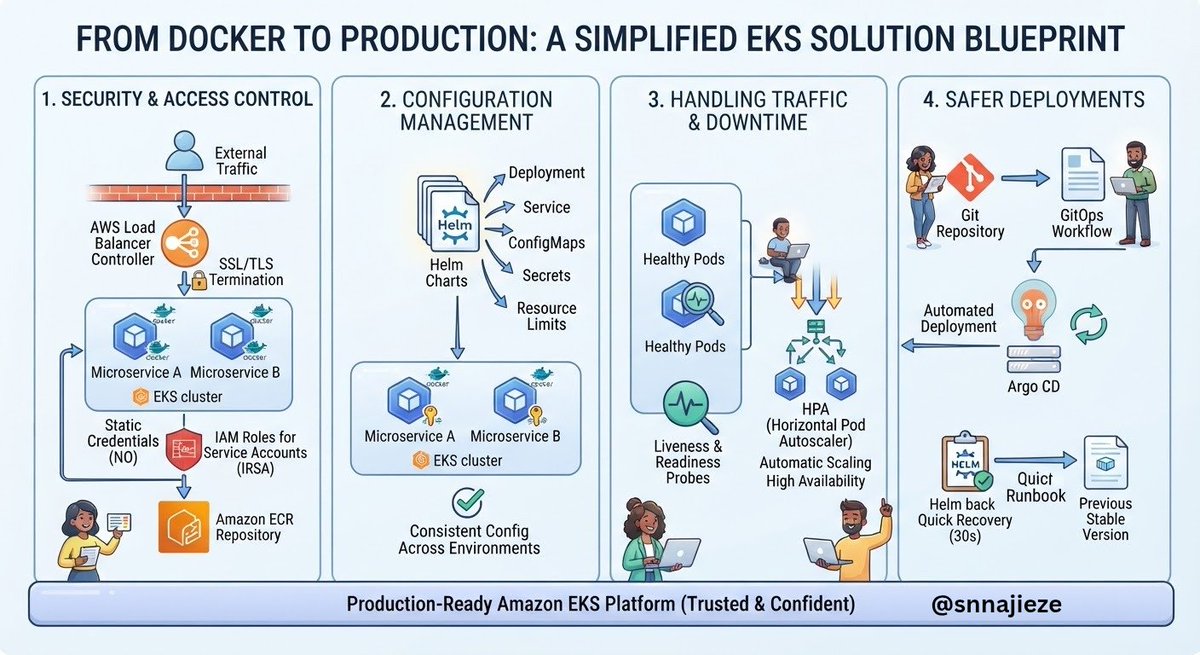
One of the biggest challenges for a growing engineering team is moving microservices from a local Docker setup to a production environment on AWS.
Normally, everything works fine on your machine.
But once you start thinking about security, scaling, deployments, and downtime, things get more complicated.
If you're moving your microservices to Amazon EKS, here are four areas worth getting right from the start.
1. Security and access control
Use IAM Roles for Service Accounts (IRSA) to manage AWS permissions without hardcoding credentials.
Set up the AWS Load Balancer Controller to handle SSL/TLS termination at the edge.
2. Configuration management
Managing configuration across multiple services can get messy.
Helm helps keep things organized.
Use separate ConfigMaps, Secrets, and resource limits for each service to avoid configuration differences between environments.
3. Handling traffic and downtime
Use liveness and readiness probes to monitor your containers.
Add Horizontal Pod Autoscalers (HPA) so Kubernetes can create more pods when traffic increases.
This helps your application stay healthy and handle sudden traffic spikes.
4. Safer deployments
Set up Argo CD for GitOps deployments.
Keep deployment changes in Git so your team can track and review them.
Also, document a simple Helm rollback process so you can recover quickly when a release causes problems.
Moving to Kubernetes is a good thing.
But you need to build a system your team can deploy, monitor, scale, and recover without panic.
The goal is to have a production-ready platform your engineering team can trust and operate....

One of the biggest challenges for a growing engineering team is moving microservices from a local Docker setup to a production environment on AWS.
Normally, everything works fine on your machine.
But once you start thinking about security, scaling, deployments, and downtime, things get more complicated.
If you're moving your microservices to Amazon EKS, here are four areas worth getting right from the start.
1. Security and access control
Use IAM Roles for Service Accounts (IRSA) to manage AWS permissions without hardcoding credentials.
Set up the AWS Load Balancer Controller to handle SSL/TLS termination at the edge.
2. Configuration management
Managing configuration across multiple services can get messy.
Helm helps keep things organized.
Use separate ConfigMaps, Secrets, and resource limits for each service to avoid configuration differences between environments.
3. Handling traffic and downtime
Use liveness and readiness probes to monitor your containers.
Add Horizontal Pod Autoscalers (HPA) so Kubernetes can create more pods when traffic increases.
This helps your application stay healthy and handle sudden traffic spikes.
4. Safer deployments
Set up Argo CD for GitOps deployments.
Keep deployment changes in Git so your team can track and review them.
Also, document a simple Helm rollback process so you can recover quickly when a release causes problems.
Moving to Kubernetes is a good thing.
But you need to build a system your team can deploy, monitor, scale, and recover without panic.
The goal is to have a production-ready platform your engineering team can trust and operate..
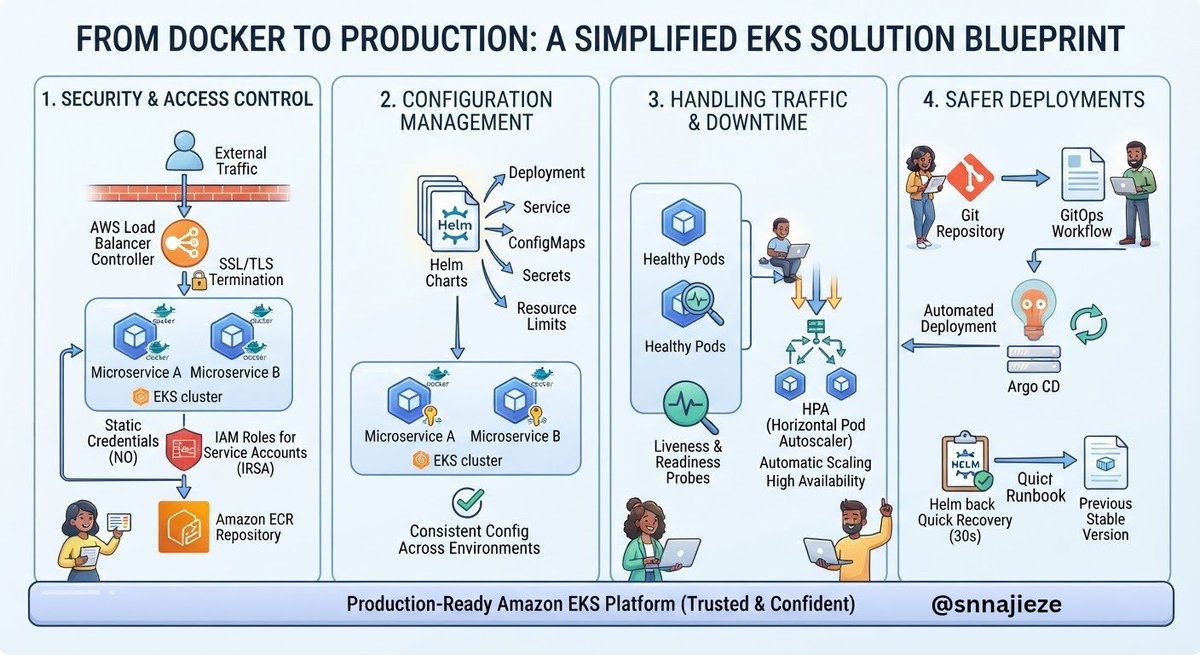
One of the biggest challenges for a growing engineering team is moving microservices from a local Docker setup to a production environment on AWS.
Normally, everything works fine on your machine.
But once you start thinking about security, scaling, deployments, and downtime, things get more complicated.
If you're moving your microservices to Amazon EKS, here are four areas worth getting right from the start.
1. Security and access control
Use IAM Roles for Service Accounts (IRSA) to manage AWS permissions without hardcoding credentials.
Set up the AWS Load Balancer Controller to handle SSL/TLS termination at the edge.
2. Configuration management
Managing configuration across multiple services can get messy.
Helm helps keep things organized.
Use separate ConfigMaps, Secrets, and resource limits for each service to avoid configuration differences between environments.
3. Handling traffic and downtime
Use liveness and readiness probes to monitor your containers.
Add Horizontal Pod Autoscalers (HPA) so Kubernetes can create more pods when traffic increases.
This helps your application stay healthy and handle sudden traffic spikes.
4. Safer deployments
Set up Argo CD for GitOps deployments.
Keep deployment changes in Git so your team can track and review them.
Also, document a simple Helm rollback process so you can recover quickly when a release causes problems.
Moving to Kubernetes is a good thing.
But you need to build a system your team can deploy, monitor, scale, and recover without panic.
The goal is to have a production-ready platform your engineering team can trust and operate.

I think one underrated skill in tech is knowing when NOT to use a new technology.
Not every application needs AI. Not every backend needs microservices. Not every problem needs a complex architecture.
Sometimes the best engineering decision is choosing the simplest thing that gets the job done.
I think one underrated skill in tech is knowing when NOT to use a new technology.
Not every application needs AI. Not every backend needs microservices. Not every problem needs a complex architecture.
Sometimes the best engineering decision is choosing the simplest thing that gets the job done.
I think one underrated skill in tech is knowing when NOT to use a new technology.
Not every application needs AI. Not every backend needs microservices. Not every problem needs a complex architecture.
Sometimes the best engineering decision is choosing the simplest thing that gets the job done.
I think one underrated skill in tech is knowing when NOT to use a new technology.
Not every application needs AI. Not every backend needs microservices. Not every problem needs a complex architecture.
Sometimes the best engineering decision is choosing the simplest thing that gets the job done.

If your startup needs microservices in year one, you don't have a product, you have a hobby.
Unpopular opinion: Microservices are just glorified Docker containers that add needless operational overhead.

Great explanation! I've seen teams spend hours searching through logs simply because nobody could trace a request across services.
Correlation IDs make debugging much easier, especially in microservices, where one request can travel through multiple APIs, queues, and databases.
I'd also recommend using OpenTelemetry for distributed tracing and propagating trace context across services.
One important detail: correlation IDs help connect logs, but they don't replace proper tracing.
Without them, debugging microservices feels like tracking a missing suitcase across five airports, with every airport claiming they've never seen it!

🔥 Heavy sidecars killing your cloud performance? Switch to native, kernel-level eBPF telemetry. Read the full guide & inspect the live GitHub Gist code:
🔗 https://t.co/8V8EADpFNk
#eBPF #DevOps #Microservices #ZeroTrust

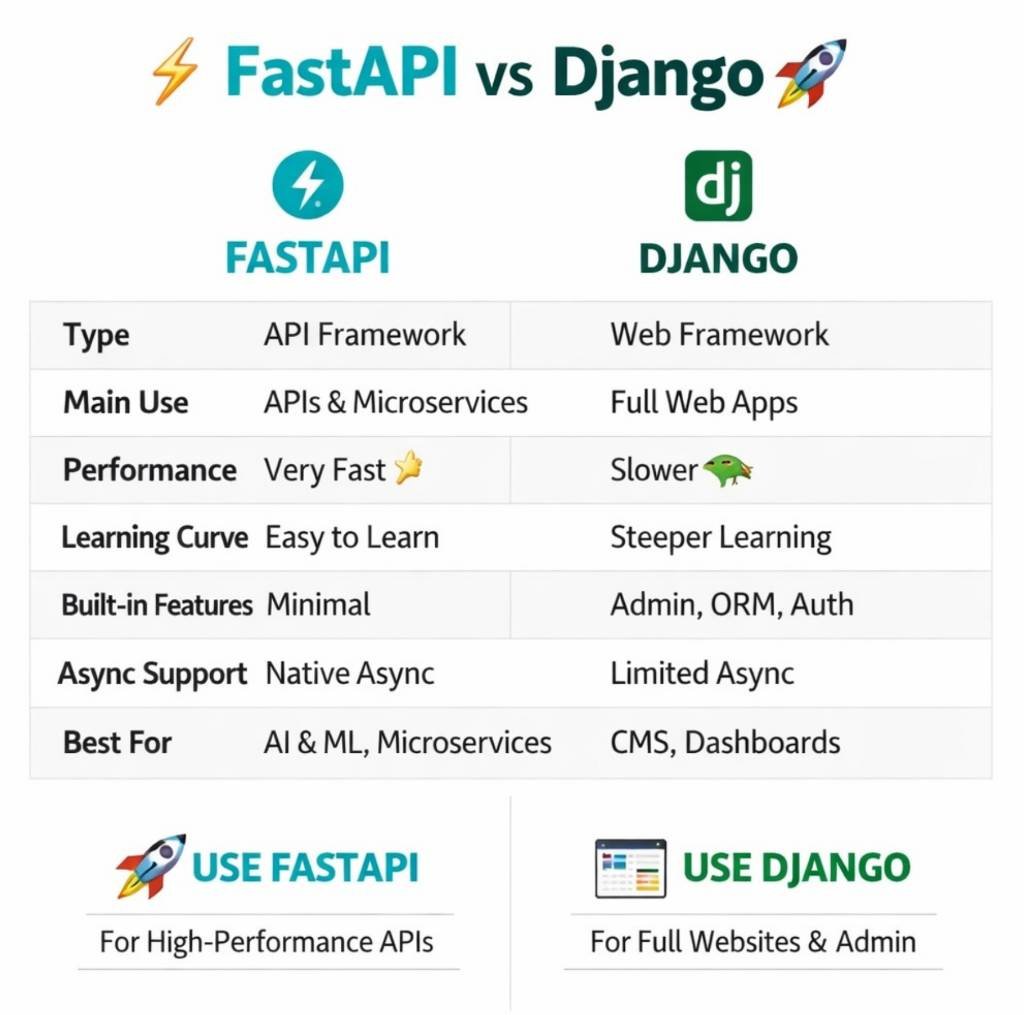
A clean architectural matrix for evaluating microservices vs battery-included web frameworks.
https://t.co/9CfCEiGNPh
Every backend kickoff meeting starts with this exact FastAPI vs Django chart and ends in a two-hour war.

do you build in a single repository or split everything into microservices from day one?

Honestly, not soon. AI already drafts solid designs, diagrams and code in minutes, but it still fails at the hard parts: reading unspoken business intent, owning irreversible trade-offs, saying no to over-engineered microservices, and carrying real accountability when production burns. Those stay human. Expect the role to shift hard toward AI orchestration and judgment within 3-5 years. Full replacement looks more like 10+ years out, if it ever happens cleanly.
Managing CDN edge caching becomes an operational nightmare once you migrate standard microservices to graph routing.
https://t.co/VlM0BIFUyx
GraphQL promised to kill over-fetching forever, yet plenty of teams are quietly migrating back to plain REST after fighting N+1 queries and broken HTTP caching.
Which side wins for you?

When the development team updates their microservices infrastructure by deleting raw files directly from production.
https://t.co/E4Nup2In7O
That 'git push --force' with the exercise ball felt way too personal.

I'm a Java Backend & AI Developer skilled in Spring Boot, Microservices, Spring AI, FastAPI, RAG, MCP & AI Agents.
Open to freelancing, full-time, part-time opportunities, and side projects.
Have an idea? Let's connect! DMs are open.
#AI #Java #RAG #Freelancing #OpenToWork
Why WebAssembly is replacing Docker in modern enterprise microservices:🔹 Zero OS dependency bloat 🔹 Sub-millisecond cold starts 🔹 Native zero-trust memory sandboxing
Full benchmark & guide: https://t.co/JXpJXpyRHz #Tech #Programming
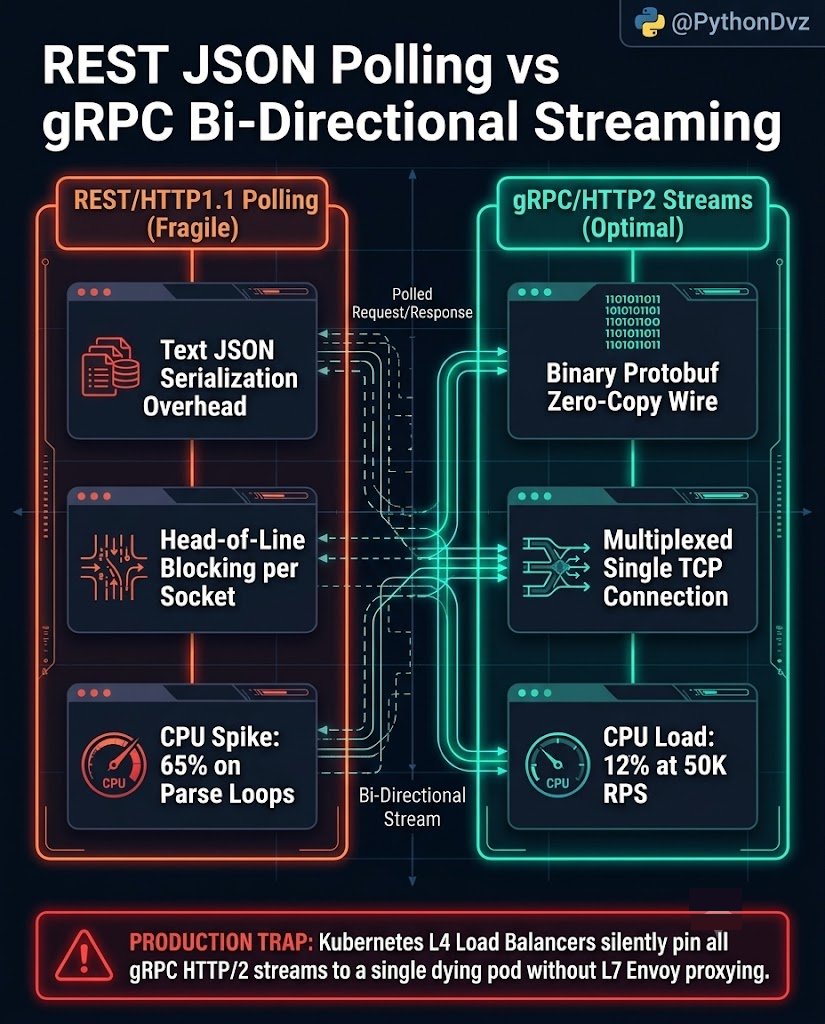
Look at row #5 before migrating high-throughput microservices to gRPC. Is your infrastructure vulnerable to persistent long-lived connection routing bugs?
https://t.co/d2OoY6uXoY
gRPC HTTP/2 streams crush REST JSON polling down to 12% CPU at 50K RPS, until the bottom production trap hits and Kubernetes L4 load balancers pin traffic to one dying pod.
L7 Envoy proxy balancing or client-side gRPC round-robin?

@lilpromptgoblin More on the US wealth-tech and financial analytics side - building document intelligence microservices, multi-tenant architectures, and AI-driven financial workflows rather than standard consumer payments.
Microservices decouple code deployment, but moving fast introduces a brutal production trap: synchronous retry storms that fry your internal API gateway worker pools.
https://t.co/SopR9xDjUz
Python backends jump into microservices too early, trading 1ms in-memory calls for 50ms+ network serialization overhead, while the "Fault Isolation" row here hides a brutal production trap.
Distributed saga or ACID monolith?

Textbooks claim microservices guarantee perfect fault isolation, but one hanging payment service dependency still cascades and freezes your whole system. Distributed saga or monolith?
https://t.co/SopR9xDjUz
Python backends jump into microservices too early, trading 1ms in-memory calls for 50ms+ network serialization overhead, while the "Fault Isolation" row here hides a brutal production trap.
Distributed saga or ACID monolith?
Ignore the "Resoure" and "telscom" typos on this API matrix—why are backend teams forcing JSON over REST for internal microservices when gRPC halves serialization latency?
https://t.co/I6FBK80eEh
REST, GraphQL, gRPC, and WebSockets solve completely different network latency bottlenecks in distributed backend systems.
For internal service-to-service communication in 2026, do you stick with REST or deploy gRPC?

@hailports Idempotent keys protect downstream microservices from replay side effects, but distributed transactions fall apart under massive async throughput anyway.
Idempotency keys or distributed transactions?

How do you handle authentication across microservices?
A) API gateway
B) JWT in every service
C) Service mesh
D) Shared database 😭
Tell me why 👇
Deconstructing the architectural trade-offs when serving real-world Python microservices and data pipelines. For new production apps: monolithic or decoupled?
https://t.co/5KnfLb3RJW
FastAPI, Django, and Flask serve completely different architectural needs across modern Python backend and AI systems.
When shipping production web APIs and AI microservices in 2026, do you deploy FastAPI or Django?

Most Popular Users

Elon Musk 
@elonmusk
240.1M followers

Barack Obama
@barackobama
118.6M followers

Cristiano Ronaldo
@cristiano
114.4M followers

Donald J. Trump
@realdonaldtrump
111.7M followers

Narendra Modi
@narendramodi
106.9M followers

Rihanna
@rihanna
98.6M followers

NASA
@nasa
92.1M followers

Justin Bieber
@justinbieber
91.7M followers

KATY PERRY
@katyperry
89.9M followers

Taylor Swift
@taylorswift13
83.9M followers

Lady Gaga
@ladygaga
75.4M followers

Virat Kohli
@imvkohli
73.3M followers

Kim Kardashian
@kimkardashian
70.8M followers

YouTube
@youtube
68.6M followers

Neymar Jr
@neymarjr
66.3M followers

Bill Gates
@billgates
65.2M followers

Selena Gomez
@selenagomez
63M followers

The Ellen Show
@theellenshow
62.1M followers

CNN
@cnn
61.7M followers

X
@x
60.6M followers