

Top Tweets for #OPENREVIEW




#OpenReview #API leak unmasked #ICLR 2026 & major conference identities—blind review broken before fixes.
Newsletter: https://t.co/n5vFOEprJl
Contact us at [email protected]
#infosec #academicintegrity #KimovaAI #Turboaudit #AI #EU #Infosec #CybersecurityNews #ISO27001 #ISO


Just a tip, @openreviewnet should wrap this whole incident up into a paper and submit it to the next @iclr_conf .
#iclr2026 #Openreview

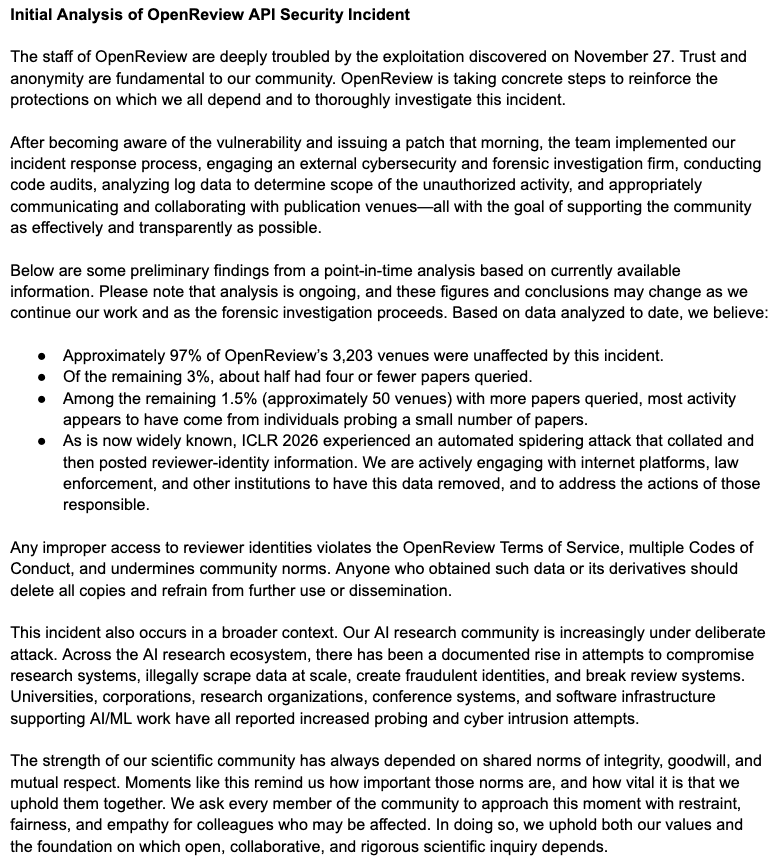
Initial Analysis of OpenReview API Security Incident

Double-Blind Intact: IJCAI Confirms No OpenReview Use. #Statement Never relying on #OpenReview, IJCAI confirms that its peer-review process — including IJCAI-ECAI 2026 — remains fully uncompromised, using the independent ChairingTool platform.
https://t.co/2f7bQKOTk2
#IJCAI2026


🤔 In the position paper we posted in May, “MLLMs are deeply affected by modality bias,” we also found a similar phenomenon: MLLMs can still answer questions even when the images are covered. We believe this is a key piece of evidence for modality bias.#ICLR #openreview #AI #ML

Got burned by an Apple ICLR paper — it was withdrawn after my Public Comment.
So here’s what happened. Earlier this month, a colleague shared an Apple paper on arXiv with me — it was also under review for ICLR 2026.
The benchmark they proposed was perfectly aligned with a project we’re working on.
I got excited after reading it. I immediately stopped my current tasks and started adapting our model to their benchmark.
Pulled a whole weekend crunch session to finish the integration… only to find our model scoring absurdly low.
I was really frustrated. I spent days debugging, checking everything — maybe I used it wrong, maybe there was a hidden bug.
During this process, I actually found a critical bug in their official code:
* When querying the VLM, it only passed in the image path string, not the image content itself.
The most ridiculous part? After I fixed their bug, the model's scores got even lower!
The results were so counterintuitive that I felt forced to do deeper validation. After multiple checks, the conclusion held: fixing the bug actually made the scores worse.
At this point I decided to manually inspect the data. I sampled the first 20 questions our model got wrong, and I was shocked:
* 6 out of 20 had clear GT errors.
* The pattern suggested the “ground truth” was model-generated with extremely poor quality control, leading to tons of hallucinations.
* Based on this quick sample, the GT error rate could be as high as 30%.
I reported the data quality issue in a GitHub issue. After 6 days, the authors replied briefly and then immediately closed the issue.
That annoyed me — I’d already wasted a ton of time, and I didn’t want others in the community to fall into the same trap — so I pushed back. Only then did they reopen the GitHub issue.
Then I went back and checked the examples displayed in the paper itself.
Even there, I found at least three clear GT errors.
It’s hard to believe the authors were unaware of how bad the dataset quality was, especially when the paper claims all samples were reviewed by annotators. Yet even the examples printed in the paper contain blatant hallucinations and mistakes.
When the ICLR reviews came out, I checked the five reviews for this paper.
Not a single reviewer noticed the GT quality issues or the hallucinations in the paper's examples.
So I started preparing a more detailed GT error analysis and wrote a Public Comment on OpenReview to inform the reviewers and the community about the data quality problems.
The next day — the authors withdrew the paper and took down the GitHub repo.
Fortunately, ICLR is an open conference with Public Comment. If this had been a closed-review venue, this kind of shoddy work would have been much harder to expose.
So here’s a small call to the community:
For any paper involving model-assisted dataset construction, reviewers should spend a few minutes checking a few samples manually. We need to prevent irresponsible work from slipping through and misleading everyone.
Looking back, I should have suspected the dataset earlier based on two red flags:
* The paper’s experiments claimed that GPT-5 has been surpassed by a bunch of small open-source models.
* The original code, with a ridiculous bug, produced higher scores than the bug-fixed version.
But because it was a paper from Big Tech, I subconsciously trusted the integrity and quality, which prevented me from spotting the problem sooner.
This whole experience drained a lot of my time, energy, and emotion — especially because accusing others of bad data requires extra caution.
I’m sharing this in hopes that the ML community remains vigilant and pushes back against this kind of sloppy, low-quality, and irresponsible behavior before it misleads people and wastes collective effort.
#ICLR #ICLR2026 #NeurIPS #CVPR #openreview #MachineLearning #LLM #VLM


The #ICLR2026 #OpenReview drama continues!
After the leak of anonymous reviewer identities, it is understandable that we need to mitigate potential effects this may have had.
Still disappointing for the majority of authors who played by the rules. Let's hope the ACs do a good job!


Please read this! #AI #openreview
Though, my name and many others have been leaked, but yea at least they fixed it ..

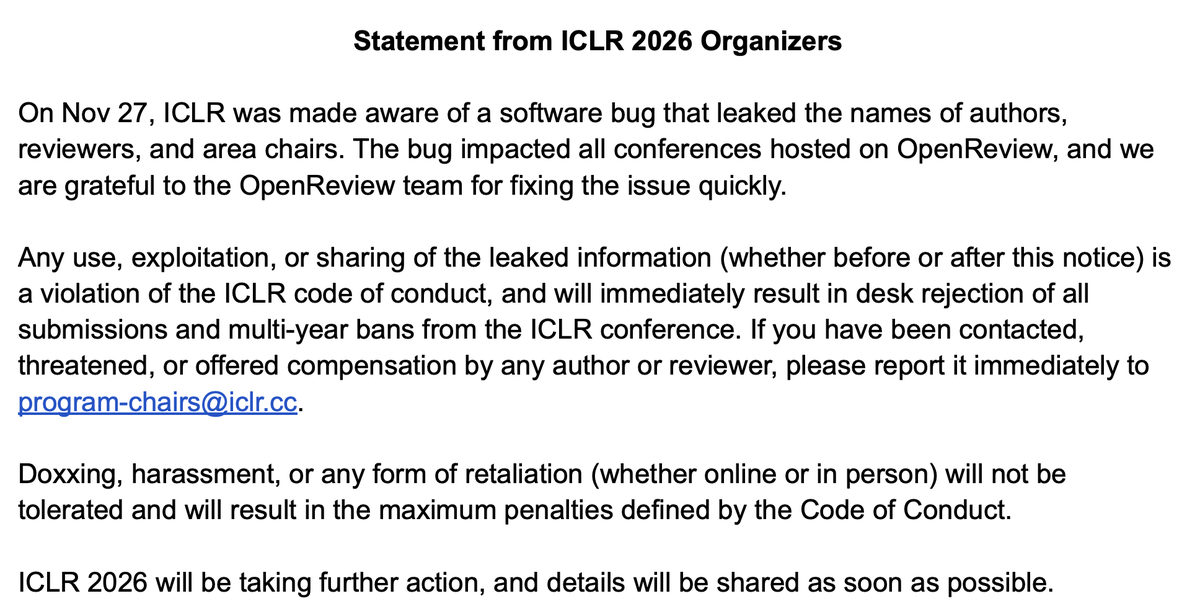

Too late to join the #openreview bug party, but honestly, probably too lazy to check who my reviewers were anyway😂. Good or bad, it is what it is...
That said, I am genuinely grateful for my #NeurIPS2025 reviewers, and I can't wait to be in San Diego next week to meet more incredible people and present our four papers:
1. Thought Communication: https://t.co/2khnEwKHFd
2. Dropout Decoding: https://t.co/SOwc9AnX9b
3. S'MoRE: https://t.co/tUSG4uBbYf
4. MJ-Bench: https://t.co/8j0BRHt1y5
See you all next week! And Happy Thanksgiving! 🍁

IMHO, one reason why major #AI conferences such as #CVPR and #NeurIPS are popular, trustworthy and respected venues is due to their double blind reviewing system.
Fortunately I checked the #CVPR2026 Area Chair #openreview profile, reviewers have not yet been assigned. 🙏

A bug in #OpenReview just exposed every reviewer’s identity across all conferences.😂
⚔️Next week’s in-person NeurIPS be like: 👇


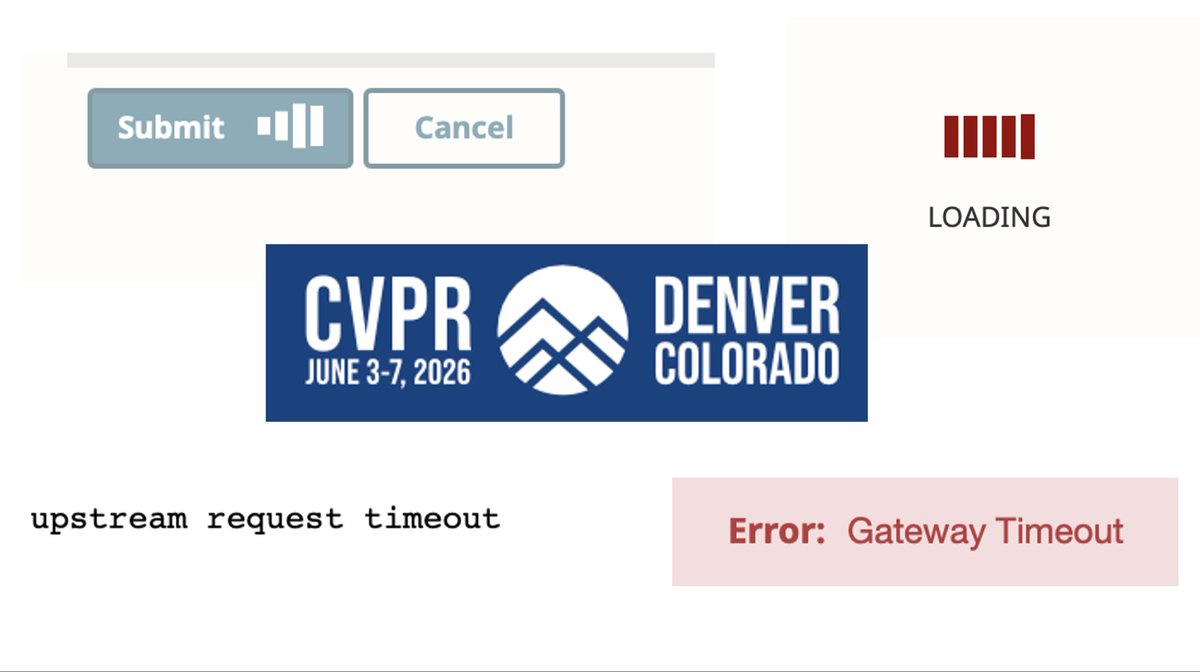

For Area Chairs,
I’ve been using this automation tool to keep track of papers in my batch efficiently:
🔗 https://t.co/FJLaUVcPKH
It's very handy for identifying those needing more attention.
Try it out and feel free to contribute!
#PeerReview #OpenReview #AI #AreaChair #ICLR #NeurIPS #ICML #CVPR #ICCV #ECCV

Meet the OpenReview Chairs for 3DV 2026!
We’re excited to have this amazing team leading the review process on OpenReview
Thank you for supporting a fair and transparent review process!
#3DV2026 #OpenReview #3DVision


Last Seen Hashtags on Sotwe
เลสเบี้ยนนัดเย็ด
Seen from Thailand
Indonesia
Seen from Indonesia
CaughtOnCamera
Seen from Germany
MGAI(*)***+filter:native_video
Seen from Malaysia
شرمطة
Seen from Italy
snapchat(())********************* filter:videos
Seen from Italy
minichat
Seen from Netherlands
Thundr
Seen from Poland
เย็ดในรถ
Seen from Thailand
teenageersss
Seen from Canada
Most Popular Users

Elon Musk 
@elonmusk
241.5M followers

Barack Obama
@barackobama
118.8M followers

Cristiano Ronaldo
@cristiano
114.5M followers

Donald J. Trump
@realdonaldtrump
111.9M followers

Narendra Modi
@narendramodi
107.1M followers

Rihanna
@rihanna
98.7M followers

NASA
@nasa
92.3M followers

Justin Bieber
@justinbieber
91.8M followers

KATY PERRY
@katyperry
90M followers

Taylor Swift
@taylorswift13
84M followers

Lady Gaga
@ladygaga
75.5M followers

Virat Kohli
@imvkohli
73.5M followers

Kim Kardashian
@kimkardashian
70.9M followers

YouTube
@youtube
68.8M followers

Neymar Jr
@neymarjr
66.5M followers

Bill Gates
@billgates
65.3M followers

Selena Gomez
@selenagomez
63.1M followers

The Ellen Show
@theellenshow
62.2M followers

CNN
@cnn
61.7M followers

X
@x
60.7M followers