

Top Tweets for #OpenState


The Washington Post spent six months building an AI podcast that fabricates quotes. I built Hakivo's AI podcast system in under 2 months by myself. Here's why architecture matters more than resources.
The Post's product lead said their "trickier part was refining the podcast." They created an internal scoring algorithm for quality, checking factual accuracy, tone, attribution, and engagement.
They had:
• A six-month timeline
• The Washington Post's resources and reputation
• An internal quality scoring system
• A dual-LLM verification architecture
Result? Fabricated quotes. Misattributions. Internal staff are calling for the tool to be pulled immediately.
Hakivo took a different approach from day one:
We didn't try to verify our way out of bad architecture. We prevented hallucinations at the source.
Structured data only - Bills from https://t.co/L3wZzARmN9 API, state legislation from OpenStates, news from Perplexity's real web search results (not AI summaries)
Mandatory attribution - Every claim requires explicit sourcing: "According to the bill's sponsors..." No claim without attribution.
Real URLs, not AI fabrications - Perplexity returns actual search results. We prioritize those over AI-generated content and filter aggressively for hallucinations.
Multiple validation layers: format checks, link verification, and audit trails. No single point of failure.
Radical transparency - Every article links to https://t.co/aN3MdiUdkf. Every search is logged.
Total development time? Less than two months. Including the entire app, personalization system, and audio generation.
Here's what I learned:
Time and resources don't fix fundamentally broken architectures.
The Post spent six months building a system that feeds unstructured articles to an LLM and hopes verification catches mistakes. When the first AI hallucinates, the second AI—trained on the same data—misses it.
It's like asking someone to proofread their own work twice. Same blind spots, same mistakes.
The lesson for anyone building AI systems:
Architecture decisions made on day one matter more than verification layers added later.
• Can your AI access external knowledge? (It shouldn't)
• Does your system work from structured, verifiable sources? (It must)
• Can users trace claims back to original sources? (They need to)
• Are you checking AI against external ground truth or just other AIs? (Ground truth wins)
The Washington Post has billions in resources, world-class journalists, and six months of development.
Hakivo is a startup with no budget and just one person: me.
Note: AI tools were used in helping with writing and researching this post.


🚀 Just submitted Hakivo to the @LiquidMetalAI AI Champion Ship Hackathon.
Every year, Congress introduces 10,000+ bills. Your state legislature adds thousands more. Yet most of us can't name a single one affecting our daily lives.
Here's the thing—members of Congress don't read all those bills either. They have legislative aides who track, summarize, and flag what matters.
Lobbyists have them. Politicians have them. You didn't.
Until now.
Hakivo is your personal legislative aide—built entirely on the Raindrop framework. 58 modules. Zero infrastructure. It monitors federal and state legislation, translates it into plain language, and delivers personalized briefings you can read, listen to, or explore.
The name comes from haki (Swahili for "justice") + vo (Latin for "voice"). The voice of rights. Bridging Capitol Hill to Main Street.
Built with: Raindrop SmartSql, SmartMemory, SmartBucket, Anthropic Claude, Cerebras, Google Gemini TTS, @Vultr Object Storage, congress API, OpenStates API, and more.
Because civic engagement shouldn't require a law degree—or a lobbyist's budget.
https://t.co/cxJRNR2ZgH
https://t.co/NCZLnwfR6I
I've been building something for the @LiquidMetalAI Hackathon that I'm genuinely excited about.
Hakivo now has a Congressional Assistant powered by @thesysdev C1 and the C1 Artifacts API and @mastra agent framework, and it's changing how I think about civic technology.
Here's the problem I was trying to solve: reading legislation is hard. Government websites are confusing. News coverage is fragmented. And most people don't have time to piece it all together.
So we built an AI assistant that lets you ask questions in plain English — "What's Congress doing about AI regulation?" — and get back something you can actually use.
What makes C1 different:
Thesys C1 is a generative UI framework — instead of returning text, the AI generates actual interactive components in real-time. Cards, charts, reports, forms.
The C1 Artifacts API takes this further by enabling the assistant to create polished slides and multi-page reports on the fly, right inside the app.
For Hakivo's Congressional Assistant, this means:
- News results appear as clickable cards with thumbnails and source citations
- Bill information displays in scannable formats with sponsor details and status
- Policy reports generate as interactive documents with executive summaries, key findings, and navigation
The technical piece I'm most proud of:
I used a two-phase approach. First, the AI gathers real data through tool calls — actual bill numbers from https://t.co/L3wZzAQOXB, real sponsor names via OpenStates API, current news through Gemini Search with grounding.
Then C1 generates the interactive artifact. Nothing made up. Everything sourced.
The Artifacts API also supports MCP integration, so the assistant can connect to external data sources securely and generate UI that's both beautiful and accurate.
Quick update on what I've been building for the @LiquidMetalAI AI Championship Hackathon.
This is easily the most complex application I've ever attempted as someone who is not a developer. And I want to be honest about that.
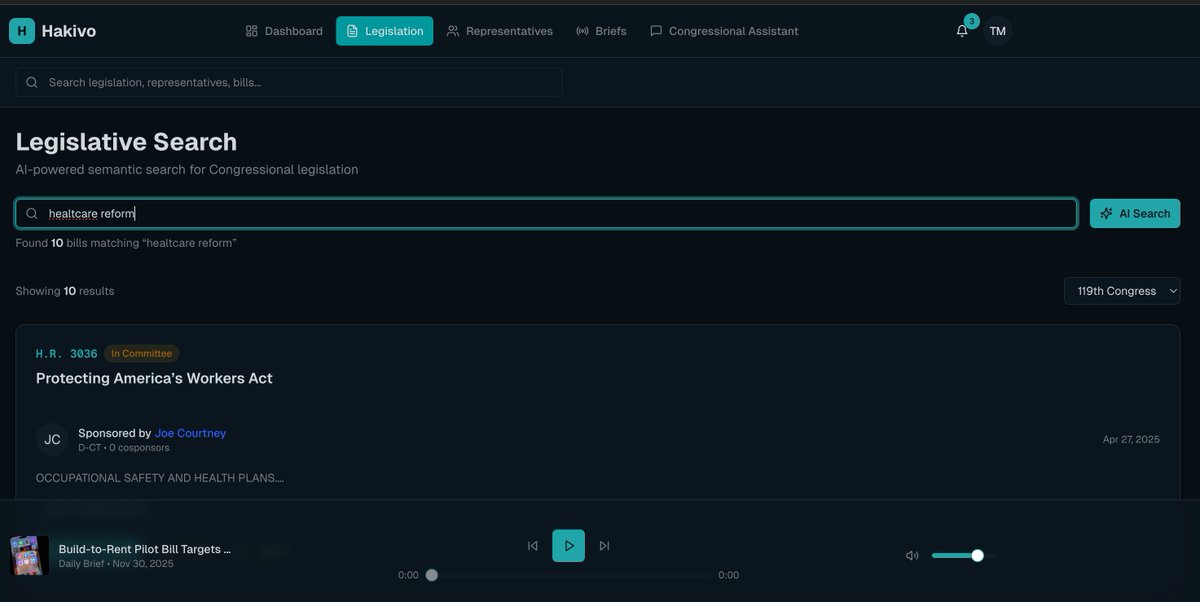
I'm building Hakivo—a civic engagement platform that helps people actually understand what their government is doing. Not just at the federal level, but also in state legislatures (which I recently just added to the app). The idea is simple: you tell it what issues you care about, and it does the heavy lifting of tracking, translating, and explaining what's happening in government.
Simple idea. Not simple to build.
Even with @claudeai Code and Opus 4.5 helping me write code, this has been a learning process on every front. I've had to understand how the https://t.co/L3wZzAQOXB API actually works (it's more complex than you'd think). I've had to learn backend development patterns I'd never worked with before—queues, observers, scheduled jobs, and microservice architecture. I've had to figure out how state legislative districts work, which is its own rabbit hole. And honestly? I've learned more about how Congress actually functions than I did in any civics class.
Here's what Hakivo does:
- Federal & State Bill Tracking — Monitor legislation from Congress and your state legislature based on your policy interests
- AI-Powered Bill Analysis — Deep forensic breakdowns using @cerebras: what a bill changes, who benefits, who loses, arguments for and against, likelihood of passing
- Find Your Representatives — Enter your zip code, get your 2 U.S. Senators, your Representative, AND your state legislators with photos and contact info
- Personalized News Feed — News aggregated from @perplexity_ai AI API filtered by your interests: healthcare, environment, economy, education, and more
- Daily Audio Briefings — AI-generated audio summaries you can listen to on your commute, personalized to what you care about
- AI Chat — Ask questions about any bill and get plain-English answers
The technical reality: 30 microservices on LiquidMetal's Raindrop framework. Data from https://t.co/L3wZzAQOXB, @pluralpolicy OpenStates, @gecodio and Perplexity. AI analysis with Cerebras extended thinking. Daily Brief scripts generated with Claude Sonnet 4.5. Audio via Gemini TTS. 22 database migrations. @geocodi
7,000+ state legislators loaded with photos.
But here's what I'm actually trying to solve:
Most people have no idea what their representatives are doing. Bills get introduced, debated, and passed while we're living our lives. The information is public—https://t.co/L3wZzAQOXB publishes everything—but who has time to read a
200-page bill written in legislative language?
Hakivo reads it for you because democracy works better when citizens actually know what their government is doing.
Is it perfect? No. Am I still learning as I build? Absolutely.
#civictech #hackathon #SocialGoodApp



@0xairdropfarmer OpenState = Pendle เวอร์ชัน BGT ที่ผูกกับกลไก stake + lending ใน Berachain ครับ
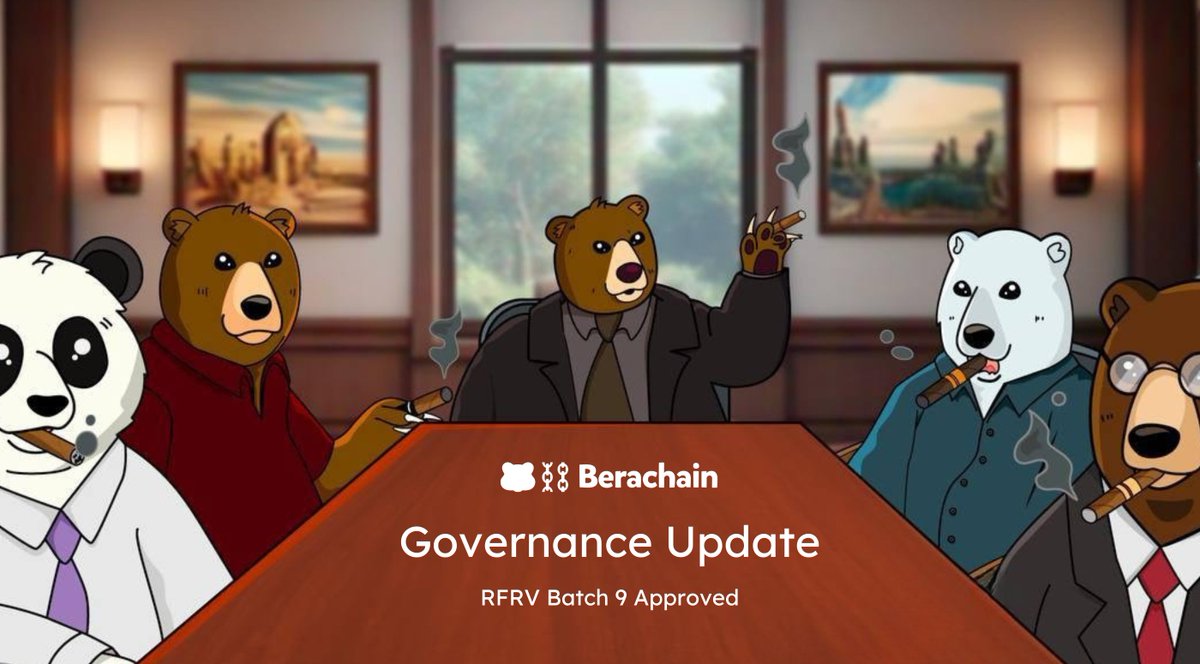
🔥 Berachain Governance อนุมัติ RFRV Batch 9 แล้ว!
3 Vault ใหม่โคตรน่าสนใจ 👇
🔸 SolvBTC Pool ดึงทุนจากเชนอื่น แจก $20K/สัปดาห์
🔸 Lending Loop ของ OpenState ปั้น flywheel ล็อก BGT → ได้ผลตอบแทนเพิ่ม
🔸 HONEY Vault จาก Wasabi ใช้ funding rate จริงมาแจกของบนเชน
⏱️ Vault ตั้งเวลาการแจก BGT ได้เอง (3-7 วัน) เพิ่มความยืดหยุ่นสุด ๆ
#Berachain #RFRV #DeFi

Decisions on the latest batch of RFRVs have been delivered by the @bgtfdn on behalf of the Guardians.
This batch brings BTC stable pools, lending receipt flywheels, and onchain perp yield into the PoL economy.
Also live: a Reward Manager upgrade gives vaults more control over how fast BGT emissions flow to stakers. This enables smoother APR curves and more predictable incentives.
Read the full update: https://t.co/lAiamHKZhJ

Most Popular Users

Elon Musk 
@elonmusk
240.1M followers

Barack Obama
@barackobama
118.6M followers

Cristiano Ronaldo
@cristiano
114.4M followers

Donald J. Trump
@realdonaldtrump
111.7M followers

Narendra Modi
@narendramodi
106.9M followers

Rihanna
@rihanna
98.6M followers

NASA
@nasa
92.1M followers

Justin Bieber
@justinbieber
91.7M followers

KATY PERRY
@katyperry
89.9M followers

Taylor Swift
@taylorswift13
83.9M followers

Lady Gaga
@ladygaga
75.4M followers

Virat Kohli
@imvkohli
73.3M followers

Kim Kardashian
@kimkardashian
70.8M followers

YouTube
@youtube
68.6M followers

Neymar Jr
@neymarjr
66.3M followers

Bill Gates
@billgates
65.2M followers

Selena Gomez
@selenagomez
63M followers

The Ellen Show
@theellenshow
62.1M followers

CNN
@cnn
61.7M followers

X
@x
60.6M followers