Today, we’re launching OpenUI Cloud.
Generative UI in production needs more than rendering.
Validation, error correction, fallbacks, versioning, audit trails - these are the parts teams shouldn’t have to rebuild from scratch.
OpenUI handles rendering.
OpenUI Cloud handles the production layer.
Try it:
npx @openuidev/cli@latest create
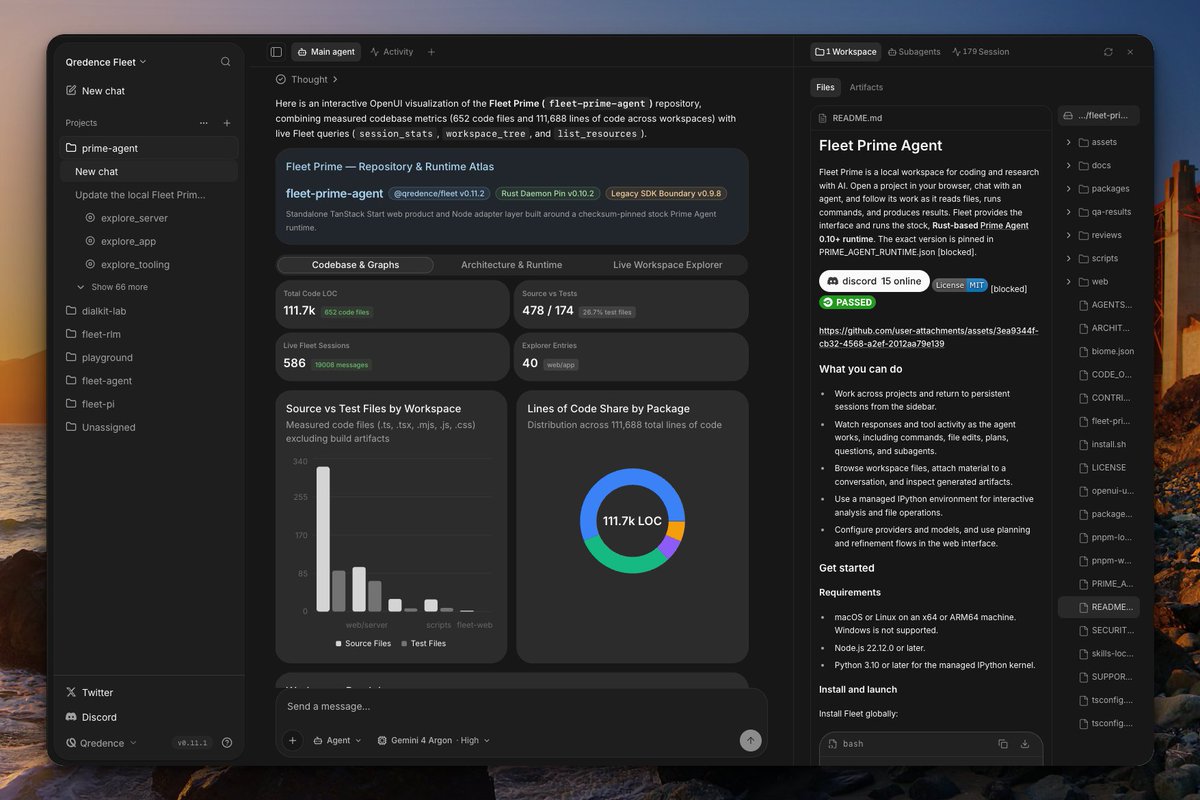
Fleet Prime v0.11 is out 🚀
The big one is OpenUI. Agents can now generate richer UI right in the chat, and that UI can read live Fleet data.
npm i -g @qredence/fleet
@PrimeIntellect@thesysdev
Rip the ugly BI iframes out of your product.
OpenUI Dashboards is now live:
> Generated from your components, inside your product
> Kept live with your data
> Edited with just a prompt
Today, we're shipping OpenUI Dashboards.
Your users are taking their data to Claude to build dashboards. Now your agent can build them - right within your product. Your own components and APIs, any model.
Claude's best feature, now for every agent.
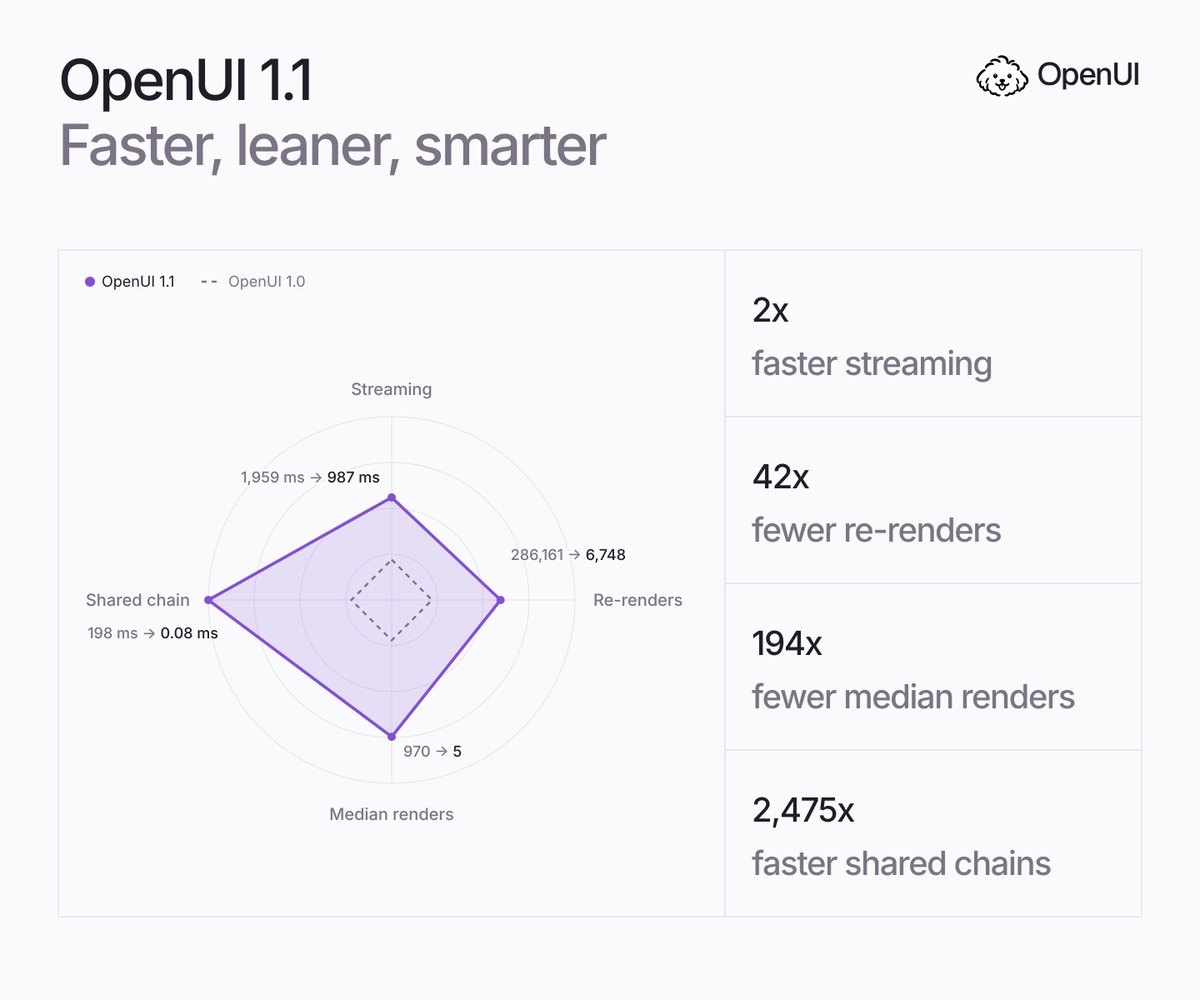
After 1.0, we decided to spend a release on just one thing: performance
OpenUI 1.1 is out. 2x faster streaming, 42x fewer re-renders
Also new:
- Chained Queries: One query can feed the next
- Math functions can now operate on whole columns
(and a few other quality of life improvements)
Unlike ChatGPT, Claude Dashboards actually write raw code. We took it apart.
tldr; Claude writes HTML and JavaScript, but never types a single number. It writes the wiring once, and a runtime renders it for every reader with no model call https://t.co/53NU8AXqOp
One of the few things I constantly struggle with is explaining what @openuidev can do beyond just pretty chats.
Until this video by @BetterStackHQ - go watch!
https://t.co/TRLtIlXJlt
I’ve had some version of this conversation every day since launch: why wouldn’t OpenAI or any of the labs just build this?
This is my (long) answer https://t.co/xnx4GXgxo4
my side projects finally got the funeral they deserved 🪦👻
how many graves would YOUR graveyard have? be honest 👀👇
made with @openuidev (it's open source!)
Check it out: https://t.co/enXvMnpiqK
#aitools#sideprojects#opensource#spookyseason
For 30 years, technology has moved in one direction: turning information into intuitive interfaces
Somehow, the smartest software we’ve ever built took us back to a textbox
We’ve spent the last 2 years at @openuidev trying to fix that. 6 months ago we open-sourced it: 10K+ GitHub stars, 6M+ downloads
ChatGPT shipped Intelligent UI and showed everyone what it looks like
Today we’re releasing OpenUI 1.0 bringing it to every other agent
OpenAI built Intelligent UI for ChatGPT
We built it for everyone else
Last week we reverse engineered how Intelligent UI works. Today we are open-sourcing ours.
Any model, even local ones on @ollama. A component library built for it. Language, renderers, runtime - all of it.
> npx @openuidev/cli@latest create --example open-intelligent-ui
Why didn’t @OpenAI just generate HTML and render it in an iframe?
The why is more interesting than the how:
1/ Iframes don’t feel native. ChatGPT runs on web, iOS and Android, and a generated interface has to feel native on all of them, not bolted on. So you need a format that’s generated once and rendered everywhere. Hence an intermediate language: DIL.
2/ A shared design language. Each platform has its own native components. The model writes one language, and each platform maps it to its own component library. Which raises the next problem: what about the logic, the JS?
3/ A code execution bridge. The logic is generated once as JS, and the client has to run it securely while passing data and events back and forth. ChatGPT Web runs it in a locked-down Web Worker inside a sandboxed iframe. Even event handlers never leave the worker; the renderer only sees an ID. Hard engineering, but there’s prior art.
4/ People expect more. Say “Generative UI” and users expect the model to build anything, not just pick from your components. ChatGPT handles this in two layers: the model composes layouts from ~70 native components, which covers most cases. For the rest, it falls back to raw HTML in an AppBlock.
5/ Design consistency, even in the escape hatch. That HTML isn’t free-styled. The host injects ChatGPT’s base styles and theme variables, so even a fully generated app still looks like ChatGPT. Brand is everything.
6/ The last mile. The catalog has to be crafted carefully, every component audited for composability and coverage. Data binding has to be bulletproof: imagine seeing wrong numbers while analysing a CSV. And images are resolved server-side from a search query, so the model never waits on an image round trip.
All this and more, goes into a production-grade Intelligent UI system.
we’re launching Open Intelligent UI :)
built with OpenUI, it brings the @ChatGPT-style Intelligent UI experience to your own stack.
use it with hosted models today, or wire it up to local models through tools like Ollama, LM Studio, etc.
the goal: the same kind of rich, generative UI experience - but open, cheaper, faster AND inside your own apps.
this is just the start. we’ll be adding a lot more examples, integrations, and capabilities to the repo over time.
Check it out:
https://t.co/cPZQAvr9kd