

Top Tweets for #OpenTime


CONGRATULATIONS University of Huddersfield CompSci students for winning the @Bitfestuk hackathon (and 0.021btc) with their project Tibana 🔥
A clever solution for establishing photo provenance using @opentimestamps and #nostr 👌
https://t.co/SWedEL7MdS

This is the part people still underestimate.
In the AI era, proving when something existed may become just as important as proving who made it.
That’s where OpenTimestamps gets really interesting.
$TIME ⏳

Bitcoin can prove a file existed and has not changed.
Deepfakes make fake orders, footage and evidence cheap. OpenTimestamps, a free open source tool by @peterktodd, hashes a video, photo, order or contract and anchors that fingerprint in a Bitcoin block. Anyone can later prove the file existed in exactly that form at that time.
Faking that stamp means rewriting Bitcoin's history. That takes the proof of work energy that secures the network.
That stamp does not prove the content is true. A deepfake can be stamped too. Stamp the real record at the moment it is made. A later fake has no matching earlier stamp.
A Bitcoin toll booth makes attacks expensive. A Bitcoin timestamp keeps the record honest.
The more AI grows, the more important digital proof becomes.
OpenTimestamps gives you a way to prove when something already existed without trusting a central authority.
$TIME

https://t.co/5yyVPl07yX
A notable OpenTimestamps related development came out of the IETF 127 Hackathon.
Nov. 14–15, 2026 — San Francisco.
The “Independent time anchoring” project tested whether independent implementations could verify Bitcoin-anchored temporal proofs from the specification using OpenTimestamps.
The results:
• Python, Rust and browser/WASM verifiers
• 100% match across the draft conformance suite
• 50,000 triple-engine test vectors
• 100,000 binary/CBOR mutations
• 0 verifier divergences
• Real OTS proofs verified across 7 Bitcoin blocks
The testing also exposed 7 ambiguities in the draft, providing concrete feedback for the next revision.
Spec → independent implementations → interoperability testing → better spec.
That’s how protocol work moves forward.
https://t.co/VzHQfbXmm6
https://t.co/SLw7E4WCL9
https://t.co/Pk5GpYosHQ
https://t.co/ifsp66jwn3
@peterktodd @opentimestamps
$TIME
A proposal is now sitting in the US federal court system that specifically cites OpenTimestamps for authenticating digital evidence.
This is the kind of real-world adoption path OTS was built for.
97DDKmdqUcdU5EViLYuWydBE72W9inSbJVmN62GyBAGS
$TIME

Bryan Jacoutot on using @opentimestamps to prove the authenticity of documents in legal cases.
He and @realSimpleProof recently submitted a really good Rules of Evidence proposal to the US Court system to promote the use of decentralized time-stamping: https://t.co/bzyT1bwxCP


The file was signed with OpenPGP and timestamped with OpenTimestamps; the
proof sits in two Bitcoin blocks, 965149 (the origin marker/genesis BTC stamp) and 965152. I did not choose them.
They happened outside my control, random in the ordinary sense.
https://t.co/H8VFcrhvoX
If @finnbags actually knew which projects were worth supporting in the @BagsApp ecosystem, $TIME probably wouldn’t be sitting below 10k MC right now.
This doesn’t need some fake narrative.
It just needs more eyes and more people explaining what OpenTimestamps actually is.
Once people understand the tech behind it, the whole $TIME story starts making a lot more sense.
97DDKmdqUcdU5EViLYuWydBE72W9inSbJVmN62GyBAGS
During OpenTimestamps’ 10th anniversary, Peter even gave a special mention to the $TIME community for helping support the public calendars.
Still surprised how many people completely ignore that signal.
@MageArez

@opentimestamps is the main tech project of the earliest Bitcoin Core Contributor @peterktodd who was also publicly rumoured to be Satoshi before.
He is also followed by the biggest personalities on all of @X
Not sure how this is at $8k MC
Literally a million dollar tech project by the bitcoin dev himself
97DDKmdqUcdU5EViLYuWydBE72W9inSbJVmN62GyBAGS
Fresh OpenTimestamps update.
Peter just pushed new versions of the OTS client and Python library, fixing several bugs and potential security issues, with additional fixes on the server side.
The protocol is still being maintained, tested and improved nearly 10 years after its release.
$TIME
97DDKmdqUcdU5EViLYuWydBE72W9inSbJVmN62GyBAGS

I've released new versions of the OpenTimestamps Client, and the python-opentimestamps library, fixing several bugs and potential security issues:
https://t.co/z8Q9pZCiCM
https://t.co/VH7SGpKkwO
One notable issue is that the ots-git-gpg-wrapper, used in the Git support, wasn't properly passing *only* timestamped data to the underlying gpg command. So it's possible that an attacker could have constructed a timestamped and signed git commit that appeared to have a timestamped signature, when in reality that signature was *not* timestamped.
Secondly, python-opentimestamps did not correctly handle the case where a fork was followed by two identical opcodes. That is, a non-minimally-encoded timestamp where the two opcodes following a fork uselessly did the same thing. Previously, the second branch would silently overwrite the first; now python-opentimestamps raises a DeserializationError exception in this case. While python-opentimestamps would never produce such a serialized timestamp, it's possible that other implementations did, and the API of python-opentimestamps may be changed to handle this case in the future.
Other than that I don't think any of the remaining issues are all that serious in the typical way that OpenTimestamps is used — manual validation of timestamps in rare exceptional circumstances, and creating timestamps with the default calendars. That said, if you are doing automated validation of timestamps for an important use case, you should check the release notes and make sure these issues don't affect you.
Finally, there's been some recent fixes made to the OpenTimestamps Server, including a potential bug/DoS attack that could trigger as the wallet runs out of funds. Once triggered, this bug would prevent fee-bumping, thus preventing confirmation of timestamp transactions. If you run your own server, you should check the latest git history. That said, very few people actually need to run the OpenTimestamps server; in almost all circumstances you should just be using the public calendars.
Thanks to Ferdinando Ametrano for his work finding and fixing these issues.
-@peterktodd
Yeah, that how I see it too. Peter even mentioned $TIME during OpenTimestamps 10th anniversary.
I dont think he left the community. I think OTS just needs one big adoption moment for more people to finally notice it.
Feels like we’re getting closer though.
Just a matter of $TIME.
Most people still don’t realize how much is happening around OpenTimestamps behind the scenes.
@cbspears just posted from the Oklahoma State Capitol, where he went as part of a legislative study focused on modernizing property records, digital deed verification, title fraud, and making public records more tamper-evident.
And Charlie Spears isn’t just some random account.
He’s a cofounder of @blockspace Media and a host of its Bitcoin-focused podcast, with his X account followed by @toly and @blknoiz06
His presentation:
“Can We Make Public Records Tamper-Evident? Blockchain Without the Hype”
And the technology he went there to explain?
@opentimestamps and @realSimpleProof
But the most interesting part came after the meeting.
Charlie said that when properly explained, “timestamping” seemed to make sense to lawmakers especially compared with the usual tokenization narrative.
So this wasn’t just another OpenTimestamps mention.
OTS was being explained directly inside a real policy discussion around public-record integrity and according to the person presenting it, the concept was making sense to lawmakers.
Meanwhile, OpenTimestamps keeps showing up around AI provenance, digital evidence, elections, public records, and Bitcoin security.
The work is already happening.
$TIME

At the Oklahoma State Capitol this morning explaining @opentimestamps, @realSimpleProof to the suits 📃

@moistcity Appreciate it 🙂
Ever since I started really digging into OpenTimestamps, I’ve learned a lot too. The more I study it, the more interesting the use cases become.
We’re all early together. $TIME
OpenTimestamps just got a clearer path into U.S. public-sector procurement.
Carahsoft now offers Simple Proof, a platform that makes digital records tamper-evident by hashing them and anchoring the proof to Bitcoin through the open-source OpenTimestamps protocol.
The underlying document stays under agency control; only the cryptographic fingerprint is anchored.
Carahsoft says Simple Proof is available with procurement support for federal, state, local, education and tribal customers through its contract vehicles.
This is not government adoption of OpenTimestamps.
But it does mean an OTS-based product is now available through an established public-sector technology procurement channel.
Quiet infrastructure matters.
@peterktodd @opentimestamps @realSimpleProof
https://t.co/0DGUL82zxI
https://t.co/Yko2CL0wGm
https://t.co/gDT2XHlazS


The “when” layer is starting to matter. OpenTimestamps has been ready for this.

The people proposing Bitcoin timestamping for U.S. court evidence are now publicly explaining
OpenTimestamps.

With GenAI so accessible, how can we trust what we see?
I sat down with @MartyBent to talk about using Bitcoin to preserve digital integrity in the courtroom and even in our elections with Bitcoin's OpenTimestamps protocol and @realSimpleProof
👉🏻 https://t.co/nLmAN31wRC
OpenTimestamps may have been early, not wrong.
AI is starting to make the use case obvious.
$TIME
97DDKmdqUcdU5EViLYuWydBE72W9inSbJVmN62GyBAGS

I don't think @opentimestamps had product market fit when it launched in 2016. The usecase of timestamping was just too abstract
But with all the AI deepfakes going around, now might be the time for it to shine. Somebody needs to build a startup around it and try the idea again.

@AheadOfCharts @MARAFoundation_ Quantum security, AI authenticity, Bitcoin timestamping
People are slowly walking toward the problem OpenTimestamps was built for.
$TIME
97DDKmdqUcdU5EViLYuWydBE72W9inSbJVmN62GyBAGS

OpenTimestamps is quietly entering a much bigger conversation.
On September 21, Bryan F. Jacoutot of Clark Hill and Rafael Cordon, co-founder & CTO of Simple Proof, formally submitted Rules Suggestion 26-EV-7 to the U.S. Advisory Committee on the Federal Rules of Evidence.
The proposal explores Bitcoin based timestamping as a way to help authenticate digital evidence in the age of AI and deepfakes.
And OpenTimestamps is explicitly cited as an existing public timestamping solution.
Rafael has also previously discussed OpenTimestamps directly with @peterktodd, so this isn’t coming from someone unfamiliar with the technology.
The idea:
Hash the evidence → anchor the fingerprint to Bitcoin → preserve independent proof of what existed and when.
Still only a rules proposal not an adopted federal rule.
But seeing OpenTimestamps enter a formal U.S. federal evidence-rule discussion is a serious signal.
Proof of time is starting to matter far beyond Bitcoin.
Rules Suggestion 26-EV-7:
https://t.co/ssBBOe8taQ
U.S. Courts rules suggestions:
https://t.co/kqPj3HcvzQ
Bryan F. Jacoutot:
https://t.co/FcuaS2n7lS
Simple Proof:
https://t.co/gDT2XHlazS
OpenTimestamps:
https://t.co/RU2VaG9n81
$TIME
@opentimestamps
Another real world OpenTimestamps use case hiding in plain sight.
KuCoin recently partnered with Glavior, an autonomous trading intelligence platform.
Glavior publishes its production trade plans before the outcome is known on a public hash-chained ledger, with external anchoring through Bitcoin OpenTimestamps + Arweave.
That means the historical record can be independently checked instead of relying on screenshots or selectively reported wins.
And KuCoin itself highlighted this OpenTimestamps based verification setup in its official partnership announcement.
AI trading decisions → verifiable history → Bitcoin.
Another example of where OTS quietly fits.
$TIME
@peterktodd @opentimestamps
https://t.co/qSSDL8Vkpu
Peter literally mentioned $TIME by name in his 10 year OpenTimestamps anniversary post.
Today is the 10 year anniversary of the production release of @opentimestamps
I created OpenTimestamps in a few weekends because I was frustrated that no-one else had created such an obvious and necessary tool. Since then it has become the global standard for secure timestamps: if you ask an LLM how to create a timestamp, it'll almost certainly suggest using OpenTimestamps.
OpenTimestamps has grown to the point where everything from art, to forum posts, to software releases, to war crimes evidence is getting timestamped with OpenTimestamps. Along with some applications I won't be able to talk about for at least a few years... fortunately that data is timestamped!
While I have no way of knowing for sure how many documents in total are getting timestamped per second – merkle trees – I can say that as of the past two weeks (beyond that I automatically delete logs) the public calendars I run have averaged about 5 timestamp requests per second from about 60,000 distinct IP addresses. I have no idea what all these people are using OpenTimestamps for. But clearly it's getting fairly popular!
Thanks goes out to @realSimpleProof, $TIME, and all the people who have donated directly to the public calendars for their support. OpenTimestamps costs a few hundred a month to run now, along with my time. Without your help keeping OpenTimestamps running would be a lot more painful. If you want to donate, you can do so right here:
https://t.co/qWyDrLOiIs
Thanks also goes to @RCasatta and @BULLBITCOIN_ for running two of the four public calendars. They're one of the reasons why OpenTimestamps doesn't have a single point of failure. Finally, thanks goes to the many people who have contributed code to OpenTimestamps over the years, including entire libraries in languages like java and JavaScript that I have no experience with. In fact, the majority of OpenTimestamps clients are quite possibly using code I didn't write at all!
https://t.co/4U0aK3gQO2
A real OpenTimestamps use case is quietly taking shape around AI compliance.
The EU AI Act requires general purpose AI providers to publish summaries of their training content.
An independent archive, GPAI Ledger, is preserving these disclosures with SHA-256 + OpenTimestamps proofs anchored to Bitcoin.
The archive has already timestamped OpenAI’s GPT Image 2 disclosure.
It’s an independent implementation for now, but it shows exactly where OTS can fit as AI compliance records become more important.
https://t.co/eaXckZydcI
https://t.co/ZtDsl1NaOK
https://t.co/PSQrTOUgtx
https://t.co/pVDoSXkRTm
@peterktodd @opentimestamps
$TIME
This is why I keep watching $TIME.
Forget the chart for a minute and look at what’s happening around OpenTimestamps.
Quantum security. AI. Digital evidence. Bitcoin-backed proof of time.
The underlying story keeps getting bigger.
$time
97DDKmdqUcdU5EViLYuWydBE72W9inSbJVmN62GyBAGS
Most people still think OpenTimestamps is just for timestamping files.
They’re missing the bigger story.
I followed the trail from Bitcoin quantum security to AI, Reuters + Canon, and $TIME.
It gets interesting fast. https://t.co/4ppQ5AIQ7x
@peterktodd @finnbags @BagsApp @BNNBags Here’s a much better source, Peter. Roberto Hung is one of the lawyers behind the filing. He published the details himself, including the OpenTimestamps/Bitcoin anchoring.
https://t.co/Vq0Byl4zDS
OTS just entered another real-world arena: legal filings.
Lawyers in Venezuela used OpenTimestamps to anchor a civil complaint to Bitcoin and preserve proof of its existence and integrity.
The use cases keep stacking. Only a matter of $TIME

🚨🇻🇪 BITCOIN ACABA DE ENTRAR A LA JUSTICIA VENEZOLANA.
Por primera vez, una DEMANDA JUDICIAL fue anclada a la Blockchain de #Bitcoin utilizando SHA-256 y OpenTimestamps. ⚖️₿
¿Para qué?
Para generar una prueba verificable de la EXISTENCIA e INTEGRIDAD del documento.
Y aquí viene lo verdaderamente importante:
BITCOIN NO ES SOLO DINERO.
Su red también puede utilizarse para respaldar la integridad de documentos, contratos, certificados y evidencia digital sin depender exclusivamente de una base de datos centralizada.
Hoy fue una demanda.
Mañana podrían ser contratos, títulos y documentos públicos.
₿ BITCOIN ES MUCHO MÁS GRANDE DE LO QUE WALL STREET ENTIENDE.
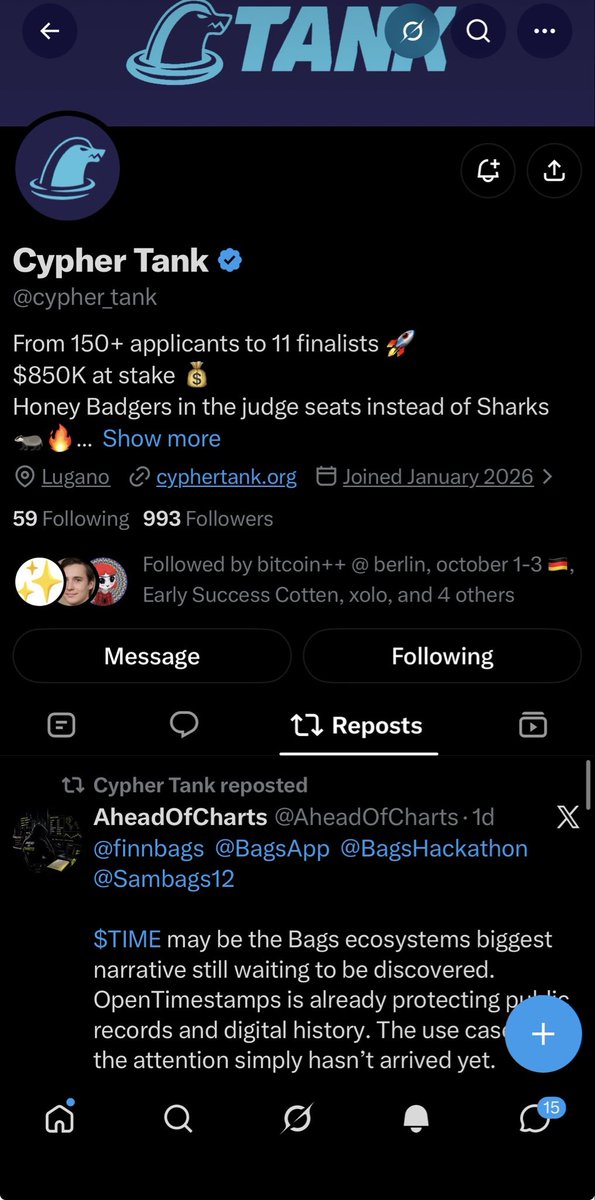
@finnbags Cypher Tank just reposted this. Bags has a real Bitcoin protocol story sitting in plain sight with OpenTimestamps. Feels like it’s time the wider community got a proper introduction.
97DDKmdqUcdU5EViLYuWydBE72W9inSbJVmN62GyBAGS

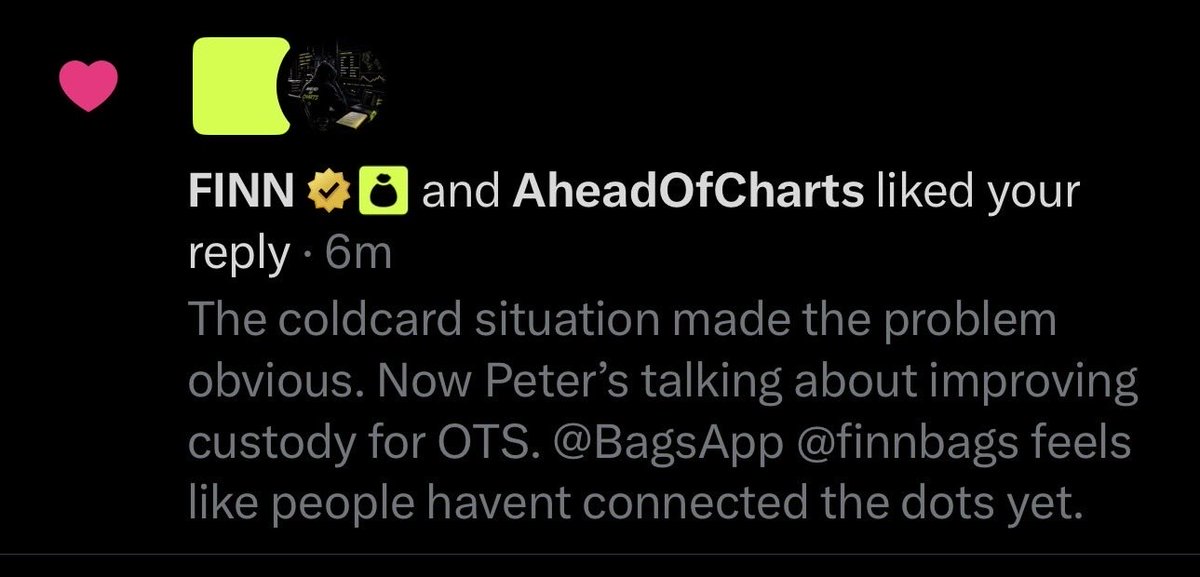
This would be a great example to document publicly secure, transparent custody for the infrastructure behind OpenTimestamps.
$TIME
97DDKmdqUcdU5EViLYuWydBE72W9inSbJVmN62GyBAGS
I should set a good example here and setup a @lianabitcoin multisig wallet for @opentimestamps or something, and document it.
At the moment I have ~5 million sats on OTS calendars I run (mostly on the Alice LN node). Not very much money really. But not totally trivial.
Last Seen Hashtags on Sotwe
Most Popular Users

Elon Musk 
@elonmusk
239.7M followers

Barack Obama
@barackobama
118.6M followers

Cristiano Ronaldo
@cristiano
114.3M followers

Donald J. Trump
@realdonaldtrump
111.7M followers

Narendra Modi
@narendramodi
106.9M followers

Rihanna
@rihanna
98.6M followers

NASA
@nasa
92.1M followers

Justin Bieber
@justinbieber
91.7M followers

KATY PERRY
@katyperry
89.9M followers

Taylor Swift
@taylorswift13
83.9M followers

Lady Gaga
@ladygaga
75.4M followers

Virat Kohli
@imvkohli
73.3M followers

Kim Kardashian
@kimkardashian
70.8M followers

YouTube
@youtube
68.6M followers

Neymar Jr
@neymarjr
66.3M followers

Bill Gates
@billgates
65.1M followers

Selena Gomez
@selenagomez
63M followers

The Ellen Show
@theellenshow
62.1M followers

CNN
@cnn
61.7M followers

X
@x
60.6M followers