

Top Tweets for #PlatformEngineering

"Approve my S3 and Redis ticket" waited 4 days.
The delay was not code; it was the path.
Paved roads beat ticket queues.
Safety can be fast. #PlatformEngineering #DevOps
'Can someone approve my S3 bucket? It has been 4 days.'
Every developer knows this pain.
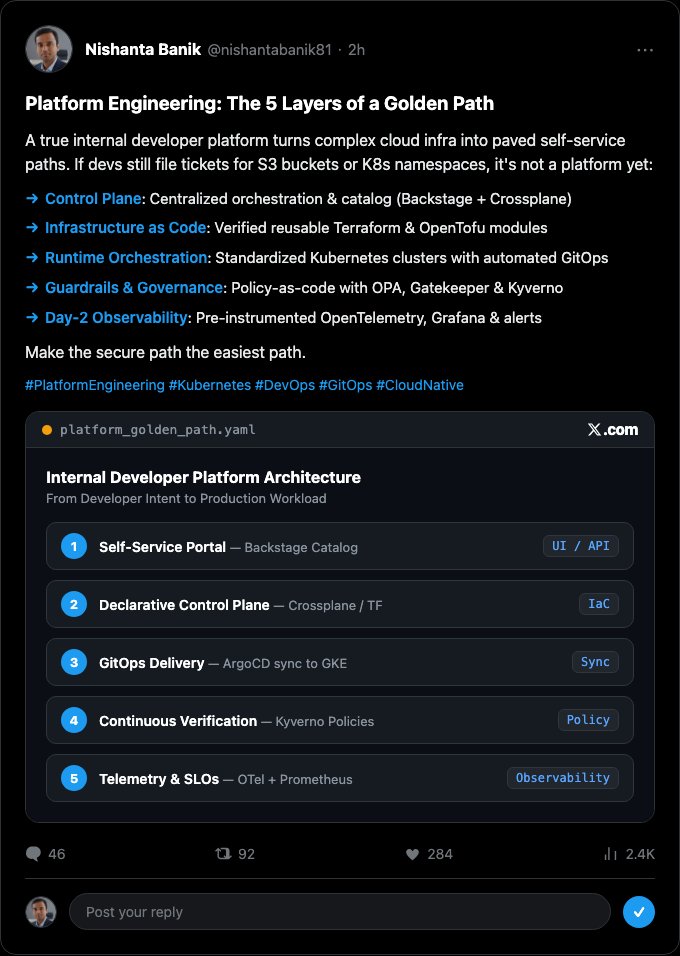
Platform Eng fixes it in 5 paved layers:
• UI: Backstage
• IaC: Crossplane
• Sync: ArgoCD
• Policy: Kyverno
• Observability: OTel
Self-service wins.
#PlatformEngineering #Cloud
"Approve my S3 and Redis ticket" waited 4 days.
The delay was not code; it was the path.
Paved roads beat ticket queues.
Safety can be fast. #PlatformEngineering #DevOps
'Can someone approve my S3 bucket? It has been 4 days.'
Every developer knows this pain.
Platform Eng fixes it in 5 paved layers:
• UI: Backstage
• IaC: Crossplane
• Sync: ArgoCD
• Policy: Kyverno
• Observability: OTel
Self-service wins.
#PlatformEngineering #Cloud

كيف يعمل OpenShift Cluster؟ | شرح المكونات الأساسية
شورت جديد باليوتيوب 🤩
piped.video/shorts/ozAMyh4bM…
#OpenShift #RedHat #Kubernetes #DevOps #CloudComputing #PlatformEngineering

No code changes. No heavy agents. Just kernel security ⚡
Discover how #eBPF blocks privilege escalations in enterprise K8s clusters.
Get free manifests:aidevtoolkit.blogspot.com/20…
#PlatformEngineering #SRE #Linux
Stop wasting CPU cycles on heavy user-space security agents ⚡
Learn how kernel-level #eBPF auditing protects clusters with zero app code changes.
Full guide:aidevtoolkit.blogspot.com/20…
#Linux #PlatformEngineering #SRE

𝗔𝗶𝗞𝗔 𝗠𝗼𝗱𝗲𝘀 𝗮𝗿𝗲 𝘀𝗲𝗿𝘃𝗲𝗿𝗹𝗲𝘀𝘀 𝗮𝗴𝗲𝗻𝘁𝘀
Think AWS Lambda, but for agents.
You define instructions, model, parameters, and tools. Portal handles the rest.
#AIInfra #PlatformEngineering


The cheapest DevOps solution isn't always the most cost-effective.
Long-term value comes from automation, reliability, security, and scalability, not just a lower price tag.
Read more: devopsconnecthub.com/latest-…
#DevOps #Cloud #CICD #PlatformEngineering #DevOpsConnectHub

Kubernetes rolling deployment finishes successfully. Minutes later, users report random 502 Bad Gateway errors. Every Pod is Ready, CPU is low, and no containers have restarted.
What production issue would you investigate first?
#Kubernetes #SRE #PlatformEngineering

Fixing the Kubernetes "ImagePullBackOff" error!
If your Pod container state is stuck in "Waiting", stop guessing and run "kubectl describe". Here is the real-world diagnostic and live fix from the official docs.
#kubernetes #devops #sre #cloudnative #platformengineering #linux

Build in public update 🚀
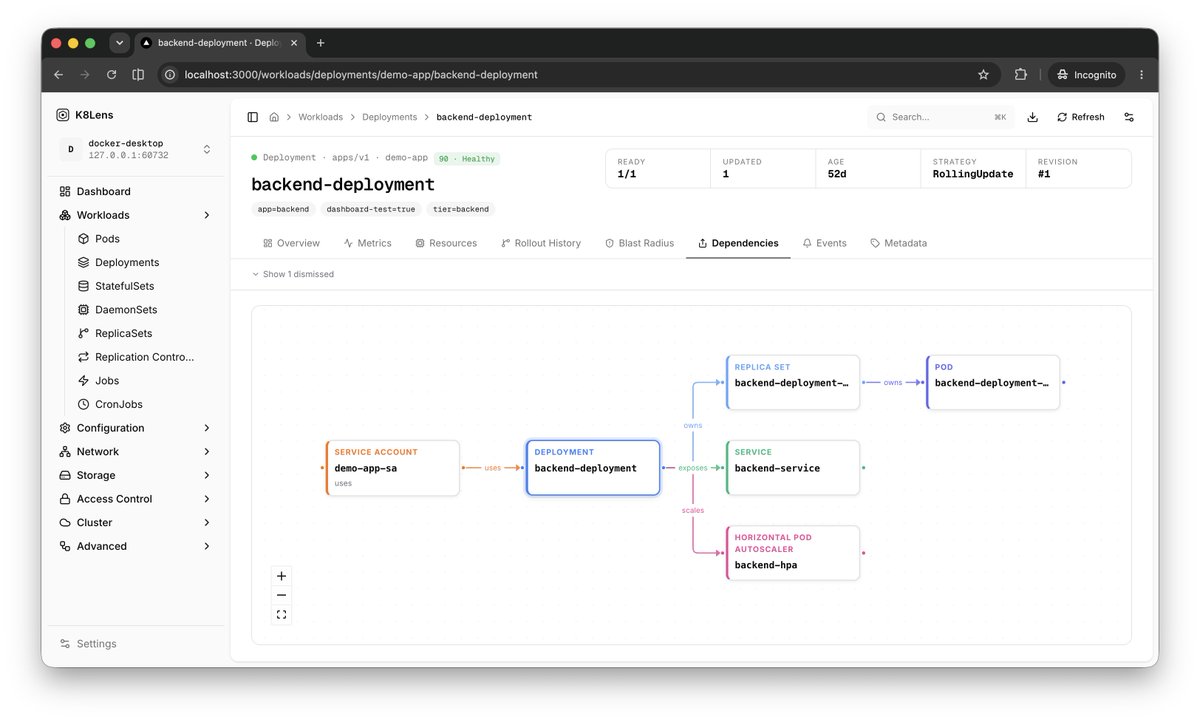
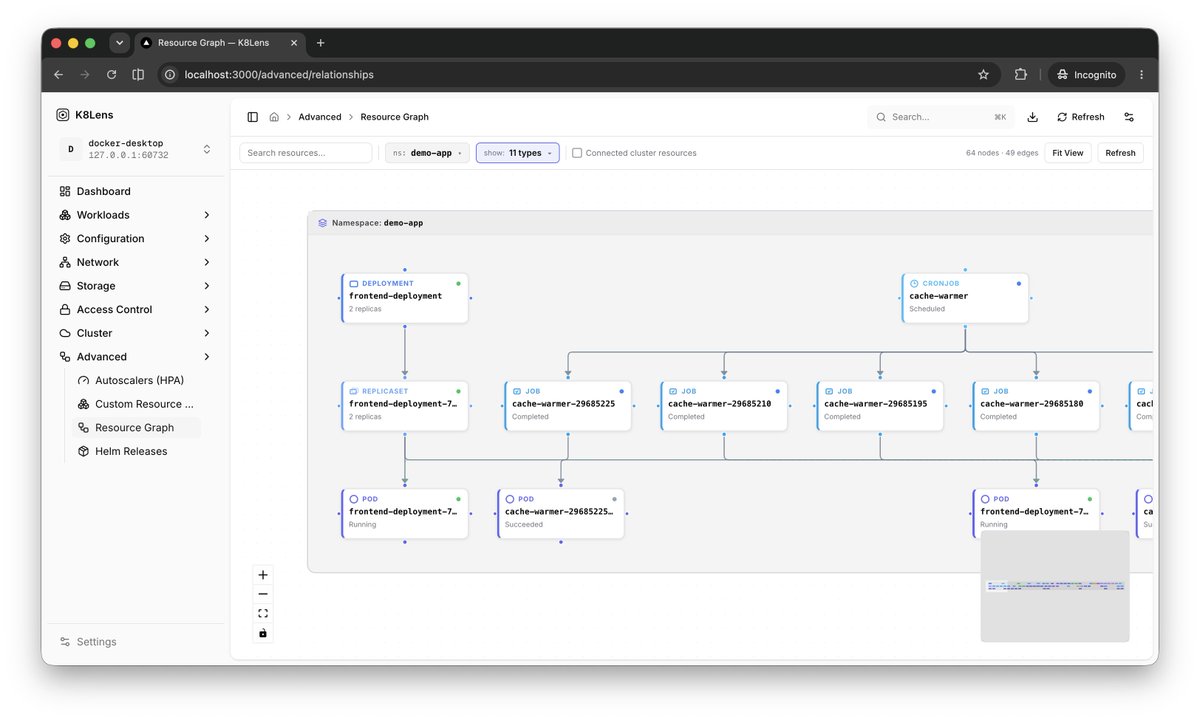
Been working on this Kubernetes Dashboard project for the past few months in my spare time.
Still early, but the first release is planned for next week.
Looking for brutal feedback:
What feature would make you switch from your current Kubernetes dashboard?
#BuildInPublic #Kubernetes #K8s #DevOps #CloudNative #PlatformEngineering #SRE #OpenSource
For the last couple of months, I've been building a new Kubernetes Dashboard project alongside my full-time job. Progress has been slower than I'd like because of work commitments, but today I'm excited to share the very first glimpse of what I've been working on. 🚀
This is still an early iteration, but the first public release is planned for next week.
My goal isn't to build another Kubernetes monitoring dashboard. I want to build something that genuinely helps platform engineers, SREs, DevOps teams, and Kubernetes operators manage their clusters more effectively.
The screenshots below showcase some of the work so far:
• Cluster connectivity & onboarding
• Cluster Dashboard
• Resource listings & detailed views
• Cluster navigation experience
I'd love feedback from the Kubernetes and DevOps community:
👉 What features do you feel are missing from existing dashboards?
👉 What are the biggest pain points you face when managing Kubernetes clusters?
👉 If you could add one feature to your ideal dashboard, what would it be?
Your feedback will directly influence the roadmap.
#Kubernetes #K8s #CloudNative #DevOps #PlatformEngineering #SRE #CNCF #OpenSource #CloudComputing #Containers #Docker #Infrastructure #Observability #GitOps #DeveloperExperience #PlatformOps #Kubectl #CloudEngineering #TechTwitter #OSS



One benchmark query failed my search 14 times in a row. I assumed I needed a smarter model; the fix was a 30-token sentence.
The query: "What GPU does the platform use, and how is VRAM allocated?" My vector search kept returning 750-token chunks that mentioned GPUs in passing but never actually answered it.
Fourteen consecutive runs, same failure, factual accuracy stuck at 0.64.
So one Saturday I built a quick-facts index: sixty atomic facts, each a single ~30-token sentence in its own Qdrant collection.
One reads "The desktop runs an RTX 4080 with 16GB VRAM, allocated to vLLM." One thing, one sentence.
Factual accuracy went from 0.64 to a perfect 1.00. The query that had failed 14 times was suddenly rank 1.
The reason isn't that the model is bad at long documents. It's that a 30-token statement about one thing is a cleaner embedding target than a 750-token document about twelve things.
Small beats big when the question is small.
Claude Code and I found ten more bugs that weekend. Every one had the same shape: a different code path through the search pipeline, each with its own gaps in the exclusion filter.
I'm not going to walk through all ten. And I haven't mentioned the transport migration that cut cold starts by 96%, or the CVSS 9.4 my own automation caught in my container registry that same Sunday.
When did "just use a bigger model" stop being your first instinct?
Link below to the blog
#BuildingInPublic #PlatformEngineering #RAG #SearchQuality

Going to build an open source Kubernetes Monitoring Dashboard 🚀
Real-time metrics, alerts, cluster insights, cost visibility, and a clean developer experience.
Building this fully in public.
Will share progress, failures, architecture decisions, and lessons along the way 👀
Wish me luck!! 🤞
#BuildInPublic #Kubernetes #OpenSource #DevOps #CloudNative #PlatformEngineering #SRE #Monitoring #OSS #K8s

Most AI agents fail silently for one reason:
Their context is already stale.
The repo changed.
The docs changed.
The Slack thread changed.
The embeddings didn't.
That's the hidden bottleneck in modern AI systems.
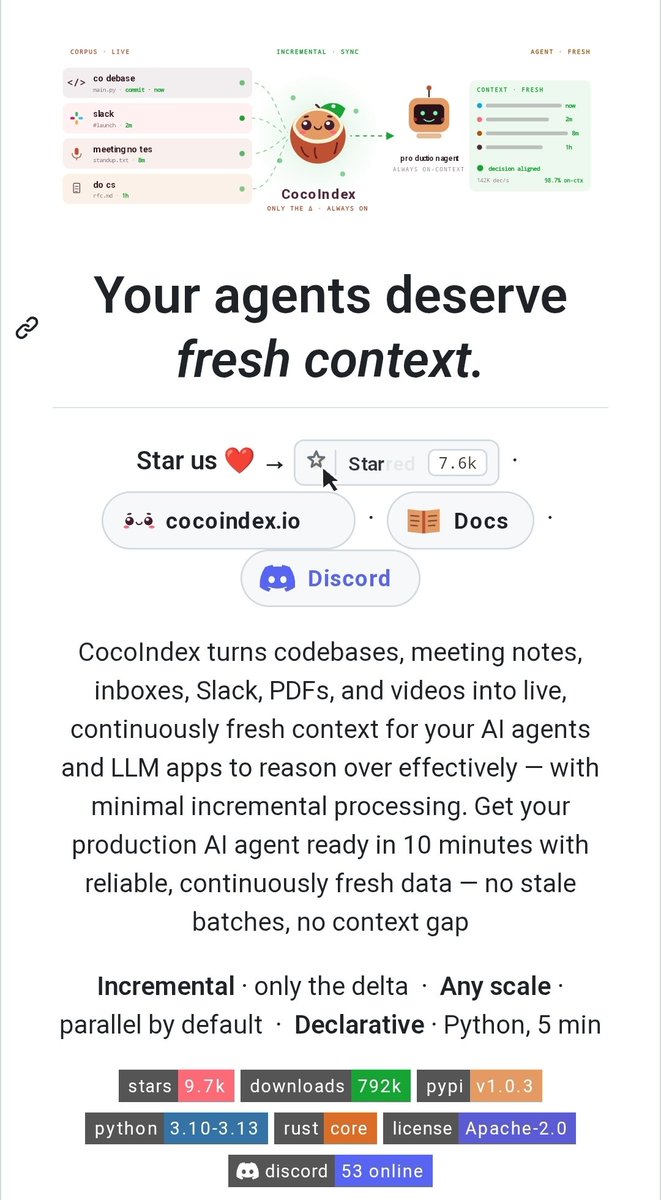
→ CocoIndex (cocoindex-io)
This is an incremental data engine built specifically for long-horizon AI agents.
Not another ETL tool.
👉 A reactive indexing system that continuously keeps AI context fresh.
The architectural shift is subtle — but massive.
Traditional RAG pipelines:
crawl → chunk → embed → store
then rerun everything later
CocoIndex changes the model entirely:
👉 Declare the target state
👉 Recompute only the delta (Δ) forever.
That sounds simple.
But under the hood, it fundamentally changes how AI infrastructure behaves.
Instead of treating indexing as:
• periodic batch jobs
• stateless pipelines
• brute-force recomputation
CocoIndex treats indexing like:
👉 a persistent reactive dataflow system.
Almost like React.js but for data engineering.
The implications are huge.
Imagine an AI coding agent indexing a 5M-line monorepo.
Without incremental processing:
• re-embed everything
• rebuild retrieval indexes
• waste tokens
• burn latency and compute
With CocoIndex:
👉 only modified files reprocess
👉 only affected embeddings update
👉 lineage stays traceable end-to-end.
That's the key insight most people miss:
The future bottleneck in AI infra is not just model quality.
It is:
• context freshness
• retrieval latency
• recomputation cost
• lineage visibility
And CocoIndex is optimized around exactly those constraints.
Architecture ↓
• Rust-based incremental engine
• Python declarative flows
• Parallel-by-default execution
• End-to-end lineage tracking
The system behaves less like:
a traditional ETL framework
and more like:
👉 a continuously updating knowledge substrate for agents.
That’s why it fits naturally into:
• AI coding agents
• semantic code search
• long-lived RAG systems
• autonomous workflows
• enterprise knowledge indexing
Another important shift:
CocoIndex does not optimize for:
query once
It optimizes for:
👉 systems that evolve continuously.
Which is exactly what autonomous agents need.
Because long-horizon agents break when:
• context drifts
• embeddings lag behind reality
• retrieval becomes stale
CocoIndex turns freshness into a first-class systems primitive.
And that's where the industry is heading:
From:
static vector databases
To:
👉 continuously reactive AI memory systems.
Reality check ↓
• Still early-stage infrastructure
• Stateful incremental systems are operationally complex
• Requires careful pipeline design at scale
But directionally?
This is one of the clearest signs that AI infrastructure is evolving beyond:
• prompt engineering
• simple RAG
• batch indexing
Toward:
👉 real-time contextual operating systems for agents.
If you're building:
• coding agents
• enterprise RAG
• autonomous workflows
• continuously learning systems
Study this project.
Try it: github.com/cocoindex-io/coco…
Follow for more on AI infra, retrieval systems, and production agent architectures.
#AI #RAG #DataEngineering #PlatformEngineering
Most teams don't fail at AI because of models.
They fail because the infrastructure stack becomes chaos.
One tool for RAG.
Another for agents.
Another for workflows.
Another for observability.
→ Dify (LangGenius)
This is an open-source LLM application platform that unifies the entire AI app stack.
Not just a chatbot builder.
👉 Workflows + RAG + agents + observability in one runtime.
Core architecture ↓
• Visual workflow orchestration
• Agent execution framework
• Built-in RAG pipeline
• Prompt IDE + evaluation tooling
• Model routing + observability
This is the important shift:
👉 AI apps are becoming infrastructure systems
👉 Not isolated prompts
Execution model ↓
Data → Retrieval → Workflow → Agent → Tools → Output
All orchestrated visually or via APIs.
No glue-code nightmare.
Capabilities ↓
• Multi-agent workflows
• Knowledge base ingestion + chunking
• Tool calling + MCP integrations
• Human-in-the-loop orchestration
• Multi-model support (OpenAI, Claude, Llama, Gemini, etc.)
This matters because:
Most AI stacks today are fragmented:
LangChain + vector DB + observability + workflow engine + custom UI
Dify compresses that into:
👉 One production-oriented platform layer
Infra implications ↓
• Faster prototype → production transition
• Self-hosted deployments (data control)
• Unified monitoring for LLM apps
• Reduced orchestration complexity
Enterprise angle ↓
• Role-based workflows
• API-first deployment model
• Plugin ecosystem + MCP support
• Works with private/local models
This is key:
👉 Dify is positioning itself as LLMOps + AgentOps + WorkflowOps not just an AI UI.
What makes it different:
Flowise → workflow playground
LangChain → developer framework
CrewAI → multi-agent orchestration
Dify →
👉 integrated AI application operating platform
Reality check ↓
• Visual builders hit limits at extreme complexity
• Enterprise-grade scaling still needs infra engineering
• Security hardening matters
But directionally?
This is one of the clearest signs that:
👉 AI development is moving toward platform consolidation
The stack is becoming:
• workflows
• retrieval
• agents
• observability
• deployment
inside one system.
If you're building:
• enterprise AI apps
• RAG systems
• multi-agent workflows
• internal AI platforms
Study this repo.
Try it: github.com/langgenius/dify
Follow for more on AI infra, agent systems, and production architectures.
#MLOps #PlatformEngineering

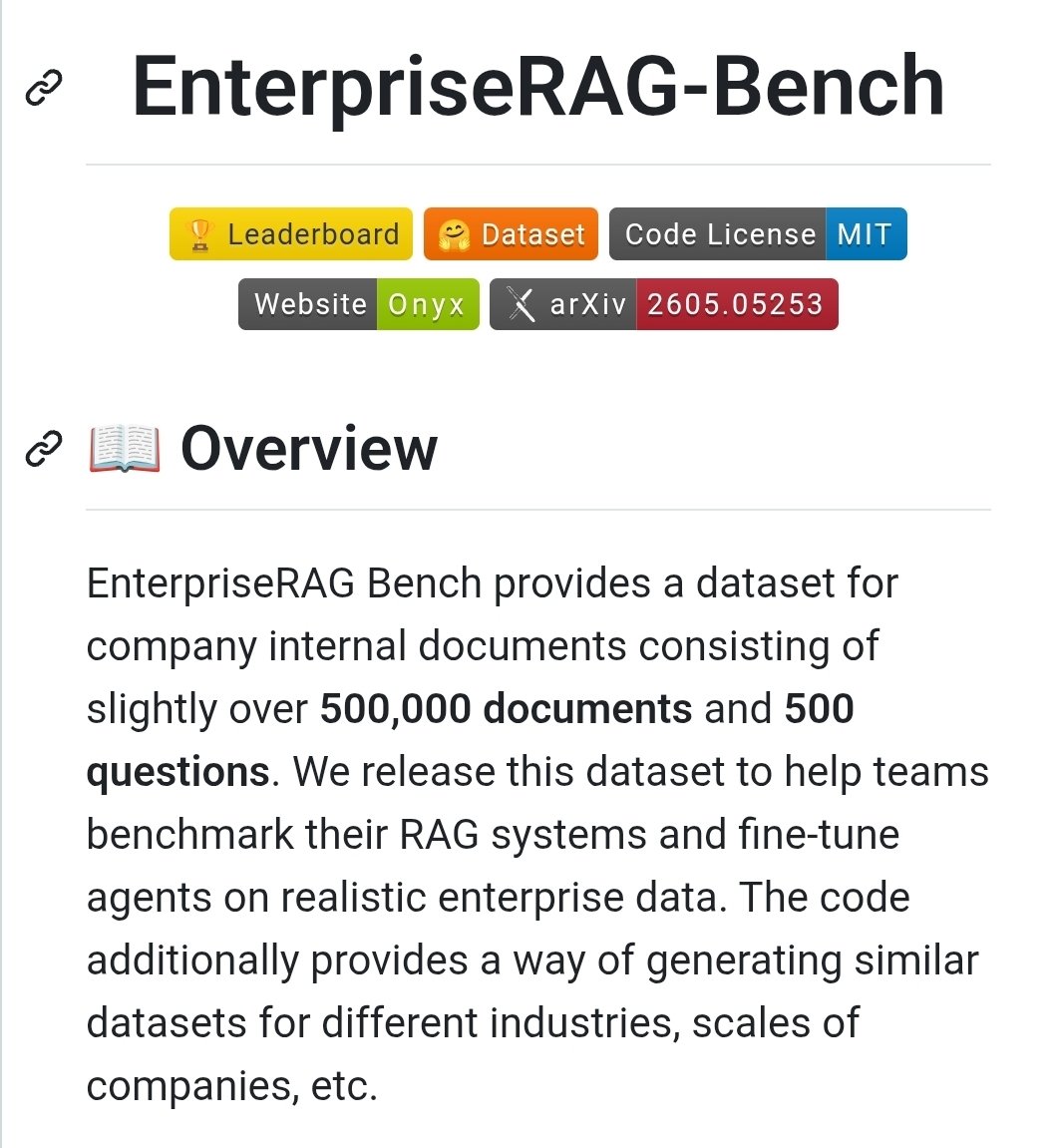
Most RAG benchmarks are useless for enterprise AI.
They test:
• simple retrieval
• short context
• clean datasets
Real enterprise docs are nothing like that.
→ EnterpriseRAG-Bench (Onyx)
This is a benchmark suite specifically designed for enterprise-grade RAG systems.
Not leaderboard theater.
👉 Stress-testing retrieval systems against real enterprise complexity.
Core problem ↓
Most RAG systems look great in demos…
then fail when exposed to:
• long PDFs
• noisy internal docs
• multi-hop reasoning
• compliance-heavy workflows
• fragmented knowledge bases
EnterpriseRAG-Bench focuses on exactly those failure modes.
Core idea ↓
Evaluate:
• retrieval quality
• grounding accuracy
• reasoning over enterprise documents
• citation fidelity
• hallucination resistance
not just chatbot fluency.
This matters because:
👉 Enterprise RAG is an infrastructure problem
👉 Not a prompt engineering problem
Architecture focus ↓
Benchmarks for:
• multi-document reasoning
• long-context retrieval
• structured + unstructured corpora
• enterprise-style knowledge workflows
The important shift:
Traditional RAG evaluation:
"Did the answer sound good?"
EnterpriseRAG-Bench:
👉 "Was the answer correct, grounded, traceable, and reproducible?"
That's a completely different standard.
Infra implications ↓
Production RAG systems need:
• observability
• retrieval evaluation
• grounding verification
• latency/cost tradeoffs
• governance + auditability
Without evaluation infrastructure:
Your "enterprise AI assistant"
becomes a very expensive hallucination engine.
This benchmark exists because the industry is realizing something important:
👉 Vector search alone is not enough
👉 Enterprise AI needs measurable retrieval reliability
Why this matters ↓
As RAG moves into:
• finance
• healthcare
• legal
• internal enterprise ops
Accuracy becomes:
• operational risk
• compliance risk
• financial risk
And benchmarks become critical infra.
Reality check ↓
• Benchmarks never perfectly reflect production
• Enterprise retrieval remains highly domain-specific
• Evaluation quality depends heavily on dataset realism
But directionally?
This is part of a major shift:
From:
"Can the model answer?"
To:
👉 "Can the entire retrieval system be trusted?"
If you're building:
• enterprise RAG
• agentic retrieval systems
• AI knowledge platforms
• production LLM infrastructure
Study this repo.
Try it: github.com/onyx-dot-app/Ente…
Follow for more on AI infra, RAG systems, and production architectures.
#AI #RAG #LLM #AIAgents #MLOps #DevOps #EnterpriseAI #OpenSource #PlatformEngineering
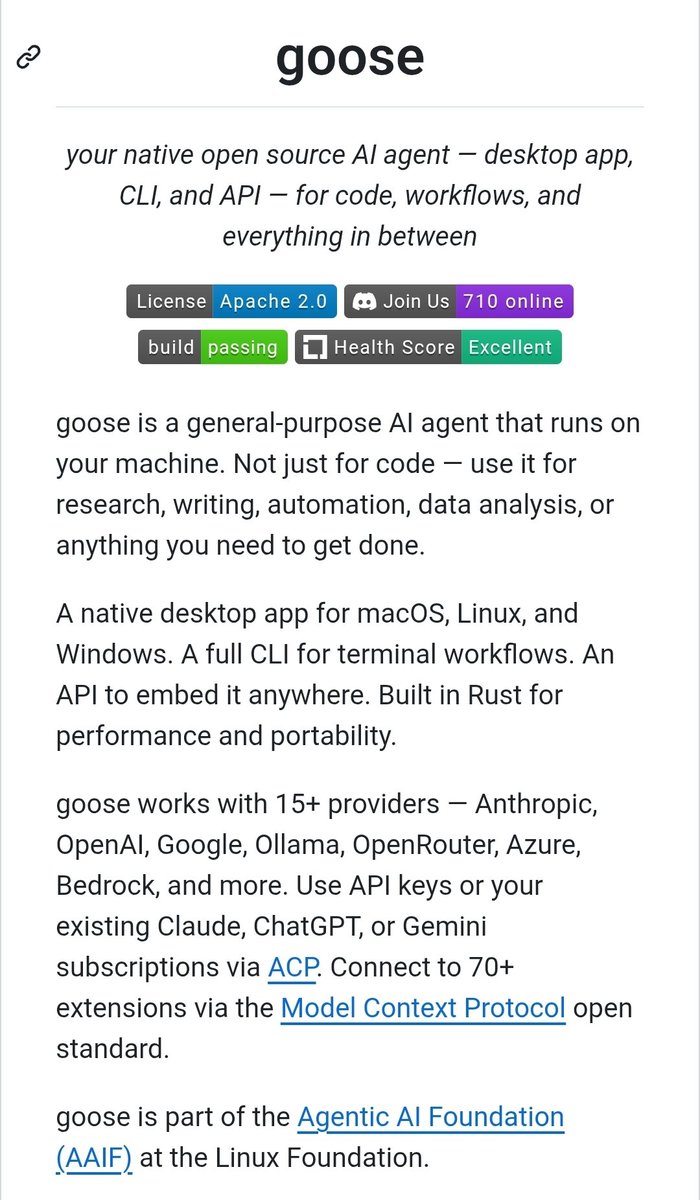
Most AI coding agents are still glorified autocomplete.
They generate code…
but can't actually operate like real developers.
→ Goose (AAIF)
This is a native open-source AI agent runtime built for execution, orchestration, and real workflows.
Not just suggestions.
👉 Install → execute → edit → test → automate
Core idea ↓
Goose runs directly on your machine:
• Desktop app
• CLI
• API layer
Built in Rust for portability + performance.
This is not "chat in an IDE."
👉 It’s an operational AI agent.
Capabilities ↓
• Code generation + editing
• Terminal command execution
• Workflow automation
• Research + data tasks
• Multi-step autonomous execution
Architecture ↓
• Model-agnostic (OpenAI, Claude, local models, etc.)
• MCP-native extension system
• Local-first execution model
• Extensible skills + tools ecosystem
This matters because:
Most agent stacks today are fragmented:
• one app for coding
• another for automation
• another for orchestration
Goose tries to unify that into:
👉 One agent runtime layer.
Infra implications ↓
• Agents become local execution environments
• MCP standardizes external tool access
• Local-first reduces vendor lock-in
• CLI + API enable CI/CD and infra automation workflows
This is also part of a bigger ecosystem shift:
Goose is now under the:
Agentic AI Foundation
Alongside:
• MCP
• AGENTS. md
• open agent interoperability standards
Translation:
👉 AI agents are slowly getting their own Linux layer
Open standards.
Portable runtimes.
Composable tooling.
Reality check ↓
• Powerful agents = real security risk
• Local execution means permission boundaries matter
• Still evolving rapidly (active issue velocity + ecosystem changes)
But directionally?
This is one of the clearest examples of:
👉 AI agents moving from chat products
👉 to operating systems for execution
If you're building:
• coding agents
• autonomous workflows
• AI infra
• developer tooling
Study this project.
Try it: github.com/aaif-goose/goose
Follow for more on AI infra, agent systems, and production architectures.
#AI #AIAgents #DevOps #OpenSource #LLM #RustLang #PlatformEngineering #Automation #MCP
Vector databases solved retrieval for generic text.
But they struggle with long professional documents.
Why?
Because similarity ≠ relevance.
→ PageIndex (VectifyAI)
This is a vectorless, reasoning-based RAG system built around hierarchical document reasoning.
No embeddings.
No chunking.
No vector DB.
Core idea ↓
Instead of:
Document → chunk → embed → similarity search
PageIndex does:
Document → semantic tree index → reasoning-based tree search
Like a human navigating a textbook using:
• table of contents
• section hierarchy
• contextual reasoning
—not cosine similarity.
Architecture ↓
Step 1:
Generate hierarchical document structure
• Titles
• Sections
• Subsections
• Summaries
• Page references
Step 2:
LLM performs multi-step reasoning over the tree to locate relevant sections.
This is the key shift:
👉 Retrieval becomes a reasoning problem
👉 Not a nearest-neighbor search problem
Capabilities ↓
• Long PDF understanding
• Financial / legal / technical documents
• Explainable retrieval paths
• Page-level traceability
No more vibe retrieval.
Every answer can point back to:
• exact section
• exact page
• exact reasoning path
Performance claims ↓
• 98.7% on FinanceBench (via Mafin 2.5)
• Strong performance on reasoning-heavy document QA
This matters because:
Traditional RAG often fails on:
• multi-hop reasoning
• structured reports
• domain-specific documents
It retrieves similar text,
not necessarily the correct context.
Infra implications ↓
• Eliminates vector DB infra overhead
• Preserves natural document structure
• Better interpretability + auditability
• Works well with agentic retrieval workflows
Tooling ecosystem ↓
• Open-source core framework
• MCP server for Claude/Cursor/OpenAI Agents
• JS SDK + APIs for integration
Reality check ↓
• More LLM inference calls = higher latency/cost
• Best for long structured docs, not generic web-scale search
• Multi-document scaling is still evolving
But directionally?
This is one of the most important shifts happening in RAG:
👉 From similarity retrieval
👉 To reasoning-native retrieval systems
If you're building:
• enterprise RAG
• document intelligence
• legal/finance AI
• agentic retrieval systems
Study this repo.
Try it: github.com/VectifyAI/PageInd…
Follow for more on AI infra, RAG systems, and production architectures.
#RAG #VectorDatabase #PlatformEngineering


🤯DEVS ARE LOSING THEIR MINDS OVER CREDENTIAL ABUSE AND CONSTANT SUPPORT🤯
Picture this:
It’s 3:47 AM. Your production app just woke you up with 47 Slack alerts.
There’s just been a massive data breach.
It’s not too late to prevent this from happening.
Sleep better.
Key Rex — Lightning-powered auth that actually works.
#DevOps #DevSecOps #CloudSecurity #CredentialAbuse #SecretsManagement #AWS #InfoSec #Cybersecurity #Developer #DevLife #SRE #BitcoinLightning #LightningNetwork #KeyRex #PlatformEngineering

Most AI assistants are just chat UIs.
No control.
No memory ownership.
No real extensibility.
That's the limitation.
→ QwenPaw (AgentScope)
This is a self-hostable, multi-agent personal AI system.
Not SaaS.
👉 Your assistant runs in your environment (local or cloud)
Core idea ↓
• Personal AI assistant with full data control
• Deploy locally → no data leaves your machine
• Or run in your own cloud (no vendor lock-in)
This is not chatGPT wrapper.
It is an agent platform + assistant combined.
Capabilities ↓
• Multi-agent system (role-based agents collaborating)
• Skill system (PDF, scheduling, automation, custom tools)
• Multi-channel integration (Discord, Telegram, Slack-like apps)
• Memory + personalization fully user-controlled
Execution model ↓
Input → Agent(s) → Tools / Skills →
Memory update → Output
Persistent + evolving system.
Not stateless chat.
Advanced features (recent updates) ↓
• Mission mode → autonomous multi-step execution
• Self-correcting agent loops
• External agent delegation (Claude Code, Codex, etc.)
Translation:
👉 It can plan, execute, and iterate tasks end-to-end
Infra layer ↓
• Built on AgentScope ecosystem (multi-agent runtime)
• Works with MCP + tool ecosystems
• Secure execution (tool guards, file access control)
• Extensible skills (drop-in capabilities, no lock-in)
What makes it different:
Most assistants → UI over API
QwenPaw →
👉 User-owned AI operating system
Use cases ↓
• Personal automation (email, docs, scheduling)
• Multi-agent workflows (research + coding + ops)
• Self-hosted AI assistant for teams
• Cross-platform AI (chat apps + tools unified)
Reality shift ↓
Before:
User → SaaS AI → response
Now:
User → local agent system → execution
This is the direction:
👉 Assistants become systems you run
👉 Not services you subscribe to
If you're building or using agents seriously,
this is the model to understand.
Try it: github.com/agentscope-ai/Qwe…
Follow for more on AI infra, agent systems, and production architectures.
#AI #AIAgents #DevOps #OpenSource #LLM #Automation #SelfHosted #PlatformEngineering

Everyone is building AI agents in Python.
But most production backends still run on PHP.
That gap is real.
→ Neuron AI
This is a production-grade agentic framework for PHP.
Not a wrapper.
👉 A full stack for building AI agents inside real backend systems
Core idea ↓
• Native PHP framework for AI agents
• Plug directly into Laravel / Symfony apps
• Treat agents like first-class backend components
No language switching.
No microservice overhead.
Architecture ↓
• Agent abstraction (memory + tools + function calling)
• Multi-agent orchestration layer
• Built-in RAG pipelines (vector stores + embeddings)
• Monitoring + execution tracing
This is not prompt engineering.
👉 It's agent orchestration inside your backend
LLM layer ↓
• OpenAI, Anthropic, Gemini, Mistral, Ollama
• Switch providers with minimal code changes
• Supports embeddings + structured outputs
Infra implications ↓
• Agents become part of your monolith (not external services)
• No separate Python stack required
• Fits existing CI/CD + PHP ecosystem
• Strong typing + dependency injection (Symfony/Laravel style)
Execution model ↓
Request → Agent → Tools / RAG →
Reasoning → Action → Response
All inside PHP runtime.
What makes it different:
Most frameworks → Python-first experimentation
Neuron →
👉 Production-first agent systems for PHP teams
Use cases:
• AI-powered SaaS backends
• CRM / ERP automation
• Customer support agents
• Internal tooling + workflows
Translation:
👉 You don't bolt AI onto your system
👉 You embed it into your backend architecture
If your stack is PHP, this is the missing layer.
Try it: github.com/neuron-core/neuro…
Follow for more on AI infra, agent systems, and production architectures.
#PHP #Laravel #Backend #MLOps #PlatformEngineering

Most teams can describe what a screen does.
Explaining what's behind it is harder.
Behind that "Confirm now" button is a billing service, a payment API, and a database table that takes real effort to trace.
Maps in UIGraph makes that visible. Drop a focal point on any UI element → instantly see the APIs, services, schemas, and tests tied to it.
Onboarding stops depending on whoever built the feature still being around to explain it.
#DevEx #PlatformEngineering

This is the real MLOps loop:
Train → Deploy → Monitor → Retrain → Automate
And you build it end-to-end.
Why it matters:
👉 Models don't fail in notebooks
👉 They fail in production
If you can handle:
• Data drift
• Broken pipelines
• Deployment rollbacks
• Monitoring alerts
You are no longer ML
You are MLOps-ready.
If you're serious about ML engineering,
this is one of the best free resources out there.
Try it: github.com/DataTalksClub/mlo…
Follow for more on AI infra, MLOps, and production systems.
#MLOps #MachineLearning #DevOps #DataEngineering #AI #Cloud #OpenSource #PlatformEngineering
Most teams optimize prompts.
The real cost leak is model selection.
→ ClawRouter (BlockRunAI)
This is an agent-native LLM routing layer that sits between your app and 30+ models.
Goal:
👉 Route every request to the cheapest model that can handle it
Automatically.
Core architecture ↓
• Local routing (<1ms latency, no external calls)
• 14–15 dimension scoring (complexity, reasoning, code, length)
• Tiered execution → SIMPLE / MEDIUM / COMPLEX / REASONING
• Picks lowest-cost viable model per request
This is not a wrapper.
It's a decision engine.
Cost layer ↓
• Up to ~78–90% inference savings
• Blended pricing vs always hitting premium models
• Handles 30–40+ models (OpenAI, Claude, Gemini, DeepSeek, etc.)
Infra primitives ↓
• Runs as local proxy / gateway
• Stateless routing logic (client-side)
• Works with agent frameworks (OpenClaw)
• Zero API keys → wallet-based auth
Payment model ↓
• x402 micropayments (USDC)
• Pay-per-request (non-custodial wallet)
• No vendor lock-in / no prepaid credits
Why this matters:
Most stacks today:
App → Hardcoded model → $$$ bleed
With ClawRouter:
App → Router → Optimal model → minimized cost
Same output class.
Lower spend.
Use cases:
• Multi-agent systems (dynamic routing)
• Cost-aware SaaS AI backends
• High-volume inference pipelines
• Autonomous agents optimizing their own spend
This is the missing layer in AI infra:
👉 Not better models
👉 Better routing between models
If you're scaling LLM usage,
this is mandatory infra.
Try it: github.com/BlockRunAI/ClawRo…
Follow for more on AI infra, cost optimization, and agent systems.
#AI #AIAgents #LLM #DevOps #CloudNative #FinOps #OpenSource #PlatformEngineering


Last Seen Hashtags on Sotwe
Most Popular Users

Elon Musk 
@elonmusk
240.2M followers

Barack Obama
@barackobama
118.6M followers

Cristiano Ronaldo
@cristiano
114.4M followers

Donald J. Trump
@realdonaldtrump
111.8M followers

Narendra Modi
@narendramodi
106.9M followers

Rihanna
@rihanna
98.6M followers

NASA
@nasa
92.1M followers

Justin Bieber
@justinbieber
91.7M followers

KATY PERRY
@katyperry
89.9M followers

Taylor Swift
@taylorswift13
83.9M followers

Lady Gaga
@ladygaga
75.4M followers

Virat Kohli
@imvkohli
73.3M followers

Kim Kardashian
@kimkardashian
70.8M followers

YouTube
@youtube
68.6M followers

Neymar Jr
@neymarjr
66.3M followers

Bill Gates
@billgates
65.2M followers

Selena Gomez
@selenagomez
63M followers

The Ellen Show
@theellenshow
62.1M followers

CNN
@cnn
61.7M followers

X
@x
60.6M followers