

Top Tweets for #RAGFL

4. RAGFlow (92K stars, Apache 2.0)
https://t.co/ghyfDoB5Vk
Give it your documents and get an AI agent that answers from them, built on a visual agent canvas.
1. RAGFlow (92K stars, Apache 2.0)
https://t.co/ghyfDoB5Vk
A full RAG app you host yourself. Upload PDFs, Word files and slides, then chat with them and see the sources.

Been playing with RAG pipelines. Any suggestions for open source pipelines ? I found out docling / ragflow ( paid ) / liteparse.

@ragflagg Subliminals and mirror affs 🥹

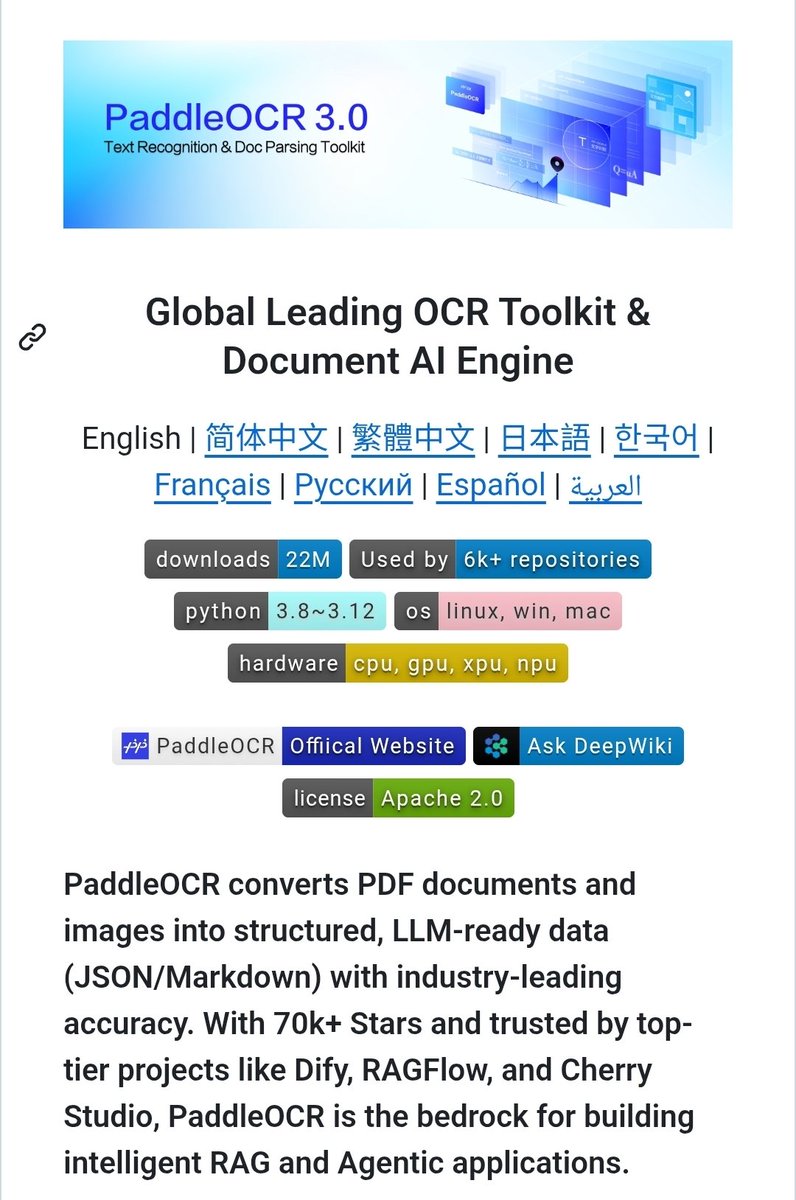
OCR is no longer just about reading text.
PaddleOCR is turning documents into AI-ready data.
And that's why it has become one of the most important document AI projects in the world, with nearly 80K GitHub stars and adoption across platforms like Dify, RAGFlow and Cherry Studio.
What's technically fascinating is the architecture.
PaddleOCR has evolved far beyond traditional OCR pipelines. The ecosystem now includes PP-OCRv5 for multilingual text recognition, PP-StructureV3 for document parsing, PP-ChatOCR for document understanding and PaddleOCR-VL, a compact 0.9B vision-language model capable of parsing text, tables, formulas, charts and complex document layouts into structured Markdown and JSON. It supports 100+ languages and bridges the gap between PDFs, images and LLM workflows.
Recent releases push the frontier even further.
PaddleOCR-VL-1.5 achieved state-of-the-art results on OmniDocBench while adding text spotting, seal recognition and stronger robustness against scanning artifacts, skewed documents, screen captures and warped pages. New research on PaddleOCR-VL-1.6 reports another leap forward with a 96.33% benchmark score through targeted post-training and region-aware optimization.
The futuristic upgrades get really interesting.
Imagine AI agents reading contracts, invoices, forms, research papers and handwritten notes with human-level accuracy.
Or enterprise memory systems where every scanned document instantly becomes searchable, structured and connected to downstream workflows.
Or autonomous document agents that OCR, classify, extract, validate and reason over millions of pages without human intervention.
GitHub:
https://t.co/tRivzLr4cK
Follow @Alacritic_Super for more AI infrastructure, document AI & open-source breakthroughs 🚀

19 RAGFlow
↳ Implements retrieval-augmented generation pipelines for enterprise search & QA.
20 Claude Code
↳ Assists coding with deep repository understanding & agent-style workflows.
What else should make this list?
===

@fadeone_x What is it? I use RAGFlow, Docling, and trying some.
Curious what make you confident with yours.
And open source? That is very welcoming!

この子の未公開差分、Patreonに置いてます💗
よかったら見てね…♡
https://t.co/RaGFlpC0D8


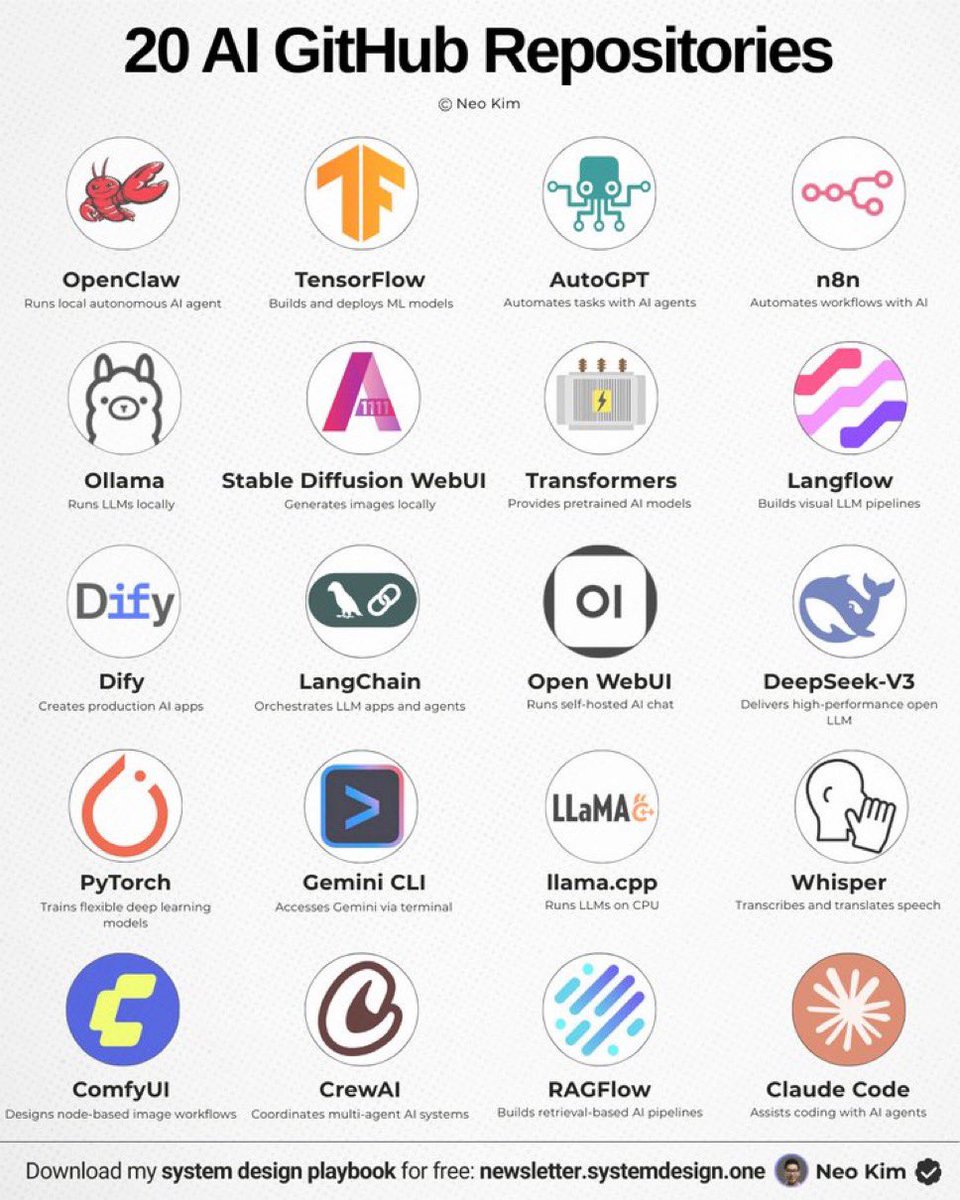
20 GitHub repos to elevate your AI engineering career (save this):
1 OpenClaw
↳ Runs a personal AI agent locally that can browse, plan & take actions on your device.
2 TensorFlow
↳ Provides a production-ready framework to build, train & deploy machine learning models at scale.
3 AutoGPT
↳ Automates multi-step tasks by chaining LLM reasoning into autonomous agents.
4 n8n
↳ Automates workflows with a visual builder that integrates APIs, data & AI tools.
5 Ollama
↳ Runs open LLMs locally with simple commands & optimized performance.
6 Stable Diffusion WebUI
↳ Generates images locally with a powerful UI for Stable Diffusion models.
7 Hugging Face Transformers
↳ Offers thousands of pretrained models for NLP, vision & multimodal AI tasks.
8 Langflow
↳ Builds & tests LLM pipelines visually using a drag-and-drop interface.
9 Dify
↳ Creates production-ready AI apps with built-in orchestration, prompts & APIs.
10 LangChain
↳ Orchestrates LLM workflows, tools, memory & agents in applications.
11 Open WebUI
↳ Delivers a self-hosted ChatGPT-style interface with local & API model support.
12 DeepSeek-V3
↳ Provides a high-performance open-weight LLM optimized for reasoning and coding.
13 PyTorch
↳ Builds & trains deep learning models with flexible, research-friendly APIs.
14 Gemini CLI
↳ Interacts with Google’s Gemini models directly from the command line.
15 llama cpp
↳ Runs LLaMA-style models efficiently on CPUs & local hardware.
16 Whisper
↳ Transcribes & translates speech with high accuracy using deep learning.
17 ComfyUI
↳ Designs advanced image generation workflows using node-based pipelines.
18 CrewAI
↳ Coordinates multiple AI agents to collaborate on complex tasks.
19 RAGFlow
↳ Implements retrieval-augmented generation pipelines for enterprise search & QA.
20 Claude Code
↳ Assists coding with deep repository understanding & agent-style workflows.
What else should make this list?
💾 Save this for later & RT to help other software engineers learn AI.

Top 12 GitHub AI Repositories
These repositories were selected based on their overall popularity and GitHub stars.
1. OpenClaw: The always-on personal AI agent that lives on your device and talks to you through WhatsApp, Telegram, and 50+ other platforms.
2. N8n: A visual workflow automation platform with native AI capabilities and 400+ integrations.
3. Ollama: Run powerful LLMs locally on your own hardware with a single command.
4. Langflow: A drag-and-drop visual builder for designing and deploying AI agents and RAG workflows.
5. Dify: A full-stack prod-ready platform for building and deploying AI-powered apps and agentic workflows.
6. LangChain: The foundational framework powering the AI agent ecosystem with modular building blocks.
7. Open WebUI: A self-hosted, offline-capable ChatGPT alternative
8. DeepSeek-V3: An open-weight LLM that rivals GPT on benchmarks and is free for commercial use.
9. Gemini CLI: Google’s open-source tool to interact with the Gemini model right from your terminal.
10. RAGFlow: An enterprise-grade RAG engine that grounds AI answers in real documents with citation tracking.
11. Claude Code: An agentic coding tool that understands your entire codebase and executes engineering tasks from the terminal.
12. CrewAI: A lightweight Python framework for assembling teams of role-playing AI agents to collaborate on tasks.
Over to you: Which other repository will you add to the list?

セフレ晒し



Lulú activo 😌


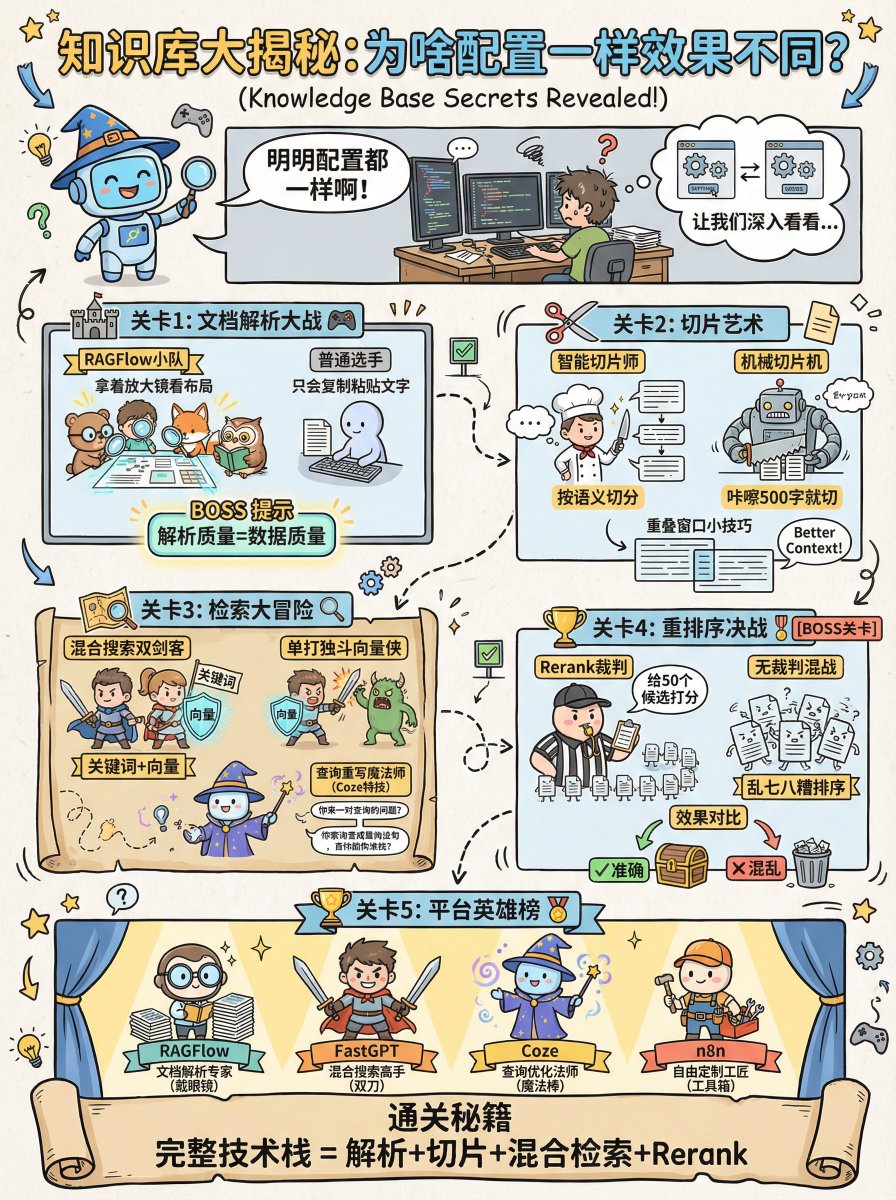
为什么知识库配置明明一样,但不同平台的效果却完全不同?
昨晚给一家企业做咨询,讨论到他们内部流程的知识库目前检索效果不佳。我看他们在用的是一个私有部署的工作流平台,顺口问了一句:“这块有没有试过专门的 FastGPT 或者 RAGFlow?”
对方很疑惑:“没有。我们这个平台现在的知识库功能挺全的,切片、向量化、混合检索都有。底层的原理不都是 RAG 吗?换个平台效果能有多大差别?”
这其实是很多B端落地的误区:以为 RAG(检索增强生成)是一个标准化的功能模块,只要有了“上传 + 切片 + 搜索”这三板斧,效果就应该是一样的。
其实不然。这里的核心差异在于「知识库工程化」的深度。即使你上传同样的文件、配置同样的切片大小(Chunk Size)、使用同样的 Embedding 模型,不同平台跑出来的检索命中率可能天差地别。
1、很多人被平台配置的UI 骗了。
通用的 RAG 流程确实大同小异:文档解析、切片、向量化、存储、检索、生成。在 UI 界面上,你看到的配置项也无非是“切片长度 512,TopK 5”。
但这两个看似相同的数字背后,执行的代码逻辑可能完全不同。决定检索质量的,往往是那些配置界面上看不到的隐形工程。
2、差异的第一步发生在「文档解析」(Parsing)阶段:是读文字,还是理解排版?
很多通用平台使用开源的基础库(如 LangChain 的默认 Loader)来读取 PDF。如果你的文档是双栏排版,普通解析器只会傻傻地按行读取,结果就是把左栏的半句话和右栏的半句话拼在一起,造成语义错乱。这种数据一旦进入数据库,检索效果必然崩塌。
而在RAGFlow 这类平台中,它引入了 DeepDoc 视觉模型。它像人眼一样先看文档的布局,识别出哪里是标题、哪里是表格、哪里是跨页段落。比如处理一张复杂的财务报表,普通平台提取出来的是一堆乱码字符,而 RAGFlow 能保留表格结构。解析精度的差异,避免了Garbage in, Garbage out 的问题。
3、当「切片策略」设置 Chunk Size = 500 时,不同平台的执行逻辑也是完全不同的:字符数 vs 语义。
n8n 如果你手动搭建流程,它可能就是机械地在第 500 个字符处截断。如果这句话没说完?对不起,切断。这会导致关键信息的上下文丢失。
而 Coze(扣子) 或 FastGPT 的切片逻辑更具语义感知。它们会尝试寻找句号、段落结束符,甚至根据语义完整性自动调整切片长度,确保一段话是完整的。更有甚者,如 RAGFlow 支持的分层切片(RAPTOR)或知识图谱结构,它不是在切分文本,而是在构建信息之间的逻辑关联。
4、「检索策略」配置里都叫“混合检索”,但搜得不一定都准
纯向量检索对于模糊语义很强,但对精确信息很弱。比如你搜“RTX 4090 显卡参数”,纯向量可能会给你找来一堆“高性能计算设备”的描述,却漏掉了包含“4090”这个具体型号的段落。
FastGPT 和 RAGFlow 都在这里下了重注。它们不仅强制开启关键词(BM25)与向量的混合检索,更关键的是引入了 重排序(Rerank) 步骤。系统先粗略召回 50 个片段,再用一个精细模型给这 50 个片段打分排序。
Coze 的做法则更偏向「意图优化」。在检索之前,它可能已经在后台把用户模糊的提问“那个很贵的显卡多少钱”,悄悄重写成了“RTX 4090 的具体价格”,然后再去检索。这种“查询重写”机制,极大地提升了命中率,但你在配置面板上是看不到的。
5、搞清楚不同平台的工程基因,也就决定了他们的应用场景。
RAGFlow 属于重型解析引擎。 它把工程资源砸在了 OCR 和版面分析上。如果你的资料是复杂的工业手册、扫描件、研报,RAGFlow 的视觉解析能力会让检索效果肉眼可见地提升。
FastGPT 偏前端应用。 它的核心是 Q&A 问答对的处理和高效的混合检索工作流。它非常适合做客户服务、标准问答库,强调的是让“问题”直接找到“答案”。
Coze 是有点迷的。 它的知识库是嵌在 Agent 逻辑里的。你觉得它效果好,往往是因为它的工作流在前置意图识别和后置数据处理上帮你做了优化,但效果依然不如前两者。
n8n 实际上并没有知识库,啥都要你自己去搭,费劲。
对于这个话题,大家还有什么看法没?欢迎讨论。


36 hours since making Vero open source
We have found very good acceptance
- Star count: 12
- Major feature request: Build In Progress
- Vero has already featured in a blog piece for evals for GraphRAG
- Docker Image with easy compatibility to RAGflow and Grafana coming soon
Adrenaline Rush!
#VeroOSS
Making Vero Open Source
Update: We have already recieved 9 stars after releasing vero as open source software for testing and debugging AI Agents with real-world edge scenarios and user-personas
Working on our first github issue to build a docker image directly compatible with RAGflow and Grafana
#VeroOSS
Also, opinions on @infiniflowai RAGFlow?
How does it work on complicated tasks?
I am planning on evaluating it using my RAG testing framework Vero, any interesting observations from anyone?

The only RAG engine you’ll ever need! ✨📄
RAGFlow is an open-source RAG engine built for deep document understanding, perfect for delivering truthful Q&A with solid citations.
100% Open Source. Ready to deploy!


the way liyu and sanghyeon been glued to each other lately… chuchuz nation we rise


I was looking for a tool that could cross-reference large documents offline with Ollama and generate a report. Came across Ragflow, which can quickly be set up with Docker. It features a familiar node workflow/chat, as well as highlighting of references.
Trends for you
Most Popular Users

Elon Musk 
@elonmusk
239.6M followers

Barack Obama
@barackobama
118.6M followers

Cristiano Ronaldo
@cristiano
114.3M followers

Donald J. Trump
@realdonaldtrump
111.7M followers

Narendra Modi
@narendramodi
106.9M followers

Rihanna
@rihanna
98.6M followers

NASA
@nasa
92.1M followers

Justin Bieber
@justinbieber
91.7M followers

KATY PERRY
@katyperry
89.9M followers

Taylor Swift
@taylorswift13
83.9M followers

Lady Gaga
@ladygaga
75.4M followers

Virat Kohli
@imvkohli
73.3M followers

Kim Kardashian
@kimkardashian
70.8M followers

YouTube
@youtube
68.6M followers

Neymar Jr
@neymarjr
66.3M followers

Bill Gates
@billgates
65.1M followers

Selena Gomez
@selenagomez
63M followers

The Ellen Show
@theellenshow
62.1M followers

CNN
@cnn
61.7M followers

X
@x
60.6M followers