

Top Tweets for #SAMVAADTALK

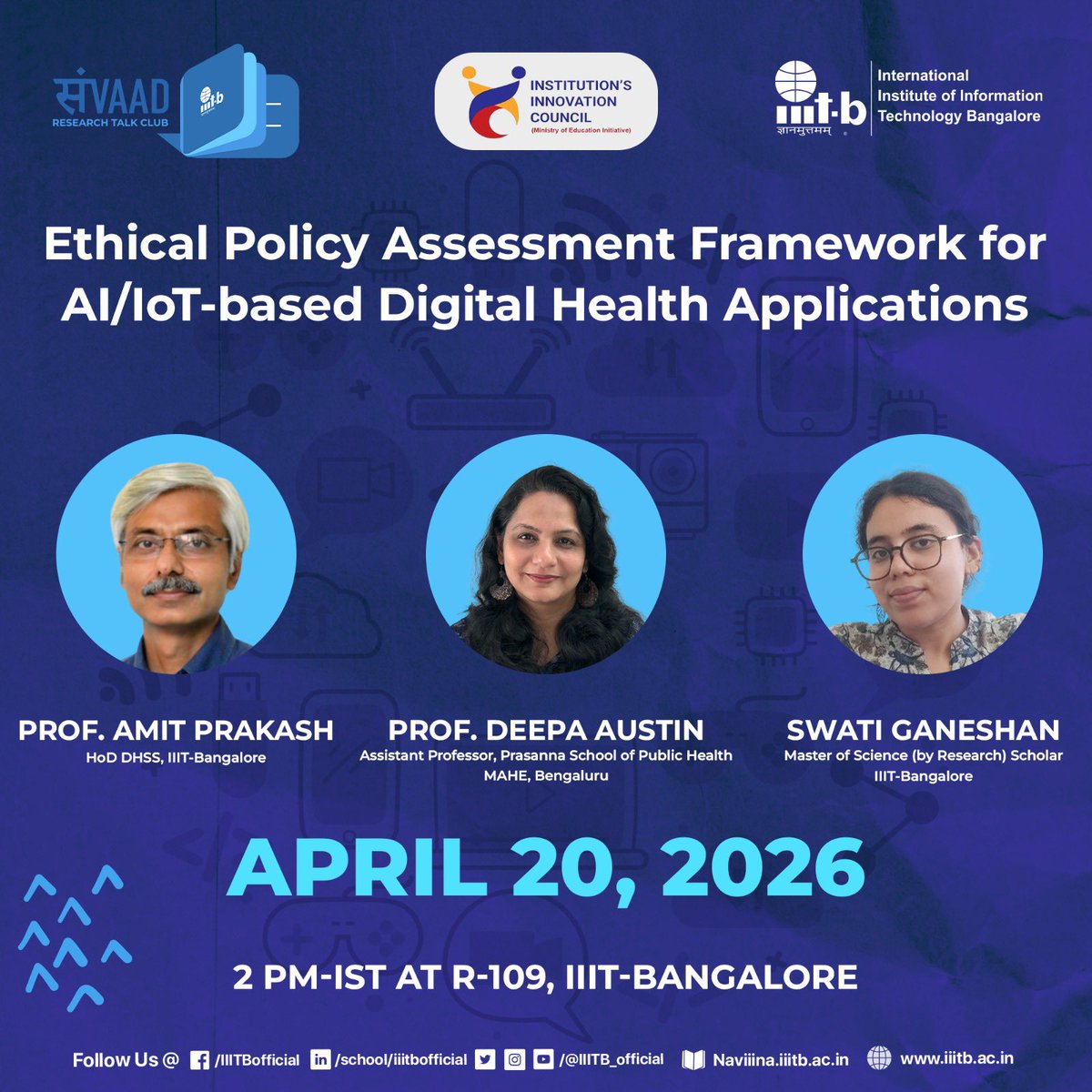
#SamvaadTalk
Speakers:
Prof. Amit Prakash, HoD DHSS, IIIT-Bangalore
Prof. Deepa Austin, Assistant Professor, Prasanna School of Public Health, MAHE, Bengaluru
Swati Ganeshan, Master of Science (by Research) Scholar, IIIT-Bangalore
Date & Time: 20th April, 2026 at 2:00 pm IST
Venue: R-109, IIIT-Bangalore
Title: Title: Ethical Policy Assessment Framework for AI/IoT-based Digital Health Applications
Abstract:
AI and IoT are increasingly being deployed in public health settings, amidst a renewed hope of faster progress towards universal care coverage and provisioning. These emerging technology deployments, however, need to be embedded in a robust governance mechanism that is appreciative of the complexity in healthcare systems and aligns with the ethical principles of medical practice.
In this talk, we present details of an applied research project carried out at the Institute's Centre for Internet of Ethical Things (CIET) that led to the development of an ethical policy assessment framework for governing AI/IoT-based digital health applications. Embedded in the philosophy of complex systems and drawing from relevant concepts in the technology ethics literature, the proposed framework seeks to enable a context-aware oversight of digital technology initiatives in public health. Towards this, we operationalize ethics as constitutive of equity, fairness, trust and dignity, and propose a set of questions to be asked of the technology designers and project managers that can allow for better governance of digital health systems.
Bio:
Amit Prakash is a Professor at IIIT-Bangalore. His prior work experience and current interests lie in equity and inclusion of technology designs and policy choices.
Deepa Austin is an Assistant Professor at the Prasanna School of Public Health, Manipal Academy of Higher Education (MAHE), Bengaluru (a HTA India-Regional Resource Centre). She was previously a post-doctoral researcher at the Center for Internet of Ethical Things (CIET), IIIT-Bangalore. Prior to her PhD in the area of IT and Society from IIIT-Bangalore, Deepa has worked for over a decade as a public health consultant and clinical dentist practitioner.
Swati Ganeshan is a Master of Science (by Research) scholar at IIIT-Bangalore. She was earlier a Research Associate at the Center for Internet of Ethical Things (CIET), IIIT-Bangalore. Her research interests include digital ethics, civic participation and urban governance.
#IIITB #IIITBangalore #SamvaadTalks #ResearchTalks
#SamvaadTalk
Speaker: Prof. Chandrashekar Ramanathan, Dean (Academics), IIIT-Bangalore
Date & Time: October 27, 2025; 2:00 pm IST
Venue: R-109, IIIT-Bangalore
Title: GRAILS - An architecture for creating responsible software
Abstract:
Despite the rise of data-driven software systems in the modern digital landscape, data governance under a legal framework remains a critical challenge. In India, the Digital Personal Data Protection (DPDP) Act mandates rigorous data privacy and compliance requirements, necessitating software that are both ethical and regulation-aware. This challenge can be generalized beyond "Responsible AI" to any environment where there are compliance mandates to various laws, rules and regulations to govern responsible use of data. From a software development perspective, traditional compliance tools often rely on enforcement through hard-coded rules and static configurations. Such software is invariably inflexible to dynamic policy updates or evolving legal contexts. Additionally, their architectures obscure decision-making processes, creating black-box behavior in critical governance workflows. Developing responsible software demands transparency, traceability, and adaptive enforcement mechanisms that make ethical decisions explainable. In this talk, we will touch one specific architecture called GRAILS that incorporates the guardrails to create software designs and implementations having these desirable characteristics in responsible software.
Speaker Bio:
Prof. Chandrashekar Ramanathan has been a faculty member at IIIT-B for over 18 years. He comes with a strong software development background having spent over 10 years in the industry in various capacities. At IIIT-B, his teaching interests are in the areas of Data Science and Software Engineering. On the research front, he heads the Machine Intelligence and Robotics (MINRO) Center and also the CTRI-DG software center, both funded by Govt of Karnataka. In data science, his primary research interest lies in the area of information convergence, which is the ability to model, store, and reason with information expressed in multiple heterogeneous data models. In software engineering, his interest lies in model-driven architecture, where the focus is not just on writing code for creating software but instead use reusable models as the building blocks for creating software. He has received accolades from various forums as one of the top data science academicians of the country. At IIIT Bangalore, he also holds the administrative position of Dean of Academics, holding the overall responsibility for all the degree programmes and continuing professional education programmes offered by IIIT-Bangalore.
#IIITB #IIITBangalore #SamvaadTalks #ResearchTalks

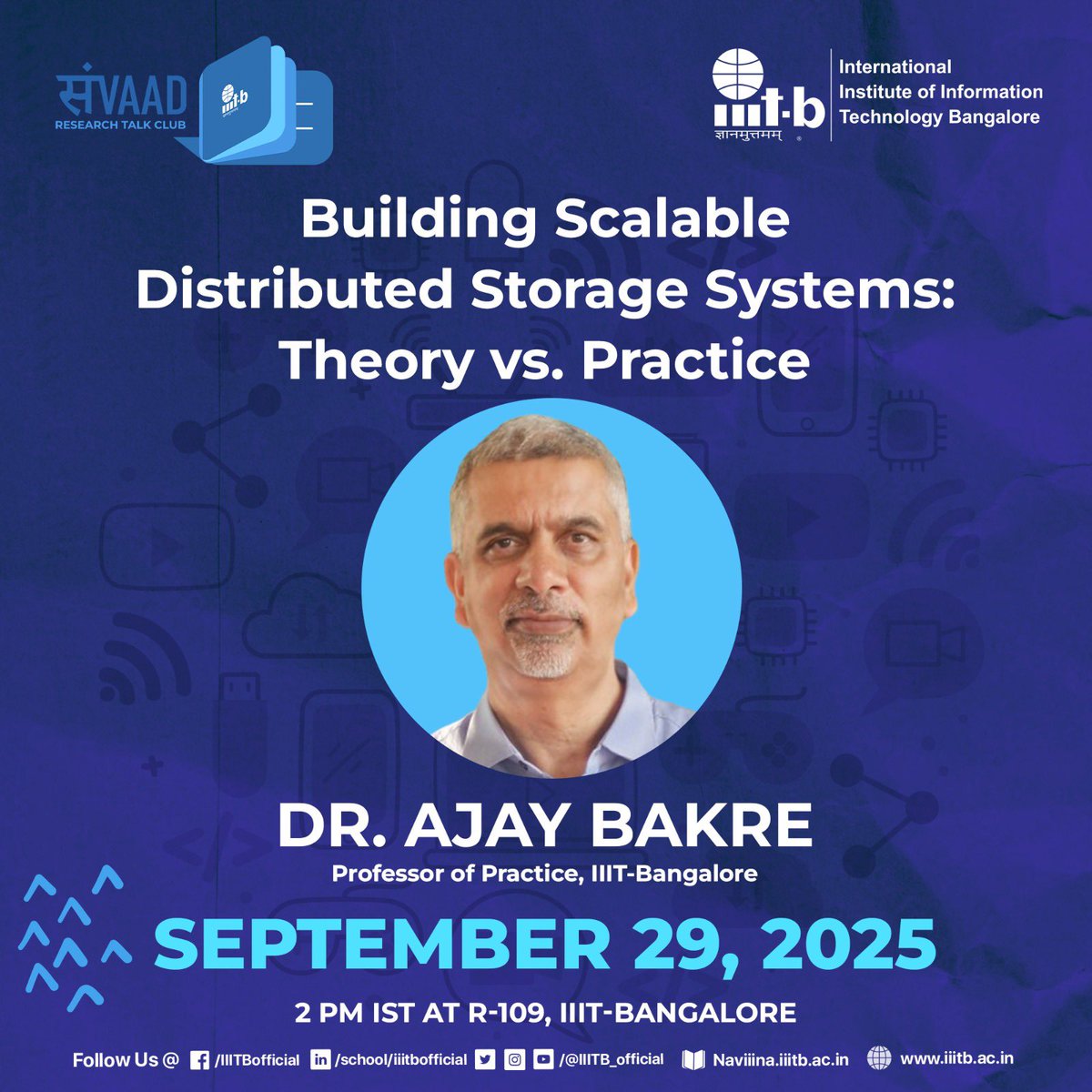
#SamvaadTalk
Speaker: Dr. Ajay Bakre, Professor of Practice, IIIT-Bangalore
Date & Time: September 29, 2025; 2:00 pm IST
Venue: R-109, IIIT-Bangalore
Title: Building Scalable Distributed Storage Systems: Theory vs. Practice
Abstract:
With the proliferation of Internet-based applications and mobile devices, distributed storage systems such as Amazon S3 and Google Drive have become popular in the past few years by managing performance, availability and resiliency expected by consumer as well as enterprise applications. Building scalable distributed storage systems involves making careful design tradeoffs to meet user requirements at reasonable cost. This talk covers fundamentals of storage system design and explores how concepts such as CAP Theorem and error correction codes along with practical considerations such as ease of implementation and cost have shaped the evolution of distributed storage systems.
Brief Profile:
Dr. Ajay Bakre joined IIIT-B and COMET Foundation as Professor of Practice in July, 2024. He has over 27 years of industry experience in startups, corporate research labs and product groups of multinational corporations. His areas of expertise include Scalable and Resilient Distributed Systems, Storage Systems Architecture, Wireless Networks and Core Networks. He holds 9 US patents and he received the ACM SIGMOBILE Test of Time Award in 2016 for his paper titled: “I-TCP: Indirect TCP for Mobile Hosts”, published in 1995.
#IIITB #IIITBangalore #SamvaadTalks #ResearchTalks
#SamvaadTalk
Speaker: Prof. Vaishnavi Gujjula, Assistant Professor, IIIT-Bangalore
Date & Time: September 22, 2025; 2:00 pm IST
Venue: R-109, IIIT-Bangalore
Title: Fast Machine Learning through Hierarchical Matrices with Low-Rank Structure
Abstract
Kernel-based methods such as Support Vector Machines, Gaussian Process Regression, and Kernel Density Estimation are widely used in data science, providing powerful tools for classification, regression, and density estimation. However, their applicability to large-scale problems is hindered by the prohibitive cost of dense matrix algebra. Similar challenges also arise in scientific machine learning, for instance, when solving partial differential equations with neural networks. In this talk, I will present how hierarchical matrix algebra and related low-rank approximations reduce the computational bottlenecks. I will talk about how this principle can be applied to speed up computations in kernel-based machine learning algorithms such as Support Vector Machines, Gaussian Process Regression, Kernel Density Estimation and to develop efficient neural network solvers for PDEs. Finally, I will also discuss how the same idea can be used to accelerate computations in vision transformers.
Biography of the speaker
Vaishnavi Gujjula is an Assistant Professor in the Department of Data Science and Artificial Intelligence (DSAI), IIIT-Bangalore. She received her Ph.D. from the Indian Institute of Technology Madras in 2023. Her research interests include computational mathematics, fast algorithms, numerical linear algebra, and scalable machine learning. Her Ph.D. thesis focused on developing fast algorithms that are based on principles from scientific computing and numerical linear algebra. These fast algorithms have applications in solving partial differential equations (PDEs) and developing scalable machine learning algorithms. After receiving her Ph.D., she was a postdoctoral fellow at the Indian Institute of Science from 2023 to 2024. Her work has been published in various reputed international journals (SISC, JCP, CiCP, and Numerical Algorithms) and conferences (SIAM AN, ILAS, CIKM, IEEE APS). Before joining IIITB, she was an Assistant Professor at PES University (Bangalore, 2024-2025). Even earlier, she had worked as a Deputy Engineer at Bharat Electronics Limited (BEL, Bangalore, 2014-2016).
#IIITB #IIITBangalore #SamvaadTalks #ResearchTalks

#SamvaadTalk
Speaker: Prof. Naganand Yadati, IIIT-Bangalore
Date & Time: September 15, 2025; 2:00 pm IST
Venue: R-109, IIIT-Bangalore
Title: Mitigating Over-Globalising in Transformers on Graphs
Abstract:
Transformers on graph-structured datasets, e.g., social networks, have shown great promise by allowing every node (e.g., user account) in a network to attend to all other nodes, capturing what we call global patterns across the entire graph. However, this strength leads to a critical 'over-globalising' problem, where the model's focus on distant nodes can overwhelm the more nuanced signals from a node's immediate neighbours, i.e., its local context. In a social network, for instance, the predictive influence of a user's immediate friends can be drowned out by globally popular but irrelevant accounts, washing out important local signals and hurting predictive performance. To address this issue, we propose LocalFormer, a novel framework that integrates a distinct local module to preserve these fine-grained neighborhood patterns with a global transformer module to integrate broader context. Through innovative collaborative and warm-up training strategies, these modules work in tandem to mitigate the negative effects of over-globalising. Our experimental results on various vertex-classification tasks demonstrate that LocalFormer effectively balances this trade-off and outperforms state-of-the-art baselines.
Biography:
Naganand Yadati holds a PhD in Computer Science from the Indian Institute of Science, awarded in 2021. He specialises in machine learning and deep learning with expertise in graph neural networks and hypergraphs. His PhD focused on novel extensions of graph neural networks to hypergraphs. Before joining IIIT-Bangalore, he was a postdoctoral researcher at the National University of Singapore, where he focused on simplified models for graph learning. His research has resulted in multiple publications at premier venues, including NeurIPS, ICDM, and TMLR.
#IIITB #IIITBangalore #SamvaadTalks #ResearchTalks

#SamvaadTalk
Speaker: Prof. Raghuram Bharadwaj, IIIT-Bangalore
Date & Time: September 08, 2025; 2:00 pm IST
Venue: R-109, IIIT-Bangalore
Title: Prompt Optimization using Reinforcement Learning
Abstract:
Prompt optimization has emerged as a critical area in maximizing the utility of large language models. In this talk, I will begin with a brief overview of the reinforcement learning (RL) paradigm, which naturally lends itself to sequential decision-making and optimization. We will then explore why prompt optimization matters, both for improving model performance and for practical considerations such as prompt compression, where reducing token length translates directly into lower inference cost and improved latency. I will highlight several prominent works from the literature that leverage RL-inspired methods for optimizing and compressing prompts. I will conclude with a discussion of open problems and promising directions for advancing this space, particularly in making prompt optimization more scalable, robust, and interpretable.
Bio:
Raghuram Bharadwaj is an Assistant Professor in the department of Data Science and Artificial Intelligence (DSAI), IIIT Bangalore. He is recipient of the prestigious ANRF Prime Minister Early Career Research Grant (PM ECRG) 2025. He received his Ph.D. from the Indian Institute of Science (IISc), Bangalore, in 2022. His main research interests are in the areas of Reinforcement Learning, Deep Learning, Machine Learning, Game theory, and Multi-agent learning. He received the best student paper award at the International Joint Conference on Neural Networks (IJCNN) 2022 in Padova, Italy. His Ph.D. thesis focuses on developing reinforcement learning algorithms to solve off-policy, multi-agent problems and apply these algorithms to the smart grid setup. He received a special commendation certification in recognition of an outstanding doctoral thesis from the Department of Computer Science and Automation (CSA), IISc. Before joining IIIT Bangalore, he was the senior data scientist at Myntra Designs Ltd., Bangalore, India, from November 2021 to November 2022.
#IIITB #IIITBangalore #SamvaadTalks #ResearchTalks

#SamvaadTalk
Speaker: Prof. Arpit Narechania, Assistant Professor, Hong Kong University of Science and Technology (HKUST)
Date & Time: August 29, 2025; 3:00 pm IST
Venue: R-101, IIIT-Bangalore
Title: Human-Centric Al Guidance for Visual Analytics
Abstract:
Given the scale and complexity of today's datasets, people face a critical challenge during visual data analysis: an overwhelming number of decisions. These decisions—about what, where, when, and how to visualize data—directly influence the quality of the analysis process and outcomes. For example, a user must decide which attributes to visualize, whether to apply filters, or which chart type best represents the data. While AI-powered tools are increasingly available to assist with these decisions, current support often lacks the human-centric adaptability and transparency that users need, leading to biased interpretations, missed insights, and flawed conclusions. In this talk, I will showcase guidance-enriched visual analytics tools where AI-powered systems and human users collaboratively “guide” each other during analysis. Specifically, I will demonstrate how guidance can (1) help data analysts increase awareness of biased and unbiased analytic behaviors, (2) support mapmakers in creating accurate and trustworthy maps, and (3) help people author and style data visualizations using natural language. In doing so, I will illustrate how human-centric AI enhances human decision-making as well as system learning, championing the vital and inevitable collaboration between humans and AI today.
Speaker Bio:
Arpit Narechania is an Assistant Professor in the Department of Computer Science and Engineering (CSE) at the Hong Kong University of Science and Technology (HKUST). He received his PhD in Computer Science from Georgia Institute of Technology, USA and BS (https://t.co/EbmHp0fn7G.) in Mechanical Engineering from Indian Institute of Technology (IIT) Mandi, India. Prior to academia, Arpit was a founding engineer at multiple startups in the FinTech and EdTech sectors, where he worked on projects to improve financial inclusion in India, optimize US stock market investments, and enhance middle school physics education. He has also contributed to digital governance initiatives for the Government of India. As an academic now, Arpit's main research interests are in visual analytics, human-computer interaction (HCI), and artificial intelligence (AI), with particular focus on 'catalyzing' human-AI collaboration, as part of which he builds interactive tools and fosters conducive environments that actively enhance the way humans and AI work together. He has collaborated with industry leaders such as Adobe Research, Microsoft Research, Ford Motor Company, and Alibaba, leading interdisciplinary projects that have resulted in multiple patents, publications, product integrations, and open-source releases. For more info, checkout https://t.co/svnxiZFT76.
#IIITB #IIITBangalore #SamvaadTalks #ResearchTalks

#SamvaadTalk
Speaker: Prof. Santosh Nagarakatte, Professor and Undergraduate Program Director of Computer Science at Rutgers University
Date & Time: July 24th, 2025; 2 pm IST
Venue: R-101, IIIT-Bangalore
Title: From Formal Verification to Correctly Rounded Math Libraries
Abstract:
This talk will provide the (previously untold) stories of the origin and the evolution of various research projects in my group ranging from memory safety enforcement to automatic verification of the peephole optimizations in the LLVM compiler finally culminating with the RLIBM project where we are building correctly rounded math libraries. In essence, audience will find instances of applying ideas from programming languages to build safe and secure computing systems.
Biography of the speaker:
Santosh Nagarakatte is a Professor and Undergraduate Program Director of Computer Science at Rutgers University. He obtained his PhD from the University of Pennsylvania in 2012. His research interests are in Hardware-Software Interfaces spanning Programming Languages, Compilers, Software Engineering, and Computer Architecture. His papers have been selected as IEEE MICRO Top Picks papers of computer architecture conferences in 2010 and 2013. He received the NSF CAREER Award in 2015, ACM SIGPLAN PLDI 2015 Distinguished Paper Award, ACM SIGSOFT ICSE 2016 Distinguished Paper Award, and 2018 Communications of the ACM Research Highlights paper for his research on LLVM compiler verification. His PhD student David Menendez’s dissertation on LLVM verification was awarded the 2018 ACM SIGPLAN John C Reynolds Outstanding Dissertation Award. His papers on correctly rounded elementary functions have been recognized with the ACM SIGPLAN PLDI 2021 Distinguished Paper Award and the ACM SIGPLAN POPL 2022 Distinguished Paper Award. His PhD student Jay Lim’s dissertation on correctly rounded elementary functions was awarded the 2022 ACM SIGPLAN John C Reynolds Outstanding Dissertation Award. He was selected as the ACM Distinguished Member in 2023.
#IIITB #IIITBangalore #SamvaadTalks #ResearchTalks

#SamvaadTalk
Speaker: Prof. Preeti Malakar, Assistant Professor in the Department of Computer Science and Engineering, Indian Institute of Technology Kanpur
Date & Time: 23rd July, 2025; 3 pm - 4 pm IST
Venue: R-101, IIIT-Bangalore
Title: High performance simulation data analysis and visualizations in resource-constrained environments
Abstract:
Today's powerful computing facilities have enabled executions of scientific simulations at unprecedented scales. Such simulations produce an enormous amount of output data that need to be analyzed and visualized in order to glean insight from the simulations. However, the time to write and read gigabytes of data may be significantly high due to comparatively lower I/O bandwidth and network bandwidth. A high temporal resolution is desirable so that important phenomena are not missed, however it is infeasible to write every time step of the simulation. Thus, an important research question is to determine how frequently to output and analyze within available resource and application constraints. In the first part of the talk, we will present an optimization problem to solve this.
Natural disasters cause massive devastation. Accurate forecasting of disasters such as cyclones, flash floods, snowfall with high lead times is essential for taking timely actions. In the second part of the talk, we will discuss an online framework to predict four extreme events while a simulation is running. Our framework uses a deep predictive model based on convolutional neural network (CNN) which is executed in parallel. The data is then transferred to visualization processes for real-time visualization of extreme events. We also improve the end-to-end simulation-analysis-visualization time using direct memory-to-memory transfer and selective data transfer based on the predictions, this results in more than 70% reduction in total times.
Biography of the speaker:
Preeti Malakar is an Assistant Professor in the Department of Computer Science and Engineering, Indian Institute of Technology Kanpur. Prior to this, she worked at the Argonne National Laboratory, USA. She completed her PhD from the Department of Computer Science and Automation, Indian Institute of Science Bangalore. Her research interests include scalable parallel communications, modeling and optimizing scientific workflows, parallel I/O, and application performance modeling/analysis.
#IIITB #IIITBangalore #SamvaadTalks #ResearchTalks

#SamvaadTalk
Speaker: Dr. Kesav Kaza, Research Fellow, University of Ottawa, Canada
Date & Time: April 21, 2025; 2:00 pm IST
Venue: R-109, IIIT-Bangalore
Title: Decision Referrals in Human-Automation
Teams: Impact of task load on team performance
Speaker bio:
Kesav Kaza is currently a research fellow at the University of Ottawa, Canada, where he works on automated decision making applications in aerial robotics including UAV and counter-UAV systems. Earlier he was a postdoctoral researcher at University of Montreal from 2021 to 2023 where he worked on human-automation teams for decision making. Kesav Kaza received a Phd in Electrical Engineering from IIT Bombay in 2020. He received Btech and M.S. by research degrees from IIIT Hyderabad. His research interests include decision making under uncertainty, human-automation teaming, reinforcement learning, stochastic control, and domain adaptation.
.
.
.
#IIITB #IIITBangalore #SamvaadTalks #ResearchTalks

#SamvaadTalk
Speaker: Prof. Kurian Polachan, IIIT-Bangalore
Date & Time: April 7, 2025; 2:00 pm IST
Venue: R-109, IIIT-Bangalore
Title: Physical Unclonable Functions for Securing Resource Constrained Hardware Nodes in IoT
Abstract: Several security breaches in IoT networks occur when hackers gain physical access to devices and replace them with compromised clones. By doing so, an attacker can leak sensitive information, such as secret keys stored in the device, which can later be used to eavesdrop on communications. In healthcare IoT, for instance, a compromised clone can expose patients’ confidential health data, posing privacy concerns. Traditional methods mitigate cloning attacks by using unique identifiers (IDs) and securing communications by encrypting transmissions with secret keys, both stored in non-volatile memory (e.g., FLASH or ROM). However, IDs or keys stored in non-volatile memory are vulnerable to physical attacks, as adversaries with device access can extract them. An alternative approach is to generate unique identifiers or secret keys at runtime, preventing attackers from accessing them. Physical Unclonable Functions (PUFs) follow this approach, leveraging inherent manufacturing variations in electronic devices to create device-specific identifiers and secret keys at runtime, making them difficult to duplicate or extract. This Samvaad talk will explore the role of PUFs as security primitives for IoT devices, discussing their mechanisms, performance metrics, and their suitability for resource-constrained IoT environments. Additionally, the talk will introduce novel PUF designs developed in the Connected Devices and Wearables Lab at IIIT-Bangalore, specifically tailored for low-power and resource-constrained IoT nodes. The session will conclude by addressing existing challenges and future research directions in PUF-based security for IoT.
Speaker's Bio: Dr. Polachan currently works as an Assistant Professor at IIIT-Bangalore. At IIIT-Bangalore, he manages the Connected Devices and Wearables Lab, which focuses on researching hardware and systems for low-power and resource-constrained IoT systems with applications in healthcare, consumer electronics, and industrial IoT. The lab's specific research interests include developing hardware security measures to protect devices from unauthorized access and cloning, securing device communications at the physical layer, and engineering low-power devices and wearables with edge AI/ML capabilities for secure and privacy-preserving data processing and analytics. Dr. Polachan worked as a postdoctoral researcher from 2021 to 2022 at Purdue University, where he worked on ultra-low-power biomedical wearable designs. He received his Ph.D. in 2021 from the Indian Institute of Science, where he worked on tactile cyber-physical systems (CPS) and time-sensitive networking, and his https://t.co/uVcYmJDwZU in 2014 from the Indian Institute of Science in Electronics Design and Technology. He has over five years of industry research experience with Cypress Semiconductors (now Infineon Technologies), where he developed capacitive touch sensing user-interface solutions for consumer electronics products.
#IIITB #IIITBangalore #SamvaadTalks #ResearchTalks

#SamvaadTalk
Speaker: Dr. Kiran Shiragur, Microsoft Research
Date & Time: February 17, 2025; 2:00 pm - 3:00 pm IST
Venue: R-109, IIIT-Bangalore
Title: New research directions in vector search
Abstract: Vector search is a fundamental problem with numerous applications in machine learning, computer vision, recommendation systems, and more. While vector search has been extensively studied, modern applications have introduced new requirements, such as diversity, multivector, multifilter, and others. In this talk, we explore these emerging research directions, with a focus on diversity and multivector embeddings in vector search.
For both problems, we propose the first provable graph-based algorithms that efficiently return approximate solutions. Our algorithms leverage popular graph-based methods, enabling us to build on existing, efficient implementations. Experimental results show that our algorithms outperform other approaches.
Speaker Bio:
Kiran Shiragur is a Senior Researcher at Microsoft Research and a Visiting Scientist at the Broad Institute of MIT and Harvard. His research interests lie at the intersection of algorithms, machine learning, statistics, and information theory, with a recent focus on retrieval algorithms. Before joining Microsoft, he was a postdoctoral research fellow at MIT and the Broad Institute. He holds a Ph.D. from Stanford University and was also a research fellow at the Simons Institute.
.
.
#IIITB #IIITBangalore #SamvaadTalks #ResearchTalks

#SamvaadTalk
Speaker: Prof. Ananda Y. R., Assistant Professor, IIIT-Bangalore
Date & Time: January 20, 2025, 2:00 PM IST
Venue: R-109, IIIT-Bangalore
Title: Advanced Memcomputing Devices
Abstract:
Memristor, memcapacitor, and meminductor are three types of memory elements (memelements) with unique properties for next-generation electronic systems. Among these, the memristor, considered the fourth fundamental circuit element, establishes the missing relationship between charge (q) and flux (φ). It is highly promising for its fast switching speed, high endurance, data retention, low power consumption, high integration density, and compatibility with CMOS technology. Memristors are key to solving the ���memory wall” problem in conventional von Neumann architecture, enabling logic-in-memory (LIM) operations and paving the way for high-density, non-volatile memory and logic gates.
Meminductors and memcapacitors, two additional classes of memelements, offer inductive and capacitive behavior, respectively, and exhibit nonvolatile characteristics such as pinched hysteresis loops (PHLs). These devices are lossless and more power-efficient than memristors. Their unique properties make them ideal for applications like neuromorphic computing, programmable analog ICs, spiking neural networks, adaptive learning circuits, AI systems, and bio-inspired designs. However, practical realization is limited by material and fabrication challenges. Emulators, designed using available solid-state devices, address these limitations, but they often face hardware complexity and frequency restrictions. This talk presents innovative, area- and power-efficient emulators capable of operating at high frequencies using minimal circuit elements.
Speaker’s Bio:
Prof. Ananda Y. R. earned his Ph.D. from IIT Guwahati in 2023. He holds a B.E. in Electronics and Communication Engineering and an https://t.co/uVcYmJCZam. in VLSI Design and Embedded Systems from VTU, Belgaum. He served as Assistant Professor at DSCE, Bangalore (2014–2017) and as a JRF at IIT Guwahati (2017–2018). His research interests include memelements, analog and mixed-signal IC design, semiconductor devices, digital circuit design, FPGA implementation, and VLSI architectures.
#IIITB #IIITBangalore #SamvaadTalks #ResearchTalks

#InvitedTalk #SamvaadTalk
Date: September 3, 2024
Time: 2 PM
Venue: IIIT-Bangalore
Title: Mixed Signal Spiking Processors for Intelligent Sensing
Speakers: Dr. Aditya Dalakoti, Innatera Nanosystems
Dr. Petrut Bogdan, Innatera Nanosystems
For details: https://t.co/fFLZDGWbDw

#SamvaadTalk
Title: Extracting geometry to understand the data from automotive-environment-sensing
Venue: https://t.co/csvdnbhDfw
Time: November 14, 2022 (Monday), 2 pm IST
For more details:
https://t.co/wep2UTyfrq
#IIITB #IIITBangalore #IIITBResearch #Samvaad

#SamvaadTalk
Topic: Digital Twin for Engineering – Challenges and Opportunities
Time: Nov 7, 2022 02:00 PM Mumbai, Kolkata, New Delhi
Venue: https://t.co/csvdnbhDfw
For more details:
https://t.co/NTaGIBISkv
#IIITB #IIITBangalore #IIITBResearch #Samvaad #IIITBTalks

#SamvaadTalk
Title: Navigation and Tracking in Space
Time: August 8, 2022, 2 p.m. IST
Venue:
https://t.co/csvdnbhDfw
For more details:
https://t.co/08IaTuVDMw
#IIITB #IIITBangalore #IIITBResearch #Samvaad #IIITBTalks

#picspeaksatiiitb
Here is a quick roundup of the happenings of #IIITB in July 2022.
https://t.co/DoyHnZztNO
#IIITBangalore #TopStories #research #paperpresentation #events #talks #iiitbtalks #iiitbresearch #samvaadtalk
#RISE-#SamvaadTalk
Date and Time: Aug 17, 2020, 02:00 PM
Speakers:
Aayushee Gupta
Jatin Chaudhary
Jayati Deshmukh
===========
Join Zoom Meeting
https://t.co/paszLNfdvn
Meeting ID: 912 9304 1321
Passcode: 171827
===========
For details: https://t.co/wMvKn3WyaF
#IIITB

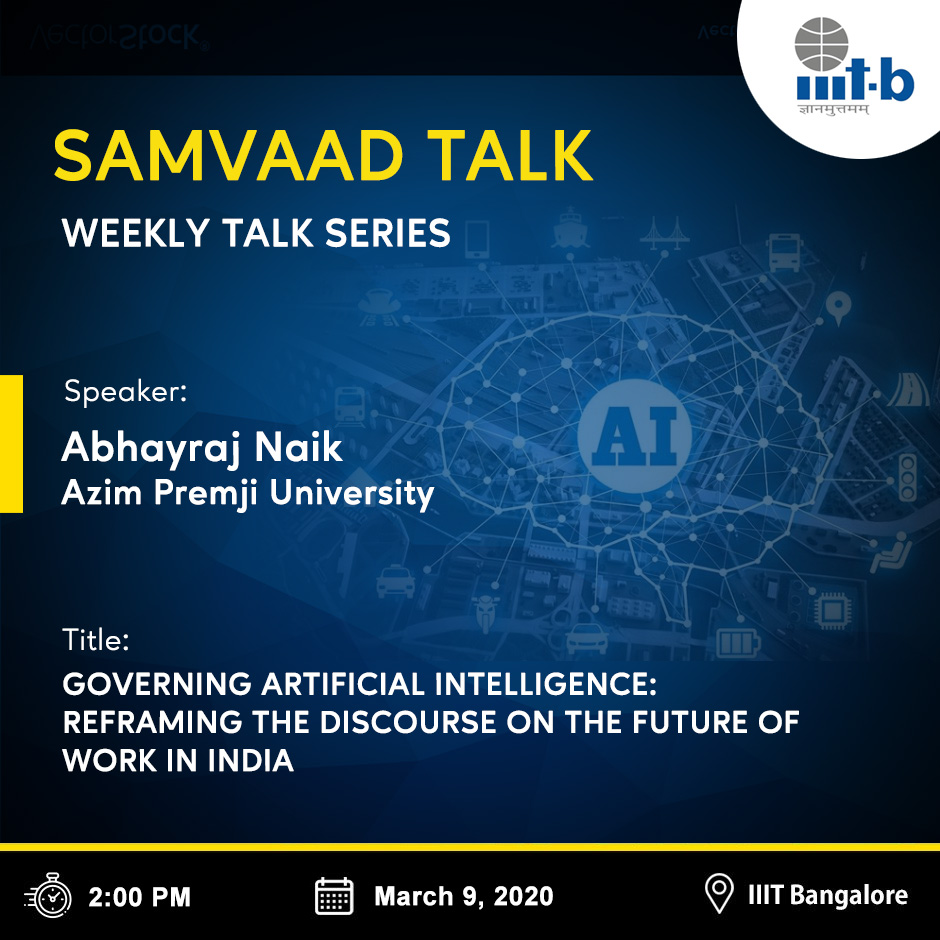
SAMVAAD TALK
“Governing Artificial Intelligence: Re-framing the Discourse on the Future of Work in India”
by Abhayraj Naik, Azim Premji University
For more details:
https://t.co/FJ70bpBPId
#IIITB #IIITB10100 #IIITBangalore #SAMVAADTALK #WeeklyTalkSeries
Last Seen Hashtags on Sotwe
女主女贝
Seen from Singapore
รับงานสุโขทัย
Seen from Thailand
snapchat #ifşa
Seen from Turkey
猫と竜
Seen from Argentina
aigayvideo
Seen from Vietnam
รุม
Seen from Thailand
tdeldescuento30e
Seen from United States
lenaisapeach
Seen from Saudi Arabia
jessicapalacios
Seen from United States
ipcam
Seen from United States
Most Popular Users

Elon Musk 
@elonmusk
241.7M followers

Barack Obama
@barackobama
119M followers

Cristiano Ronaldo
@cristiano
114.4M followers

Donald J. Trump
@realdonaldtrump
111.9M followers

Narendra Modi
@narendramodi
107.2M followers

Rihanna
@rihanna
98.7M followers

NASA
@nasa
92.4M followers

Justin Bieber
@justinbieber
91.8M followers

KATY PERRY
@katyperry
90M followers

Taylor Swift
@taylorswift13
83.9M followers

Lady Gaga
@ladygaga
75.4M followers

Virat Kohli
@imvkohli
73.3M followers

Kim Kardashian
@kimkardashian
70.9M followers

YouTube
@youtube
68.8M followers

Neymar Jr
@neymarjr
66.3M followers

Bill Gates
@billgates
65.1M followers

Selena Gomez
@selenagomez
63M followers

The Ellen Show
@theellenshow
62.3M followers

CNN
@cnn
61.8M followers

X
@x
60.7M followers