

Top Tweets for #SIloES

The Shared Sequencer @RialoHQ
1) The Isolated Rollup Problem Most Layer 2 rollups run their own isolated sequencer to batch transactions. This creates centralized points of failure, siloes liquidity, and makes moving assets across different rollups slow, clunk.


AI democratize so many opportunities for builders
but it also possess a huge risk to give more power to those who have it already (namely capital + moats)
The long tail of builders can win, but not if they spread thin and build in siloes.
We need a system that can empower the long tail of builders of tomorrow to better coordinate
Agree ?

day 60 of going all in:
-> figured out a big problem for our startup today that genuinely changes the entire trajectory of our upcoming year.
-> learn systems thinking
-> understanding that things need to work in a circular manner is the new edge. You need to optimise against linearity. Against siloes. Push for emergence.

The Real Market Gap: Who Really Owns Your Audience.
Today’s loyalty programs are broken. Airline points are locked in siloes, retail rewards have no resale value, and creator fan clubs are at the mercy of social media algorithms. The core problem is a lack of ownership.
🔸 Brands don’t own the relationship. Their customer data lives on third-party platforms.
🔸Creators don’t own their engagement. Their reach is dictated by an algorithm.
🔸 Users don’t own their loyalty. Their points and status can be devalued or lost with a change in terms of service.
This is the gap Gotas identified and attacked. They transformed passive interactions into ownable, tradable digital assets. But scaling this vision required something current infrastructure couldn't offer.


We need to talk about the "Fragmentation Trap."
On every other Layer 2, liquidity is siloed.
DEX A has its own pool.
DEX B has its own pool.
If you want to trade on DEX B, you can't access the deep liquidity sitting on DEX A.
It's inefficient and creates slippage for everyone.
@reya_xyz is built as a Liquidity Network, not just a chain.
• The Design: Liquidity is pooled at the network level.
• The Result: Any DEX that builds on Reya instantly taps into the same massive ocean of liquidity.
It's like an "interconnected clearinghouse" for DeFi. If you build a new exchange on Reya tomorrow, you don't start from zero. You start witht the entire network's liquidity backing you from Day 1.
Stop building in siloes. Start building on a network @wallchain


Openmind has recently made a partnership with Robostore —a platfrom in the US ,which is a largest distributor of humanoids.
The partnership was not just for markets,they invited enthusiastic students and learners who are intrested in developing the humanoids
They have structured a OM1 curimculum.
The curriculum is built on OM1 intelligence ,motion video and perception relating unitree G1 models.
In Recent event with @DobotRobotics
the team has also shows the attendees their 6 legged dog robot that is built with OM1 software.
There may be many different types of Robots but every robot needs to be structured with unified collaborative layer, so there will be no siloes of coordination between the robotic automation.
Some sources are projecting that by 2050 1 billion of humanoid robots will be shipped, it means if we compare population with some countries there will be more robots than humans.
But to automate these tasks of Robots we need a collaborative layer which commands the robots to perform without any siloes , a FABRIC layer like openminds vision can be a solution for this .


We hosted an event with @DobotRobotics where we showed attendees their 6-legged dog.
The future has many different types of robots all needing a unified coordination layer.
That's why at OpenMind, we look forward to many more industry collaborations.


Beyond the Buzzword: The Blueprint for a Real TradFi-DeFi Bridge
For years, "bridging TradFi and DeFi" has been a ubiquitous slogan in crypto. It's been a promise of a future where the transparency and efficiency of decentralized finance would merge with the massive, institutional capital of traditional finance. Yet, for most, it remained just that, a promise.
The reason? Most attempts have been fragile, one-way streets. They might bring a TradFi asset onto a blockchain, but they fail to create a seamless, two-way flow of value and trust. The comment that "Composability, proof of reserve, and yield alignment all in one design. That’s serious," cuts to the heart of what makes a real bridge stand out.
So, what does a real, functional bridge actually look like? It looks like a design that solves the fundamental requirements for institutional capital simultaneously.
1. Composability: The Engine of Efficiency
In TradFi, assets are often trapped in siloes. Bringing them on-chain is pointless if they remain inert. Composability, the ability for on-chain assets to seamlessly interact with multiple applications is the core innovation of DeFi.
Solv’s approach, where staked Bitcoin maintains its liquidity, ensures this principle is upheld. The value isn't locked away; it becomes a liquid, programmable building block. It can be used as collateral in a lending protocol one moment and then deployed into a yield vault the next. This creates a capital efficiency that traditional systems simply cannot match. It’s not just a bridge; it’s an integration into the entire on-chain financial stack.
2. Proof of Reserve: The Bedrock of Trust
Institutional capital cannot operate on blind faith. The trillion-dollar question in DeFi has always been, "Are the assets really there?" A theoretical bridge collapses without verifiable trust.
This is where proof of reserve becomes non-negotiable. Solv’s foundation as an on-chain treasury, with its assets verifiable by anyone, at any time, solves this. It replaces promises with cryptographic proof. This isn't a minor feature; it's the foundational pillar that allows TradFi to engage without compromising its fiduciary duties. It’s the audit, built into the protocol itself.
3. Yield Alignment: The Shared Incentive
A bridge must lead somewhere desirable. For TradFi, the destination is risk-adjusted yield. But the mechanism for generating that yield must be transparent and aligned with the holder's interests.
This is the brilliance of a unified design. The yield generated through Solv’s strategies isn’t an opaque black box. It’s derived from clear, on-chain activities (lending, staking, RWA vaults). The protocol’s success is directly tied to the success of its users in earning yield. This alignment of incentives ensures the platform is built to perform for its depositors, creating a sustainable economic model rather than a temporary gateway.
The @SolvProtocol Blueprint: A Trifecta of Institutional Readiness
What makes the design "serious" is that these three elements are not separate features; they are interdependent parts of a single, cohesive system.
· Proof of Reserve provides the trust for capital to cross the bridge.
· Composability provides the utility for that capital once it arrives.
· Yield Alignment provides the incentive for the capital to stay and grow.
This is the blueprint that moves beyond talking about a bridge to actually building one that can bear the weight of institutional traffic. It’s how you turn "digital gold" into a dynamic, productive asset and finally begin the serious work of merging two financial worlds.



@Annour_gaya Siloes keep liquidity hostage.
Break 'em with native flows that span chains.
Freedom tastes like efficiency.


Why we call @idOS_network big on Open Identity
Open source isn’t idealistic leftovers from the ’90s
It’s proven infrastructure that beat lock-in, vendor control, and centralized gatekeeping
@idOS_network sees this past, believes this present, and is engineering toward an open identity future where developers, users, issuers all win
What “Open Source Won Before” Means
IBM’s big investment in Linux around 2000 wasn’t a bet on one product
It was a bet on a neutral, shared substrate
Linux broke the stranglehold of proprietary UNIX silos
It made innovation about quality, performance, flexibility
idOS takes that lesson
Identity today is too splintered, too locked behind APIs and KYC siloes
If identity remains closed, stablecoins, DeFi, fintech will re-build Web2’s control points
Open source identity means:
> composable protocols
> interoperable credentials
> reusable verification
It means identity isn’t a toll booth, but infrastructure
Open source already won once, in infrastructure and OSes
Now the fight is over identity
idOS is designing the tools and governance so that identity becomes an open protocol
If identity is built as a public good, stablecoins and all real-world finance can avoid repeating old mistakes
The next big stack isn’t owned by one company
it’s shared, open, and aligned with users and builders alike


Have you traded on @BungeeExchange today?
It is powered by @SOCKETProtocol, and you could literally trade any token there
Liquidity is not fragmented, and chains are not in siloes
Low fees, fast, and secure


GM Legends
Just rolled into the banking‑chain testnet and it feels like teh grown‑ups finally showed up
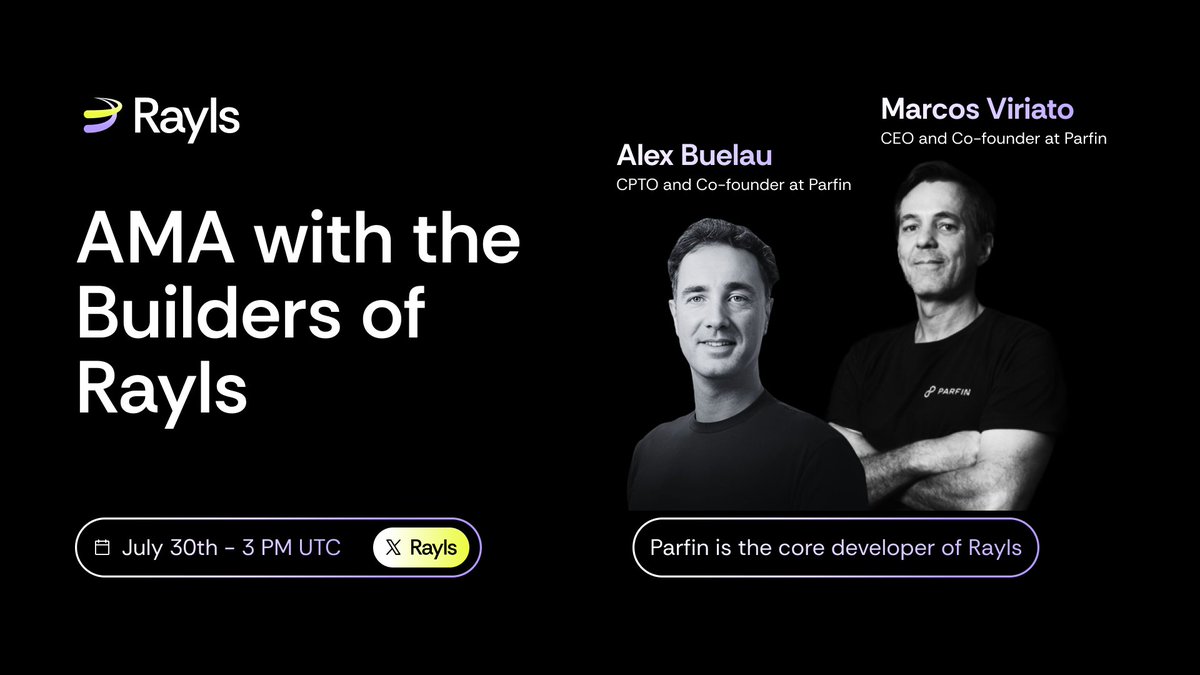
Why I’m camping @RaylsLabs rn:
KYC/AML compliance rails with ZK privacy by default
Tokenized RWAs receivables to CBDC pilots, onchain settlement
Private subnets regulated DeFi without the noise
Cross‑network tx clean finality across siloes
Decentralized compute AI unshackled from gatekeepers
Get in, ship a flow, measure lat/fee, then push it harder


☕️ Infinite Garden, No Walls
Building onchain isn’t just building online, it’s about composability.
The freedom to stack, remix, and extend what others have built. That’s the magic of the “infinite garden”, an open space where creativity thrives without the locked doors of Web2 APIs or closed finance databases.
But here’s the catch: while blockchains have scaled, they’ve also become siloes, each chain competing, splitting up developers, users, and liquidity. Instead of one big garden, we’ve got fenced-off patches.
@EspressoSys mission? Tear down the walls. We’re building the rails for chains to actually work together as one unified system.
We do this in two ways:
• Espresso Product → production-ready infrastructure so chains can coordinate and stay composable.
• Espresso Research → exploring the future of cross-chain systems, new standards, and experimental ideas.
At the heart of it is the Espresso Network: a decentralized confirmation layer that gives chains fast, secure, and credibly neutral views of what’s happening on other chains. Instead of waiting 15 minutes for Ethereum finality or trusting a centralized sequencer, confirmations happen in seconds, backed by BFT consensus and moving toward proof-of-stake.
When a chain plugs into Espresso, its sequencers publish blocks to Espresso validators, which keep a consistent record across chains. Settlement contracts only accept blocks aligned with Espresso, making it simple for anyone to verify state across chains.
In short: Espresso is building the foundation for true cross-chain composability. One infinite garden, no walls. 🌍

Hirys (✧ᴗ✧)
@irys_xyz makes data permanent, so nothing gets lost in the noise.
It’s programmable too, your files can act, protect, and create value.
Not just storage, but the groundwork for a trustworthy digital future.


It seems there's some magic in building in public. Anyways, how about we build the largest chain of convenience stores across the globe. Just democratize retail and break down the siloes of closed loyalty programs.


Physical intelligence is already increasingly accessible in everyday life. By 2029, machines will be expected to run companies, educate our children, keep us healthy, and initiate most financial transactions. Yet, today's robots still operate in siloes, despite the fact that scalable productivity, and meaningful human-robot interaction, requires robust orchestration and coordination from various stakeholders. Without the fabric that connects robots to one another, and to us, vertical ecosystems of robotic AI can't take off. We think the future should look very different.
https://t.co/Q6dgsTMuqd

Trends for you
Most Popular Users

Elon Musk 
@elonmusk
239.8M followers

Barack Obama
@barackobama
118.6M followers

Cristiano Ronaldo
@cristiano
114.3M followers

Donald J. Trump
@realdonaldtrump
111.7M followers

Narendra Modi
@narendramodi
106.9M followers

Rihanna
@rihanna
98.6M followers

NASA
@nasa
92.1M followers

Justin Bieber
@justinbieber
91.7M followers

KATY PERRY
@katyperry
89.9M followers

Taylor Swift
@taylorswift13
83.9M followers

Lady Gaga
@ladygaga
75.4M followers

Virat Kohli
@imvkohli
73.3M followers

Kim Kardashian
@kimkardashian
70.8M followers

YouTube
@youtube
68.6M followers

Neymar Jr
@neymarjr
66.3M followers

Bill Gates
@billgates
65.1M followers

Selena Gomez
@selenagomez
63M followers

The Ellen Show
@theellenshow
62.1M followers

CNN
@cnn
61.7M followers

X
@x
60.6M followers