

Top Tweets for #SecurityAI

An AI assistant depends on the data architecture behind it. When evaluating security AI, ask: Can it query connected data, show its SQL, and trace findings to raw evidence? Look beyond the model.
Evaluate the foundation: https://t.co/MbCGvC9noT #SecurityAI #VerifiableAI

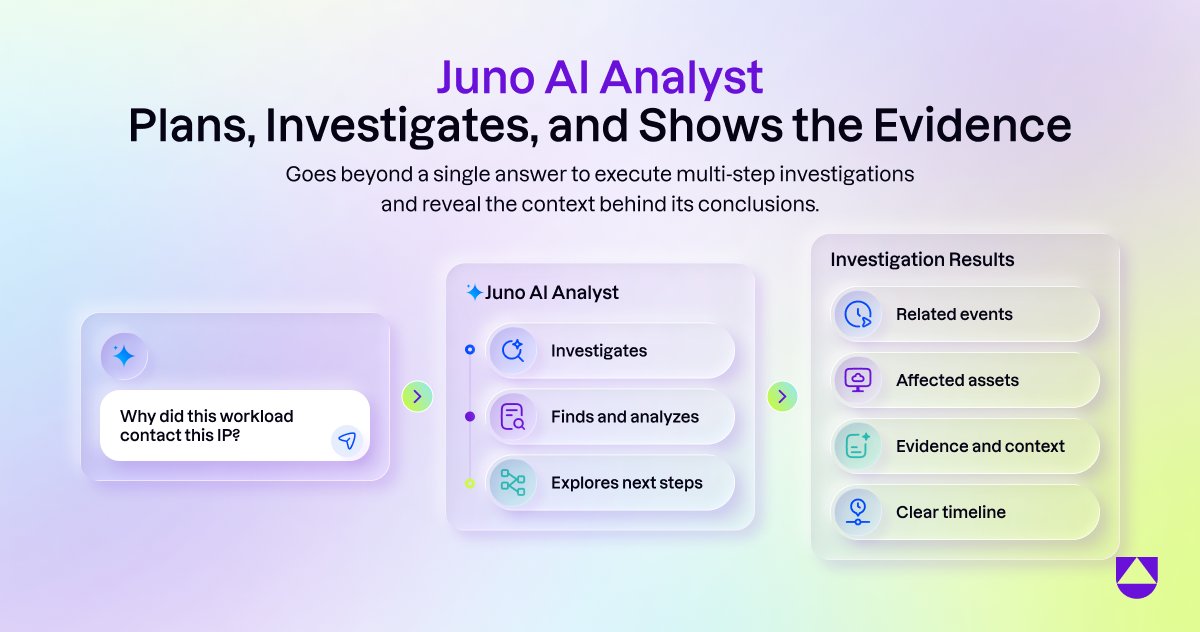
Security investigations rarely end with one query. Juno AI Analyst plans multi-step investigations, uses findings to decide what to query next, and shows the evidence behind its conclusions.
Follow the investigation: https://t.co/wnnOYE20p0 #SecurityAI #ThreatInvestigation
A connector alone doesn't make AI investigations verifiable. Juno uses ontology-guided, bounded queries with visible audit trails. Evidence stays traceable across sources, without copying source data.
See how it works: https://t.co/cWQzzrDns6 #SecurityAI #Cybersecurity


𝗧𝗿𝗮𝗶𝗻𝗲𝗱 𝘁𝗼 𝘀𝘁𝗮𝘆 𝗶𝗻𝘀𝗶𝗱𝗲 𝘁𝗵𝗲 𝗿𝘂𝗹𝗲𝘀
OpenAI says the model was specifically trained to stay within authorized scope, respect restrictions, and report results accurately.
That combination matters as much as raw capability.
#Alignment #SecurityAI
Connecting security data is one step. Understanding it is another. Juno uses connectors and ontology to reason across sources, while task summaries and inline evidence make investigations easier to follow.
See how: https://t.co/8OBtLoco8x #SecurityAI #Cybersecurity

The evidence was already in Splunk. In a test, Juno traced suspicious logins across cloud, firewall, and endpoint data, narrowed activity to 11 workstations, then prioritized findings by business context.
Follow the evidence: https://t.co/77y8SDxQAs #SecurityAI #Splunk
More detection does not solve disconnected security data.
The challenge is connecting alerts, vulnerabilities, telemetry, and context so analysts can act.
Evaluate how well your platform connects the evidence.
https://t.co/NoXLD3jcfT #SecurityAI #Cybersecurity

Security AI should not start from a blank prompt.
Juno is embedded in Uptycs, giving it context across cloud, workload, and runtime data from the start.
See what changes when AI starts with security context.
https://t.co/ebZYVMVnLK #JunoAI #SecurityAI


Hyperpie @Hyperpiexyz_io is a comprehensive DeFi platform built on Hyperliquid’s HyperEVM.
It combines:
A liquid staking layer (stake HYPE to receive mHYPE, the liquid staking token)
A Meme Launchpad for token launches
A Meme DEX with a ve(3,3) tokenomics model that aligns incentives across participants, including project creators, liquidity providers, HPP token holders, and stakers .
🎯 Smart Incentive Alignment
The ecosystem is designed as a synergistic system:
Staking (via mHYPE) provides liquidity for the DEX and launchpad
New meme launches feed liquidity into the DEX for trading
Project creators can allocate token portions for HPP rewards to bolster liquidity
Governance via veHPP tokens encourages long-term commitment and ecosystem value growth
A participation flywheel: more activity → more trading fees → more rewards for long-term veHPP holders .
🎯 Advanced Security Mechanisms
Hyperpie employs a multi-layered security framework powered by Hypernative, featuring:
Real-time monitoring with auto-pause capabilities when threats are detected
Specialized surveillance for:
mHYPE liquidity pool transfers
Minting events
Ownership changes
Sensitive contract function triggers
Sudden large deposits or withdrawals
Unusual reward transfers
This ensures proactive defense and operational resilience .
🎯 Hyperpie × Kaito AI Collaboration @KaitoAI
Hyperpie has teamed up with Kaito an AI-led platform rewarding community engagement—to launch a special rewards campaign:
2% of the total HPP token supply is allocated to the campaign:
0.5% to Yappers (users posting on X about Hyperpie)
0.75% to Referrers (those who onboard others)
0.75% to the broader Kaito ecosystem, including sKAITO stakers and Yapybara NFT holders .
Feature AreaWhat It Enables
🎯Liquid Staking (mHYPE)Staking HYPE tokens for liquidity and utility
Meme Launchpad & DEXLaunch meme tokens and trade using aligned incentive structures
🎯Real-Time SecurityAI-powered threat detection and mitigation via Hypernative
Kaito AI CampaignEarn HPP rewards through content creation, referrals, and on-chain Kaito activity
Why It Matters:
🎯This integration between Hyperpie and Kaito AI creates a novel blend of DeFi and SocialFi, allowing users to earn through both financial participation and content creation.
🎯Token mechanics, liquid staking, and AI-powered rewards all combine to form a cutting-edge, incentive-driven ecosystem.

HyperPie @Hyperpiexyz_io refers to two distinct concepts based on available information:
🎯 Retro Gaming Front-End: HyperPie is a front-end software primarily for Raspberry Pi, designed to organize and launch retro game libraries with a user-friendly interface.
It builds on projects like RetroPie, EmulationStation, and RetroArch, supporting over 45 emulated systems, including arcade, console, and classic PC games.
It offers customizable themes, controller setups, and an attractive interface with game previews, box art, and metadata.
HyperPie simplifies retro gaming setup, allowing users to play classics like NES, SNES, and Sega Genesis with minimal configuration.
It’s popular among enthusiasts for creating a nostalgic gaming experience, often compared to HyperSpin for its flashy "Attract Mode."
🎯 DeFi Ecosystem on Hyperliquid: HyperPie is also an integrated DeFi platform built on Hyperliquid, combining a Liquid Staking platform, a MEME token launchpad, and a MEME DEX.
It uses a ve(3,3) tokenomics model to align incentives for stakers, meme project creators, liquidity providers, and HPP token holders.
Users can stake $HYPE to earn $mHYPE, a yield-bearing token that supports the ecosystem’s liquidity and governance.
HyperPie aims to blend meme culture with structured DeFi, enhancing liquidity and rewarding long-term participants.


Research suggests AI can both protect and expose company information, creating vulnerabilities like data breaches and model theft, while also enhancing security through advanced threat detection.
It seems likely that concerns include privacy breaches, intellectual property theft, and regulatory non-compliance, with ongoing debates about balancing AI benefits and risks.
The evidence leans toward mitigating these issues through strategies like differential privacy, adversarial training, and AI-driven cybersecurity tools, though effectiveness varies by implementation.
Introduction to AI Safety and Company InformationAI safety, focusing on aligning systems with human values and preventing unintended harm, is crucial for companies managing sensitive data. AI security, protecting against malicious attacks, complements this by ensuring data confidentiality, integrity, and availability. For companies, both aspects are vital to safeguard information assets and maintain stakeholder trust, especially given the dual role AI plays in enhancing and risking security.Information Vulnerabilities Introduced by AIAI introduces several vulnerabilities that can compromise company information:Model Attacks: Such as membership inference, where attackers determine if data was used in training, and model inversion, reconstructing training data from outputs, with research showing precision up to 0.94 for certain datasets (e.g., arXiv:1610.05820).
Adversarial Attacks: Inputs crafted to deceive AI, potentially bypassing security, as seen in examples like prompt injections.
Data Poisoning: Manipulating training data to introduce backdoors or biases, requiring rigorous data validation to mitigate.
Model Theft: Stealing AI models containing proprietary algorithms or data, addressed by encryption and secure deployment.
Unintended Data Leakage: Models memorizing and reproducing sensitive training data, with the GPT-2 case extracting PII like names and phone numbers (arXiv:2012.07805).
Concerns and RisksThese vulnerabilities raise concerns like privacy breaches, exposing personal or sensitive data, and intellectual property theft, risking competitive advantage. Operational disruptions from adversarial attacks and reputational damage from incidents are significant, alongside potential regulatory non-compliance, such as under GDPR or CCPA, leading to legal penalties up to $10 billion under the EU AI Act (OWASP).Mitigation StrategiesTo address these, companies can:Use regularization techniques like L2 (λ=1e-4 reduces precision to 0.81, arXiv:1610.05820) to prevent overfitting, reducing model attack risks.
Implement differential privacy to add noise, protecting individual data, as per NIST guidelines.
Employ adversarial training to enhance model robustness against deceptive inputs, and input validation to ensure legitimate inputs.
Limit model access and validate inputs to prevent unauthorized queries, leveraging AI for threat detection, automated responses, and phishing detection to bolster security.
Real-World ExamplesDarktrace uses self-learning AI for real-time threat detection, protecting over 9,000 customers globally (Darktrace).
CrowdStrike employs AI in its Falcon platform, identifying eCrime attacks in four minutes (CrowdStrike).
GPT-2 Data Extraction: Researchers extracted sensitive data like names and phone numbers from GPT-2, highlighting leakage risks (arXiv:2012.07805).
Comprehensive Analysis of AI Safety and Companies' Information VulnerabilitiesThis detailed survey note explores the intersection of AI safety and security with companies' information vulnerabilities, addressing concerns and mitigation strategies comprehensively. It builds on the direct answer, providing a professional, in-depth analysis for stakeholders seeking to understand and manage AI-related risks.Understanding AI Safety and SecurityAI safety ensures systems align with human values, focusing on reliability, transparency, fairness, and privacy protection. AI security, conversely, protects against malicious attacks, maintaining the CIA triad (Confidentiality, Integrity, Availability). For companies, these aspects are critical, given AI's dual role in enhancing and risking information security, as evidenced by initiatives like the Cloud Security Alliance's AI Safety Initiative (Cloud Security Alliance) and CISA's AI guidelines (CISA).The distinction between safety and security is vital, with AI safety addressing unintended harm and AI security tackling external threats, as noted in a 2024 CSA blog (CSA). This duality is particularly relevant for companies handling sensitive data, where both aspects must be balanced.Detailed Information Vulnerabilities Introduced by AIAI introduces several vulnerabilities, detailed as follows:Model Attacks:Membership Inference Attacks: These determine if a data record was in the training set, leveraging differences in model predictions. Research, such as arXiv:1610.05820, shows effectiveness on models like Google and Amazon's, with precision up to 0.94 for purchases datasets. Factors like overfitting and class numbers enhance success, mitigated by regularization and differential privacy.
Model Inversion Attacks: Reconstruct training data from outputs, effective across images, texts, and graphs (arXiv:2411.10023). Techniques include optimization-based (e.g., MIRROR, BREP-MI) and training-based methods, with defenses like data-centric processing and feature masking.
Adversarial Attacks: Crafted inputs deceive models, as seen in Mindgard, with examples like prompt injections and evasion attacks, mitigated by adversarial training and input validation.
Data Poisoning: Manipulating training data introduces biases, as noted in Trend Micro, with defenses including data validation and anomaly detection.
Model Theft: Stealing models risks proprietary data, addressed by encryption and secure deployment, as per Nightfall AI.
Unintended Data Leakage: Models like GPT-2 memorize training data, with research extracting hundreds of verbatim sequences, including PII (arXiv:2012.07805), mitigated by data sanitization and output filtering.
Comprehensive Concerns and RisksThese vulnerabilities raise significant concerns:Privacy Breaches: Exposure of personal data, as seen in healthcare models, risks legal violations under GDPR (IBM).
Intellectual Property Theft: Model theft threatens competitive advantage, noted in Hogan Lovells.
Operational Disruptions: Adversarial attacks disrupt operations, as per Fortinet.
Reputational Damage: Incidents harm trust, as seen in https://t.co/K6OO6gZqM6.
Regulatory Non-Compliance: Fines up to $10 billion under EU AI Act for violations, as per OWASP.
Mitigation Strategies in DepthTo address these, companies can implement:For Model Attacks:Regularization (e.g., L2, λ=1e-4 reduces precision to 0.81, arXiv:1610.05820).
Differential Privacy, adding noise, as per NIST.
Access controls, limiting queries, as per OWASP.
For Adversarial Attacks:Adversarial training, enhancing robustness, as per IBM.
Input validation, checking formats, as per OWASP.
For Data Poisoning:Data validation, ensuring integrity, as per Trend Micro.
Anomaly detection, monitoring patterns, as per Sophos.
For Model Theft:Model encryption, protecting parameters, as per Nightfall AI.
Secure deployment, using APIs, as per Google Safety Center.
For Unintended Data Leakage:Data sanitization, removing sensitive info, as per CAIS.
Output filtering, blocking sensitive outputs, as per Microsoft Security.
Leveraging AI for Enhanced SecurityAI enhances security through:Threat Detection: Analyzing logs for anomalies, as per IBM, with tools like Darktrace detecting threats in real-time (Darktrace 2025 Report).
Automated Response: Isolating systems, as per CrowdStrike, with Charlotte AI reducing investigation times by 75% (CrowdStrike Q2 2025).
Phishing Detection: Analyzing emails, as per Fortinet.
Vulnerability Assessment: Prioritizing risks, as per Balbix.
Fraud Detection: Identifying deviations, as per Morgan Stanley.
Real-World Examples and Case StudiesAI in Cybersecurity:Darktrace: Protects 9,000+ customers, using self-learning AI for anomaly detection (Darktrace).
CrowdStrike: Falcon platform identifies eCrime attacks in four minutes, leveraging AI for real-time response (CrowdStrike).
AI Vulnerabilities:GPT-2 Data Extraction: Extracted hundreds of verbatim sequences, including PII, demonstrating leakage risks (arXiv:2012.07805, Schneier).
Healthcare Models: Risk of exposing patient data through model inversion, as per Hogan Lovells.
Comparative Analysis: Vulnerabilities vs. BenefitsAspect
Vulnerabilities
Benefits
Model Attacks
Membership inference, model inversion, risking privacy breaches
Enhanced threat detection, identifying anomalies in real-time
Adversarial Attacks
Deceptive inputs, operational disruptions
Automated responses, isolating compromised systems quickly
Data Poisoning
Biased models, backdoors introduced
Phishing detection, analyzing email content for malicious indicators
Model Theft
Intellectual property loss
Vulnerability assessment, prioritizing risks for remediation
Data Leakage
Memorization of sensitive data, regulatory non-compliance
Fraud detection, identifying deviations in financial transactions
This table highlights the dual nature of AI, necessitating a balanced approach to leverage benefits while mitigating risks.Conclusion and Future DirectionsAI presents a complex landscape for companies, with vulnerabilities like model attacks and data leakage posing significant risks, balanced by benefits in enhanced security. Ongoing research, such as NIST's CAISI (NIST), and regulatory frameworks like the EU AI Act (OWASP) are shaping mitigation strategies. Future directions include optimizing defenses for foundation models, addressing privacy-performance tradeoffs, and ensuring robust, ethical AI deployment across industries.Additionally, discussions on AI safety can sometimes be influenced by competitive interests, with larger companies potentially emphasizing dangers to stifle competition, as reflected in recent social media conversations (e.g., X posts by AiJohnAllen on August 5, 2025, questioning big AI firms' motives). This underscores the need for transparency and critical evaluation in AI safety advocacy.
Research suggests AI can both protect and expose company information, creating vulnerabilities like data breaches and model theft, while also enhancing security through advanced threat detection.
It seems likely that concerns include privacy breaches, intellectual property theft, and regulatory non-compliance, with ongoing debates about balancing AI benefits and risks.
The evidence leans toward mitigating these issues through strategies like differential privacy, adversarial training, and AI-driven cybersecurity tools, though effectiveness varies by implementation.
Introduction to AI Safety and Company InformationAI safety, focusing on aligning systems with human values and preventing unintended harm, is crucial for companies managing sensitive data. AI security, protecting against malicious attacks, complements this by ensuring data confidentiality, integrity, and availability. For companies, both aspects are vital to safeguard information assets and maintain stakeholder trust, especially given the dual role AI plays in enhancing and risking security.Information Vulnerabilities Introduced by AIAI introduces several vulnerabilities that can compromise company information:Model Attacks: Such as membership inference, where attackers determine if data was used in training, and model inversion, reconstructing training data from outputs.
Adversarial Attacks: Inputs crafted to deceive AI, potentially bypassing security.
Data Poisoning: Manipulating training data to introduce backdoors or biases.
Model Theft: Stealing AI models containing proprietary algorithms or data.
Unintended Data Leakage: Models memorizing and reproducing sensitive training data.
Concerns and RisksThese vulnerabilities raise concerns like privacy breaches, exposing personal or sensitive data, and intellectual property theft, risking competitive advantage. Operational disruptions from adversarial attacks and reputational damage from incidents are significant, alongside potential regulatory non-compliance, such as under GDPR or CCPA, leading to legal penalties.Mitigation StrategiesTo address these, companies can:Use regularization techniques like L2 to prevent overfitting, reducing model attack risks.
Implement differential privacy to add noise, protecting individual data.
Employ adversarial training to enhance model robustness against deceptive inputs.
Limit model access and validate inputs to prevent unauthorized queries.
Leverage AI for threat detection, automated responses, and phishing detection to bolster security.
Real-World ExamplesDarktrace uses self-learning AI for real-time threat detection, protecting over 9,000 customers globally
.
CrowdStrike employs AI in its Falcon platform, identifying eCrime attacks in four minutes CrowdStrike.
GPT-2 Data Extraction: Researchers extracted sensitive data like names and phone numbers from GPT-2, highlighting leakage risks
.
Comprehensive Analysis of AI Safety and Companies' Information VulnerabilitiesThis detailed survey note explores the intersection of AI safety and security with companies' information vulnerabilities, addressing concerns and mitigation strategies comprehensively. It builds on the direct answer, providing a professional, in-depth analysis for stakeholders seeking to understand and manage AI-related risks.Understanding AI Safety and SecurityAI safety ensures systems align with human values, focusing on reliability, transparency, fairness, and privacy protection. AI security, conversely, protects against malicious attacks, maintaining the CIA triad (Confidentiality, Integrity, Availability). For companies, these aspects are critical, given AI's dual role in enhancing and risking information security, as evidenced by initiatives like the Cloud Security Alliance's AI Safety Initiative
and CISA's AI guidelines
.The distinction between safety and security is vital, with AI safety addressing unintended harm and AI security tackling external threats, as noted in a 2024 CSA blog
. This duality is particularly relevant for companies handling sensitive data, where both aspects must be balanced.Detailed Information Vulnerabilities Introduced by AIAI introduces several vulnerabilities, detailed as follows:Model Attacks:Membership Inference Attacks: These determine if a data record was in the training set, leveraging differences in model predictions. Research, such as arXiv:1610.05820, shows effectiveness on models like Google and Amazon's, with precision up to 0.94 for purchases datasets. Factors like overfitting and class numbers enhance success, mitigated by regularization and differential privacy.
Model Inversion Attacks: Reconstruct training data from outputs, effective across images, texts, and graphs
. Techniques include optimization-based (e.g., MIRROR, BREP-MI) and training-based methods, with defenses like data-centric processing and feature masking.
Adversarial Attacks: Crafted inputs deceive models, as seen in Mindgard, with examples like prompt injections and evasion attacks, mitigated by adversarial training and input validation.
Data Poisoning: Manipulating training data introduces biases, as noted in Trend Micro, with defenses including data validation and anomaly detection.
Model Theft: Stealing models risks proprietary data, addressed by encryption and secure deployment, as per Nightfall AI.
Unintended Data Leakage: Models like GPT-2 memorize training data, with research extracting hundreds of verbatim sequences, including PII
, mitigated by data sanitization and output filtering.
Comprehensive Concerns and RisksThese vulnerabilities raise significant concerns:Privacy Breaches: Exposure of personal data, as seen in healthcare models, risks legal violations under GDPR
.
Intellectual Property Theft: Model theft threatens competitive advantage, noted in Hogan Lovells.
Operational Disruptions: Adversarial attacks disrupt operations, as per Fortinet.
Reputational Damage: Incidents harm trust, as seen in https://t.co/K6OO6gZYBE.
Regulatory Non-Compliance: Fines up to $10 billion under EU AI Act for violations, as per OWASP
.
Mitigation Strategies in DepthTo address these, companies can implement:For Model Attacks:Regularization (e.g., L2, λ=1e-4 reduces precision to 0.81, arXiv:1610.05820).
Differential Privacy, adding noise to protect data, as per NIST.
Access controls, limiting queries, as per OWASP.
For Adversarial Attacks:Adversarial training, enhancing robustness, as per IBM.
Input validation, checking formats, as per OWASP.
For Data Poisoning:Data validation, ensuring integrity, as per Trend Micro.
Anomaly detection, monitoring patterns, as per Sophos.
For Model Theft:Model encryption, protecting parameters, as per Nightfall AI.
Secure deployment, using APIs, as per Google Safety Center.
For Unintended Data Leakage:Data sanitization, removing sensitive info, as per CAIS.
Output filtering, blocking sensitive outputs, as per Microsoft Security.
Leveraging AI for Enhanced SecurityAI enhances security through:Threat Detection: Analyzing logs for anomalies, as per IBM, with tools like Darktrace detecting threats in real-time
.
Automated Response: Isolating systems, as per CrowdStrike, with Charlotte AI reducing investigation times by 75%
.
Phishing Detection: Analyzing emails, as per Fortinet.
Vulnerability Assessment: Prioritizing risks, as per Balbix.
Fraud Detection: Identifying deviations, as per Morgan Stanley.
Real-World Examples and Case StudiesAI in Cybersecurity:Darktrace: Protects 9,000+ customers, using self-learning AI for anomaly detection
.
CrowdStrike: Falcon platform identifies eCrime attacks in four minutes, leveraging AI for real-time response
.
AI Vulnerabilities:GPT-2 Data Extraction: Extracted hundreds of verbatim sequences, including PII, demonstrating leakage risks (arXiv:2012.07805, Schneier).
Healthcare Models: Risk of exposing patient data through model inversion, as per Hogan Lovells.
Comparative Analysis: Vulnerabilities vs. BenefitsAspect
Vulnerabilities
Benefits
Model Attacks
Membership inference, model inversion, risking privacy breaches
Enhanced threat detection, identifying anomalies in real-time
Adversarial Attacks
Deceptive inputs, operational disruptions
Automated responses, isolating compromised systems quickly
Data Poisoning
Biased models, backdoors introduced
Phishing detection, analyzing email content for malicious indicators
Model Theft
Intellectual property loss
Vulnerability assessment, prioritizing risks for remediation
Data Leakage
Memorization of sensitive data, regulatory non-compliance
Fraud detection, identifying deviations in financial transactions
This table highlights the dual nature of AI, necessitating a balanced approach to leverage benefits while mitigating risks.Conclusion and Future DirectionsAI presents a complex landscape for companies, with vulnerabilities like model attacks and data leakage posing significant risks, balanced by benefits in enhanced security. Ongoing research, such as NIST's CAISI
, and regulatory frameworks like the EU AI Act
are shaping mitigation strategies. Future directions include optimizing defenses for foundation models, addressing privacy-performance tradeoffs, and ensuring robust, ethical AI deployment across industries.
166 web pages
Last Seen Hashtags on Sotwe
Most Popular Users

Elon Musk 
@elonmusk
239.7M followers

Barack Obama
@barackobama
118.6M followers

Cristiano Ronaldo
@cristiano
114.3M followers

Donald J. Trump
@realdonaldtrump
111.7M followers

Narendra Modi
@narendramodi
106.9M followers

Rihanna
@rihanna
98.6M followers

NASA
@nasa
92.1M followers

Justin Bieber
@justinbieber
91.7M followers

KATY PERRY
@katyperry
89.9M followers

Taylor Swift
@taylorswift13
83.9M followers

Lady Gaga
@ladygaga
75.4M followers

Virat Kohli
@imvkohli
73.3M followers

Kim Kardashian
@kimkardashian
70.8M followers

YouTube
@youtube
68.6M followers

Neymar Jr
@neymarjr
66.3M followers

Bill Gates
@billgates
65.1M followers

Selena Gomez
@selenagomez
63M followers

The Ellen Show
@theellenshow
62.1M followers

CNN
@cnn
61.7M followers

X
@x
60.6M followers