

Top Tweets for #SingleCellRNAseq

Benchmarking Algorithms for RNA Velocity Inference
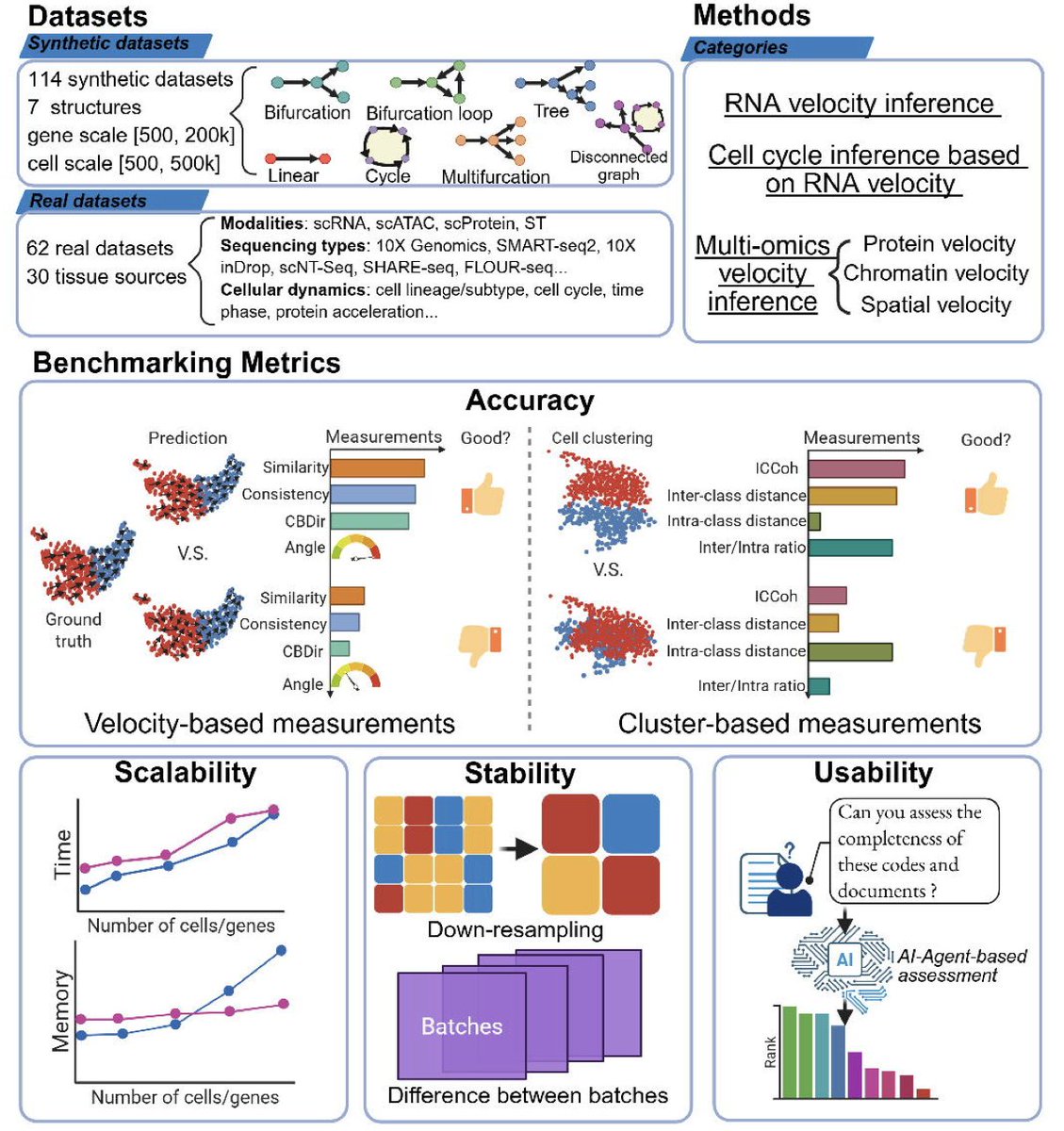
1. A comprehensive study benchmarks 29 RNA velocity inference algorithms across 176 datasets, including simulated and real scRNA-seq data. This work provides a systematic evaluation framework focusing on accuracy, scalability, stability, and usability. The results highlight that no single method is universally optimal, emphasizing the importance of selecting tools based on specific data modalities and biological contexts.
2. The study introduces a unified benchmarking framework that decomposes performance into four practical dimensions. Accuracy is assessed through metrics like vector correlation, clustering coherence, and spatial consistency. Scalability is evaluated by runtime and memory usage across datasets of varying sizes. Stability tests include robustness to input perturbations and reproducibility across multiple runs.
3. Key findings include veloVI ranking as the top overall method due to its balanced performance across metrics. The study also identifies challenges such as scalability limitations for large datasets, sensitivity to gene selection, and the lack of truly multimodal and spatially explicit velocity models. Practical guidelines are provided for selecting RNA velocity tools based on data type, available priors, and computational constraints.
4. For spatial and multi-omics data, the study evaluates several specialized methods. Spatial velocity methods like SDEvelo and STT show robust performance in capturing spatially coherent dynamics, while multi-omics approaches like scKINETICS and MultiVelo demonstrate the potential for integrating additional modalities to improve velocity inference.
5. The study concludes that RNA velocity is a powerful tool for visualizing cellular dynamics but requires careful consideration of its limitations. Future development should focus on integrating multimodal data and improving scalability to handle large-scale datasets.
📜Paper: biorxiv.org/content/10.64898…
#RNAVelocity #SingleCellRNASeq #Benchmarking #ComputationalBiology #Multiomics #SpatialTranscriptomics
An Agentic AI Framework for Ingestion and Standardization of Single-Cell RNA-seq Data Analysis
1. A new agentic AI framework called CellAtria is introduced, designed to automate the ingestion and analysis of single-cell RNA sequencing (scRNA-seq) data through a chatbot interface. This innovation significantly reduces the manual effort required for data preparation and analysis in biomedical research.
2. CellAtria integrates a large language model (LLM) with a graph-based, multi-actor architecture to orchestrate the full lifecycle of data reuse. It supports dialogue-driven interactions, allowing researchers to extract metadata from articles, retrieve datasets, and execute standardized analysis pipelines without manual scripting.
3. The framework includes CellExpress, a co-developed pipeline that applies state-of-the-art scRNA-seq processing steps to transform raw count matrices into analysis-ready single-cell profiles. This ensures standardized, reproducible analyses and accelerates the reuse of public single-cell resources.
4. CellAtria demonstrates the ability to autonomously execute a complete document-to-analysis workflow using a single instruction. This includes parsing articles, extracting metadata, retrieving datasets, configuring analysis pipelines, and executing the analysis—all without manual intervention.
5. The system is designed to be modular and extensible, supporting future integration of additional computational tools. It also includes interactive panels for real-time monitoring and control, ensuring transparency and user oversight during automated workflows.
6. CellAtria’s runtime environment is fully containerized using Docker, ensuring consistent and reproducible deployment across different computational infrastructures. This design choice facilitates seamless portability and scalability.
📜Paper: biorxiv.org/content/10.1101/…
#AI #SingleCellRNASeq #Bioinformatics #Automation #ResearchTools

PLM-OMG: Protein Language Model-Based Ortholog Detection for Cross-Species Cell Type Mapping
1.A new framework called PLM-OMG leverages protein language models (PLMs) to detect orthogroups, enabling scalable cross-species cell type mapping in plants without re-running traditional pipelines like OrthoFinder.
2.Among five tested models, ProtGPT2 achieved the highest classification performance with 0.95 accuracy and excellent precision, recall, and F1 scores. ESM2 followed closely, offering strong performance with fewer parameters and faster training time.
3.Traditional ortholog detection methods are limited by inefficiency and poor performance on distantly related species. PLM-OMG overcomes this by using deep learning models trained on millions of sequences to capture structural and evolutionary features.
4.The models generalize well across varying degrees of sequence similarity. ProtGPT2, ESM2, and ProGen2 maintained robust performance even on sequences with less than 40% identity, which are typically challenging for alignment-based methods.
5.PLM-OMG showed strong scalability. On large monocot and dicot datasets, transformer-based models outperformed traditional methods in both accuracy and consistency, confirming their robustness across diverse plant species.
6.The authors compared OrthoFinder and ESM2 within the OMG framework to map cell types between Arabidopsis and Tomato/Maize. ESM2 produced stronger signals and more accurate mappings, particularly for key cell types like root hairs and cortex.
7.A key innovation is that PLM-OMG avoids recomputing orthogroups when new species are added. This makes it highly reusable and efficient for expanding plant transcriptomic datasets and updating cell type annotations.
8.Despite requiring high computational resources, PLM-OMG's benefits in speed, accuracy, and scalability make it a promising alternative to conventional ortholog detection tools, especially for comparative genomics and single-cell analysis in non-model plants.
9.The study highlights the transformative potential of protein language models in plant genomics, suggesting a shift from alignment-heavy methods to PLM-driven approaches for future cross-species studies.
💻Code: github.com/ct-tranchau/PLM-O… 📜Paper: biorxiv.org/content/10.1101/…
#ComputationalBiology #ProteinLanguageModel #PlantGenomics #SingleCellRNAseq #DeepLearning #OrthologDetection #Bioinformatics

CellUntangler: Separating Distinct Biological Signals in Single-Cell Data with Deep Generative Models
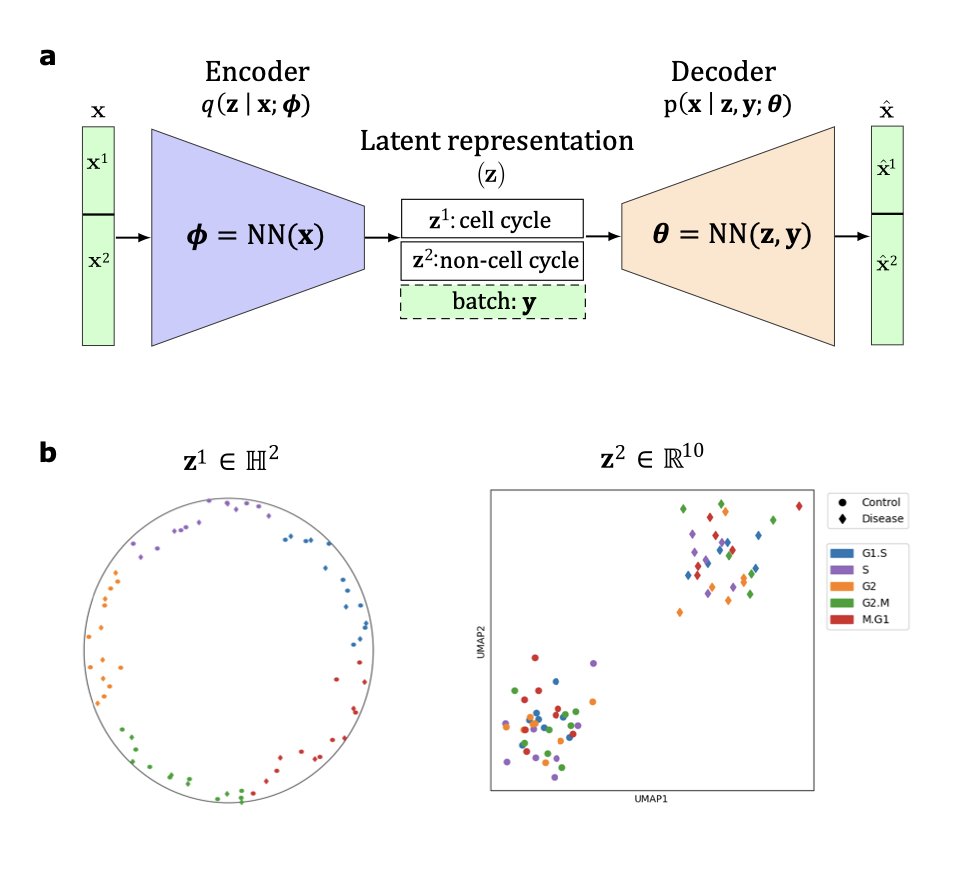
1. The article presents CellUntangler, a deep generative model that utilizes variational autoencoders (VAEs) to disentangle distinct biological signals from complex single-cell RNA sequencing (scRNA-seq) data, enabling more accurate downstream analysis.
2. Unlike traditional methods that attempt to remove or filter out signals, CellUntangler preserves multiple biological processes by representing them in separate latent spaces, with each subspace tailored to capture a distinct signal (e.g., cell cycle, cell type, differentiation trajectory).
3. The model's architecture includes both Euclidean and non-Euclidean latent spaces, allowing users to select the appropriate geometry for different biological signals, enhancing its flexibility and effectiveness for diverse datasets.
4. CellUntangler was successfully applied to datasets containing both cycling and non-cycling cells, such as immune cells, where it efficiently captured and removed the cell cycle signal, revealing hidden biological processes like cell type and differentiation state.
5. In experiments using a variety of cell types, including mouse embryonic stem cells and myeloid cells, CellUntangler accurately separated cell cycle signals from other cellular information, improving cell classification and resolving batch effects.
6. For differentiation studies, the method was able to disentangle the cell cycle from differentiation trajectories, offering clear insights into cellular transitions, as seen in the analysis of pancreatic stem cells.
7. CellUntangler also handled spatial zonation signals in liver cells, demonstrating its ability to separate spatial from non-spatial biological processes, which is crucial for understanding tissue-specific biological mechanisms.
8. This approach overcomes challenges faced by previous methods, such as the misplacement of non-cycling cells and the inadequate separation of signals in highly complex datasets, providing a robust tool for scRNA-seq data analysis.
9. Overall, CellUntangler represents a significant advance in single-cell analysis by providing an end-to-end solution for modeling and filtering biological signals in a flexible and efficient manner.
💻Code: github.com/Ding-Group/CellUn…
📜Paper: biorxiv.org/content/10.1101/…
#SingleCellRNAseq #DeepLearning #GenerativeModels #Bioinformatics #CellCycle #Differentiation
Uncovering Predictive Gene and Cellular Signatures for Checkpoint Immunotherapy Response through Machine Learning Analysis of Immune Single-Cell RNA-seq Data
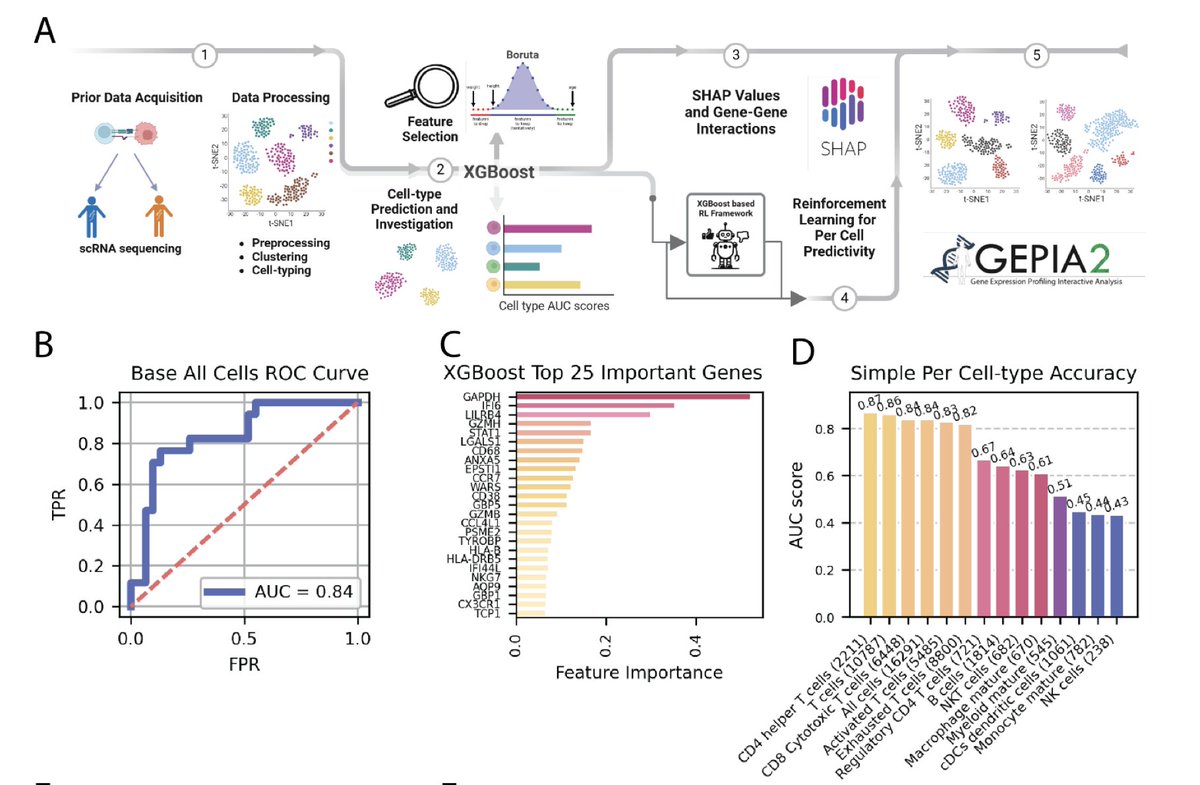
1. This study introduces PRECISE, a pipeline leveraging single-cell RNA sequencing and machine learning to predict immune checkpoint inhibitor (ICI) therapy responses, revealing interpretable gene and cellular signatures.
2. Key innovation: The pipeline achieves an Area Under the Curve (AUC) of 0.89 in predicting ICI responses using Boruta feature selection to identify an 11-gene predictive signature, highlighting genes such as GAPDH, STAT1, and CCR7.
3. SHAP (SHapley Additive exPlanations) analysis unveils non-linear gene interactions and cell-specific behaviors, showcasing how these genes and their interactions influence immunotherapy outcomes.
4. A novel reinforcement learning framework identifies non-predictive cells that detract from model performance, enabling finer predictions and improved model accuracy across diverse datasets.
5. Validation across cancer types, including melanoma, TNBC, and glioblastoma, demonstrates the robustness of the gene-based signature and cell-level predictions, with AUC scores up to 0.95.
6. The study emphasizes the heterogeneous nature of the tumor microenvironment and the potential of cell-level analysis to refine predictions, guiding personalized immunotherapy approaches.
7. The integration of advanced computational methods with single-cell data paves the way for deeper insights into cancer immunity, offering tools to enhance precision medicine.
📜Paper: biorxiv.org/content/10.1101/…
#Immunotherapy #CancerResearch #MachineLearning #SingleCellRNAseq #TumorMicroenvironment
GraphComm: A Graph-based Deep Learning Method to Predict Cell-Cell Communication in single-cell RNAseq data
1. GraphComm is a novel graph-based deep learning method that redefines cell-cell communication (CCC) inference by leveraging ligand-receptor networks and spatial information from single-cell RNAseq data.
2. It integrates directed graph representations with advanced feature annotation, capturing both intracellular and intercellular signaling dynamics. This allows it to identify biologically relevant CCC patterns even in datasets with spatial dimensions.
3. One of the standout features is its ability to analyze changes in CCC in response to genetic or chemical perturbations, as demonstrated with cancer cell lines treated with drugs.
4. It outperforms traditional methods by including over 30,000 protein interaction pairs, pathway information, and protein complexes for a more comprehensive analysis.
5. GraphComm excels in spatial transcriptomics applications, providing insights into cell communication dynamics in myocardial infarction datasets by identifying spatially probable interactions.
6. This framework has broad implications, from studying tumor microenvironments to informing therapeutic strategies and multimodal data integration.
💻Code: github.com/bhklab/GraphComm
📜Paper: doi.org/10.1101/2023.04.26.5…
#GraphNeuralNetworks #SingleCellRNAseq #Bioinformatics #DeepLearning #CellCommunication

CellPatch: A Highly Efficient Foundation Model for Single-Cell Transcriptomics with Heuristic Patching
• CellPatch introduces an innovative gene-patching mechanism, significantly reducing model complexity while maintaining state-of-the-art performance in single-cell RNA sequencing (scRNA-seq) analysis.
• By leveraging cross-attention and patch-tokenization, CellPatch efficiently extracts biological features, outperforming other models like scGPT, scBERT, and GeneFormer across diverse datasets.
• The model’s pretraining uses unsupervised masked gene modeling on a dataset of 10 million cells, capturing high-resolution gene expression patterns and cellular contexts.
• CellPatch integrates seamlessly with other tools such as STAGATE, enhancing spatial domain identification and clustering accuracy in spatial transcriptomics analysis.
• Demonstrated flexibility in cell type annotation tasks, achieving superior accuracy and F1 scores while reducing computational costs, making it highly scalable.
• The interpretability of CellPatch is highlighted by its ability to identify cell-specific gene markers and reveal gene-gene relationships through UMAP visualization and attention score analysis.
• Extensive evaluations reveal its robustness across diverse cell types, tissues, and experimental platforms, setting a new benchmark for single-cell transcriptomic models.
• Future iterations of CellPatch aim to include broader genomic features and additional data, enhancing its scope and precision in scRNA-seq research.
💻Code: github.com/HanwenZhu98/CellP…
📜Paper: biorxiv.org/content/10.1101/…
#SingleCellRNAseq #AIforBiology #Bioinformatics #CellPatch

Most Popular Users

Elon Musk 
@elonmusk
240.3M followers

Barack Obama
@barackobama
118.6M followers

Cristiano Ronaldo
@cristiano
114.4M followers

Donald J. Trump
@realdonaldtrump
111.8M followers

Narendra Modi
@narendramodi
106.9M followers

Rihanna
@rihanna
98.7M followers

NASA
@nasa
92.2M followers

Justin Bieber
@justinbieber
91.7M followers

KATY PERRY
@katyperry
89.9M followers

Taylor Swift
@taylorswift13
83.9M followers

Lady Gaga
@ladygaga
75.4M followers

Virat Kohli
@imvkohli
73.3M followers

Kim Kardashian
@kimkardashian
70.8M followers

YouTube
@youtube
68.6M followers

Neymar Jr
@neymarjr
66.3M followers

Bill Gates
@billgates
65.2M followers

Selena Gomez
@selenagomez
63M followers

The Ellen Show
@theellenshow
62.1M followers

CNN
@cnn
61.7M followers

X
@x
60.6M followers