

Top Tweets for #SoLeadSaturday

Gregory’s Taylor Series! @vaishalilambe’s #SoLeadSaturday Podcast! Featuring. @gp_pulipaka! Article Gregory’s Taylor Series - by @gp_pulipaka, based on the book - 510-Page ‘A Greater Foundation for Machine Learning’ by @gp_pulipaka
#BigData #Analytics #DataScience #AI #MachineLearning #IoT #IIoT #PyTorch #Python #RStats #TensorFlow #Java #JavaScript #ReactJS #GoLang #CloudComputing #Serverless #DataScientist #Linux #Mathematics #Programming #Coding #100DaysofCode
https://t.co/2sIkDR1Rrd
https://t.co/EmBUgS4wSG
https://t.co/xXMYimQDIA
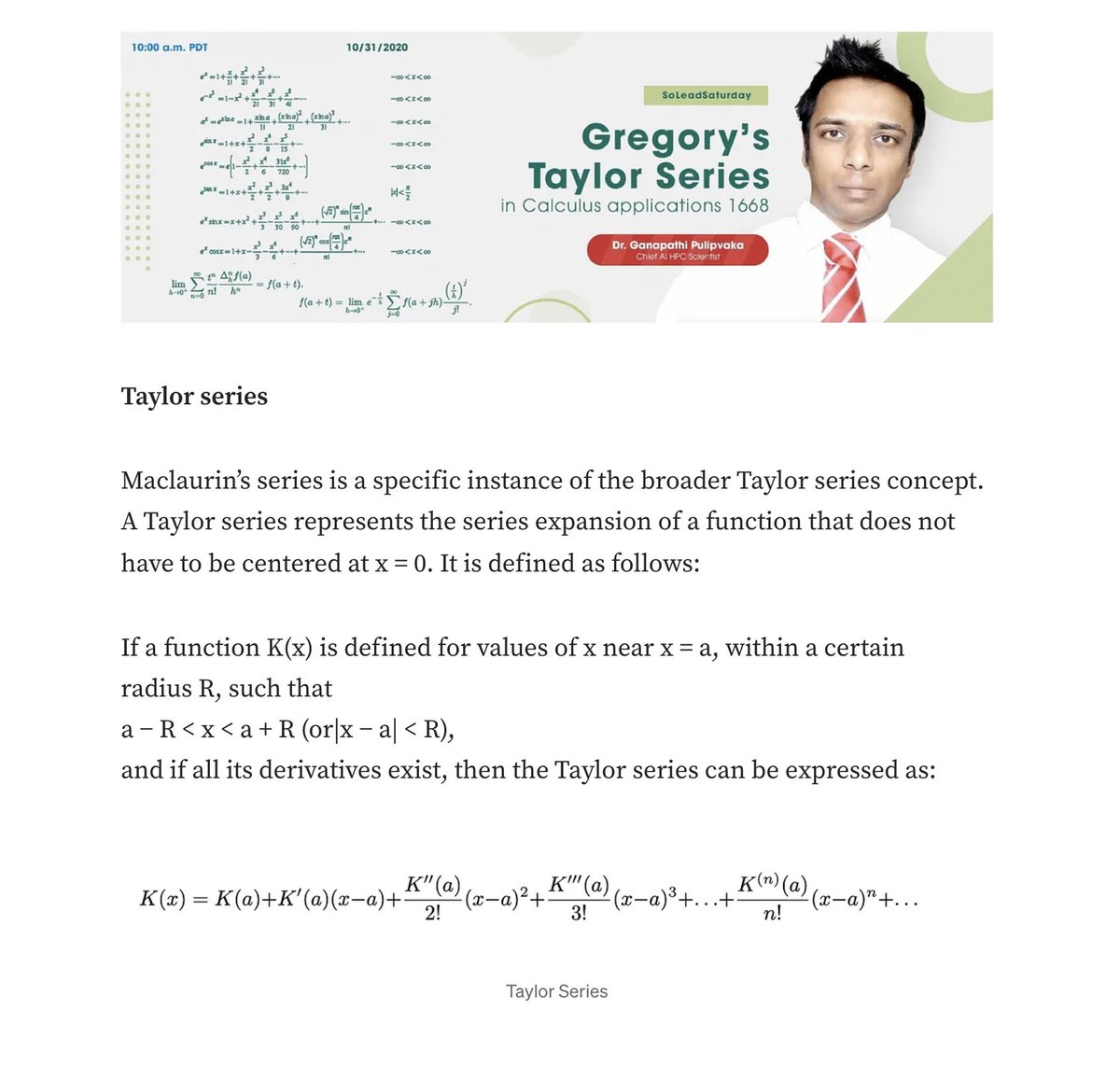
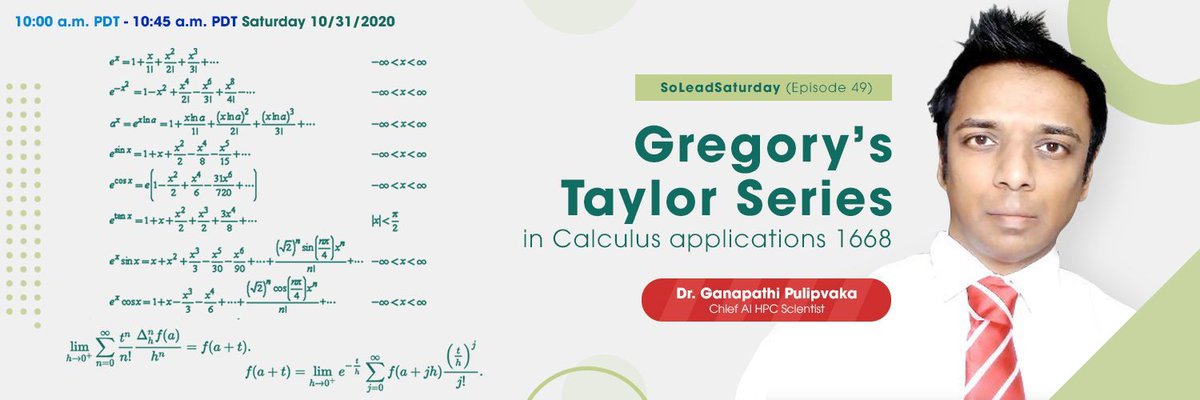
Maclaurin’s series is a specific instance of the broader Taylor series concept. A Taylor series represents the series expansion of a function that does not have to be centered at x = 0. It is defined as follows:


Gregory’s Taylor Series! @vaishalilambe’s #SoLeadSaturday Podcast! Featuring. @gp_pulipaka! Article Gregory’s Taylor Series - by @gp_pulipaka, based on the book - 510-Page ‘A Greater Foundation for Machine Learning’ by @gp_pulipaka
#BigData #Analytics #DataScience #AI #MachineLearning #IoT #IIoT #PyTorch #Python #RStats #TensorFlow #Java #JavaScript #ReactJS #GoLang #CloudComputing #Serverless #DataScientist #Linux #Mathematics #Programming #Coding #100DaysofCode
https://t.co/2sIkDR1Rrd
https://t.co/EmBUgS4wSG
https://t.co/xXMYimQDIA
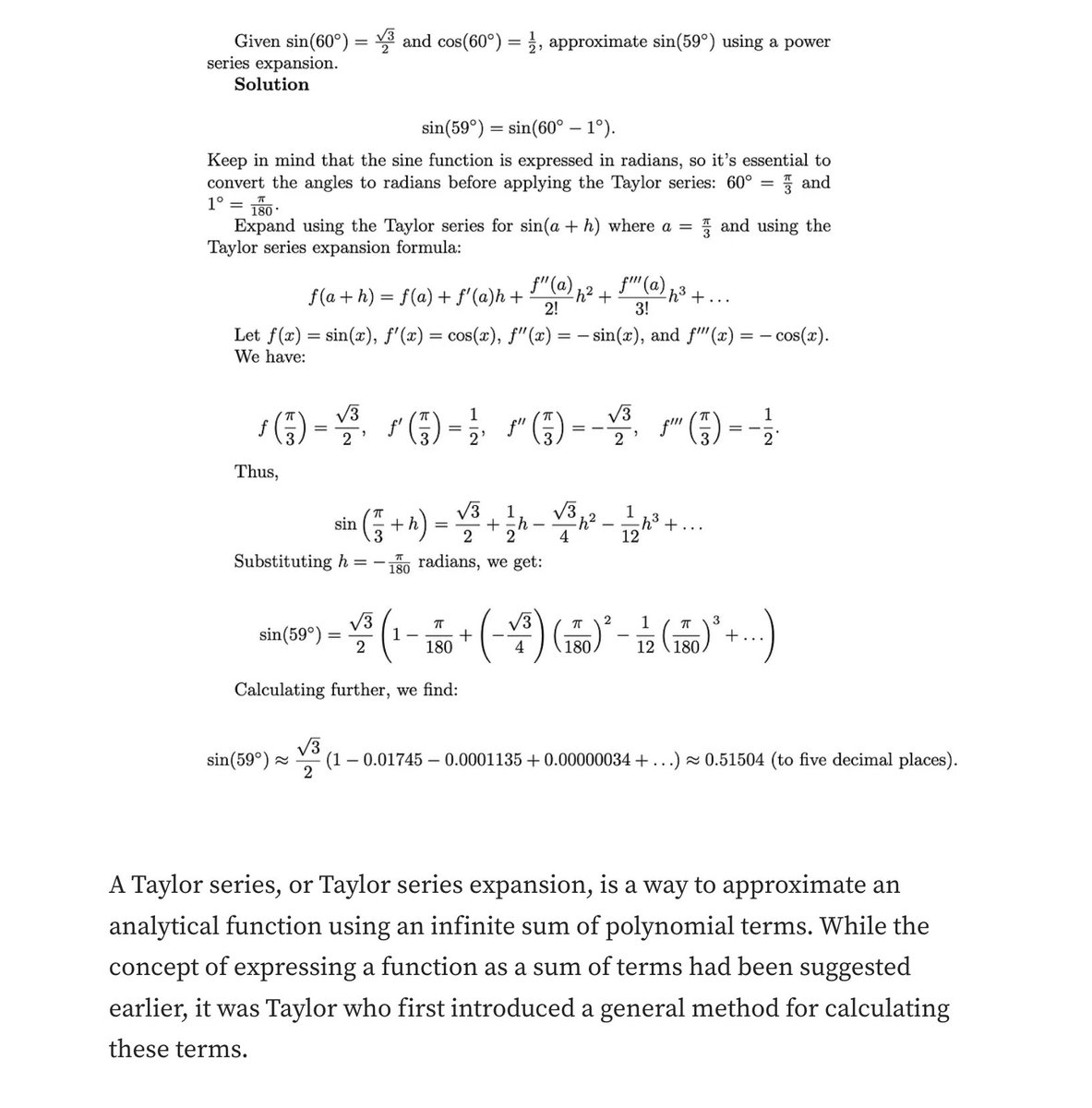
A Taylor series, or Taylor series expansion, is a way to approximate an analytical function using an infinite sum of polynomial terms. While the concept of expressing a function as a sum of terms had been suggested earlier, it was Taylor who first introduced a general method for calculating these terms.
Taylor series are essential tools in numerous practical applications of mathematics. Often, it is challenging or even impossible to derive a closed analytical expression for a function. In these cases, it can be much simpler to approximate the function using a finite number of terms from a polynomial expansion. While the Taylor series itself involves an infinite sum, in many situations, we can effectively use just a limited number of terms to get a functional approximation. Naturally, the more terms included in the approximation, the smaller the potential error becomes.
In essence, a Taylor series serves as a bridge between analytical and numerical calculus. In real-world problems, especially those involving partial differential equations (PDEs), numerical approximations often become a necessity. This is particularly true when deriving an exact analytical solution proves to be impossible. Thus, Taylor series provide a valuable method for obtaining practical approximations in various mathematical disciplines.
To work with a Taylor series, several prerequisites must be satisfied. This book does not aim to provide a comprehensive introduction to Taylor series, so we will focus on a few key requirements that are straightforward to understand.
First, a Taylor series is always constructed around a specific point of the function. We say that the Taylor series is “expanded around” this value. As we move away from this point, the approximation provided by the Taylor series can become less accurate. Therefore, to construct a more precise representation of a function across a given domain, it may be necessary to create multiple Taylor series at various points.
Additionally, the Taylor series expansion relies on the derivatives of the function. It might seem that if we do not know the function itself, we are also unaware of its derivatives. However, this is often not the case. Many practical problems in physics and mathematics are described by partial differential equations. In such instances, while we may have little to no information about the function that serves as the solution to the differential equation, we often have knowledge about its derivatives, even at higher orders. This information is crucial for constructing accurate Taylor series approximations.


Gregory’s Taylor Series! @vaishalilambe’s #SoLeadSaturday Podcast! Featuring. @gp_pulipaka! Article Gregory’s Taylor Series - by @gp_pulipaka, based on the book - 510-Page ‘A Greater Foundation for Machine Learning’ by @gp_pulipaka
#BigData #Analytics #DataScience #AI #MachineLearning #IoT #IIoT #PyTorch #Python #RStats #TensorFlow #Java #JavaScript #ReactJS #GoLang #CloudComputing #Serverless #DataScientist #Linux #Mathematics #Programming #Coding #100DaysofCode
https://t.co/2sIkDR1Rrd
https://t.co/EmBUgS4wSG
https://t.co/xXMYimQDIA
Taylor Series Polynomial Approximation
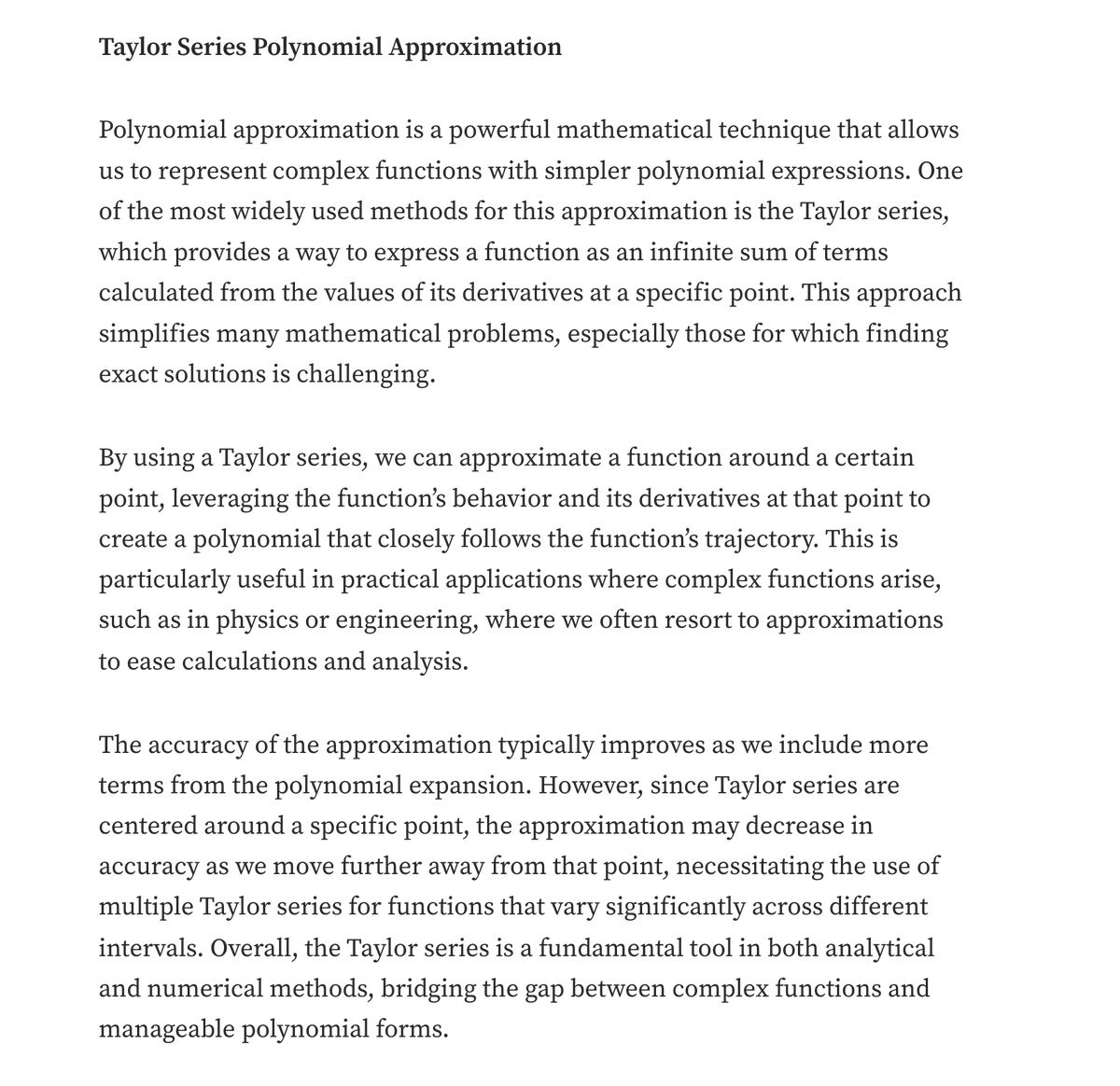
Polynomial approximation is a powerful mathematical technique that allows us to represent complex functions with simpler polynomial expressions. One of the most widely used methods for this approximation is the Taylor series, which provides a way to express a function as an infinite sum of terms calculated from the values of its derivatives at a specific point. This approach simplifies many mathematical problems, especially those for which finding exact solutions is challenging.
By using a Taylor series, we can approximate a function around a certain point, leveraging the function’s behavior and its derivatives at that point to create a polynomial that closely follows the function’s trajectory. This is particularly useful in practical applications where complex functions arise, such as in physics or engineering, where we often resort to approximations to ease calculations and analysis.
The accuracy of the approximation typically improves as we include more terms from the polynomial expansion. However, since Taylor series are centered around a specific point, the approximation may decrease in accuracy as we move further away from that point, necessitating the use of multiple Taylor series for functions that vary significantly across different intervals. Overall, the Taylor series is a fundamental tool in both analytical and numerical methods, bridging the gap between complex functions and manageable polynomial forms.
Goal
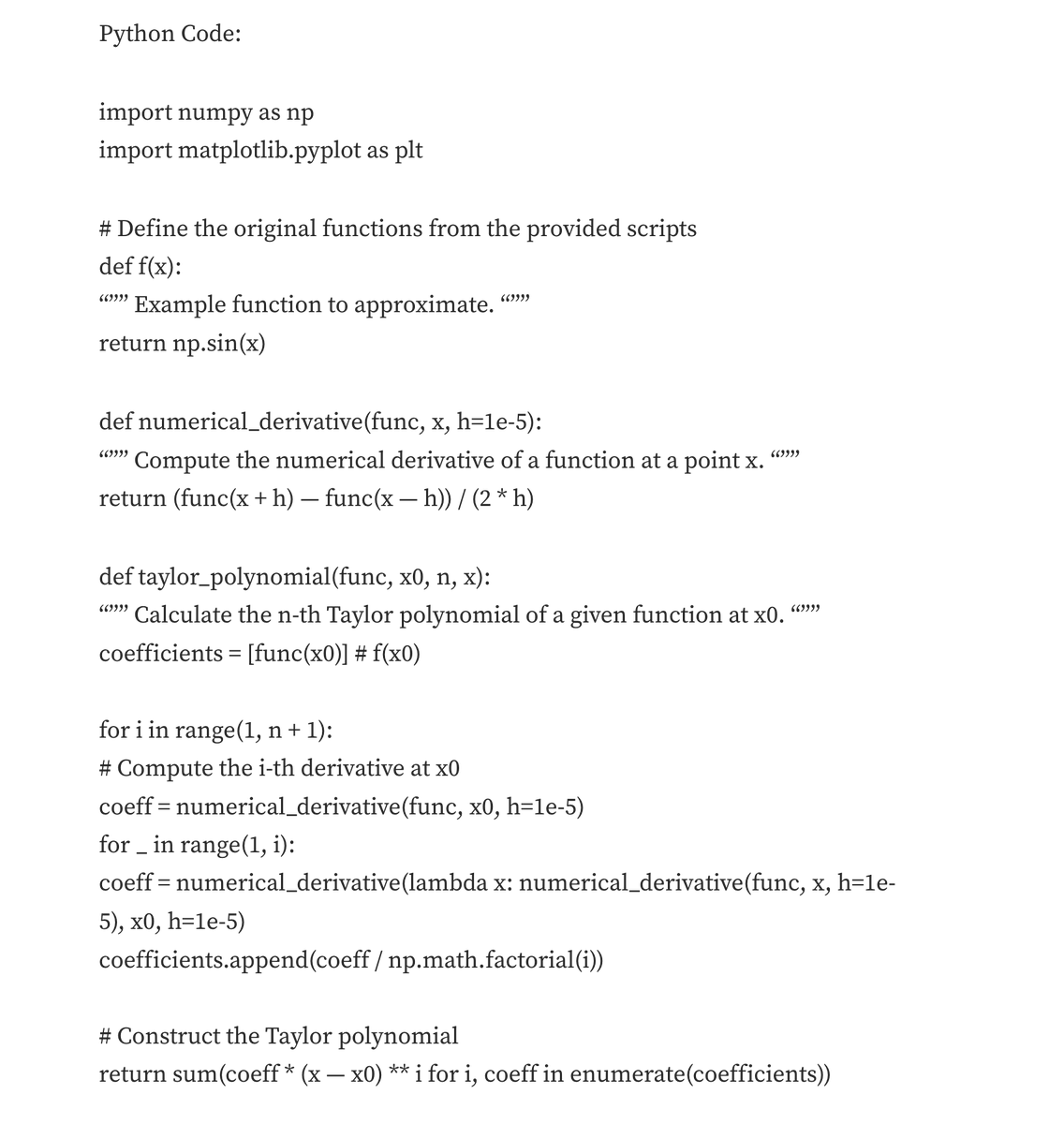
In this article, we aim to explore the concept of Taylor series and its application in approximating functions. Specifically, we will focus on the Taylor polynomial expansion, which is instrumental in analyzing and predicting the behavior of functions near a point of interest.
The Taylor series allows us to express a function as an infinite sum of terms calculated from the function’s derivatives at that point. This technique simplifies complex functions, enabling us to study their behavior with greater ease. The Taylor polynomial, which is a finite truncation of the Taylor series, provides a powerful tool for approximating functions closely around the chosen point.
Applications of Taylor series are prevalent in various fields such as physics, engineering, and economics, where understanding the local behavior of functions can lead to effective problem-solving strategies. By examining how the function behaves near the point of interest, we can make accurate predictions and streamline calculations.
As we delve deeper into the properties of Taylor series, we will also discuss the importance of selecting an appropriate expansion point and the implications it has on the accuracy of the approximation. Furthermore, we will highlight scenarios in which multiple Taylor series may be necessary to capture variations in function behavior across different intervals. Through this exploration, we hope to illustrate the significance of Taylor series as a bridge between complex functions and manageable mathematical tools.



Gregory’s Taylor Series! @vaishalilambe’s #SoLeadSaturday Podcast! Featuring. @gp_pulipaka! Article Gregory’s Taylor Series - by @gp_pulipaka, based on the book - 510-Page ‘A Greater Foundation for Machine Learning’ by @gp_pulipaka
#BigData #Analytics #DataScience #AI #MachineLearning #IoT #IIoT #PyTorch #Python #RStats #TensorFlow #Java #JavaScript #ReactJS #GoLang #CloudComputing #Serverless #DataScientist #Linux #Mathematics #Programming #Coding #100DaysofCode
https://t.co/2sIkDR1Rrd
https://t.co/EmBUgS4wSG
https://t.co/xXMYimQDIA
Maclaurin’s series is a specific instance of the broader Taylor series concept. A Taylor series represents the series expansion of a function that does not have to be centered at x = 0. It is defined as follows:



Watch my #SoLeadSaturday podcast with @vaishalilambe >> our conversation was a lot of fun. Watch & listen to the complete episode at:
https://t.co/DCwzSgcp6N
—————
#BigData #DataScience #DataLiteracy #DataScientists #Career #DataLeadership #AnalyticThinking #MachineLearning #AI

Watch my #SoLeadSaturday podcast with @vaishalilambe >> our conversation was a lot of fun. Watch & listen to the complete episode at:
https://t.co/6RwOrxKwOF
—————
#BigData #DataScience #DataLiteracy #DataScientists #Career #DataLeadership #AnalyticThinking #MachineLearning #AI

#SoLeadSaturday - Episode 51 Gregory's Taylor Series with @vaishalilambe. #BigData #Analytics #DataScience #AI #MachineLearning #IoT #IIoT #Python #RStats #JavaScript #ReactJS #CloudComputing #Serverless #Linux #Programming #Coding #100DaysofCode
https://t.co/OyTHJ2cBju

** Sneak Peek - Upcoming Episode w/ @Vaishalilambe. #BigData #Analytics #DataScience #AI #MachineLearning #IoT #IIoT #Python #RStats #JavaScript #ReactJS #CloudComputing #Serverless #DataScientist #Linux #Programming #Coding #100DaysofCode
#SoLeadSaturday
https://t.co/dLjA8bD2Lh

"If you type in Powerpoint it becomes AI, if you write in Python it becomes ML"
Agree?
Insightful watching https://t.co/xRRjCaxcSf #SoLeadSaturday w/ @Vaishalilambe featuring @drangshu
#DataScience #Career #AI #MachineLearning

It is necessary to publish regular updates on #codeflaw #programmer #codedith #developer #100DaysOfCode RT @gp_pulipaka: Gregory's Taylor Series 1668 #SoLeadSaturday Podcast w/ @Vaishalilambe. #BigData #Analytics #DataScience #AI… https://t.co/A8I4x24HcR
Gregory's Taylor Series 1668 #SoLeadSaturday Podcast w/ @Vaishalilambe. #BigData #Analytics #DataScience #AI #MachineLearning #IoT #IIoT #Python #RStats #JavaScript #ReactJS #CloudComputing #Serverless #Linux #Programming #Coding #100DaysofCode
https://t.co/pUroYMRMvK

Today #SoLeadSaturday Podcast with @Vaishalilambe. #BigData #Analytics #DataScience #AI #MachineLearning #IoT #IIoT #Python #RStats #JavaScript #ReactJS #CloudComputing #Serverless #Linux #Mathematics #Programming #Coding #100DaysofCode
https://t.co/pUroYMRMvK


#SoLeadSaturday #Podcast with @Vaishalilambe & @gp_pulipaka
🎙️⬇️
https://t.co/Hyw69b6gBb
📅31/10/2020
#BigData #Analytics #DataScience #AI #MachineLearning #ML #IoT #IIoT #IoTPL #Python #RStats #CloudComputing #Serverless #Linux #Mathematics #Programming #Coding #100DaysofCode

Next Saturday #SoLeadSaturday Podcast with @Vaishalilambe. #BigData #Analytics #DataScience #AI #MachineLearning #IoT #IIoT #Python #RStats #JavaScript #ReactJS #CloudComputing #Serverless #Linux #Mathematics #Programming #Coding #100DaysofCode
https://t.co/wcW4Rxb5fH
It is important to share regular updates on #codeflaw #programmer #codedith #developer #100DaysOfCode RT @gp_pulipaka: Next Saturday #SoLeadSaturday Podcast with @Vaishalilambe. #BigData #Analytics #DataScience #AI #MachineLearning… https://t.co/TpOmGdnNkx
Next Saturday #SoLeadSaturday Podcast with @Vaishalilambe. #BigData #Analytics #DataScience #AI #MachineLearning #IoT #IIoT #Python #RStats #JavaScript #ReactJS #CloudComputing #Serverless #Linux #Mathematics #Programming #Coding #100DaysofCode
https://t.co/wcW4Rxb5fH
It is important to publish regular updates on #codeflaw #programmer #codedith #developer #100DaysOfCode RT @gp_pulipaka: Next Saturday #SoLeadSaturday Podcast with @Vaishalilambe. #BigData #Analytics #DataScience #AI #MachineLearning… https://t.co/qP7CfXMzyx
Next Saturday #SoLeadSaturday Podcast with @Vaishalilambe. #BigData #Analytics #DataScience #AI #MachineLearning #IoT #IIoT #Python #RStats #Java #JavaScript #ReactJS #CloudComputing #Serverless #DataScientist #Linux #Programming #Coding #100DaysofCode
https://t.co/zyGS9qpdtb
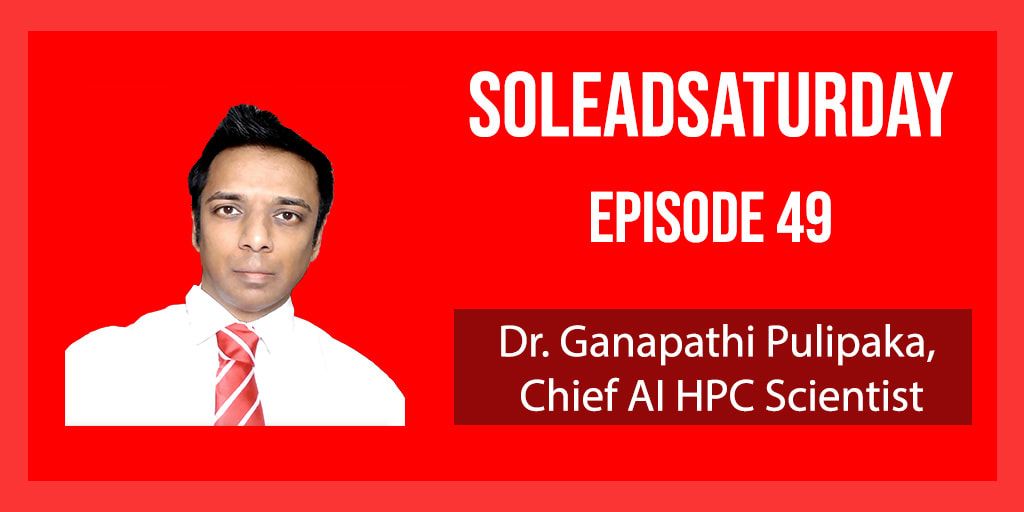

Enjoyed doing this interview on #Leadership with
#SoLeadSaturday - Episode 43 - Interview with Manjiri Prabhu
https://t.co/7gwHOVYFnc
My #SoLeadSaturday podcast with @vaishalilambe is now live. This conversation was a lot of fun. Watch & listen to the complete episode at:
https://t.co/6RwOrxKwOF
—————
#BigData #DataScience #DataScientists #Career #DataLeadership #AnalyticThinking #MachineLearning #AI
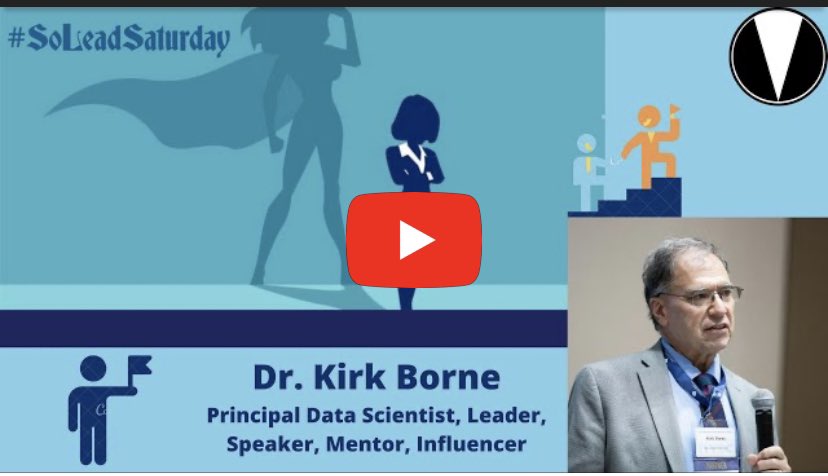

Had a great time interviewed by Vaishali Lambe [Lisha] in her podcast #SoLeadSaturday. We talked about how #cybersecurity and #AI are intertwined, leadership is crucial, and how technology is being used for both good and malicious purposes
https://t.co/waVhqBzAgR
Last Seen Hashtags on Sotwe
Trends for you
Most Popular Users

Elon Musk 
@elonmusk
240.5M followers

Barack Obama
@barackobama
118.7M followers

Cristiano Ronaldo
@cristiano
114.4M followers

Donald J. Trump
@realdonaldtrump
111.8M followers

Narendra Modi
@narendramodi
107M followers

Rihanna
@rihanna
98.7M followers

NASA
@nasa
92.2M followers

Justin Bieber
@justinbieber
91.8M followers

KATY PERRY
@katyperry
90M followers

Taylor Swift
@taylorswift13
84M followers

Lady Gaga
@ladygaga
75.5M followers

Virat Kohli
@imvkohli
73.4M followers

Kim Kardashian
@kimkardashian
70.8M followers

YouTube
@youtube
68.7M followers

Neymar Jr
@neymarjr
66.4M followers

Bill Gates
@billgates
65.2M followers

Selena Gomez
@selenagomez
63M followers

The Ellen Show
@theellenshow
62.1M followers

CNN
@cnn
61.7M followers

X
@x
60.6M followers