

Top Tweets for #Spacelaw

Some quotes from me on lunar issues in https://t.co/czrCR0pnTt from @rostraeconomica @rostra_econ🚀#SpaceLaw #SpacePolicy

خطوة جميلة من مجتمع الفضاء السعودي لدعم الكفاءات الوطنية في قطاع الفضاء السعودي🚀🇸🇦
سجلت في منصة Space Talent Network ومتحمسة لكل فرصة للتعلم، والتعاون، والمساهمة في هذا القطاع الواعد خصوصًا في مجال قانون الفضاء⚖️🪐✨
#قطاع_الفضاء #SpaceLaw #Space #رؤية_2030

UNOOSA Launches African Space Law Initiative
UNOOSA and the Italian Space Agency will host a space law #advisory mission in Kenya this November to support national regulatory frameworks across #Africa.
🔗Read on SWGL Website.
#SpaceWatchNews #SpaceLaw @ASI_spazio @UNOOSA


من يملك ذهب الفضاء؟ ⚖️
إذا وصلت شركة إلى كويكب مليء بالمعادن… هل يحق لها امتلاكه؟
السؤال لم يعد خيالًا علميًا، بل أصبح من أهم النقاشات القانونية حول مستقبل الاستثمار في الفضاء.
برأيك: موارد الفضاء لمن؟
للدول؟ للشركات؟ أم للبشرية كلها؟
#قانون_الفضاء #الفضاء #SpaceLaw
م
Who has the right to look down from space?
@TKriening and ESA's Kai-Uwe Schrogl talk satellite imaging laws, national shutter control, and dual-use realities at #ILA 2026.
🔗 https://t.co/p7S3XoY9Jg
#SpaceCafeClip @esa #SpaceLaw #DualUse

This Wednesday in Paris🇫🇷 I'll be speaking about lunar issues at 'Geopolitical stakes of the New Moon race' at @IFRI_ 🚀 https://t.co/09uMPW342q #SpaceLaw #SpacePolicy


Join us for our virtual information session on June 19 to explore our @OleMiss air and space law programs and learn about opportunities in one of the fastest-growing areas of law and policy. To register, please email [email protected]. #HottyToddy #SpaceLaw #AirLaw #DroneLaw


Join @OleMiss on June 19 for a virtual info session to meet our faculty, explore our programs and learn about career opportunities in air and space law. To register, please email [email protected].
#HottyToddy #SpaceLaw #AirLaw #DroneLaw

Today I presented on #SpaceLaw & Lunar Governance at the 1st 'Workshop on Enabling Sustainable and Responsible Lunar Activities' held at @esa @spacegovuk Harwell 🇬🇧 My slides: https://t.co/IKuOEPWbLx 🛰️Conference Website: https://t.co/42JojVmHtT🚀


#SPACELAW #LAUNCHREENTRY #SMALLSATELLITES
SPACE LAW PART 2: This part of the post is taken from 14 CFR Parts 450, 420, & 433 as well as a summary of FCC regulations re satellites
Part 450 LAUNCH AND REENTRY LICENSE REQUIREMENTS
14 CFR PART 450 sets forth, among other things, scope of a vehicle operator license, a key concept.
In conjunction with licensing, it provides an integrated definition of scope of launch and scope of reentry as well as compliance requirements for and payload determinations for the enumerated classes of payloads including safety reviews. This also includes small satellites below.
On March 17, 2026, FAA announced by press release that it would Streamline Commercial Space License Approvals under Part 450 in support of American commercial space innovation. https://t.co/RFutUR6W0S
All licensing will now occur under the Part 450 rule, which consolidates four old rules into one.
For five years, the old and new regulations were in effect simultaneously to provide a transition period for operators to obtain a Part 450 license.
Part 450 reduces the number of times an operator needs an FAA license approval and allows one license for a portfolio of operations, different vehicle configurations and mission profiles, and even multiple launch and reentry sites.
Attached is a bar chart of the number of licensed launches to date. Look at SpaceX!!! cf to others.
========================================
Part 450 SMALL SATELLITE OPERATOR & FCC PROVISIONS
450.43 Payload review and determination.
General. If applicable, the FAA issues a favorable payload determination for a launch or reentry to a license applicant or payload owner or operator if—(1) The applicant, payload owner, or payload operator has obtained all required licenses, authorizations, and permits; and (2) Its launch or reentry would not jeopardize public health and safety, safety of property, U.S. national security or foreign policy interests, or international obligations of the United States.
(b) Relationship to other executive agencies. The FAA does not make a determination under paragraph (a)(2) of this section for—(1) Those aspects of payloads that are subject to regulation by the Federal Communications Commission or the Department of Commerce; or (2) Payloads owned or operated by the U.S. Government.
The payload owner/operator may also apply for the determination.
=======================================
FCC Small Satellite and Small Spacecraft Licensing Process
https://t.co/h62FcAxDUU
In 2019, the FCC created an alternative, optional application process for small satellites and spacecraft with non-Earth orbit missions in its Report and Order on Streamlining Licensing Procedures for Small Satellites (IB Docket No. 18-86; FCC 19-18). This process enables small satellite and spacecraft applicants to take advantage of an easier application process with lower application fees, generally shorter processing times, forbearance from the performance bond requirement for one year, and exemption from processing round rules.
The Order sets forth qualifying characteristics generally relating to size, duration, radio frequency, operational debris and collision risk.
The applicant must provide a demonstration that the satellite operations can share spectrum with current and future operators. This usually involves a demonstration, for example, that the satellites are communicating with a limited number of earth stations or otherwise have limited spectrum use.
Streamlined Small Spacecraft Licensing
This process is also adopted for small spacecraft with planned non-Earth orbiting missions, such as commercial lunar missions. Applicants for these missions are exempt from several of the characteristics, but are subject to others:
In addition to the specifying compliance with the qualifying criteria, applicants for small satellite license or grant of market access must provide the following:
An overall description of system facilities, operations, and services and an explanation of how uplink frequency bands would be connected to downlink frequency bands;
Public interest considerations in support of grant;
A description of means by which requested spectrum could be shared with both current and future operators, (e.g., how ephemeris data will be shared, antenna design, earth station geographic locations) thereby not materially constraining other operations in the requested frequency band(s);
For space stations with any means of maneuverability, including both active and passive means, a description of the design and operation of maneuverability and deorbit systems, and a description of the anticipated evolution over time of the orbit of the proposed satellite or satellites.
In any instances where spacecraft capable of having crew aboard will be located at or below the deployment orbital altitude of the space station seeking a license, a description of the design and operational strategies that will be used to avoid in-orbit collision with such crewed spacecraft shall be furnished at time of application.
Other information is required as described in the Part 25 Space Station Checklist.
==================================
SPACEPORTS: LAUNCH SITES AND REENTRY SITES
An updated FAA spaceport chart from Mar 2025 is posted separately
14 CFR PART 420—sets forth the regulations to obtain a LICENSE TO OPERATE A LAUNCH SITE (Authority: 51 U.S.C. 50901-50923 Docket No. FAA-1999-5833, 65 FR 62861, Oct. 19, 2000, unless otherwise noted)
Part 420 prescribes the information and demonstrations that must be provided to the FAA as part of a license application, the bases for license approval, license terms and conditions, and post-licensing requirements with which a licensee shall comply to remain licensed. 420 also contains definitions such as liquid propellants, safety, environmental, and other terms and conditions such as agreements with the Coast Guard and FAA, scheduling, handling of mishaps, and distance requirements.
Requirements for preparing a license application are contained in part 413 of this subchapter.
14 CFR PART 433—sets forth the regulations to obtain a LICENSE TO OPERATE A REENTRY SITE (Authority:51 U.S.C. 50901-50923, Docket No. FAA-1999-5535, 65 FR 56665, Sept. 19, 2000, unless otherwise noted.)
Section 433.3 Issuance of a license to operate a reentry site. (a) The FAA issues a license to operate a reentry site when it determines that an applicant's operation of the reentry site does not jeopardize public health and safety, the safety of property, U.S. national security or foreign policy interests, or international obligations of the United States.
A license to operate a reentry site authorizes the licensee to offer use of the site to support reentry of a reentry vehicle for which the three-sigma footprint of the vehicle upon reentry is wholly contained within the site. The regs specify compliance with NEPA, first an EA, then an EIS or CE as appropriate.

#SpaceLaw
Space Law Basics Part 1
Streamlined Small Sat Regulations ( in Part 2)
The US Space Launch Competitiveness Act of 2015
https://t.co/Zz3RHRZHN1
The U.S. Commercial Space Launch Competitiveness Act of 2015 (also known as the SPACE Act, Public Law 114-90) is landmark legislation enacted to stimulate the private space sector. It establishes property rights for U.S. citizens who mine resources in space and extends regulatory and liability protections for commercial spaceflight providers.
The enabling statute for commercial space operations is Commercial Space Launch Act of 1984 (51 U.S.C. § 50901-50923). This was amended by Commercial Space Launch Amendments Act of 2004. .
The principal agencies regulating space law are DOT/FAA/Office of Commercial Space Transportation and NOAA and FCC. (The FAA licenses launch and reentries for U.S. citizens and from U.S. territory.)
Statute and multiple executive policies have directed the U.S. government to, when possible, use commercial space launch services to promote the U.S. commercial space industry and to improve cost effectiveness. The Commercial Space Act of 1998 (P.L. 105-303) directs the federal government to "acquire space transportation services from United States commercial providers whenever such services are required in the course of its activities," with certain exceptions (e.g., if transportation services that meet specific mission requirements would not be reasonably available from U.S. commercial providers). Commercial Space Act of 1998 (P.L. 105-303), Title II, codified at 51 U.S.C. §50131.
Major amendments were provided for in the aforementioned US Space Launch Competitiveness Act of 2015, summarized by its 4 Titles.
The Act encompasses four titles:
I. Spurring Private Aerospace Competitiveness and Entrepreneurship (acronym: SPACE),
II. Commercial Remote Sensing,
III. Office of Space Commerce, and
IV. Space Resource Exploration and Utilization.
LICENSING OF LAUNCHES: Title I amends the Commercial Space Launch Act, which comprises the licensing regime for launches, reentries, and launch port activities, including those carrying spaceflight participants on board.
Definitions of many of the terms are found in the regulations. For example, 14 C.F.R. §401.5 defines reentry vehicle as "a vehicle designed to return from Earth orbit or outer space to Earth substantially intact. A reusable launch vehicle that is designed to return from Earth orbit or outer space to Earth substantially intact is a reentry vehicle."
Use the official Spaceport License resources to view application checklists (https://t.co/P3H7neJnNP), or check the Spaceports by State directory for details on individual sites (https://t.co/8zqzCh71o7).
LICENSING OF COMMERCIAL SATELLITE REMOTE SENSING OPERATIONS: (Satellites covered in a followup post.) Title II amends the Land Remote Sensing Policy Act, which allowed for the licensing of private commercial satellite remote-sensing operations, and essentially requires the Secretary of Commerce to provide an overview of licensing practices in this sector so far and any perceived need to update the statutory regime in this respect.
Title III relabels the existing Office of Space Commercialization as Office of Space Commerce and rephrases its purposes.
PRELIMINARY SPACE RESOURCE EXPLOITATION: Title IV, the Space Resource Exploration and Utilization Act (Chapter 513 of 51 USC), addresses in a preliminary fashion space resource exploitation—the most innovative and disputed part of the Act, certainly in an international context.
Space Resource Rights (Title IV): Grants U.S. companies the legal right to own, possess, transport, use, and sell resources extracted from asteroids and other celestial bodies. It explicitly states that the U.S. does not claim sovereignty over celestial bodies, but ensures private entities can legally profit from space mining.
Commercial Spaceflight Indemnification: Extends the federal government's indemnification of commercial launch providers for catastrophic third-party losses.
Regulatory "Learning Period": Extends the Federal Aviation Administration (FAA) "learning period," which restricts the government from imposing strict passenger safety regulations on the burgeoning commercial spaceflight industry, allowing room for innovation.
Government Astronaut Definition: Formally defines "government astronaut" in statute to ensure U.S. government employees (like NASA astronauts flying on commercial spacecraft) are properly protected under existing liability frameworks.
Satellites: Remote Sensing & Space Commerce: Streamlines regulations for the private remote-sensing (satellite) industry and renames/reorganizes the Office of Space Commerce to better support the growing commercial aerospace sector.


What ethical framework should guide adolescents in space?
OSMED’s Monthly Space Ethics and Law Interest Group opens to the public June 1 at 8 PM ET to discuss this question and explore a potential white paper.
Register: https://t.co/Nrrph9efmD
#SpaceEthics #SpaceLaw #OSMED


THE KEY ROLE OF STAKEHOLDERS AND EXPERTS IN SPACE GOVERNANCE
Read More:
https://t.co/4BDDbYhrzE
#space #SpaceX #SpaceResearch #SpacePollution #SpaceLaw #spaceWeather #spaceexploration #spacefacts #spaceplanning #spacestation #spaceShip


Last year, Strathmore University from Kenya made history by becoming the first Kenyan institution to reach the global semi-finals at the world finals in Sydney. 🏆Who will rise to the occasion this year and represent Africa in Türkiye later this year? 👀
#RoadToTürkiye #SpaceLaw
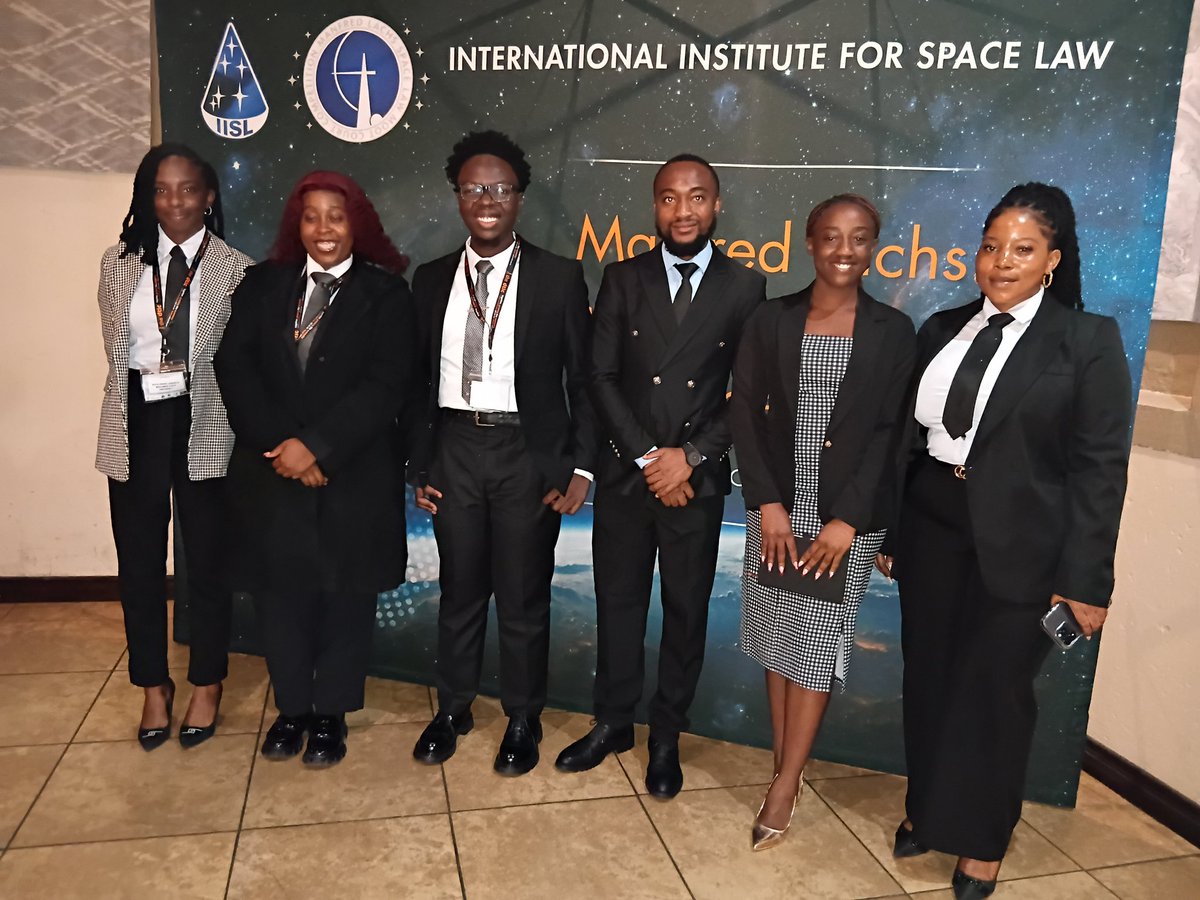
🚀 Africa's future in space governance takes centre stage TODAY in Pretoria as @the_dtic in partnership with @SANSA7 hosts the 17th Africa Regional Round of the Manfred Lachs Space Law Moot Court Competition at Casa Toscana Convention Centre. 🌎
#SpaceLaw #ManfredLachs2026

Explore the legal challenges shaping the future of satellite imagery, data ownership, privacy, and global access to information. Apply today to @OleMiss's MS in Air and Space Law. https://t.co/HoU1FLkjYO #SpaceLaw #RemoteSensing 🛰️


☀️ A Spanish woman legally registered the Sun as hers.
Angeles Duran used a notary loophole to claim ownership.
Space law has a wild gap.
Sources: BBC News, The Guardian
#omgfacts #SpaceLaw #astronomy

Explore how law and business intersect beyond Earth, shaping the future of the space economy. Apply now to our new MS in Air and Space Law, starting this fall @OleMiss! https://t.co/HoU1FLkjYO #SpaceCommerce #SpaceLaw #HottyToddy 🚀 🛰️


Join the #Centre_for_Space_Futures webinar on the future of space law and the practical implementation of space governance.
Register: https://t.co/hJowi7ZPYa
#SpaceLaw #SpaceGovernance #FutureOfSpace

Last Seen Hashtags on Sotwe
鉱物の王国
Seen from United States
大屌萌妹
Seen from United States
JasonTrost
Seen from United States
ometv
Seen from France
nalguitas
bnwo sister
Seen from United States
WomensRightsAreHumanRights
Seen from United States
universo4
Seen from United States
ConstructionAssistant
Seen from United States
momson
Seen from Peru
Trends for you
Most Popular Users

Elon Musk 
@elonmusk
240.8M followers

Barack Obama
@barackobama
119.2M followers

Donald J. Trump
@realdonaldtrump
111.7M followers

Cristiano Ronaldo
@cristiano
111.4M followers

Narendra Modi
@narendramodi
107M followers

Rihanna
@rihanna
97.8M followers

NASA
@nasa
92.2M followers

Justin Bieber
@justinbieber
91.1M followers

KATY PERRY
@katyperry
88.1M followers

Taylor Swift
@taylorswift13
81.9M followers

Lady Gaga
@ladygaga
73.5M followers

Virat Kohli
@imvkohli
70.5M followers

Kim Kardashian
@kimkardashian
70M followers

YouTube
@youtube
68.7M followers

Bill Gates
@billgates
64.1M followers

Neymar Jr
@neymarjr
63.4M followers

The Ellen Show
@theellenshow
62.4M followers

CNN
@cnn
61.9M followers

Selena Gomez
@selenagomez
61.2M followers

X
@x
60.8M followers