

Top Tweets for #Specifiers

After a conversation with @norpadon, I decided to check how C++ compilers can solve basic problems using assumptions provided via C++23 attribute specifiers. I didn't find an impressive example, but it seems that GCC just ignores all assumptions, while Clang can actually use them.


@StokeWillie @V4ldeLund Тут очень интересно посмотреть, например, на язык F*. В отличие от других языков с зависимыми типами, которые требуют от программиста явных доказательств или ссылок на тактики, F* использует SMT солвер для того чтобы доказывать утверждения наподобие n+1 = 1+n.

Corvette of concrete?
Amrize launches EVERtect™, unmatched high-performance, customizable concrete mixes precision-engineered for the most demanding performance requirements, delivering greater speed, efficiency, flexibility in one smart system for builders & specifiers
$AMRZ

Learnt about variables and format specifiers in C today.
Going slow due to ongoing lab internals.
#CodingJourney #BuildInPublic
#LearningInPublic #Coding

Best class on static and access specifiers.


Thinking about what makes @Alloranetwork so fundamentally different...
It's not just another "decentralized AI" play. The real genius is inverting the entire workflow.
Instead of you hunting for the right model (which is a losing battle as market conditions shift), you just state your goal: "predict ETH price in 1 hour."
The network's solver market then does the heavy lifting. It's like having a meta-AI that's constantly evaluating which specialist AI is best suited for this specific moment.
A macro model might be best in a stable market, while a sentiment model kicks in during news events. Allora dynamically finds the signal.
This objective-centric approach is the next logical step. We're moving from tool-users to outcome-specifiers. The network becomes a collective intelligence engine.
The mainnet launch isn't just a network going live; it's the activation of a new primitive. The "intelligence-backed asset" concept with $ALLO is what truly ties it all together

Thinking about what makes @Alloranetwork so fundamentally different...
It's not just another "decentralized AI" play. The real genius is inverting the entire workflow.
Instead of you hunting for the right model (which is a losing battle as market conditions shift), you just state your goal: "predict ETH price in 1 hour."
The network's solver market then does the heavy lifting. It's like having a meta-AI that's constantly evaluating which specialist AI is best suited for this specific moment.
A macro model might be best in a stable market, while a sentiment model kicks in during news events. Allora dynamically finds the signal.
This objective-centric approach is the next logical step. We're moving from tool-users to outcome-specifiers. The network becomes a collective intelligence engine.
The mainnet launch isn't just a network going live; it's the activation of a new primitive. The "intelligence-backed asset" concept with $ALLO is what truly ties it all together.


Day 4/60 – 60 Days of System Design 🚀
Dived deeper into Encapsulation & Access Specifiers (default, public, private, protected). Controlling what’s exposed vs hidden keeps systems modular & secure 🔒
#60DaysOfSystemDesign #OOP #SystemDesign #BuildInPublic
Day 3/60 – 60 Days of System Design 🚀
Revised constructors, and went deeper into attributes & methods – the state + behavior that define how objects live & act.
Small steps, building solid OOP foundations 💪
#60DaysOfSystemDesign #OOP #SystemDesign

Day 2 of learning C:
Today I learned more about data types. Here’s the most amazing part:
~The char data type stores characters and works withm2 format specifiers
%c prints the character.
%d prints its ASCII value.
What’s the coolest thing you’ve learned about data types in C?


Why IrysVM Matters.
IrysVm provides the same functionality as the Ethereum Virtual Machine (EVM), with one major exception: it is designed to extract all relevant information from @irys_xyz data record.
This enables smart contracts to communicate with local data without relying on external systems, which would ordinarily incur additional fees and complexity.
This is how it works:
- Direct Data Access: Smart contracts on IrysVM can access the Publish Ledger by using such methods as range specifiers ensuring efficient retrieval.
- Embedded Properties: Data on Irys carries programmable metadata, such as ownership rights, access controls, or royalty rules, which smart contracts can enforce automatically.
- Cost Efficiency: IrysVM separates storage and computation into different processing lanes, preventing competition for blockspace and keeping transaction costs predictable.
For developers, this means you can create apps where data is flexible, easy to work with, and budget-friendly — just right for things like AI, NFTs, or DeFi.


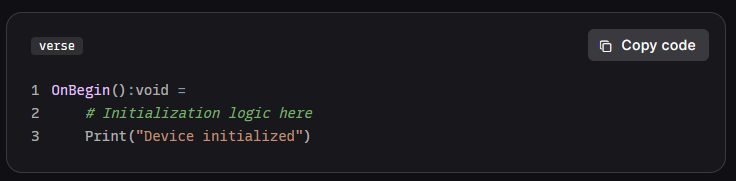
Epic assistant seems to be bugged, not displaying specifiers <suspends> <overrides> <concrete> @FNCreate

Hirys to @irys_xyz family
⛩️ "Fine grained data access in Irys" ⛩️
One of the most powerful aspects of Irys is that data stored on the network isn’t just permanent, it’s programmable. This means smart contracts can interact with data in precise and efficient ways, instead of pulling down entire datasets every time execution is required.
At the core of this design are range specifiers, which tell the system exactly what portion of the data to fetch. Since Irys stores information in chunks, developers can use a chunk range specifier to indicate the partition where the data lives, the offset to begin from, and how many chunks to retrievwe.
This matters because it brings true efficiency to on chain data use. By letting smart contracts retrieve only the information they need, Irys also reduces gas costs, makes handling large datasets possible, and integrates seamlessly with Ethereum’s existing tooling through EIP-2930 access list compatibility.

Hirys to my @irys_xyz family
⛩️ "How Irys Bundles transactions II" ⛩️
The real strength of this system lies in how bundlers handle transaction costs. Instead of attaching a fee to every single DataItem, costs are consolidated at the bundle level. This means the bundler pays for submitting the entire package to the network, lifting the weight of transaction fees from individual users. For developers, it creates a practical way to upload large datasets without excessive expenses, while applications can even choose to absorb these costs on behalf of their users. The result is a seamless and user-friendly experience, where data uploads remain both scalable and cost-efficient.


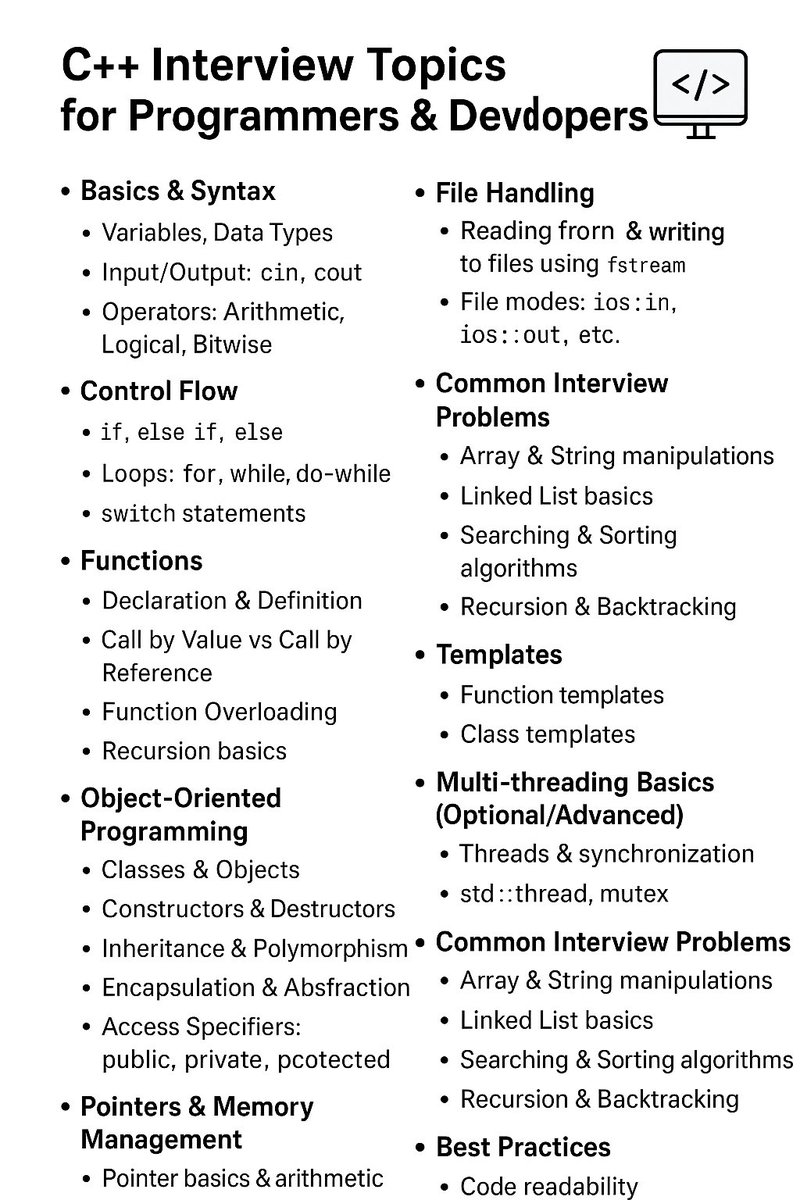
✅ C++ Interview Topics for Programmers & Developers 💻
🔹 Basics & Syntax
– Variables, Data Types
– Input/Output: `cin`, `cout`
– Operators: Arithmetic, Logical, Bitwise
*🔹 Control Flow*
– `if`, `else if`, `else`
– Loops: `for`, `while`, `do-while`
– `switch` statements
*🔹 Functions*
– Declaration & Definition
– Call by Value vs Call by Reference
– Function Overloading
– Recursion basics
*🔹 Object-Oriented Programming*
– Classes & Objects
– Constructors & Destructors
– Inheritance & Polymorphism
– Encapsulation & Abstraction
– Access Specifiers: `public`, `private`, `protected`
*🔹 Pointers & Memory Management*
– Pointer basics & arithmetic
– Dynamic memory: `new` & `delete`
– Smart pointers (if applicable)
*🔹 STL (Standard Template Library)*
– Vectors, Lists, Deques
– Maps & Sets
– Algorithms: `sort()`, `find()`, etc.
– Iterators
*🔹 File Handling*
– Reading from & writing to files using `fstream`
– File modes: `ios::in`, `ios::out`, etc.
*🔹 Exception Handling*
– `try`, `catch`, `throw`
– Custom exceptions
*🔹 Templates*
– Function templates
– Class templates
*🔹 Multi-threading Basics* (Optional/Advanced)
– Threads & synchronization
– `std::thread`, `mutex`
*🔹 Common Interview Problems*
– Array & String manipulations
– Linked List basics
– Searching & Sorting algorithms
– Recursion & Backtracking
*🔹 Best Practices*
– Code readability
– Debugging tips
– Time & space complexity basics
💬 *Tap ❤️ for more!*
🚀 Transforming C++ Development with GitHub Copilot's Next Edit Suggestions
Maintaining and evolving C++ codebases often requires navigating across multiple code regions to apply consistent changes. Whether you're updating access specifiers, migrating to STL, or modernizing legacy syntax, it can be a tedious, manual process. That’s where Next Edit Suggestions (NES) in GitHub Copilot steps in — helping you stay in flow by predicting what you’ll need to change next and where those changes should occur.
---
✨ Smarter Code Edits: From fgets to std::getline
Take for example a common modernization task — replacing C-style input code like:
char name[50];
fgets(name, sizeof(name), stdin);
With modern C++:
std::string name;
std::getline(std::cin, name);
With NES, GitHub Copilot automatically suggests these updates dynamically across your file:
Replacing fgets with std::getline
Converting raw character arrays (char[]) to std::string
Swapping atoi for the safer and more expressive std::stoi
This allows you to convert entire functions from C-style to C++ idiomatic style with minimal context switching.
---
💡 Stay in Flow
NES doesn’t just make one change — it anticipates all the related edits across your file or class and suggests them near your cursor. This means fewer manual jumps, fewer missed updates, and more time focusing on your logic.
---
🧪 Available Now in Visual Studio and VS Code
Next Edit Suggestions is now integrated into both Visual Studio and VS Code. Whether you’re working in a legacy C++ repo or building something new, NES keeps your workflow consistent, intelligent, and fast.
🙌 We’d love your feedback as you explore NES!
🗣️ Share your thoughts on Developer Community (VS)
🧵 Or submit feedback via GitHub (VS Code)
📩 You can also reach us directly: [email protected]
---
🔧 Ready to Code Smarter?
Start using Next Edit Suggestions today and experience how GitHub Copilot can accelerate not just writing — but also refactoring and modernizing your C++ code.

Format String Vulnerabilities Explained
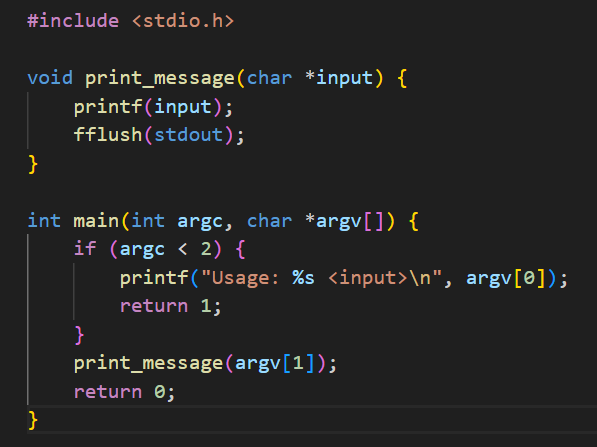
Format string vulnerabilities happen when a program takes user input and passes it directly to functions like printf without specifying a proper format. This allows attackers to exploit the way these functions access memory, potentially reading sensitive information or even writing to arbitrary memory locations.
For example, if a developer uses printf(userInput); instead of something like printf("%s", userInput);, an attacker can inject format specifiers such as %x to read memory or %n to write to it. With carefully crafted input, they might even overwrite return addresses or function pointers, gaining control over the program's execution, which is especially dangerous in applications with elevated privileges!.
To protect against this, developers should always use explicit format strings, enable compiler warnings like -Wformat security, and implement memory protection techniques (like ASLR).
Most importantly, never trust user input blindly, always validate it before passing it to any format function!
A solid understanding of how the stack works and how format strings are parsed is essential for writing secure code.
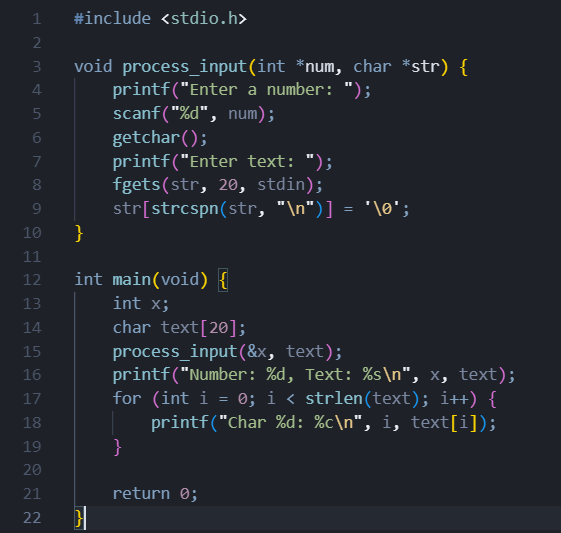
Code Example:


Day 67 of #LearningInPublic
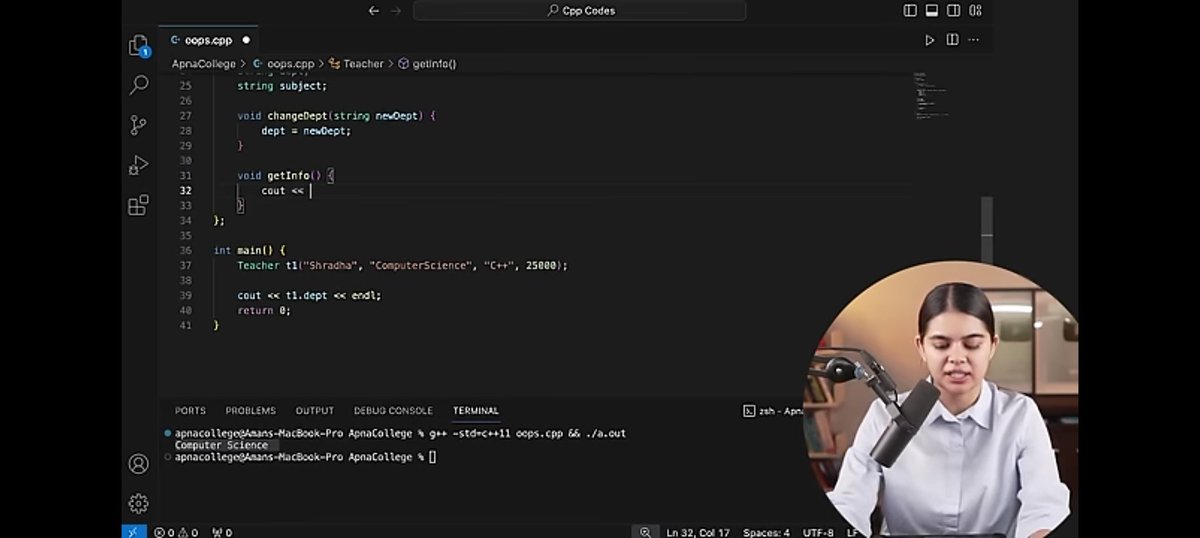
Stepped into the world of OOPs today! 🧱 Learned about classes & objects, access specifiers, encapsulation, and constructors. It’s exciting to see how code becomes more organized and reusable with these concepts! 🚀 #DSA #100DaysOfCode
Input Handling
The scanf function captures user input, storing it in variables with appropriate format specifiers.

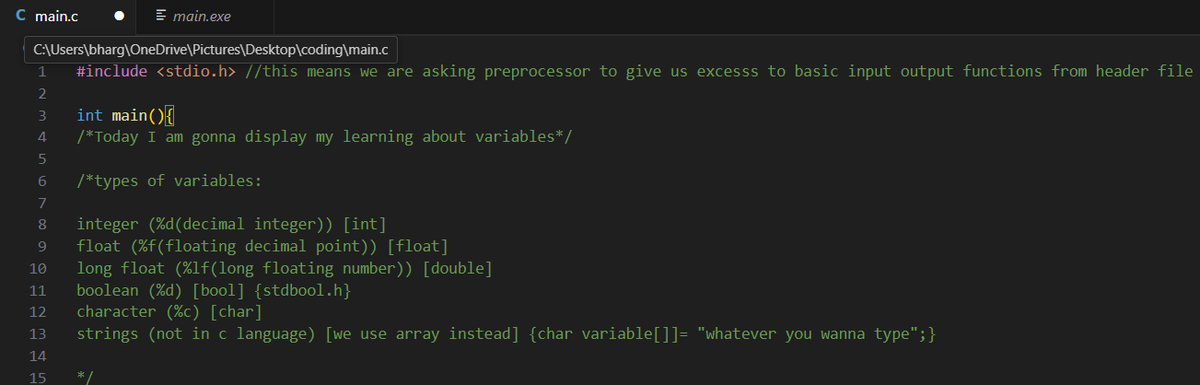
Now about my learnings so far? 🔥
1) done with how to set up C from scratch.
2) learnt basic things which everyone misses.
3) done with comments (// or /**/)
4) done with data types and variables (even with format specifiers)
5) done with arithmetic operations
Here's notes



@excavated0 Interesting in the sense that you're using the wrong format specifiers?

Created the summarized explanation on %lf format specifiers and output function issues as promised. I'll drop an updated and more factually accurate summary later.
This is the first draft summary on %lf format specifier and why it throws errors(on some compilers) when using it to print a double despite it being the valid format specifier for double in other scenarios.

With all these effect specifiers, you're ready to write clean, predictable, and rollback-safe code in Verse. Mastering them is the key to building great game loops, from shops to combat systems to async flows.
Now go script something Epic! 🧠⚙️🎮
Effect specifiers are keywords that change how a Verse function behaves under the hood:
- Can it fail?
- Can it wait? (while other things are running)
- Can it change values?
- Can it be rolled back?
Add them between the parameters and the returning type:

💡 Verse Effect Specifiers explained!
Whether you're building your first device or a full game system in Fortnite, understanding function modifiers in Verse is essential.
This is the ultimate guide to master them.
Let's break them down in plain English 🧵👇

Most Popular Users

Elon Musk 
@elonmusk
240M followers

Barack Obama
@barackobama
118.6M followers

Cristiano Ronaldo
@cristiano
114.4M followers

Donald J. Trump
@realdonaldtrump
111.7M followers

Narendra Modi
@narendramodi
106.9M followers

Rihanna
@rihanna
98.6M followers

NASA
@nasa
92.1M followers

Justin Bieber
@justinbieber
91.7M followers

KATY PERRY
@katyperry
89.9M followers

Taylor Swift
@taylorswift13
83.9M followers

Lady Gaga
@ladygaga
75.4M followers

Virat Kohli
@imvkohli
73.3M followers

Kim Kardashian
@kimkardashian
70.8M followers

YouTube
@youtube
68.6M followers

Neymar Jr
@neymarjr
66.3M followers

Bill Gates
@billgates
65.2M followers

Selena Gomez
@selenagomez
63M followers

The Ellen Show
@theellenshow
62.1M followers

CNN
@cnn
61.7M followers

X
@x
60.6M followers