

Top Tweets for #Steelproxy

#MonolithischIndia #MONOLITH #SteelProxy #InfraPlay
Every time India pours more steel, a thin layer of silica inside a furnace gets destroyed. That consumable must be replaced. Every batch. Every time. Forever.
Monolithisch India isn't a steel company. It's the consumable that steel can't run without — a recurring revenue engine hidden inside India's infrastructure capex supercycle.
The question: can a ₹135Cr niche supplier absorb a 3× capacity jump without cracking its own lining?
Business story
The business story starts with a frustration. In 2018, Prabhat and Harsh Tekriwal watched steel plants in West Bengal manually mixing raw quartzite and boric acid on-site — an error-prone, inefficient process causing furnace cracks and costly downtime.
Their pivot: don't sell the ingredients. Sell the pre-mixed, ready-to-use solution. They built an automated facility in Purulia — right next to high-purity quartzite mines in Bihar/Jharkhand — and delivered consistent, 98.9% silica-grade ramming mass that eliminates on-site mixing entirely.
The big structural trigger: India's secondary steel sector is booming. These induction furnace operators need ramming mass on a rolling monthly basis. It's not a one-time sale — it's a forced-repurchase every few batches.
Revenue: ₹41.9Cr (FY23) → ₹97.3Cr (FY25) → ₹135.3Cr (FY26) → ₹250–300Cr guided for FY27.
No turnaround story. Just a smart niche compounding quietly.
Moat — is it real?
Three genuine moat pillars:
① Geographic citadel. The Purulia plant sits between the ore source (Bihar/Jharkhand quartzite) and the customer (Eastern India steel belt). Silica mass is heavy. Freight is destiny. A competitor from Rajasthan cannot bridge this cost gap.
② Operational switching costs. If a furnace lining fails mid-batch — molten metal breakout, cracked shell, multi-crore downtime. Steel plant operators won't switch vendors to save ₹50/MT. 61.4% of revenue comes from repeat corporate buyers.
③ Proprietary blends. The SGB-777 series is a trade-secret formula. Competitors can buy the same quartzite; they can't replicate the exact boric acid to grain-size ratio that gives one more batch per lining.
What's missing: no patents, no network effects. A well-funded clone near Eastern India would be the real threat — but environmental clearances take 6–12 months and automated plant setup requires ₹50–100Cr+. Substitution risk (EAF replacing induction furnaces): 10+ year horizon.
Valuation & operational leverage
The numbers first:
FY26 A: Rev ₹135Cr | EBITDA 23.6% | PAT ₹23Cr | EPS ₹10.65 | ROIC 26.8%
FY27 E: Rev ₹265Cr | EBITDA 23.0% | PAT ₹42.5Cr | EPS ₹19.65 | ROIC 31.4%
FY28 E: Rev ₹385Cr | EBITDA 23.8% | PAT ₹65Cr | EPS ₹30.18 | ROIC 35.1%
At ~₹751/share, trailing P/E is 70.6×. That sounds expensive until you see the earnings trajectory: forward FY27 P/E compresses to ~38×, FY28 to ~25×.
Is there big operational leverage?
Yes, but it's volume-led not margin-led. EBITDA stays flat at 23–24% — this is a volume multiplier, not a margin expander.
The real leverage is CFO: ₹18.5Cr (FY26) → ₹58.5Cr (FY28). Nearly debt-free balance sheet (D/E near zero) ensures every rupee of EBITDA flows cleanly to PAT.
Growth triggers:
✅ 574,000 MTPA capacity live by FY28 (from 210,000 now)
✅ Market share target: 20–25% domestic within 24 months
✅ Export corridors (Nepal, Bangladesh, Gulf) at 4–5% price premium
✅ Premiumization: SGB Series mix shift expanding EBITDA to 28%+ in Q4
Red flags:
⚠ FY27 ₹265Cr target needs ~2× volume — execution risk is real
⚠ Rolling order pipeline vs. multi-year backlog = visibility limited to 50% of quarterly revenue
⚠ Raw material pass-through lag: +5% quartzite = 110bps gross margin hit
⚠ RPEL (Raghav Productivity) expanding south — could squeeze geography
Management quality & governance
Family-run. Tight. Functional. Not flawless.
The positives:
— Prabhat Tekriwal (Chairman + CFO): 23 years in mineral and refractory supply chains. Deep procurement relationships in Bihar/Jharkhand quartzite networks that are non-replicable in the short term.
— 71–74% promoter holding post-IPO. Zero pledged shares. The IPO was 100% fresh issue
— not a single rupee of OFS. The ₹82Cr went entirely to Purulia plant expansion.
— Revenue guided at ₹135Cr; delivered exactly at ₹135.3Cr. Track record is clean.
The concerns:
— Prabhat Tekriwal is simultaneously Chairman AND CFO. Concentrated power, reduced oversight.
— All four family members (Prabhat, Harsh, Sharmila, Kritish) sit in executive roles.
— Related party transactions with group entity Mineral India Global — audit committee must police arm's-length pricing on raw stone procurement. Cash leakage risk.
Key-man risk is the highest single governance concern. If Prabhat steps back, mineral procurement relationships and banking lines are at risk.
Order pipeline reality check
The ₹265Cr FY27 target raises one important question every analyst must ask: where is the order book?
The answer: there isn't a traditional one.
Ramming mass isn't an engineering project — it's a consumable. Steel plants don't place 3-year bulk contracts. They run rolling monthly and quarterly off-take agreements. The revenue visibility model is:
→ ~50% of quarterly revenue locked via rolling supply agreements
→ Remaining 50% flows from Letters of Intent + repeat buyer pull
This means revenue is structurally predictable (61.4% repeat customers, structural furnace degradation cycle) but not formally booked.
Why will orders keep coming despite a 2.7× capacity jump?
① The domestic premixed market is growing toward 60 Lakh MTPA (vs. Monolithisch's 5.74 Lakh target — still <10% of TAM)
② Formalization wave: unorganized grinders failing compliance → volumes moving to corporate suppliers
③ Geographic expansion into Rajasthan and South India planned → new demand clusters
④ Bangladesh + Nepal exports already live; Gulf pipeline being built
The demand case is structural and credible. The risk is ramp speed — new automated lines need 6–9 months of customer qualification before full-volume pull. Watch FY27 Q1/Q2 volume ramp as the key proof point.
Closing thesis:
Back to the question: is Monolithisch really a repeatable, critical-component steel proxy that benefits from India's infrastructure capex?
Yes — but with a specific character that matters:
It doesn't benefit from steel capex. It benefits from steel production. That's the distinction. Steel Capex (furnace builds) is lumpy and cyclical. Steel production volumes are steady and recurring. Monolithisch earns on every batch poured, not on every furnace built.
The triggers to watch:
✅ FY27 revenue print — does ₹265Cr land or does it slip to ₹200Cr?
✅ Capacity utilisation rate on new Purulia lines — Q1/Q2 FY27 the tell
✅ Customer qualification of new Unit 2 by large Tier-1 steel clients
✅ SGB Series mix shift toward 70%+ of sales (margin re-rating catalyst)
✅ Export revenue crossing ₹20Cr (valuation re-rating for premium earnings)
⚠ Any RPT irregularity or governance friction during SME-to-mainboard shift
⚠ Entry of a well-capitalised competitor in the Eastern mineral corridor
At FY28E EPS of ₹30.18, the stock at ₹751 trades at ~25× forward — reasonable for a 45%+ PAT CAGR business with near-zero debt and 35% ROIC. The valuation works IF the capacity ramp executes on time.
[Not investment advice, DYOR]
![ramesh_vd's tweet photo. #MonolithischIndia #MONOLITH #SteelProxy #InfraPlay
Every time India pours more steel, a thin layer of silica inside a furnace gets destroyed. That consumable must be replaced. Every batch. Every time. Forever.
Monolithisch India isn't a steel company. It's the consumable that steel can't run without — a recurring revenue engine hidden inside India's infrastructure capex supercycle.
The question: can a ₹135Cr niche supplier absorb a 3× capacity jump without cracking its own lining?
Business story
The business story starts with a frustration. In 2018, Prabhat and Harsh Tekriwal watched steel plants in West Bengal manually mixing raw quartzite and boric acid on-site — an error-prone, inefficient process causing furnace cracks and costly downtime.
Their pivot: don't sell the ingredients. Sell the pre-mixed, ready-to-use solution. They built an automated facility in Purulia — right next to high-purity quartzite mines in Bihar/Jharkhand — and delivered consistent, 98.9% silica-grade ramming mass that eliminates on-site mixing entirely.
The big structural trigger: India's secondary steel sector is booming. These induction furnace operators need ramming mass on a rolling monthly basis. It's not a one-time sale — it's a forced-repurchase every few batches.
Revenue: ₹41.9Cr (FY23) → ₹97.3Cr (FY25) → ₹135.3Cr (FY26) → ₹250–300Cr guided for FY27.
No turnaround story. Just a smart niche compounding quietly.
Moat — is it real?
Three genuine moat pillars:
① Geographic citadel. The Purulia plant sits between the ore source (Bihar/Jharkhand quartzite) and the customer (Eastern India steel belt). Silica mass is heavy. Freight is destiny. A competitor from Rajasthan cannot bridge this cost gap.
② Operational switching costs. If a furnace lining fails mid-batch — molten metal breakout, cracked shell, multi-crore downtime. Steel plant operators won't switch vendors to save ₹50/MT. 61.4% of revenue comes from repeat corporate buyers.
③ Proprietary blends. The SGB-777 series is a trade-secret formula. Competitors can buy the same quartzite; they can't replicate the exact boric acid to grain-size ratio that gives one more batch per lining.
What's missing: no patents, no network effects. A well-funded clone near Eastern India would be the real threat — but environmental clearances take 6–12 months and automated plant setup requires ₹50–100Cr+. Substitution risk (EAF replacing induction furnaces): 10+ year horizon.
Valuation & operational leverage
The numbers first:
FY26 A: Rev ₹135Cr | EBITDA 23.6% | PAT ₹23Cr | EPS ₹10.65 | ROIC 26.8%
FY27 E: Rev ₹265Cr | EBITDA 23.0% | PAT ₹42.5Cr | EPS ₹19.65 | ROIC 31.4%
FY28 E: Rev ₹385Cr | EBITDA 23.8% | PAT ₹65Cr | EPS ₹30.18 | ROIC 35.1%
At ~₹751/share, trailing P/E is 70.6×. That sounds expensive until you see the earnings trajectory: forward FY27 P/E compresses to ~38×, FY28 to ~25×.
Is there big operational leverage?
Yes, but it's volume-led not margin-led. EBITDA stays flat at 23–24% — this is a volume multiplier, not a margin expander.
The real leverage is CFO: ₹18.5Cr (FY26) → ₹58.5Cr (FY28). Nearly debt-free balance sheet (D/E near zero) ensures every rupee of EBITDA flows cleanly to PAT.
Growth triggers:
✅ 574,000 MTPA capacity live by FY28 (from 210,000 now)
✅ Market share target: 20–25% domestic within 24 months
✅ Export corridors (Nepal, Bangladesh, Gulf) at 4–5% price premium
✅ Premiumization: SGB Series mix shift expanding EBITDA to 28%+ in Q4
Red flags:
⚠ FY27 ₹265Cr target needs ~2× volume — execution risk is real
⚠ Rolling order pipeline vs. multi-year backlog = visibility limited to 50% of quarterly revenue
⚠ Raw material pass-through lag: +5% quartzite = 110bps gross margin hit
⚠ RPEL (Raghav Productivity) expanding south — could squeeze geography
Management quality & governance
Family-run. Tight. Functional. Not flawless.
The positives:
— Prabhat Tekriwal (Chairman + CFO): 23 years in mineral and refractory supply chains. Deep procurement relationships in Bihar/Jharkhand quartzite networks that are non-replicable in the short term.
— 71–74% promoter holding post-IPO. Zero pledged shares. The IPO was 100% fresh issue
— not a single rupee of OFS. The ₹82Cr went entirely to Purulia plant expansion.
— Revenue guided at ₹135Cr; delivered exactly at ₹135.3Cr. Track record is clean.
The concerns:
— Prabhat Tekriwal is simultaneously Chairman AND CFO. Concentrated power, reduced oversight.
— All four family members (Prabhat, Harsh, Sharmila, Kritish) sit in executive roles.
— Related party transactions with group entity Mineral India Global — audit committee must police arm's-length pricing on raw stone procurement. Cash leakage risk.
Key-man risk is the highest single governance concern. If Prabhat steps back, mineral procurement relationships and banking lines are at risk.
Order pipeline reality check
The ₹265Cr FY27 target raises one important question every analyst must ask: where is the order book?
The answer: there isn't a traditional one.
Ramming mass isn't an engineering project — it's a consumable. Steel plants don't place 3-year bulk contracts. They run rolling monthly and quarterly off-take agreements. The revenue visibility model is:
→ ~50% of quarterly revenue locked via rolling supply agreements
→ Remaining 50% flows from Letters of Intent + repeat buyer pull
This means revenue is structurally predictable (61.4% repeat customers, structural furnace degradation cycle) but not formally booked.
Why will orders keep coming despite a 2.7× capacity jump?
① The domestic premixed market is growing toward 60 Lakh MTPA (vs. Monolithisch's 5.74 Lakh target — still <10% of TAM)
② Formalization wave: unorganized grinders failing compliance → volumes moving to corporate suppliers
③ Geographic expansion into Rajasthan and South India planned → new demand clusters
④ Bangladesh + Nepal exports already live; Gulf pipeline being built
The demand case is structural and credible. The risk is ramp speed — new automated lines need 6–9 months of customer qualification before full-volume pull. Watch FY27 Q1/Q2 volume ramp as the key proof point.
Closing thesis:
Back to the question: is Monolithisch really a repeatable, critical-component steel proxy that benefits from India's infrastructure capex?
Yes — but with a specific character that matters:
It doesn't benefit from steel capex. It benefits from steel production. That's the distinction. Steel Capex (furnace builds) is lumpy and cyclical. Steel production volumes are steady and recurring. Monolithisch earns on every batch poured, not on every furnace built.
The triggers to watch:
✅ FY27 revenue print — does ₹265Cr land or does it slip to ₹200Cr?
✅ Capacity utilisation rate on new Purulia lines — Q1/Q2 FY27 the tell
✅ Customer qualification of new Unit 2 by large Tier-1 steel clients
✅ SGB Series mix shift toward 70%+ of sales (margin re-rating catalyst)
✅ Export revenue crossing ₹20Cr (valuation re-rating for premium earnings)
⚠ Any RPT irregularity or governance friction during SME-to-mainboard shift
⚠ Entry of a well-capitalised competitor in the Eastern mineral corridor
At FY28E EPS of ₹30.18, the stock at ₹751 trades at ~25× forward — reasonable for a 45%+ PAT CAGR business with near-zero debt and 35% ROIC. The valuation works IF the capacity ramp executes on time.
[Not investment advice, DYOR]](https://pbs.twimg.com/media/HL9rsxFaIAAFbQV.png)

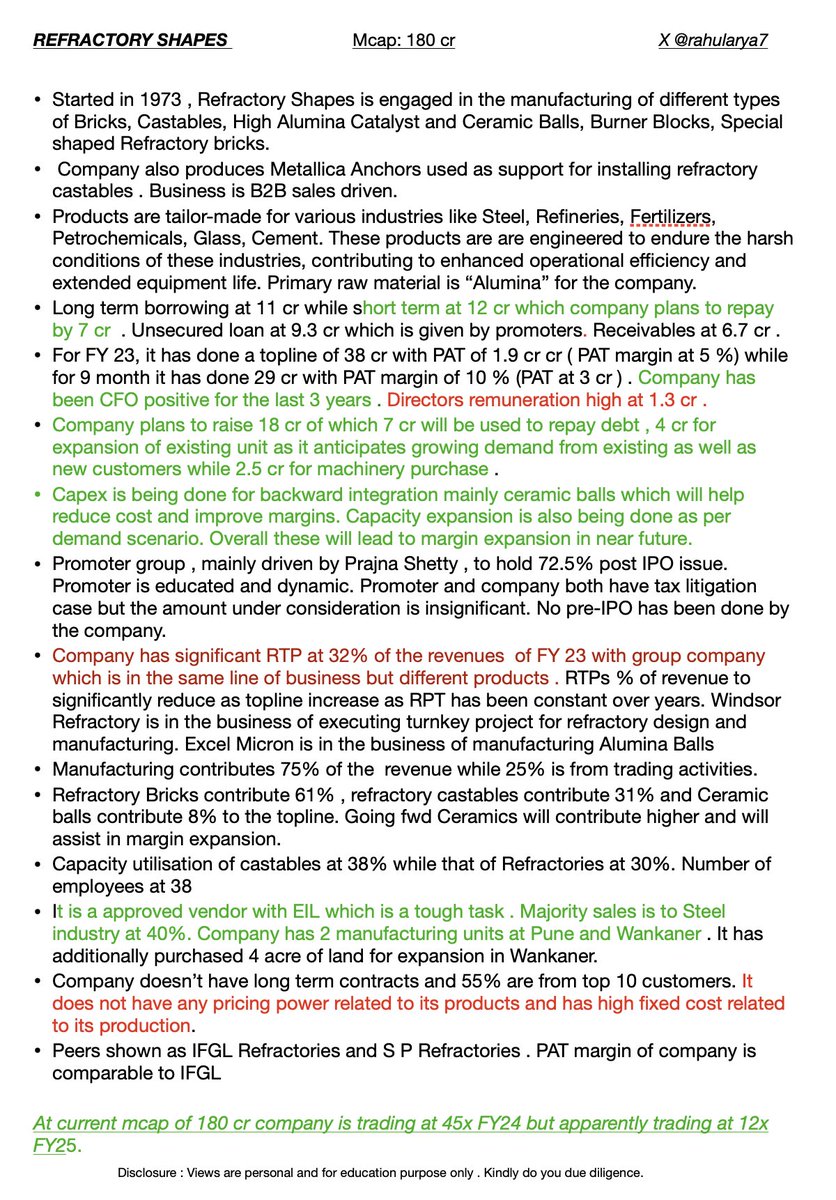
REFRACTORY SHAPES
Mcap : 180cr
"The future is as solid as steel"
Expansion and backward integration on the cards.
Few Notes 👇 🧵
#SMEs #Steelproxy #Refractory
Last Seen Hashtags on Sotwe
icespiceleakedvideo
omegle
Seen from Germany
GraciasLucasVazquez
Seen from United States
windscream
Seen from Korea
virgoSeason
Seen from United States
gachaheat #gachaedit #gachasex
ometv(())filter:native_video
Seen from United Kingdom
nolimits(***)*************+filter:native_video
Seen from United States
chilegay
Seen from Chile
Most Popular Users

Elon Musk 
@elonmusk
241.6M followers

Barack Obama
@barackobama
119M followers

Cristiano Ronaldo
@cristiano
114.1M followers

Donald J. Trump
@realdonaldtrump
111.8M followers

Narendra Modi
@narendramodi
107.2M followers

Rihanna
@rihanna
98.7M followers

NASA
@nasa
92.4M followers

Justin Bieber
@justinbieber
91.8M followers

KATY PERRY
@katyperry
89.8M followers

Taylor Swift
@taylorswift13
83.8M followers

Lady Gaga
@ladygaga
75.3M followers

Virat Kohli
@imvkohli
73.1M followers

Kim Kardashian
@kimkardashian
70.8M followers

YouTube
@youtube
68.8M followers

Neymar Jr
@neymarjr
66.1M followers

Bill Gates
@billgates
65M followers

Selena Gomez
@selenagomez
62.9M followers

The Ellen Show
@theellenshow
62.3M followers

CNN
@cnn
61.8M followers

X
@x
60.7M followers