

Top Tweets for #StructureBased

AgenticPosesRanker: An agentic AI framework for physically grounded ranking of protein–ligand docking poses
1. The paper proposes a tool-augmented LLM “pose judge” that ranks docking poses by explicit multi-criteria reasoning over physically interpretable metrics, rather than learning or fitting a new scoring function.
2. AgenticPosesRanker combines 6 deterministic analysis tools (PLIP interaction fingerprinting, SASA/burial, MMFF94-based conformational strain, steric clash detection, unsatisfied buried polar atom penalty, and SMILES identity checks) plus 3 derived assessments (interaction quality scoring, binding-mode classification, ligand efficiency).
3. Key design choice: keep each physicochemical observable separate and interpretable, then let the LLM integrate conflicting evidence (e.g., strong interactions vs. high strain, deep burial vs. polar desolvation risk) with a structured decision rubric instead of fixed weights.
4. The agent uses GPT-5 with chain-of-thought enabled and a long domain-specific system prompt that encodes tool documentation, thresholds, and a hierarchical ranking policy (e.g., binding mode and interaction quality prioritized; strain/clashes/polar penalties as discriminators; “surface binders should never rank first”).
5. To reduce name-based leakage (e.g., pose_01 implying docking-score order), poses are anonymized via deterministic SHA-256-derived 8-character base-36 codes; tool outputs are sanitized to remove original identifiers before being passed to the LLM, then de-anonymized after inference.
6. Benchmark: 10 protein–ligand systems, 162 poses, curated to be balanced “by construction” between cases where Smina ranks a near-native pose correctly and cases where Smina fails. Ground truth is RMSD to crystallographic pose.
7. Main result: 50.0% best-pose accuracy on the 10-system benchmark, matching the design-fixed Smina baseline (50.0%) and far above a uniformly random baseline (7.7%; p < 0.001, one-sided exact binomial test). The aggregate hides symmetry: 80% retention of Smina successes (4/5) but only 20% recovery of Smina failures (1/5).
8. A notable methodological contribution is “decision attribution” analysis: the paper compares the agent’s self-reported tool weighting against objective metric separations for the selected pose, finding strong alignment (median Spearman ρ = +0.83) across both correct and incorrect outcomes—suggesting the limiting factor is tool-suite coverage, not inconsistent reasoning.
9. The work emphasizes interpretability and auditability: instead of an opaque scalar score, the output includes metric-by-metric justification and structured comparative analysis, positioning the agent as an interpretable curation layer for late-stage pose refinement rather than a guaranteed accuracy upgrade over classical scoring.
📜Paper: https://t.co/ET1nBjmPOW
#computationalbiology #computationalchemistry #moleculardocking #structurebaseddrugdesign #LLM #agenticAI #interpretableAI #drugdiscovery #proteinligand #cheminformatics

Revisiting Target-Aware de novo Molecular Generation with TarPass: Between Rational Design and Texas Sharpshooter
1. The paper argues that many “target-aware” de novo generators may not truly use target information, but instead risk a Texas Sharpshooter pattern: retrospectively rationalizing outputs using coarse metrics (e.g., docking) and cherry-picked examples.
2. To address this, the authors introduce TarPass, a curated benchmark designed for fair, target-grounded evaluation across paradigms. It includes 18 well-studied, pharmaceutically relevant targets (20 structures total), expert-annotated key interactions, and ~1000 experimentally validated actives per target (from BindingDB), plus a ChEMBL-random baseline to test whether models beat “just sample from a drug-like database.”
3. TarPass is explicitly built to reduce data leakage: targets are time-split (post-2019) and selected to avoid overlap with common structure–ligand training sets (CrossDocked2020, PDBbind). The benchmark frames generalization realistically as “within druggable families” (e.g., kinases) rather than assuming entirely novel folds.
4. The evaluation is holistic and standardized: generate up to 1000 unique molecules/target, run a consistent docking workflow (with special handling for 3D in situ initial poses), then score both protein–ligand interactions (PLIs) and molecular plausibility (validity, drug-likeness, synthesizability, structural alerts, and chemical-distance behavior).
5. 15 representative methods are benchmarked across three paradigms: non-3D (DeepBlock, DRAGONFLY, SimpleSBDD, TamGen), 3D in situ (DiffSBDD, DrugFlow, IPDiff, Lingo3DMol, MolCraft, PocketFlow, SurfGen, TargetDiff), and optimization-based variants (DrugFlow-PA, MolPilot, REINVENT). The study also reports practical deployability: runtime, validity, uniqueness, and input-structure compatibility.
6. Key PLI finding: 3D in situ methods show only a modest average advantage in docking/interaction metrics, and many do not significantly outperform the ChEMBL-random baseline across targets. Only a small subset of methods shows consistent gains, and even then performance can be sensitive to conditions like reliance on an input ligand (raising concerns about robustness/generalization).
7. Interaction recovery is used as a stricter test than docking score alone. Even reference ligands achieve only ~51% exact match (limited by docking/PLIP constraints), but most models perform near random on exact match and match ratio; only a few (notably including DrugFlow/MolCraft and optimized variants) approach reference-like interaction recovery.
8. Pose realism remains a bottleneck for 3D in situ generation: initial conformations frequently contain steric clashes, centroid placement errors correlate strongly with reduced interaction recovery, and certain targets expose systematic failure modes (e.g., incomplete pocket definitions causing clashes; metal coordination such as Zn in HDAC6 being mishandled or unsupported by some models).
9. Plausibility/drug-likeness trade-off: non-3D models (often benefiting from broader pretraining) tend to generate more drug-like and synthesizable molecules (higher QED, better SA scores, fewer medicinal-chemistry alerts) but show weaker target specificity in PLIs. Many graph-based 3D in situ models overproduce implausible stereochemistry and overly complex ring systems (e.g., highly fused rings), harming synthetic feasibility.
10. The paper proposes a practical post-processing strategy: a multi-tier virtual screening workflow that applies hard filters across PLIs + plausibility + drug-likeness, followed by softer refinement (experience-based filters, optional clustering/MD). In case studies (JAK2/TYK2), hard filters reduce libraries to ~10% and later steps downscale to ~20–30 candidates, yielding some enrichment—but still highlighting that filtering cannot substitute for improving pose accuracy, interaction fidelity, and plausibility in the generators themselves.
📜Paper: https://t.co/Vrb9DIv7Z5
#ComputationalBiology #DrugDiscovery #GenerativeAI #MolecularGeneration #StructureBasedDrugDesign #Benchmarking #Docking #Cheminformatics #MachineLearning

Structure-guided molecular design with contrastive 3D protein–ligand learning
1 The paper proposes a unified pipeline that connects two usually separate steps in structure-based drug discovery: (i) fast 3D protein–ligand compatibility retrieval via contrastive learning, and (ii) de novo molecule generation via an autoregressive chemical language model, while explicitly steering outputs toward purchasable/synthetically accessible commercial spaces.
2 At the core is CLIPP-SET: an SE(3)-equivariant Transformer encoder that maps 3D pockets and 3D ligands into a shared embedding space, enabling cosine-similarity screening without docking ultra-large libraries and without target-specific fine-tuning (zero-shot).
3 A key technical detail is how they handle “false negatives” in contrastive learning caused by pocket collisions (many ligands bind the same pocket): they use Collision-Free InfoNCE (CF-InfoNCE), selecting (for pocket→ligand) the strongest-affinity ligand among those sharing the same pocket as the positive, rather than treating all off-diagonal pairs as negatives.
4 On LIT-PCBA zero-shot virtual screening (15 targets), CLIPP-SET pocket-based screening shows particularly strong early enrichment: best BEDROC, EF(0.5%), and EF(1%) among compared baselines, indicating it prioritizes actives near the top of the ranked list even if broader AUROC/EF(5%) can favor some docking-based methods.
5 The work then tests “realistic scale” retrieval on Enamine REAL (5.9B compounds): pocket-only queries (no reference ligand) retrieve top-100 candidates per target with higher predicted pIC50 on 13/15 targets and much higher internal diversity than 2D Morgan fingerprint search, suggesting the embedding captures binding-relevant geometry rather than just 2D similarity.
6 Because ligands and pockets share the same embedding space, the same system supports ligand-based search for scaffold hopping: given a known active, it retrieves molecules with high 3D shape/pharmacophore similarity but low 2D similarity (lower Tanimoto than Morgan FP), aligning with the goal of finding chemically novel scaffolds that preserve 3D binding features.
7 For generation, they introduce an MCLM (multimodal chemical language model): a Llama2-style autoregressive SMILES decoder conditioned by prepending a learned structural embedding token (from the frozen contrastive encoder) plus a learned dataset token [ds] that controls which chemical space distribution to emulate.
8 The dataset token is the mechanism for “commercial space steering”: trained on a 287M conformer–SMILES corpus labeled by source (PubChem, Enamine Diversity, Mcule, ChEMBL, GEOM-drugs), the model can be prompted with an “Enamine” token at inference to bias outputs toward Enamine-like chemistry; an ablation shows the token increases nearest-neighbor similarity to Enamine REAL and raises the fraction of exact catalog matches.
9 In structure-conditioned de novo design on LIT-PCBA (100 molecules/target), ligand-conditioned generation achieves the highest predicted affinity metrics (affinity probability and predicted pIC50) among evaluated methods, while pocket-conditioned generation (despite the decoder being trained only with ligand embeddings) remains competitive without reference ligands and yields the highest diversity, highlighting practical utility when only target structure is available.
📜Paper: https://t.co/wscD8WXMXE
#ComputationalBiology #Cheminformatics #DrugDiscovery #StructureBasedDrugDesign #GenerativeAI #MachineLearning #ProteinLigand #EquivariantNetworks #ContrastiveLearning #VirtualScreening

MolGenBench: A Comprehensive Benchmark for Structure-Based Molecular Generation
1. The article introduces MolGenBench, a new benchmark designed to bridge the gap between molecular generation algorithms and real-world drug discovery outcomes. It integrates a large-scale dataset with 120 protein targets and 220,000 experimentally confirmed active molecules, offering a rigorous evaluation framework.
2. A key innovation is the inclusion of a hit-to-lead (H2L) optimization scenario, which is critical for drug development but often overlooked in existing benchmarks. This scenario evaluates models' ability to optimize compounds for potency and selectivity, simulating a crucial phase in drug design.
3. The study proposes novel metrics such as the Target-Aware Score and Mean Normalized Affinity (MNA) Score to assess models' ability to rediscover target-specific actives and optimize compounds. These metrics provide a more comprehensive evaluation compared to traditional benchmarks.
4. The authors systematically evaluated 10 de novo design methods and 7 H2L optimization approaches, covering diverse architectures (autoregressive, diffusion, Bayesian Flow Networks) and training data sources. This comprehensive assessment highlights significant gaps between current models and real-world drug development needs.
5. The results show that current generative models struggle with rediscovering known active molecules and generating target-specific compounds. The study also reveals limitations in predicting physically valid molecular conformations and leveraging protein structural information effectively.
6. MolGenBench uncovers that models trained on crystal structures outperform those trained on simulated complexes in certain tasks, emphasizing the importance of high-quality training data. The benchmark also highlights the need for more rigorous evaluation metrics that reflect real-world applicability.
7. The study concludes that substantial advances are needed to improve the practical impact of molecular generative models in drug discovery. It provides actionable insights for future development, emphasizing the need for task-aware design and generalized optimization.
📜Paper: https://t.co/lugAjgyTTg
💻Code: https://t.co/dWoAoY80pb
#MolGenBench #DrugDiscovery #AIinPharma #Benchmarking #StructureBasedDrugDesign

Flowr.root – A Flow Matching Based Foundation Model for Joint Multi-Purpose Structure-Aware 3D Ligand Generation and Affinity Prediction
1. Flowr.root is a novel SE(3)-equivariant flow-matching model that revolutionizes 3D ligand generation and binding affinity prediction. It integrates pocket-aware ligand design with multi-endpoint affinity prediction, offering a unified framework for structure-based drug design.
2. The model supports multiple design modes, including de novo generation, interaction/pharmacophore-conditional sampling, fragment elaboration, and multi-endpoint affinity prediction. This versatility makes it suitable for various stages of drug discovery, from hit identification to lead optimization.
3. Flowr.root achieves state-of-the-art performance in both unconditional 3D molecule and pocket-conditional ligand generation. It produces geometrically realistic, low-strain structures with high computational efficiency, outperforming recent models on established benchmark datasets.
4. The integrated affinity prediction module demonstrates superior accuracy on the SPINDR test set and outperforms recent models on the Schrödinger FEP+/OpenFE benchmark, while offering substantial speed advantages.
5. As a foundation model, Flowr.root requires continuous parameter-efficient fine-tuning on project-specific datasets to account for unseen structure-activity landscapes. This approach yields strong correlation with experimental in-house data, making it a dynamic companion for early-stage drug discovery campaigns.
6. The model’s joint generation and affinity prediction capabilities enable inference-time scaling through importance sampling, effectively steering molecular design toward higher-affinity compounds. Case studies validate this approach, showing significant correlation between predicted and quantum-mechanical binding energies.
7. By integrating structure-aware generation, affinity estimation, and property-guided sampling within a unified framework, Flowr.root provides a comprehensive foundation for structure-based drug design, spanning hit identification through lead optimization.
📜Paper: https://t.co/T2znU3VQEw
#FlowrRoot #DrugDiscovery #StructureBasedDesign #LigandGeneration #AffinityPrediction
Prior-Guided Flow Matching for Target-Aware Molecule Design with Learnable Atom Number
1. A groundbreaking approach in structure-based drug design (SBDD) has been proposed in a new paper titled “Prior-Guided Flow Matching for Target-Aware Molecule Design with Learnable Atom Number”. This method, named PAFlow, introduces a novel way to generate 3D molecules with high binding affinity to target proteins, addressing key limitations of previous models.
2. One of the most significant innovations of PAFlow is its use of flow matching framework to model the generation process. Unlike traditional methods that suffer from unstable probability dynamics, PAFlow employs Variance Preserving (VP) probability path for continuous atomic coordinates and a newly developed Conditional Flow Matching (CFM) for discrete atom types, ensuring more stable and accurate molecule generation.
3. The incorporation of a protein-ligand interaction predictor is another highlight of PAFlow. This predictor guides the vector field during the generation process, steering it towards regions with higher binding affinity. By leveraging prior binding knowledge, PAFlow can produce molecules that bind more effectively to target proteins.
4. A unique feature of PAFlow is the learnable atom number predictor. Unlike other methods that rely on predefined distributions, PAFlow estimates the number of atoms in the generated molecules based solely on the target protein pocket information. This approach better aligns the size of the generated molecules with the geometry of the binding site.
5. Extensive experiments on the CrossDocked2020 benchmark demonstrate PAFlow’s superior performance. It achieves a new state-of-the-art in binding affinity, with an average Vina Score of -8.31, significantly outperforming other strong baselines. Moreover, PAFlow maintains favorable molecular properties such as QED, SA, and diversity.
6. In terms of sampling efficiency, PAFlow also shows remarkable advantages. Compared to other methods, it requires fewer sampling steps to generate high-quality molecules. For example, it achieves competitive results with only 20 sampling steps, while diffusion-based models typically need 1000 steps. This makes PAFlow a more efficient choice for drug design.
7. The authors also conducted ablation studies to validate the effectiveness of different components of PAFlow. Results show that the flow matching framework, prior-guided generation, and learnable atom number predictor all contribute significantly to the overall performance. These components work together to enhance the quality and efficiency of molecule generation.
📜Paper: https://t.co/E8AEEs5I8R
#StructureBasedDrugDesign #FlowMatching #MoleculeGeneration #DrugDiscovery #AIinPharma

Generative Molecule Evolution Using 3D Pharmacophore for Efficient Structure-Based Drug Design
1. A groundbreaking framework named MEVO has been introduced to bridge the gap between large-scale small molecule datasets and limited protein-ligand complex datasets, significantly enhancing the training data for structure-based drug design (SBDD) models. This innovative approach leverages pharmacophore-guided molecule generation and evolutionary optimization strategies to design high-affinity binders for various protein targets.
2. MEVO incorporates three key components: a high-fidelity VQ-VAE for molecule representation in latent space, a diffusion model for pharmacophore-guided molecule generation, and a pocket-aware evolutionary strategy for optimizing molecules with physics-based scoring functions. This combination allows for the efficient generation of molecules that fit both pharmacophore principles and target-binding constraints.
3. The framework demonstrates remarkable versatility and generalizability, validated through the design of potent inhibitors for KRASG12D, a challenging cancer target. MEVO-generated molecules exhibit binding affinities comparable to known highly active inhibitors, as evaluated by free energy perturbation (FEP) calculations.
4. MEVO effectively addresses the limitations of current SBDD methods by integrating extensive training data from ligand-only datasets, which are almost unlimited compared to protein-ligand complex datasets. This strategy allows the model to learn robust pharmacophore patterns and generate diverse and plausible molecules.
5. The evolutionary optimization strategy in MEVO uses a physics-informed scoring function to iteratively improve the binding affinity of generated molecules. This training-free approach can be easily transferred to other tasks, such as optimizing ligand properties like permeability and solubility.
6. MEVO generates drug-like molecules with desirable properties, as evidenced by comparisons with FDA-approved drugs. The generated molecules comply with Lipinski’s rule of five, exhibit reasonable drug-likeness scores, and have similar logP distributions to reference molecules.
7. In hit discovery, MEVO successfully identifies high-affinity binders for various protein targets, outperforming known binders in some cases. The model’s ability to preserve critical interactions within binding pockets provides a strong foundation for developing potent ligands.
8. MEVO’s high versatility is showcased through its application in different stages of drug design, including ligand growing, linker design, and lead optimization. The model’s ability to design high-affinity binders for KRASG12D highlights its potential in tackling challenging drug targets.
📜Paper: https://t.co/VntHRvLFoJ
#DrugDesign #GenerativeModels #StructureBasedDrugDesign #Pharmacophore #EvolutionaryOptimization #KRASInhibitors #AIinPharma

Template-Guided 3D Molecular Pose Generation via Flow Matching and Differentiable Optimization
1.The paper introduces FMA-PO, a novel two-stage method for 3D molecular pose prediction using a crystallized reference ligand as a template to guide ligand conformation generation from a 2D molecular graph.
2.The first stage applies a flow-matching generative model that progressively denoises random initial conformations to align query molecules spatially with the template ligand in 3D space.
3.The second stage refines initial poses by differentiable optimization directly on atomic coordinates, maximizing shape and pharmacophore similarity while minimizing internal energy and optionally considering protein pocket interactions.
4.FMA-PO uniquely integrates ligand-based alignment with receptor-aware refinement, leveraging both template ligand geometry and, optionally, protein binding site information to improve docking accuracy.
5.The method outperforms classical docking tools like AutoDock Vina and rDock, as well as recent open-access alignment methods, especially in challenging cases with low template-query similarity or highly flexible ligands.
6.The authors introduce AlignDockBench, a new benchmark dataset with 369 protein-ligand pairs spanning diverse targets, enabling realistic evaluation of template-based docking and alignment methods.
7.FMA-PO demonstrates higher accuracy with about 70% of predicted poses under 2Å RMSD, improving to nearly 78% with the enhanced FMA-PO+ version that refines all candidate poses.
8.The model architecture features a hybrid molecular graph including atomic and functional group nodes, processed by multi-head attention with edge bias and a vector field network predicting ligand conformations conditioned on the template.
9.Optimization uses novel shape-based and pharmacophore-based Tanimoto similarity scores computed via Gaussian volume overlaps, combined with internal energy from GAFF2 force fields, allowing flexible yet physically plausible pose adjustments.
10.The framework supports data augmentation and downstream predictive modeling, providing a pathway for improved structure-based drug design workflows that leverage known ligand geometries.
11.Future directions include incorporating receptor flexibility, conditioning on multiple templates, and enhancing computational efficiency to make the approach more practical for large-scale drug discovery.
💻Code: https://t.co/UJTMB28O1b
📜Paper: https://t.co/TUKrdmf97I
#DrugDesign #MolecularDocking #FlowMatching #StructureBasedDesign #ComputationalChemistry #DeepLearning #3DAlignment #LigandPosePrediction

Tokenizing Electron Cloud in Protein-Ligand Interaction Learning
1.This paper presents ECBind, a novel framework that tokenizes electron cloud signals into quantized embeddings to enhance protein-ligand interaction prediction, uncovering binding patterns beyond atomic structure and achieving state-of-the-art results across multiple benchmarks.
2.Unlike conventional models that rely on atoms or fragments, ECBind explicitly incorporates electron density information—capturing non-covalent interactions, charge polarization, and π-π stacking—to provide a more physically grounded understanding of binding affinity and specificity.
3.A structure-aware transformer and hierarchical vector quantization are used to compress dense electron cloud data into discrete tokens, which are then used as inputs for downstream tasks such as binding affinity regression and activity classification.
4.ECBind is trained using a pretrain-finetune paradigm. During pretraining, the model reconstructs electron cloud signals and predicts masked atom types, enabling joint learning of 3D electronic and 2D atomic structures.
5.To address the high computational cost of computing electron clouds, the authors introduce ECBind-stdt, a student model trained via knowledge distillation from the full ECBind model, achieving nearly identical performance without requiring electron cloud inputs at inference.
6.On the MISATO dataset for relative binding affinity, ECBind-ptn achieves a 6.42% improvement in per-structure Pearson correlation and 15.58% in Spearman correlation over the best baseline, significantly outperforming fragment-level, atom-level, and hierarchical GNNs.
7.ECBind’s performance on LBA and LEP datasets also tops existing baselines. While the performance gain on LBA is more modest, this is attributed to LBA’s noisier electron cloud data, emphasizing the importance of data quality for quantum-scale modeling.
8.An ablation analysis shows that electron cloud tokenization is especially valuable for distinguishing subtle differences in ligand binding to the same protein, improving per-structure metrics by avoiding encoder over-smoothing.
9.By combining atomic and electronic structure representations, ECBind learns complementary features that enhance its capacity to model protein-ligand interactions holistically, especially in complex or "hard" binding sites.
10.The electron-aware encoder architecture is adapted from ESM3’s GeoMHA, enabling message passing that accounts for both geometric and invariant attention, and ensuring trans-rotational invariance in the learned embeddings.
11.Electron cloud patches are assigned to atoms via probabilistic sampling and neighborhood search, and are compressed into hierarchical codebooks for 2D atomic and 3D electronic attributes—enabling efficient, multi-scale representation learning.
12.ECBind sets a new direction in computational drug discovery by integrating quantum-level signals into deep learning pipelines without compromising scalability, enabling more accurate affinity predictions and ligand prioritization.
💻Code: https://t.co/FgVjshgSoA
📜Paper: https://t.co/EnP4QwUX1w
#ProteinLigandBinding #QuantumML #ElectronDensity #ECBind #DrugDiscovery #AffinityPrediction #GraphNeuralNetworks #StructureBasedDesign #MolecularRepresentation #Bioinformatics

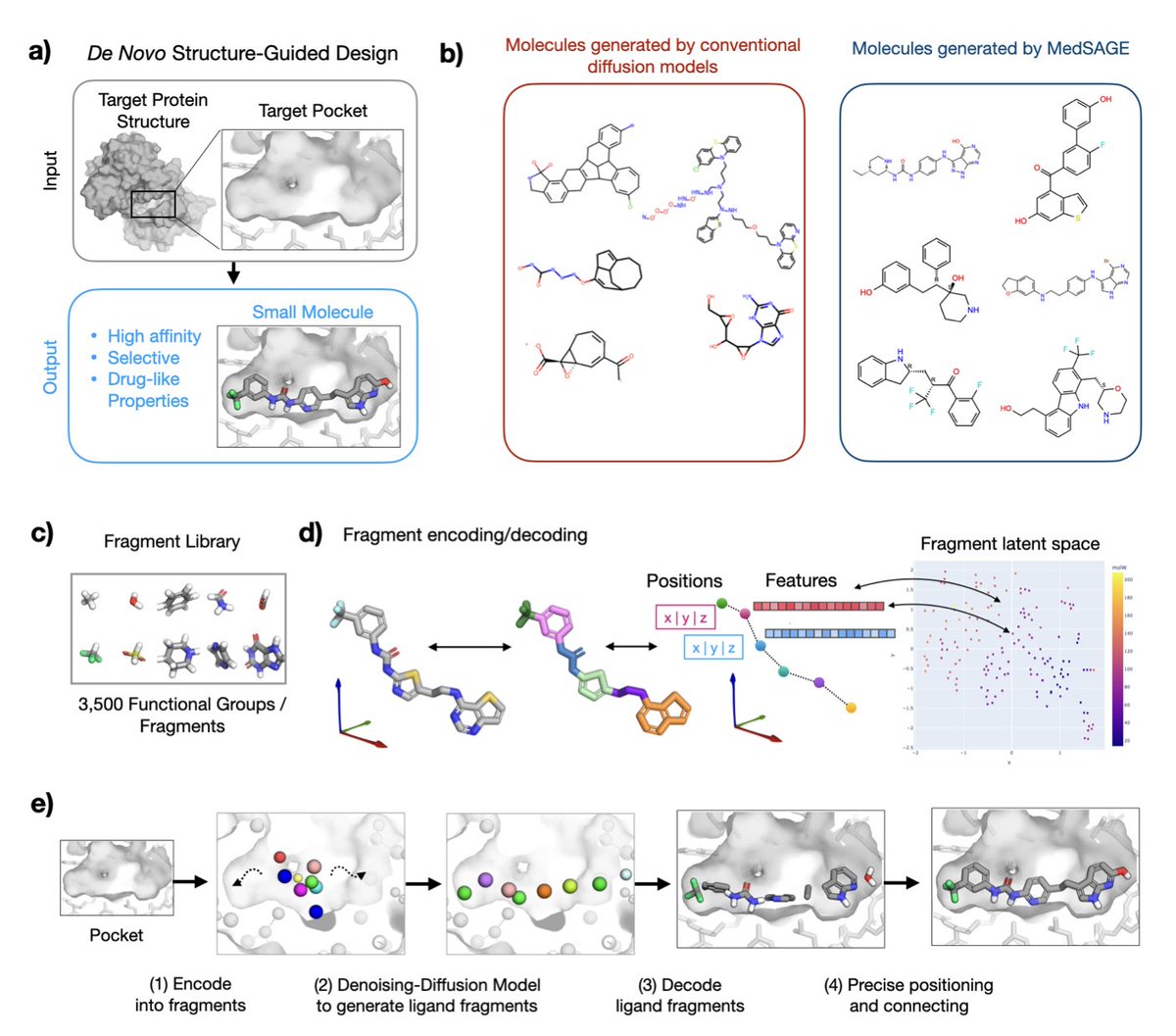
MedSAGE: Bridging Generative AI and Medicinal Chemistry for Structure-Based Design of Small Molecule Drugs
1.MedSAGE is a novel generative AI framework that addresses long-standing limitations in structure-based small-molecule drug design by operating directly on medicinal chemistry fragments instead of atoms or SMILES strings.
2.Unlike previous diffusion models that often generate chemically unstable or synthetically infeasible molecules, MedSAGE embeds functional groups and ring systems into a smooth latent space—improving interpretability, synthesizability, and design relevance.
3.The model employs a two-phase design: fragment generation via a 3D diffusion model guided by the protein pocket, followed by atomic-level assembly using a custom bond-connection algorithm that enforces chemical rules and optimizes Glide docking scores.
4.On a benchmark of 25 therapeutically relevant targets, MedSAGE-generated molecules had predicted affinities and selectivity statistically indistinguishable from those of approved drugs and clinical candidates—outperforming recent all-atom diffusion methods.
5.MedSAGE shows high selectivity: its ligands consistently reproduced more native binding interactions and avoided excessive hydrophobicity or bulkiness, unlike many molecules from DiffSBDD or IPDiff that lacked pocket specificity.
6.Despite no explicit optimization, MedSAGE molecules adhered to drug-likeness heuristics: Lipinski’s Rule of 5, appropriate logP, low synthetic complexity scores (~3.5), and scaffold diversity (~197 unique scaffolds out of 400 molecules per target).
7.Case studies showed MedSAGE could “rediscover” scaffolds structurally close to known binders like reboxetine, temsavir, and AK1, preserving key pharmacophores and even enhancing binding interactions via new hydrogen bonds.
8.Compared to traditional virtual screening of 30–400 million compound libraries, MedSAGE achieved comparable or better hit quality by generating only 2,000 molecules—offering a 100–1,000× improvement in hit enrichment efficiency.
9.Its fragment-based generation ensures aromatic ring planarity and reduces stereocenter complexity, avoiding common issues in atom-wise models. Fragment embeddings were learned via t-SNE and encode both 3D and chemical properties.
10.Although MedSAGE doesn’t yet handle protein flexibility or apo structures, it performs robustly on holo structure-based tasks—a realistic setting for many early-stage drug discovery projects.
11.The study introduces a scalable pipeline to pair AI-based molecule generation with similarity searches in large commercial libraries (e.g., Enamine REALSpace) to find purchasable analogs with similar binding profiles.
12.MedSAGE provides a compelling proof of concept that generative AI can capture medicinal chemistry principles and generate practical drug-like compounds directly from protein structures, with high interpretability and minimal data.
📜Paper: https://t.co/YW3e7iGH4z
#MedSAGE #DrugDesign #GenerativeAI #DiffusionModels #MedicinalChemistry #ProteinLigand #StructureBasedDesign #MolecularGeneration #FragmentBasedDesign #AI4Science #DeNovoDrugs #VirtualScreening #Bioinformatics #MachineLearning
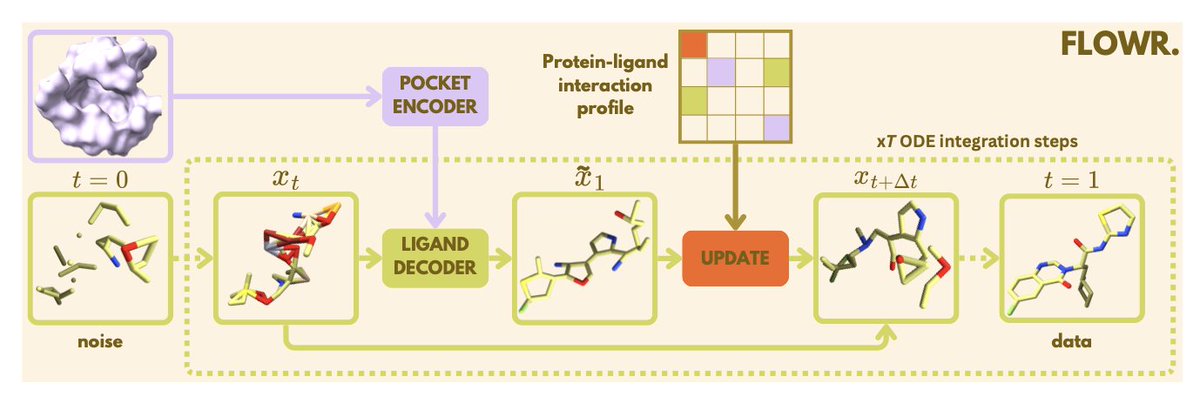
FLOWR – Flow Matching for Structure- and Interaction-Aware de novo Ligand Generation
1.FLOWR is a novel generative framework that enables de novo 3D ligand design conditioned on both protein pocket geometry and desired protein-ligand interactions—achieving state-of-the-art performance in pose quality, interaction fidelity, and inference speed.
2.Built on flow matching rather than diffusion, FLOWR significantly outperforms the PILOT model, delivering up to 30× faster inference and better ligand validity, binding affinity, and physical plausibility.
3.A standout feature is FLOWR's ability to condition generation on atomic-level interaction profiles (e.g., H-bonds, salt bridges), enabling targeted synthesis of ligands that recapitulate biologically relevant interactions.
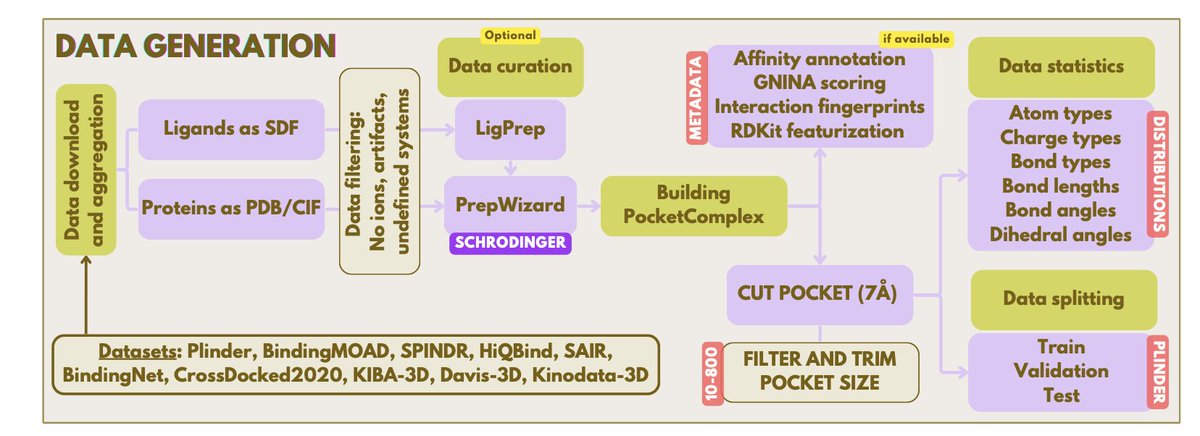
4.The model is trained and evaluated on SPIRE—a new benchmark dataset of 35,000+ high-quality, refined protein-ligand complexes derived from crystallographic data and designed to avoid data leakage.
5.FLOWR introduces interaction-aware training: atoms involved in key interactions are masked during sampling, improving recovery of binding contacts while preserving chemical diversity.
6.Interaction-conditional generation improves recovery of interaction fingerprints by over 60% and leads to stronger Vina binding scores (e.g., -7.43 kcal/mol vs. -6.36 for unconditional).
7.The architecture builds on SemlaFlow, using an E(3)-equivariant model with a cross-attention mechanism and pocket encoder, making ligand generation efficient and structurally grounded.
8.Unlike diffusion-based models, FLOWR allows flexible sampling steps (as few as 20), maintaining performance while achieving up to 50× speedup—ideal for large-scale compound generation.
9.Explicit hydrogen modeling is supported in both training and inference, yielding chemically accurate poses that improve downstream interpretability and docking performance.
10.FLOWR produces more physically valid ligands (RDKit-validity 0.94, PB-validity 0.86) than PILOT (0.82 and 0.75), with better generalization to unseen targets in terms of bond geometry and centroid proximity.
11.Despite lower novelty and uniqueness compared to PILOT, FLOWR excels in pose realism and ligand-pocket complementarity—crucial for structure-based drug design applications.
12.Overall, FLOWR bridges structural accuracy, speed, and interaction control, making it a strong candidate for integration in hit-to-lead workflows, lead optimization, and interaction-driven generative design.
📜Paper: https://t.co/zdr4VmZMNT
#DrugDiscovery #MolecularDesign #GenerativeModels #LigandGeneration #FlowMatching #ProteinLigand #StructureBasedDesign #ICLR2025 #SPIRE #FLOWR
Integrating Machine Learning-Based Pose Sampling with Established Scoring Functions for Virtual Screening @JCIM_JCTC
1.This study evaluates the integration of DiffDock-L, a leading ML-based pose sampling method, with established scoring functions (Vina, Gnina, RTMScore) for virtual screening (VS), aiming to combine ML flexibility with physics-based rigor.
2.Using the DUDE-Z benchmark (43 pharmaceutically relevant targets), the study shows that DiffDock-L combined with Gnina scoring achieves high VS performance (AUC 0.82), closely matching or surpassing traditional Vina-based pipelines.
3.DiffDock-L-generated poses are physically valid for over 99.5% of active ligands and recover biologically relevant interaction patterns, proving suitable even in challenging cross-docking scenarios.
4.Compared to Vina, DiffDock-L shows similar performance trends across physicochemical spaces (e.g., molecular weight, logP, rotatable bonds), and performs slightly worse in terms of PLIF similarity to known structures—but still retrieves viable poses for novel ligands.
5.Scoring functions, not pose generators, have the largest impact on VS outcomes: replacing Vina with Gnina consistently improves early enrichment (EF1%) and active scaffold recovery.
6.A consensus strategy that averages compound ranks from DiffDock-L+Gnina and Vina+Gnina boosts BEDROC and EF1% further, recovering 21% of active scaffolds among top 1% hits—higher than any individual method.
7.DiffDock-L performs blind docking and is not constrained by predefined pockets, making it valuable for ligand discovery on novel or poorly characterized targets.
8.The study addresses concerns about ML model memorization by curating targets absent from DiffDock-L’s training set; performance remained stable, but more diverse benchmarks are needed.
9.The authors also benchmark DiffDock-L’s computational efficiency (~62 s/compound with GPU) and show its performance scales with protein size—offering a trade-off between flexibility and speed.
10.Overall, the study supports ML-based pose sampling as a viable and complementary method to physics-based docking for VS, particularly when paired with advanced scoring functions.
11.Code and data are available for reproducibility, offering a standardized framework for future evaluations of ML-docking integrations.
💻Code: https://t.co/oMOvstdVVW 📜Paper: https://t.co/TO6TG6Z0BC #VirtualScreening #DrugDiscovery #MolecularDocking #DiffDock #MLforChemistry #ComputationalBiology #ScoringFunctions #DeepLearning #StructureBasedDesign

PhysDock: A Physics-Guided All-Atom Diffusion Model for Protein-Ligand Complex Prediction
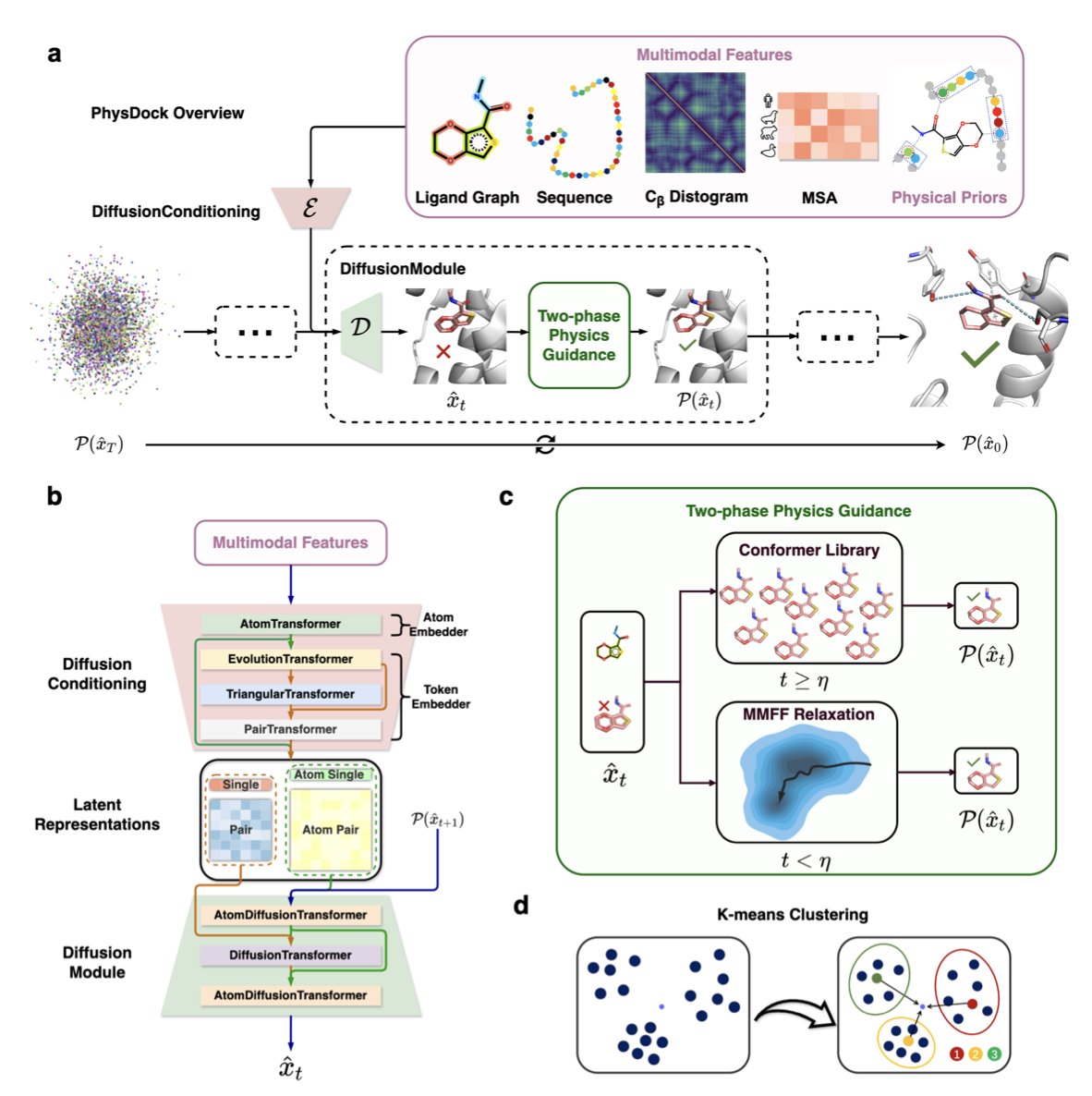
1. PhysDock introduces an all-atom diffusion model that integrates physical priors and two-phase physics guidance to predict protein-ligand complexes with high structural and physical plausibility.
2. Unlike traditional docking tools or many DL-based models, PhysDock models both ligand flexibility and subtle protein conformational adjustments (precision-flexibility), capturing mutual induced fit during binding.
3. PhysDock achieves state-of-the-art performance in redocking tasks, with 95.3% success on PoseBusters and 83.0% on the challenging PhiBench benchmark, outperforming AlphaFold3 and Chai-1 with a 2–16x speedup.
4. It performs exceptionally well on cross-docking tasks, surpassing other models by over 15% in docking success rate and excelling at recovering key non-covalent interactions like hydrogen bonds and salt bridges.
5. A key innovation is its two-phase physics guidance mechanism, which corrects chiral and steric errors via conformer matching and MMFF-based relaxation during the diffusion denoising process.
6. The model is trained on Plinder, a curated protein-ligand dataset, and includes extensive data augmentation, such as spatial cropping, MSA sampling, and probabilistic masking of key residues.
7. PhysDock enables practical applications: it resolved CB1/CB2 cannabinoid receptor selectivity with accuracy comparable to experiments, highlighting structure-based explanations for selectivity differences.
8. In virtual screening of NTRK3 kinase, PhysDock distinguishes known high-affinity drugs from weak binders and proposes novel candidate molecules, demonstrating strong binding pose accuracy and scoring agreement with crystal structures.
9. Its architecture includes a dual-scale diffusion transformer and clustering-based structure ranking, producing diverse and physically plausible candidate complexes with high sampling efficiency.
10. The model is open-sourced and optimized for real-world utility in drug discovery pipelines, with potential to scale across diverse targets, ligands, and screening libraries.
💻Code: https://t.co/XKO89kwzBA
📜Paper: https://t.co/QmQSmZ7FIs
#AI4Science #DrugDiscovery #MolecularDocking #ComputationalBiology #DiffusionModels #StructureBasedDesign #ProteinLigand #OpenSourceScience
A 3D Pocket-Aware and Affinity-Guided Diffusion Model for Lead Optimization
1. Diffleop introduces a novel 3D generative diffusion model that explicitly incorporates binding affinity gradients into the denoising process, guiding the generation of ligands with optimized protein binding in the context of lead optimization.
2. Unlike prior 3D pocket-aware models that only use structural features, Diffleop integrates both protein-ligand geometry and predicted binding affinity via an E(3)-equivariant graph neural network, enhancing both precision and drug-likeness of generated compounds.
3. The model operates on both continuous (atomic coordinates) and discrete (atom and bond types) noise distributions and introduces a bond diffusion mechanism to eliminate post hoc bond inference, significantly improving molecular realism.
4. A key innovation is affinity-guided denoising: at each time step, the model computes gradients of predicted binding affinity w.r.t. atom positions, atom types, and bond types to guide molecular assembly toward higher-affinity structures.
5. Diffleop significantly outperforms baseline models including GraphBP, AR, Pocket2Mol, and DiffLinker on metrics such as binding affinity (6.71 vs. 5.47–6.14) and high-affinity success rate (52.6% vs. 17.8–28.9%) in scaffold decoration and linker design tasks.
6. Beyond affinity, molecules generated by Diffleop maintain competitive scores in drug-likeness (QED), synthetic accessibility (SA), LogP, and Lipinski’s rule adherence—highlighting the model’s practicality for downstream medicinal chemistry.
7. Ablation studies reveal that removing affinity guidance reduces performance markedly (e.g., high-affinity rate drops from 52.6% to 40.4%), and excluding bond diffusion also harms chemical validity, confirming the necessity of both components.
8. The model uses equivariant graph neural networks (EGNNs) for both ligand generation and affinity prediction, and a dual-graph architecture captures both intra-ligand and protein-ligand interactions via directional message passing.
9. Unlike autoregressive models that place atoms sequentially and may introduce errors in long-range context, Diffleop uses simultaneous generation of all atoms and bonds in the masked region, resulting in more globally coherent structures.
10. Diffleop represents a next-generation framework for structure-based drug design, leveraging diffusion modeling, geometric deep learning, and knowledge-informed guidance to generate chemically valid, high-affinity molecules in 3D protein contexts.
📜Paper: https://t.co/Fmm3SbGPme
#DrugDesign #MolecularGeneration #DiffusionModel #ProteinLigand #EquivariantGNN #LeadOptimization #ComputationalBiology #3DGenAI #AI4Science #StructureBasedDesign

AI-guided Antibiotic Discovery Pipeline from Target Selection to Compound Identification
1. This study presents an end-to-end AI-guided pipeline for antibiotic discovery, integrating structure-based target selection with deep learning-driven molecule generation, filtering, and compound realization—all benchmarked across multiple generative models.
2. To identify novel antibacterial targets, the authors applied Foldseek to perform large-scale structural clustering of predicted proteomes from seven pathogens. This allowed discovery of conserved, essential, non-human-homologous proteins often missed by sequence-based approaches.
3. Among the selected targets were MurC (validated antibiotic target), CdsA (novel, enzymatic), and CohE (putative dimerization interface)—chosen to represent a range of structural similarity to known datasets, enabling rigorous evaluation of generalizability across models.
4. Six structure-aware generative models were compared: DeepBlock, DiffSBDD, Pocket2Mol, ResGen, TamGen, and TargetDiff. The evaluation considered installation, usability, documentation, output formats, and input flexibility.
5. DeepBlock and DiffSBDD scored highest in ease-of-use and implementation, while TamGen and TargetDiff required complex, under-documented preprocessing. DeepBlock lacked pocket-specific generation but offered user-friendly outputs and intrinsic binding site detection.
6. Over 117,000 molecules were generated across models. DeepBlock achieved the highest chemical validity (~90%), while others hovered around 50%. ResGen generated the fewest valid molecules (~30%).
7. TamGen explored the widest chemical space but also showed high scaffold redundancy, often generating identical molecules across different targets—suggesting strong priors but lower structural specificity.
8. The authors applied rigorous medicinal chemistry filters (REOS/Dundee) and property-based selection (logD and molecular weight) to identify ~30,000 candidates, followed by commercial analogue searches using SpaceMACS across 5.3 trillion hypothetical molecules.
9. DeepBlock and TamGen accounted for 95% of all compounds that passed the entire pipeline. Notably, 61% of commercially accessible final candidates came from DeepBlock alone, underlining its balance of structural awareness and practical design quality.
10. Finally, AlphaFold 3 was used to predict target-ligand complexes, filtering compounds by binding proximity. This ensured only ligands binding within well-defined pockets were selected for future synthesis and wet-lab validation.
📜Paper: https://t.co/defVyl5bqN
#antibiotics #drugdiscovery #structurebaseddesign #generativemodels #moleculargeneration #AI4Science #bioinformatics #deepblock #diffusionmodels #proteinstructure #AlphaFold

FLOWR – Flow Matching for Structure-Aware de novo and Conditional Ligand Generation
1. FLOWR introduces a new generative framework for structure-based ligand design using flow matching instead of diffusion, achieving up to 70x faster inference while improving ligand validity, pose accuracy, and interaction recovery.
2. The model leverages a dedicated protein pocket encoder and jointly models both continuous (3D coordinates) and categorical (atom types, bonds) molecular properties, conditioned on target pockets and optional protein-ligand interaction features.
3. FLOWR significantly outperforms leading diffusion-based models like PILOT on the SPINDR benchmark across multiple metrics: higher PoseBusters-validity (0.92 vs. 0.83), better AutoDock-Vina scores (-6.93 vs. -6.30), and lower strain energy.
4. A major architectural advantage is that FLOWR only requires a single forward pass through the protein pocket encoder, making it far more efficient than diffusion models that recompute pocket embeddings at each sampling step.
5. FLOWR.MULTI extends the model to support multi-purpose conditional generation, including interaction-, scaffold-, and functional group-conditional ligand design, without retraining or re-sampling—enabling flexible scaffold hopping and fragment-based design.
6. In interaction-conditional mode, FLOWR.MULTI achieves a 76.1% interaction recovery rate, doubling interaction Tanimoto similarity compared to its de novo version, while maintaining similar chemical diversity and synthesizability.
7. FLOWR’s superiority is further validated on two challenging protein targets (5YEA and 4MPE), where it consistently produces high-validity, synthetically accessible ligands with strong docking scores and accurate interaction profiles under all conditioning modes.
8. To support robust benchmarking, the authors introduce SPINDR—a high-quality dataset of 35,000+ ligand-pocket complexes with energy-minimized structures, explicit hydrogens, and atomic-resolution interaction annotations—addressing flaws in prior datasets.
9. Compared to PILOT, FLOWR shows 20–70x speedups while improving on all major evaluation metrics. FLOWR.MULTI enables targeted, interaction-aware ligand generation ideal for lead optimization and hit expansion in real-world drug discovery settings.
📜Paper: https://t.co/d5S95yQPdc
#drugdiscovery #cheminformatics #structurebaseddesign #ligandgeneration #machinelearning #generativemodels #moleculargeneration #flowmatching #AI4Science

Drugit: crowd-sourcing molecular design of non-peptidic VHL binders @NatureComms
1. This paper introduces Drugit, a novel small molecule design interface built into the Foldit citizen science game, enabling non-experts to design protein-targeting molecules using intuitive tools and real-time feedback.
2. Using von Hippel-Lindau (VHL) E3 ligase as a model, players participated in ten weekly puzzle rounds to design non-peptidic VHL binders with improved drug-like properties such as lower polarity and better permeability.
3. Over 6,500 unique compounds were submitted by 160 Foldit players, covering broader chemical space than known VHL ligands. Submissions were filtered and triaged through cheminformatics tools, docking, and expert review.
4. One player-designed compound was synthesized, shown to bind VHL via NMR, and co-crystallized with the protein. The bound structure confirmed key pharmacophores and preserved the intended player-conceived binding mode.
5. Remarkably, the binding compound was designed by a player with no formal medicinal chemistry training, underscoring the potential of gamified citizen science in early drug discovery.
6. The final hit compound features a hydroxy-piperidinone core—a novel bioisostere of the canonical hydroxyproline motif—and showed improved predicted ADME properties, including reduced efflux and better solubility.
7. Drugit’s integrated scoring system (RosettaLigand), property filters (e.g., TPSA, cLogP), and user-friendly tools empowered players to design chemically feasible, synthetically accessible molecules in a guided, iterative environment.
8. Post-game refinement included docking (Glide), torsion checks, and absolute binding free energy calculations (FEP+ and Biggin ABFE), ensuring high-confidence candidate selection for synthesis and testing.
9. The co-crystal structure revealed that the experimentally validated eutomer maintained essential hydrogen bonds and binding pocket complementarity, providing a starting point for PROTAC development with enhanced pharmacokinetics.
10. Drugit showcases a scalable and democratized approach to molecular innovation, combining AI-guided design, game-based interaction, and open-access pipelines to engage a global community in drug discovery.
💻Code: https://t.co/p7FZixhb5H (client download)
📜Paper: https://t.co/rWh9dn4fGe
#drugdiscovery #crowdsourcing #foldit #computationalchemistry #citizenscience #VHL #PROTACs #moleculardesign #bioinformatics #rosetta #structurebaseddesign

Pharmolix-FM: An All-Atom Multi-Modal Foundation Model for Molecular Modeling and Generation
1/ Pharmolix-FM introduces an all-atom, multi-modal foundation model that supports multiple generative paradigms (Diffusion and Bayesian Flow Networks), achieving unified and generalizable modeling across diverse molecular interaction tasks without the need for fine-tuning.
2/ Unlike prior models that focus on coarse-grained or residue-level representations, Pharmolix-FM leverages atomic-level details and local pocket contexts (10 Å region) to accurately capture interaction patterns while significantly reducing computational complexity.
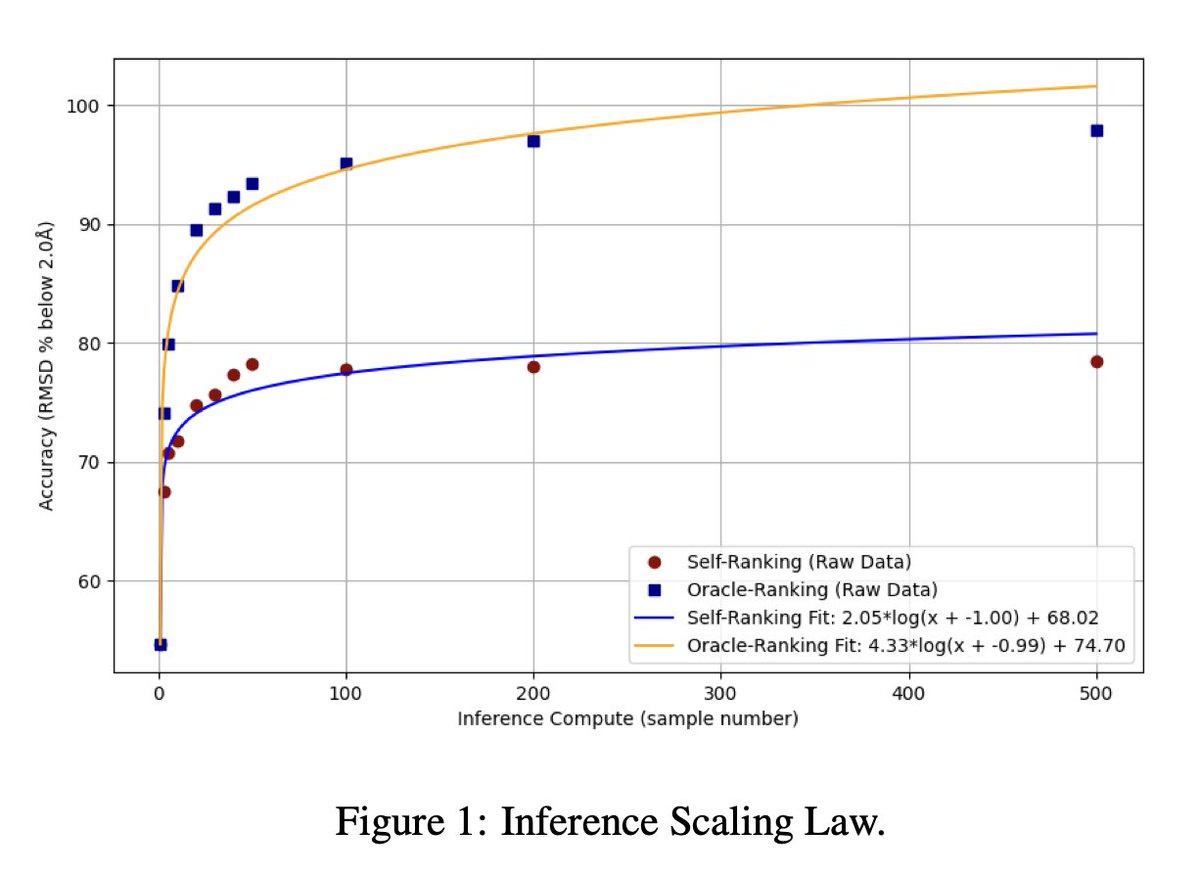
3/ On the PoseBusters benchmark for docking accuracy, Pharmolix-FM's Diffusion model outperforms PocketXMol in self-ranking (81.07% vs 78.97%) and matches it in oracle-ranking (94.16%), demonstrating strong generalization and robustness.
4/ In structure-based drug design (SBDD), Pharmolix-FM shows competitive performance in generating drug-like molecules with good synthetic accessibility. Its BFN and Diffusion models achieve better binding affinity scores than PocketXMol, while maintaining comparable QED and SA metrics.
5/ Pharmolix-FM enables systematic comparisons of generative modeling strategies. The results show that both Diffusion and BFN models are capable of capturing fine-grained molecular interactions and are adaptable to various tasks, from docking to drug design.
6/ The model incorporates a scaling law for inference accuracy, revealing a logarithmic relationship between the number of generated samples and prediction accuracy. This insight guides practical deployment under computational constraints.
7/ Overall, Pharmolix-FM demonstrates the feasibility and benefits of using diverse generative approaches under a unified all-atom modeling framework, offering a scalable and accurate tool for molecular interaction prediction and molecular generation.
💻Code: https://t.co/yvGRRSYfNG
📜Paper: https://t.co/atOJEgfOsg
#AI4Science #MolecularModeling #DrugDiscovery #DiffusionModels #BayesianFlowNetworks #StructureBasedDesign #AllAtom #GenerativeAI #PharmolixFM
Last Seen Hashtags on Sotwe
hermana
Seen from Argentina
minichattttt
Seen from Canada
brosis
Seen from Italy
stripper #blowjob
Seen from Italy
incest()******************************************************************
Seen from Turkey
longersecondtoe
Seen from United States
prisonsex
drkiki
せっとろぐ
Seen from Japan
shoga
Seen from Austria
Most Popular Users

Elon Musk 
@elonmusk
239.6M followers

Barack Obama
@barackobama
118.6M followers

Cristiano Ronaldo
@cristiano
114.3M followers

Donald J. Trump
@realdonaldtrump
111.7M followers

Narendra Modi
@narendramodi
106.9M followers

Rihanna
@rihanna
98.6M followers

NASA
@nasa
92.1M followers

Justin Bieber
@justinbieber
91.7M followers

KATY PERRY
@katyperry
89.9M followers

Taylor Swift
@taylorswift13
83.9M followers

Lady Gaga
@ladygaga
75.4M followers

Virat Kohli
@imvkohli
73.3M followers

Kim Kardashian
@kimkardashian
70.8M followers

YouTube
@youtube
68.6M followers

Neymar Jr
@neymarjr
66.3M followers

Bill Gates
@billgates
65.1M followers

Selena Gomez
@selenagomez
63M followers

The Ellen Show
@theellenshow
62.1M followers

CNN
@cnn
61.7M followers

X
@x
60.6M followers