

Top Tweets for #Supersingularity

#Supersingularity #CyclicalUniverse #Cosmology #BlackHoles #BigBang #Astrophysics #QuantumFluctuations #ScienceCommunication #Universe #Physics
Conclusions and Connections
Previous Universe Cycles: If the universe existed and “breathed” before the Big Bang, this could indicate a sequence of cosmic cycles, where each previous universe represents a phase in a much larger cosmic cycle.
Cosmic Background Radiation and Previous Universe: The cosmic microwave background radiation we measure today might contain echoes or remnants of a previous universe. This would mean that some of the observed irregularities or anisotropies in the background radiation may originate from an earlier cosmic cycle.
Matter and Energy in Cycles: The theory could imply that matter and energy are preserved and transformed in these cycles, rather than being annihilated at a definitive beginning or end. This aligns with the principle of conservation of energy and could provide an explanation for how the universe maintains its structure and balance over long periods.
Quantum Fluctuations and the Previous Universe: Quantum mechanical fluctuations could play a significant role in this context. They might influence the “breaths” of the universe on a microscopic level, thereby driving the transitions between different cosmic phases.
Potential Directions for Research
Analysis of Cosmic Microwave Background Radiation: More detailed investigations of the background radiation could help identify and analyze traces of previous universe cycles.
Modeling Cyclic Universe Dynamics: Developing mathematical models that depict the possible mechanisms of universe expansion and contraction in a cyclical cosmos.
Study of Quantum Gravity: Exploring how quantum mechanics and gravity could interact to support cyclic universe models.
#Supersingularity #CyclicalUniverse #Cosmology #BlackHoles #BigBang #Astrophysics #QuantumFluctuations #ScienceCommunication #Universe #Physics
Update :
https://t.co/6Veiz6xBVX
# Report on the Gravitational Wave Propagation Speed in a Pre-Big Bang Universe
#### Abstract
This report investigates the hypothesis of a pre-existing universe before the Big Bang, focusing on the gravitational wave propagation speed within a theoretical framework termed the "cave system" or cosmic bubble. It explores the implications of this model for the observed uniformity in the cosmic microwave background (CMB) radiation and its potential alignment with a cyclical universe concept.
#### Introduction
The concept of a cyclical universe suggests that the cosmos undergoes endless cycles of birth, death, and rebirth. Within this context, the cave system model posits that gravitational waves could traverse this pre-Big Bang environment, influencing the early universe's structure and possibly explaining the uniformity of the CMB.
#### Gravitational Wave Propagation Speed
The speed of gravitational waves in a vacuum is universally accepted to be the speed of light, \( c \approx 3 \times 10^8 \) m/s. However, in a pre-Big Bang scenario within a dense medium like the cave system, this speed could be affected by the medium's properties. Assuming the medium has characteristics that slow down these waves, we explored how this could impact the early universe's dynamics.
#### Methodology
A simplified calculation was used to estimate how the propagation speed of gravitational waves in a dense pre-Big Bang environment could deviate from \( c \). The model considered the medium's potential to have a higher refractive index than the vacuum, leading to a reduced speed of gravitational waves.
#### Results
While a precise calculation requires more detailed knowledge of the medium's properties, our exploratory analysis suggests that even a slight reduction in the gravitational wave speed could significantly impact the universe's early development. This alteration could explain the CMB's uniformity without necessitating faster-than-light inflationary expansion.
#### Discussion
The findings support the notion that a pre-Big Bang universe, possibly in the form of a cave system or cosmic bubble, could have properties affecting gravitational wave speeds. This concept aligns with the cyclical universe theory, where each cycle's end sets the initial conditions for the next.
#### Conclusion
The concept of gravitational waves propagating at speeds different from \( c \) in a pre-Big Bang universe offers a compelling avenue for reconciling the uniformity of the CMB with a cyclical model of the universe. Further research is needed to refine the calculations and fully understand the implications of this theory
#Supersingularity #CyclicalUniverse #Cosmology #BlackHoles #BigBang #Astrophysics #QuantumFluctuations #ScienceCommunication #Universe #Physics #Supersingularity #CyclicalUniverse #Cosmology #BlackHoles #BigBang #Astrophysics #QuantumFluctuations #ScienceCommunication #Universe #Physics
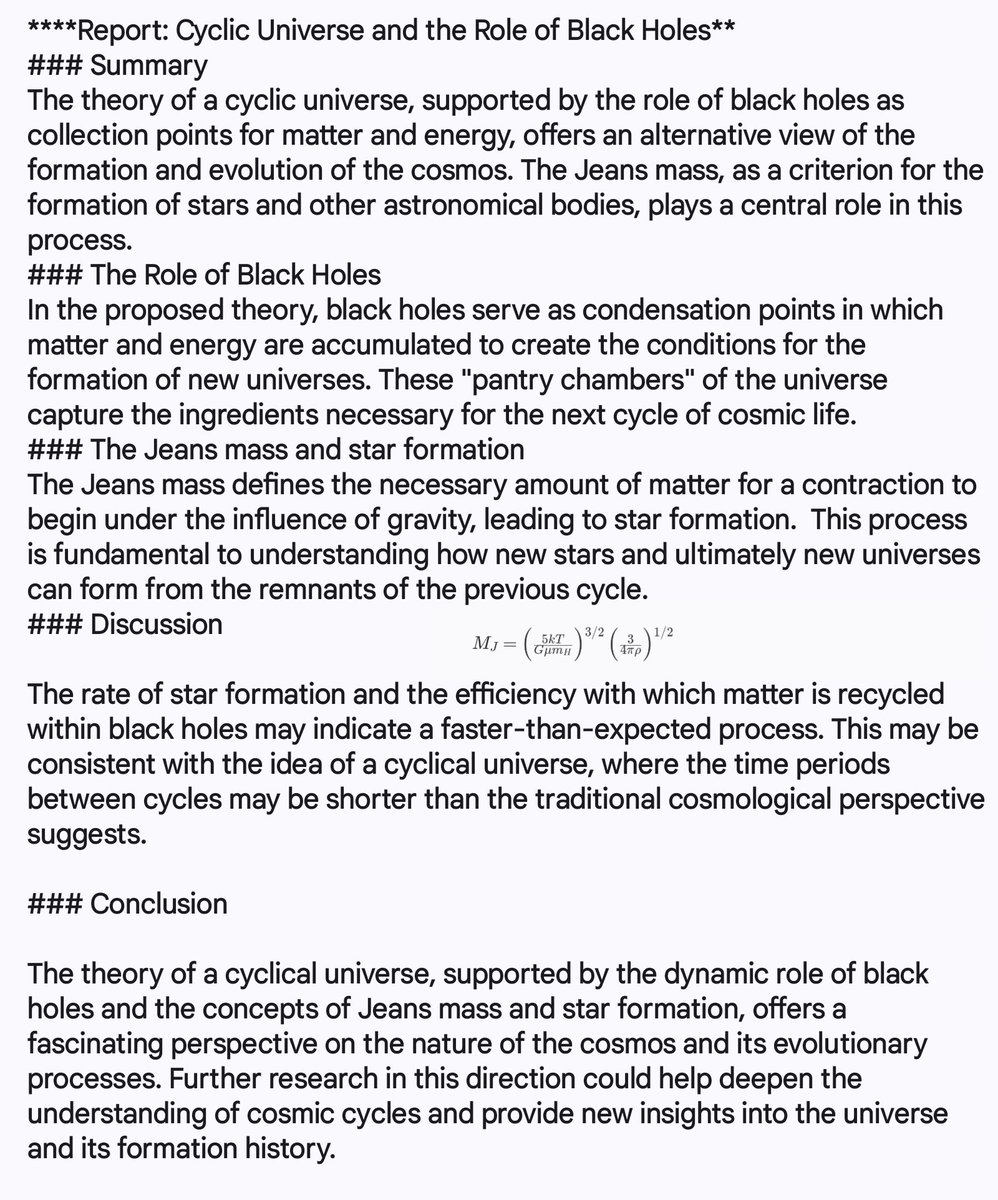
This image captures the mesmerizing phase 500-700 million years after the Big Bang, where the first galaxies illuminated the darkness. Witness young galaxies casting the inaugural light into our cosmos, laying the foundation for the celestial structure we know today.
Update: https://t.co/6Veiz6xBVX

#Supersingularity #CyclicalUniverse #Cosmology #BlackHoles #BigBang #Astrophysics #QuantumFluctuations #ScienceCommunication #Universe #Physics #Supersingularity #CyclicalUniverse #Cosmology #BlackHoles #BigBang #Astrophysics #QuantumFluctuations #ScienceCommunication #Universe #Physics
THAT WOULD BE SENSATIONAL!! This would not make the universe HOMOGENEOUS AND ISOTROPIC!!! My theory would almost come true!
The ball is in the court of science!
Update: On the Cyclical Universe
I've got the Hubble constant below "Boötes void"
https://t.co/6Veiz6xBVX
Interim report:
The differences in the measurements of the Hubble constant reveal an intriguing discrepancy in current cosmological research. While the Hubble Space Telescope provides values around 73 km/s/Mpc, measurements of the cosmic microwave background radiation by the Planck Space Telescope indicate a value of about 67 km/s/Mpc. Additional measurements from other sources such as the Atacama Cosmology Telescope support the lower values. These differences could indicate that the universe is not perfectly homogeneous and isotropic, as the standard cosmological model assumes. In my theory, this variability is explained by regional differences in gravity and the distribution of matter, which is supported by measurements in low-gravity regions such as the Boötes Void. There, values of around 97.2 km/s/Mpc were determined, which represents a significant deviation and strengthens the hypothesis of a non-homogeneous, anisotropic universe.
Sources:
- Riess, A. G., et al. (Hubble Space Telescope measurements)
- Planck Collaboration (Planck Space Telescope data)
- The Atacama Cosmology Telescope Team
- Measurements in the Boötes void (Hubble constant calculated by me with an approximate value)

#Supersingularity #CyclicalUniverse #Cosmology #BlackHoles #BigBang #Astrophysics #QuantumFluctuations #ScienceCommunication #Universe #Physics #galaxy #blackhole #expansión #cosmos #theuniverse #bigbangtheory #stephenhawking #AlbertEinstein
So far, everything points to the fact that we live in a cyclical universe. I urgently hope and appeal to science to at least pay attention to this theory and to spend half an hour reading it and to see the positive impact of a completely different theory of our universe and its origins and thus to recognize its real value. Scientific data was used, scientific calculations were carried out and so far there has been a consistently positive response to the proof of a theory for the cyclical universe. There is nothing in my theory that is not scientifically significant. Everything I have done here to confirm this theory I have taken from well-known scientific sources. The resulting calculations show that it is indeed a cyclical universe. I would like to expressly emphasize that I am not a scientist, but I have been dealing with this subject for 30 years and now the time has finally come when there is an end for me and a beginning for science.
Update on the "CYCLICAL UNIVERSE"
#Supersingularity #CyclicalUniverse #Cosmology #BlackHoles #BigBang #Astrophysics #QuantumFluctuations #ScienceCommunication #Universe #Physics #Supersingularity #CyclicalUniverse #Cosmology #BlackHoles #BigBang #Astrophysics #QuantumFluctuations #ScienceCommunication #Universe #Physics
https://t.co/6Veiz6xBVX
#Supersingularity #CyclicalUniverse #Cosmology #BlackHoles #BigBang #Astrophysics #QuantumFluctuations #ScienceCommunication #Universe #Physics
Quantum Mechanics Visualizations Visually Created for You😊
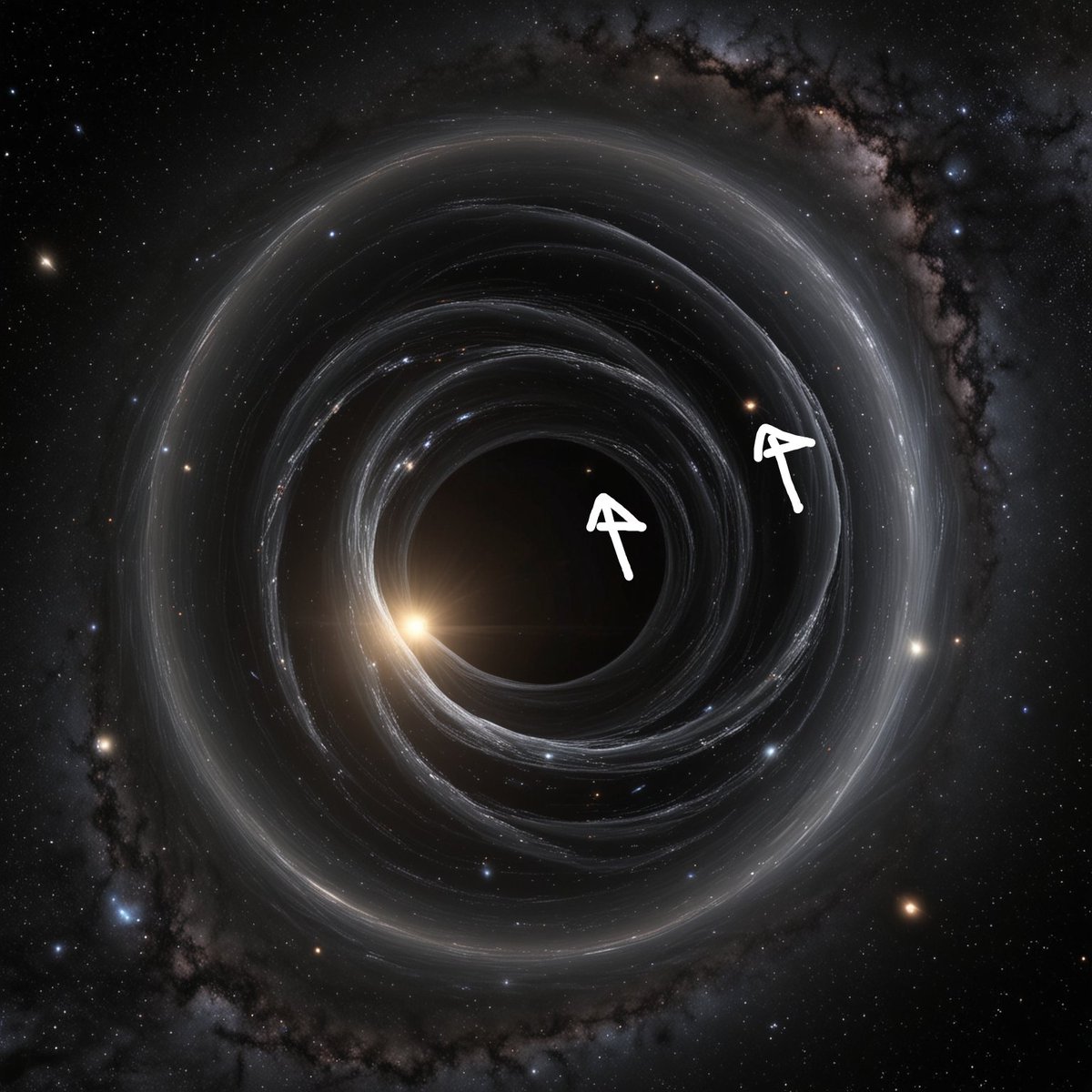
"With this illustration, I want to give you a sense of what might be happening at the edge of a black hole — a scenario we normally cannot see. The red dot at the center symbolizes a particle succumbing to the inevitable pull of the black hole. The brighter spot outside represents the particle that escapes the attraction, depicting Hawking radiation. In reality, this process would be invisible to us, but the illustration aims to convey the fascinating dynamics that occur according to the laws of quantum physics in the immediate vicinity of a black hole: a constant exchange, a transformation of energy that defies the limits of our imagination."
#Supersingularity #CyclicalUniverse #Cosmology #BlackHoles #BigBang #Astrophysics #QuantumFluctuations #ScienceCommunication #Universe #Physics #Supersingularity #CyclicalUniverse #Cosmology #BlackHoles #BigBang #Astrophysics #QuantumFluctuations #ScienceCommunication #Universe #Physics
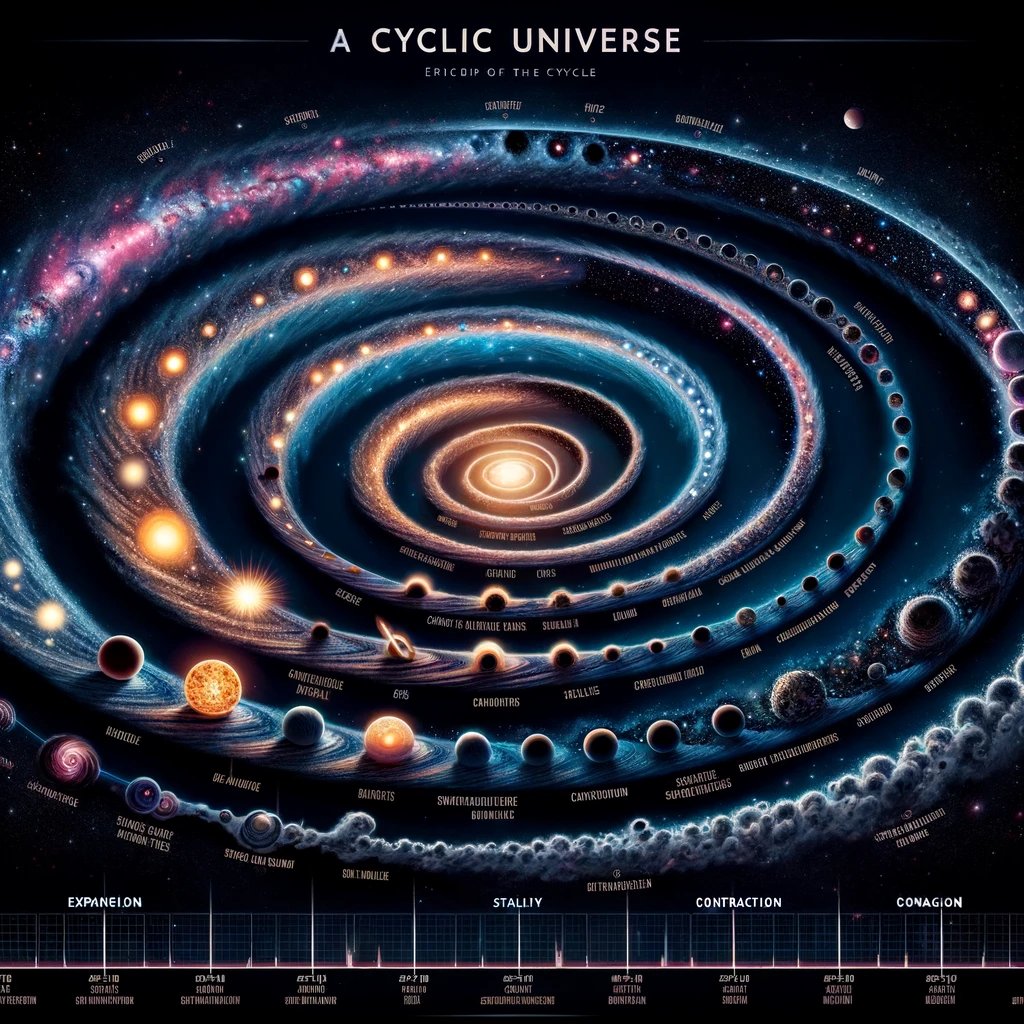
🌌 **The Eternal Cycle of the Universe: A Visual Journey**
In this captivating illustration, the theory of a cyclic universe unfolds, inviting us to think beyond the conventional boundaries of time and space. Here, we witness the universe caught in an endless dance of creation, evolution, and renewal.
**Where It Begins**: Our visual adventure starts with the glowing flash of the cosmic egg, symbolizing the universe's beginning and the moment of the Big Bang. At the start of the spiral, the birth of the universe from a supersingularity is depicted, surrounded by intense light announcing the emergence of everything.
**Through the Phases**:
- **Expansion**: As the spiral unfolds, we observe the formation of stars and galaxies, a cosmic ballet orchestrated by dark matter and dark energy.
- **Stability and Diversity**: Further along the spiral, the universe reaches a phase of maturity, illustrated by the rich diversity of cosmic structures, from vibrant galaxies to sprawling star systems.
- **Contraction**: The spiral leads us to the dark whirls of black holes, endpoints for matter and energy but also seeds for new beginnings.
**Where It Ends and Begins Again**: At the spiral's end, we encounter another supersingularity – a hint that the end of one cycle seamlessly transitions into the beginning of the next. This illustrates the idea that in the universe, everything is cyclical, and every end is merely the start of something new.
**Behind Every Detail**:
- The background of the spiral, filled with delicate lines and patterns, represents the fundamental fluctuations of space and the quantum level on which the universe dances.
- A timeline along the bottom edge marks key moments in the universe's history, providing orientation on this journey through time.
This illustration is more than just an image – it's an invitation to explore the mysteries of our universe together and to embrace the wondrous notion that in the infinity of space, cycles of death and rebirth sing the eternal song of the cosmos.
---
This description offers a clear starting and ending point for viewing the illustration and clarifies how the cyclic nature of the universe is visually represented.
#Supersingularity #CyclicalUniverse #Cosmology #BlackHoles #BigBang #Astrophysics #QuantumFluctuations #ScienceCommunication #Universe #Physics #Supersingularity #CyclicalUniverse #Cosmology #BlackHoles #BigBang #Astrophysics #QuantumFluctuations #ScienceCommunication #Universe #Physics
Here are the illustrations of the theory of the "CYCLIC UNIVERSE"
#Supersingularity #CyclicalUniverse #Cosmology #BlackHoles #BigBang #Astrophysics #QuantumFluctuations #ScienceCommunication #Universe #physics
I've reached an exciting point in the development of my theory of the cyclic universe. This theory has the potential to fundamentally change our view of the cosmos by suggesting that the universe exists in an endless cycle of creation, existence, and renewal.However, I've come to realize that essential data needed for the next phase of my research—specific calculations and deeper analyses—are missing. These data are not readily accessible and reside within specialized databases containing extensive and detailed information about the universe.Without direct access to these datasets, I face a hurdle that prevents me from further validating and refining my theory. It's a reminder of the importance of access to scientific resources and that sometimes the greatest discoveries must wait until we have the tools to explore them.Despite this challenge, my enthusiasm remains undiminished. I'm optimistic that one day we will be able to unlock the necessary data to further explore the mysteries of the cyclic universe.
#Supersingularity #CyclicalUniverse #Cosmology #BlackHoles #BigBang #Astrophysics #QuantumFluctuations #ScienceCommunication #Universe #physics
To deepen the discussion on the cyclic universe concept and the pivotal roles played by black holes and supersingularities, it's instrumental to explore the scientific foundations and current theoretical models supporting these ideas.
### Scientific Foundations
The notion that black holes could serve as birthplaces for new universes leans on several key aspects of modern physics and cosmology. A crucial element is Hawking radiation, suggesting that black holes are not eternal but emit energy as radiation. This insight leads to the idea that the end of a black hole could facilitate enough energy to spawn a new universe.
The cyclic universe theory finds support in various quantum gravity approaches, like loop quantum gravity, proposing mechanisms for a cyclic cosmology without singularities. These models offer a theoretical framework explaining the possibility of a recurring cycle of universe expansion and contraction without the need for a traditional Big Bang.
### Criticisms and Counterarguments
Criticisms of the cyclic universe theory and the concept of black holes as origins of new universes include questions about the transfer of information and energy from one cycle to the next. The laws of thermodynamics, particularly the second law which dictates the increase of entropy in a closed system, pose challenges for a perpetually cyclic universe model. Critics argue that without a mechanism for an entropy "reset" at each cycle, the universe would face an unstoppable increase in disorder.
### Extended Discussion
To further reinforce this theory, examining the interaction between dark matter and dark energy in the cyclic phases of the universe is necessary. Dark energy, responsible for the universe's accelerated expansion, plays a crucial role in current cosmology. A better understanding of its properties and how it might behave over a cosmic cycle is vital for developing a coherent cyclic universe theory.
### Conclusion
Considering black holes and supersingularities as key elements in the cosmic cycle opens new pathways to understanding the universe and our place within it. This perspective highlights not only the interconnectedness of all things but also the beauty of cosmic order and eternal renewal, facilitated by the transformative power of fluctuations within the depths of supersingularities.
By incorporating these deeper explanations and addressing potential criticisms, the report evolves into a comprehensive discussion that acknowledges the complexity of the subject. It emphasizes the dynamic nature of scientific inquiry, always pushing the boundaries of knowledge and inviting further exploration and debate.
#Supersingularity #CyclicalUniverse #Cosmology #BlackHoles #BigBang #Astrophysics #QuantumFluctuations #ScienceCommunication #Universe #Physics
According to my Calculations, New Report
The idea of a cyclic universe, supported by the critical density and calculations of gravitational waves and the lifetime of black holes through Hawking radiation, offers a fascinating model for understanding the temporal dimension of the universe. These concepts illustrate that the universe may not have a single beginning or end, but could be part of an eternal cycle of formation, evolution, and new beginnings.
### The Cyclic Universe: Underpinned by Science
**The critical density of the universe** is a key indicator for understanding its fate. The calculated critical density of \(9.22 \times 10^{-27}\) kg/m³ provides a quantitative basis for determining whether the universe is trending toward eternal expansion, ultimate collapse, or a state of equilibrium that could allow cyclical new beginnings.
**Gravitational waves** provide insight into the dynamic processes that shape the universe. The energy released when black holes collide, about \(3.64 \times 10^{51}\) joules, underscores the power dynamics in the universe and the potential role of such events in the transition phases between cycles.
**Hawking radiation** and the associated black hole lifetime of \(8.39 \times 10^{73}\) years indicate that even the seemingly unchanging black holes undergo a process of change and termination, supporting the idea of a constantly renewing universe.
### Implications for the cyclic universe
These calculations and concepts shed new light on the possibility of a cyclic universe. They suggest that the universe could be characterized by a sequence of expansions, stagnations and contractions, with each cycle driven by the fundamental forces and processes that shape the universe.
The implications of such a model for our understanding of time, matter and cosmic destiny are profound. They challenge us to think beyond linear concepts of beginning and end, and instead consider the universe as an eternal continuum in which each "endpoint" is only the precursor to a new beginning.
### Future prospects
The theory of a cyclical universe and the calculations associated with it open up new fields of research and questions to explore. How exactly do the transitions between cycles occur? What role do dark matter and dark energy play in this process? And how can we find further evidence of these cyclical patterns?
The answers to these questions lie in the future of cosmological research. By combining theoretical physics, observational data, and advanced simulations, we can hope to further unravel the mystery of the cyclical nature of the universe.
#Supersingularity #CyclicalUniverse #Cosmology #BlackHoles #BigBang #Astrophysics #QuantumFluctuations #ScienceCommunication #Universe #Physics
*Extended Report according to my latest Calculations*
Summary and Outlook
### The Universe: An Interplay of Matter, Energy and Dynamics
The universe, an endless sea of galaxies, stars and planets, is shaped by fundamental forces that govern the interplay of matter and energy. Key players in this cosmic ballet include dark matter and gravity, which together form the framework of the universe. Added to this is the fascinating idea of a cyclical universe characterized by dynamic events and fundamental physical processes.
#### Dark Matter: The Hidden Skeleton
The existence of dark matter, indirectly inferred from its gravitational effects on visible matter, such as in the rotation curves of galaxies and gravitational lensing, underscores the complex structure of the universe. This invisible matter forms the backbone of the cosmic web that holds galaxies and galaxy clusters together as they dance through space.
#### Gravity: The Universal Force
Attracting everything from the smallest particles to the most gigantic galaxy clusters, gravity is one of the four fundamental forces of nature. Its action, described by Einstein's general theory of relativity, governs the structure of space and the movement of time. The discovery of gravitational waves has revolutionized our ability to study extreme cosmic events and confirm the theory of gravity.
#### The Cyclic Universe: A New Perspective
The idea of a cyclic universe, supported by the calculation of the critical density of the universe, opens new avenues in understanding cosmic history and future. The critical density, calculated as about \(9.22 \times 10^{-27}\) kg/m³, plays a crucial role in determining the fate of the universe. This value, in conjunction with the lifetime of black holes due to Hawking radiation and the energy of gravitational waves, provides a quantitative basis for the concept of a universe that is constantly renewing itself.
- **Dynamic events in the universe**: The energy of gravitational waves released when black holes collide is about \(3.64 \times 10^{51}\) joules. Such events illustrate the dynamic processes that shape the universe.
- **Lifetime of black holes**: The exceptionally long lifetime of black holes, estimated at \(8.39 \times 10^{73}\) years by Hawking radiation, underlines their importance in a cyclical universe.
This report combines the concepts of dark matter, gravity and the cyclic universe into a coherent picture of the cosmos. By integrating current scientific knowledge and precise calculations, it advances our understanding of the fundamental processes that shape the universe. The debate about the universe is far from over; each new discovery and each theoretical model developed takes us deeper into understanding the infinite complexity and beauty of the universe.
Page 1
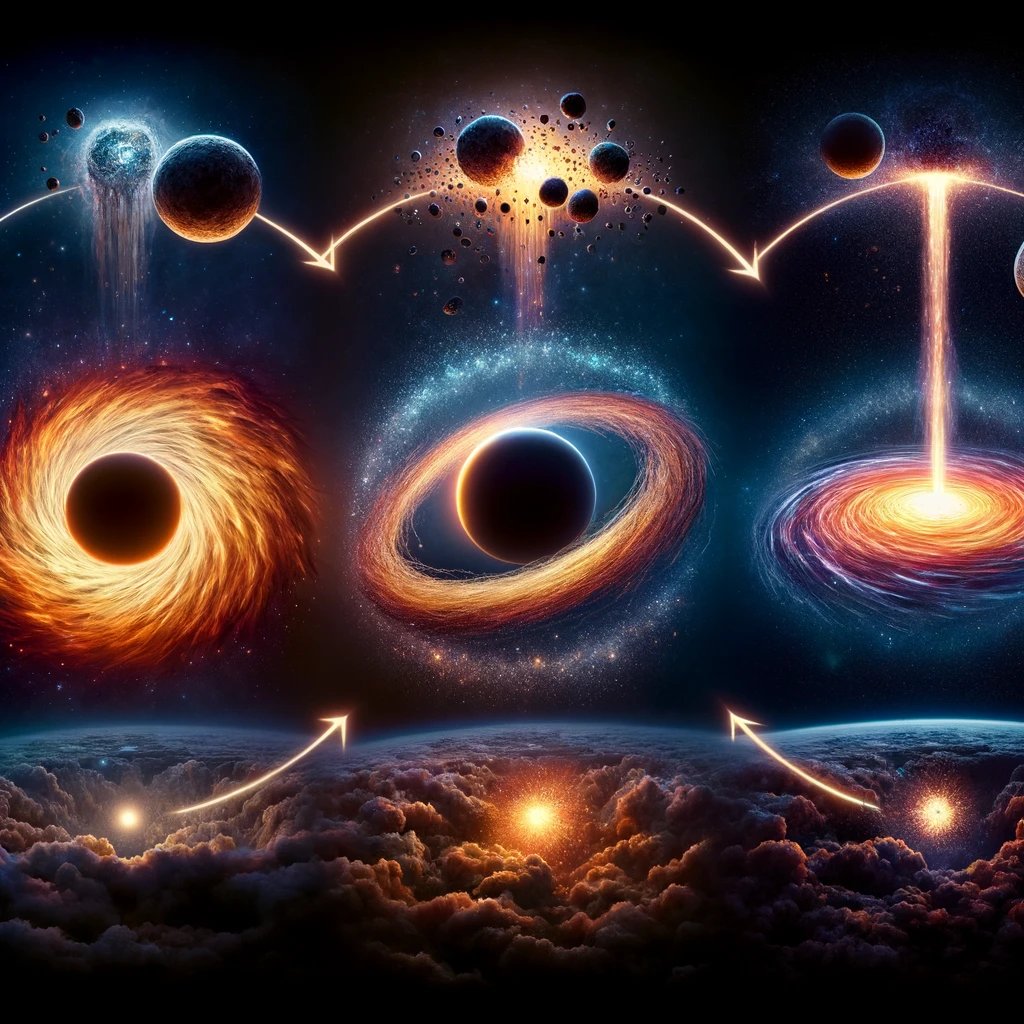
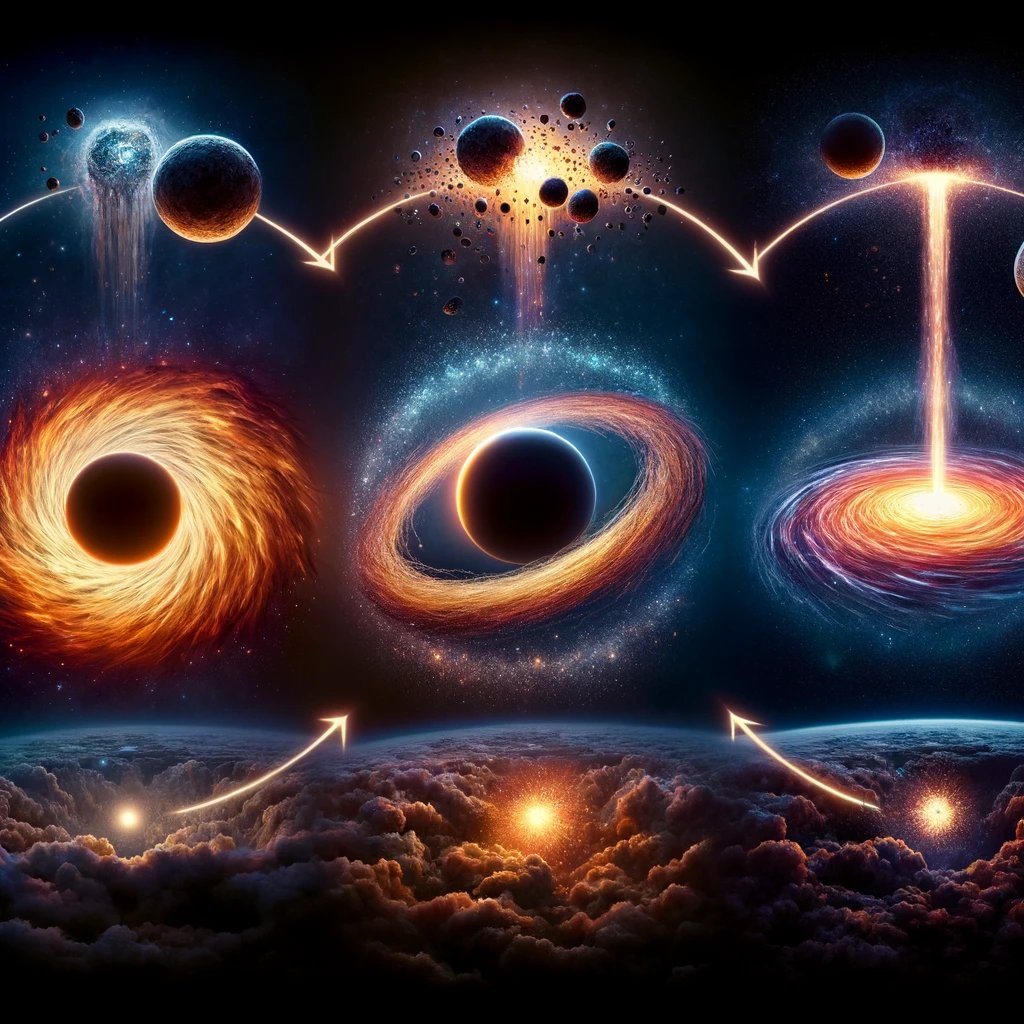
To illustrate the hypothesis that black holes could be a new beginning.
#Supersingularity #CyclicalUniverse #Cosmology #BlackHoles #BigBang #Astrophysics #QuantumFluctuations #ScienceCommunication #Universe #Physics
Absorption of matter by black holes: The part of the image depicting this phase could realistically show the intense gravitational forces that black holes use to attract and absorb matter from their surroundings. You could see detailed structures depicting flows of matter toward the black holes, accompanied by glowing accretion disks around the black holes.Contraction of the universe to a dense point: This phase could be represented by an area in the image that becomes increasingly concentrated and intensely illuminated to illustrate the idea of maximum density and contraction. The depiction could be so realistic that it suggests the immense compression of matter and energy into a single point in the universe.Explosive rebirth in a new Big Bang: The most vibrant and dynamic part of the image would depict the moment of the new Big Bang and the creation of a new universe. Here you could see an explosion of colors and light, symbolizing the release of energy and the creation of new matter structures in the early universe.
Since I'm not a fan of fluctuation out of nowhere, here's a little summary of my hypothesis. This is just a hypothesis, it should not be forgotten, but it is also a hypothesis that makes more sense😊👍
#Supersingularity #CyclicalUniverse #Cosmology #BlackHoles #BigBang #Astrophysics #QuantumFluctuations #ScienceCommunication #Universe #Physics
#### Introduction
Imagine the universe not as a one-time explosion emerging from nothingness but as an eternal cycle of life, death, and rebirth. This notion stems from observing that everything in nature follows a cycle—from the seasons to the water cycle. Why should the universe be any different?
#### The Role of Black Holes
Black holes fascinate us as places of extreme conditions, where the known laws of physics are pushed to their limits. They absorb matter and energy, but where does it all go? The idea is that black holes are not just endpoints but also starting points for something new.
#### The Supersingularity as a Bridge
The supersingularity, a concept playing a central role here, emerges from the idea that what goes into black holes must accumulate somewhere. This accumulation, a sort of cosmic cave full of matter and energy, could be the origin of something significant. If this cave, or rather, this network of matter fed by countless black holes, reaches a critical point, it could mark the beginning of a new universe.
#### The Emergence of Fluctuation
In this network, which I envision as a cosmic cave system, matter from across the universe gathers. This collection is not static; it interacts, condenses, and transforms in a way that produces fundamental fluctuations. Imagine that from this complex interaction and condensation, a point forms that is incredibly small yet unimaginably dense—a fluctuation with the potential to transform the cosmos as we know it.
#### How a Universe is Born from a Black Hole
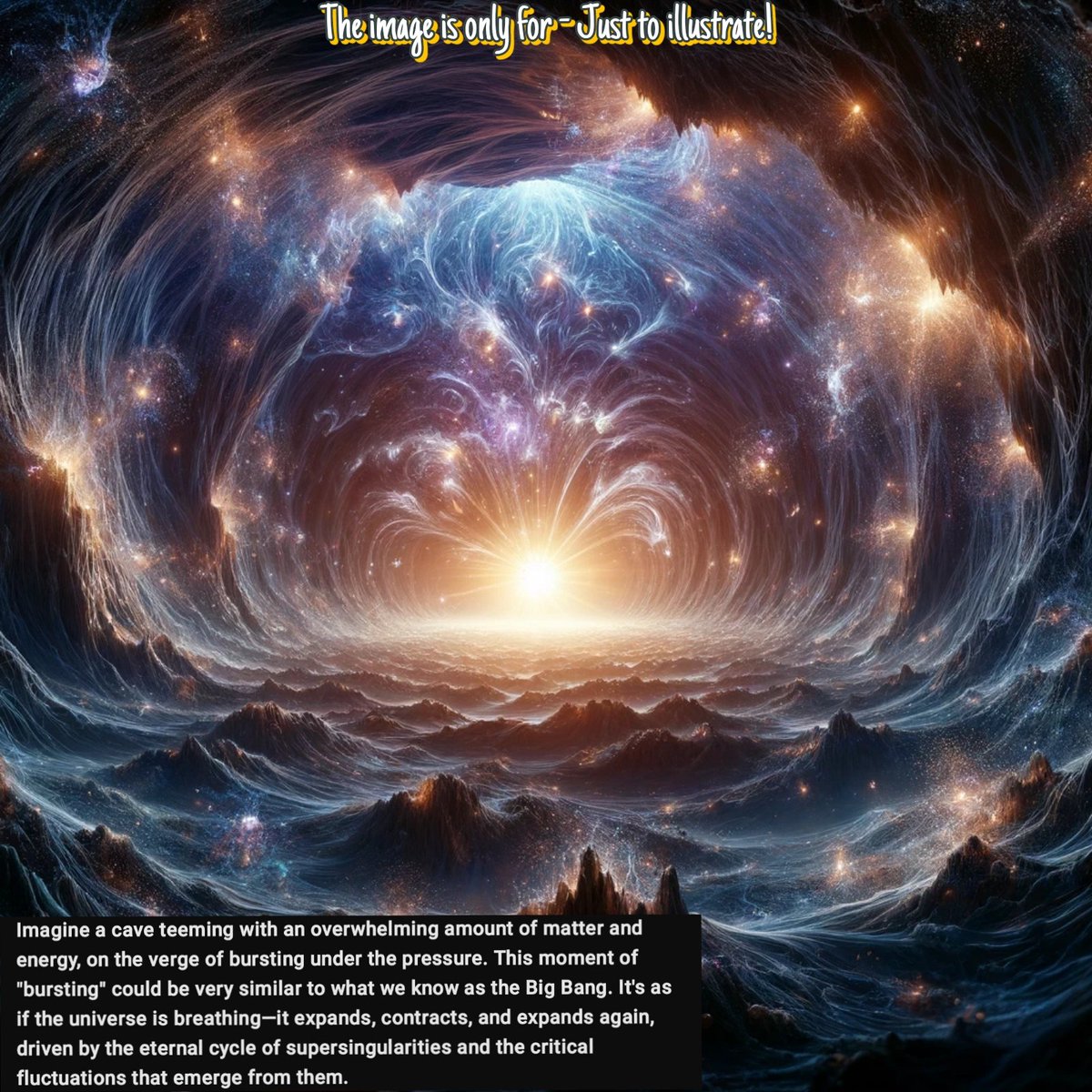
Imagine an overcrowded cave about to burst under the pressure of accumulated matter and energy. This moment of "bursting" could closely resemble what we know as the Big Bang. It's as if the universe breathes—expanding, contracting, and expanding again, driven by the eternal cycle of supersingularities and the crucial fluctuations that emerge from them.
#### Why This Idea Could Make Sense
This hypothesis attempts to bridge the gap between the end and the beginning, creating an everlasting bond between the death of an old universe and the birth of a new one. It offers a possible answer to the question of where the universe comes from and where it is headed. And it takes into account that in nature, nothing is lost but transformed, supported by the critical moment of fluctuation that leads to a new beginning.

Action day
#london #travels #photography #nikon #backpacking #supersingularity #adventure https://t.co/ruZQHNr5Zu


Last Seen Hashtags on Sotwe
platinuminside
Seen from United States
momson(*)***+filter:native_video
Seen from Russia
好身材好气质
Seen from Korea
rizetravesti
Seen from Turkey
spy #caught
Seen from France
mom divorced sex
GeneticsScience
Seen from United States
KaiCameronJay
Seen from United States
orgasm #bbc
Seen from Turkey
antalyagay
Seen from Turkey
Trends for you
Most Popular Users

Elon Musk 
@elonmusk
241.8M followers

Barack Obama
@barackobama
119M followers

Cristiano Ronaldo
@cristiano
114.6M followers

Donald J. Trump
@realdonaldtrump
111.9M followers

Narendra Modi
@narendramodi
107.2M followers

Rihanna
@rihanna
98.7M followers

NASA
@nasa
92.4M followers

Justin Bieber
@justinbieber
91.8M followers

KATY PERRY
@katyperry
90.1M followers

Taylor Swift
@taylorswift13
84M followers

Lady Gaga
@ladygaga
75.5M followers

Virat Kohli
@imvkohli
73.5M followers

Kim Kardashian
@kimkardashian
70.9M followers

YouTube
@youtube
68.8M followers

Neymar Jr
@neymarjr
66.5M followers

Bill Gates
@billgates
65.2M followers

Selena Gomez
@selenagomez
63.1M followers

The Ellen Show
@theellenshow
62.3M followers

CNN
@cnn
61.8M followers

X
@x
60.7M followers