

Top Tweets for #UltraProcessed

An @NIH study led by @KevinH_PhD matched fat, sugar, and fiber line-for-line. People on ultra-processed food still ate 500 extra calories a day without realizing it.
See why soft food is so easy to overeat: https://t.co/P1cL21rDZg
#UltraprocessedFood #RealFood #TheRealFoodShow #TheHealthBriefing


Diet's Role in Modifying Risk of Alzheimer's Disease: History and Present Understanding
William B Grant et al @wbgrant2. J Alzheimers Dis. 2023.
Abstract
Diet is an important nonpharmacological risk-modifying factor for Alzheimer's disease (AD). The approaches used here to assess diet's role in the risk of AD include multi-country ecological studies, prospective and cross-sectional observational studies, and laboratory studies. Ecological studies have identified fat, meat, and obesity from high-energy diets as important risk factors for AD and reported that AD rates peak about 15-20 years after national dietary changes. Observational studies have compared the Western dietary pattern with those of the Dietary Approaches to Stop Hypertension (DASH), Mediterranean (MedDi), and Mediterranean-DASH Intervention for Neurodegenerative Delay (MIND) diets. Those studies identified AD risk factors including higher consumption of saturated and total fats, meat, and ultraprocessed foods and a lower risk of AD with higher consumption of fruits, legumes, nuts, omega-3 fatty acids, vegetables, and whole grains. Diet-induced factors associated with a significant risk of AD include inflammation, insulin resistance, oxidative stress, elevated homocysteine, dietary advanced glycation end products, and trimethylamine N-oxide. The molecular mechanisms by which dietary bioactive components and specific foods affect risk of AD are discussed. Given most countries' entrenched food supply systems, the upward trends of AD rates would be hard to reverse. However, for people willing and able, a low-animal product diet with plenty of anti-inflammatory, low-glycemic load foods may be helpful.
INTRODUCTION
Alzheimer’s disease (AD) is the most common cause of dementia characterized by accumulation of tau protein tangles and amyloid-β (Aβ) plaque, progressive loss of neurons, and deterioration of normal brain function.
According to a 2023 review, the global number of people with AD, prodromal AD, and preclinical AD were estimated at 32 million, 69 million, and 315 million, respectively. Together they constituted 416 million across the AD continuum, or 22% of all people aged 50 or older [1]. Thus, AD is a serious health risk. A 2022 article identified 75 genetic risk foci, of which 42 were newly discovered [2]. However, people with genetic risk factors such as apolipoprotein E ɛ4 can modify their risk of developing AD by taking measures to reduce dietary risk factors.
A 2015 meta-analysis of modifiable risk factors for AD identified a healthful dietary pattern as the most important factor with a risk ratio (RR)/odds ratio (OR) of 0.45 (95% confidence interval [CI], 0.23–0.61) with grade II-A level of evidence [3]. The RR/OR values for specific dietary consumption were high folate intake, 0.49 (95% CI, 0.28–0.74), grade I; fish consumption, 0.68 (95% CI, 0.46–0.95), grade II-A; high vitamin E intake, 0.74 (95% CI, 0.63–0.83), grade I; and high vitamin C intake, 0.75 (95% CI, 0.57–0.02), grade I.
A 2020 review outlined the modifiable risk factors for AD throughout the lifespan [4]. In early life, more schooling reduces risk. Starting after age 45 years, many other modifiable risk factors become important. The review identified 10 factors with level A evidence (lack of cognitive activity,
https://t.co/3SS8Av6rPL

Diet's Role in Modifying Risk of Alzheimer's Disease: History and Present Understanding
William B Grant @wbgrant2 et al. J Alzheimers Dis. 2023.
Abstract
Diet is an important nonpharmacological risk-modifying factor for Alzheimer's disease (AD). The approaches used here to assess diet's role in the risk of AD include multi-country ecological studies, prospective and cross-sectional observational studies, and laboratory studies. Ecological studies have identified fat, meat, and obesity from high-energy diets as important risk factors for AD and reported that AD rates peak about 15-20 years after national dietary changes. Observational studies have compared the Western dietary pattern with those of the Dietary Approaches to Stop Hypertension (DASH), Mediterranean (MedDi), and Mediterranean-DASH Intervention for Neurodegenerative Delay (MIND) diets. Those studies identified AD risk factors including higher consumption of saturated and total fats, meat, and ultraprocessed foods and a lower risk of AD with higher consumption of fruits, legumes, nuts, omega-3 fatty acids, vegetables, and whole grains. Diet-induced factors associated with a significant risk of AD include inflammation, insulin resistance, oxidative stress, elevated homocysteine, dietary advanced glycation end products, and trimethylamine N-oxide. The molecular mechanisms by which dietary bioactive components and specific foods affect risk of AD are discussed. Given most countries' entrenched food supply systems, the upward trends of AD rates would be hard to reverse. However, for people willing and able, a low-animal product diet with plenty of anti-inflammatory, low-glycemic load foods may be helpful.
INTRODUCTION
Alzheimer’s disease (AD) is the most common cause of dementia characterized by accumulation of tau protein tangles and amyloid-β (Aβ) plaque, progressive loss of neurons, and deterioration of normal brain function.
According to a 2023 review, the global number of people with AD, prodromal AD, and preclinical AD were estimated at 32 million, 69 million, and 315 million, respectively. Together they constituted 416 million across the AD continuum, or 22% of all people aged 50 or older [1]. Thus, AD is a serious health risk. A 2022 article identified 75 genetic risk foci, of which 42 were newly discovered [2]. However, people with genetic risk factors such as apolipoprotein E ɛ4 can modify their risk of developing AD by taking measures to reduce dietary risk factors.
A 2015 meta-analysis of modifiable risk factors for AD identified a healthful dietary pattern as the most important factor with a risk ratio (RR)/odds ratio (OR) of 0.45 (95% confidence interval [CI], 0.23–0.61) with grade II-A level of evidence [3]. The RR/OR values for specific dietary consumption were high folate intake, 0.49 (95% CI, 0.28–0.74), grade I; fish consumption, 0.68 (95% CI, 0.46–0.95), grade II-A; high vitamin E intake, 0.74 (95% CI, 0.63–0.83), grade I; and high vitamin C intake, 0.75 (95% CI, 0.57–0.02), grade I.
A 2020 review outlined the modifiable risk factors for AD throughout the lifespan [4]. In early life, more schooling reduces risk. Starting after age 45 years, many other modifiable risk factors become important. The review identified 10 factors with level A evidence (lack of cognitive activity,
https://t.co/3SS8Av6rPL

Diet's Role in Modifying Risk of Alzheimer's Disease: History and Present Understanding
William B Grant et al @wbgrant2. J Alzheimers Dis. 2023.
Abstract
Diet is an important nonpharmacological risk-modifying factor for Alzheimer's disease (AD). The approaches used here to assess diet's role in the risk of AD include multi-country ecological studies, prospective and cross-sectional observational studies, and laboratory studies. Ecological studies have identified fat, meat, and obesity from high-energy diets as important risk factors for AD and reported that AD rates peak about 15-20 years after national dietary changes. Observational studies have compared the Western dietary pattern with those of the Dietary Approaches to Stop Hypertension (DASH), Mediterranean (MedDi), and Mediterranean-DASH Intervention for Neurodegenerative Delay (MIND) diets. Those studies identified AD risk factors including higher consumption of saturated and total fats, meat, and ultraprocessed foods and a lower risk of AD with higher consumption of fruits, legumes, nuts, omega-3 fatty acids, vegetables, and whole grains. Diet-induced factors associated with a significant risk of AD include inflammation, insulin resistance, oxidative stress, elevated homocysteine, dietary advanced glycation end products, and trimethylamine N-oxide. The molecular mechanisms by which dietary bioactive components and specific foods affect risk of AD are discussed. Given most countries' entrenched food supply systems, the upward trends of AD rates would be hard to reverse. However, for people willing and able, a low-animal product diet with plenty of anti-inflammatory, low-glycemic load foods may be helpful.
Keywords: Advanced glycation end products; Alzheimer’s disease; TMAO; dementia; diet; meat; neuroinflammation; obesity; saturated fat; ultraprocessed foods.
https://t.co/UyYJbx4hE9
A Brief History of the Progress in Our Understanding of Genetics and Lifestyle, Especially Diet, in the Risk of Alzheimer's Disease
William B Grant. J Alzheimers Dis. 2024.
Author
William B Grant @wbgrant2
Abstract
The two major determining factors for Alzheimer's disease (AD) are genetics and lifestyle. Alleles of the apolipoprotein E (APOE) gene play important roles in the development of late-onset AD, with APOEɛ4 increasing risk, APOEɛ3 being neutral, and APOEɛ2 reducing risk. Several modifiable lifestyle factors have been studied in terms of how they can modify the risk of AD. Among these factors are dietary pattern, nutritional supplements such as omega-3 fatty acids, and B vitamins, physical exercise, and obesity, and vitamin D. The Western diet increases risk of AD, while dietary patterns such as the Mediterranean and vegetarian/vegan diets reduce risk. Foods associated with reduced risk include coffee, fruits and vegetables, whole grains and legumes, and fish, while meat and ultraprocessed foods are associated with increased risk, especially when they lead to obesity. In multi-country ecological studies, the amount of meat in the national diet has the highest correlation with risk of AD. The history of research regarding dietary patterns on risk of AD is emphasized in this review. The risk of AD can be modified starting at least by mid-life. People with greater genetic risk for AD would benefit more by choosing lifestyle factors to reduce and/or delay incidence of AD.
Keywords: APOE; Alzheimer’s disease; Western diet; dietary pattern; ecological study; genetic risk; lifestyle; meat; obesity; ultraprocessed foods.
https://t.co/fnsqky5klE


New in The Innovation Nutrition! Rethinking ultra-processed foods Controversies, health evidence, and policy directions.
This commentary critically examines ultra-processed food classification systems and the mechanistic plausibility of processing-related harms.
https://t.co/swYZYxQrFZ
#nutrition #UltraProcessedFoods

Diet's Role in Modifying Risk of Alzheimer's Disease (AD): History and Present Understanding
William B Grant et al @wbgrant2. J Alzheimers Dis. 2023
Dietary patterns and risk of AD
The study of AD incidence with respect to dietary patterns offers useful information regarding how various food groups generally affect risk of AD. Those studies form the basis for further research. The WD pattern [22, 23], MedDi [24–26], DASH diet [27, 28], and MIND diet [6] have received the most attention. The WD is characterized as having high consumption of fat, ultraprocessed foods (UPFs), and meat [22]. A recent definition of the WD is a dietary pattern in which 70% of calories originate from animal foods, oils and fats, and sweeteners [23]. The WD thus includes low intakes of fruits, vegetables, whole grains, legumes, and nuts— all important sources of vitamins, minerals, fiber, and antioxidants, which are essential for optimal health. The MedDi has large amounts of olive oil, fish, breads and cereals, fruits, vegetables, legumes, nuts, beans, and seeds; moderate amounts of dairy products, poultry, and alcohol; and small amounts of red and processed meat and sweets [9]. The DASH diet has large amounts of grains, fruits, vegetables, legumes, nuts, and low-fat dairy products; moderate amounts of poultry and fish; and small amounts of red meat, sweets, saturated and total fat, cholesterol, and salt [9]. The MIND diet, based on the MedDi and DASH diets, has large amounts of olive oil, fish, whole grains, berries, green leafy vegetables, other vegetables, nuts, and beans; moderate amounts of poultry and alcohol/wine; and small amounts of red and processed meats, pastries and sweets, cheese, butter/margarine, and deep-fried foods [9].
Table 3 compares the quantities of the components of three dietary patterns. No comparable data are given for the WD since no tabulation similar to those for the other dietary patterns could be found. Instead, the data for Canada in 1975 and the US in 1980 given in Table 1 can be used. What is apparent is that in these two countries, animal fat, animal product energy, and meat supply is much higher than in two Mediterranean countries, Greece and Italy, while cereals and pulses supply is much lower. In scoring the DASH dietary pattern, 0 points is given for the first number, 0.5 points for values between the two numbers, and 1 point for the higher number. The higher the score, the closer the personal diet is to the ideal DASH dietary pattern [28]. The average MIND diet score for the AD sample was 7.4 and ranged from 2.5 to 12.5 in the MIND diet–Alzheimer’s disease risk study [6].
https://t.co/3SS8Av6rPL
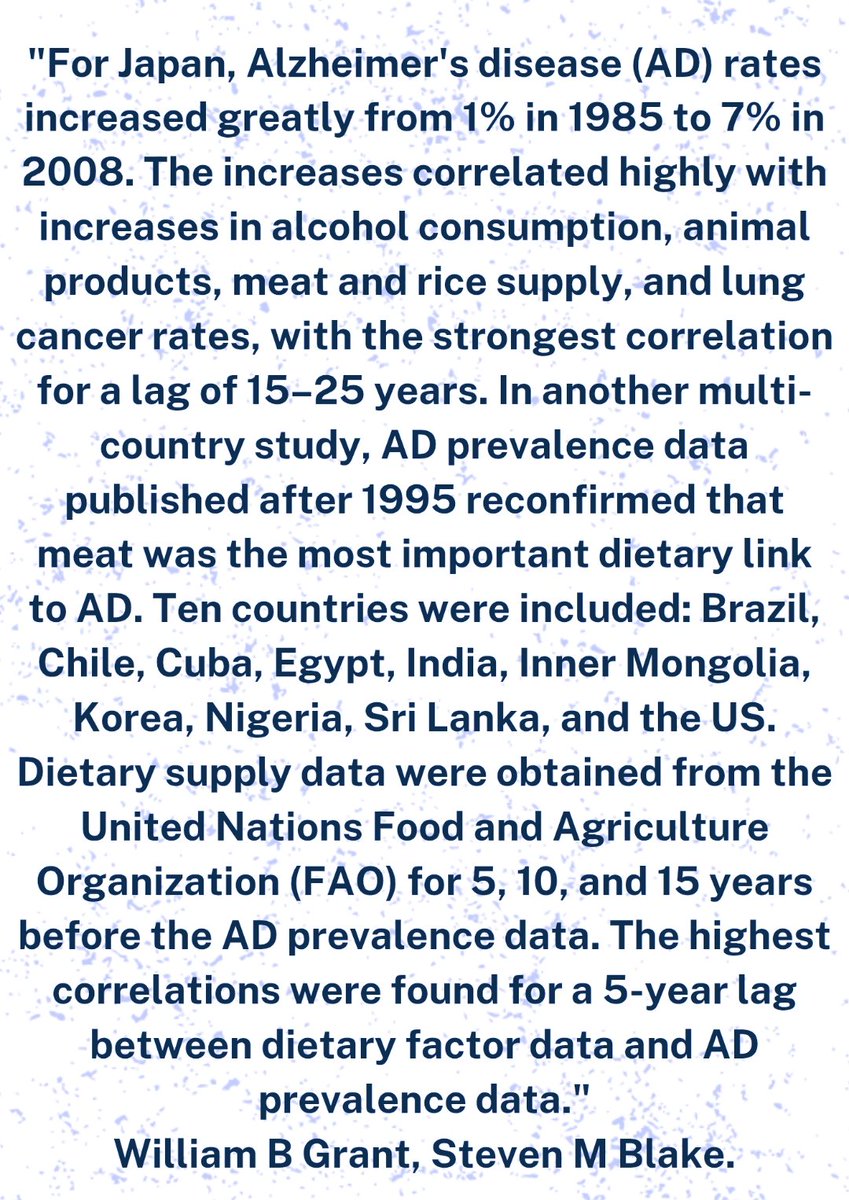
Diet's Role in Modifying Risk of Alzheimer's Disease: History and Present Understanding
William B Grant et al @wbgrant2. J Alzheimers Dis. 2023.
Abstract
Diet is an important nonpharmacological risk-modifying factor for Alzheimer's disease (AD). The approaches used here to assess diet's role in the risk of AD include multi-country ecological studies, prospective and cross-sectional observational studies, and laboratory studies. Ecological studies have identified fat, meat, and obesity from high-energy diets as important risk factors for AD and reported that AD rates peak about 15-20 years after national dietary changes. Observational studies have compared the Western dietary pattern with those of the Dietary Approaches to Stop Hypertension (DASH), Mediterranean (MedDi), and Mediterranean-DASH Intervention for Neurodegenerative Delay (MIND) diets. Those studies identified AD risk factors including higher consumption of saturated and total fats, meat, and ultraprocessed foods and a lower risk of AD with higher consumption of fruits, legumes, nuts, omega-3 fatty acids, vegetables, and whole grains. Diet-induced factors associated with a significant risk of AD include inflammation, insulin resistance, oxidative stress, elevated homocysteine, dietary advanced glycation end products, and trimethylamine N-oxide. The molecular mechanisms by which dietary bioactive components and specific foods affect risk of AD are discussed. Given most countries' entrenched food supply systems, the upward trends of AD rates would be hard to reverse. However, for people willing and able, a low-animal product diet with plenty of anti-inflammatory, low-glycemic load foods may be helpful.
Keywords: Advanced glycation end products; Alzheimer’s disease; TMAO; dementia; diet; meat; neuroinflammation; obesity; saturated fat; ultraprocessed foods.
https://t.co/UyYJbx4hE9


Watching documentaries about ultraprocessed Junk food and the terrible Sugar Industry to make myself stay Away from that stuff

Editorial
Diet, Inflammation, and Infectious Diseases
William B Grant. Nutrients. 2023.
Author
William B Grant @wbgrant2
It has become abundantly clear in the past couple of decades that the Western diet, with high amounts of animal products, such as red and processed meat as well as ultraprocessed foods with little fiber, is a major cause of chronic diseases. A recent article from Harvard reported findings regarding dietary patterns and food groups and risk of chronic diseases based on following health professionals for up to 32 years with use of food frequency questionnaires every 4 years [9]. They identified two dietary patterns associated with greatest risk reduction for diabetes: low insulinemic and low inflammatory. These two dietary patterns were associated with a 65% reduced risk of type 2 diabetes mellitus for 90th percentile vs. 10th percentile adherence. They were also associated with a ~40% reduction in major chronic disease. The food groups with highest risk were red and processed meats, French fries, and both low- and high-energy drinks. The food groups with highest risk reduction were coffee, wine, whole grains, fruit, and dark-yellow and leafy green vegetables.
Siddiqui et al. reviewed the evidence regarding the role of vitamin D in the immunity against viral infections [7]. They considered the effect on rhinovirus, influenza virus, respiratory syncytial virus, dengue virus, hepatitis C virus, HIV, and SARS-CoV-2. They discussed both innate immunity and adaptive immunity. The innate immune responses include chemotaxis, phagocytosis, and induction of cathelicidin and defensins. The adaptive immune response involves learning to recognize harmful viruses and deal with them through effects on B and T cells. In the discussion regarding influenza, they recognized that vitamin D was not the only reason why influenza rates are higher in winter than in summer. There are, indeed, other mechanisms involved. One is cold temperature. Eccles reviews a number of effects related to temperature and the success of common respiratory viruses [10]. Another is the release of nitric oxide from nitrate stores in the skin by solar UV radiation [11]. Nitric oxide has antimicrobial properties, and in that article, it was demonstrated to reduce COVID-19 deaths.
As the manuscript was accepted in August 2020, it was early in the COVID-19 pandemic, and the effect of serum 25-hydroxyvitamin D [25(OH)D] and vitamin D supplementation was not well understood by that time. There is now good evidence that vitamin D does reduce the risk of SARS-CoV-2 infection and subsequent COVID-19, and that early treatment with high-dose vitamin D can improve survival. An observational study was conducted based on data from veterans receiving treatment at US Veterans Administration Health facilities [12]. Patients who received vitamin D supplementation via prescription were compared to those who did not. Those who received vitamin D3 had a 28% reduced risk of COVID-19 [HR = 0.72, (95% CI 0.65, 0.79)] and a 33% reduced risk of mortality [HR = 0.67, (95% CI 0.59, 0.75)]. Since two important roles of vitamin D in reducing the risk of COVID-19, reducing the virus viability, and reducing risk of an overactive immune response including a cytokine storm, serum 25(OH)D concentrations have to be raised rapidly near the time of infection. To this end, supplementing with high-dose calcifediol [25(OH)D] raises 25(OH)D concentrations more rapidly than with cholecalciferol (vitamin D3). A pilot study conducted in Barcelona with calcifediol greatly reduced progression to the intensive care unit (ICU) and morality [13]. Of the 50 patients treated with calcifediol, one required admission to the ICU (2%), while of the 26 untreated patients, 13 required hospital admission (50%) p < 0.001.
https://t.co/1BowenFKVG


JAMA
Ultraprocessed foods make up much of the US diet.
And @American_Heart says the cardiometabolic harms may extend past their caloric and nutritional content.
https://t.co/LBQQVLlI0j

@lucia_revi61297 burgers ... nd i dont mean like mcdonalds cause thats ultraprocessed nd comes back up easy im talking like homemade burgers. insane
A Brief History of the Progress in Our Understanding of Genetics and Lifestyle, Especially Diet, in the Risk of Alzheimer’s Disease.
Journal of Alzheimer’s Disease DOI 10.3233/JAD-240658
William B. Grant, PhD @wbgrant2
Abstract. The two major determining factors for Alzheimer’s disease (AD) are genetics and lifestyle. Alleles of the apolipoprotein E (APOE) gene play important roles in the development of late-onset AD, with APOE s4 increasing risk, APOE s3 being neutral, and APOE s2 reducing risk. Several modifiable lifestyle factors have been studied in terms of how they can modify the risk of AD. Among these factors are dietary pattern, nutritional supplements such as omega-3 fatty acids, and B vitamins, physical exercise, and obesity, and vitamin D. The Western diet increases risk of AD, while dietary patterns such as the Mediterranean and vegetarian/vegan diets reduce risk. Foods associated with reduced risk include coffee, fruits and vegetables, whole grains and legumes, and fish, while meat and ultraprocessed foods are associated with increased risk, especially when they lead to obesity. In multi-country ecological studies, the amount of meat in the national diet has the highest correlation with risk of AD. The history of research regarding dietary patterns on risk of AD is emphasized in this review. The risk of AD can be modified starting at least by mid-life. People with greater genetic risk for AD would benefit more by choosing lifestyle factors to reduce and/or delay incidence of AD.
INTRODUCTION
I am pleased to be invited to submit a review regarding genetic and lifestyle risk factors for AD for the Mark A. Smith JAD 100th Volume. He, and the editor of the Journal of Alzheimer’s Disease, encouraged me at the beginning of my health research career that started with publishing the first article linking diet to risk of AD in 1997.1 The two of them wrote the editorial that accompanied my article,2 and discussed it in a 1998 review.3 They invited me to write an update on the topic in 19994 and to participate in a symposium on AD at Case Western Reserve in 2002: “Challenging Views of Alzheimer’s Disease.” We debated whether genetics or environment was the more important risk factor for AD. Our topic was the significance of environmental factors in the etiology of AD.5 We emphasized the effect of diet, aluminum, and infectious agents such as herpes simplex type 1 virus. While aluminum is no longer considered a significant risk factor for AD, infections are.6,7 Ashford and Mortimer proposed that non-familial AD is mainly due to genetic factors.8 They estimated that the heritability of AD is about 60%, based on results from twin studies, and the APOE genotype accounts for about 50% of AD in many populations.
AD is a devastating disease that strikes many elderly people. In 2020, the number of people in the US with clinical AD was estimated at 6.1 million (95% confidence interval [CI], 5.9 million-6.4 million) people.9 The US census-adjusted prevalence of clinical AD was 10% among non-Hispanic whites, 14% among Hispanics, and 18.6% among non-Hispanic African Americans.9 A 2022 article estimated the number of persons worldwide across the AD continuum as 32 million with AD, 69 million with prodromal AD, and 315 million with preclini- cal AD.10 This represents 22% of all persons aged 50 and above. However, the impact is much greater, as others have to care for those with AD. It was estimated that in 2016, the cost of formal care per AD patient was $28,100 (95% CI, $25,900-$30,400), and informal care cost of $52,500 (95% CI, $47,000-$58,200).
The risk of developing AD depends on genetics and lifestyle factors, and their interactions. People born with certain genes have greater or lesser risk of developing AD. Lifestyle choices can modify the risk of developing AD. This review will begin with a discussion of the basic findings regarding genetics and the risk of AD.
https://t.co/Lod9eBoZH9


The Details Behind Hawaiʻi's MAHA Win
Aloha, folks—building on that big news:
Today (Dec 10, 2025), HHS Secretary Robert F. Kennedy Jr., CMS Director Dr. Mehmet Oz, and USDA Secretary Brooke Rollins announced Hawaiʻi as one of six new states (alongside Missouri, North Dakota, South Carolina, Virginia, and Tennessee) joining the Trump administration's MAHA initiative. This brings the total to 12 states committed to SNAP reforms.
Key SNAP Changes for Hawaiʻi (Effective Aug 1, 2026):
- Banned Items: Soft drinks with >10g added sugar per serving—no more funding liquid candy that spikes diabetes rates (Hawaiʻi leads the nation at 11.4% adult prevalence).
- Allowed Focus: Whole foods like fresh fish (ahi poke, anyone?), local fruits (papaya, mango), veggies, and poi to rebuild nutritional integrity. SNAP still covers most groceries except alcohol/tobacco/hot foods.
- Bigger Picture: Ties into a $50B rural health fund for states like us, plus a new $700M regenerative farming pilot to grow healthier, local produce. Goal? Reverse chronic disease epidemic—obesity, heart issues—hitting our islands hard.
Direct Quotes from the Announcement:
- RFK Jr. (HHS Secretary): "Chronic diseases are bankrupting our families and nation. MAHA restores SNAP's original mission: nutrition over junk. Hawaiʻi's bold step empowers communities to choose health, not addiction. We've seen ultraprocessed foods fuel this crisis—today, we fight back with real food." (From USDA press event remarks.)
- Brooke Rollins (USDA Secretary): "President Trump made it clear: SNAP is for nutrition. Under MAHA, we're taking historic steps to end the chronic disease epidemic. Hawaiʻi and these states are leading—12 now total—proving healthier benefits save lives and dollars."
- Dr. Mehmet Oz (CMS Director): "This isn't restriction; it's liberation from Big Food's grip. By prioritizing nutrient-dense foods, we're investing in prevention over pills. Expect better outcomes for keiki and kūpuna alike."
Critics worry about access in food deserts, but proponents say it reduces fraud ($1B+ annually) and boosts local farms. Full USDA release: https://t.co/bV10J6Jksc.
What's your take—game-changer or needs tweaks? Reply below. Mahalo for reading! 🌺


TUESDAY DECEMBER 2ND NEWS BLAST
Trump administration pauses immigration applications
- from nationals of 19 countries
San Francisco sues nation's top food manufacturers over ultraprocessed foods
Pentagon inspector general investigation into 'Signalgate' is complete
Australia to enforce social media age limit of 16 next week
Republican Matt Van Epps wins special election in Tennessee
MH370: Search for long-missing Malaysia Airlines fight to resume
Trump calls Ilhan Omar 'garbage'
Dells give $6.25 billion to create 25 million 'Trump Accounts'
Sabrina Carpenter, Franklin the Turtle in tiff with Trump administration
Virginia unveils plan to create marijuana retail market
Comey friend seeks to block DOJ from accessing materials seized
- from him more than 5 years ago
Trump again posts about voiding Biden's autopen usage
Proverbs 10:20
What is your favorite conspiracy theory?


can someone pls tell me if this is ortho? i dont like eating the same thing everyday, esp if it is low protein and low fiber cause i doesnt satiate me and i feel hungry 2 seconds after also if it is high sugar or ultraprocessed food. i dont have a problem with eating
Most Popular Users

Elon Musk 
@elonmusk
239.8M followers

Barack Obama
@barackobama
118.6M followers

Cristiano Ronaldo
@cristiano
114.3M followers

Donald J. Trump
@realdonaldtrump
111.7M followers

Narendra Modi
@narendramodi
106.9M followers

Rihanna
@rihanna
98.6M followers

NASA
@nasa
92.1M followers

Justin Bieber
@justinbieber
91.7M followers

KATY PERRY
@katyperry
89.9M followers

Taylor Swift
@taylorswift13
83.9M followers

Lady Gaga
@ladygaga
75.4M followers

Virat Kohli
@imvkohli
73.3M followers

Kim Kardashian
@kimkardashian
70.8M followers

YouTube
@youtube
68.6M followers

Neymar Jr
@neymarjr
66.3M followers

Bill Gates
@billgates
65.1M followers

Selena Gomez
@selenagomez
63M followers

The Ellen Show
@theellenshow
62.1M followers

CNN
@cnn
61.7M followers

X
@x
60.6M followers